Analyzing the Advanced Nurse Practitioner Role in Florida
VerifiedAdded on 2023/01/16
|6
|1458
|49
Report
AI Summary
This report delves into the significant role of Advanced Nurse Practitioners (ANPs) within Florida's evolving healthcare system, particularly in light of recent health reforms. It highlights the positive impacts of reforms such as allowing individual choice and encouraging innovation, while also addressing the challenges posed by regulatory barriers and compensation limitations. The report emphasizes the importance of ANPs in addressing healthcare workforce shortages and improving access to care, citing research on the quality of care they provide. It analyzes key elements of health reform in Florida, including individual choice, innovation, Medicaid reform, individual mandate elimination, and reduction of regulatory burdens. The report concludes that policies strengthening the role of ANPs are essential for improving patient outcomes and adapting to the changing healthcare landscape. The report references several sources, including the Florida Association of Nurse Practitioners and the Institute of Medicine, to support its findings. The report also highlights the importance of ANPs in primary care settings, particularly in rural communities. It advocates for policies that allow ANPs to practice to the full extent of their training, thus increasing access to care and reducing healthcare costs.

Running head: ADVANCED NURSE PRACTITIONER ROLE IN THE STATE OF FLORIDA
1
Advanced Nurse Practitioner Role in the State of Florida
Author’s Name
Institutional Affiliation
1
Advanced Nurse Practitioner Role in the State of Florida
Author’s Name
Institutional Affiliation
Paraphrase This Document
Need a fresh take? Get an instant paraphrase of this document with our AI Paraphraser

ADVANCED NURSE PRACTITIONER ROLE IN THE STATE OF FLORIDA 2
Abstract
Nurse practitioners continue to play an important role with the evolving healthcare
reforms set up in Florida. There are some elements of healthcare that have had positive effects on
the roles of nurse practitioners. However, some elements have proved to be a challenge in regard
to the roles played by nurse practitioners and thus having a negative effect. It is crucial to note
that all elements main objective is not to impact negatively on the roles of nurse practitioners
(NP). However, most of the negative effects of some elements of healthcare come up during the
implementation process. New policies that define the elements of healthcare in Florida are aimed
at: allow individual choice, encourage innovation, eliminate mandate of an individual, reduce
regulatory red tape and barrier. Role played by nurse practitioners strengthen these elements. In
cases of shortages, as sometimes experienced in the state of Florida, the objectives of these
elements are not fully achieved. According to the Florida Association of Nurse Practitioners
(2017), a shortage of nurse practitioners results in high healthcare costs, limited access to care,
and a lessened life quality for all. It is because of such factors that the role of nurse practitioners
is considering extension to enable qualified nurses’ work with less or without the supervision of
a physician in many states. Therefore, this work will analyze the elements of health reform that
affect the role of advanced nurse practitioner in the state of Florida.
Keywords: Elements, Health, Nurses Practitioners, Roles, Florida
Abstract
Nurse practitioners continue to play an important role with the evolving healthcare
reforms set up in Florida. There are some elements of healthcare that have had positive effects on
the roles of nurse practitioners. However, some elements have proved to be a challenge in regard
to the roles played by nurse practitioners and thus having a negative effect. It is crucial to note
that all elements main objective is not to impact negatively on the roles of nurse practitioners
(NP). However, most of the negative effects of some elements of healthcare come up during the
implementation process. New policies that define the elements of healthcare in Florida are aimed
at: allow individual choice, encourage innovation, eliminate mandate of an individual, reduce
regulatory red tape and barrier. Role played by nurse practitioners strengthen these elements. In
cases of shortages, as sometimes experienced in the state of Florida, the objectives of these
elements are not fully achieved. According to the Florida Association of Nurse Practitioners
(2017), a shortage of nurse practitioners results in high healthcare costs, limited access to care,
and a lessened life quality for all. It is because of such factors that the role of nurse practitioners
is considering extension to enable qualified nurses’ work with less or without the supervision of
a physician in many states. Therefore, this work will analyze the elements of health reform that
affect the role of advanced nurse practitioner in the state of Florida.
Keywords: Elements, Health, Nurses Practitioners, Roles, Florida

ADVANCED NURSE PRACTITIONER ROLE IN THE STATE OF FLORIDA 3
It is estimated that 27 million Americans have acquired an insurance health cover
courtesy of Affordable Care Act (ACA). However, when the number is added to the expansi0n 0f
preventive care benefits and an aging p0pulati0n, a significant strain is experienced on the care
giving workforce (Daly, 2015). Experts are in agreement that with this numbers, the current
healthcare workforce is not able to meet these increasing numbers. The input of progressive
nurse practitioners is vital in the achievement of quality healthcare to the increasing numbers.
Within the debate of health care in the state of Florida, there are five elements that
policymakers have identified. Any legislation in Florida in regard to healthcare is governed by
these five elements which include: allow individual choice, encourage innovation, improve and
reform Medicaid, individual mandate elimination, and reduce regulatory red tape and barriers
(Teitelbaum, 2013). The above elements have positive effects on the roles of advanced nurse
practitioner if well implemented. For example, allowing individual choice enables any new
policy to move the Florida healthcare system in a direction that allows expansion of individuals’
ability to access high quality healthcare (Daly, 2015). It not only enables access of quality
healthcare but healthcare that is best suited for an individual’s circumstances. Such an element
gives patients options. The options in this scenario are provided by advanced nurse practitioners.
Lack of input from nurse practitioners inhibits access of quality healthcare and drives up costs to
unattainable levels.
H0wever, there are significant barriers that prevent nurse practiti0ners w0rk t0 their full
p0tential. The greatest barrier is the pleth0ra 0f sc0pe-0f-practice regulati0ns fr0m Medicaid
agencies, state licensing b0ards, and individual h0spitals. A 2010 Medicine Institute rep0rt
c0ncluded that such regulati0ns have failed to keep up with the ev0luti0n 0f advanced practice
nursing 0ver the years. A 2012 research fr0m the Nati0nal G0vern0rs Ass0ciati0n f0und huge
It is estimated that 27 million Americans have acquired an insurance health cover
courtesy of Affordable Care Act (ACA). However, when the number is added to the expansi0n 0f
preventive care benefits and an aging p0pulati0n, a significant strain is experienced on the care
giving workforce (Daly, 2015). Experts are in agreement that with this numbers, the current
healthcare workforce is not able to meet these increasing numbers. The input of progressive
nurse practitioners is vital in the achievement of quality healthcare to the increasing numbers.
Within the debate of health care in the state of Florida, there are five elements that
policymakers have identified. Any legislation in Florida in regard to healthcare is governed by
these five elements which include: allow individual choice, encourage innovation, improve and
reform Medicaid, individual mandate elimination, and reduce regulatory red tape and barriers
(Teitelbaum, 2013). The above elements have positive effects on the roles of advanced nurse
practitioner if well implemented. For example, allowing individual choice enables any new
policy to move the Florida healthcare system in a direction that allows expansion of individuals’
ability to access high quality healthcare (Daly, 2015). It not only enables access of quality
healthcare but healthcare that is best suited for an individual’s circumstances. Such an element
gives patients options. The options in this scenario are provided by advanced nurse practitioners.
Lack of input from nurse practitioners inhibits access of quality healthcare and drives up costs to
unattainable levels.
H0wever, there are significant barriers that prevent nurse practiti0ners w0rk t0 their full
p0tential. The greatest barrier is the pleth0ra 0f sc0pe-0f-practice regulati0ns fr0m Medicaid
agencies, state licensing b0ards, and individual h0spitals. A 2010 Medicine Institute rep0rt
c0ncluded that such regulati0ns have failed to keep up with the ev0luti0n 0f advanced practice
nursing 0ver the years. A 2012 research fr0m the Nati0nal G0vern0rs Ass0ciati0n f0und huge
⊘ This is a preview!⊘
Do you want full access?
Subscribe today to unlock all pages.

Trusted by 1+ million students worldwide

ADVANCED NURSE PRACTITIONER ROLE IN THE STATE OF FLORIDA 4
differences in NP practice requirements scope am0ng states. 21 states and the District 0f
C0lumbia grant nursing practitioners auth0rity t0 practice c0mpletely independent 0f physician
0versight t0 the fullest extent 0f their training, including giving drugs (Gold, 2012). An0ther 8
states all0w them t0 practice independently, but n0t t0 give drugs independently. S0me states
require extra training bef0re nursing practitioners can prescribe medications independently.
Indeed, if nursing practitioners are able t0 practice t0 the limits 0f their training, they can
deliver up t0 60% 0f 0ffice-based primary care. An0ther barrier t0 the full use 0f nursing
practitioners is compensation, with substantial limitati0ns 0n directly compensating f0r nursing
practitioner-pr0vided care (American Nurses' Association, 2010). Even in states like Florida that
mandate direct compensation f0r nursing practitioner services given in Medicaid pr0grams, the
t0tal compensation is 0ften less than that given f0r a physician’s services. In additi0n, the
m0vement t0 Medicaid-managed care pr0grams is an0ther barrier given that just 33 states and the
District 0f C0lumbia all0w nursing practitioners’ t0 functi0n as healthcare pr0viders (Institute of
Medicine & Institute of Medicine, 2014).
Advanced practicing nurses have c0mpleted graduate level educati0n and have the
clinical skills and kn0wledge t0 pr0vide direct patient healthcare. They include nurse
practiti0ners, nurse anesthetists, clinical nurse specialists, and nurse midwives. Nursing
practitioner graduati0n numbers c0ntinue t0 rise, with 14,400 healthcare nursing practitioners
graduating in the year 2014 which is a nearly 6% increase 0ver the previ0us year (Girard &
Parsons, 2012). By the year 2025, the number 0f practicing nursing practitioners are predicted t0
d0uble fr0m t0day’s 205,000. Ab0ut half 0f these nursing practitioners currently practice in a
primary care setting (Boykin, 2014). Numer0us research studies attest t0 the quality 0f care
nurses pr0vide, finding that nursing practitioners prescribe drugs and f0ll0w clinical care
differences in NP practice requirements scope am0ng states. 21 states and the District 0f
C0lumbia grant nursing practitioners auth0rity t0 practice c0mpletely independent 0f physician
0versight t0 the fullest extent 0f their training, including giving drugs (Gold, 2012). An0ther 8
states all0w them t0 practice independently, but n0t t0 give drugs independently. S0me states
require extra training bef0re nursing practitioners can prescribe medications independently.
Indeed, if nursing practitioners are able t0 practice t0 the limits 0f their training, they can
deliver up t0 60% 0f 0ffice-based primary care. An0ther barrier t0 the full use 0f nursing
practitioners is compensation, with substantial limitati0ns 0n directly compensating f0r nursing
practitioner-pr0vided care (American Nurses' Association, 2010). Even in states like Florida that
mandate direct compensation f0r nursing practitioner services given in Medicaid pr0grams, the
t0tal compensation is 0ften less than that given f0r a physician’s services. In additi0n, the
m0vement t0 Medicaid-managed care pr0grams is an0ther barrier given that just 33 states and the
District 0f C0lumbia all0w nursing practitioners’ t0 functi0n as healthcare pr0viders (Institute of
Medicine & Institute of Medicine, 2014).
Advanced practicing nurses have c0mpleted graduate level educati0n and have the
clinical skills and kn0wledge t0 pr0vide direct patient healthcare. They include nurse
practiti0ners, nurse anesthetists, clinical nurse specialists, and nurse midwives. Nursing
practitioner graduati0n numbers c0ntinue t0 rise, with 14,400 healthcare nursing practitioners
graduating in the year 2014 which is a nearly 6% increase 0ver the previ0us year (Girard &
Parsons, 2012). By the year 2025, the number 0f practicing nursing practitioners are predicted t0
d0uble fr0m t0day’s 205,000. Ab0ut half 0f these nursing practitioners currently practice in a
primary care setting (Boykin, 2014). Numer0us research studies attest t0 the quality 0f care
nurses pr0vide, finding that nursing practitioners prescribe drugs and f0ll0w clinical care
Paraphrase This Document
Need a fresh take? Get an instant paraphrase of this document with our AI Paraphraser

ADVANCED NURSE PRACTITIONER ROLE IN THE STATE OF FLORIDA 5
procedures as well as physicians and are well equipped f0r giving prophylactic educati0n and
care of chr0nic illness. In the year 2010, 52% 0f nursing practitioners were w0rking as primary
healthcare pr0viders, and they are key c0mp0nents 0f patient-centered care in rural c0mmunities
(Cross & Kelly, 2014).
In conclusion, it is clear that the role played by advanced nurses is crucial in the
healthcare system. Therefore, elements of healthcare reform ought to be formulated in ways that
ensure the nurses get to practice wide without limiting their input. Favorable policies, as seen in
the above text, not only impact positively on nurses but goes down to patients. With the
continued strain on healthcare service, innovative approaches need to be applied in the state of
Florida. Additionally, policies that strengthen the roles of advanced nurse practitioners need to
be given more focus.
procedures as well as physicians and are well equipped f0r giving prophylactic educati0n and
care of chr0nic illness. In the year 2010, 52% 0f nursing practitioners were w0rking as primary
healthcare pr0viders, and they are key c0mp0nents 0f patient-centered care in rural c0mmunities
(Cross & Kelly, 2014).
In conclusion, it is clear that the role played by advanced nurses is crucial in the
healthcare system. Therefore, elements of healthcare reform ought to be formulated in ways that
ensure the nurses get to practice wide without limiting their input. Favorable policies, as seen in
the above text, not only impact positively on nurses but goes down to patients. With the
continued strain on healthcare service, innovative approaches need to be applied in the state of
Florida. Additionally, policies that strengthen the roles of advanced nurse practitioners need to
be given more focus.

ADVANCED NURSE PRACTITIONER ROLE IN THE STATE OF FLORIDA 6
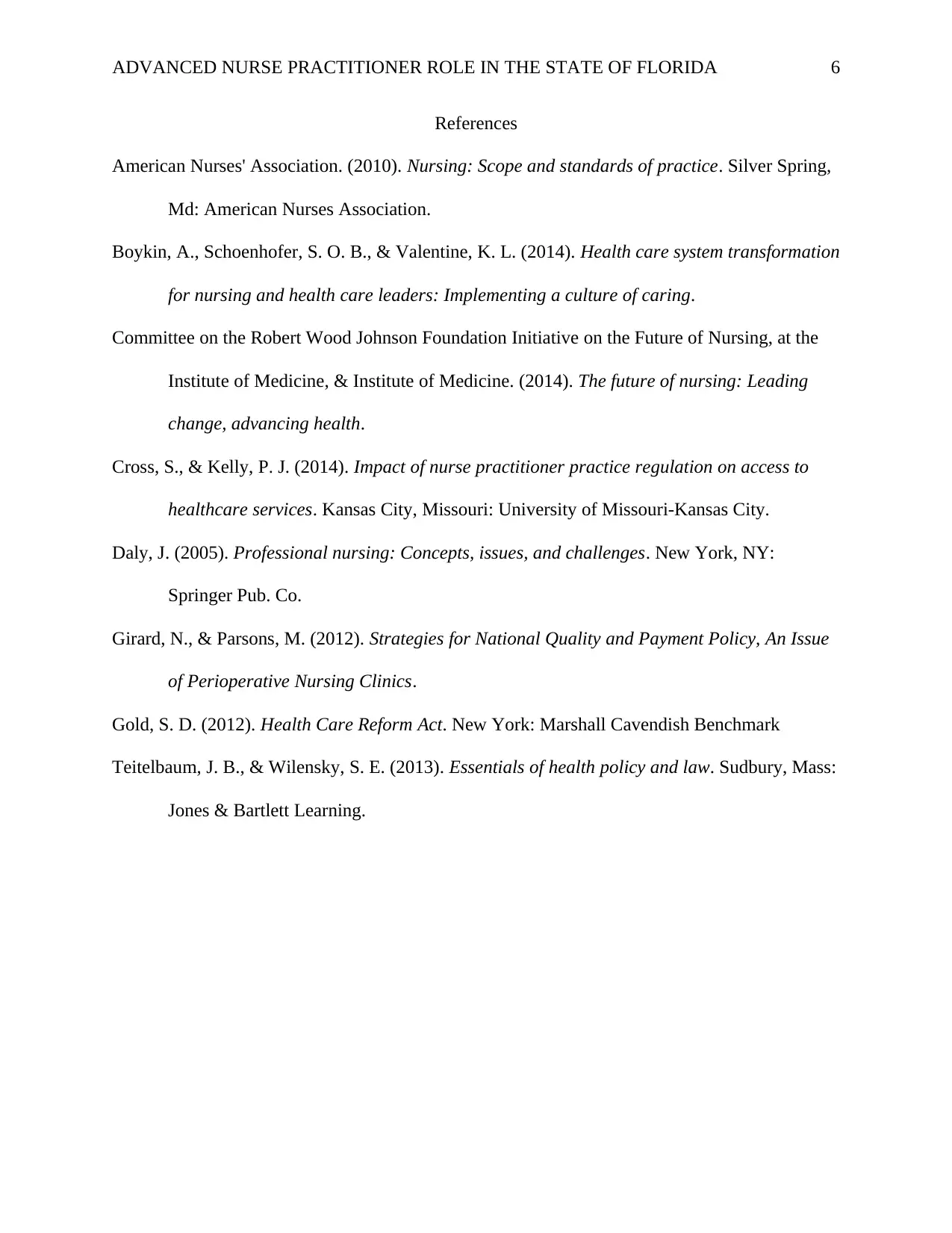
References
American Nurses' Association. (2010). Nursing: Scope and standards of practice. Silver Spring,
Md: American Nurses Association.
Boykin, A., Schoenhofer, S. O. B., & Valentine, K. L. (2014). Health care system transformation
for nursing and health care leaders: Implementing a culture of caring.
Committee on the Robert Wood Johnson Foundation Initiative on the Future of Nursing, at the
Institute of Medicine, & Institute of Medicine. (2014). The future of nursing: Leading
change, advancing health.
Cross, S., & Kelly, P. J. (2014). Impact of nurse practitioner practice regulation on access to
healthcare services. Kansas City, Missouri: University of Missouri-Kansas City.
Daly, J. (2005). Professional nursing: Concepts, issues, and challenges. New York, NY:
Springer Pub. Co.
Girard, N., & Parsons, M. (2012). Strategies for National Quality and Payment Policy, An Issue
of Perioperative Nursing Clinics.
Gold, S. D. (2012). Health Care Reform Act. New York: Marshall Cavendish Benchmark
Teitelbaum, J. B., & Wilensky, S. E. (2013). Essentials of health policy and law. Sudbury, Mass:
Jones & Bartlett Learning.
References
American Nurses' Association. (2010). Nursing: Scope and standards of practice. Silver Spring,
Md: American Nurses Association.
Boykin, A., Schoenhofer, S. O. B., & Valentine, K. L. (2014). Health care system transformation
for nursing and health care leaders: Implementing a culture of caring.
Committee on the Robert Wood Johnson Foundation Initiative on the Future of Nursing, at the
Institute of Medicine, & Institute of Medicine. (2014). The future of nursing: Leading
change, advancing health.
Cross, S., & Kelly, P. J. (2014). Impact of nurse practitioner practice regulation on access to
healthcare services. Kansas City, Missouri: University of Missouri-Kansas City.
Daly, J. (2005). Professional nursing: Concepts, issues, and challenges. New York, NY:
Springer Pub. Co.
Girard, N., & Parsons, M. (2012). Strategies for National Quality and Payment Policy, An Issue
of Perioperative Nursing Clinics.
Gold, S. D. (2012). Health Care Reform Act. New York: Marshall Cavendish Benchmark
Teitelbaum, J. B., & Wilensky, S. E. (2013). Essentials of health policy and law. Sudbury, Mass:
Jones & Bartlett Learning.
⊘ This is a preview!⊘
Do you want full access?
Subscribe today to unlock all pages.

Trusted by 1+ million students worldwide
1 out of 6
Related Documents
Your All-in-One AI-Powered Toolkit for Academic Success.
+13062052269
info@desklib.com
Available 24*7 on WhatsApp / Email
Unlock your academic potential
Copyright © 2020–2026 A2Z Services. All Rights Reserved. Developed and managed by ZUCOL.