Data Splitting Methods in Advanced Statistics: An In-Depth Analysis

Verified

Added on  2023/06/13

|6
|1139
|481
Report
AI Summary
This report provides an overview of data splitting techniques in advanced statistics, emphasizing its importance in cross-validation and data analysis. It discusses methods for filtering data, including simple random sampling, trial and error methods, systematic sampling, convenience sampling, CADEX, DUPLEX, and stratified sampling. The report highlights the advantages and applications of each method, such as using trial and error for multimedia data and convenience sampling for time-interval data. It also addresses the decision-making process behind data splitting, particularly when comparing groups or organizing data outputs. The document concludes by reiterating the significance of data splitting in data analysis and filtering, with examples illustrating its practical applications. Desklib provides access to this and many other solved assignments for students.
Document Page
Running head: ADVANCED STATISTICS
Advanced Statistics
Name of Student:
Name of University:
Author’s Note:
tabler-icon-diamond-filled.svg

Paraphrase This Document

Need a fresh take? Get an instant paraphrase of this document with our AI Paraphraser
Document Page
1ADVANCED STATISTICS
Table of Contents
Introduction......................................................................................................................................2
Discussion........................................................................................................................................2
Conclusion.......................................................................................................................................3
References........................................................................................................................................4
Document Page
2ADVANCED STATISTICS
Introduction
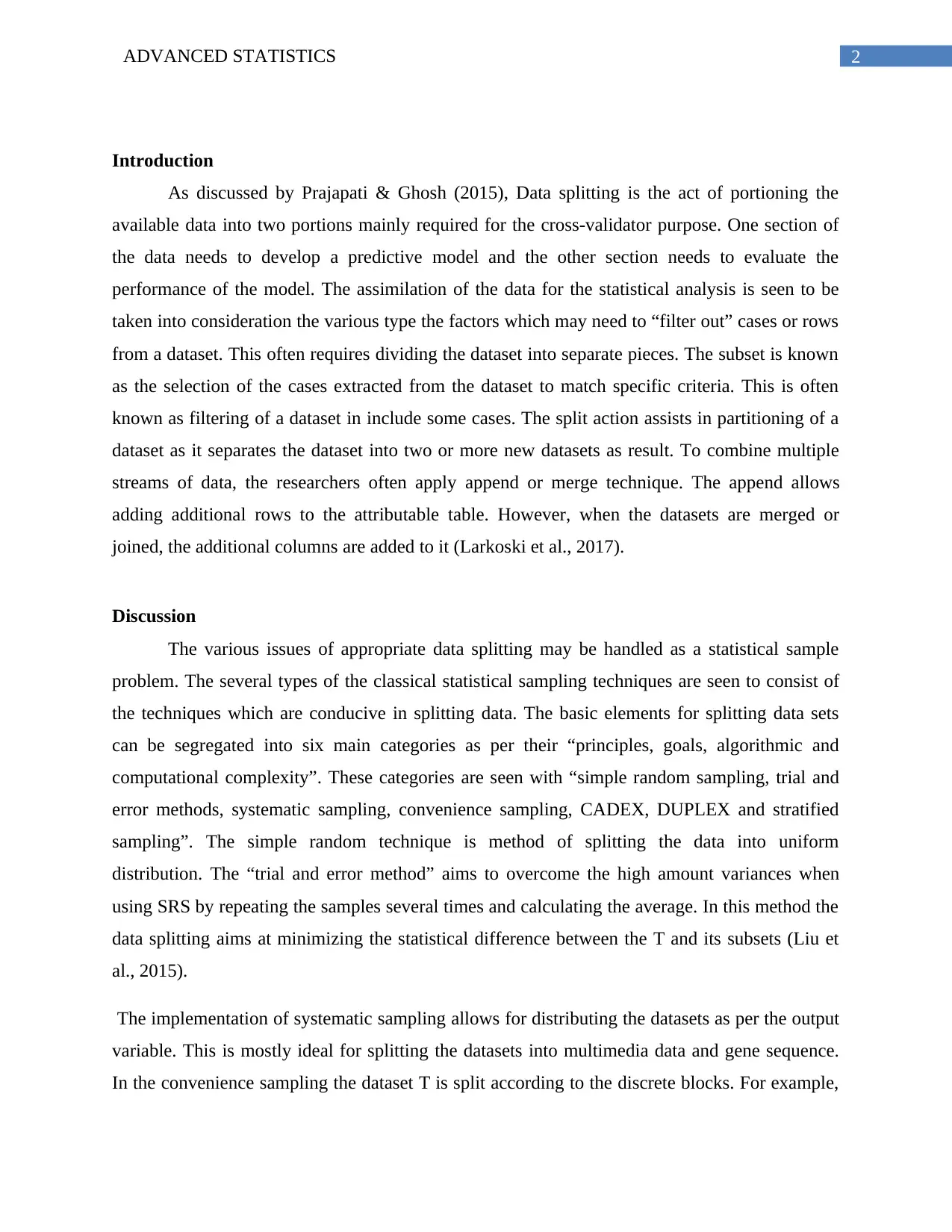
As discussed by Prajapati & Ghosh (2015), Data splitting is the act of portioning the
available data into two portions mainly required for the cross-validator purpose. One section of
the data needs to develop a predictive model and the other section needs to evaluate the
performance of the model. The assimilation of the data for the statistical analysis is seen to be
taken into consideration the various type the factors which may need to “filter out” cases or rows
from a dataset. This often requires dividing the dataset into separate pieces. The subset is known
as the selection of the cases extracted from the dataset to match specific criteria. This is often
known as filtering of a dataset in include some cases. The split action assists in partitioning of a
dataset as it separates the dataset into two or more new datasets as result. To combine multiple
streams of data, the researchers often apply append or merge technique. The append allows
adding additional rows to the attributable table. However, when the datasets are merged or
joined, the additional columns are added to it (Larkoski et al., 2017).
Discussion
The various issues of appropriate data splitting may be handled as a statistical sample
problem. The several types of the classical statistical sampling techniques are seen to consist of
the techniques which are conducive in splitting data. The basic elements for splitting data sets
can be segregated into six main categories as per their “principles, goals, algorithmic and
computational complexity”. These categories are seen with “simple random sampling, trial and
error methods, systematic sampling, convenience sampling, CADEX, DUPLEX and stratified
sampling”. The simple random technique is method of splitting the data into uniform
distribution. The “trial and error method” aims to overcome the high amount variances when
using SRS by repeating the samples several times and calculating the average. In this method the
data splitting aims at minimizing the statistical difference between the T and its subsets (Liu et
al., 2015).
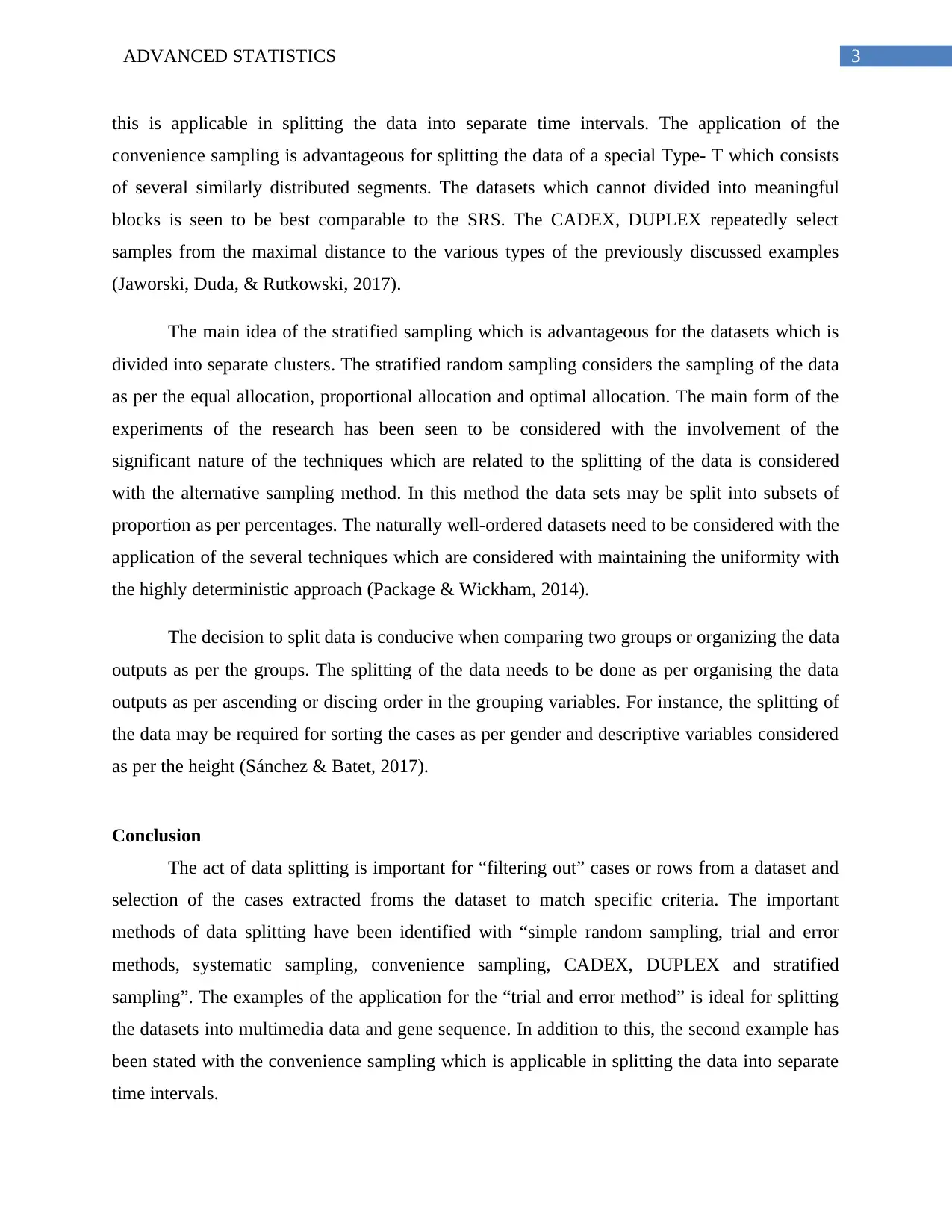
The implementation of systematic sampling allows for distributing the datasets as per the output
variable. This is mostly ideal for splitting the datasets into multimedia data and gene sequence.
In the convenience sampling the dataset T is split according to the discrete blocks. For example,
Document Page
3ADVANCED STATISTICS
this is applicable in splitting the data into separate time intervals. The application of the
convenience sampling is advantageous for splitting the data of a special Type- T which consists
of several similarly distributed segments. The datasets which cannot divided into meaningful
blocks is seen to be best comparable to the SRS. The CADEX, DUPLEX repeatedly select
samples from the maximal distance to the various types of the previously discussed examples
(Jaworski, Duda, & Rutkowski, 2017).
The main idea of the stratified sampling which is advantageous for the datasets which is
divided into separate clusters. The stratified random sampling considers the sampling of the data
as per the equal allocation, proportional allocation and optimal allocation. The main form of the
experiments of the research has been seen to be considered with the involvement of the
significant nature of the techniques which are related to the splitting of the data is considered
with the alternative sampling method. In this method the data sets may be split into subsets of
proportion as per percentages. The naturally well-ordered datasets need to be considered with the
application of the several techniques which are considered with maintaining the uniformity with
the highly deterministic approach (Package & Wickham, 2014).
The decision to split data is conducive when comparing two groups or organizing the data
outputs as per the groups. The splitting of the data needs to be done as per organising the data
outputs as per ascending or discing order in the grouping variables. For instance, the splitting of
the data may be required for sorting the cases as per gender and descriptive variables considered
as per the height (Sánchez & Batet, 2017).
Conclusion
The act of data splitting is important for “filtering out” cases or rows from a dataset and
selection of the cases extracted froms the dataset to match specific criteria. The important
methods of data splitting have been identified with “simple random sampling, trial and error
methods, systematic sampling, convenience sampling, CADEX, DUPLEX and stratified
sampling”. The examples of the application for the “trial and error method” is ideal for splitting
the datasets into multimedia data and gene sequence. In addition to this, the second example has
been stated with the convenience sampling which is applicable in splitting the data into separate
time intervals.
tabler-icon-diamond-filled.svg

Paraphrase This Document

Need a fresh take? Get an instant paraphrase of this document with our AI Paraphraser
Document Page
4ADVANCED STATISTICS
Document Page
5ADVANCED STATISTICS
References
Jaworski, M., Duda, P., & Rutkowski, L. (2017). New Splitting Criteria for Decision Trees in
Stationary Data Streams. IEEE Transactions on Neural Networks and Learning Systems.
https://doi.org/10.1109/TNNLS.2017.2698204
Larkoski, A., Marzani, S., Thaler, J., Tripathee, A., & Xue, W. (2017). Exposing the QCD
Splitting Function with CMS Open Data. Physical Review Letters, 119(13).
https://doi.org/10.1103/PhysRevLett.119.132003
Liu, X., Song, M., Tao, D., Liu, Z., Zhang, L., Chen, C., & Bu, J. (2015). Random forest
construction with robust semisupervised node splitting. IEEE Transactions on Image
Processing, 24(1), 471–483. https://doi.org/10.1109/TIP.2014.2378017
Package, T., & Wickham, H. (2014). plyr: Tools for splitting, applying and combining data. R
Package Version 0.1, 9. https://doi.org/10.1016/j.dendro.2008.01.002
Prajapati, S., & Ghosh, D. (2015). Analysis of Shear-wave Splitting using Multicomponent
Seismic data. SEG Technical Program Expanded Abstracts 2015, 377–382.
https://doi.org/doi:10.1190/segam2015-5853299.1
Sánchez, D., & Batet, M. (2017). Privacy-preserving data outsourcing in the cloud via semantic
data splitting. Computer Communications, 110, 187–201.
https://doi.org/10.1016/j.comcom.2017.06.012
chevron_up_icon
1 out of 6
circle_padding
hide_on_mobile
zoom_out_icon
[object Object]