Advanced WHS Management Report for WHS 10 - University

Verified

Added on  2020/03/16

|11
|2002
|284
Report
AI Summary
This report, titled "Advanced Management of WHS (Assessment 2)", addresses key aspects of workplace health and safety (WHS) management. It begins with a hazard identification table, analyzing potential risks like slippery floors, untidy aisles, and electrical hazards, and suggests employer actions to mitigate these risks. The report emphasizes the urgent need to eliminate alcohol use in the workplace. It also outlines the process of hazard identification, including identifying reasons, responsible parties, and costs. Furthermore, the report discusses risk assessment, the importance of consulting previous owners and senior workers for identifying risks, and the need for a comprehensive WHS training program. It details essential training programs, including first aid and emergency procedures, and WHS information. The report also covers record-keeping systems, including monitoring airborne contaminants, electrical installations, and health records. It then discusses the components of a WHS management system, including general reviews, risk management strategies, and record system reviews. Finally, it addresses the importance of disciplinary measures for non-compliance, such as leaving stock boxes in aisles, and suggests penalties to ensure WHS standards are met. The report is a detailed guide to managing and improving WHS in a retail setting.
Document Page
Running head: ADVANCED MANAGEMENT OF WHS (ASSESSMENT 2)
Advanced Management Of WHS (Assessment 2)
Name of the Student:
Name of the University:
Author note:
tabler-icon-diamond-filled.svg

Paraphrase This Document

Need a fresh take? Get an instant paraphrase of this document with our AI Paraphraser
Document Page
1
ADVANCED MANAGEMENT OF WHS (ASSESSMENT 2)
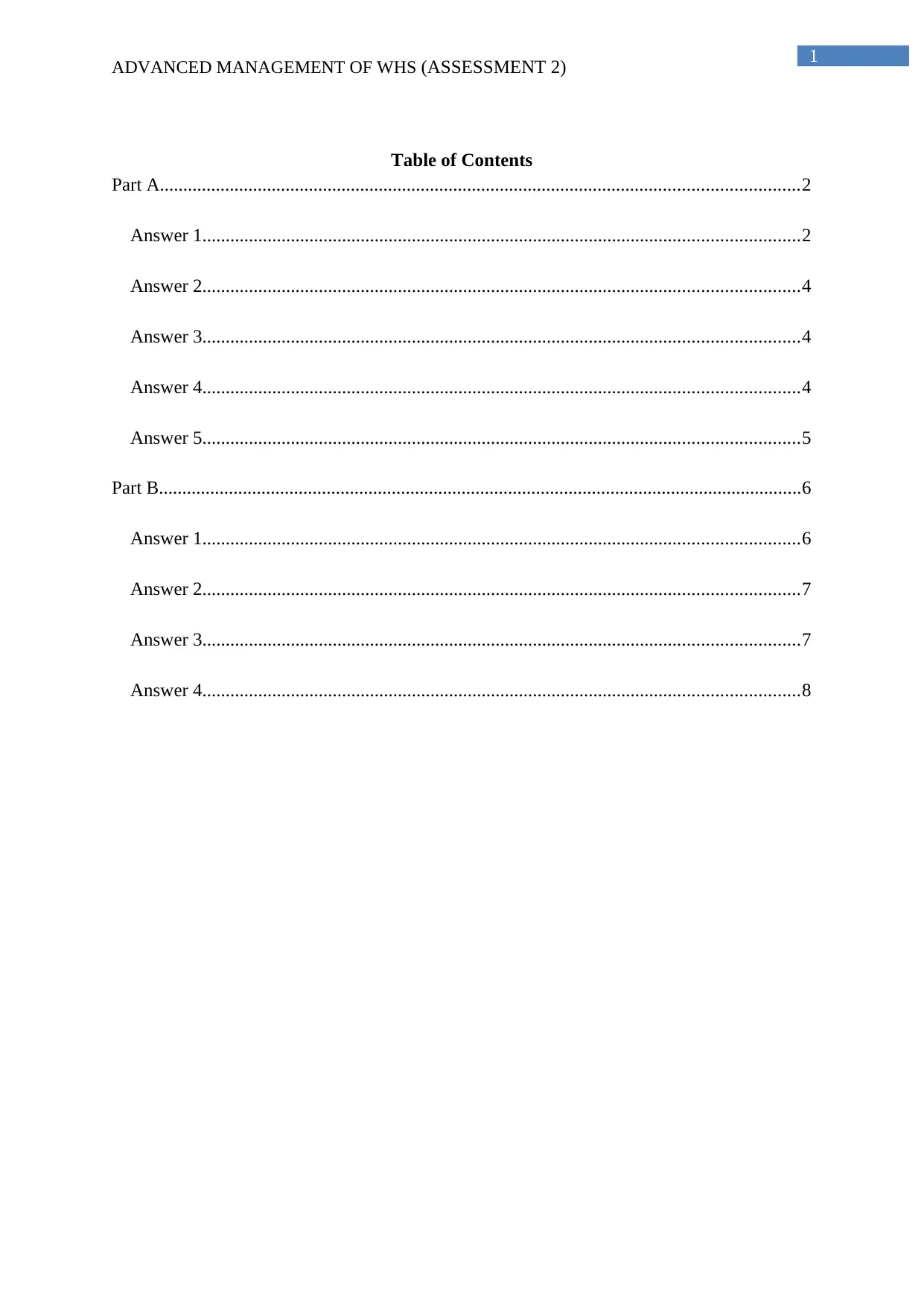
Table of Contents
Part A.........................................................................................................................................2
Answer 1................................................................................................................................2
Answer 2................................................................................................................................4
Answer 3................................................................................................................................4
Answer 4................................................................................................................................4
Answer 5................................................................................................................................5
Part B..........................................................................................................................................6
Answer 1................................................................................................................................6
Answer 2................................................................................................................................7
Answer 3................................................................................................................................7
Answer 4................................................................................................................................8
Document Page
2
ADVANCED MANAGEMENT OF WHS (ASSESSMENT 2)
Part A
Answer 1
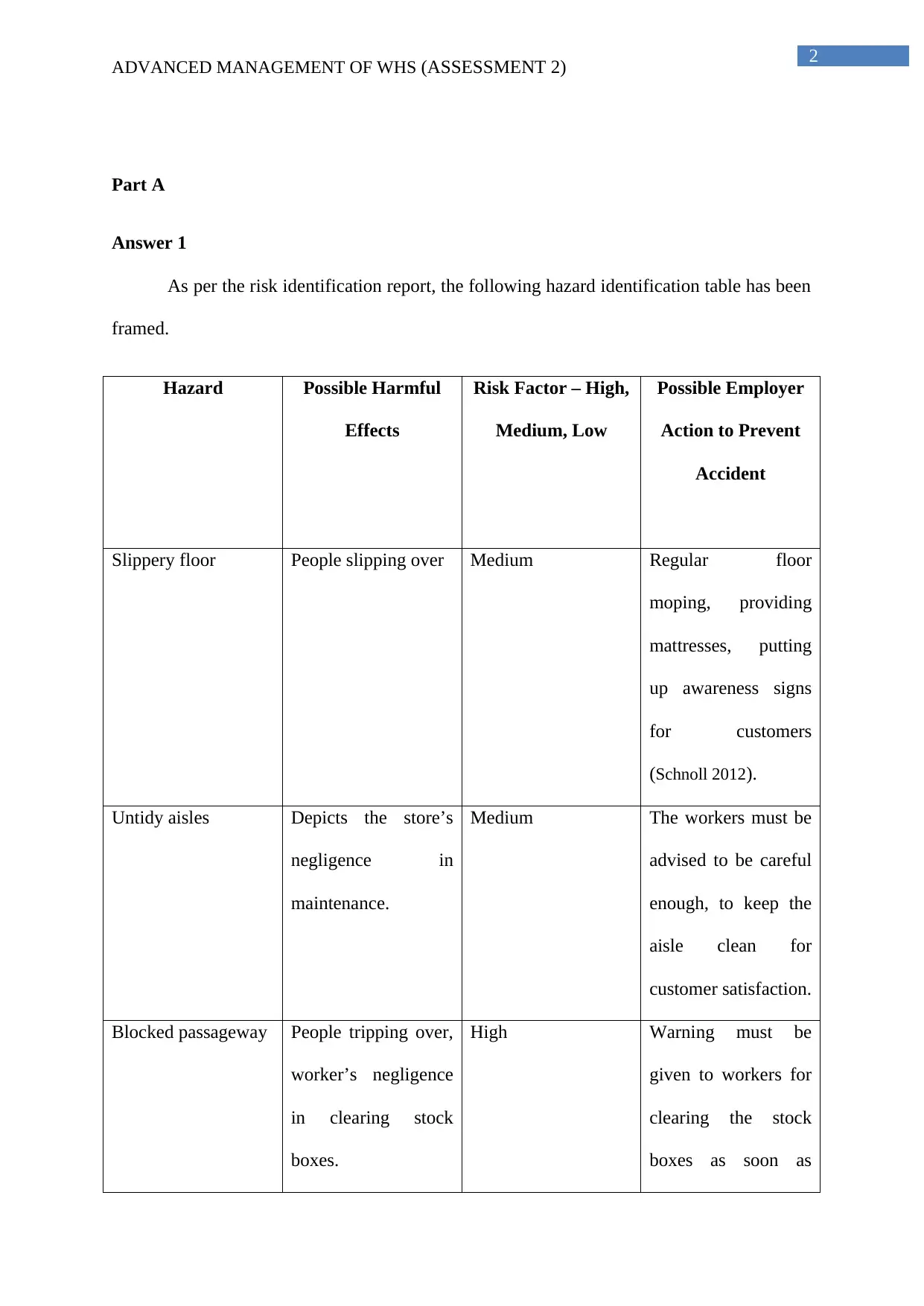
As per the risk identification report, the following hazard identification table has been
framed.
Hazard Possible Harmful
Effects
Risk Factor – High,
Medium, Low
Possible Employer
Action to Prevent
Accident
Slippery floor People slipping over Medium Regular floor
moping, providing
mattresses, putting
up awareness signs
for customers
(Schnoll 2012).
Untidy aisles Depicts the store’s
negligence in
maintenance.
Medium The workers must be
advised to be careful
enough, to keep the
aisle clean for
customer satisfaction.
Blocked passageway People tripping over,
worker’s negligence
in clearing stock
boxes.
High Warning must be
given to workers for
clearing the stock
boxes as soon as
Document Page
3
ADVANCED MANAGEMENT OF WHS (ASSESSMENT 2)
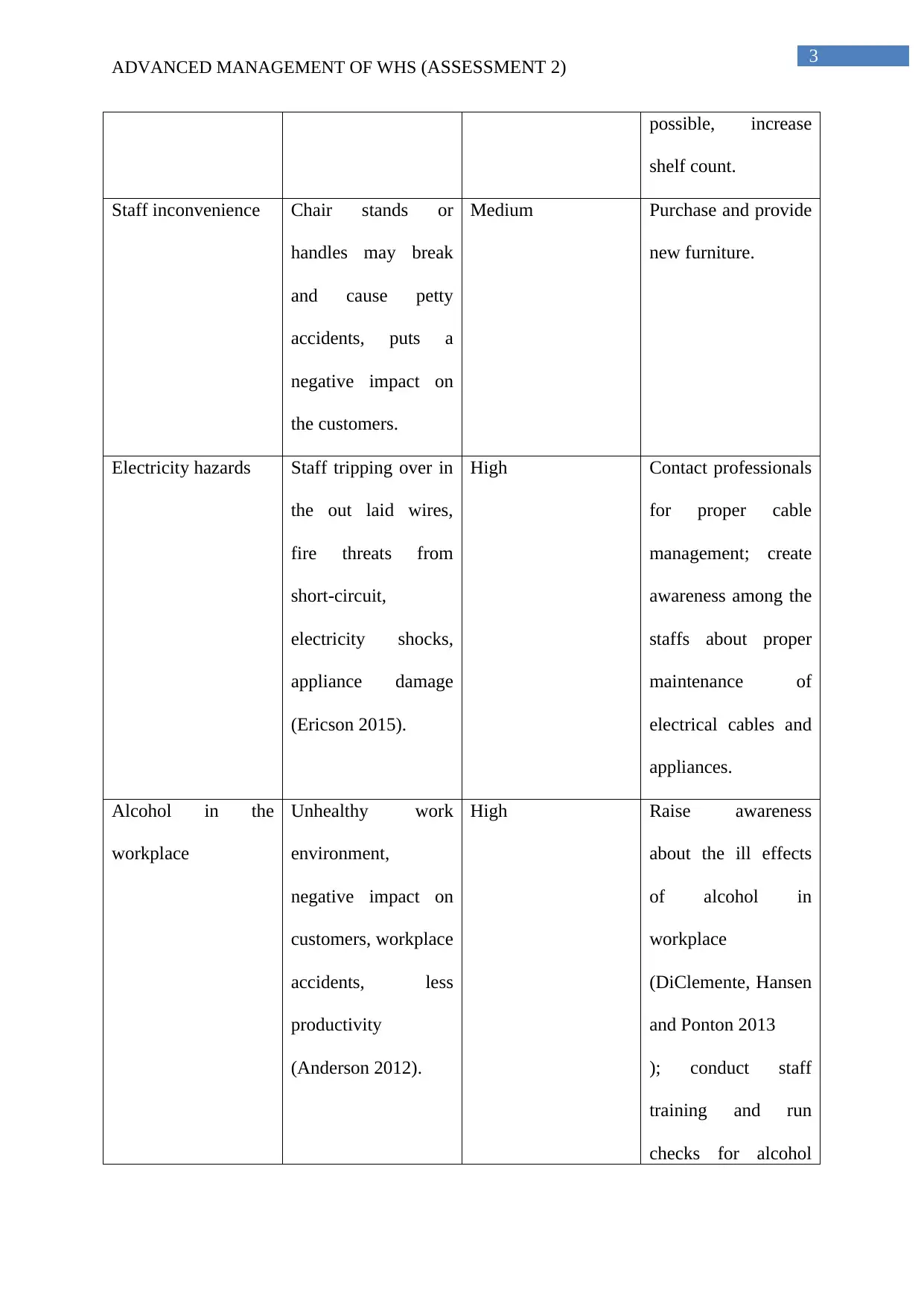
possible, increase
shelf count.
Staff inconvenience Chair stands or
handles may break
and cause petty
accidents, puts a
negative impact on
the customers.
Medium Purchase and provide
new furniture.
Electricity hazards Staff tripping over in
the out laid wires,
fire threats from
short-circuit,
electricity shocks,
appliance damage
(Ericson 2015).
High Contact professionals
for proper cable
management; create
awareness among the
staffs about proper
maintenance of
electrical cables and
appliances.
Alcohol in the
workplace
Unhealthy work
environment,
negative impact on
customers, workplace
accidents, less
productivity
(Anderson 2012).
High Raise awareness
about the ill effects
of alcohol in
workplace
(DiClemente, Hansen
and Ponton 2013
); conduct staff
training and run
checks for alcohol
tabler-icon-diamond-filled.svg

Paraphrase This Document

Need a fresh take? Get an instant paraphrase of this document with our AI Paraphraser
Document Page
4
ADVANCED MANAGEMENT OF WHS (ASSESSMENT 2)
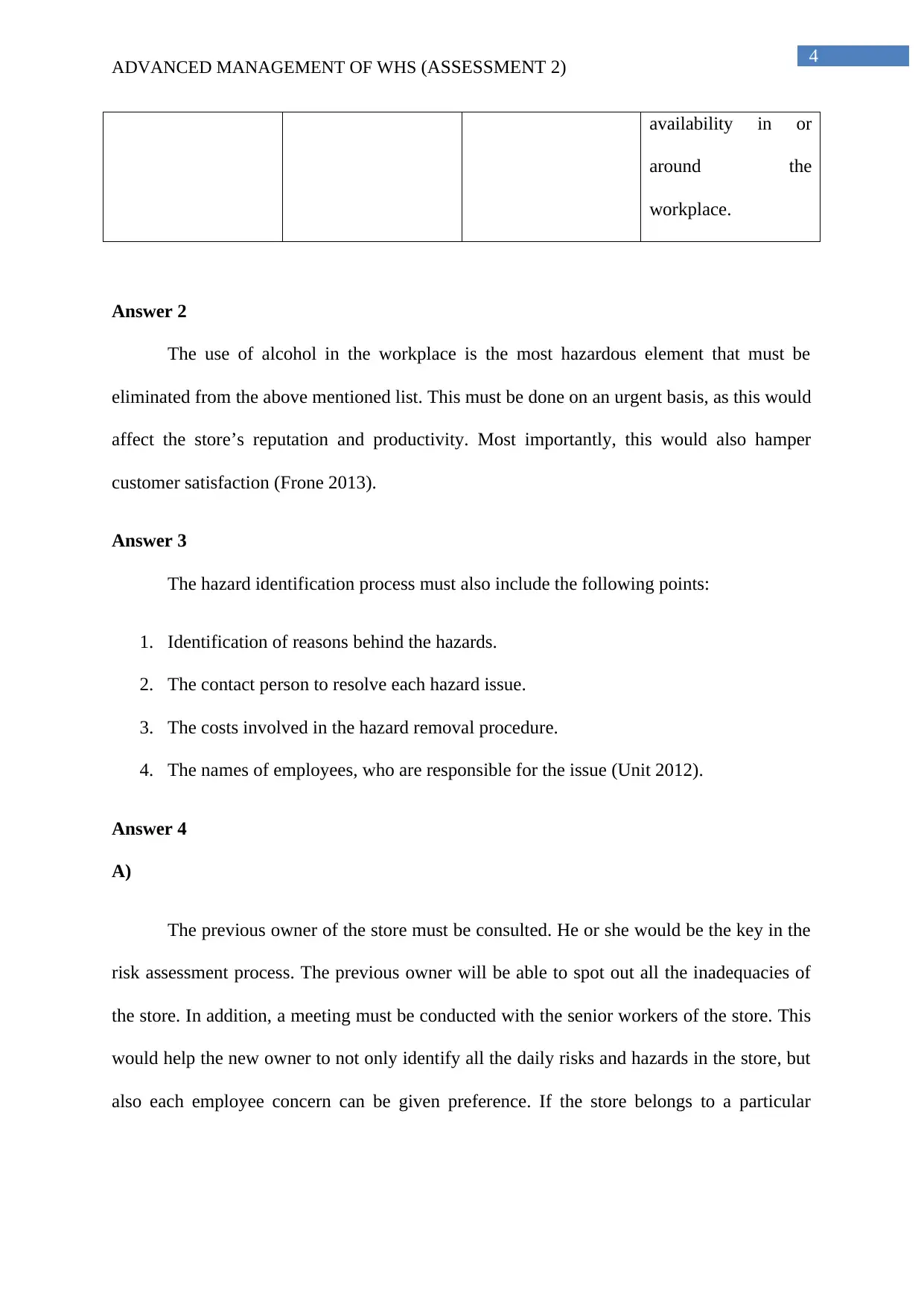
availability in or
around the
workplace.
Answer 2
The use of alcohol in the workplace is the most hazardous element that must be
eliminated from the above mentioned list. This must be done on an urgent basis, as this would
affect the store’s reputation and productivity. Most importantly, this would also hamper
customer satisfaction (Frone 2013).
Answer 3
The hazard identification process must also include the following points:
1. Identification of reasons behind the hazards.
2. The contact person to resolve each hazard issue.
3. The costs involved in the hazard removal procedure.
4. The names of employees, who are responsible for the issue (Unit 2012).
Answer 4
A)
The previous owner of the store must be consulted. He or she would be the key in the
risk assessment process. The previous owner will be able to spot out all the inadequacies of
the store. In addition, a meeting must be conducted with the senior workers of the store. This
would help the new owner to not only identify all the daily risks and hazards in the store, but
also each employee concern can be given preference. If the store belongs to a particular
Document Page
5
ADVANCED MANAGEMENT OF WHS (ASSESSMENT 2)
franchise, the Human Resource Management of the company must also be informed about the
Risk Assessment program.
B)
Regarding the hazard elimination or control measures, some Health Service
Organisation must be consulted. In case of any accident or health issue within the store, they
would be able to provide quick service. Apart from them, some electrical mechanic must also
be consulted. They will come handy in case of any electrical emergencies. Contacting the
accounts head or the HR management of the store’s franchise is necessary. In case of urgent
fund requirement for organisation based on health issues in the store, the management’s
attraction must be drawn. Lastly, each employee of the store must be made aware about the
health and occupational hazards. They are the people who will be able to act promptly to the
situation.
Answer 5
Improved surveillance system must be installed within the store. This would help in
spotting the hazardous situations and person at fault as well. Quick actions can thus be taken.
As for the hazard elimination process, employee awareness is the key factor. Employees and
the store owner himself must take every adequate steps to improve health and services within
the store. Use of any sort of alcoholic beverages or prohibited drugs during or before the store
hours must be abolished. Notice must be circulated among the staffs about the harsh
punishments that it may attract.
Document Page
6
ADVANCED MANAGEMENT OF WHS (ASSESSMENT 2)
Part B
Answer 1
A WHS induction and training program is a crucial aspect according to the
Occupational Health and Safety Act (Reese 2015). According to the rules of this act, the
employer is needed to provide all adequate instruction and information alongside proper
training and supervision to the employees regarding the health and safety in the workplace.
The following training and induction program can be conducted to train and educate
the staffs about the health and safety measures to be followed with in the store:
1. First Aid and Emergency Procedures:
Stuffs must be trained to act with haste and wit if a fire breaks out. They must
be made aware of the location of emergency exits and fire extinguishers.
Everybody must know the number to call at, during emergencies.
They must be advised about the first aid procedures and the location of first
aid kits or personnel (Pingle 2012).
2. Work Health and Safety
Provide the employees with contact details of the areas’s Health and Safety
Representative.
Employees should be provided with the Work Health and Safety Information
Brochure.
Explain safe work techniques relevant to specific field of work.
Let them know of the location of Safety Data Sheets, Hazardous Substances
Register and Safe Work Method Statement ((Matsuura 2016)).
3. Conduct special sessions to raise awareness about the ill effects of alcohol or other
hazardous drugs in workplace and on personal health as well.
tabler-icon-diamond-filled.svg

Paraphrase This Document

Need a fresh take? Get an instant paraphrase of this document with our AI Paraphraser
Document Page
7
ADVANCED MANAGEMENT OF WHS (ASSESSMENT 2)
Answer 2
The following details must be kept in mind while designing a record keeping system
for the store:
Monitoring air-borne contaminant level: Due to the presence of paint and chemical
stock in the store, record of air monitoring must be kept for at least 30 years.
Electrical installations and handling experience: A record of the dates and details
of new electrical installations and repairs must be kept for as long as it is functional.
Apart from that, the safe working technique of each electrical appliance must be kept
in record for further safety. Risk assessment records of damaged electrical
components must be kept for a minimum of 1 month after replacements.
Arrival of stock: The details of stock clearance must be kept for at least a week. This
would help ensure that no box of stock is lying in the store without notice.
Health records: The health records of every employee need to be kept in records for
the whole working tenure. Half-yearly or annual updates must be made to the same.
General record keeping: Details of previous mishaps and hazardous encounters of
the store must be kept in record for a minimum of 10 years. This would help in risk
assessment to identify and monitor possible threats. The details about newly bought or
repaired objects must be kept in record till it lasts. This would help the supervisor in
recognising old and worn out objects, thus making way for newer and safer ones
(Business.qld.gov.au, 2017).
Answer 3
A Workplace Health and Safety (WHS) management system is a collection of
employees, procedures and policies, which are used in the management of health and safety
in the workplace. A WHS Management System must be designed to suit the needs of
Document Page
8
ADVANCED MANAGEMENT OF WHS (ASSESSMENT 2)
particular business models (Bennett, Dexter and Sakoulas 2016). The following factors must
be kept in mind while reviewing the WHS Management System:
1. General Review: A general review of the WHSMS must include an annual internal
review, a detailed overview of the current WHS Action Plan and regular workplace
inspections. Feedbacks from the workplace participants are a necessary component of
this system.
2. Risk Management Strategies: Risk management strategies should include regular
review of injury or incident rates and a detailed evaluation of hazard reports and post
incident action plans (Glendon, Clarke and McKenna 2016). Reviewing the WHS
audits and planned inspections is also necessary.
3. Review of the WHS Record System: Supervisors must regularly review the WHS
Record System to stay updated about the health and safety details of the workplace,
the store in this case.
4. Every aspect and component of the WHS Management System needs to be reviewed
annually and reported to the respective authorities.
Answer 4
Even after repeated warnings from the store manager, if the staffs tend to ignore those
details, harsh measures must be implemented. These should be such that, an example is set
for others to stay aware. The individuals involved in leaving the stock boxes in the aisles
should be punished. For the first few instances, a particular percentage of their salary may be
deducted. This should be added into the WHS records.
Not just in the above mentioned case, but any repetitive mistakes related to WHS
standards should be penalized. The record system must be updated with the penalty that must
Document Page
9
ADVANCED MANAGEMENT OF WHS (ASSESSMENT 2)
be imposed for particular ignorance that may affect WHS. This will help all the employees
and staffs to be aware of the WHS dos and don’ts.
tabler-icon-diamond-filled.svg

Paraphrase This Document

Need a fresh take? Get an instant paraphrase of this document with our AI Paraphraser
Document Page
10
ADVANCED MANAGEMENT OF WHS (ASSESSMENT 2)
References
Anderson, P., 2012. Alcohol and the workplace. Alcohol in the European Union:
consumption, harm and policy approaches. Copenhagen: World Health Organisation
Regional Office for Europe, pp.69-82.
Bennett, I., Dexter, L. and Sakoulas, K., 2016. WHS enforceable undertakings on the
rise. Governance Directions, 68(11), p.669.
business.qld.gov.au (2017). Basic record keeping requirements | Business Queensland.
[online] Business.qld.gov.au. Available at: https://www.business.qld.gov.au/running-
business/finances-cash-flow/records/requirements [Accessed 12 Oct. 2017].
DiClemente, R.J., Hansen, W.B. and Ponton, L.E. eds., 2013. Handbook of adolescent health
risk behavior. Springer Science & Business Media.
Ericson, C.A., 2015. Hazard analysis techniques for system safety. John Wiley & Sons.
Frone, M.R., 2013. Alcohol and illicit drug use in the workforce and workplace. American
Psychological Association.
Glendon, A.I., Clarke, S. and McKenna, E., 2016. Human safety and risk management. Crc
Press.
Matsuura, H., 2016. Occupational Health and Safety. The Wiley Blackwell Encyclopedia of
Gender and Sexuality Studies.
Pingle, S., 2012. Occupational safety and health in India: now and the future. Industrial
health, 50(3), pp.167-171.
Reese, C.D., 2015. Occupational health and safety management: a practical approach. CRC
press.
chevron_up_icon
1 out of 11
circle_padding
hide_on_mobile
zoom_out_icon
[object Object]