Historical Analysis: Changing Ethical Standards in Advertising

Verified

Added on  2022/09/09

|5
|759
|17
Essay
AI Summary
This essay provides a comparative analysis of ethical considerations in advertising, contrasting historical practices with contemporary standards. It examines advertisements from the 1940s and 1950s, highlighting how perceptions of ethical advertising have evolved. The analysis includes a discussion of cigarette advertisements from the 1940s, which were once considered acceptable but are now deemed unethical due to increased awareness of health risks. Additionally, the essay explores a 1950s advertisement promoting sugary drinks for babies, which is now considered unethical due to health concerns and stricter advertising standards. The essay references theories of meaning and mediation to explain the shifting ethical landscape in advertising. Desklib offers a wealth of similar solved assignments for students.
Document Page
Running head: ADVERTISEMENT
Advertisement
Name of the student:
Name of the university
Authors note:
tabler-icon-diamond-filled.svg

Paraphrase This Document

Need a fresh take? Get an instant paraphrase of this document with our AI Paraphraser
Document Page
1ADVERTISEMENT
Advertisement One
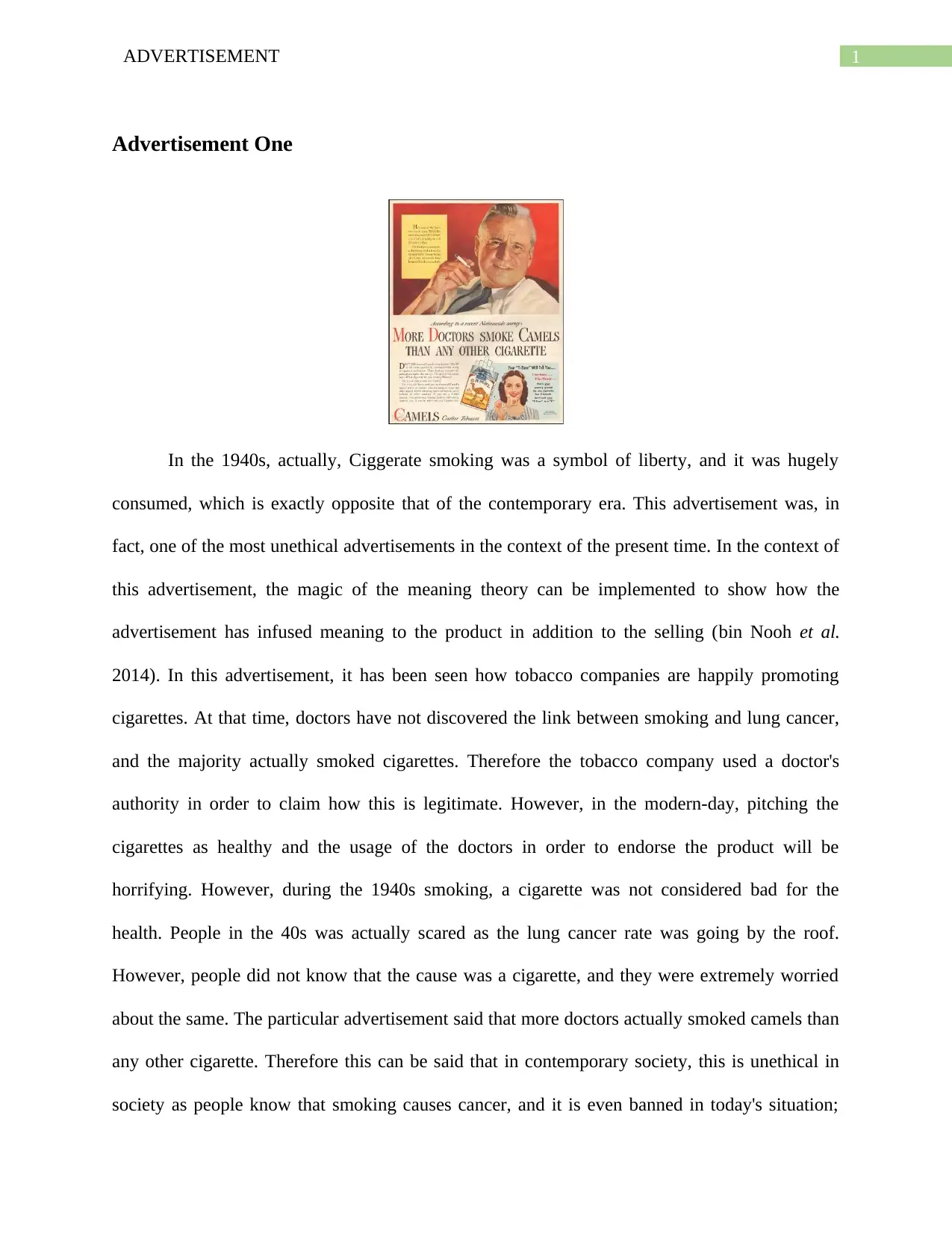
In the 1940s, actually, Ciggerate smoking was a symbol of liberty, and it was hugely
consumed, which is exactly opposite that of the contemporary era. This advertisement was, in
fact, one of the most unethical advertisements in the context of the present time. In the context of
this advertisement, the magic of the meaning theory can be implemented to show how the
advertisement has infused meaning to the product in addition to the selling (bin Nooh et al.
2014). In this advertisement, it has been seen how tobacco companies are happily promoting
cigarettes. At that time, doctors have not discovered the link between smoking and lung cancer,
and the majority actually smoked cigarettes. Therefore the tobacco company used a doctor's
authority in order to claim how this is legitimate. However, in the modern-day, pitching the
cigarettes as healthy and the usage of the doctors in order to endorse the product will be
horrifying. However, during the 1940s smoking, a cigarette was not considered bad for the
health. People in the 40s was actually scared as the lung cancer rate was going by the roof.
However, people did not know that the cause was a cigarette, and they were extremely worried
about the same. The particular advertisement said that more doctors actually smoked camels than
any other cigarette. Therefore this can be said that in contemporary society, this is unethical in
society as people know that smoking causes cancer, and it is even banned in today's situation;
Document Page
2ADVERTISEMENT
however, in the context of that time, people were aware of the situation and did not mind
advertising (Il’ia et al. 2016).
Advertisement Two
The 1950s was a time when the backlash started coming in against the sugary drinks in
the country. In the present time, there is much talk that is going on against the consumption of
carbonated drinks in the world. The 1950s was a time when the print advertisement was in
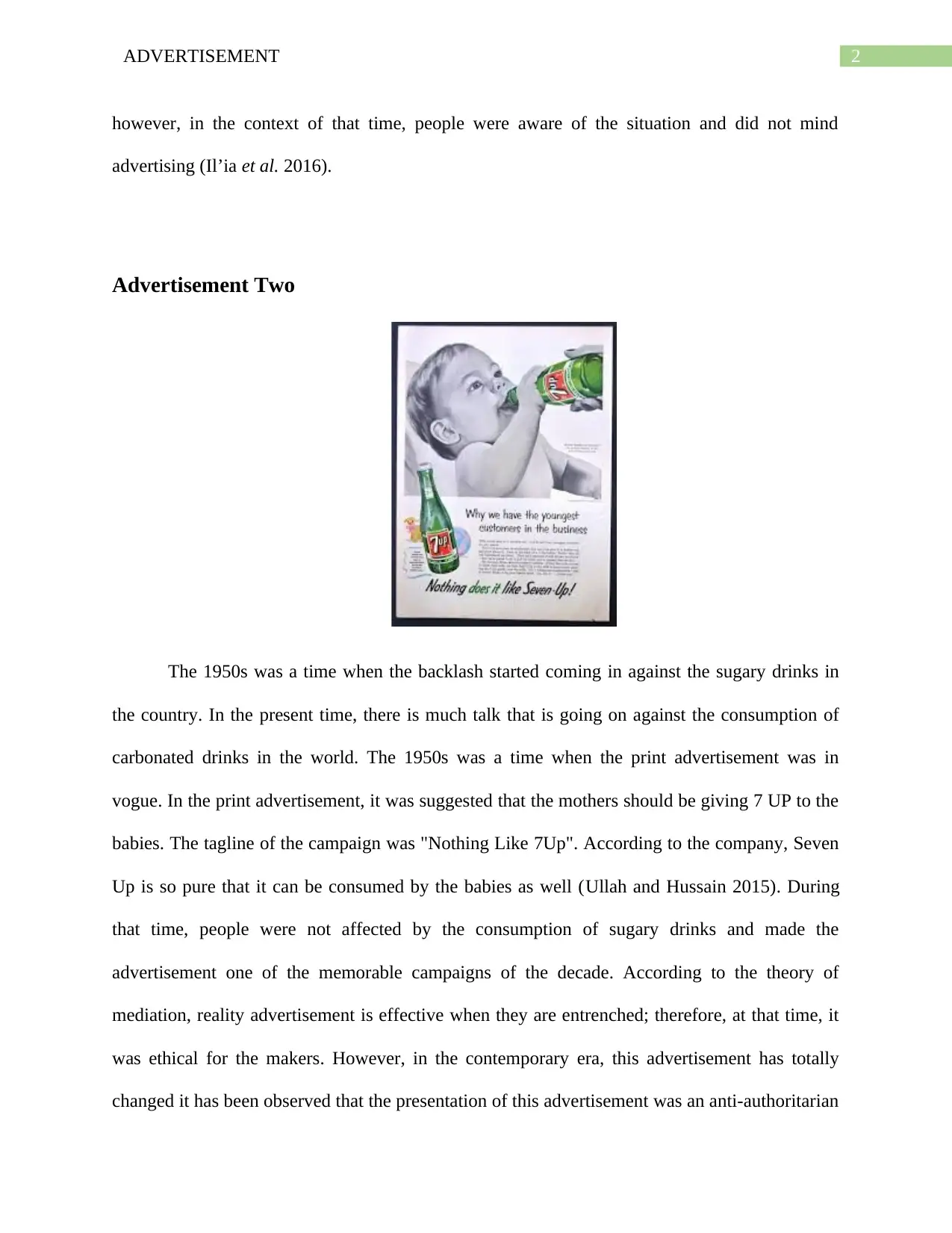
vogue. In the print advertisement, it was suggested that the mothers should be giving 7 UP to the
babies. The tagline of the campaign was "Nothing Like 7Up". According to the company, Seven
Up is so pure that it can be consumed by the babies as well (Ullah and Hussain 2015). During
that time, people were not affected by the consumption of sugary drinks and made the
advertisement one of the memorable campaigns of the decade. According to the theory of
mediation, reality advertisement is effective when they are entrenched; therefore, at that time, it
was ethical for the makers. However, in the contemporary era, this advertisement has totally
changed it has been observed that the presentation of this advertisement was an anti-authoritarian
Document Page
3ADVERTISEMENT
and hippie culture that was distributed by the company to persuade the status quo for achieving
the capitalist interest. However, in recent time there is an ethical standard in the media
advertisements, and this advertisement is totally unethical because it has shown that consumption
of sugary drink among the babies which is totally a wrong concept and the advertisement is
risking the health of the babies and setting the wrong notion in the society.
tabler-icon-diamond-filled.svg

Paraphrase This Document

Need a fresh take? Get an instant paraphrase of this document with our AI Paraphraser
Document Page
4ADVERTISEMENT
References
bin Nooh, M.N., Khairi, K.F., Ab Aziz, M.R., Abdullah, M. and Shukor, S.A., 2014. The criteria
and challenges of unethical advertising. American Journal of Business, 2(4), pp.88-93.
Il’ia, A.B., Cherkashchenko, T.A., Dorskii, A.Y. and Kaverina, E.A., 2015. Government
regulation of advertising in the eurasian economic union: contradictions of public policy and
advertising ethics. International Journal of Economics and Financial Issues, 5(2S), pp.116-120.
Ullah, N. and Hussain, M., 2015. Impact of unethical advertising, misleading information or
deceptive advertising on customer purchasing intention with mediating effect of word of mouth:
Case of Pakistan. International Journal of Innovation and Economic Development, 1(4), pp.49-
69.
chevron_up_icon
1 out of 5
circle_padding
hide_on_mobile
zoom_out_icon
[object Object]