University of Hertfordshire Aerospace Group Design: Commuter Aircraft

Verified

Added on  2022/09/12

|8
|1059
|17
Project
AI Summary
This report details the design of a 15-passenger commuter aircraft, focusing on aerodynamic principles, structural considerations, and performance characteristics. The project begins with an abstract outlining the aircraft's features and design choices, followed by an introduction discussing the integration of advanced engineering, lightweight materials, and high-performance aerodynamics to meet passenger demands and economic constraints. Objectives include specifying structural designs for wings, tailplanes, and fuselages, engine mount specifications, and calculating key structural component sizes. The report also covers the selection of a tapered wing design due to its superior performance and weight characteristics compared to rectangular and elliptical wing options, along with a detailed fuselage design analysis. The project aims to achieve efficient long-range transport with reduced fuel consumption, improved efficiency, and optimized noise levels, providing a comprehensive overview of the design process from initial concepts to detailed analysis.
Document Page
1
COMMUTER AIRCRAFT DESIGN
By Name
Course
Instructor
Institution
Location
Date: 08/04/2020
tabler-icon-diamond-filled.svg

Paraphrase This Document

Need a fresh take? Get an instant paraphrase of this document with our AI Paraphraser
Document Page
2
Table of Contents
Abstract......................................................................................................................................................3
Introduction...............................................................................................................................................3
Objectives...............................................................................................................................................5
Required parameter..................................................................................................................................5
Document Page
3
COMMUTER AIRCRAFT DESIGN
Abstract
The report presents the initial design of 15 passenger seat aircraft. The paper aims
to give guidelines on conception of general commuter aircraft. Aircraft
configurations and aerodynamic design choices are shown and compared with
other types. Investigation on wing-fuselage effect and nacelle lift influence on the
effect of wing span loading. Aerodynamic analysis done results to accurate
estimation of control derivatives, aircraft stability and accurate sizing of tail
surface. The analysis was carried out by use of 3-D calculation panel code
supported by a semi-empirical estimation method. The aircraft design can allow
along range transport with a reduced fuel consumption rate, better efficiency and
outstanding noise levels to design features and art engine.
Introduction
Latest aircraft are made of combination of advanced engineering system, light
weight and durable structures and high performance aerodynamics. The
passengers on air demands a more comfortable and friendly environment.
Technical challenges requires to be balanced so that the aircraft design
specification are economically achieved. The design is laborious and complex
activity as it involves a numerous factors to consider and their details required to
Document Page
4
obtain optimum finished product. The process of design starts from scratch and
includes a number of logistic planning, calculation, actual world consideration,
and design and level head to attain any hurdle head on. Every aircraft undergoes
through many design changes before the final product. The steps between the 1st
idea for aircraft and the period when it is working.
A long the design four main aeronautics areas are encountered. Areas includes;
Propulsion, Structure and Materials, Stability and Control Aerodynamics.
Propulsion involves the kind of engine and energy an aircraft requires. A
commuter aircraft carries passengers and luggages over long distances, thus the
engine must use fuel efficiently. The designers must ensure exhaust is made
cleaner and environmental friendly. Structure and materials is comprised of how
strong the aircraft is and the material used in building it.The aircraft must be light
in weight with less work for the engine does to fly. Tough aircraft design that are
strong and light weight must be used. Due to this composite material that exhibit
all the required characteristics are used.
Stability and control comprises of the study on how the aircraft interacts and
handles inputs and feeds. Aircraft input includes; altitude, aircraft speed, fuel
level and direction displayed in a computer. The pilot requires to be able process
accurate data very fast in order to think on the next action to be taken and react in
a proper way. Aircraft must display the data that is simple and easily
understandable to the pilot. Control in cockpit should be easily reached by the
pilot. It is also significant for the aircraft to respond quickly and appropriately to
pilot maneuvers and instructions. Aerodynamics deals with the study of airflow
tabler-icon-diamond-filled.svg

Paraphrase This Document

Need a fresh take? Get an instant paraphrase of this document with our AI Paraphraser
Document Page
5
around the aircraft. For aircraft to fly, air must flow under and over the wings.
The more streamlined the aircraft is the less air resistance is.If air flows around
the aircraft easily, the less work for the aircraft engine to do.
Objectives.
i. To examine and specify structural design of aircraft’s wings, tailplane and
fuselage.
ii. To examine engine mount specification and undercarriage load paths.
iii. To calculate and stipulate position and sizes main structure components of
fuselage and wings.
iv. To stipulate skin thickness for the aircraft wings, fin, horizontal tailplane,
and fuselage.
v. To conduct stress analysis in producing the main shear force, wings torque
distribution and the bending moments.
vi. To prepare manoeuvre and gust envelope and calculate tailplane loads
balancing manoeuvre and gust at extreme cases of centre of gravity limits
and take-off.
Required parameters
To create an effective conception design, the number of parameters where
determined and needed to be finalized. The aim of the 1st phase of the design was
to determine the existing parameters of design and pass them to the requirement
of the design and transform the parameters. The parameters includes;
i. Wing aspect ratio (AR)
ii. Optimum Airfoil lift ( CL )
Document Page
6
iii. Thrust ¿ weight ratio
iv. Wing loading
Wing design Analysis
In the process of wing design, there were three types of wings that could be used
in the design. They include elliptical, tapered and rectangular.
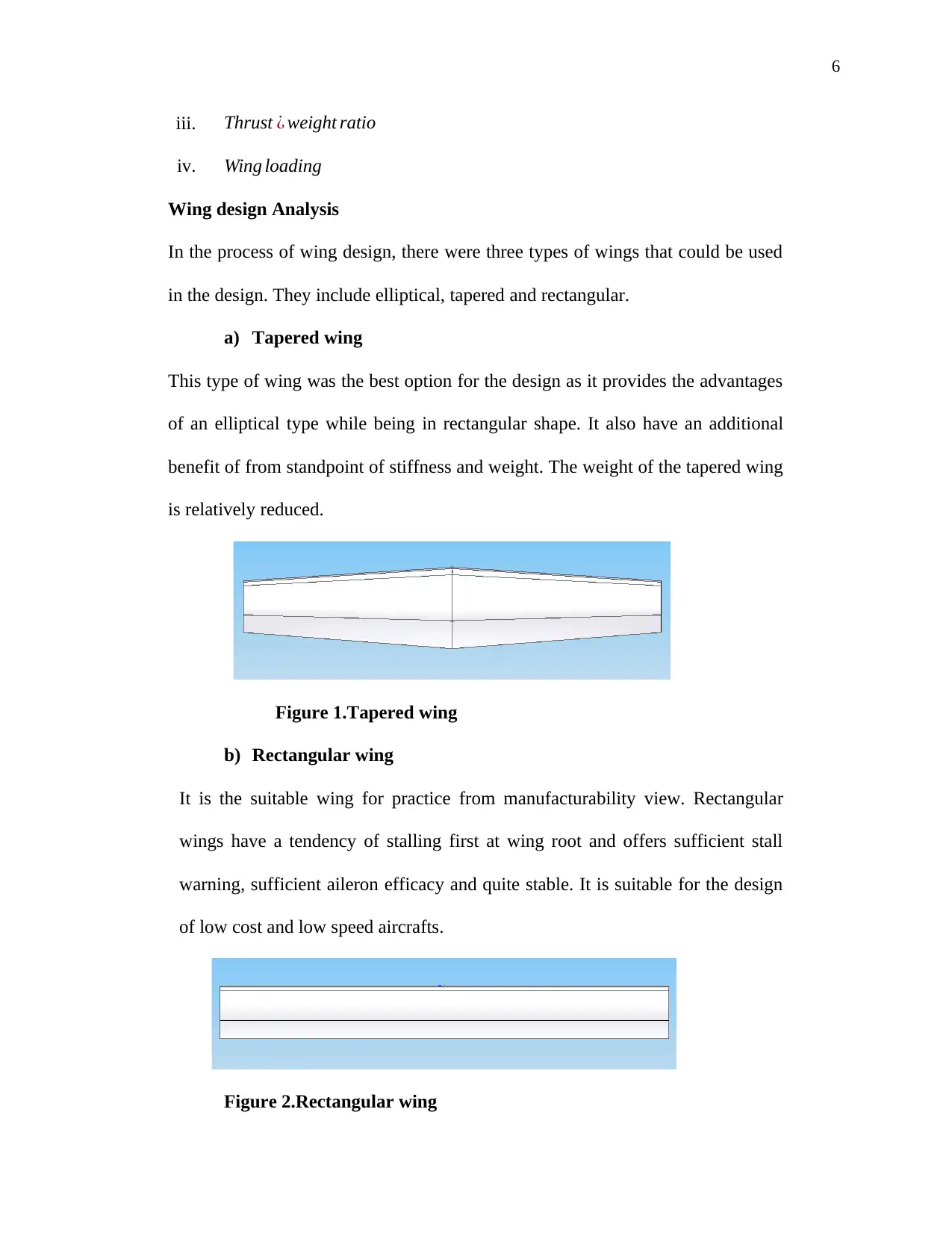
a) Tapered wing
This type of wing was the best option for the design as it provides the advantages
of an elliptical type while being in rectangular shape. It also have an additional
benefit of from standpoint of stiffness and weight. The weight of the tapered wing
is relatively reduced.
Figure 1.Tapered wing
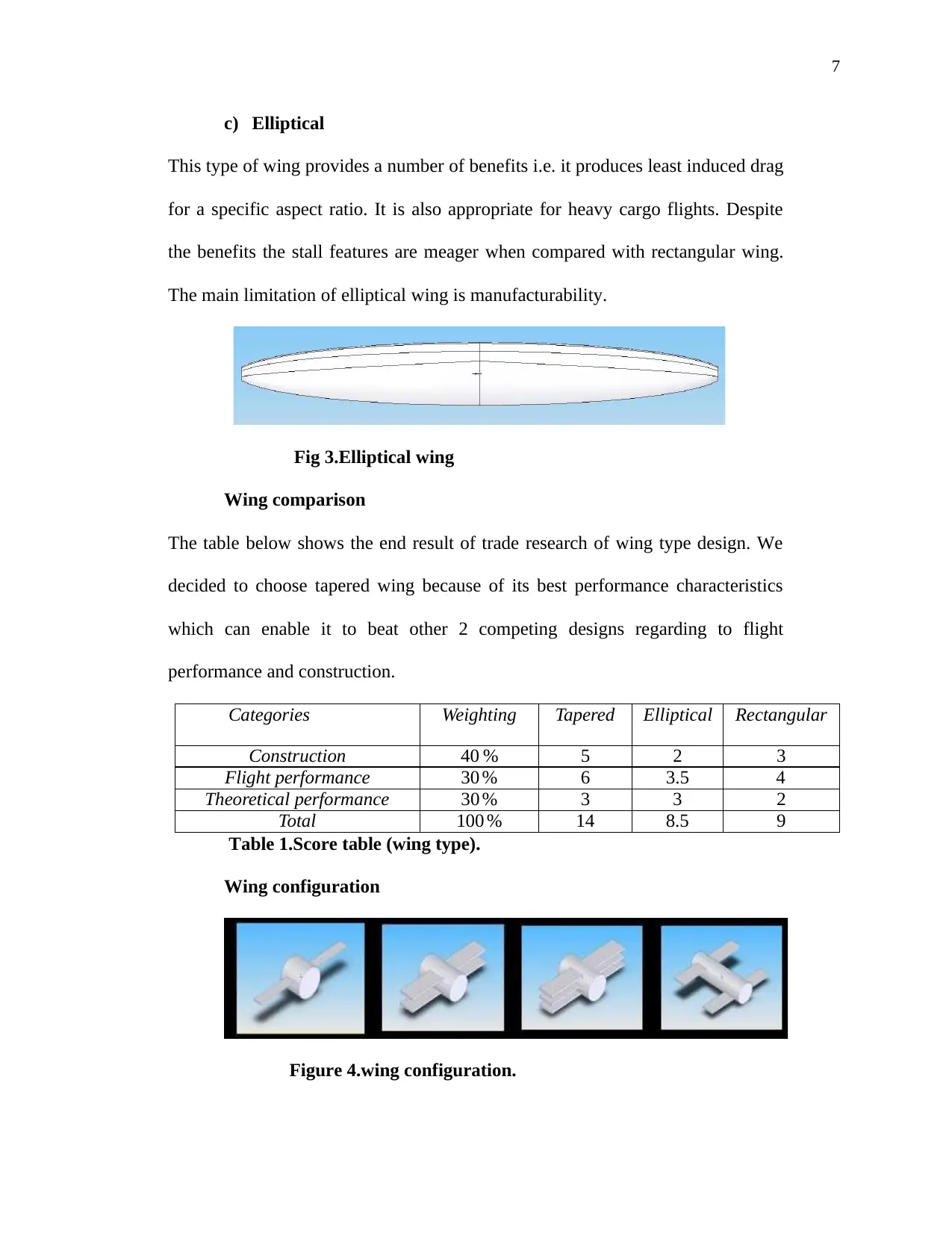
b) Rectangular wing
It is the suitable wing for practice from manufacturability view. Rectangular
wings have a tendency of stalling first at wing root and offers sufficient stall
warning, sufficient aileron efficacy and quite stable. It is suitable for the design
of low cost and low speed aircrafts.
Figure 2.Rectangular wing
Document Page
7
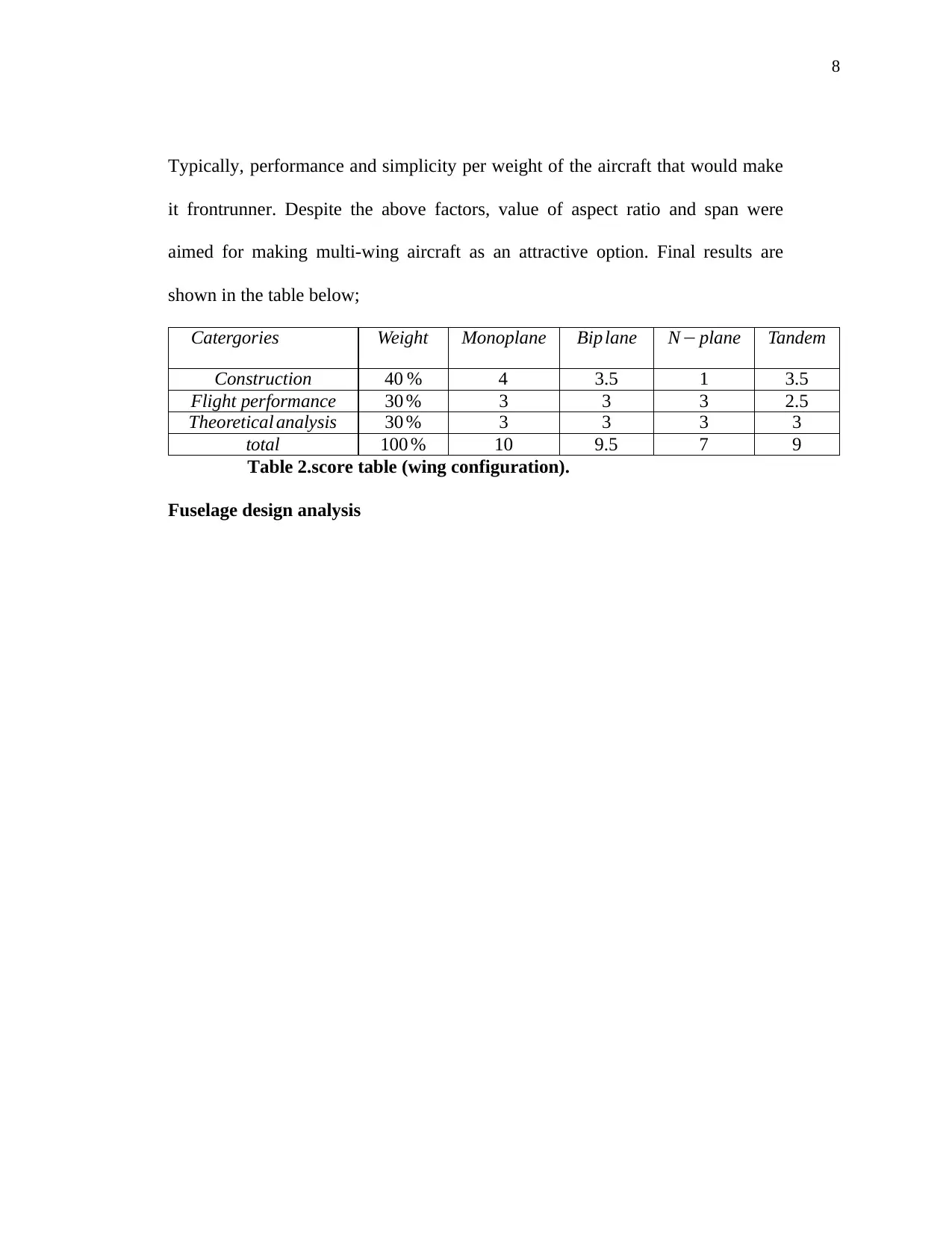
c) Elliptical
This type of wing provides a number of benefits i.e. it produces least induced drag
for a specific aspect ratio. It is also appropriate for heavy cargo flights. Despite
the benefits the stall features are meager when compared with rectangular wing.
The main limitation of elliptical wing is manufacturability.
Fig 3.Elliptical wing
Wing comparison
The table below shows the end result of trade research of wing type design. We
decided to choose tapered wing because of its best performance characteristics
which can enable it to beat other 2 competing designs regarding to flight
performance and construction.
Categories Weighting Tapered Elliptical Rectangular
Construction 40 % 5 2 3
Flight performance 30 % 6 3.5 4
Theoretical performance 30 % 3 3 2
Total 100 % 14 8.5 9
Table 1.Score table (wing type).
Wing configuration
Figure 4.wing configuration.
tabler-icon-diamond-filled.svg

Paraphrase This Document

Need a fresh take? Get an instant paraphrase of this document with our AI Paraphraser
Document Page
8
Typically, performance and simplicity per weight of the aircraft that would make
it frontrunner. Despite the above factors, value of aspect ratio and span were
aimed for making multi-wing aircraft as an attractive option. Final results are
shown in the table below;
Catergories Weight Monoplane Bip lane N plane Tandem
Construction 40 % 4 3.5 1 3.5
Flight performance 30 % 3 3 3 2.5
Theoretical analysis 30 % 3 3 3 3
total 100 % 10 9.5 7 9
Table 2.score table (wing configuration).
Fuselage design analysis
chevron_up_icon
1 out of 8
circle_padding
hide_on_mobile
zoom_out_icon
[object Object]