ECO2EDC: Analyzing Afghanistan's Development Path and Economy
VerifiedAdded on 2023/06/11
|13
|2242
|363
Report
AI Summary
This report provides an in-depth analysis of Afghanistan's economic development path, examining its growth drivers, challenges, and socio-economic indicators. It highlights the country's GDP growth, per capita income, unemployment and inflation rates, and corruption rank, comparing its performance with peer nations. The report identifies foreign direct investment, simplified consumption procedures, transit trade, electrification, and agricultural productivity as key drivers of growth. Despite conflicts hindering progress, Afghanistan has shown improvement in various economic indicators, including increased consumer spending and reduced unemployment and inflation rates. The analysis concludes that while Afghanistan's progress has been moderate, the country has the potential for substantial growth with continued development in agriculture, manufacturing, and infrastructure. Desklib provides access to this and other solved assignments for students.
Running head: ECONOMICS ASSIGNMENT
Afghanistan’s development path
Name of the student:
Name of the University:
Author note
Afghanistan’s development path
Name of the student:
Name of the University:
Author note

Paraphrase This Document
Need a fresh take? Get an instant paraphrase of this document with our AI Paraphraser
1ECONOMICS ASSIGNMENT
Table of Contents
Introduction:...............................................................................................................................3
Growth path of Afghanistan:......................................................................................................3
Driver of growth of Afghanistan:...............................................................................................8
Comparison of Afghanistan’s performance with its peers:........................................................9
Conclusion:................................................................................................................................9
Reference:................................................................................................................................10
Table of Contents
Introduction:...............................................................................................................................3
Growth path of Afghanistan:......................................................................................................3
Driver of growth of Afghanistan:...............................................................................................8
Comparison of Afghanistan’s performance with its peers:........................................................9
Conclusion:................................................................................................................................9
Reference:................................................................................................................................10
2ECONOMICS ASSIGNMENT
Table of Figures
Figure 1: Afghanistan population...............................................................................................3
Figure 2: Afghanistan per capita income...................................................................................3
Figure 3: Afghanistan GDP growth rate....................................................................................4
Figure 4: Afghanistan unemployment rate.................................................................................5
Figure 5: Afghanistan inflation rate...........................................................................................5
Figure 6: Afghanistan corruption rank.......................................................................................6
Figure 7: Afghanistan consumer spending.................................................................................7
Table of Figures
Figure 1: Afghanistan population...............................................................................................3
Figure 2: Afghanistan per capita income...................................................................................3
Figure 3: Afghanistan GDP growth rate....................................................................................4
Figure 4: Afghanistan unemployment rate.................................................................................5
Figure 5: Afghanistan inflation rate...........................................................................................5
Figure 6: Afghanistan corruption rank.......................................................................................6
Figure 7: Afghanistan consumer spending.................................................................................7
⊘ This is a preview!⊘
Do you want full access?
Subscribe today to unlock all pages.

Trusted by 1+ million students worldwide
3ECONOMICS ASSIGNMENT
Introduction:
Afghanistan is one of the growing nations in the Asian region that has been
demonstrating improvement during the last decade through the infusion of the billions of
dollars via international remittances and assistance. This rise in the foreign investment has
aided the country’s economy to face growth during the last three decades making
Afghanistan one of the stable economy around the world. With GDP growth rate of 2.2% it is
one of the growing economy in the Asian region that has shown extraordinary transformation
in its economic performance (Park et al. 2017). Over four decades of Taliban occupancy, the
way Afghanistan has been transforming its economy on daily basis, it can be said that, soon it
will become one of the largest developing nation in its region. In order to have better
perspective regarding the performance of the Afghanistan’s economy this report is aimed to
provide insight details regarding the same (Noorzai et al. 2017). Through analysing the socio
economic structure of the economy and providing details regarding the political, economic as
well as human development phenomenon of the economy, this report will provide the growth
path of the Afghanistan during the last few decades.
Introduction:
Afghanistan is one of the growing nations in the Asian region that has been
demonstrating improvement during the last decade through the infusion of the billions of
dollars via international remittances and assistance. This rise in the foreign investment has
aided the country’s economy to face growth during the last three decades making
Afghanistan one of the stable economy around the world. With GDP growth rate of 2.2% it is
one of the growing economy in the Asian region that has shown extraordinary transformation
in its economic performance (Park et al. 2017). Over four decades of Taliban occupancy, the
way Afghanistan has been transforming its economy on daily basis, it can be said that, soon it
will become one of the largest developing nation in its region. In order to have better
perspective regarding the performance of the Afghanistan’s economy this report is aimed to
provide insight details regarding the same (Noorzai et al. 2017). Through analysing the socio
economic structure of the economy and providing details regarding the political, economic as
well as human development phenomenon of the economy, this report will provide the growth
path of the Afghanistan during the last few decades.
Paraphrase This Document
Need a fresh take? Get an instant paraphrase of this document with our AI Paraphraser
4ECONOMICS ASSIGNMENT
Growth path of Afghanistan:
Economy of Afghanistan is one of the developing nations that has been enhancing at a
rate of 2.2% rate every year (Hawker and Nino 2017). With the GDP per capital value of
$1900 as per the 2017 data, Afghanistan has broadening its growth path since last two
decades with the enhancement in the growth of the investment inflow from the foreign
nations. With agricultural sector share of 22%, GDP of the nation is marching towards
sustainability (Neufeld and Earle 2014). Large chunk of the GDP is gained through the robust
performance of the service sector. As per the latest information, service sector the
Afghanistan is producing 56% of the country’s GDP and industrial sector provides 22% of
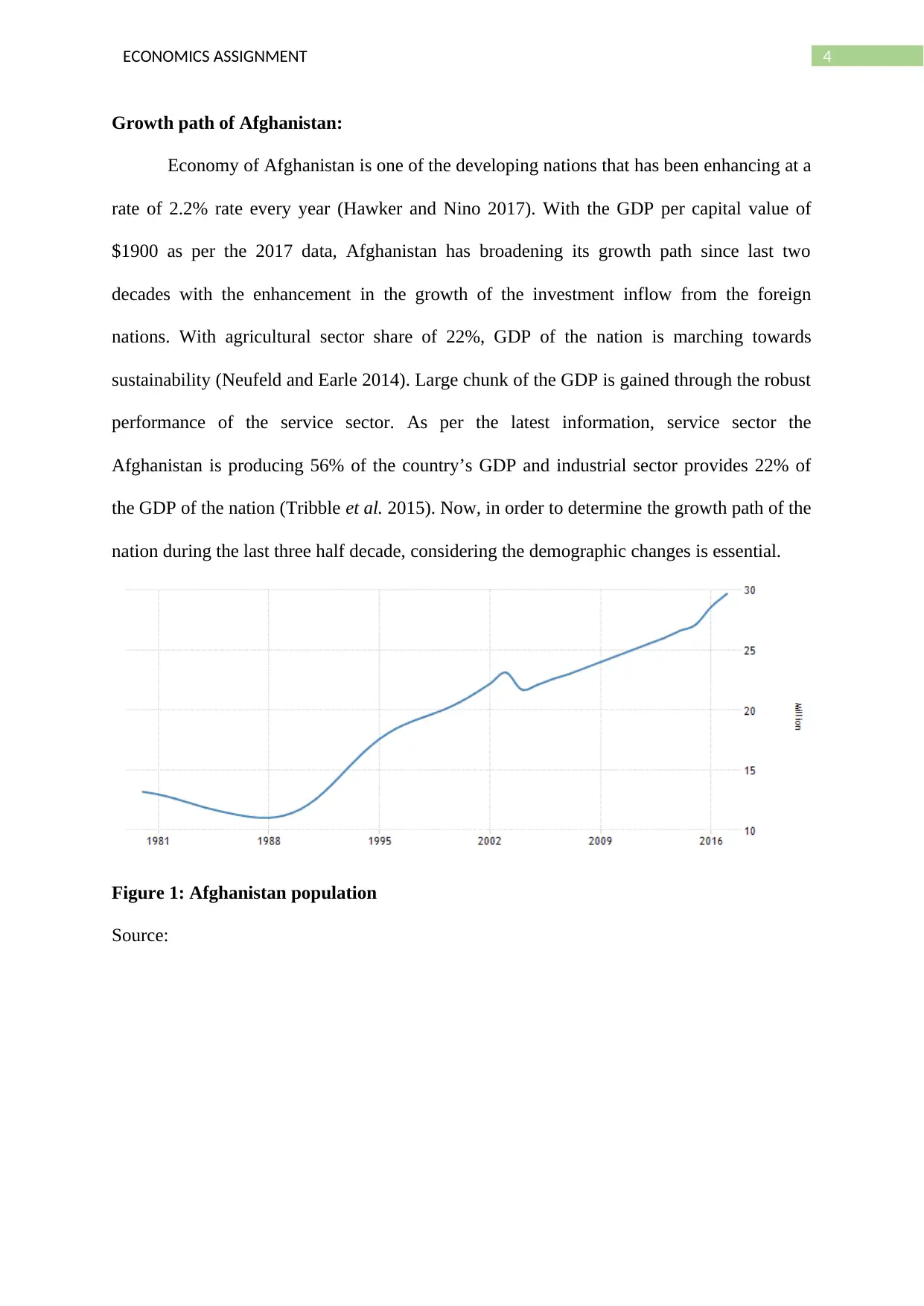
the GDP of the nation (Tribble et al. 2015). Now, in order to determine the growth path of the
nation during the last three half decade, considering the demographic changes is essential.
Figure 1: Afghanistan population
Source:
Growth path of Afghanistan:
Economy of Afghanistan is one of the developing nations that has been enhancing at a
rate of 2.2% rate every year (Hawker and Nino 2017). With the GDP per capital value of
$1900 as per the 2017 data, Afghanistan has broadening its growth path since last two
decades with the enhancement in the growth of the investment inflow from the foreign
nations. With agricultural sector share of 22%, GDP of the nation is marching towards
sustainability (Neufeld and Earle 2014). Large chunk of the GDP is gained through the robust
performance of the service sector. As per the latest information, service sector the
Afghanistan is producing 56% of the country’s GDP and industrial sector provides 22% of
the GDP of the nation (Tribble et al. 2015). Now, in order to determine the growth path of the
nation during the last three half decade, considering the demographic changes is essential.
Figure 1: Afghanistan population
Source:
5ECONOMICS ASSIGNMENT
From the above figure it can be seen that the population of Afghanistan has increased
during the last three decades at a rapid rate and since 1988. Since 1981 to 1988 there has been
a fall in the population due to rise in the presence of the extremist group in the area.
However, post 1988, presence of foreign investment and military assistance in the area has
aided it to become where it is now (Leao et al. 2018).
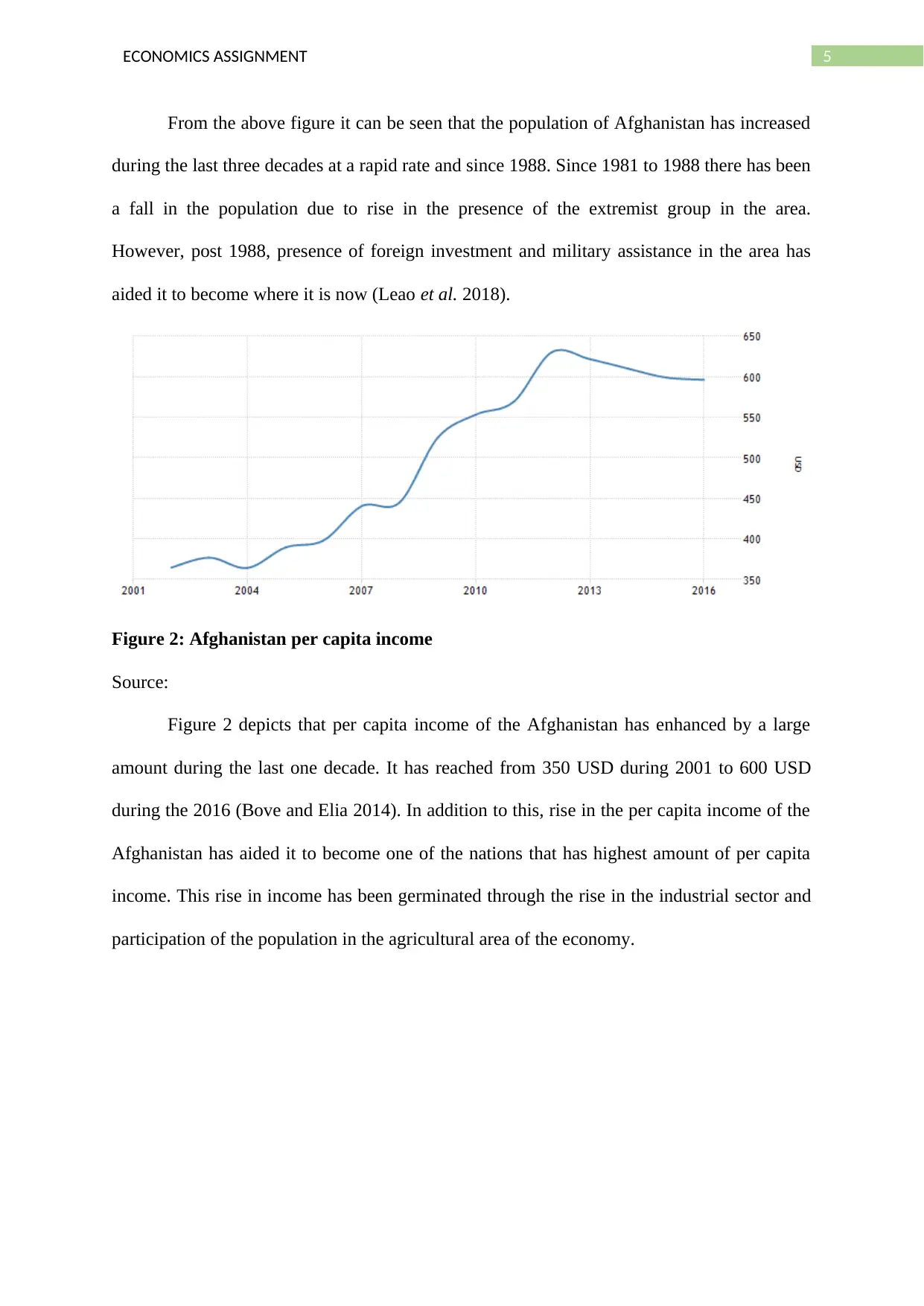
Figure 2: Afghanistan per capita income
Source:
Figure 2 depicts that per capita income of the Afghanistan has enhanced by a large
amount during the last one decade. It has reached from 350 USD during 2001 to 600 USD
during the 2016 (Bove and Elia 2014). In addition to this, rise in the per capita income of the
Afghanistan has aided it to become one of the nations that has highest amount of per capita
income. This rise in income has been germinated through the rise in the industrial sector and
participation of the population in the agricultural area of the economy.
From the above figure it can be seen that the population of Afghanistan has increased
during the last three decades at a rapid rate and since 1988. Since 1981 to 1988 there has been
a fall in the population due to rise in the presence of the extremist group in the area.
However, post 1988, presence of foreign investment and military assistance in the area has
aided it to become where it is now (Leao et al. 2018).
Figure 2: Afghanistan per capita income
Source:
Figure 2 depicts that per capita income of the Afghanistan has enhanced by a large
amount during the last one decade. It has reached from 350 USD during 2001 to 600 USD
during the 2016 (Bove and Elia 2014). In addition to this, rise in the per capita income of the
Afghanistan has aided it to become one of the nations that has highest amount of per capita
income. This rise in income has been germinated through the rise in the industrial sector and
participation of the population in the agricultural area of the economy.
⊘ This is a preview!⊘
Do you want full access?
Subscribe today to unlock all pages.
Trusted by 1+ million students worldwide
6ECONOMICS ASSIGNMENT
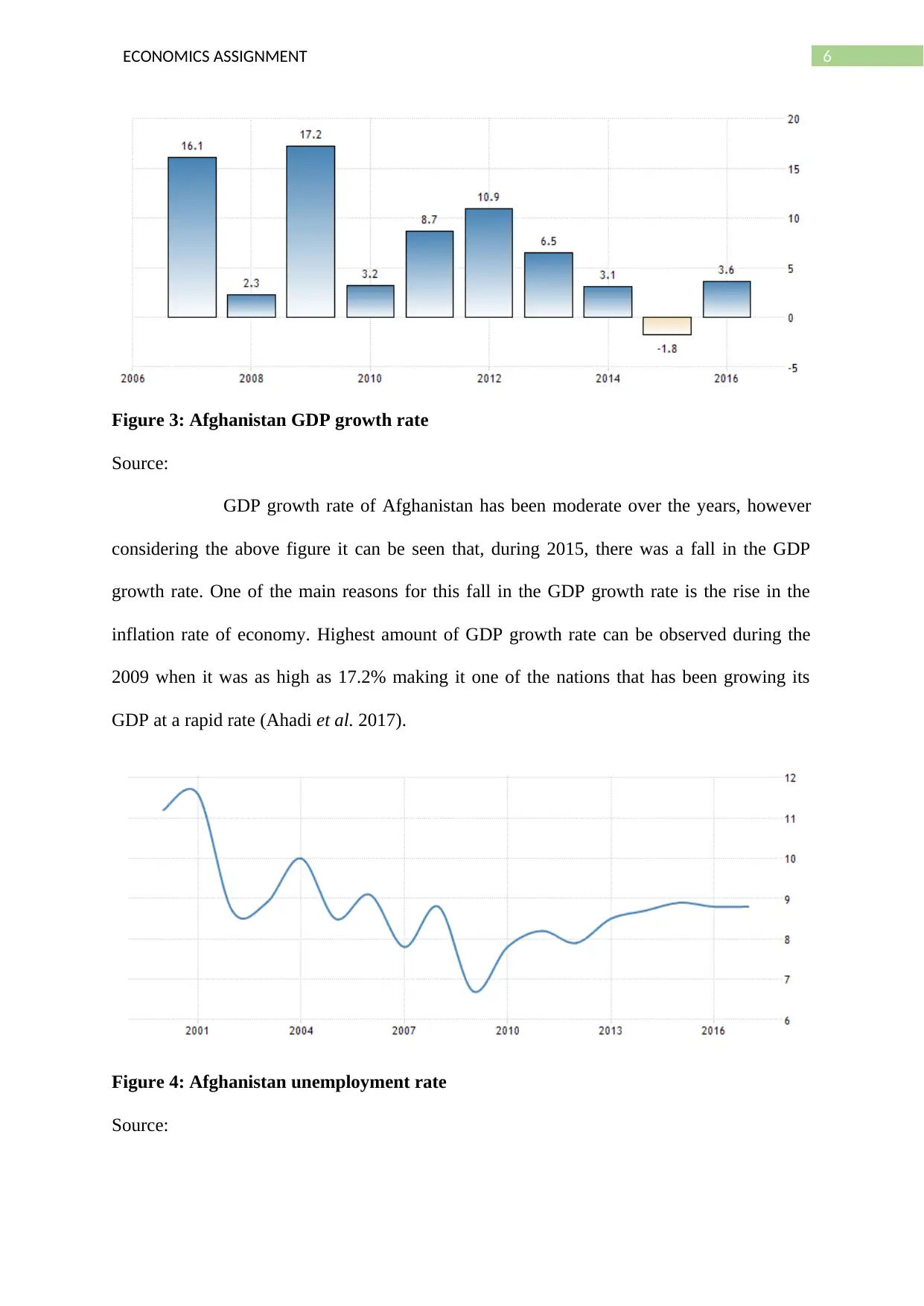
Figure 3: Afghanistan GDP growth rate
Source:
GDP growth rate of Afghanistan has been moderate over the years, however
considering the above figure it can be seen that, during 2015, there was a fall in the GDP
growth rate. One of the main reasons for this fall in the GDP growth rate is the rise in the
inflation rate of economy. Highest amount of GDP growth rate can be observed during the
2009 when it was as high as 17.2% making it one of the nations that has been growing its
GDP at a rapid rate (Ahadi et al. 2017).
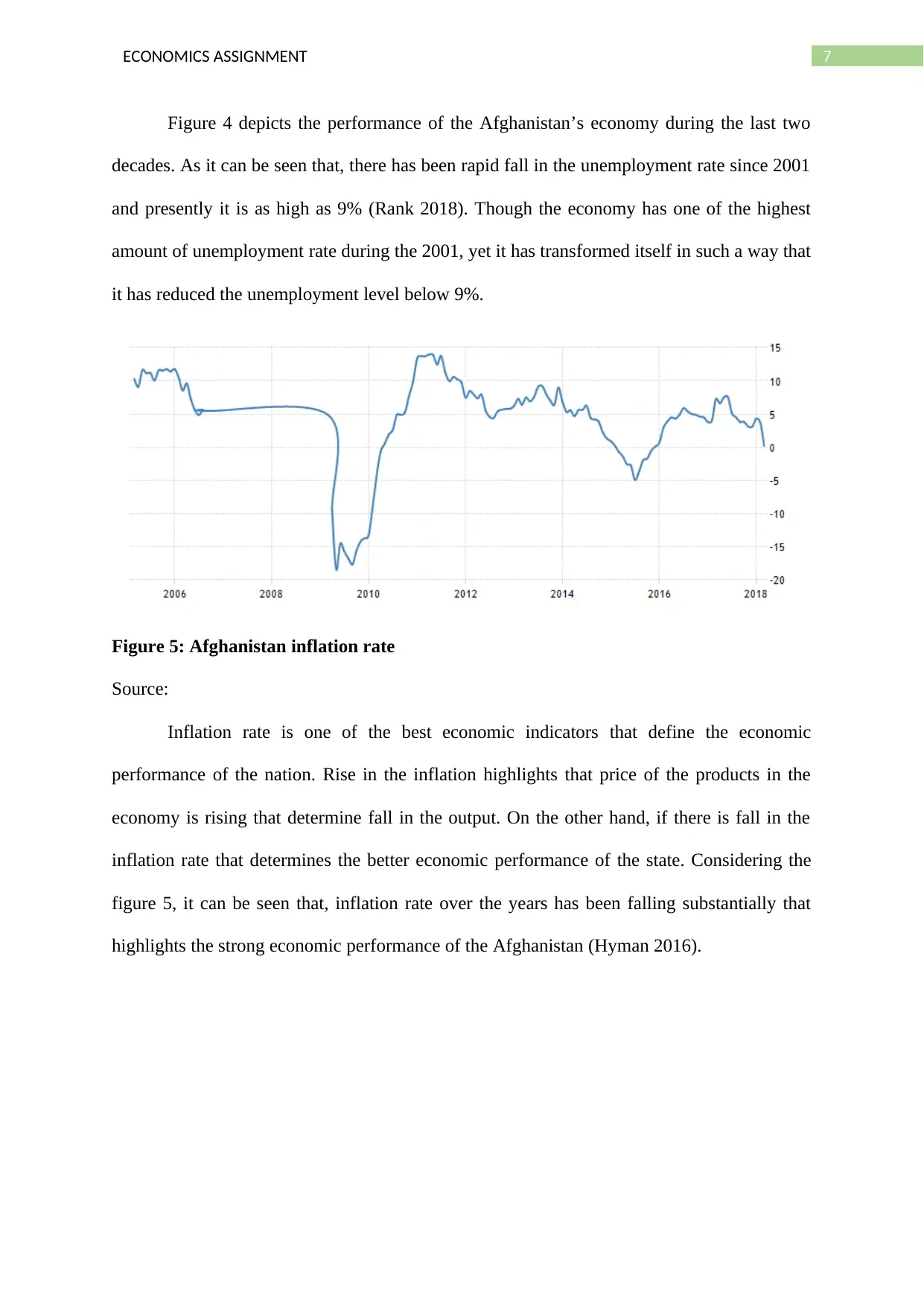
Figure 4: Afghanistan unemployment rate
Source:
Figure 3: Afghanistan GDP growth rate
Source:
GDP growth rate of Afghanistan has been moderate over the years, however
considering the above figure it can be seen that, during 2015, there was a fall in the GDP
growth rate. One of the main reasons for this fall in the GDP growth rate is the rise in the
inflation rate of economy. Highest amount of GDP growth rate can be observed during the
2009 when it was as high as 17.2% making it one of the nations that has been growing its
GDP at a rapid rate (Ahadi et al. 2017).
Figure 4: Afghanistan unemployment rate
Source:
Paraphrase This Document
Need a fresh take? Get an instant paraphrase of this document with our AI Paraphraser
7ECONOMICS ASSIGNMENT
Figure 4 depicts the performance of the Afghanistan’s economy during the last two
decades. As it can be seen that, there has been rapid fall in the unemployment rate since 2001
and presently it is as high as 9% (Rank 2018). Though the economy has one of the highest
amount of unemployment rate during the 2001, yet it has transformed itself in such a way that
it has reduced the unemployment level below 9%.
Figure 5: Afghanistan inflation rate
Source:
Inflation rate is one of the best economic indicators that define the economic
performance of the nation. Rise in the inflation highlights that price of the products in the
economy is rising that determine fall in the output. On the other hand, if there is fall in the
inflation rate that determines the better economic performance of the state. Considering the
figure 5, it can be seen that, inflation rate over the years has been falling substantially that
highlights the strong economic performance of the Afghanistan (Hyman 2016).
Figure 4 depicts the performance of the Afghanistan’s economy during the last two
decades. As it can be seen that, there has been rapid fall in the unemployment rate since 2001
and presently it is as high as 9% (Rank 2018). Though the economy has one of the highest
amount of unemployment rate during the 2001, yet it has transformed itself in such a way that
it has reduced the unemployment level below 9%.
Figure 5: Afghanistan inflation rate
Source:
Inflation rate is one of the best economic indicators that define the economic
performance of the nation. Rise in the inflation highlights that price of the products in the
economy is rising that determine fall in the output. On the other hand, if there is fall in the
inflation rate that determines the better economic performance of the state. Considering the
figure 5, it can be seen that, inflation rate over the years has been falling substantially that
highlights the strong economic performance of the Afghanistan (Hyman 2016).
8ECONOMICS ASSIGNMENT
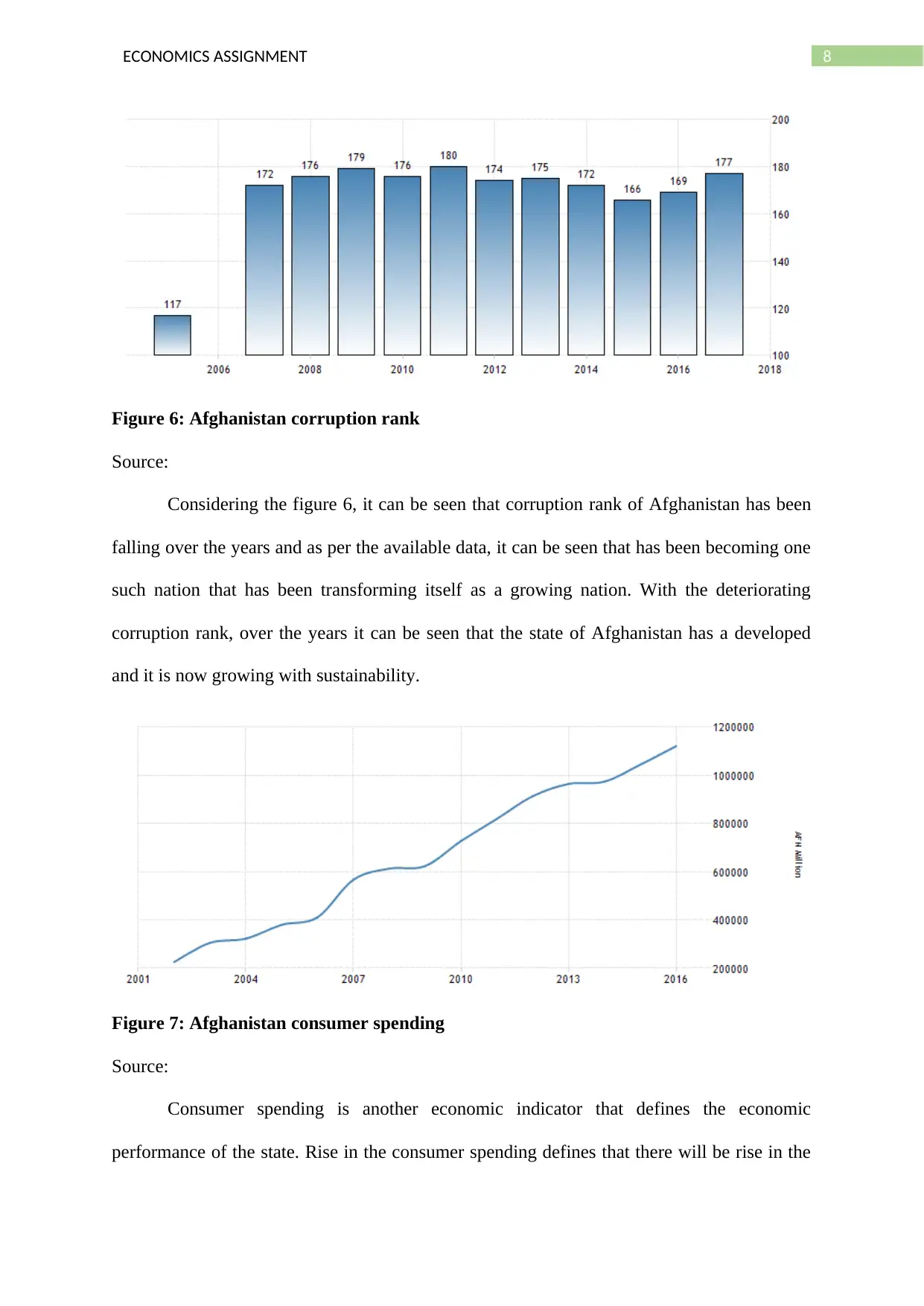
Figure 6: Afghanistan corruption rank
Source:
Considering the figure 6, it can be seen that corruption rank of Afghanistan has been
falling over the years and as per the available data, it can be seen that has been becoming one
such nation that has been transforming itself as a growing nation. With the deteriorating
corruption rank, over the years it can be seen that the state of Afghanistan has a developed
and it is now growing with sustainability.
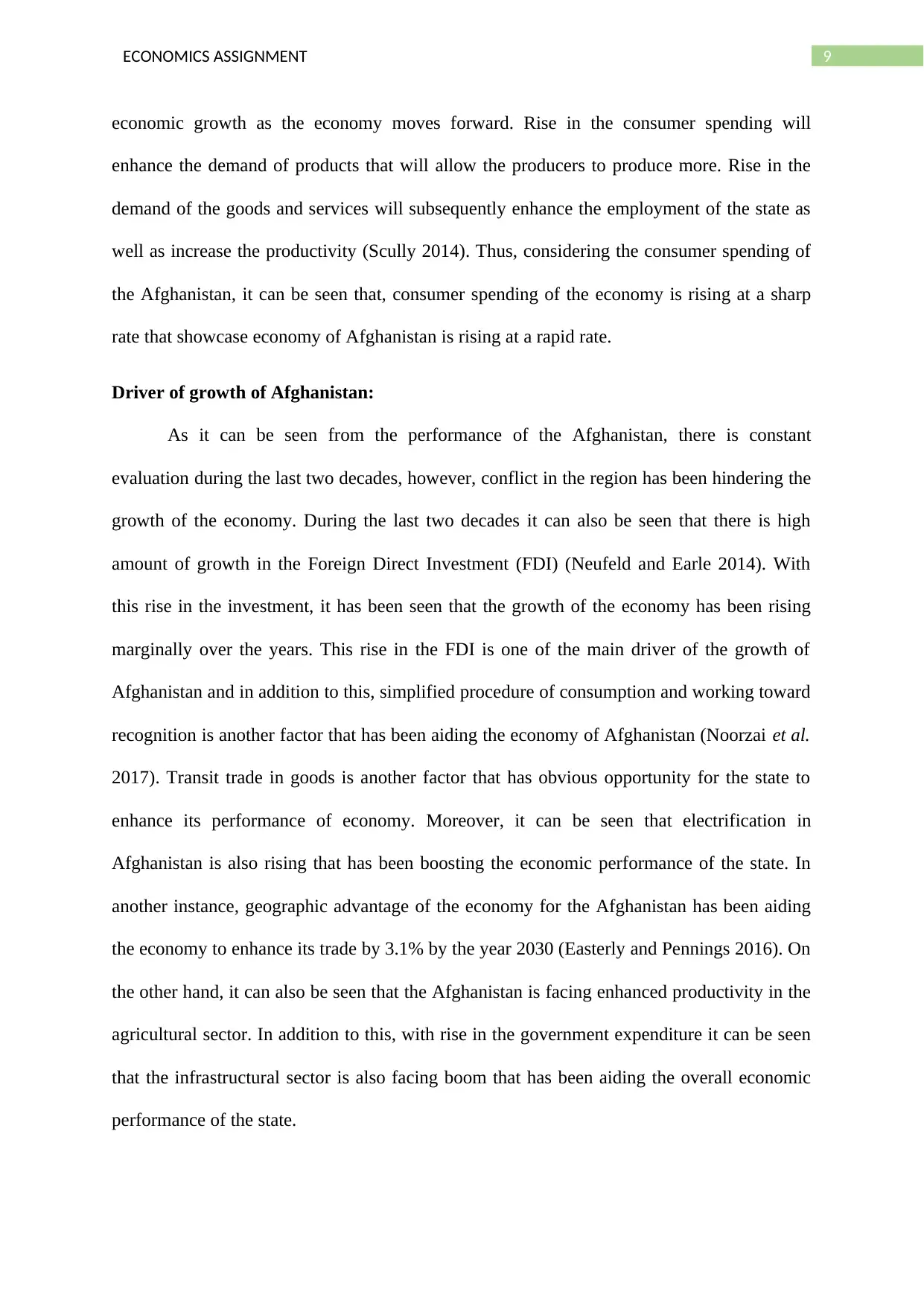
Figure 7: Afghanistan consumer spending
Source:
Consumer spending is another economic indicator that defines the economic
performance of the state. Rise in the consumer spending defines that there will be rise in the
Figure 6: Afghanistan corruption rank
Source:
Considering the figure 6, it can be seen that corruption rank of Afghanistan has been
falling over the years and as per the available data, it can be seen that has been becoming one
such nation that has been transforming itself as a growing nation. With the deteriorating
corruption rank, over the years it can be seen that the state of Afghanistan has a developed
and it is now growing with sustainability.
Figure 7: Afghanistan consumer spending
Source:
Consumer spending is another economic indicator that defines the economic
performance of the state. Rise in the consumer spending defines that there will be rise in the
⊘ This is a preview!⊘
Do you want full access?
Subscribe today to unlock all pages.
Trusted by 1+ million students worldwide
9ECONOMICS ASSIGNMENT
economic growth as the economy moves forward. Rise in the consumer spending will
enhance the demand of products that will allow the producers to produce more. Rise in the
demand of the goods and services will subsequently enhance the employment of the state as
well as increase the productivity (Scully 2014). Thus, considering the consumer spending of
the Afghanistan, it can be seen that, consumer spending of the economy is rising at a sharp
rate that showcase economy of Afghanistan is rising at a rapid rate.
Driver of growth of Afghanistan:
As it can be seen from the performance of the Afghanistan, there is constant
evaluation during the last two decades, however, conflict in the region has been hindering the
growth of the economy. During the last two decades it can also be seen that there is high
amount of growth in the Foreign Direct Investment (FDI) (Neufeld and Earle 2014). With
this rise in the investment, it has been seen that the growth of the economy has been rising
marginally over the years. This rise in the FDI is one of the main driver of the growth of
Afghanistan and in addition to this, simplified procedure of consumption and working toward
recognition is another factor that has been aiding the economy of Afghanistan (Noorzai et al.
2017). Transit trade in goods is another factor that has obvious opportunity for the state to
enhance its performance of economy. Moreover, it can be seen that electrification in
Afghanistan is also rising that has been boosting the economic performance of the state. In
another instance, geographic advantage of the economy for the Afghanistan has been aiding
the economy to enhance its trade by 3.1% by the year 2030 (Easterly and Pennings 2016). On
the other hand, it can also be seen that the Afghanistan is facing enhanced productivity in the
agricultural sector. In addition to this, with rise in the government expenditure it can be seen
that the infrastructural sector is also facing boom that has been aiding the overall economic
performance of the state.
economic growth as the economy moves forward. Rise in the consumer spending will
enhance the demand of products that will allow the producers to produce more. Rise in the
demand of the goods and services will subsequently enhance the employment of the state as
well as increase the productivity (Scully 2014). Thus, considering the consumer spending of
the Afghanistan, it can be seen that, consumer spending of the economy is rising at a sharp
rate that showcase economy of Afghanistan is rising at a rapid rate.
Driver of growth of Afghanistan:
As it can be seen from the performance of the Afghanistan, there is constant
evaluation during the last two decades, however, conflict in the region has been hindering the
growth of the economy. During the last two decades it can also be seen that there is high
amount of growth in the Foreign Direct Investment (FDI) (Neufeld and Earle 2014). With
this rise in the investment, it has been seen that the growth of the economy has been rising
marginally over the years. This rise in the FDI is one of the main driver of the growth of
Afghanistan and in addition to this, simplified procedure of consumption and working toward
recognition is another factor that has been aiding the economy of Afghanistan (Noorzai et al.
2017). Transit trade in goods is another factor that has obvious opportunity for the state to
enhance its performance of economy. Moreover, it can be seen that electrification in
Afghanistan is also rising that has been boosting the economic performance of the state. In
another instance, geographic advantage of the economy for the Afghanistan has been aiding
the economy to enhance its trade by 3.1% by the year 2030 (Easterly and Pennings 2016). On
the other hand, it can also be seen that the Afghanistan is facing enhanced productivity in the
agricultural sector. In addition to this, with rise in the government expenditure it can be seen
that the infrastructural sector is also facing boom that has been aiding the overall economic
performance of the state.
Paraphrase This Document
Need a fresh take? Get an instant paraphrase of this document with our AI Paraphraser
10ECONOMICS ASSIGNMENT
Comparison of Afghanistan’s performance with its peers:
Considering the peer countries of Afghanistan, it can be seen that countries like
Pakistan, china, India has leaped forward with its growth by a large extent during the last two
and half decades (Leao et al. 2018). Though there has been difference in the economic
capacity and performance of these state, however, Afghanistan in recent decades has been
gaining momentum in order to compete with its peer nations.
Conclusion:
Considering the above analysis it can be seen that the performance of the Afghanistan
during the last decade was slow, however, moderate in nature to enhance the growth of the
nation. With the robust growth of the agriculture and marginal growth of the manufacturing
sector, it can be seen that the Afghanistan has been growing at a large extent. In addition to
this it has also been seen that, there has been rise in the consumption expenditure of the
country that showcase growth of the economy and on the other hand, it can also be seen that
there is fall in the unemployment rate as well as the inflation rate. Price of the goods and
services of the Afghanistan has been reducing, aiding the economy to have substantial
amount of growth.
Reference:
Ahadi, A.A., Mei, M. and Yar, P., 2017. The Conditions of Women Education Post 9/11
event in Kabul City, Afghanistan. International Journal of Social Science and Humanities
Research, 5(1), pp.1-7.
Bove, V. and Elia, L., 2014. The impact of American and British involvement in Afghanistan
and Iraq on health spending, military spending and economic growth. The BE Journal of
Macroeconomics, 14(1), pp.325-339.
Easterly, W. and Pennings, S., 2016. Shrinking dictators: how much economic growth can we
attribute to national leaders. Development Research Institute Working Paper, (94).
Comparison of Afghanistan’s performance with its peers:
Considering the peer countries of Afghanistan, it can be seen that countries like
Pakistan, china, India has leaped forward with its growth by a large extent during the last two
and half decades (Leao et al. 2018). Though there has been difference in the economic
capacity and performance of these state, however, Afghanistan in recent decades has been
gaining momentum in order to compete with its peer nations.
Conclusion:
Considering the above analysis it can be seen that the performance of the Afghanistan
during the last decade was slow, however, moderate in nature to enhance the growth of the
nation. With the robust growth of the agriculture and marginal growth of the manufacturing
sector, it can be seen that the Afghanistan has been growing at a large extent. In addition to
this it has also been seen that, there has been rise in the consumption expenditure of the
country that showcase growth of the economy and on the other hand, it can also be seen that
there is fall in the unemployment rate as well as the inflation rate. Price of the goods and
services of the Afghanistan has been reducing, aiding the economy to have substantial
amount of growth.
Reference:
Ahadi, A.A., Mei, M. and Yar, P., 2017. The Conditions of Women Education Post 9/11
event in Kabul City, Afghanistan. International Journal of Social Science and Humanities
Research, 5(1), pp.1-7.
Bove, V. and Elia, L., 2014. The impact of American and British involvement in Afghanistan
and Iraq on health spending, military spending and economic growth. The BE Journal of
Macroeconomics, 14(1), pp.325-339.
Easterly, W. and Pennings, S., 2016. Shrinking dictators: how much economic growth can we
attribute to national leaders. Development Research Institute Working Paper, (94).
11ECONOMICS ASSIGNMENT
Hawker, M.E. and Nino, A., 2017. Factors Contributing to Posttraumatic Growth in Iraq and
Afghanistan Combat Veterans. Journal of Aggression, Maltreatment & Trauma, 26(10),
pp.1104-1116.
Hyman, A., 2016. Afghanistan under Soviet domination, 1964–91. Springer.
Leao, I., Ahmed, M. and Kar, A., 2018. Jobs from Agriculture in Afghanistan.
Neufeld, B.M. and Earle, J., 2014. The Growth of Export-oriented Small and Medium
Enterprises in Afghanistan, Kyrgyzstan and Tajikistan.
Noorzai, A.U., Choudhary, A.K., Bana, R.S. and Prasad, R., 2017. Growth behaviour,
productivity and profitability of promising mungbean varieties in semi-arid region of
Afghanistan. Ann. Agric. Res, 38(1), pp.78-86.
Park, C.L., Smith, P.H., Lee, S.Y., Mazure, C.M., McKee, S.A. and Hoff, R., 2017. Positive
and negative religious/spiritual coping and combat exposure as predictors of posttraumatic
stress and perceived growth in Iraq and Afghanistan veterans. Psychology of religion and
spirituality, 9(1), p.13.
Rank, D., 2018. Leveraging US-China Cooperation to Build a Regional Consensus on
Afghanistan.
Scully, G.W., 2014. Constitutional environments and economic growth. Princeton University
Press.
Tribble, D.R., Rodriguez, C.J., Weintrob, A.C., Shaikh, F., Aggarwal, D., Carson, M.L.,
Murray, C.K., Masuoka, P. and Infectious Disease Clinical Research Program Trauma
Infectious Disease Outcomes Study Group, 2015. Environmental factors related to fungal
wound contamination after combat trauma in Afghanistan, 2009–2011. Emerging infectious
diseases, 21(10), p.1759.
Hawker, M.E. and Nino, A., 2017. Factors Contributing to Posttraumatic Growth in Iraq and
Afghanistan Combat Veterans. Journal of Aggression, Maltreatment & Trauma, 26(10),
pp.1104-1116.
Hyman, A., 2016. Afghanistan under Soviet domination, 1964–91. Springer.
Leao, I., Ahmed, M. and Kar, A., 2018. Jobs from Agriculture in Afghanistan.
Neufeld, B.M. and Earle, J., 2014. The Growth of Export-oriented Small and Medium
Enterprises in Afghanistan, Kyrgyzstan and Tajikistan.
Noorzai, A.U., Choudhary, A.K., Bana, R.S. and Prasad, R., 2017. Growth behaviour,
productivity and profitability of promising mungbean varieties in semi-arid region of
Afghanistan. Ann. Agric. Res, 38(1), pp.78-86.
Park, C.L., Smith, P.H., Lee, S.Y., Mazure, C.M., McKee, S.A. and Hoff, R., 2017. Positive
and negative religious/spiritual coping and combat exposure as predictors of posttraumatic
stress and perceived growth in Iraq and Afghanistan veterans. Psychology of religion and
spirituality, 9(1), p.13.
Rank, D., 2018. Leveraging US-China Cooperation to Build a Regional Consensus on
Afghanistan.
Scully, G.W., 2014. Constitutional environments and economic growth. Princeton University
Press.
Tribble, D.R., Rodriguez, C.J., Weintrob, A.C., Shaikh, F., Aggarwal, D., Carson, M.L.,
Murray, C.K., Masuoka, P. and Infectious Disease Clinical Research Program Trauma
Infectious Disease Outcomes Study Group, 2015. Environmental factors related to fungal
wound contamination after combat trauma in Afghanistan, 2009–2011. Emerging infectious
diseases, 21(10), p.1759.
⊘ This is a preview!⊘
Do you want full access?
Subscribe today to unlock all pages.
Trusted by 1+ million students worldwide

1 out of 13


Related Documents


Your All-in-One AI-Powered Toolkit for Academic Success.
+13062052269
info@desklib.com
Available 24*7 on WhatsApp / Email
![[object Object]](/_next/static/media/star-bottom.7253800d.svg)
Unlock your academic potential
Copyright © 2020–2026 A2Z Services. All Rights Reserved. Developed and managed by ZUCOL.