MAE307: Social CBA of AFP Drug Investigation Spending in 2016-17
VerifiedAdded on 2023/06/07
|13
|3666
|323
Report
AI Summary
This report provides a cost-benefit analysis of the Australian Federal Police's (AFP) spending on drug investigation services in 2016-17. It reviews existing literature on measuring social benefits, including direct and indirect benefits, and considers externality factors. The study determines the total social cost and calculates both social and commercial rates of return. It explores the economic value of initiatives like irrigation water consumption in Victoria, highlighting its impact on agricultural production and the broader economy. The analysis includes detailed calculations of total social benefits (TSB) and discusses the importance of considering long-term sustainability in economic assessments. The report concludes with a summary of the net economic value and commercial and social rates of return, offering insights into the effectiveness and broader societal impact of the AFP's drug investigation efforts.
The Australian Federal Police Spending on Drug Investigation Services in 2016-17 1
THE AUSTRALIAN FEDERAL POLICE SPENDING ON DRUG INVESTIGATION
SERVICES IN 2016-17
By (Name)
Institution
Tutor
Course
City/Date
THE AUSTRALIAN FEDERAL POLICE SPENDING ON DRUG INVESTIGATION
SERVICES IN 2016-17
By (Name)
Institution
Tutor
Course
City/Date

Paraphrase This Document
Need a fresh take? Get an instant paraphrase of this document with our AI Paraphraser
The Australian Federal Police Spending on Drug Investigation Services in 2016-17 2
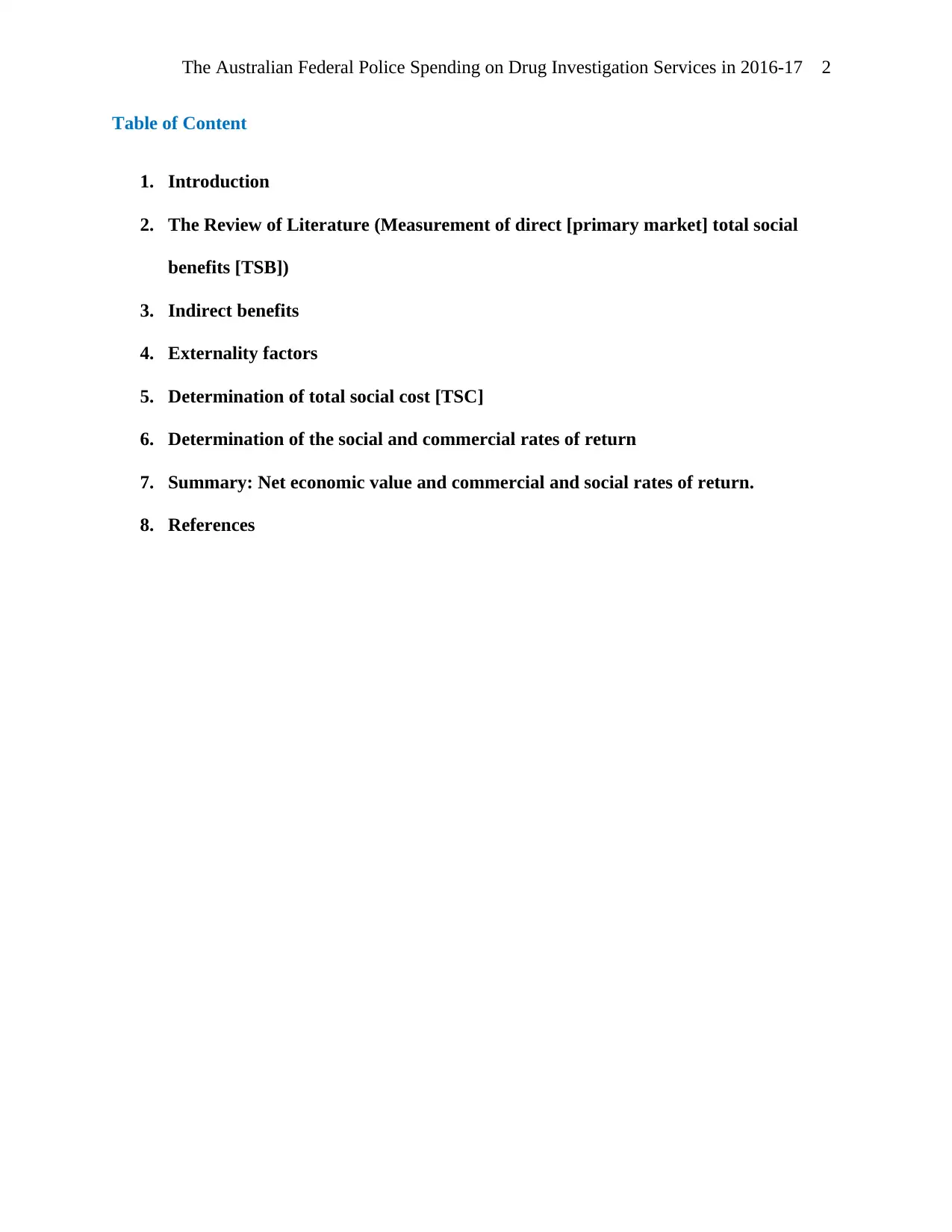
Table of Content
1. Introduction
2. The Review of Literature (Measurement of direct [primary market] total social
benefits [TSB])
3. Indirect benefits
4. Externality factors
5. Determination of total social cost [TSC]
6. Determination of the social and commercial rates of return
7. Summary: Net economic value and commercial and social rates of return.
8. References
Table of Content
1. Introduction
2. The Review of Literature (Measurement of direct [primary market] total social
benefits [TSB])
3. Indirect benefits
4. Externality factors
5. Determination of total social cost [TSC]
6. Determination of the social and commercial rates of return
7. Summary: Net economic value and commercial and social rates of return.
8. References
The Australian Federal Police Spending on Drug Investigation Services in 2016-17 3
Introduction
The world has changed within a very short time in terms of human affairs and morality,
the known dictates of the societal standards of life. Since the adoption of the Commonwealth
policing in Australia, years ago, there has been an increase in the use of technological data in lots
of human interactions. The social nature of humanity and human interactions have evolved
because of the interactions of the technology and data manipulations to influence the
globalization processes and much of what people can or cannot do. In the discussion of the social
and economic control in the world, the issues of policing department come to the picture. Thus,
in this context, the discussion revolves around the AAustralian Federal Police Spending on Drug
Investigation Services in 2016-17 based on the social CBA framework of estimating the
commercial and the social rate of return from the resources invested in the investigation of drugs
during the period.
Literature review Measurement of direct [primary market] total social benefits [TSB]
Based on the statement of McFadden & Toni-Lee porter (2011), it is prudent for the
Policing department of the Federal Australia have the responsibility of dealing with many old-
styled crime patterns that have changed with a progressively extensive perspective of new and
complex types of crime. The reason for this is that it would create a vibrant setting in which the
police department is distinctively in a position to perform their duty. Based on the reports form
the department, there is every reason to believe that the department has the capabilities and
personnel for local, national, and global operations especially on matters pertaining to
cyberspace, thus to protect the people of Australia as well as the interest of Australia from
criminal activities wherever they may arise (Stafford & Burns, 2010). The department is steadily
Introduction
The world has changed within a very short time in terms of human affairs and morality,
the known dictates of the societal standards of life. Since the adoption of the Commonwealth
policing in Australia, years ago, there has been an increase in the use of technological data in lots
of human interactions. The social nature of humanity and human interactions have evolved
because of the interactions of the technology and data manipulations to influence the
globalization processes and much of what people can or cannot do. In the discussion of the social
and economic control in the world, the issues of policing department come to the picture. Thus,
in this context, the discussion revolves around the AAustralian Federal Police Spending on Drug
Investigation Services in 2016-17 based on the social CBA framework of estimating the
commercial and the social rate of return from the resources invested in the investigation of drugs
during the period.
Literature review Measurement of direct [primary market] total social benefits [TSB]
Based on the statement of McFadden & Toni-Lee porter (2011), it is prudent for the
Policing department of the Federal Australia have the responsibility of dealing with many old-
styled crime patterns that have changed with a progressively extensive perspective of new and
complex types of crime. The reason for this is that it would create a vibrant setting in which the
police department is distinctively in a position to perform their duty. Based on the reports form
the department, there is every reason to believe that the department has the capabilities and
personnel for local, national, and global operations especially on matters pertaining to
cyberspace, thus to protect the people of Australia as well as the interest of Australia from
criminal activities wherever they may arise (Stafford & Burns, 2010). The department is steadily
⊘ This is a preview!⊘
Do you want full access?
Subscribe today to unlock all pages.

Trusted by 1+ million students worldwide
The Australian Federal Police Spending on Drug Investigation Services in 2016-17 4
focused on the policing operations and law enforcement capabilities by complementing them
with technological and specialized know-hows that have proven to be significant in increasingly
innovative environment. In this way, the old-fashioned systems are changing in the policing
agency of Australia with a focus of harnessing the building phase of the organizational
capability.
The commitment of the Australian policing department involves the commitment to
warrant that the department is in a position to sustain its goodwill in a better platform so that
people can trust in their abilities to meet the demands on us now and into the future. In the past
decade, there have been some snaps of achievements in this department, especially between the
brief periods of 2016 to 2017 (Beletsky, Macalino, & Burris, 2015). Some of the achievements
involve disruption and investigation, governance and accountability, community engagement,
internal collaboration, and national collaboration.
On the disruption nd investigation, it is important to realize that the department has
seized over 15 tons of illicit drugs and precursors; they have controlled more than an equivalence
of $93.3 million in criminal assets, and 955 court conviction rate (Miller, 2012). Based on their
activities, they have ensured that over $225 million benefits have been injected into the economy
from the successful financial crime investigations (Mugford, 2013). They have also made over
730 arrests from the crimes associated with the commonwealth and have charged over 27 people
for crimes related to terrorism investigations and 348 courts convictions.
Concerning the governance and accountability, the Australian police department have
strengthened staff engagement at all level of the management connecting the senior and the
front-line officers. The departments have also made strides in ensuring that the gender targets
focused on the policing operations and law enforcement capabilities by complementing them
with technological and specialized know-hows that have proven to be significant in increasingly
innovative environment. In this way, the old-fashioned systems are changing in the policing
agency of Australia with a focus of harnessing the building phase of the organizational
capability.
The commitment of the Australian policing department involves the commitment to
warrant that the department is in a position to sustain its goodwill in a better platform so that
people can trust in their abilities to meet the demands on us now and into the future. In the past
decade, there have been some snaps of achievements in this department, especially between the
brief periods of 2016 to 2017 (Beletsky, Macalino, & Burris, 2015). Some of the achievements
involve disruption and investigation, governance and accountability, community engagement,
internal collaboration, and national collaboration.
On the disruption nd investigation, it is important to realize that the department has
seized over 15 tons of illicit drugs and precursors; they have controlled more than an equivalence
of $93.3 million in criminal assets, and 955 court conviction rate (Miller, 2012). Based on their
activities, they have ensured that over $225 million benefits have been injected into the economy
from the successful financial crime investigations (Mugford, 2013). They have also made over
730 arrests from the crimes associated with the commonwealth and have charged over 27 people
for crimes related to terrorism investigations and 348 courts convictions.
Concerning the governance and accountability, the Australian police department have
strengthened staff engagement at all level of the management connecting the senior and the
front-line officers. The departments have also made strides in ensuring that the gender targets
Paraphrase This Document
Need a fresh take? Get an instant paraphrase of this document with our AI Paraphraser
The Australian Federal Police Spending on Drug Investigation Services in 2016-17 5
have exceeded in protective services of office recruitment plans (Weatherburn, Jones Freeman,
& Makkai, 2013). Surveys that are done also prove that over 80% of the public and the
stakeholders are satisfied with the service rendered by the Australian department in their
programs.
In the same way, concerning the community engagement, it is true that community
policing has become fundamental in the protective service that the department do (Moore &
Moore, 2008). Therefore, they have engaged the public using the various social media platforms
like the twitters and the Facebook to follow up with the trends of the community. Lastly on this
front, they have enhanced cyber safety among many primary and secondary schools in Australia.
The economic Value of the irrigation water consumed in Victoria in 2016
Irrigation water is normally a futuristic ordeal akin to averting the negative attributes of the
climatic changes in the face of a growing population. For purposes of healthy environment,
sometimes it is possible to include irrigation for a prosperous economy with growing agricultural
production in a thriving community. The economic value of the irrigation water consumed in
Victoria, especially in 2016 is the increased agricultural production.
The fluctuations in the quality of water and its reliability have diverse effects on the cost
of business. These fluctuations may be caused by man-made factors or natural ones. Based on
the analysis of Grafton, Horne, & Wheeler (2016), more than 40,000 of farms that have not been
irrigated in the Basin rely on the Basin's water resources for stock and domestic needs. In this
way, it is prudent to argue that the quality and the reliability of the water have a direct impact on
the profitability in the farms and thus, their quality of life of the farming families. However, in
have exceeded in protective services of office recruitment plans (Weatherburn, Jones Freeman,
& Makkai, 2013). Surveys that are done also prove that over 80% of the public and the
stakeholders are satisfied with the service rendered by the Australian department in their
programs.
In the same way, concerning the community engagement, it is true that community
policing has become fundamental in the protective service that the department do (Moore &
Moore, 2008). Therefore, they have engaged the public using the various social media platforms
like the twitters and the Facebook to follow up with the trends of the community. Lastly on this
front, they have enhanced cyber safety among many primary and secondary schools in Australia.
The economic Value of the irrigation water consumed in Victoria in 2016
Irrigation water is normally a futuristic ordeal akin to averting the negative attributes of the
climatic changes in the face of a growing population. For purposes of healthy environment,
sometimes it is possible to include irrigation for a prosperous economy with growing agricultural
production in a thriving community. The economic value of the irrigation water consumed in
Victoria, especially in 2016 is the increased agricultural production.
The fluctuations in the quality of water and its reliability have diverse effects on the cost
of business. These fluctuations may be caused by man-made factors or natural ones. Based on
the analysis of Grafton, Horne, & Wheeler (2016), more than 40,000 of farms that have not been
irrigated in the Basin rely on the Basin's water resources for stock and domestic needs. In this
way, it is prudent to argue that the quality and the reliability of the water have a direct impact on
the profitability in the farms and thus, their quality of life of the farming families. However, in
The Australian Federal Police Spending on Drug Investigation Services in 2016-17 6
the perspective multi farming, most farms meant for grazing reap benefits of the periodic
flooding because such events boost productivity on their floodplains, improving profitability.
The water for irrigation supports farmers in the Victorian community because it helps
them adjust to the drier future and ensure the farmers maximize their value of agricultural
production with the available water (Gill, Webb, Stott, Cheng, Wilkinson, & Cossens, 2017).
Thus, the economic value is identified within the spheres of maximized value of agricultural
production in comparison with the investment made for irrigation and water preservations.
The rates of irrigation return in the commercial and social perspective in Victoria in 2016
The agricultural practise in Victoria has a pivotal input to the Australia’s economy at
large. The land which is irrigated in Victoria alone is estimated to be $4.9 billion worth in 2014-
15 (ABS 2016). Out of this portion, the total agricultural production from irrigation alone is
about 33% in Australia. Based on the data given by Qureshi, Schwabe, Connor & Kirby (2010),
it was noted that the irrigation began in Victoria in the 19th century. As a result, there is an
increasing change in the infrastructure that needs to update its style to suit the contemporary
modes of irrigation. While many kilometres of channels and pipelines are used in the provision
of water to Victoria’s agriculture industries, this is a significant investment meant for our future.
As a result of this investment, there is an investment of $2.4 billion by Victorian government in
water arrangement schemes to update the systems of irrigation that would suit the modern
demand of water to extend the grid in expanding this comfort to the upcountry society. The
financial injection comes from the donations from the Victorian Government, Commonwealth
Government and Water Corporations (Grafton, Horne, & Wheeler, 2016). This means that the
the perspective multi farming, most farms meant for grazing reap benefits of the periodic
flooding because such events boost productivity on their floodplains, improving profitability.
The water for irrigation supports farmers in the Victorian community because it helps
them adjust to the drier future and ensure the farmers maximize their value of agricultural
production with the available water (Gill, Webb, Stott, Cheng, Wilkinson, & Cossens, 2017).
Thus, the economic value is identified within the spheres of maximized value of agricultural
production in comparison with the investment made for irrigation and water preservations.
The rates of irrigation return in the commercial and social perspective in Victoria in 2016
The agricultural practise in Victoria has a pivotal input to the Australia’s economy at
large. The land which is irrigated in Victoria alone is estimated to be $4.9 billion worth in 2014-
15 (ABS 2016). Out of this portion, the total agricultural production from irrigation alone is
about 33% in Australia. Based on the data given by Qureshi, Schwabe, Connor & Kirby (2010),
it was noted that the irrigation began in Victoria in the 19th century. As a result, there is an
increasing change in the infrastructure that needs to update its style to suit the contemporary
modes of irrigation. While many kilometres of channels and pipelines are used in the provision
of water to Victoria’s agriculture industries, this is a significant investment meant for our future.
As a result of this investment, there is an investment of $2.4 billion by Victorian government in
water arrangement schemes to update the systems of irrigation that would suit the modern
demand of water to extend the grid in expanding this comfort to the upcountry society. The
financial injection comes from the donations from the Victorian Government, Commonwealth
Government and Water Corporations (Grafton, Horne, & Wheeler, 2016). This means that the
⊘ This is a preview!⊘
Do you want full access?
Subscribe today to unlock all pages.
Trusted by 1+ million students worldwide
The Australian Federal Police Spending on Drug Investigation Services in 2016-17 7
society is already putting much of its hope in irrigation as a means for social and commercial
benefits.
In northern Victoria, of the total volume traded, about 40% was trades between accounts
held by environmental water holders. Excluding trades between environmental accounts, the
volume of allocation trade in 2016-17 was around 20% higher than the volume traded in 2015-
16. The high volume of trade was partly a result of large volumes of trade late in the season to
organize unused allocation for carryover into 2017-18.
The allocation available under water shares may be traded separately from the water
share and from land (Lai, Bruno, Hall, Gartner, Kirkbride, & Mueller, 2013). Allocation trade
includes trade of allocation made available under water shares and bulk entitlements. Allocation
made available under water shares may also be tagged for use in another location. This is another
way that water allocation can move between trading zones. However, water allocation in tagged
accounts retains its trading zone source characteristics until it is used in another location.
The Net economic value for the water consumed for industrial use in Victoria in 2016
The enhancements of the environmental conditions through irrigation have supported
local agribusinesses through the domestic use of irrigation water in Australia. This is in respect
to those who are ardent in their effort to advertise their products as a profound result from their
agricultural and water consumption efforts. A cost-benefit analysis approaches ‘have influences
through a different lens by examining total social benefits (TSB) and total social cost (TSC). The
assessment into the economic value of the water for industrial use in Victoria sometimes put a
total value on the ecosystem services that are being given by the resources of Basin water as well
society is already putting much of its hope in irrigation as a means for social and commercial
benefits.
In northern Victoria, of the total volume traded, about 40% was trades between accounts
held by environmental water holders. Excluding trades between environmental accounts, the
volume of allocation trade in 2016-17 was around 20% higher than the volume traded in 2015-
16. The high volume of trade was partly a result of large volumes of trade late in the season to
organize unused allocation for carryover into 2017-18.
The allocation available under water shares may be traded separately from the water
share and from land (Lai, Bruno, Hall, Gartner, Kirkbride, & Mueller, 2013). Allocation trade
includes trade of allocation made available under water shares and bulk entitlements. Allocation
made available under water shares may also be tagged for use in another location. This is another
way that water allocation can move between trading zones. However, water allocation in tagged
accounts retains its trading zone source characteristics until it is used in another location.
The Net economic value for the water consumed for industrial use in Victoria in 2016
The enhancements of the environmental conditions through irrigation have supported
local agribusinesses through the domestic use of irrigation water in Australia. This is in respect
to those who are ardent in their effort to advertise their products as a profound result from their
agricultural and water consumption efforts. A cost-benefit analysis approaches ‘have influences
through a different lens by examining total social benefits (TSB) and total social cost (TSC). The
assessment into the economic value of the water for industrial use in Victoria sometimes put a
total value on the ecosystem services that are being given by the resources of Basin water as well
Paraphrase This Document
Need a fresh take? Get an instant paraphrase of this document with our AI Paraphraser
The Australian Federal Police Spending on Drug Investigation Services in 2016-17 8
as to determine the degree to which extra water from the environment is provided by the Basin
Plan may have added to that significance. The recent studies done by MDBA found out that the
water resource from the Basin is vital in providing a substantial services of ecosystem that are
effective in water recovery that is required in supporting the capacity for sustainability in the
same manner. Below is a summary of the assumed economic value of the water consumed for
industrial use in Victoria in the year.
Industrial = -0.29
-0.29 = [-b]*[$7.50M/1,316PJ]; -b = 50.89.
Qd = a – bP
1,316 = a – 50.89(7.5); a = 1,698
Qd = 1,698 – 50.89P
There is need to estimate the impact the additional agricultural production have on price
TSB = TPB = (X2 – X1) 1/2(P1 + P2)
Considering P (Q) and P = 33 – 0.0197Qd, then P = 33 – 0.0197(1319.5) = 7M [initial
production = 1316 PJ + extra production 3.5 PJ]
Reduction in price = 7.5m – 7m = 0.5 million.
Using the formulae TPB = TSB = [3.5PJ]*0.5($7.5m + $7.37m) = $26.02 million. This is the
economic value of the increment of agricultural production.
as to determine the degree to which extra water from the environment is provided by the Basin
Plan may have added to that significance. The recent studies done by MDBA found out that the
water resource from the Basin is vital in providing a substantial services of ecosystem that are
effective in water recovery that is required in supporting the capacity for sustainability in the
same manner. Below is a summary of the assumed economic value of the water consumed for
industrial use in Victoria in the year.
Industrial = -0.29
-0.29 = [-b]*[$7.50M/1,316PJ]; -b = 50.89.
Qd = a – bP
1,316 = a – 50.89(7.5); a = 1,698
Qd = 1,698 – 50.89P
There is need to estimate the impact the additional agricultural production have on price
TSB = TPB = (X2 – X1) 1/2(P1 + P2)
Considering P (Q) and P = 33 – 0.0197Qd, then P = 33 – 0.0197(1319.5) = 7M [initial
production = 1316 PJ + extra production 3.5 PJ]
Reduction in price = 7.5m – 7m = 0.5 million.
Using the formulae TPB = TSB = [3.5PJ]*0.5($7.5m + $7.37m) = $26.02 million. This is the
economic value of the increment of agricultural production.
The Australian Federal Police Spending on Drug Investigation Services in 2016-17 9
The social economic benefit of water may at some surpass just irrigation, but extensive to
include drinking and other interventions that may be small scaled or large scaled. Based on the
study done by Carey, Krumholz, Duignan, McConell, Browne, Burns, & Lawrence, (2016), the
complexity of intervention may involves direct and indirect outcomes. The interventions may
also involve physical or socioeconomic systems. Under this perspectives, the economic
assessment of water and irrigation interventions cover changes in the agricultural and social
security through food production.
According to Coombes, Smit, Byrne & Walsh, (2016), sustainability is a keyword in
wider development thinking as well as in economic assessment. Sustainability involves explicit
consideration of long-term processes. Economic assessments clearly cannot be delayed
indefinitely to assess impact and sustainability. Hence, assessment frameworks need to be able to
incorporate long-term processes and the associated inevitable uncertainty (Grafton, Horne, &
Wheeler, 2016). Therefore, in the irrigation schemes in Victorian region, the focus framework of
the basic social cost–benefit analysis model builds on standard commercial, financial cost–
benefit analysis of irrigation.
According to McFadden & Toni-Lee porter (2011), concerning the first economic
principles, it known that the economist’s fundamental measure of social benefits is maximum
WTP, or willingness to accept compensation. Travellers do not have the legal right to demand
train travel, so the WTP is used to measure of benefits. In this case, the first step in assessing the
social value of the proposed transport is to calibrate a ‘market’ demand curve.
The basic question when assessing the socio-economic benefits involves determining
how the demand curves for transport measurement from one point to the other. Focusing on the
benefit to the society, it is to measure of marginal private benefits (MPB) to users of any
The social economic benefit of water may at some surpass just irrigation, but extensive to
include drinking and other interventions that may be small scaled or large scaled. Based on the
study done by Carey, Krumholz, Duignan, McConell, Browne, Burns, & Lawrence, (2016), the
complexity of intervention may involves direct and indirect outcomes. The interventions may
also involve physical or socioeconomic systems. Under this perspectives, the economic
assessment of water and irrigation interventions cover changes in the agricultural and social
security through food production.
According to Coombes, Smit, Byrne & Walsh, (2016), sustainability is a keyword in
wider development thinking as well as in economic assessment. Sustainability involves explicit
consideration of long-term processes. Economic assessments clearly cannot be delayed
indefinitely to assess impact and sustainability. Hence, assessment frameworks need to be able to
incorporate long-term processes and the associated inevitable uncertainty (Grafton, Horne, &
Wheeler, 2016). Therefore, in the irrigation schemes in Victorian region, the focus framework of
the basic social cost–benefit analysis model builds on standard commercial, financial cost–
benefit analysis of irrigation.
According to McFadden & Toni-Lee porter (2011), concerning the first economic
principles, it known that the economist’s fundamental measure of social benefits is maximum
WTP, or willingness to accept compensation. Travellers do not have the legal right to demand
train travel, so the WTP is used to measure of benefits. In this case, the first step in assessing the
social value of the proposed transport is to calibrate a ‘market’ demand curve.
The basic question when assessing the socio-economic benefits involves determining
how the demand curves for transport measurement from one point to the other. Focusing on the
benefit to the society, it is to measure of marginal private benefits (MPB) to users of any
⊘ This is a preview!⊘
Do you want full access?
Subscribe today to unlock all pages.
Trusted by 1+ million students worldwide
The Australian Federal Police Spending on Drug Investigation Services in 2016-17 10
proposed transport system and since these users are part of wider society, it also measures
marginal social benefits (MSB) of the transportation trip (Carey, Krumholz, Duignan, McConell,
Browne, Burns & Lawrence, 2016). Some of the social benefits of the project listed by the PTV
are better dealt with in an economic impact study rather than a consumer surplus measure for a
social cost-benefit analysis.
The following parameters are used in estimating TSB for 2016: (i) In 2016, 1800
passengers are using the line on an average weekday, which translates into 1800*5*50 (weeks) =
Q = 450,000 passengers a year; (ii) Ticket price = P = $25; (iii) Value of elasticity for transport
travel -0.35.
proposed transport system and since these users are part of wider society, it also measures
marginal social benefits (MSB) of the transportation trip (Carey, Krumholz, Duignan, McConell,
Browne, Burns & Lawrence, 2016). Some of the social benefits of the project listed by the PTV
are better dealt with in an economic impact study rather than a consumer surplus measure for a
social cost-benefit analysis.
The following parameters are used in estimating TSB for 2016: (i) In 2016, 1800
passengers are using the line on an average weekday, which translates into 1800*5*50 (weeks) =
Q = 450,000 passengers a year; (ii) Ticket price = P = $25; (iii) Value of elasticity for transport
travel -0.35.
Paraphrase This Document
Need a fresh take? Get an instant paraphrase of this document with our AI Paraphraser
The Australian Federal Police Spending on Drug Investigation Services in 2016-17 11
References
Attewell, R. G., & McFadden, M. (2008). Measuring the benefits of drug law enforcement: the
development of the Australian Federal Police Drug Harm Index. Bulletin on Narcotics, 60.
Beletsky, L., Macalino, G. E., & Burris, S. (2015). Attitudes of police officers towards syringe
access, occupational needle-sticks, and drug use: a qualitative study of one city police
department in the United States. International Journal of drug policy, 16(4), 267-274.
Bessant, J. (2008). From ‘harm minimization’to ‘zero tolerance’drugs policy in Australia: how
the Howard government changed its mind. Policy Studies, 29(2), 197-214.
Carey, R., Krumholz, F., Duignan, K., McConell, K., Browne, J. L., Burns, C., & Lawrence, M.
(2016). Integrating agriculture and food policy to achieve sustainable peri-urban fruit and
vegetable production in Victoria, Australia. Journal of Agriculture, Food Systems, and
Community Development, 1(3), 181-195.
Collins, D., & Lapsley, H. M. (2008). The costs of tobacco, alcohol and illicit drug abuse to
Australian society in 2004/05 (pp. 41-47). Canberra: Department of Health and Ageing.
Coombes, P. J., Smit, M., Byrne, J., & Walsh, C. J. (2016). Water resources, stormwater and
waterway benefits of water conservation measures for Australian capital cities. In Proceedings of
Conference: Stormwater2016, Stormwater Australia.
Cooper, H., Moore, L., Gruskin, S., & Krieger, N. (2005). The impact of a police drug
crackdown on drug injectors’ ability to practice harm reduction: a qualitative study. Social
science & medicine, 61(3), 673-684.
References
Attewell, R. G., & McFadden, M. (2008). Measuring the benefits of drug law enforcement: the
development of the Australian Federal Police Drug Harm Index. Bulletin on Narcotics, 60.
Beletsky, L., Macalino, G. E., & Burris, S. (2015). Attitudes of police officers towards syringe
access, occupational needle-sticks, and drug use: a qualitative study of one city police
department in the United States. International Journal of drug policy, 16(4), 267-274.
Bessant, J. (2008). From ‘harm minimization’to ‘zero tolerance’drugs policy in Australia: how
the Howard government changed its mind. Policy Studies, 29(2), 197-214.
Carey, R., Krumholz, F., Duignan, K., McConell, K., Browne, J. L., Burns, C., & Lawrence, M.
(2016). Integrating agriculture and food policy to achieve sustainable peri-urban fruit and
vegetable production in Victoria, Australia. Journal of Agriculture, Food Systems, and
Community Development, 1(3), 181-195.
Collins, D., & Lapsley, H. M. (2008). The costs of tobacco, alcohol and illicit drug abuse to
Australian society in 2004/05 (pp. 41-47). Canberra: Department of Health and Ageing.
Coombes, P. J., Smit, M., Byrne, J., & Walsh, C. J. (2016). Water resources, stormwater and
waterway benefits of water conservation measures for Australian capital cities. In Proceedings of
Conference: Stormwater2016, Stormwater Australia.
Cooper, H., Moore, L., Gruskin, S., & Krieger, N. (2005). The impact of a police drug
crackdown on drug injectors’ ability to practice harm reduction: a qualitative study. Social
science & medicine, 61(3), 673-684.
The Australian Federal Police Spending on Drug Investigation Services in 2016-17 12
Darke, S., Kaye, S., & Topp, L. (2002). Cocaine use in New South Wales, Australia, 1996–2000:
5 year monitoring of trends in price, purity, availability and use from the illicit drug reporting
system. Drug and Alcohol Dependence, 67(1), 81-88.
Dolan, K., Kimber, J., Fry, C., Fitzgerald, J., McDonald, D., & Trautmann, F. (2010). Drug
consumption facilities in Europe and the establishment of supervised injecting centres in
Australia. Drug and alcohol review, 19(3), 337-346.
Gill, B., Webb, J., Stott, K., Cheng, X., Wilkinson, R., & Cossens, B. (2017). Economic, social
and resource management factors influencing groundwater trade: Evidence from Victoria,
Australia. Journal of hydrology, 550, 253-267.
Grafton, R. Q., Horne, J., & Wheeler, S. A. (2016). On the marketisation of water: evidence from
the Murray-Darling Basin, Australia. Water Resources Management, 30(3), 913-926.
Lai, F. Y., Bruno, R., Hall, W., Gartner, C., Ort, C., Kirkbride, P., ... & Mueller, J. F. (2013).
Profiles of illicit drug use during annual key holiday and control periods in Australia: wastewater
analysis in an urban, a semi‐rural and a vacation area. Addiction, 108(3), 556-565.
Loxley, W., Toumbourou, J., Stockwell, T., Haines, B., Scott, K., Godfrey, C., ... & Marshall, J.
(2014). The prevention of substance use, risk and harm in Australia: a review of the evidence.
Commonwealth of Australia.
McFadden, M. & Toni-Lee porter (2011) Australian Federal Police drug investigations: benefit-
cost analysis. International Journal of Public sector Management 24(4). Pp. 368-78.
McFadden, M. (2006) The Australian Federal Police Drug Harm Index: A new methodology for
quantifying success in combating drug use. Australian Journal of Public Administration 65(4).
Pp. 68-81.
Darke, S., Kaye, S., & Topp, L. (2002). Cocaine use in New South Wales, Australia, 1996–2000:
5 year monitoring of trends in price, purity, availability and use from the illicit drug reporting
system. Drug and Alcohol Dependence, 67(1), 81-88.
Dolan, K., Kimber, J., Fry, C., Fitzgerald, J., McDonald, D., & Trautmann, F. (2010). Drug
consumption facilities in Europe and the establishment of supervised injecting centres in
Australia. Drug and alcohol review, 19(3), 337-346.
Gill, B., Webb, J., Stott, K., Cheng, X., Wilkinson, R., & Cossens, B. (2017). Economic, social
and resource management factors influencing groundwater trade: Evidence from Victoria,
Australia. Journal of hydrology, 550, 253-267.
Grafton, R. Q., Horne, J., & Wheeler, S. A. (2016). On the marketisation of water: evidence from
the Murray-Darling Basin, Australia. Water Resources Management, 30(3), 913-926.
Lai, F. Y., Bruno, R., Hall, W., Gartner, C., Ort, C., Kirkbride, P., ... & Mueller, J. F. (2013).
Profiles of illicit drug use during annual key holiday and control periods in Australia: wastewater
analysis in an urban, a semi‐rural and a vacation area. Addiction, 108(3), 556-565.
Loxley, W., Toumbourou, J., Stockwell, T., Haines, B., Scott, K., Godfrey, C., ... & Marshall, J.
(2014). The prevention of substance use, risk and harm in Australia: a review of the evidence.
Commonwealth of Australia.
McFadden, M. & Toni-Lee porter (2011) Australian Federal Police drug investigations: benefit-
cost analysis. International Journal of Public sector Management 24(4). Pp. 368-78.
McFadden, M. (2006) The Australian Federal Police Drug Harm Index: A new methodology for
quantifying success in combating drug use. Australian Journal of Public Administration 65(4).
Pp. 68-81.
⊘ This is a preview!⊘
Do you want full access?
Subscribe today to unlock all pages.
Trusted by 1+ million students worldwide

1 out of 13


Related Documents


Your All-in-One AI-Powered Toolkit for Academic Success.
+13062052269
info@desklib.com
Available 24*7 on WhatsApp / Email
![[object Object]](/_next/static/media/star-bottom.7253800d.svg)
Unlock your academic potential
Copyright © 2020–2026 A2Z Services. All Rights Reserved. Developed and managed by ZUCOL.