Comprehensive Risk Management Report: Aged Care Organization

Verified

Added on  2022/08/23

|5
|923
|17
Report
AI Summary
This report comprehensively examines risk management within aged care organizations. It begins by outlining the fundamental policies, procedures, and processes essential for effective risk mitigation, emphasizing the employer's responsibility for safety. The report then defines and explains the significance of 'risk context' and 'risk scope,' highlighting their crucial role in tailored risk management strategies. A PEST (Political, Economic, Social, and Technological) analysis is employed to identify potential risks within each of these areas relevant to the community sector, providing real-world examples. Furthermore, the report details the key considerations when establishing an organization's risk context, including the importance of stakeholder identification and external environment analysis. It also lists both internal and external stakeholders crucial for the risk management process. Finally, the report outlines practical approaches, tools, and methods, such as SWOT analysis, market environment analysis, and documentation reviews, to effectively carry out various risk management activities, ensuring the implementation of robust risk management strategies within aged care settings. The report leverages the provided assignment solution to present a well-structured and insightful analysis of risk management practices in aged care.
Document Page
Running head: RISK MANAGEMENT
Risk Management
Name of the Student:
Name of the University:
Author note:
tabler-icon-diamond-filled.svg

Paraphrase This Document

Need a fresh take? Get an instant paraphrase of this document with our AI Paraphraser
Document Page
1RISK MANAGEMENT
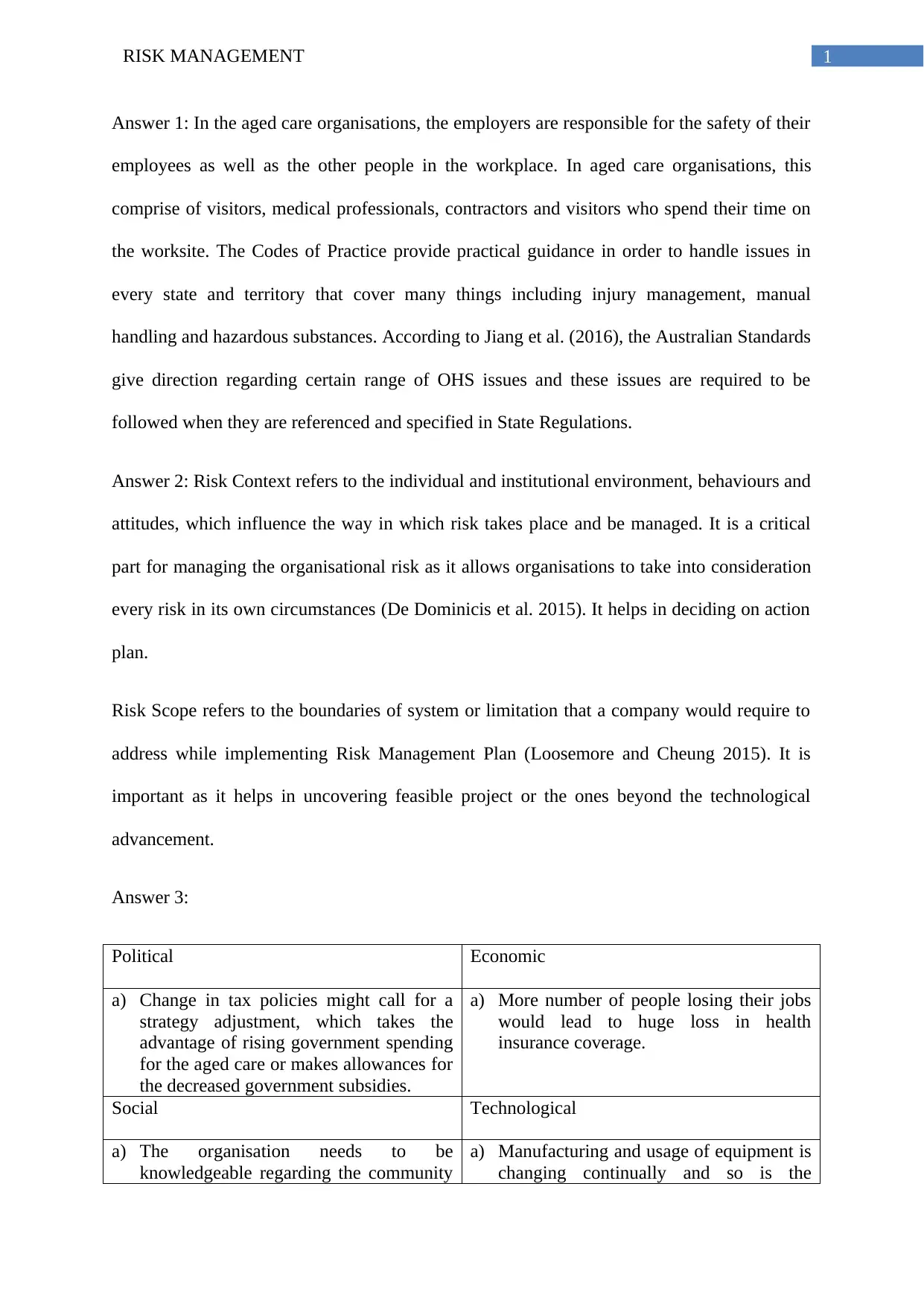
Answer 1: In the aged care organisations, the employers are responsible for the safety of their
employees as well as the other people in the workplace. In aged care organisations, this
comprise of visitors, medical professionals, contractors and visitors who spend their time on
the worksite. The Codes of Practice provide practical guidance in order to handle issues in
every state and territory that cover many things including injury management, manual
handling and hazardous substances. According to Jiang et al. (2016), the Australian Standards
give direction regarding certain range of OHS issues and these issues are required to be
followed when they are referenced and specified in State Regulations.
Answer 2: Risk Context refers to the individual and institutional environment, behaviours and
attitudes, which influence the way in which risk takes place and be managed. It is a critical
part for managing the organisational risk as it allows organisations to take into consideration
every risk in its own circumstances (De Dominicis et al. 2015). It helps in deciding on action
plan.
Risk Scope refers to the boundaries of system or limitation that a company would require to
address while implementing Risk Management Plan (Loosemore and Cheung 2015). It is
important as it helps in uncovering feasible project or the ones beyond the technological
advancement.
Answer 3:
Political Economic
a) Change in tax policies might call for a
strategy adjustment, which takes the
advantage of rising government spending
for the aged care or makes allowances for
the decreased government subsidies.
a) More number of people losing their jobs
would lead to huge loss in health
insurance coverage.
Social Technological
a) The organisation needs to be
knowledgeable regarding the community
a) Manufacturing and usage of equipment is
changing continually and so is the
Document Page
2RISK MANAGEMENT
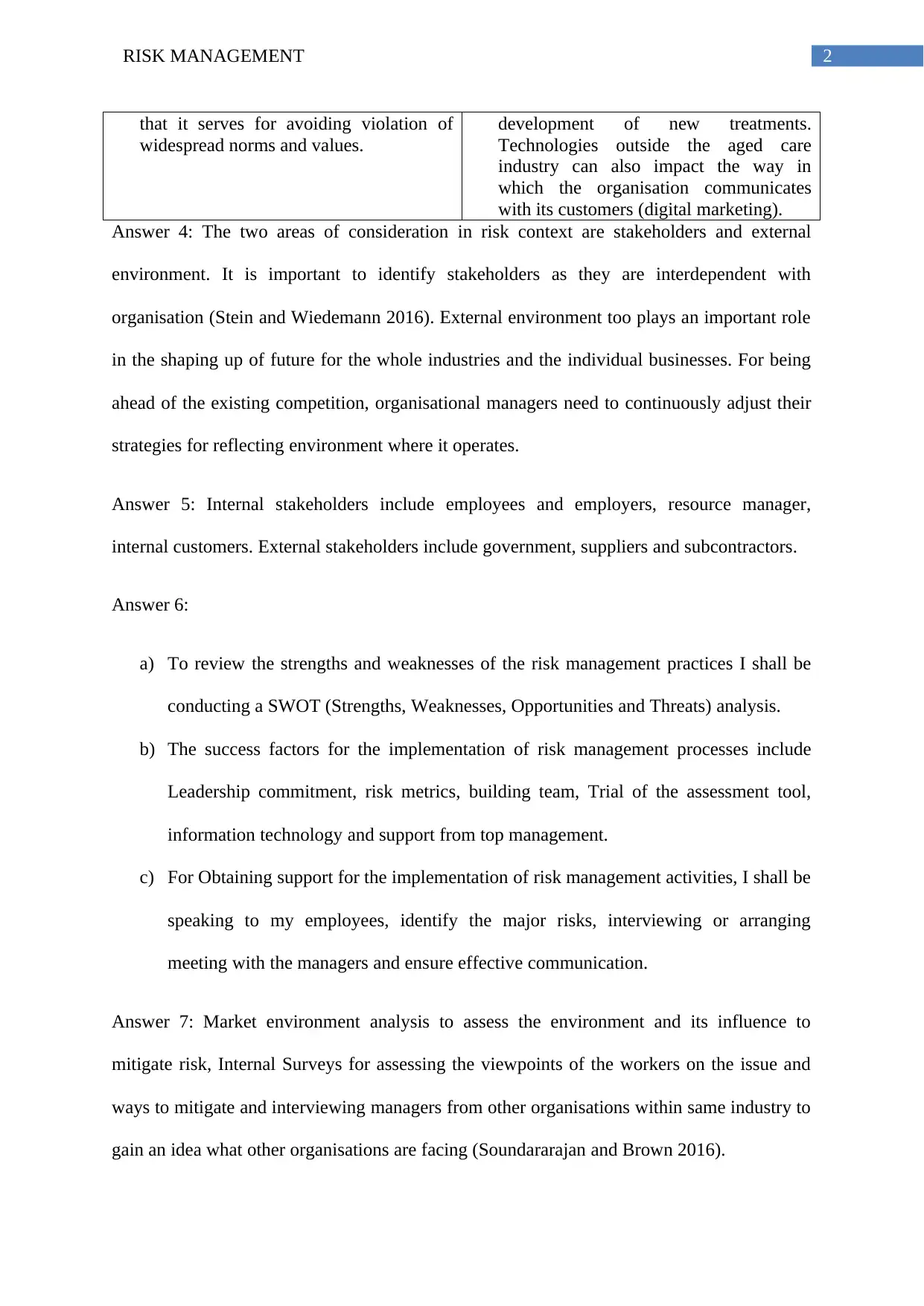
that it serves for avoiding violation of
widespread norms and values.
development of new treatments.
Technologies outside the aged care
industry can also impact the way in
which the organisation communicates
with its customers (digital marketing).
Answer 4: The two areas of consideration in risk context are stakeholders and external
environment. It is important to identify stakeholders as they are interdependent with
organisation (Stein and Wiedemann 2016). External environment too plays an important role
in the shaping up of future for the whole industries and the individual businesses. For being
ahead of the existing competition, organisational managers need to continuously adjust their
strategies for reflecting environment where it operates.
Answer 5: Internal stakeholders include employees and employers, resource manager,
internal customers. External stakeholders include government, suppliers and subcontractors.
Answer 6:
a) To review the strengths and weaknesses of the risk management practices I shall be
conducting a SWOT (Strengths, Weaknesses, Opportunities and Threats) analysis.
b) The success factors for the implementation of risk management processes include
Leadership commitment, risk metrics, building team, Trial of the assessment tool,
information technology and support from top management.
c) For Obtaining support for the implementation of risk management activities, I shall be
speaking to my employees, identify the major risks, interviewing or arranging
meeting with the managers and ensure effective communication.
Answer 7: Market environment analysis to assess the environment and its influence to
mitigate risk, Internal Surveys for assessing the viewpoints of the workers on the issue and
ways to mitigate and interviewing managers from other organisations within same industry to
gain an idea what other organisations are facing (Soundararajan and Brown 2016).
Document Page
3RISK MANAGEMENT
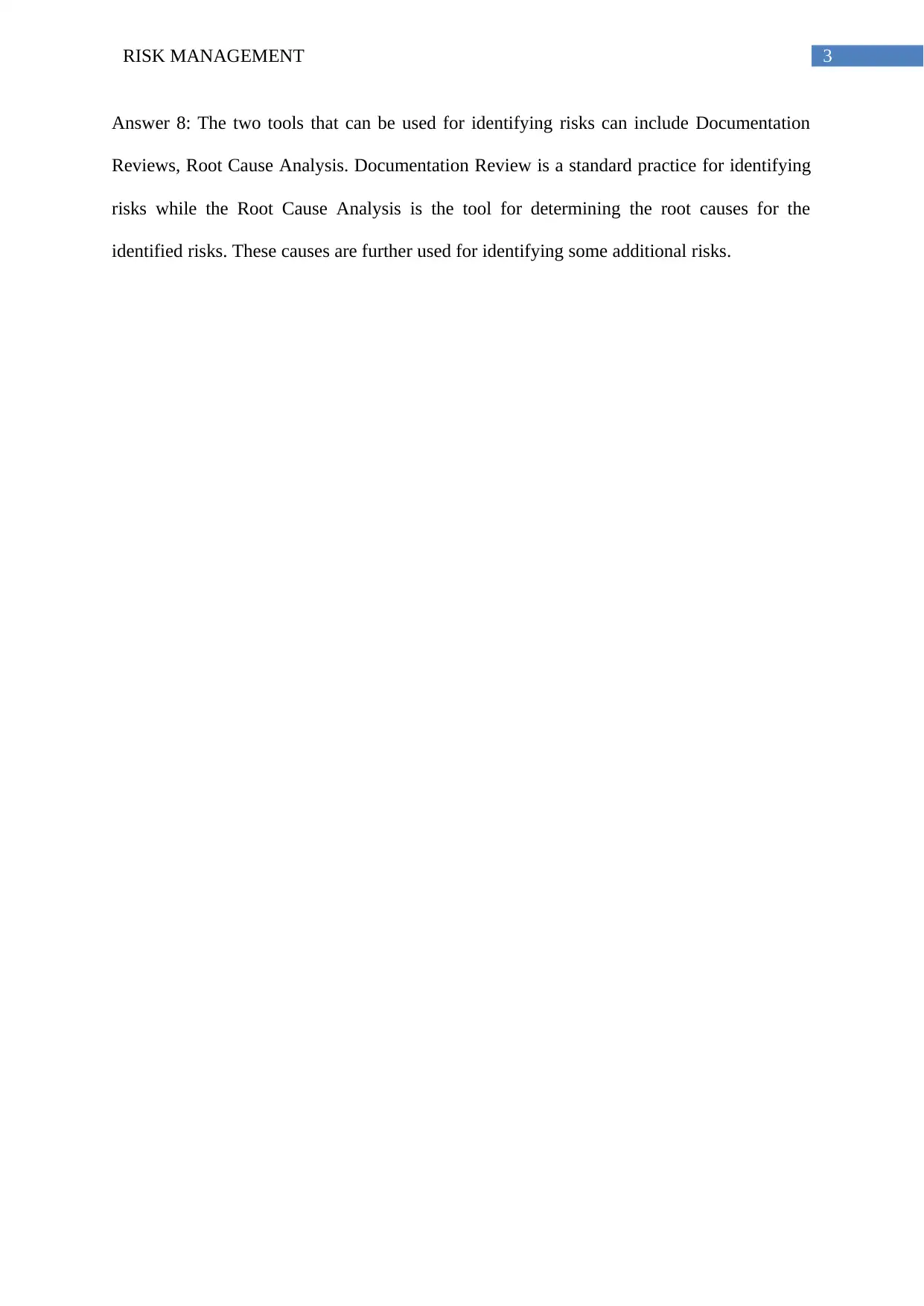
Answer 8: The two tools that can be used for identifying risks can include Documentation
Reviews, Root Cause Analysis. Documentation Review is a standard practice for identifying
risks while the Root Cause Analysis is the tool for determining the root causes for the
identified risks. These causes are further used for identifying some additional risks.
tabler-icon-diamond-filled.svg

Paraphrase This Document

Need a fresh take? Get an instant paraphrase of this document with our AI Paraphraser
Document Page
4RISK MANAGEMENT
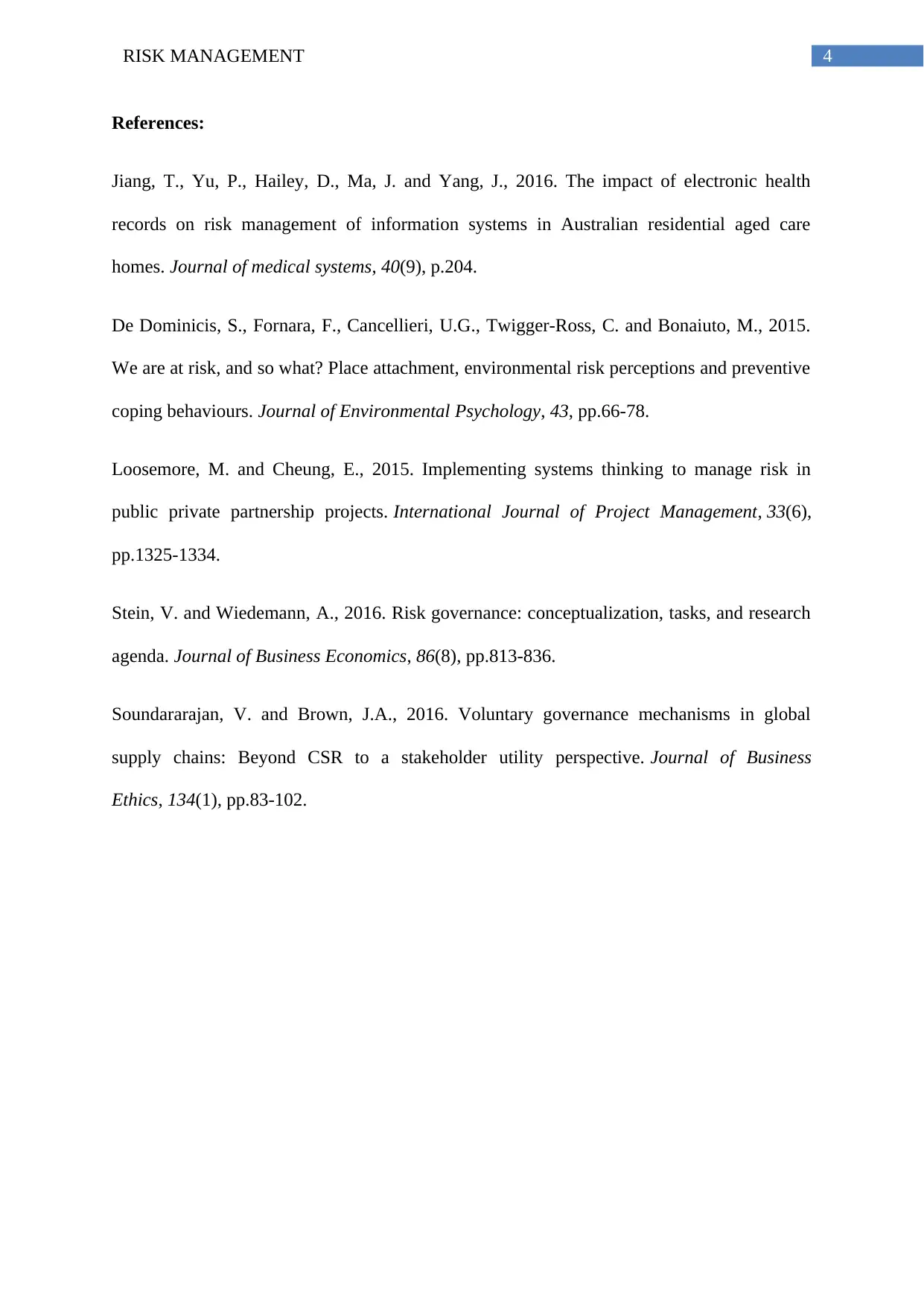
References:
Jiang, T., Yu, P., Hailey, D., Ma, J. and Yang, J., 2016. The impact of electronic health
records on risk management of information systems in Australian residential aged care
homes. Journal of medical systems, 40(9), p.204.
De Dominicis, S., Fornara, F., Cancellieri, U.G., Twigger-Ross, C. and Bonaiuto, M., 2015.
We are at risk, and so what? Place attachment, environmental risk perceptions and preventive
coping behaviours. Journal of Environmental Psychology, 43, pp.66-78.
Loosemore, M. and Cheung, E., 2015. Implementing systems thinking to manage risk in
public private partnership projects. International Journal of Project Management, 33(6),
pp.1325-1334.
Stein, V. and Wiedemann, A., 2016. Risk governance: conceptualization, tasks, and research
agenda. Journal of Business Economics, 86(8), pp.813-836.
Soundararajan, V. and Brown, J.A., 2016. Voluntary governance mechanisms in global
supply chains: Beyond CSR to a stakeholder utility perspective. Journal of Business
Ethics, 134(1), pp.83-102.
chevron_up_icon
1 out of 5
circle_padding
hide_on_mobile
zoom_out_icon
[object Object]