To Identify the Impact of Ageing in Health and Social Care Practices
VerifiedAdded on 2020/06/04
|22
|5581
|26
Report
AI Summary
This research project examines the impact of ageing and later life on health and social care practices. The report begins with an introduction that defines ageing and its physiological and behavioral changes, followed by a background study highlighting the increasing impact of ageing on individual needs and healthcare services. A literature review provides insights from various authors and organizations, discussing the effects of ageing, related health issues, and the role of healthcare services. The project sets aims and objectives to identify the influence of ageing on social and healthcare practices, evaluate its effects on individuals, analyze support provided by care workers, and identify the role of healthcare services in providing quality care. The research methodology outlines the research design, philosophy, type, approach, strategy, techniques, sampling, ethical considerations, and limitations. A Gantt chart is included to illustrate the project timeline. Resources and a questionnaire used for data collection are detailed. The report also includes data and relation variables, data collection methods, data analysis, conclusions, and recommendations, followed by a list of references. The questionnaire explores the impact of ageing, behavioral and physical changes, new needs, the aspects of social care services, and problems faced by individuals in later life. The project aims to provide a comprehensive understanding of the relationship between ageing and healthcare practices.
RESEARCH PROJECT
(To identify the Impact of Ageing and later life
in health and social care practices)
Contents
INTRODUCTION...........................................................................................................................1
(To identify the Impact of Ageing and later life
in health and social care practices)
Contents
INTRODUCTION...........................................................................................................................1

Paraphrase This Document
Need a fresh take? Get an instant paraphrase of this document with our AI Paraphraser
BACKGROUND.............................................................................................................................1
LITERATURE REVIEW................................................................................................................1
AIMS AND OBJECTIVES.............................................................................................................2
RESEARCH QUESTIONS.............................................................................................................3
RESEARCH METHODOLOGY.....................................................................................................3
Research Design.....................................................................................................................3
Research Philosophy..............................................................................................................4
Research Type........................................................................................................................4
Research Approach.................................................................................................................4
Research Strategy...................................................................................................................4
Research Techniques..............................................................................................................4
Sampling.................................................................................................................................5
Ethical consideration..............................................................................................................5
Limitations..............................................................................................................................5
GANTT CHART.............................................................................................................................5
RESOURCES..................................................................................................................................6
QUESTIONNAIRE.........................................................................................................................6
DATA AND RELATION VARIABLES........................................................................................8
DATA COLLECTION METHOD..................................................................................................8
DATA ANALYSIS..........................................................................................................................9
CONCLUSION AND RECOMMENDATION.............................................................................18
REFERENCES..............................................................................................................................19
LITERATURE REVIEW................................................................................................................1
AIMS AND OBJECTIVES.............................................................................................................2
RESEARCH QUESTIONS.............................................................................................................3
RESEARCH METHODOLOGY.....................................................................................................3
Research Design.....................................................................................................................3
Research Philosophy..............................................................................................................4
Research Type........................................................................................................................4
Research Approach.................................................................................................................4
Research Strategy...................................................................................................................4
Research Techniques..............................................................................................................4
Sampling.................................................................................................................................5
Ethical consideration..............................................................................................................5
Limitations..............................................................................................................................5
GANTT CHART.............................................................................................................................5
RESOURCES..................................................................................................................................6
QUESTIONNAIRE.........................................................................................................................6
DATA AND RELATION VARIABLES........................................................................................8
DATA COLLECTION METHOD..................................................................................................8
DATA ANALYSIS..........................................................................................................................9
CONCLUSION AND RECOMMENDATION.............................................................................18
REFERENCES..............................................................................................................................19
Title: To evaluate the Impact of Ageing and later life in health and social care practices in
delivering effective services to person.
INTRODUCTION
Ageing is process of getting older with time. In this process the human body goes through
many physiological as well as behavioural changes. The ageing develops new problem in person
later life. The later life of individual is identified through lower capability to respond to the
external environment and also towards various infections and disease. At this stage the
physiological function of body goes down (Matthews, F. E and et. al., 2013). In this report the
investigator studies about gaining and later life from various books and journal and also collects
primary data in order to evaluate the significant relationship between the services provided by
health care sector to the ageing person in his later life.
BACKGROUND
This can be evidenced from the background study of ageing that this is having larger impact
on the later life of individual. The ageing process also brings newer changes in the needs of an
individual related with health care services. The health and social care sector practices changes
as per the demand of the person going through different stages of ageing to live better and
independent life (Hawton and et. al., 2011). The background analysis of ageing process comes
up with the information that ageing leads to many behavioural changes and as well as individual
needs which largely influence the types of services delivered by care worker to person.
LITERATURE REVIEW
As per the views of Phelan, (2011) this can be concluded that Ageing is having significant
effect on the lives of individual in later life. Ageing is the process of becoming old with time
which goes through many physiological changes in the individual body as well huge changes in
the person mentality and behaviour. With the gaining the metabolic rate of person goes down and
this largely affects the normal functioning of body in later life. The body of individual become
more susceptible to the infections. So, the person needs proper care in order to live better life in
later period of living.
As stated by Adams, Leibbrandt and Moon, (2011) it can be evidenced that with ageing
person faces large numbers of problems and health issues. In later life individual losses its
1
delivering effective services to person.
INTRODUCTION
Ageing is process of getting older with time. In this process the human body goes through
many physiological as well as behavioural changes. The ageing develops new problem in person
later life. The later life of individual is identified through lower capability to respond to the
external environment and also towards various infections and disease. At this stage the
physiological function of body goes down (Matthews, F. E and et. al., 2013). In this report the
investigator studies about gaining and later life from various books and journal and also collects
primary data in order to evaluate the significant relationship between the services provided by
health care sector to the ageing person in his later life.
BACKGROUND
This can be evidenced from the background study of ageing that this is having larger impact
on the later life of individual. The ageing process also brings newer changes in the needs of an
individual related with health care services. The health and social care sector practices changes
as per the demand of the person going through different stages of ageing to live better and
independent life (Hawton and et. al., 2011). The background analysis of ageing process comes
up with the information that ageing leads to many behavioural changes and as well as individual
needs which largely influence the types of services delivered by care worker to person.
LITERATURE REVIEW
As per the views of Phelan, (2011) this can be concluded that Ageing is having significant
effect on the lives of individual in later life. Ageing is the process of becoming old with time
which goes through many physiological changes in the individual body as well huge changes in
the person mentality and behaviour. With the gaining the metabolic rate of person goes down and
this largely affects the normal functioning of body in later life. The body of individual become
more susceptible to the infections. So, the person needs proper care in order to live better life in
later period of living.
As stated by Adams, Leibbrandt and Moon, (2011) it can be evidenced that with ageing
person faces large numbers of problems and health issues. In later life individual losses its
1
⊘ This is a preview!⊘
Do you want full access?
Subscribe today to unlock all pages.

Trusted by 1+ million students worldwide
hearing capability and eyesight also become weak. The person suffers from many diseases in old
age as his immune system is not functions appropriately. The physiological activities and also
physical activities slows down with age and in later life faces problem in walking, standing and
handling heavy things accurately. So, the individual needs support from social care sector to live
better and quality life in last period of his live. The person develops higher problems in
breathing, problems related with bones and muscles, lower heart rate, stiffed blood vessels which
leads to many suffering which needs proper treatment to live better life with ageing.
This can be evidenced from the study of World Health Organization, (2015) that health
care services largely support the individual lives in their later lives. The person needs assistance
to carry out daily task appropriately. The social care services provide emotional support to the
old age person. Aged person in their later life feel loneliness, emptiness because their children
not gave proper time for their care. So, these people are emotionally weak and needs support
from health care workers. The social worker or caretaker also provides assistance to physical
activities of the person and also helps in better mental and psychic health of person in later life.
All these services provides mental, physical, emotional support to the ageing people in later time
period of lives to live better in their end life.
As stated by the Windle, (2012) this can be defined that health care services are having great
role in promoting better life to individual. The person suffering from illness is assisted by the
health acre professional to life healthy later life. The health and social care workers supports a
person in every step of development and ageing so that they can empower individual to live
independent life. The person learning new ways from care taker to carry put task more accurately
in later life. The care services provided by the health and social care sector also provides some
technological aids which helps in hearing and seeing things clearly, seeing properly and carry out
daily routine work more independently.
AIMS AND OBJECTIVES
Aims: To identify the impact of ageing and later life behavioural change on the social and
health care practices.
Objectives:
To evaluate the effect of ageing in the later life of an individual.
To identify various types of problems faced by individual in later life due to ageing.
2
age as his immune system is not functions appropriately. The physiological activities and also
physical activities slows down with age and in later life faces problem in walking, standing and
handling heavy things accurately. So, the individual needs support from social care sector to live
better and quality life in last period of his live. The person develops higher problems in
breathing, problems related with bones and muscles, lower heart rate, stiffed blood vessels which
leads to many suffering which needs proper treatment to live better life with ageing.
This can be evidenced from the study of World Health Organization, (2015) that health
care services largely support the individual lives in their later lives. The person needs assistance
to carry out daily task appropriately. The social care services provide emotional support to the
old age person. Aged person in their later life feel loneliness, emptiness because their children
not gave proper time for their care. So, these people are emotionally weak and needs support
from health care workers. The social worker or caretaker also provides assistance to physical
activities of the person and also helps in better mental and psychic health of person in later life.
All these services provides mental, physical, emotional support to the ageing people in later time
period of lives to live better in their end life.
As stated by the Windle, (2012) this can be defined that health care services are having great
role in promoting better life to individual. The person suffering from illness is assisted by the
health acre professional to life healthy later life. The health and social care workers supports a
person in every step of development and ageing so that they can empower individual to live
independent life. The person learning new ways from care taker to carry put task more accurately
in later life. The care services provided by the health and social care sector also provides some
technological aids which helps in hearing and seeing things clearly, seeing properly and carry out
daily routine work more independently.
AIMS AND OBJECTIVES
Aims: To identify the impact of ageing and later life behavioural change on the social and
health care practices.
Objectives:
To evaluate the effect of ageing in the later life of an individual.
To identify various types of problems faced by individual in later life due to ageing.
2
Paraphrase This Document
Need a fresh take? Get an instant paraphrase of this document with our AI Paraphraser
To analyse the level of support provided to individual by care workers in living
independent life in their later lives.
To identify the role of health care services in providing quality care to aged people to
spend their later life more effectively.
RESEARCH QUESTIONS
How does the ageing influence the lives of a person in living their later life?
What kind of problems can arises due to ageing in the individual behaviour and physical
health in his later life?
To what extent the health care services are supporting and encouraging the person lives in
living independent life after ageing in their later lives?
What are the different roles of health and social care sector in accomplishing their
responsibilities and delivering services and support to the person live better later life?
RESEARCH METHODOLOGY
Research methodology defines various tools and techniques used to carry out research
effectively and more accurately. The investigation uses various tools to carry out investigation in
efficient manner by developing blueprint of investigation (Alvesson and Sköldberg, 2017).
Research methodology is an outline sketch of all the activities which are to be followed by
investigator like Research design, philosophies, type, strategy, technique, ethical consideration
etc. to come up with accurate findings (Kitchin and Tate, 2013). The research methodology
followed by researcher in evaluating the influence of ageing on later life of individual and the
health care practices are as follows:
Research Design
The investigator can develop exploratory research design as well as the descriptive
research in order to carry out investigation related with the subject matter. The researcher is
developing descriptive research design in order to describe the subject matter in deep and come
up with appropriate findings (Taylor, Bogdan and DeVault, 2015). The exploratory research is
carried out tom find out new results for new research topic which is not earlier discuses or
carried out by the other finders.
3
independent life in their later lives.
To identify the role of health care services in providing quality care to aged people to
spend their later life more effectively.
RESEARCH QUESTIONS
How does the ageing influence the lives of a person in living their later life?
What kind of problems can arises due to ageing in the individual behaviour and physical
health in his later life?
To what extent the health care services are supporting and encouraging the person lives in
living independent life after ageing in their later lives?
What are the different roles of health and social care sector in accomplishing their
responsibilities and delivering services and support to the person live better later life?
RESEARCH METHODOLOGY
Research methodology defines various tools and techniques used to carry out research
effectively and more accurately. The investigation uses various tools to carry out investigation in
efficient manner by developing blueprint of investigation (Alvesson and Sköldberg, 2017).
Research methodology is an outline sketch of all the activities which are to be followed by
investigator like Research design, philosophies, type, strategy, technique, ethical consideration
etc. to come up with accurate findings (Kitchin and Tate, 2013). The research methodology
followed by researcher in evaluating the influence of ageing on later life of individual and the
health care practices are as follows:
Research Design
The investigator can develop exploratory research design as well as the descriptive
research in order to carry out investigation related with the subject matter. The researcher is
developing descriptive research design in order to describe the subject matter in deep and come
up with appropriate findings (Taylor, Bogdan and DeVault, 2015). The exploratory research is
carried out tom find out new results for new research topic which is not earlier discuses or
carried out by the other finders.
3
Research Philosophy
The investigator can use interpretevism research or positivism research in his activity
plan while conducting investigation (Liamputtong, 2013). The finder chooses to carry out
interpretevism research to interpret the collected data appropriately and come up with relevant
findings. While positivism research follow up a scientific approach to come up with new results
related with the topic.
Research Type
The investigator can carry out both qualitative research type and quantitative research
type depending upon the type of data collected. In this respective research project the finder is
developing qualitative research type in order to the facts related with the secondary information
collected relevant to subject matter (Gioia, Corley and Hamilton, 2013). While the person is
developing quantitative type of research for analysing the primary data collected from the
questionnaire survey to come up with accurate findings related with the matter of research
subject.
Research Approach
The investigator can find out deductive approach in order to carry out research
appropriately. The finder carries out deductive approach in order to extract important facts and
figures related with the subject matter (Silverman, 2016). The data related with this particular
subject matter is deducted from the different sources to come up with appropriate findings.
Research Strategy
The questionnaire can be efficient strategy for carrying out effective research as this will
helps in collected the responses of the different candidates who are participating in survey
(Smith, 2015). The questionnaire helps in collecting primary data for interpreting to accurate
findings.
Research Techniques
The researcher can develop thematic analysis by developing a specific theme or particular
responses of the participant as per the questions developed in questionnaire (Lakatos, 2014). This
can be useful in carrying out effective data analysis as per particular themes.
4
The investigator can use interpretevism research or positivism research in his activity
plan while conducting investigation (Liamputtong, 2013). The finder chooses to carry out
interpretevism research to interpret the collected data appropriately and come up with relevant
findings. While positivism research follow up a scientific approach to come up with new results
related with the topic.
Research Type
The investigator can carry out both qualitative research type and quantitative research
type depending upon the type of data collected. In this respective research project the finder is
developing qualitative research type in order to the facts related with the secondary information
collected relevant to subject matter (Gioia, Corley and Hamilton, 2013). While the person is
developing quantitative type of research for analysing the primary data collected from the
questionnaire survey to come up with accurate findings related with the matter of research
subject.
Research Approach
The investigator can find out deductive approach in order to carry out research
appropriately. The finder carries out deductive approach in order to extract important facts and
figures related with the subject matter (Silverman, 2016). The data related with this particular
subject matter is deducted from the different sources to come up with appropriate findings.
Research Strategy
The questionnaire can be efficient strategy for carrying out effective research as this will
helps in collected the responses of the different candidates who are participating in survey
(Smith, 2015). The questionnaire helps in collecting primary data for interpreting to accurate
findings.
Research Techniques
The researcher can develop thematic analysis by developing a specific theme or particular
responses of the participant as per the questions developed in questionnaire (Lakatos, 2014). This
can be useful in carrying out effective data analysis as per particular themes.
4
⊘ This is a preview!⊘
Do you want full access?
Subscribe today to unlock all pages.
Trusted by 1+ million students worldwide
Sampling
The sampling can be defined as selected sample through which responses are collected
from people (Neuman and Robson, 2014). This is the small numbers of candidates selected for
carrying out research out of complete population. In this particular research project sample size
of 20 people are selected.
Ethical consideration
The individual should act ethically while collecting data or asking some question to the
participants. The individual should take care of the people that while surveying sentiments of the
person are not hurt (Stanley, 2013). The person should be responsive while asking question to
people as these questions should not be personal or not be on controversial or religious issues to
carry out research ethically.
Limitations
One of the limitation of this research is the sample size collected is to sort.
Also the subject matter of investigation is having broader scope and needs more
discussion.
Another limitation to the research is time spend for the investigation is not sufficient as
per requirement.
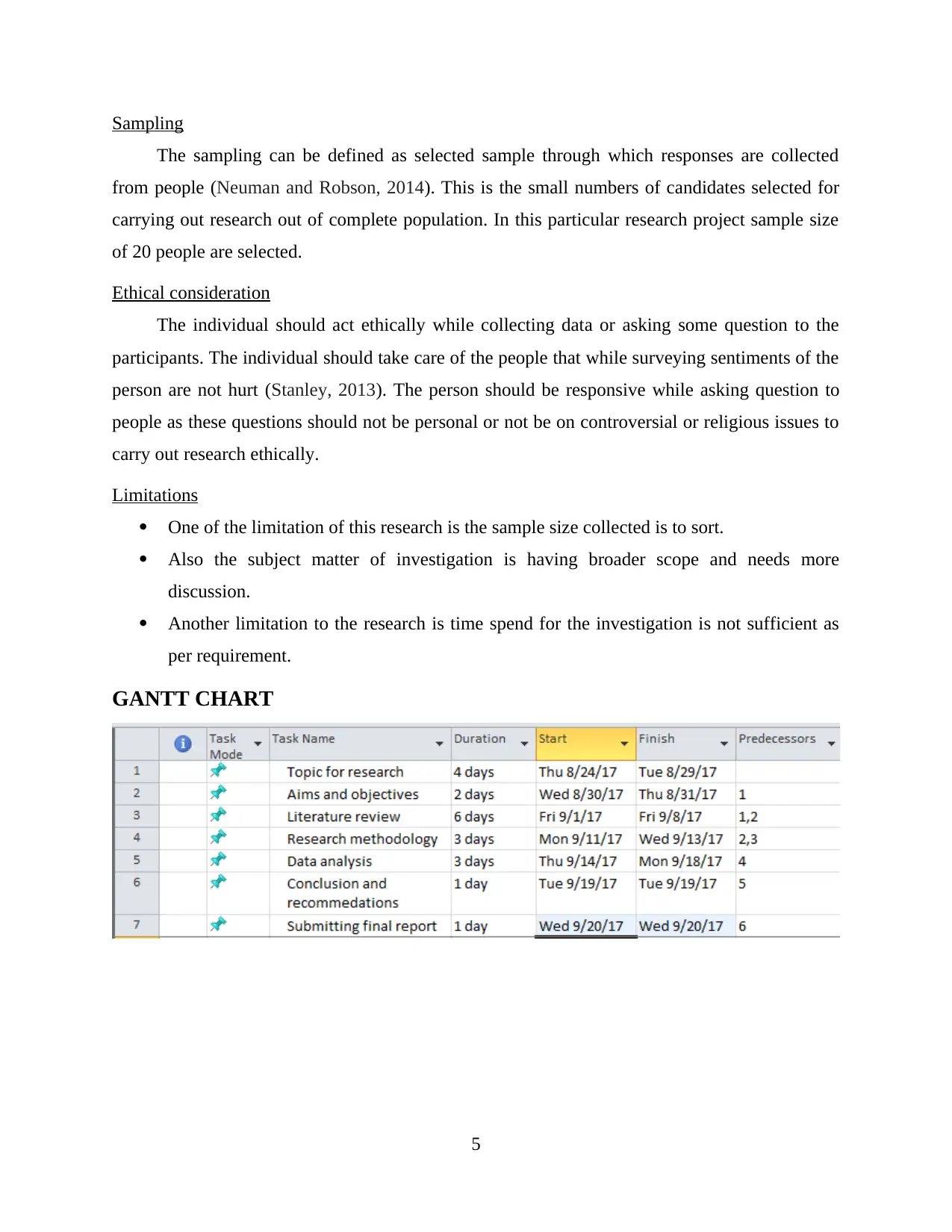
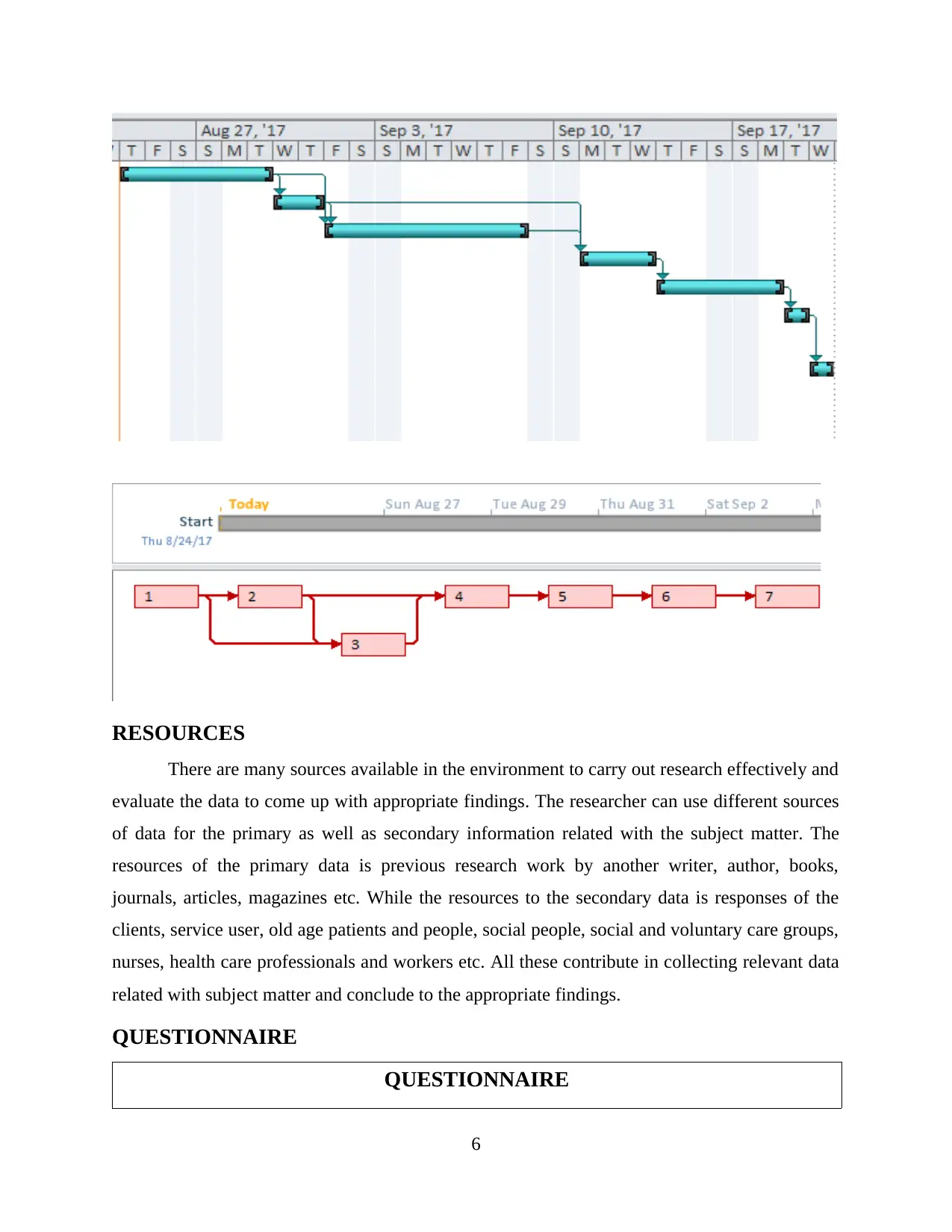
GANTT CHART
5
The sampling can be defined as selected sample through which responses are collected
from people (Neuman and Robson, 2014). This is the small numbers of candidates selected for
carrying out research out of complete population. In this particular research project sample size
of 20 people are selected.
Ethical consideration
The individual should act ethically while collecting data or asking some question to the
participants. The individual should take care of the people that while surveying sentiments of the
person are not hurt (Stanley, 2013). The person should be responsive while asking question to
people as these questions should not be personal or not be on controversial or religious issues to
carry out research ethically.
Limitations
One of the limitation of this research is the sample size collected is to sort.
Also the subject matter of investigation is having broader scope and needs more
discussion.
Another limitation to the research is time spend for the investigation is not sufficient as
per requirement.
GANTT CHART
5
Paraphrase This Document
Need a fresh take? Get an instant paraphrase of this document with our AI Paraphraser
RESOURCES
There are many sources available in the environment to carry out research effectively and
evaluate the data to come up with appropriate findings. The researcher can use different sources
of data for the primary as well as secondary information related with the subject matter. The
resources of the primary data is previous research work by another writer, author, books,
journals, articles, magazines etc. While the resources to the secondary data is responses of the
clients, service user, old age patients and people, social people, social and voluntary care groups,
nurses, health care professionals and workers etc. All these contribute in collecting relevant data
related with subject matter and conclude to the appropriate findings.
QUESTIONNAIRE
QUESTIONNAIRE
6
There are many sources available in the environment to carry out research effectively and
evaluate the data to come up with appropriate findings. The researcher can use different sources
of data for the primary as well as secondary information related with the subject matter. The
resources of the primary data is previous research work by another writer, author, books,
journals, articles, magazines etc. While the resources to the secondary data is responses of the
clients, service user, old age patients and people, social people, social and voluntary care groups,
nurses, health care professionals and workers etc. All these contribute in collecting relevant data
related with subject matter and conclude to the appropriate findings.
QUESTIONNAIRE
QUESTIONNAIRE
6
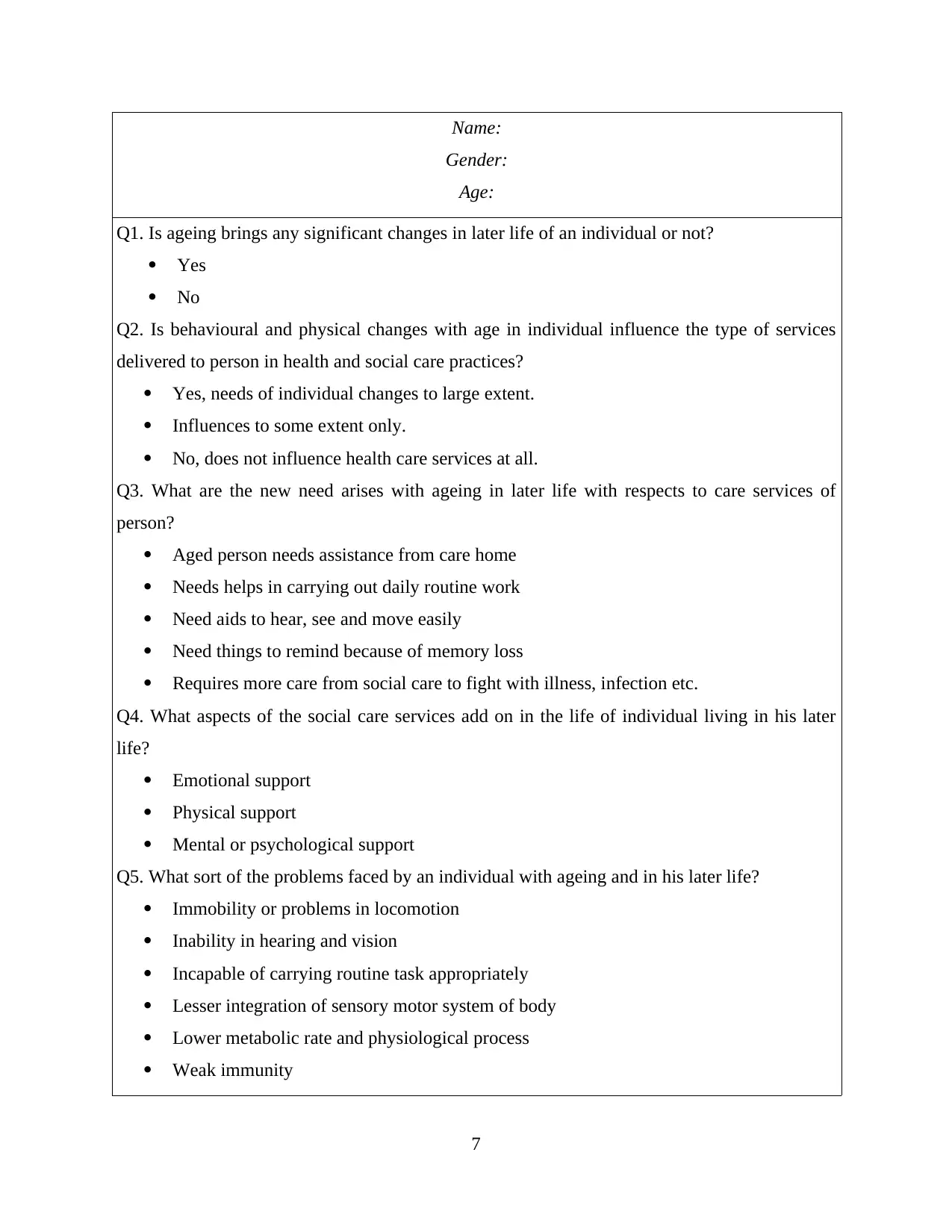
Name:
Gender:
Age:
Q1. Is ageing brings any significant changes in later life of an individual or not?
Yes
No
Q2. Is behavioural and physical changes with age in individual influence the type of services
delivered to person in health and social care practices?
Yes, needs of individual changes to large extent.
Influences to some extent only.
No, does not influence health care services at all.
Q3. What are the new need arises with ageing in later life with respects to care services of
person?
Aged person needs assistance from care home
Needs helps in carrying out daily routine work
Need aids to hear, see and move easily
Need things to remind because of memory loss
Requires more care from social care to fight with illness, infection etc.
Q4. What aspects of the social care services add on in the life of individual living in his later
life?
Emotional support
Physical support
Mental or psychological support
Q5. What sort of the problems faced by an individual with ageing and in his later life?
Immobility or problems in locomotion
Inability in hearing and vision
Incapable of carrying routine task appropriately
Lesser integration of sensory motor system of body
Lower metabolic rate and physiological process
Weak immunity
7
Gender:
Age:
Q1. Is ageing brings any significant changes in later life of an individual or not?
Yes
No
Q2. Is behavioural and physical changes with age in individual influence the type of services
delivered to person in health and social care practices?
Yes, needs of individual changes to large extent.
Influences to some extent only.
No, does not influence health care services at all.
Q3. What are the new need arises with ageing in later life with respects to care services of
person?
Aged person needs assistance from care home
Needs helps in carrying out daily routine work
Need aids to hear, see and move easily
Need things to remind because of memory loss
Requires more care from social care to fight with illness, infection etc.
Q4. What aspects of the social care services add on in the life of individual living in his later
life?
Emotional support
Physical support
Mental or psychological support
Q5. What sort of the problems faced by an individual with ageing and in his later life?
Immobility or problems in locomotion
Inability in hearing and vision
Incapable of carrying routine task appropriately
Lesser integration of sensory motor system of body
Lower metabolic rate and physiological process
Weak immunity
7
⊘ This is a preview!⊘
Do you want full access?
Subscribe today to unlock all pages.
Trusted by 1+ million students worldwide
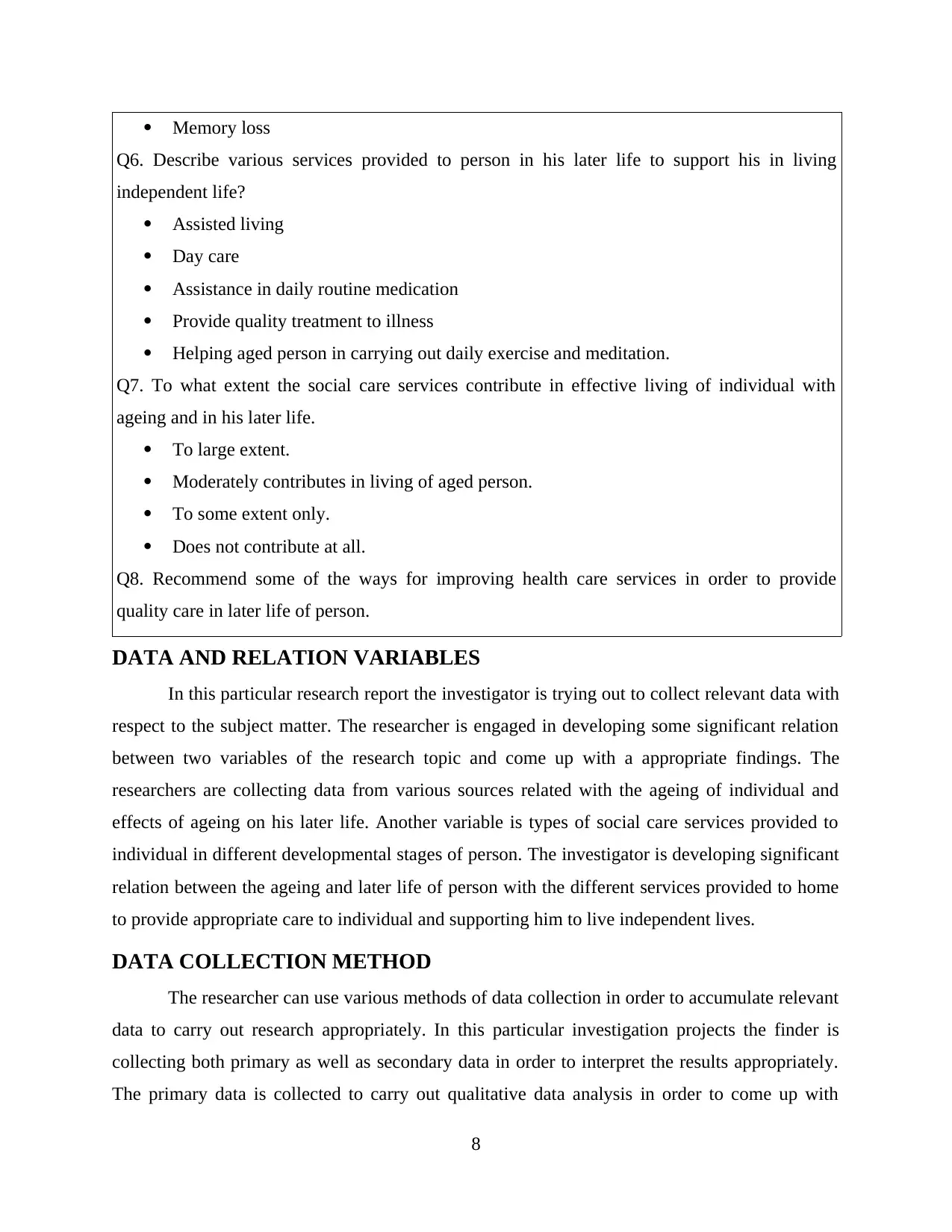
Memory loss
Q6. Describe various services provided to person in his later life to support his in living
independent life?
Assisted living
Day care
Assistance in daily routine medication
Provide quality treatment to illness
Helping aged person in carrying out daily exercise and meditation.
Q7. To what extent the social care services contribute in effective living of individual with
ageing and in his later life.
To large extent.
Moderately contributes in living of aged person.
To some extent only.
Does not contribute at all.
Q8. Recommend some of the ways for improving health care services in order to provide
quality care in later life of person.
DATA AND RELATION VARIABLES
In this particular research report the investigator is trying out to collect relevant data with
respect to the subject matter. The researcher is engaged in developing some significant relation
between two variables of the research topic and come up with a appropriate findings. The
researchers are collecting data from various sources related with the ageing of individual and
effects of ageing on his later life. Another variable is types of social care services provided to
individual in different developmental stages of person. The investigator is developing significant
relation between the ageing and later life of person with the different services provided to home
to provide appropriate care to individual and supporting him to live independent lives.
DATA COLLECTION METHOD
The researcher can use various methods of data collection in order to accumulate relevant
data to carry out research appropriately. In this particular investigation projects the finder is
collecting both primary as well as secondary data in order to interpret the results appropriately.
The primary data is collected to carry out qualitative data analysis in order to come up with
8
Q6. Describe various services provided to person in his later life to support his in living
independent life?
Assisted living
Day care
Assistance in daily routine medication
Provide quality treatment to illness
Helping aged person in carrying out daily exercise and meditation.
Q7. To what extent the social care services contribute in effective living of individual with
ageing and in his later life.
To large extent.
Moderately contributes in living of aged person.
To some extent only.
Does not contribute at all.
Q8. Recommend some of the ways for improving health care services in order to provide
quality care in later life of person.
DATA AND RELATION VARIABLES
In this particular research report the investigator is trying out to collect relevant data with
respect to the subject matter. The researcher is engaged in developing some significant relation
between two variables of the research topic and come up with a appropriate findings. The
researchers are collecting data from various sources related with the ageing of individual and
effects of ageing on his later life. Another variable is types of social care services provided to
individual in different developmental stages of person. The investigator is developing significant
relation between the ageing and later life of person with the different services provided to home
to provide appropriate care to individual and supporting him to live independent lives.
DATA COLLECTION METHOD
The researcher can use various methods of data collection in order to accumulate relevant
data to carry out research appropriately. In this particular investigation projects the finder is
collecting both primary as well as secondary data in order to interpret the results appropriately.
The primary data is collected to carry out qualitative data analysis in order to come up with
8
Paraphrase This Document
Need a fresh take? Get an instant paraphrase of this document with our AI Paraphraser
appropriate and relevant facts and figures related with ageing and the health care practices.
While the secondary data is collected from various sources like old age people, general
practitioner, society people, voluntary groups, social care groups, nurse, care taker etc. All the
information collected from these sources helps in evaluating the quantitative data accurately and
come up with right findings. The individual is using both close end question to get limited and
specific respond from participant and also open end recommendation question to collect other
people views and suggestion towards ageing and effect on later life of individual and the care
process provide by health and social care organisation to individual in supporting independent
life of person.
DATA ANALYSIS
This is the method through which individual or researcher interprets the collected data. In
this particular report the researcher is carrying out quantitative data analysis in order to develop
relevant figures related with the subject matter. The investigator is selected sample size of 20
people who appropriately in the survey related with the research topic of evaluating influence of
ageing ion later life of individual and with to the social and health care practices. The sample
involves participation of patient, old age people, country and social groups. Nurses, health care
workers, general practitioner, care taker etc. to come up with appropriate funding and results.
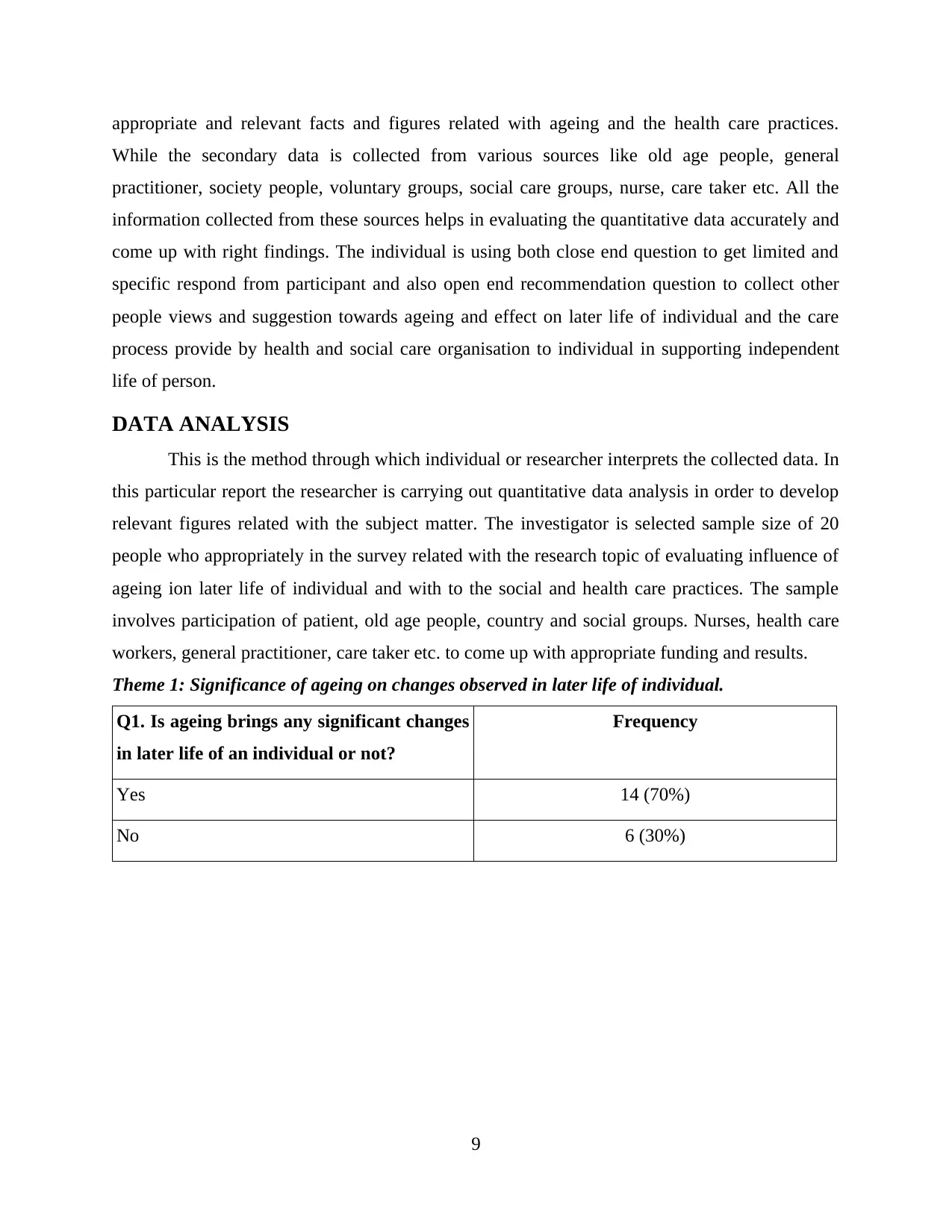
Theme 1: Significance of ageing on changes observed in later life of individual.
Q1. Is ageing brings any significant changes
in later life of an individual or not?
Frequency
Yes 14 (70%)
No 6 (30%)
9
While the secondary data is collected from various sources like old age people, general
practitioner, society people, voluntary groups, social care groups, nurse, care taker etc. All the
information collected from these sources helps in evaluating the quantitative data accurately and
come up with right findings. The individual is using both close end question to get limited and
specific respond from participant and also open end recommendation question to collect other
people views and suggestion towards ageing and effect on later life of individual and the care
process provide by health and social care organisation to individual in supporting independent
life of person.
DATA ANALYSIS
This is the method through which individual or researcher interprets the collected data. In
this particular report the researcher is carrying out quantitative data analysis in order to develop
relevant figures related with the subject matter. The investigator is selected sample size of 20
people who appropriately in the survey related with the research topic of evaluating influence of
ageing ion later life of individual and with to the social and health care practices. The sample
involves participation of patient, old age people, country and social groups. Nurses, health care
workers, general practitioner, care taker etc. to come up with appropriate funding and results.
Theme 1: Significance of ageing on changes observed in later life of individual.
Q1. Is ageing brings any significant changes
in later life of an individual or not?
Frequency
Yes 14 (70%)
No 6 (30%)
9
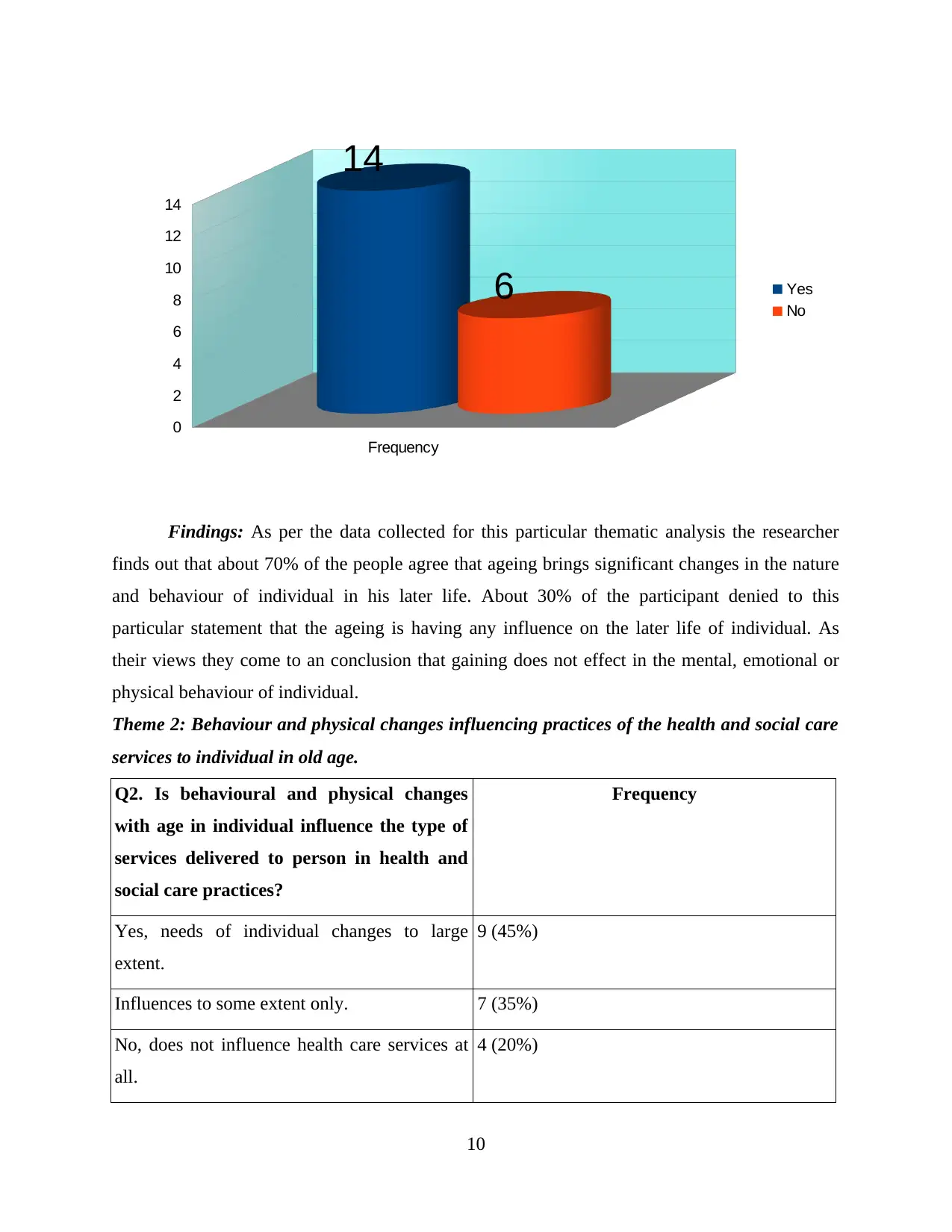
Findings: As per the data collected for this particular thematic analysis the researcher
finds out that about 70% of the people agree that ageing brings significant changes in the nature
and behaviour of individual in his later life. About 30% of the participant denied to this
particular statement that the ageing is having any influence on the later life of individual. As
their views they come to an conclusion that gaining does not effect in the mental, emotional or
physical behaviour of individual.
Theme 2: Behaviour and physical changes influencing practices of the health and social care
services to individual in old age.
Q2. Is behavioural and physical changes
with age in individual influence the type of
services delivered to person in health and
social care practices?
Frequency
Yes, needs of individual changes to large
extent.
9 (45%)
Influences to some extent only. 7 (35%)
No, does not influence health care services at
all.
4 (20%)
10
Frequency
0
2
4
6
8
10
12
14
14
6 Yes
No
finds out that about 70% of the people agree that ageing brings significant changes in the nature
and behaviour of individual in his later life. About 30% of the participant denied to this
particular statement that the ageing is having any influence on the later life of individual. As
their views they come to an conclusion that gaining does not effect in the mental, emotional or
physical behaviour of individual.
Theme 2: Behaviour and physical changes influencing practices of the health and social care
services to individual in old age.
Q2. Is behavioural and physical changes
with age in individual influence the type of
services delivered to person in health and
social care practices?
Frequency
Yes, needs of individual changes to large
extent.
9 (45%)
Influences to some extent only. 7 (35%)
No, does not influence health care services at
all.
4 (20%)
10
Frequency
0
2
4
6
8
10
12
14
14
6 Yes
No
⊘ This is a preview!⊘
Do you want full access?
Subscribe today to unlock all pages.
Trusted by 1+ million students worldwide

1 out of 22


Related Documents


Your All-in-One AI-Powered Toolkit for Academic Success.
+13062052269
info@desklib.com
Available 24*7 on WhatsApp / Email
![[object Object]](/_next/static/media/star-bottom.7253800d.svg)
Unlock your academic potential
Copyright © 2020–2026 A2Z Services. All Rights Reserved. Developed and managed by ZUCOL.