Commercial Law: Agency, Authority and Liability Analysis Report
VerifiedAdded on 2023/06/07
|9
|2481
|349
Report
AI Summary
This report analyzes key aspects of business law, specifically focusing on the law of agency and the different types of authority that can be granted to an agent. The report examines agency by necessity, implied authority, and the scope of an agent's actions in relation to the principal. It explores scenarios involving express authority, and implied authority through a series of case analyses, and then applies the legal principles to a case study involving a contract for the transportation of goods, the actions of a carrier, and the potential liability of the principal. It also reviews relevant case law, such as *Prager v. Blatspiel, Stamp and Heacock Ltd*, *Springer v Great Western Railway Company*, and *Watteau v Fenwick*, to illustrate the application of legal principles. The report concludes that while there was express authority, there was no agency of necessity created between the parties, and therefore the principal is liable.
Running head: BUSINESS LAW
Business law
Name of the Student
Name of the University
Author Note
Business law
Name of the Student
Name of the University
Author Note

Paraphrase This Document
Need a fresh take? Get an instant paraphrase of this document with our AI Paraphraser
1BUSINESS LAW
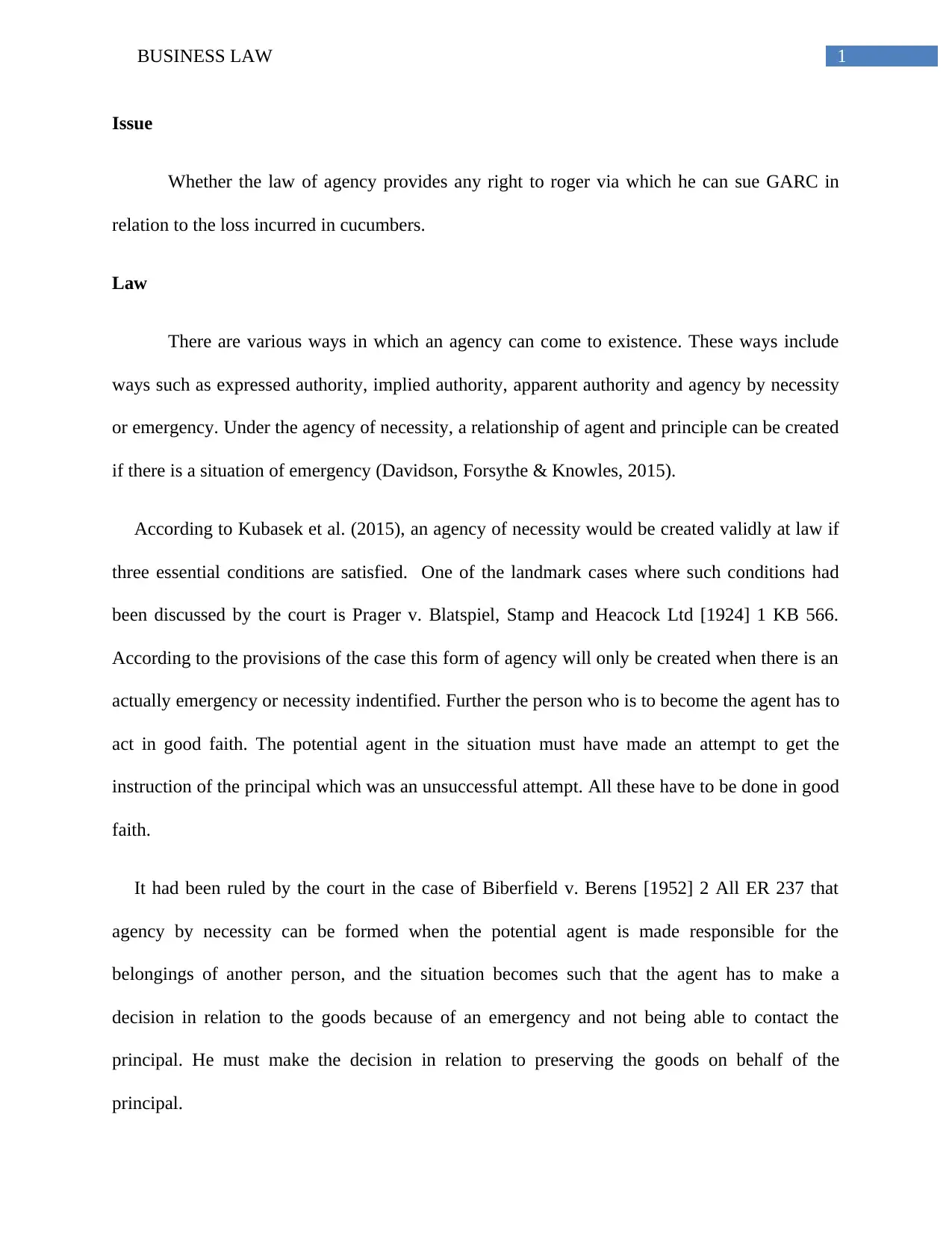
Issue
Whether the law of agency provides any right to roger via which he can sue GARC in
relation to the loss incurred in cucumbers.
Law
There are various ways in which an agency can come to existence. These ways include
ways such as expressed authority, implied authority, apparent authority and agency by necessity
or emergency. Under the agency of necessity, a relationship of agent and principle can be created
if there is a situation of emergency (Davidson, Forsythe & Knowles, 2015).
According to Kubasek et al. (2015), an agency of necessity would be created validly at law if
three essential conditions are satisfied. One of the landmark cases where such conditions had
been discussed by the court is Prager v. Blatspiel, Stamp and Heacock Ltd [1924] 1 KB 566.
According to the provisions of the case this form of agency will only be created when there is an
actually emergency or necessity indentified. Further the person who is to become the agent has to
act in good faith. The potential agent in the situation must have made an attempt to get the
instruction of the principal which was an unsuccessful attempt. All these have to be done in good
faith.
It had been ruled by the court in the case of Biberfield v. Berens [1952] 2 All ER 237 that
agency by necessity can be formed when the potential agent is made responsible for the
belongings of another person, and the situation becomes such that the agent has to make a
decision in relation to the goods because of an emergency and not being able to contact the
principal. He must make the decision in relation to preserving the goods on behalf of the
principal.
Issue
Whether the law of agency provides any right to roger via which he can sue GARC in
relation to the loss incurred in cucumbers.
Law
There are various ways in which an agency can come to existence. These ways include
ways such as expressed authority, implied authority, apparent authority and agency by necessity
or emergency. Under the agency of necessity, a relationship of agent and principle can be created
if there is a situation of emergency (Davidson, Forsythe & Knowles, 2015).
According to Kubasek et al. (2015), an agency of necessity would be created validly at law if
three essential conditions are satisfied. One of the landmark cases where such conditions had
been discussed by the court is Prager v. Blatspiel, Stamp and Heacock Ltd [1924] 1 KB 566.
According to the provisions of the case this form of agency will only be created when there is an
actually emergency or necessity indentified. Further the person who is to become the agent has to
act in good faith. The potential agent in the situation must have made an attempt to get the
instruction of the principal which was an unsuccessful attempt. All these have to be done in good
faith.
It had been ruled by the court in the case of Biberfield v. Berens [1952] 2 All ER 237 that
agency by necessity can be formed when the potential agent is made responsible for the
belongings of another person, and the situation becomes such that the agent has to make a
decision in relation to the goods because of an emergency and not being able to contact the
principal. He must make the decision in relation to preserving the goods on behalf of the
principal.
2BUSINESS LAW
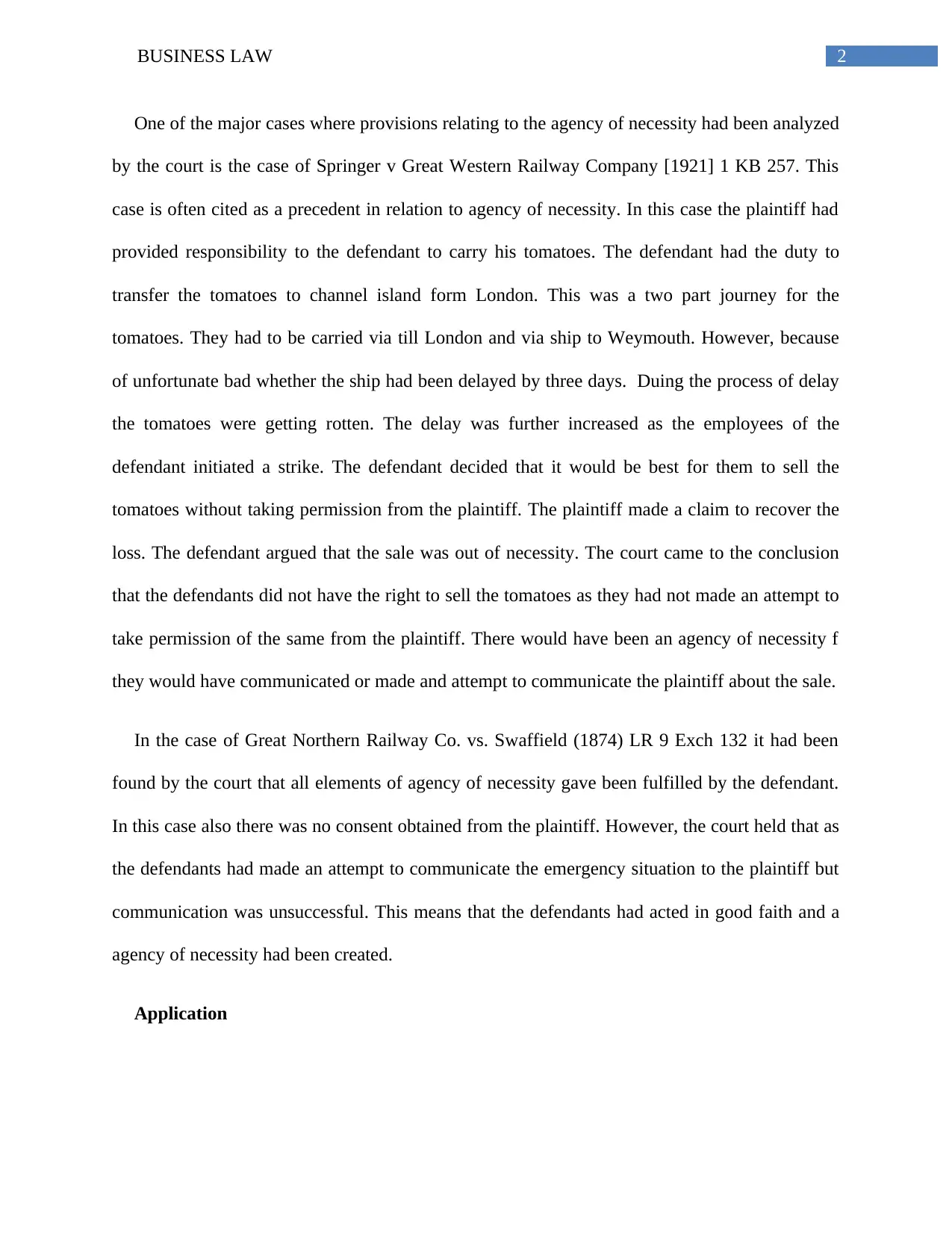
One of the major cases where provisions relating to the agency of necessity had been analyzed
by the court is the case of Springer v Great Western Railway Company [1921] 1 KB 257. This
case is often cited as a precedent in relation to agency of necessity. In this case the plaintiff had
provided responsibility to the defendant to carry his tomatoes. The defendant had the duty to
transfer the tomatoes to channel island form London. This was a two part journey for the
tomatoes. They had to be carried via till London and via ship to Weymouth. However, because
of unfortunate bad whether the ship had been delayed by three days. Duing the process of delay
the tomatoes were getting rotten. The delay was further increased as the employees of the
defendant initiated a strike. The defendant decided that it would be best for them to sell the
tomatoes without taking permission from the plaintiff. The plaintiff made a claim to recover the
loss. The defendant argued that the sale was out of necessity. The court came to the conclusion
that the defendants did not have the right to sell the tomatoes as they had not made an attempt to
take permission of the same from the plaintiff. There would have been an agency of necessity f
they would have communicated or made and attempt to communicate the plaintiff about the sale.
In the case of Great Northern Railway Co. vs. Swaffield (1874) LR 9 Exch 132 it had been
found by the court that all elements of agency of necessity gave been fulfilled by the defendant.
In this case also there was no consent obtained from the plaintiff. However, the court held that as
the defendants had made an attempt to communicate the emergency situation to the plaintiff but
communication was unsuccessful. This means that the defendants had acted in good faith and a
agency of necessity had been created.
Application
One of the major cases where provisions relating to the agency of necessity had been analyzed
by the court is the case of Springer v Great Western Railway Company [1921] 1 KB 257. This
case is often cited as a precedent in relation to agency of necessity. In this case the plaintiff had
provided responsibility to the defendant to carry his tomatoes. The defendant had the duty to
transfer the tomatoes to channel island form London. This was a two part journey for the
tomatoes. They had to be carried via till London and via ship to Weymouth. However, because
of unfortunate bad whether the ship had been delayed by three days. Duing the process of delay
the tomatoes were getting rotten. The delay was further increased as the employees of the
defendant initiated a strike. The defendant decided that it would be best for them to sell the
tomatoes without taking permission from the plaintiff. The plaintiff made a claim to recover the
loss. The defendant argued that the sale was out of necessity. The court came to the conclusion
that the defendants did not have the right to sell the tomatoes as they had not made an attempt to
take permission of the same from the plaintiff. There would have been an agency of necessity f
they would have communicated or made and attempt to communicate the plaintiff about the sale.
In the case of Great Northern Railway Co. vs. Swaffield (1874) LR 9 Exch 132 it had been
found by the court that all elements of agency of necessity gave been fulfilled by the defendant.
In this case also there was no consent obtained from the plaintiff. However, the court held that as
the defendants had made an attempt to communicate the emergency situation to the plaintiff but
communication was unsuccessful. This means that the defendants had acted in good faith and a
agency of necessity had been created.
Application
⊘ This is a preview!⊘
Do you want full access?
Subscribe today to unlock all pages.

Trusted by 1+ million students worldwide
3BUSINESS LAW
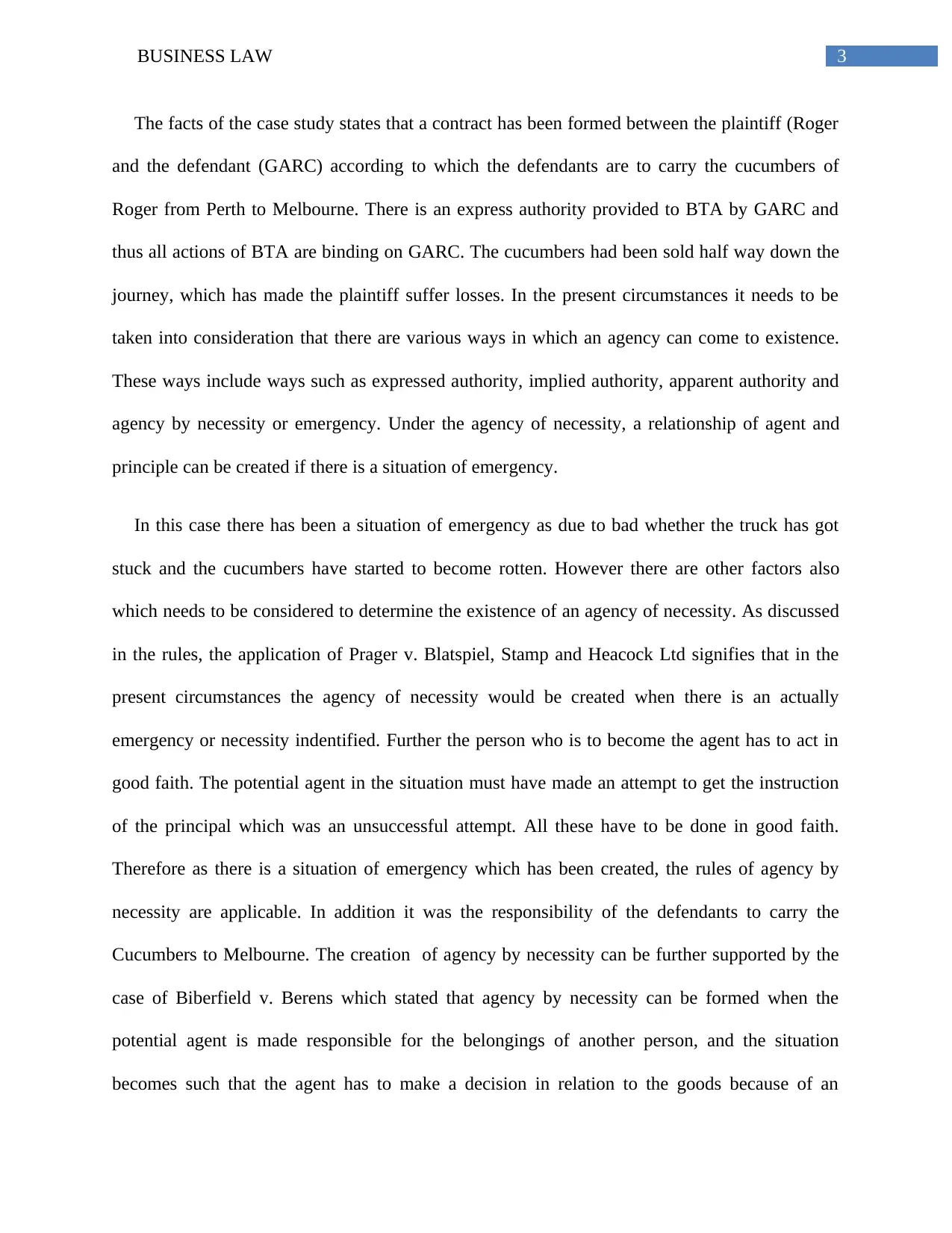
The facts of the case study states that a contract has been formed between the plaintiff (Roger
and the defendant (GARC) according to which the defendants are to carry the cucumbers of
Roger from Perth to Melbourne. There is an express authority provided to BTA by GARC and
thus all actions of BTA are binding on GARC. The cucumbers had been sold half way down the
journey, which has made the plaintiff suffer losses. In the present circumstances it needs to be
taken into consideration that there are various ways in which an agency can come to existence.
These ways include ways such as expressed authority, implied authority, apparent authority and
agency by necessity or emergency. Under the agency of necessity, a relationship of agent and
principle can be created if there is a situation of emergency.
In this case there has been a situation of emergency as due to bad whether the truck has got
stuck and the cucumbers have started to become rotten. However there are other factors also
which needs to be considered to determine the existence of an agency of necessity. As discussed
in the rules, the application of Prager v. Blatspiel, Stamp and Heacock Ltd signifies that in the
present circumstances the agency of necessity would be created when there is an actually
emergency or necessity indentified. Further the person who is to become the agent has to act in
good faith. The potential agent in the situation must have made an attempt to get the instruction
of the principal which was an unsuccessful attempt. All these have to be done in good faith.
Therefore as there is a situation of emergency which has been created, the rules of agency by
necessity are applicable. In addition it was the responsibility of the defendants to carry the
Cucumbers to Melbourne. The creation of agency by necessity can be further supported by the
case of Biberfield v. Berens which stated that agency by necessity can be formed when the
potential agent is made responsible for the belongings of another person, and the situation
becomes such that the agent has to make a decision in relation to the goods because of an
The facts of the case study states that a contract has been formed between the plaintiff (Roger
and the defendant (GARC) according to which the defendants are to carry the cucumbers of
Roger from Perth to Melbourne. There is an express authority provided to BTA by GARC and
thus all actions of BTA are binding on GARC. The cucumbers had been sold half way down the
journey, which has made the plaintiff suffer losses. In the present circumstances it needs to be
taken into consideration that there are various ways in which an agency can come to existence.
These ways include ways such as expressed authority, implied authority, apparent authority and
agency by necessity or emergency. Under the agency of necessity, a relationship of agent and
principle can be created if there is a situation of emergency.
In this case there has been a situation of emergency as due to bad whether the truck has got
stuck and the cucumbers have started to become rotten. However there are other factors also
which needs to be considered to determine the existence of an agency of necessity. As discussed
in the rules, the application of Prager v. Blatspiel, Stamp and Heacock Ltd signifies that in the
present circumstances the agency of necessity would be created when there is an actually
emergency or necessity indentified. Further the person who is to become the agent has to act in
good faith. The potential agent in the situation must have made an attempt to get the instruction
of the principal which was an unsuccessful attempt. All these have to be done in good faith.
Therefore as there is a situation of emergency which has been created, the rules of agency by
necessity are applicable. In addition it was the responsibility of the defendants to carry the
Cucumbers to Melbourne. The creation of agency by necessity can be further supported by the
case of Biberfield v. Berens which stated that agency by necessity can be formed when the
potential agent is made responsible for the belongings of another person, and the situation
becomes such that the agent has to make a decision in relation to the goods because of an
Paraphrase This Document
Need a fresh take? Get an instant paraphrase of this document with our AI Paraphraser
4BUSINESS LAW
emergency and not being able to contact the principal. He must make the decision in relation to
preserving the goods on behalf of the principal.
However, the case of Springer v Great Western Railway Company does not support the claim
that an agency of necessity has been created. This is because nowhere in the facts has it been
stated that the defendants had made an attempt to contact the plaintiff to take his consent in
relation to selling the tomatoes. As there has been no attempt or actual consent taken from the
plaintiff the court will hold that there is no agency of necessity which has been created between
Roger and the defendant. The facts of this case are very similar to the case in hand and thus this
would likely to be the precedent case in this situation.
In addition the assertion that there is no agency of necessity between the defendant and the
plaintiff can be supported by the application of the case of Great Northern Railway Co. vs.
Swaffield. This is because in this case the court only found that the agency had been created
because as the defendants had made an attempt to communicate the emergency situation to the
plaintiff but communication was unsuccessful. This means that the defendants had acted in good
faith and a agency of necessity had been created. However, such situation did not take place in
the present case. Therefore there is no agency of necessity.
Conclusion
By express authority agency has been provided by GARC to BTA. However there is no
agency of necessity created between Roger and GARC and therefore Roger can make a claim
against GARC for the actions of BTA.
Answer 2
emergency and not being able to contact the principal. He must make the decision in relation to
preserving the goods on behalf of the principal.
However, the case of Springer v Great Western Railway Company does not support the claim
that an agency of necessity has been created. This is because nowhere in the facts has it been
stated that the defendants had made an attempt to contact the plaintiff to take his consent in
relation to selling the tomatoes. As there has been no attempt or actual consent taken from the
plaintiff the court will hold that there is no agency of necessity which has been created between
Roger and the defendant. The facts of this case are very similar to the case in hand and thus this
would likely to be the precedent case in this situation.
In addition the assertion that there is no agency of necessity between the defendant and the
plaintiff can be supported by the application of the case of Great Northern Railway Co. vs.
Swaffield. This is because in this case the court only found that the agency had been created
because as the defendants had made an attempt to communicate the emergency situation to the
plaintiff but communication was unsuccessful. This means that the defendants had acted in good
faith and a agency of necessity had been created. However, such situation did not take place in
the present case. Therefore there is no agency of necessity.
Conclusion
By express authority agency has been provided by GARC to BTA. However there is no
agency of necessity created between Roger and GARC and therefore Roger can make a claim
against GARC for the actions of BTA.
Answer 2
5BUSINESS LAW
There are various ways in which an agency can come to existence. These ways include
ways such as expressed authority, implied authority, apparent authority and agency by necessity
or emergency. Under the agency of necessity, a relationship of agent and principle can be created
if there is a situation of emergency (Davidson, Forsythe & Knowles, 2015). This section of the
paper discussed how implied authority can extend actual authority in relation to law of agency.
The discussion has been carried out in the light of Australian case laws with respect to implied
authority.
Implied authority just like the agency of necessity is not provided or given, it is created
trough the principles of law. According to Clarkson, Miller and Cross (2014), implied authority
take place when a person has been provided with express role as an agent and does an act which
falls within the scope of such role even of the act had not been expressly authorized.
In the case of Brick and Pipe Industries Ltd v Occidental Life Nominees Pty Ltd (1992)
10 ACLC 253, it had been stated by ten court that implied authority may be provided to an agent.
This rises mist frequently when a particular position is provided to the agent by the principal. In
this case the court stated that a director has an authority to act in an implied manner as he had
been provided with a controlling shareholding and there was no attempt of any interference with
respect to the assertion. In addition as per the case of Hely Hutchinson v Brayhead Ltd (1968) 1
QB 549 a person who has been provided the role of managing a business has an implied
authority of getting into all contracts which can be done by a manager is such position (Glover &
Doss 2017).
An agent, for instance an employee, has to be provided with implied authority for the
purpose of undertaking certain activities. This can particularly take place in relation to those
There are various ways in which an agency can come to existence. These ways include
ways such as expressed authority, implied authority, apparent authority and agency by necessity
or emergency. Under the agency of necessity, a relationship of agent and principle can be created
if there is a situation of emergency (Davidson, Forsythe & Knowles, 2015). This section of the
paper discussed how implied authority can extend actual authority in relation to law of agency.
The discussion has been carried out in the light of Australian case laws with respect to implied
authority.
Implied authority just like the agency of necessity is not provided or given, it is created
trough the principles of law. According to Clarkson, Miller and Cross (2014), implied authority
take place when a person has been provided with express role as an agent and does an act which
falls within the scope of such role even of the act had not been expressly authorized.
In the case of Brick and Pipe Industries Ltd v Occidental Life Nominees Pty Ltd (1992)
10 ACLC 253, it had been stated by ten court that implied authority may be provided to an agent.
This rises mist frequently when a particular position is provided to the agent by the principal. In
this case the court stated that a director has an authority to act in an implied manner as he had
been provided with a controlling shareholding and there was no attempt of any interference with
respect to the assertion. In addition as per the case of Hely Hutchinson v Brayhead Ltd (1968) 1
QB 549 a person who has been provided the role of managing a business has an implied
authority of getting into all contracts which can be done by a manager is such position (Glover &
Doss 2017).
An agent, for instance an employee, has to be provided with implied authority for the
purpose of undertaking certain activities. This can particularly take place in relation to those
⊘ This is a preview!⊘
Do you want full access?
Subscribe today to unlock all pages.
Trusted by 1+ million students worldwide
6BUSINESS LAW
people who have been provided with managerial or administrative positions. A person who is in
contact which such employee has the right to assume that the employee has implied authority
which is reasonably required to carry out the functions imposed by a role. In this situation the
question of fact is that what actions are actually necessary. Another example can be provided in
relation to a person who has not been provided a managerial role but still would be deemed to
have an implied authority.. This can take place in case of a hotel waiter who has promised to
serve the consumer with free Ice cream after the mean. Even when the owner can make a claim
that the waiter had no right to provide the free ice-crème, it would be implied that he had the
authority to do so at law because of the nature of his role (DeMott, 2018). However, an actual
authority will be extend to implied authority only when it is reasonably necessary. In case a
reasonable person would not assume the authority to be in the course of the role of the person no
implied authority would be present. One of the most landmark cases of implied authority is the
case of Watteau v Fenwick (1893) 1 QB 346. In this case the hotel owner had appointed a person
as the manager of the hotel. He had not been provided the authority to purchase cigars. However
he did so and the plaintiff made a claim from the owner. The court in this case stated that
although the defendant owner has the right to make a claim from the agent for any loss, he is
bound to pay the plaintiff for the Cigar. In case the agent would not have had a managerial role
and it would not reasonable to assume that he has the authority to purchase the cigars on behalf
of the principal the actual authority of the agent would not have extended to implied authority
(Saintier, 2017).
It can therefore be concluded form the above discussion that, Implied authority just like
the agency of necessity is not provided or given, it is created trough the principles of law. When
a person has been provided with express role as an agent and does an act which falls within the
people who have been provided with managerial or administrative positions. A person who is in
contact which such employee has the right to assume that the employee has implied authority
which is reasonably required to carry out the functions imposed by a role. In this situation the
question of fact is that what actions are actually necessary. Another example can be provided in
relation to a person who has not been provided a managerial role but still would be deemed to
have an implied authority.. This can take place in case of a hotel waiter who has promised to
serve the consumer with free Ice cream after the mean. Even when the owner can make a claim
that the waiter had no right to provide the free ice-crème, it would be implied that he had the
authority to do so at law because of the nature of his role (DeMott, 2018). However, an actual
authority will be extend to implied authority only when it is reasonably necessary. In case a
reasonable person would not assume the authority to be in the course of the role of the person no
implied authority would be present. One of the most landmark cases of implied authority is the
case of Watteau v Fenwick (1893) 1 QB 346. In this case the hotel owner had appointed a person
as the manager of the hotel. He had not been provided the authority to purchase cigars. However
he did so and the plaintiff made a claim from the owner. The court in this case stated that
although the defendant owner has the right to make a claim from the agent for any loss, he is
bound to pay the plaintiff for the Cigar. In case the agent would not have had a managerial role
and it would not reasonable to assume that he has the authority to purchase the cigars on behalf
of the principal the actual authority of the agent would not have extended to implied authority
(Saintier, 2017).
It can therefore be concluded form the above discussion that, Implied authority just like
the agency of necessity is not provided or given, it is created trough the principles of law. When
a person has been provided with express role as an agent and does an act which falls within the
Paraphrase This Document
Need a fresh take? Get an instant paraphrase of this document with our AI Paraphraser
7BUSINESS LAW
scope of such role even of the act had not been expressly authorized. The question which needs
to be determined in relation to implied authority being extended to the actual authority is that
whether it is reasonable to assume authority with respect to the role which has been provided to
the agent. In case it is not reasonable, actual authority would not be extended.
scope of such role even of the act had not been expressly authorized. The question which needs
to be determined in relation to implied authority being extended to the actual authority is that
whether it is reasonable to assume authority with respect to the role which has been provided to
the agent. In case it is not reasonable, actual authority would not be extended.
8BUSINESS LAW
References
Biberfield v. Berens [1952] 2 All ER 237
Brick and Pipe Industries Ltd v Occidental Life Nominees Pty Ltd (1992) 10 ACLC 253
Clarkson, K., Miller, R., & Cross, F. (2014). Business Law: Texts and Cases. Nelson Education.
Davidson, D. V., Forsythe, L. M., & Knowles, B. E. (2015). Business law: Principles and cases
in the legal environment. Wolters Kluwer Law & Business.
DeMott, D. (2018). Fiduciary Principles in Agency Law.
Glover, W., & Doss, D. (2017). Business law for people in business. Austin, TX: Sentia
Publishing.
Great Northern Railway Co. vs. Swaffield (1874) LR 9 Exch 132
Hely Hutchinson v Brayhead Ltd (1968) 1 QB 549
Kubasek, N., Browne, M. N., Dhooge, L. J., Herron, D. J., Williamson, C., & Barkacs, L. L.
(2015). Dynamic business law. McGraw-Hill Education.
Prager v. Blatspiel, Stamp and Heacock Ltd [1924] 1 KB 566
Saintier, S. (2017). Commercial agency law: A comparative analysis. Taylor & Francis.
Springer v Great Western Railway Company [1921] 1 KB 257
Watteau v Fenwick (1893) 1 QB 346
.
References
Biberfield v. Berens [1952] 2 All ER 237
Brick and Pipe Industries Ltd v Occidental Life Nominees Pty Ltd (1992) 10 ACLC 253
Clarkson, K., Miller, R., & Cross, F. (2014). Business Law: Texts and Cases. Nelson Education.
Davidson, D. V., Forsythe, L. M., & Knowles, B. E. (2015). Business law: Principles and cases
in the legal environment. Wolters Kluwer Law & Business.
DeMott, D. (2018). Fiduciary Principles in Agency Law.
Glover, W., & Doss, D. (2017). Business law for people in business. Austin, TX: Sentia
Publishing.
Great Northern Railway Co. vs. Swaffield (1874) LR 9 Exch 132
Hely Hutchinson v Brayhead Ltd (1968) 1 QB 549
Kubasek, N., Browne, M. N., Dhooge, L. J., Herron, D. J., Williamson, C., & Barkacs, L. L.
(2015). Dynamic business law. McGraw-Hill Education.
Prager v. Blatspiel, Stamp and Heacock Ltd [1924] 1 KB 566
Saintier, S. (2017). Commercial agency law: A comparative analysis. Taylor & Francis.
Springer v Great Western Railway Company [1921] 1 KB 257
Watteau v Fenwick (1893) 1 QB 346
.
⊘ This is a preview!⊘
Do you want full access?
Subscribe today to unlock all pages.
Trusted by 1+ million students worldwide

1 out of 9


Related Documents


Your All-in-One AI-Powered Toolkit for Academic Success.
+13062052269
info@desklib.com
Available 24*7 on WhatsApp / Email
![[object Object]](/_next/static/media/star-bottom.7253800d.svg)
Unlock your academic potential
Copyright © 2020–2026 A2Z Services. All Rights Reserved. Developed and managed by ZUCOL.