Accounting Theory and Current Issues: Agency Theory Implications
VerifiedAdded on 2020/05/16
|10
|2165
|32
Report
AI Summary
This report examines the evolution of management accounting and the application of agency theory within the field. It begins with an introduction to the changing economic conditions and the need for flexible tools, followed by a discussion of the development of management accounting from 1850 to 1925, highlighting the impact of industrialization and the need for control systems. The report then delves into agency theory, defining the principal-agent relationship, agency problems, and models such as the principal-agent, transaction cost economics, and Rochester models. It explores the implications of agency theory in management accounting, focusing on performance analysis, managerial incentives, and the design of monitoring systems to mitigate information asymmetry and opportunistic behavior. The report concludes by emphasizing the importance of combining agency theory with managerial accounting to improve the value of information and the need for tools to monitor and control managerial behavior, ultimately enhancing the value of management accounting techniques.
Running head: ACCOUNTING THEORY AND CURRENT ISSUES
Accounting Theory and Current Issues
Name of the Student:
Name of the University:
Author’s Note:
Course ID:
Accounting Theory and Current Issues
Name of the Student:
Name of the University:
Author’s Note:
Course ID:

Paraphrase This Document
Need a fresh take? Get an instant paraphrase of this document with our AI Paraphraser
1ACCOUNTING THEORY AND CURRENT ISSUES
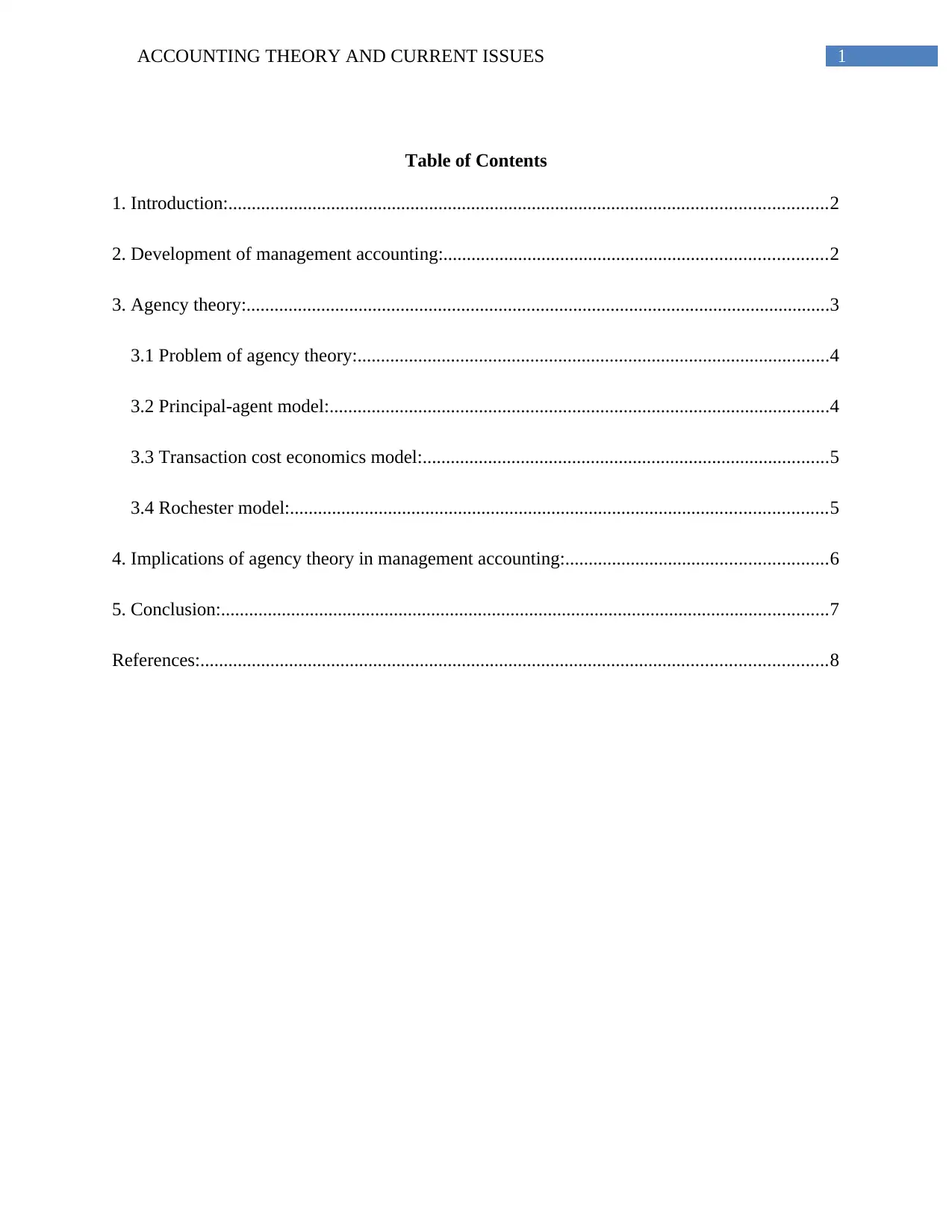
Table of Contents
1. Introduction:................................................................................................................................2
2. Development of management accounting:..................................................................................2
3. Agency theory:.............................................................................................................................3
3.1 Problem of agency theory:.....................................................................................................4
3.2 Principal-agent model:...........................................................................................................4
3.3 Transaction cost economics model:.......................................................................................5
3.4 Rochester model:...................................................................................................................5
4. Implications of agency theory in management accounting:........................................................6
5. Conclusion:..................................................................................................................................7
References:......................................................................................................................................8
Table of Contents
1. Introduction:................................................................................................................................2
2. Development of management accounting:..................................................................................2
3. Agency theory:.............................................................................................................................3
3.1 Problem of agency theory:.....................................................................................................4
3.2 Principal-agent model:...........................................................................................................4
3.3 Transaction cost economics model:.......................................................................................5
3.4 Rochester model:...................................................................................................................5
4. Implications of agency theory in management accounting:........................................................6
5. Conclusion:..................................................................................................................................7
References:......................................................................................................................................8
2ACCOUNTING THEORY AND CURRENT ISSUES
1. Introduction:
With the constantly changing economic conditions in the recent era, it has become
essential of using flexible approaches and tools. The article that has been selected to fit the
purpose of this assignment is “Management accounting and agency theory”. The current paper
intends to describe the way management accounting evolved and the area of scope for additional
extension of management accounting with the help of agency theory. For designing the future
direction of management accounting, it is crucial to obtain an overview of the development of
that field. Thus, this assignment provides a brief discussion of the evolution of management
accounting, agency theory and its related issues. Finally, this assignment sheds light on
discussing the implications of agency theory in the field of management accounting.
2. Development of management accounting:
In the words of Agoglia, Hatfield and Lambert (2015), management accounting is
developed on business practice and it needs to serve for promotion of business activities. This
field has evolved with the establishment of the big organisations between 1850 and 1925 that
necessitated the need for information crucial for control and planning. During this time, it is
necessary for the organisations to streamline production that has resulted in the establishment of
management accounting. The manufacturing firms now use to appoint staffs on long-term
contracts, which was not prevalent before the industrial revolution. In addition, the headquarters
are now separated from the factories, which raised the information system and the requirement to
analyse the managers and staffs of the organisations.
There is considerable impact of mass distribution and production on the management
accounting concept, which needs to deliver information regarding the turnover in individual
1. Introduction:
With the constantly changing economic conditions in the recent era, it has become
essential of using flexible approaches and tools. The article that has been selected to fit the
purpose of this assignment is “Management accounting and agency theory”. The current paper
intends to describe the way management accounting evolved and the area of scope for additional
extension of management accounting with the help of agency theory. For designing the future
direction of management accounting, it is crucial to obtain an overview of the development of
that field. Thus, this assignment provides a brief discussion of the evolution of management
accounting, agency theory and its related issues. Finally, this assignment sheds light on
discussing the implications of agency theory in the field of management accounting.
2. Development of management accounting:
In the words of Agoglia, Hatfield and Lambert (2015), management accounting is
developed on business practice and it needs to serve for promotion of business activities. This
field has evolved with the establishment of the big organisations between 1850 and 1925 that
necessitated the need for information crucial for control and planning. During this time, it is
necessary for the organisations to streamline production that has resulted in the establishment of
management accounting. The manufacturing firms now use to appoint staffs on long-term
contracts, which was not prevalent before the industrial revolution. In addition, the headquarters
are now separated from the factories, which raised the information system and the requirement to
analyse the managers and staffs of the organisations.
There is considerable impact of mass distribution and production on the management
accounting concept, which needs to deliver information regarding the turnover in individual
⊘ This is a preview!⊘
Do you want full access?
Subscribe today to unlock all pages.

Trusted by 1+ million students worldwide
3ACCOUNTING THEORY AND CURRENT ISSUES
areas along with generating formal reports on performance. These are little different from the
reports that the current management accounting provides. The requirement for management
information results in development of control systems and budget planning, which would help in
ensuring that the various activities of the different divisions are in tandem with the business
objectives.
As laid out in the article of Boučková (2015), management accounting has concentrated
traditionally on financial outcomes and it has remained oblivious of the other indicators like
market position, customer loyalty, customer relationships, loyalty and staff motivation. With the
formation of non-financial indicators and association with external business environment, new
demands are levied on the management system and information support in the perspective of
management accounting. Such extension of management accounting gives new information,
which might enable in solving critical issues. Thus, there is a proactive approach in responding
to the situation by transferring management accounting from a passive role towards solving
actions and strategic approach (Bahli and Rivard 2017).
3. Agency theory:
One of the most significant paradigms in management accounting is agency theory for
the past 27 years. This theory helps in providing an effective theoretical framework in order to
gain an insight of the business processes from the principal-agent viewpoint. As commented by
Bosse and Phillips (2016), agency theory is a contractual relationship, where a single or more
individuals (principal) hire one or more individuals (agent) for performing some actions in the
favour of the principal. This needs the delegation of various decision-making powers to the
agent. The agents and principals are considered as rational economic individuals, who are
motivated due to self-interest and these might change based on conviction, preference and
areas along with generating formal reports on performance. These are little different from the
reports that the current management accounting provides. The requirement for management
information results in development of control systems and budget planning, which would help in
ensuring that the various activities of the different divisions are in tandem with the business
objectives.
As laid out in the article of Boučková (2015), management accounting has concentrated
traditionally on financial outcomes and it has remained oblivious of the other indicators like
market position, customer loyalty, customer relationships, loyalty and staff motivation. With the
formation of non-financial indicators and association with external business environment, new
demands are levied on the management system and information support in the perspective of
management accounting. Such extension of management accounting gives new information,
which might enable in solving critical issues. Thus, there is a proactive approach in responding
to the situation by transferring management accounting from a passive role towards solving
actions and strategic approach (Bahli and Rivard 2017).
3. Agency theory:
One of the most significant paradigms in management accounting is agency theory for
the past 27 years. This theory helps in providing an effective theoretical framework in order to
gain an insight of the business processes from the principal-agent viewpoint. As commented by
Bosse and Phillips (2016), agency theory is a contractual relationship, where a single or more
individuals (principal) hire one or more individuals (agent) for performing some actions in the
favour of the principal. This needs the delegation of various decision-making powers to the
agent. The agents and principals are considered as rational economic individuals, who are
motivated due to self-interest and these might change based on conviction, preference and
Paraphrase This Document
Need a fresh take? Get an instant paraphrase of this document with our AI Paraphraser
4ACCOUNTING THEORY AND CURRENT ISSUES
information. As the principal provides capital and bears the risk, while the agent performs the
tasks, a decision is made in favour of the principal and the risk is transferred to the principal as
well.
3.1 Problem of agency theory:
The agency relationship encounters a fundamental issue that deals with the agent
behaviour and desire for maximising the utility function and this might not be consistent with the
principal objectives. This results in agency problem, in which the agent might not act in the best
interest of the principal. Information asymmetry takes place when one party has more
information than the other party (Dawar 2014). In majority of the cases, the agent has more
information due to direct engagement in the daily operations of the organisation. Thus, it could
be viewed as market failure, which results in ineffective distribution of available resources.
Another issue associated with the agency theory is the kind of shareholder-manager
relationship. If the ownership and management is separated, a situation might take place, in
which the shareholders could not observe the behaviours of the managers (Habib and Jiang
2015). As a result, the managers would not perform according to the best interests of the
shareholders and they might behave opportunistically. Hence, the relationship between the
shareholders and the managers is exposed to risk.
3.2 Principal-agent model:
The principal-agent model depends on the rational attitude of the individuals and it is
assumed that these individuals have the ability to estimate and analyse the likelihood of future
eventualities. According to Jones (2015), the principal-agent model benefits management
accounting a way for assuring valuable and coherent framework, in which the management
information. As the principal provides capital and bears the risk, while the agent performs the
tasks, a decision is made in favour of the principal and the risk is transferred to the principal as
well.
3.1 Problem of agency theory:
The agency relationship encounters a fundamental issue that deals with the agent
behaviour and desire for maximising the utility function and this might not be consistent with the
principal objectives. This results in agency problem, in which the agent might not act in the best
interest of the principal. Information asymmetry takes place when one party has more
information than the other party (Dawar 2014). In majority of the cases, the agent has more
information due to direct engagement in the daily operations of the organisation. Thus, it could
be viewed as market failure, which results in ineffective distribution of available resources.
Another issue associated with the agency theory is the kind of shareholder-manager
relationship. If the ownership and management is separated, a situation might take place, in
which the shareholders could not observe the behaviours of the managers (Habib and Jiang
2015). As a result, the managers would not perform according to the best interests of the
shareholders and they might behave opportunistically. Hence, the relationship between the
shareholders and the managers is exposed to risk.
3.2 Principal-agent model:
The principal-agent model depends on the rational attitude of the individuals and it is
assumed that these individuals have the ability to estimate and analyse the likelihood of future
eventualities. According to Jones (2015), the principal-agent model benefits management
accounting a way for assuring valuable and coherent framework, in which the management
5ACCOUNTING THEORY AND CURRENT ISSUES
accounting issues could be viewed. In this model, there is an assumption of information
asymmetry. The agent possesses some information to which the principal could not gain access
costless and the agent is assumed as risk-averse.
3.3 Transaction cost economics model:
According to this model, the individuals perform activities based on their self-interest.
This could be termed as opportunistic behaviour, since the individuals do not behave as per the
rules (Libby and Thorne 2017). In this model, it is assumed that the individuals possess restricted
opportunity. As a result, the individuals could not estimate all the probable future contingencies.
Thus, in this model, it is assumed that the contracts are incomplete. This model gives a
description of unusual relationships between firms aiming to develop or using monopoly power.
Hence, it could be stated that this model concentrates on the resolution of contractual
associations between organisations, which could lay additional stress on contractual associations
within the organisation.
3.4 Rochester model:
This model is identical to the transaction cost economics model, which depicts
transaction costs and opportunistic behaviour; however, it is developed on the theory of positive
accounting. With the help of this model, situations could be identified where there are variations
of interests between agent and principal inherent along with evaluation of cost-effectiveness in
setting control mechanisms (Mitnick 2015). Another advantage of this model is that the
framework could be applied to the agency problem and its intention is to gain an overview of the
occurrence of agency problem and the ways it could be mitigated through the organisational
culture.
accounting issues could be viewed. In this model, there is an assumption of information
asymmetry. The agent possesses some information to which the principal could not gain access
costless and the agent is assumed as risk-averse.
3.3 Transaction cost economics model:
According to this model, the individuals perform activities based on their self-interest.
This could be termed as opportunistic behaviour, since the individuals do not behave as per the
rules (Libby and Thorne 2017). In this model, it is assumed that the individuals possess restricted
opportunity. As a result, the individuals could not estimate all the probable future contingencies.
Thus, in this model, it is assumed that the contracts are incomplete. This model gives a
description of unusual relationships between firms aiming to develop or using monopoly power.
Hence, it could be stated that this model concentrates on the resolution of contractual
associations between organisations, which could lay additional stress on contractual associations
within the organisation.
3.4 Rochester model:
This model is identical to the transaction cost economics model, which depicts
transaction costs and opportunistic behaviour; however, it is developed on the theory of positive
accounting. With the help of this model, situations could be identified where there are variations
of interests between agent and principal inherent along with evaluation of cost-effectiveness in
setting control mechanisms (Mitnick 2015). Another advantage of this model is that the
framework could be applied to the agency problem and its intention is to gain an overview of the
occurrence of agency problem and the ways it could be mitigated through the organisational
culture.
⊘ This is a preview!⊘
Do you want full access?
Subscribe today to unlock all pages.
Trusted by 1+ million students worldwide
6ACCOUNTING THEORY AND CURRENT ISSUES
4. Implications of agency theory in management accounting:
The management accounting research is focused considerably on performance analysis
and issues concerning the control of the organisation. This takes into account management
incentives along with the behaviours of the agent and the principal. The agency theory has been
deduced from a concept, which could estimate managerial and organisational output in
association with the financial processes and information. The research, in this field, has focused
on designing the optimum monitoring system. Thus, it is necessary for the principal in deciding
the amount to be invested in the production system and in the monitoring system. It has been
found out that if heavy investment is made on the production process on the part of the principal,
the firm could invest in a monitoring system for minimising the agency problem (Pepper and
Gore 2015).
The agency theory could be applied in organisations along with attempting to describe
the relationships between them. A significant prerequisite is the contract imperfection, since it is
not possible to include all future contract contingencies. However, the agency theory has the
issue of information asymmetry. In order to deal with this specific issue, promoting information
exchange would be a feasible idea between the firms. Hence, by combining the agency theory
and managerial accounting, there is ardent need for tools to monitor the managerial behaviour.
Moreover, a need is inherent to control and manage the monitoring costs. With the help of
agency theory, an overview of the managerial behaviour could be obtained, which has direct
influence on the value of information in management accounting (Rashid 2015). In case, the
information of management accounting is not able to disclose this opportunistic behaviour
depending on agency theory, additional costs have been incurred and the resources of the firm
4. Implications of agency theory in management accounting:
The management accounting research is focused considerably on performance analysis
and issues concerning the control of the organisation. This takes into account management
incentives along with the behaviours of the agent and the principal. The agency theory has been
deduced from a concept, which could estimate managerial and organisational output in
association with the financial processes and information. The research, in this field, has focused
on designing the optimum monitoring system. Thus, it is necessary for the principal in deciding
the amount to be invested in the production system and in the monitoring system. It has been
found out that if heavy investment is made on the production process on the part of the principal,
the firm could invest in a monitoring system for minimising the agency problem (Pepper and
Gore 2015).
The agency theory could be applied in organisations along with attempting to describe
the relationships between them. A significant prerequisite is the contract imperfection, since it is
not possible to include all future contract contingencies. However, the agency theory has the
issue of information asymmetry. In order to deal with this specific issue, promoting information
exchange would be a feasible idea between the firms. Hence, by combining the agency theory
and managerial accounting, there is ardent need for tools to monitor the managerial behaviour.
Moreover, a need is inherent to control and manage the monitoring costs. With the help of
agency theory, an overview of the managerial behaviour could be obtained, which has direct
influence on the value of information in management accounting (Rashid 2015). In case, the
information of management accounting is not able to disclose this opportunistic behaviour
depending on agency theory, additional costs have been incurred and the resources of the firm
Paraphrase This Document
Need a fresh take? Get an instant paraphrase of this document with our AI Paraphraser
7ACCOUNTING THEORY AND CURRENT ISSUES
have gone in vain. The advantage of agency theory is that it urges the practice of considering the
value of management accounting techniques (Song, Wang and Cavusgil 2015).
5. Conclusion:
From the above discussion, it has been found out that management accounting is
developed on business practice and it needs to serve for promotion of business activities. One of
the most significant paradigms in management accounting is agency theory for the past 27 years.
This theory helps in providing an effective theoretical framework in order to gain an insight of
the business processes from the principal-agent viewpoint. The agency theory could be applied in
organisations along with attempting to describe the relationships between them. A significant
prerequisite is the contract imperfection, since it is not possible to include all future contract
contingencies. Hence, by combining the agency theory and managerial accounting, there is
ardent need for tools to monitor the managerial behaviour.
have gone in vain. The advantage of agency theory is that it urges the practice of considering the
value of management accounting techniques (Song, Wang and Cavusgil 2015).
5. Conclusion:
From the above discussion, it has been found out that management accounting is
developed on business practice and it needs to serve for promotion of business activities. One of
the most significant paradigms in management accounting is agency theory for the past 27 years.
This theory helps in providing an effective theoretical framework in order to gain an insight of
the business processes from the principal-agent viewpoint. The agency theory could be applied in
organisations along with attempting to describe the relationships between them. A significant
prerequisite is the contract imperfection, since it is not possible to include all future contract
contingencies. Hence, by combining the agency theory and managerial accounting, there is
ardent need for tools to monitor the managerial behaviour.
8ACCOUNTING THEORY AND CURRENT ISSUES
References:
Agoglia, C.P., Hatfield, R.C. and Lambert, T.A., 2015. Audit team time reporting: An agency
theory perspective. Accounting, Organizations and Society, 44, pp.1-14.
Bahli, B. and Rivard, S., 2017. The Information Technology Outsourcing Risk: A Transaction
Cost and Agency Theory-Based Perspective. In Outsourcing and Offshoring Business
Services (pp. 53-77). Palgrave Macmillan, Cham.
Bosse, D.A. and Phillips, R.A., 2016. Agency theory and bounded self-interest. Academy of
Management Review, 41(2), pp.276-297.
Boučková, M., 2015. Management accounting and agency theory. Procedia Economics and
Finance, 25, pp.5-13.
Dawar, V., 2014. Agency theory, capital structure and firm performance: some Indian
evidence. Managerial Finance, 40(12), pp.1190-1206.
Habib, A. and Jiang, H., 2015. Journal of International Accounting, Auditing and
Taxation. Journal of International Accounting, Auditing and Taxation, 24, pp.29-45.
Jones, S. ed., 2015. The Routledge companion to financial accounting theory. Routledge.
Libby, T. and Thorne, L. eds., 2017. The Routledge Companion to Behavioural Accounting
Research. Routledge.
Mitnick, B.M., 2015. Agency theory. Wiley Encyclopedia of Management.
Pepper, A. and Gore, J., 2015. Behavioral agency theory: New foundations for theorizing about
executive compensation. Journal of management, 41(4), pp.1045-1068.
References:
Agoglia, C.P., Hatfield, R.C. and Lambert, T.A., 2015. Audit team time reporting: An agency
theory perspective. Accounting, Organizations and Society, 44, pp.1-14.
Bahli, B. and Rivard, S., 2017. The Information Technology Outsourcing Risk: A Transaction
Cost and Agency Theory-Based Perspective. In Outsourcing and Offshoring Business
Services (pp. 53-77). Palgrave Macmillan, Cham.
Bosse, D.A. and Phillips, R.A., 2016. Agency theory and bounded self-interest. Academy of
Management Review, 41(2), pp.276-297.
Boučková, M., 2015. Management accounting and agency theory. Procedia Economics and
Finance, 25, pp.5-13.
Dawar, V., 2014. Agency theory, capital structure and firm performance: some Indian
evidence. Managerial Finance, 40(12), pp.1190-1206.
Habib, A. and Jiang, H., 2015. Journal of International Accounting, Auditing and
Taxation. Journal of International Accounting, Auditing and Taxation, 24, pp.29-45.
Jones, S. ed., 2015. The Routledge companion to financial accounting theory. Routledge.
Libby, T. and Thorne, L. eds., 2017. The Routledge Companion to Behavioural Accounting
Research. Routledge.
Mitnick, B.M., 2015. Agency theory. Wiley Encyclopedia of Management.
Pepper, A. and Gore, J., 2015. Behavioral agency theory: New foundations for theorizing about
executive compensation. Journal of management, 41(4), pp.1045-1068.
⊘ This is a preview!⊘
Do you want full access?
Subscribe today to unlock all pages.
Trusted by 1+ million students worldwide
9ACCOUNTING THEORY AND CURRENT ISSUES
Rashid, A., 2015. Revisiting agency theory: Evidence of board independence and agency cost
from Bangladesh. Journal of business ethics, 130(1), pp.181-198.
Song, J., Wang, R. and Cavusgil, S.T., 2015. State ownership and market orientation in China's
public firms: An agency theory perspective. International Business Review, 24(4), pp.690-699.
Rashid, A., 2015. Revisiting agency theory: Evidence of board independence and agency cost
from Bangladesh. Journal of business ethics, 130(1), pp.181-198.
Song, J., Wang, R. and Cavusgil, S.T., 2015. State ownership and market orientation in China's
public firms: An agency theory perspective. International Business Review, 24(4), pp.690-699.

1 out of 10


Related Documents


Your All-in-One AI-Powered Toolkit for Academic Success.
+13062052269
info@desklib.com
Available 24*7 on WhatsApp / Email
![[object Object]](/_next/static/media/star-bottom.7253800d.svg)
Unlock your academic potential
Copyright © 2020–2026 A2Z Services. All Rights Reserved. Developed and managed by ZUCOL.