Aggregate Plan: Production, Demand, and Cost Analysis

Verified

Added on  2022/09/12

|6
|1133
|38
Project
AI Summary
This assignment presents an aggregate plan designed for a manufacturing plant producing pudding food products. The plan addresses key aspects of operations management, including production rates, labor requirements, and projected finished goods inventory levels. The analysis includes decision variables, constraints, and cost breakdowns for various periods, considering factors like hiring, layoffs, regular time, overtime, inventory, stockouts, subcontracting, and material costs. The solution explores two aggregate plans: one maintaining a constant production rate and another incorporating hiring and training of production personnel to increase capacity. It examines pricing strategies, marketing approaches, and the impact of economic cycles on production costs and profitability. The document highlights the importance of addressing seasonality and the potential for profit maximization through effective planning and resource allocation. The analysis includes detailed cost breakdowns, revenue projections, and profit calculations, providing a comprehensive overview of the aggregate planning process.
Document Page
Aggregate Plan for Demand and Supply
Name
Institution
tabler-icon-diamond-filled.svg

Paraphrase This Document

Need a fresh take? Get an instant paraphrase of this document with our AI Paraphraser
Document Page
Question 1
Aggregate Plan Decision Variables
Ht Lt Wt Ot It St Ct Pt
Perio
d
#
Hired # Laid off # Workforce
Overtim
e
Inventor
y Stockout
Subcontra
ct
Productio
n
Deman
d
0 1 0 56 0 0 0 0
1 0 16 56 0 400,000 0 0 450,000 40,000
2 0 0 56 0 250,000 0 0 450,000 24,000
3 0 0 56 0 450,000 0 0 450,000 40,200
4 0 0 56 0 200,000 0 0 450,000 30,000
5 0 0 0 0 0
6 0 0 0 0 0
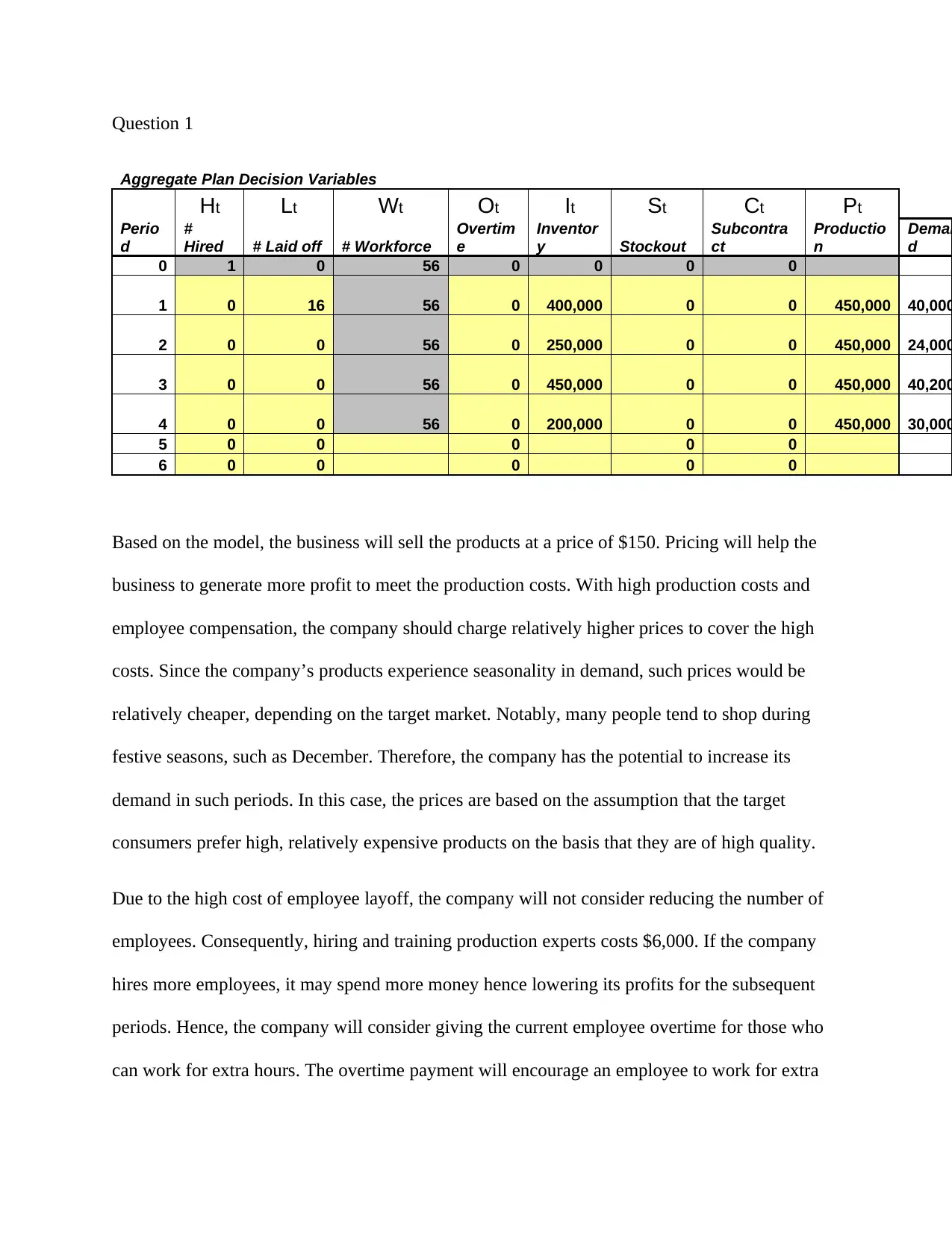
Based on the model, the business will sell the products at a price of $150. Pricing will help the
business to generate more profit to meet the production costs. With high production costs and
employee compensation, the company should charge relatively higher prices to cover the high
costs. Since the company’s products experience seasonality in demand, such prices would be
relatively cheaper, depending on the target market. Notably, many people tend to shop during
festive seasons, such as December. Therefore, the company has the potential to increase its
demand in such periods. In this case, the prices are based on the assumption that the target
consumers prefer high, relatively expensive products on the basis that they are of high quality.
Due to the high cost of employee layoff, the company will not consider reducing the number of
employees. Consequently, hiring and training production experts costs $6,000. If the company
hires more employees, it may spend more money hence lowering its profits for the subsequent
periods. Hence, the company will consider giving the current employee overtime for those who
can work for extra hours. The overtime payment will encourage an employee to work for extra
Document Page
hours. Ideally, encouraging and developing the existing employees is more cost-effective as
compared to hiring or laying off employees. The primary objective of the overtime payment is to
increase production to meet the increasing demand. According to the model, the demand
fluctuates from one period to another besides the production, which remains constant. The
company will employ effective marketing strategies to meet the demand and to determine
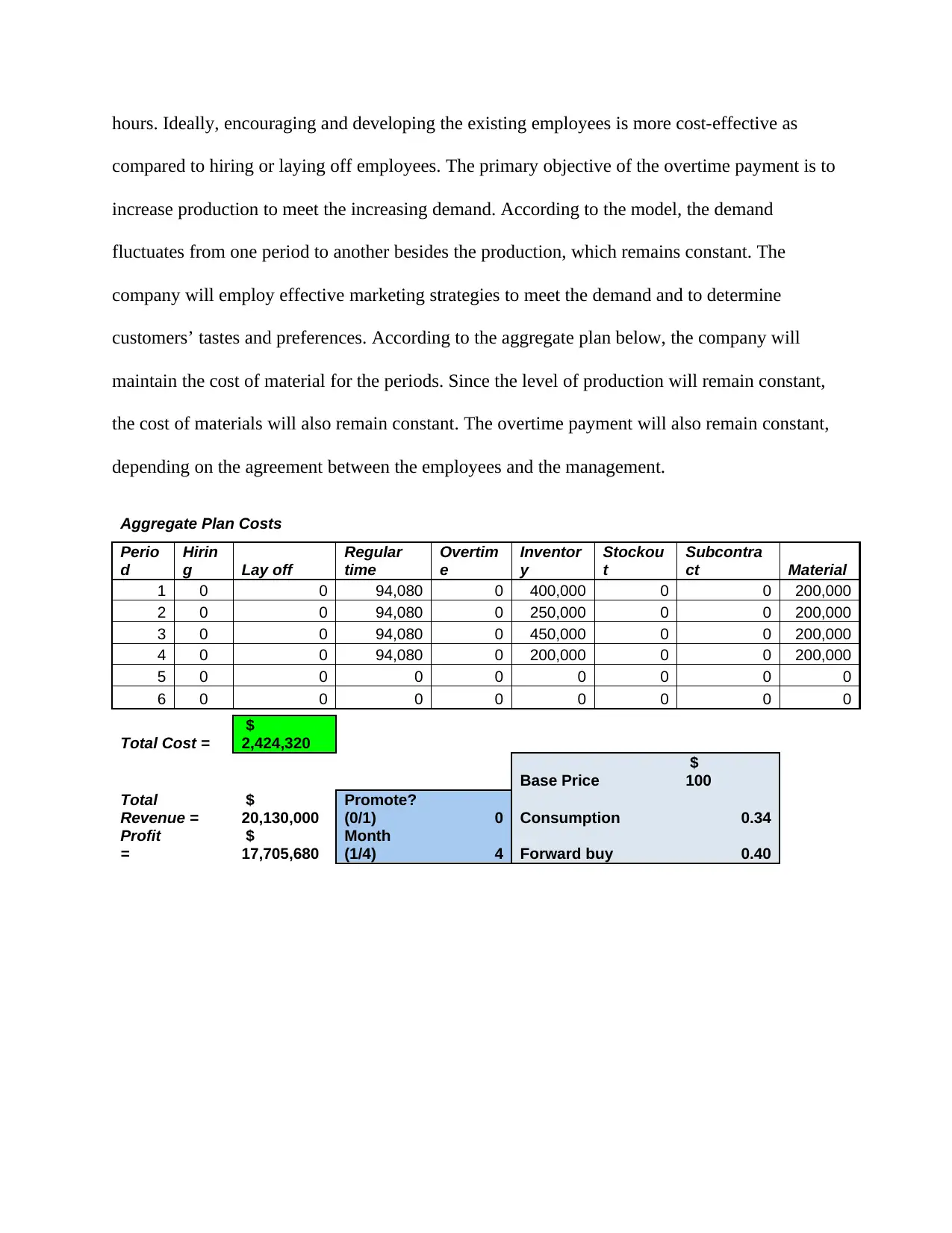
customers’ tastes and preferences. According to the aggregate plan below, the company will
maintain the cost of material for the periods. Since the level of production will remain constant,
the cost of materials will also remain constant. The overtime payment will also remain constant,
depending on the agreement between the employees and the management.
Aggregate Plan Costs
Perio
d
Hirin
g Lay off
Regular
time
Overtim
e
Inventor
y
Stockou
t
Subcontra
ct Material
1 0 0 94,080 0 400,000 0 0 200,000
2 0 0 94,080 0 250,000 0 0 200,000
3 0 0 94,080 0 450,000 0 0 200,000
4 0 0 94,080 0 200,000 0 0 200,000
5 0 0 0 0 0 0 0 0
6 0 0 0 0 0 0 0 0
Total Cost =
$
2,424,320
Base Price
$
100
Total
Revenue =
$
20,130,000
Promote?
(0/1) 0 Consumption 0.34
Profit
=
$
17,705,680
Month
(1/4) 4 Forward buy 0.40
Document Page
Workforce Capacity Inventory Overtime
20 -160 -2000 560
20 -160 150 560
20 -160 -2000 560
20 -160 -350 560
0 200 0
0 0 0 0
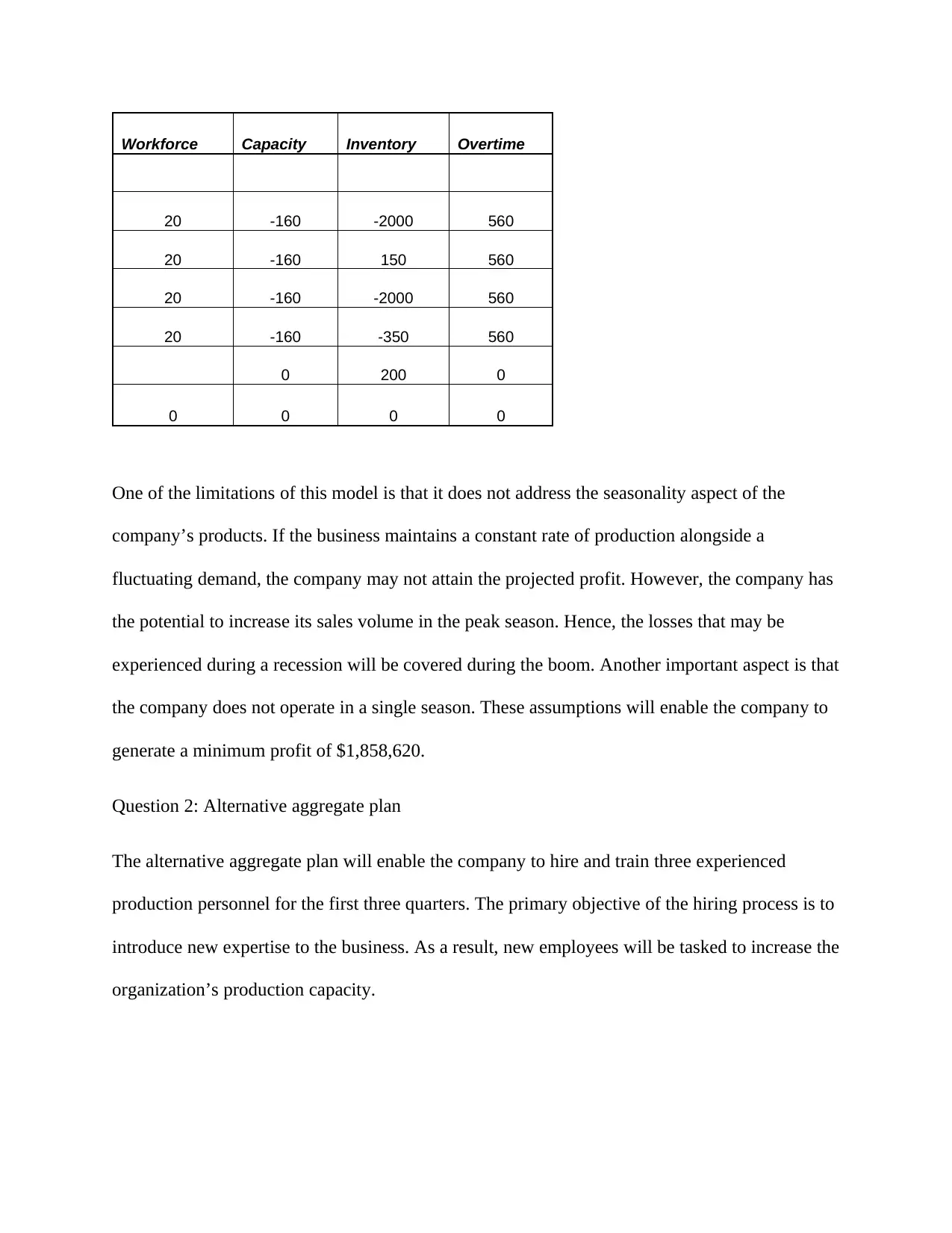
One of the limitations of this model is that it does not address the seasonality aspect of the
company’s products. If the business maintains a constant rate of production alongside a
fluctuating demand, the company may not attain the projected profit. However, the company has
the potential to increase its sales volume in the peak season. Hence, the losses that may be
experienced during a recession will be covered during the boom. Another important aspect is that
the company does not operate in a single season. These assumptions will enable the company to
generate a minimum profit of $1,858,620.
Question 2: Alternative aggregate plan
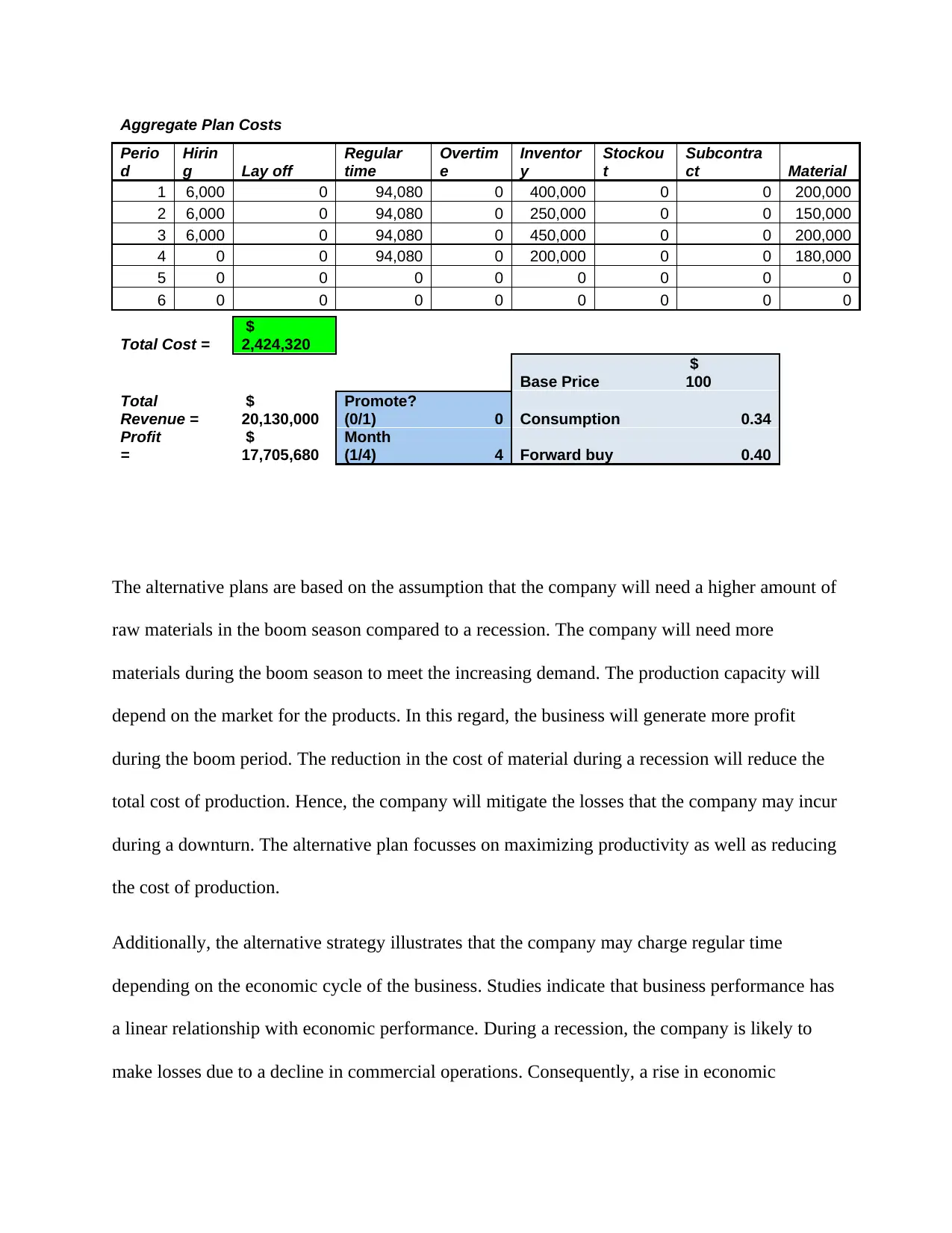
The alternative aggregate plan will enable the company to hire and train three experienced
production personnel for the first three quarters. The primary objective of the hiring process is to
introduce new expertise to the business. As a result, new employees will be tasked to increase the
organization’s production capacity.
tabler-icon-diamond-filled.svg

Paraphrase This Document

Need a fresh take? Get an instant paraphrase of this document with our AI Paraphraser
Document Page
Aggregate Plan Costs
Perio
d
Hirin
g Lay off
Regular
time
Overtim
e
Inventor
y
Stockou
t
Subcontra
ct Material
1 6,000 0 94,080 0 400,000 0 0 200,000
2 6,000 0 94,080 0 250,000 0 0 150,000
3 6,000 0 94,080 0 450,000 0 0 200,000
4 0 0 94,080 0 200,000 0 0 180,000
5 0 0 0 0 0 0 0 0
6 0 0 0 0 0 0 0 0
Total Cost =
$
2,424,320
Base Price
$
100
Total
Revenue =
$
20,130,000
Promote?
(0/1) 0 Consumption 0.34
Profit
=
$
17,705,680
Month
(1/4) 4 Forward buy 0.40
The alternative plans are based on the assumption that the company will need a higher amount of
raw materials in the boom season compared to a recession. The company will need more
materials during the boom season to meet the increasing demand. The production capacity will
depend on the market for the products. In this regard, the business will generate more profit
during the boom period. The reduction in the cost of material during a recession will reduce the
total cost of production. Hence, the company will mitigate the losses that the company may incur
during a downturn. The alternative plan focusses on maximizing productivity as well as reducing
the cost of production.
Additionally, the alternative strategy illustrates that the company may charge regular time
depending on the economic cycle of the business. Studies indicate that business performance has
a linear relationship with economic performance. During a recession, the company is likely to
make losses due to a decline in commercial operations. Consequently, a rise in economic
Document Page
performance will result in a significant increase in the company’s net income. Therefore, the
production cost will vary depending on the economic cycle of the company. The periods will be
experienced from one quarter to another. In the long run, the company will maximize profits.
Excel files: https://jumpshare.com/v/lumvq1xj1EkLHGPZgg4U
chevron_up_icon
1 out of 6
circle_padding
hide_on_mobile
zoom_out_icon
[object Object]