Reflection on Agile Team Roles in Project Management (MIS608)
VerifiedAdded on  2021/04/09
|7
|2020
|90
Report
AI Summary
This report provides a reflection on the roles within Agile teams, focusing on the application of Agile methodologies in project management. It delves into the various roles within small and large Agile teams, including team leads, product owners, stakeholders, and technical experts, and examines the responsibilities associated with each. The report analyzes the benefits of Agile working ways, such as increased collaboration, improved performance, and adaptability to changing conditions. It also discusses the challenges and potential drawbacks of Agile practices, such as the need for re-education and adjustments to working habits. Furthermore, the report outlines an action plan for implementing Agile team structures, emphasizing the importance of self-organization, team size, and the adoption of a flexible approach to roles. The author concludes by recommending the formation of Agile teams to enhance project outcomes and improve the overall project development phase.
0
THARUN KUMAR ATHULURI
A00022877
LECTURER : SHARYN JEVON
MIS608 AGILE PROJECT
MANAGEMENT
REFLECTION ON THE ROLES OF AGILE IN
TEAM
THARUN KUMAR ATHULURI
A00022877
LECTURER : SHARYN JEVON
MIS608 AGILE PROJECT
MANAGEMENT
REFLECTION ON THE ROLES OF AGILE IN
TEAM
Paraphrase This Document
Need a fresh take? Get an instant paraphrase of this document with our AI Paraphraser

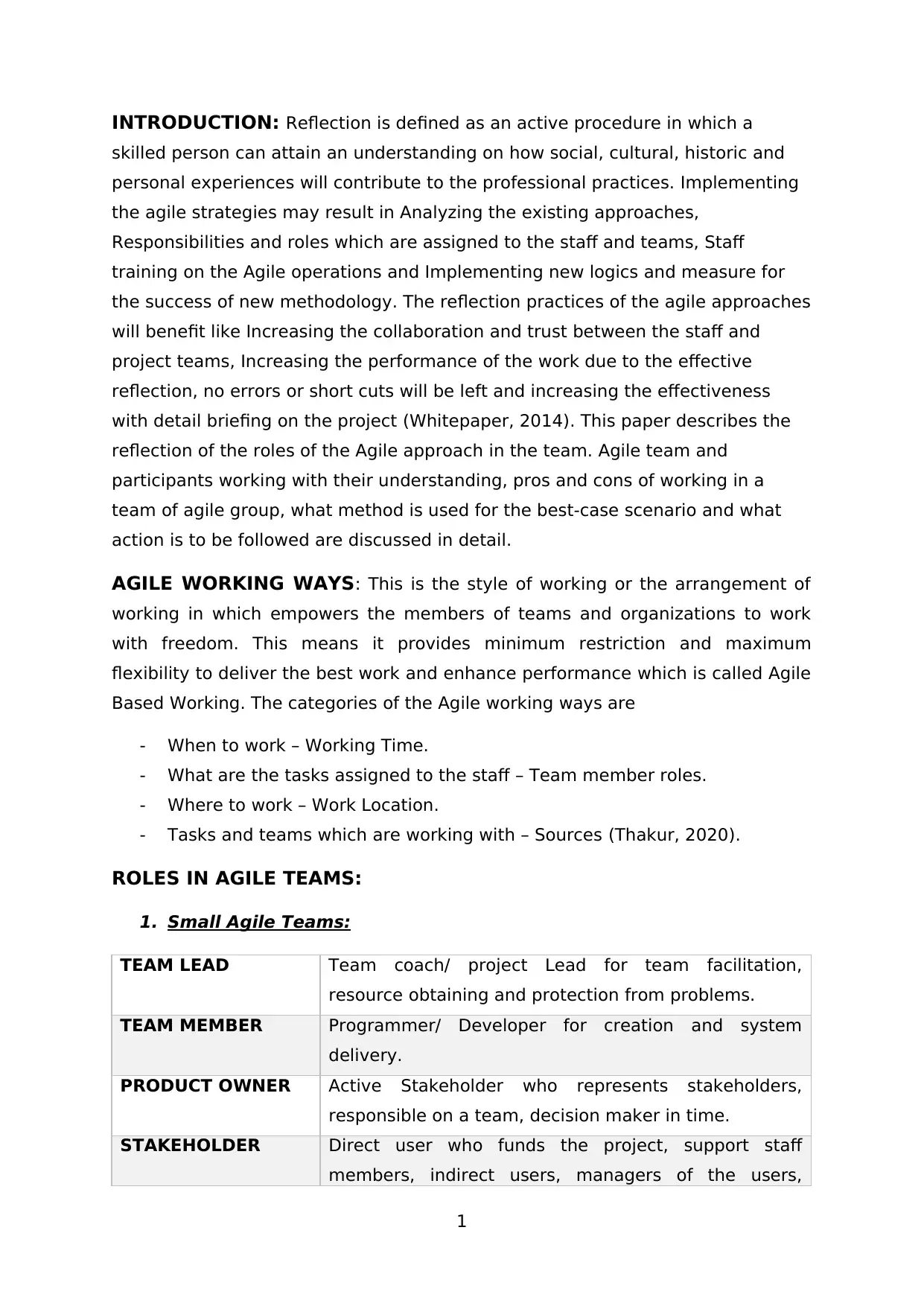
INTRODUCTION: Reflection is defined as an active procedure in which a
skilled person can attain an understanding on how social, cultural, historic and
personal experiences will contribute to the professional practices. Implementing
the agile strategies may result in Analyzing the existing approaches,
Responsibilities and roles which are assigned to the staff and teams, Staff
training on the Agile operations and Implementing new logics and measure for
the success of new methodology. The reflection practices of the agile approaches
will benefit like Increasing the collaboration and trust between the staff and
project teams, Increasing the performance of the work due to the effective
reflection, no errors or short cuts will be left and increasing the effectiveness
with detail briefing on the project (Whitepaper, 2014). This paper describes the
reflection of the roles of the Agile approach in the team. Agile team and
participants working with their understanding, pros and cons of working in a
team of agile group, what method is used for the best-case scenario and what
action is to be followed are discussed in detail.
AGILE WORKING WAYS: This is the style of working or the arrangement of
working in which empowers the members of teams and organizations to work
with freedom. This means it provides minimum restriction and maximum
flexibility to deliver the best work and enhance performance which is called Agile
Based Working. The categories of the Agile working ways are
- When to work – Working Time.
- What are the tasks assigned to the staff – Team member roles.
- Where to work – Work Location.
- Tasks and teams which are working with – Sources (Thakur, 2020).
ROLES IN AGILE TEAMS:
1. Small Agile Teams:
TEAM LEAD Team coach/ project Lead for team facilitation,
resource obtaining and protection from problems.
TEAM MEMBER Programmer/ Developer for creation and system
delivery.
PRODUCT OWNER Active Stakeholder who represents stakeholders,
responsible on a team, decision maker in time.
STAKEHOLDER Direct user who funds the project, support staff
members, indirect users, managers of the users,
1
skilled person can attain an understanding on how social, cultural, historic and
personal experiences will contribute to the professional practices. Implementing
the agile strategies may result in Analyzing the existing approaches,
Responsibilities and roles which are assigned to the staff and teams, Staff
training on the Agile operations and Implementing new logics and measure for
the success of new methodology. The reflection practices of the agile approaches
will benefit like Increasing the collaboration and trust between the staff and
project teams, Increasing the performance of the work due to the effective
reflection, no errors or short cuts will be left and increasing the effectiveness
with detail briefing on the project (Whitepaper, 2014). This paper describes the
reflection of the roles of the Agile approach in the team. Agile team and
participants working with their understanding, pros and cons of working in a
team of agile group, what method is used for the best-case scenario and what
action is to be followed are discussed in detail.
AGILE WORKING WAYS: This is the style of working or the arrangement of
working in which empowers the members of teams and organizations to work
with freedom. This means it provides minimum restriction and maximum
flexibility to deliver the best work and enhance performance which is called Agile
Based Working. The categories of the Agile working ways are
- When to work – Working Time.
- What are the tasks assigned to the staff – Team member roles.
- Where to work – Work Location.
- Tasks and teams which are working with – Sources (Thakur, 2020).
ROLES IN AGILE TEAMS:
1. Small Agile Teams:
TEAM LEAD Team coach/ project Lead for team facilitation,
resource obtaining and protection from problems.
TEAM MEMBER Programmer/ Developer for creation and system
delivery.
PRODUCT OWNER Active Stakeholder who represents stakeholders,
responsible on a team, decision maker in time.
STAKEHOLDER Direct user who funds the project, support staff
members, indirect users, managers of the users,
1

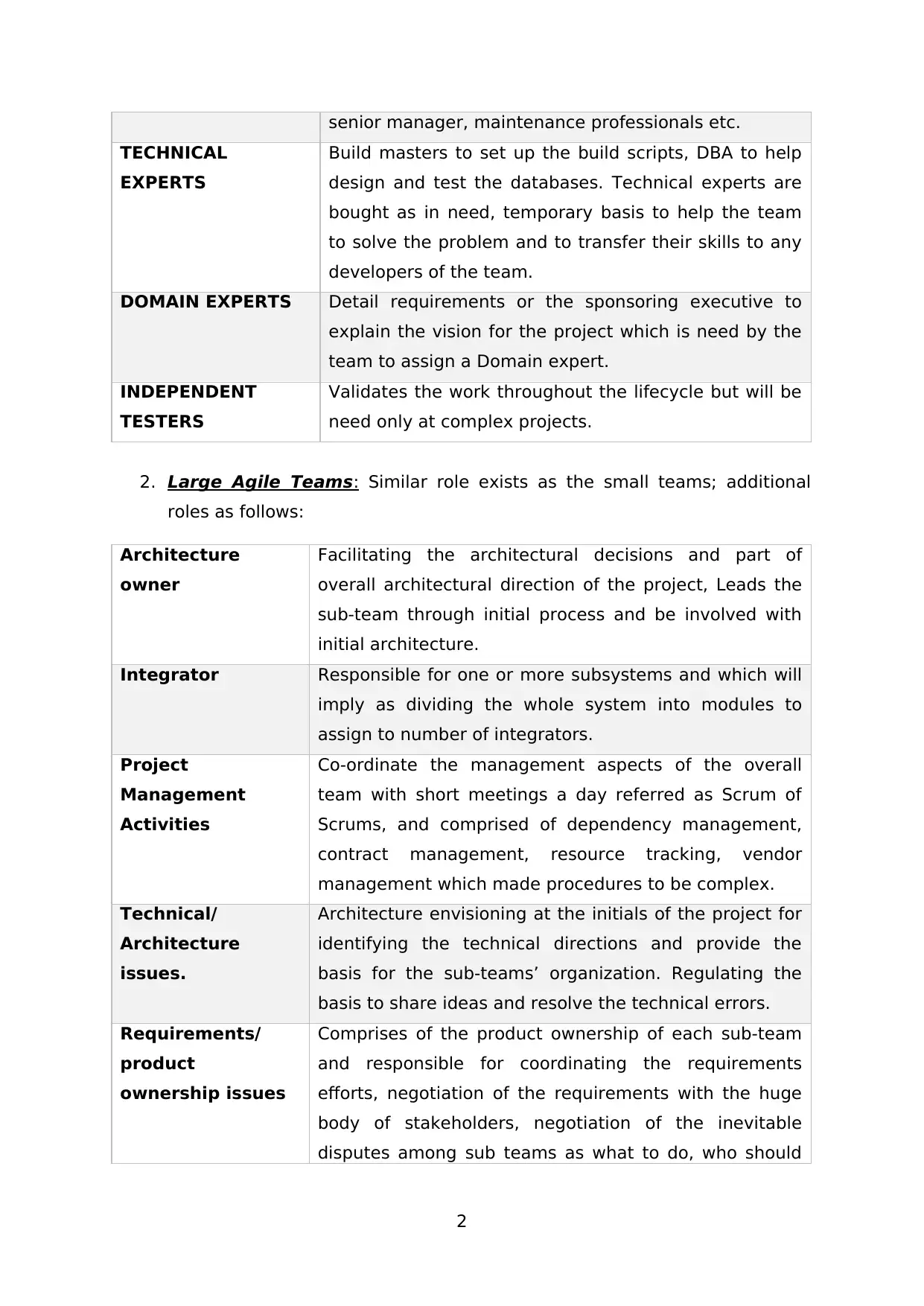
senior manager, maintenance professionals etc.
TECHNICAL
EXPERTS
Build masters to set up the build scripts, DBA to help
design and test the databases. Technical experts are
bought as in need, temporary basis to help the team
to solve the problem and to transfer their skills to any
developers of the team.
DOMAIN EXPERTS Detail requirements or the sponsoring executive to
explain the vision for the project which is need by the
team to assign a Domain expert.
INDEPENDENT
TESTERS
Validates the work throughout the lifecycle but will be
need only at complex projects.
2. Large Agile Teams: Similar role exists as the small teams; additional
roles as follows:
Architecture
owner
Facilitating the architectural decisions and part of
overall architectural direction of the project, Leads the
sub-team through initial process and be involved with
initial architecture.
Integrator Responsible for one or more subsystems and which will
imply as dividing the whole system into modules to
assign to number of integrators.
Project
Management
Activities
Co-ordinate the management aspects of the overall
team with short meetings a day referred as Scrum of
Scrums, and comprised of dependency management,
contract management, resource tracking, vendor
management which made procedures to be complex.
Technical/
Architecture
issues.
Architecture envisioning at the initials of the project for
identifying the technical directions and provide the
basis for the sub-teams’ organization. Regulating the
basis to share ideas and resolve the technical errors.
Requirements/
product
ownership issues
Comprises of the product ownership of each sub-team
and responsible for coordinating the requirements
efforts, negotiation of the requirements with the huge
body of stakeholders, negotiation of the inevitable
disputes among sub teams as what to do, who should
2
TECHNICAL
EXPERTS
Build masters to set up the build scripts, DBA to help
design and test the databases. Technical experts are
bought as in need, temporary basis to help the team
to solve the problem and to transfer their skills to any
developers of the team.
DOMAIN EXPERTS Detail requirements or the sponsoring executive to
explain the vision for the project which is need by the
team to assign a Domain expert.
INDEPENDENT
TESTERS
Validates the work throughout the lifecycle but will be
need only at complex projects.
2. Large Agile Teams: Similar role exists as the small teams; additional
roles as follows:
Architecture
owner
Facilitating the architectural decisions and part of
overall architectural direction of the project, Leads the
sub-team through initial process and be involved with
initial architecture.
Integrator Responsible for one or more subsystems and which will
imply as dividing the whole system into modules to
assign to number of integrators.
Project
Management
Activities
Co-ordinate the management aspects of the overall
team with short meetings a day referred as Scrum of
Scrums, and comprised of dependency management,
contract management, resource tracking, vendor
management which made procedures to be complex.
Technical/
Architecture
issues.
Architecture envisioning at the initials of the project for
identifying the technical directions and provide the
basis for the sub-teams’ organization. Regulating the
basis to share ideas and resolve the technical errors.
Requirements/
product
ownership issues
Comprises of the product ownership of each sub-team
and responsible for coordinating the requirements
efforts, negotiation of the requirements with the huge
body of stakeholders, negotiation of the inevitable
disputes among sub teams as what to do, who should
2
⊘ This is a preview!⊘
Do you want full access?
Subscribe today to unlock all pages.

Trusted by 1+ million students worldwide

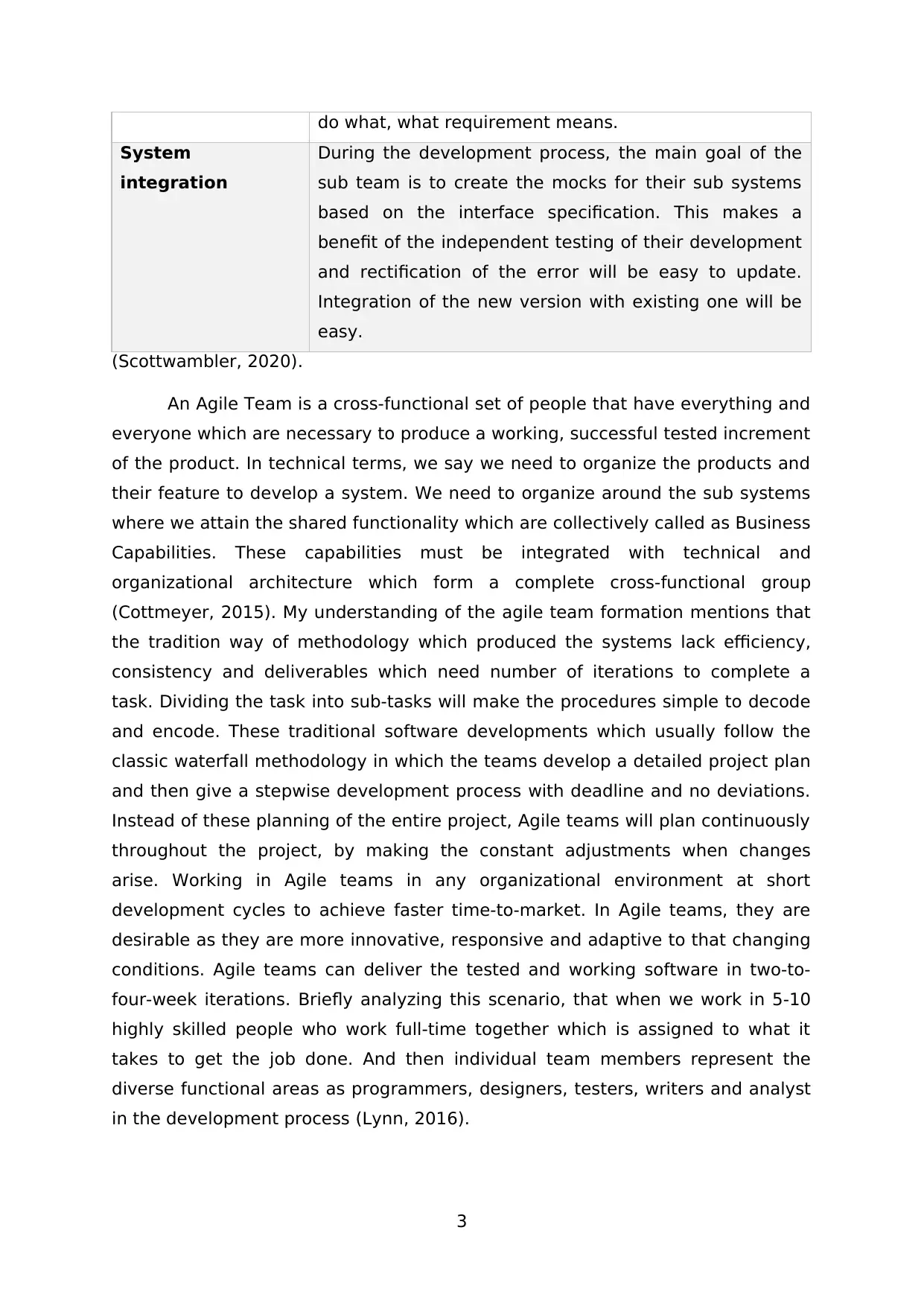
do what, what requirement means.
System
integration
During the development process, the main goal of the
sub team is to create the mocks for their sub systems
based on the interface specification. This makes a
benefit of the independent testing of their development
and rectification of the error will be easy to update.
Integration of the new version with existing one will be
easy.
(Scottwambler, 2020).
An Agile Team is a cross-functional set of people that have everything and
everyone which are necessary to produce a working, successful tested increment
of the product. In technical terms, we say we need to organize the products and
their feature to develop a system. We need to organize around the sub systems
where we attain the shared functionality which are collectively called as Business
Capabilities. These capabilities must be integrated with technical and
organizational architecture which form a complete cross-functional group
(Cottmeyer, 2015). My understanding of the agile team formation mentions that
the tradition way of methodology which produced the systems lack efficiency,
consistency and deliverables which need number of iterations to complete a
task. Dividing the task into sub-tasks will make the procedures simple to decode
and encode. These traditional software developments which usually follow the
classic waterfall methodology in which the teams develop a detailed project plan
and then give a stepwise development process with deadline and no deviations.
Instead of these planning of the entire project, Agile teams will plan continuously
throughout the project, by making the constant adjustments when changes
arise. Working in Agile teams in any organizational environment at short
development cycles to achieve faster time-to-market. In Agile teams, they are
desirable as they are more innovative, responsive and adaptive to that changing
conditions. Agile teams can deliver the tested and working software in two-to-
four-week iterations. Briefly analyzing this scenario, that when we work in 5-10
highly skilled people who work full-time together which is assigned to what it
takes to get the job done. And then individual team members represent the
diverse functional areas as programmers, designers, testers, writers and analyst
in the development process (Lynn, 2016).
3
System
integration
During the development process, the main goal of the
sub team is to create the mocks for their sub systems
based on the interface specification. This makes a
benefit of the independent testing of their development
and rectification of the error will be easy to update.
Integration of the new version with existing one will be
easy.
(Scottwambler, 2020).
An Agile Team is a cross-functional set of people that have everything and
everyone which are necessary to produce a working, successful tested increment
of the product. In technical terms, we say we need to organize the products and
their feature to develop a system. We need to organize around the sub systems
where we attain the shared functionality which are collectively called as Business
Capabilities. These capabilities must be integrated with technical and
organizational architecture which form a complete cross-functional group
(Cottmeyer, 2015). My understanding of the agile team formation mentions that
the tradition way of methodology which produced the systems lack efficiency,
consistency and deliverables which need number of iterations to complete a
task. Dividing the task into sub-tasks will make the procedures simple to decode
and encode. These traditional software developments which usually follow the
classic waterfall methodology in which the teams develop a detailed project plan
and then give a stepwise development process with deadline and no deviations.
Instead of these planning of the entire project, Agile teams will plan continuously
throughout the project, by making the constant adjustments when changes
arise. Working in Agile teams in any organizational environment at short
development cycles to achieve faster time-to-market. In Agile teams, they are
desirable as they are more innovative, responsive and adaptive to that changing
conditions. Agile teams can deliver the tested and working software in two-to-
four-week iterations. Briefly analyzing this scenario, that when we work in 5-10
highly skilled people who work full-time together which is assigned to what it
takes to get the job done. And then individual team members represent the
diverse functional areas as programmers, designers, testers, writers and analyst
in the development process (Lynn, 2016).
3
Paraphrase This Document
Need a fresh take? Get an instant paraphrase of this document with our AI Paraphraser

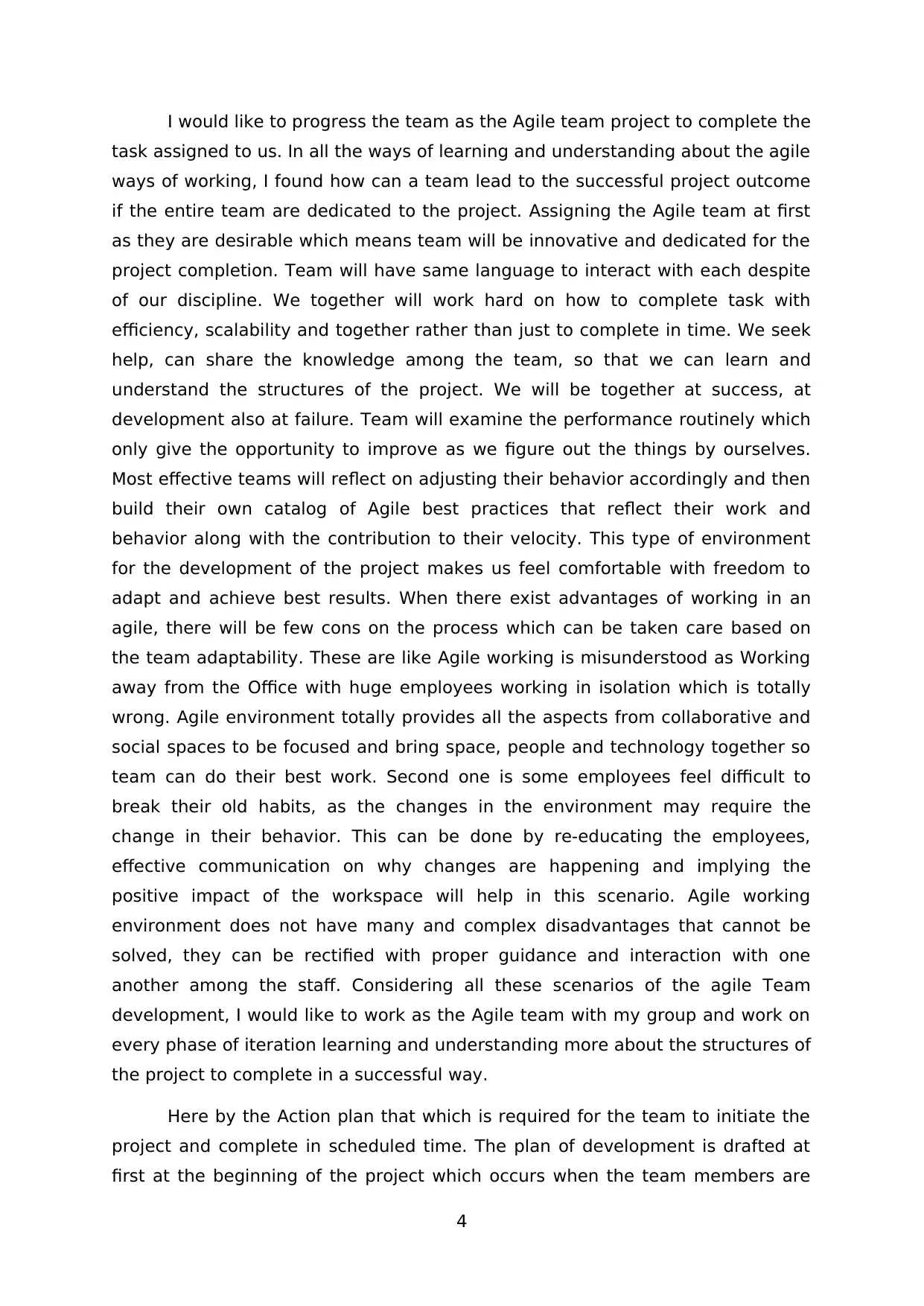
I would like to progress the team as the Agile team project to complete the
task assigned to us. In all the ways of learning and understanding about the agile
ways of working, I found how can a team lead to the successful project outcome
if the entire team are dedicated to the project. Assigning the Agile team at first
as they are desirable which means team will be innovative and dedicated for the
project completion. Team will have same language to interact with each despite
of our discipline. We together will work hard on how to complete task with
efficiency, scalability and together rather than just to complete in time. We seek
help, can share the knowledge among the team, so that we can learn and
understand the structures of the project. We will be together at success, at
development also at failure. Team will examine the performance routinely which
only give the opportunity to improve as we figure out the things by ourselves.
Most effective teams will reflect on adjusting their behavior accordingly and then
build their own catalog of Agile best practices that reflect their work and
behavior along with the contribution to their velocity. This type of environment
for the development of the project makes us feel comfortable with freedom to
adapt and achieve best results. When there exist advantages of working in an
agile, there will be few cons on the process which can be taken care based on
the team adaptability. These are like Agile working is misunderstood as Working
away from the Office with huge employees working in isolation which is totally
wrong. Agile environment totally provides all the aspects from collaborative and
social spaces to be focused and bring space, people and technology together so
team can do their best work. Second one is some employees feel difficult to
break their old habits, as the changes in the environment may require the
change in their behavior. This can be done by re-educating the employees,
effective communication on why changes are happening and implying the
positive impact of the workspace will help in this scenario. Agile working
environment does not have many and complex disadvantages that cannot be
solved, they can be rectified with proper guidance and interaction with one
another among the staff. Considering all these scenarios of the agile Team
development, I would like to work as the Agile team with my group and work on
every phase of iteration learning and understanding more about the structures of
the project to complete in a successful way.
Here by the Action plan that which is required for the team to initiate the
project and complete in scheduled time. The plan of development is drafted at
first at the beginning of the project which occurs when the team members are
4
task assigned to us. In all the ways of learning and understanding about the agile
ways of working, I found how can a team lead to the successful project outcome
if the entire team are dedicated to the project. Assigning the Agile team at first
as they are desirable which means team will be innovative and dedicated for the
project completion. Team will have same language to interact with each despite
of our discipline. We together will work hard on how to complete task with
efficiency, scalability and together rather than just to complete in time. We seek
help, can share the knowledge among the team, so that we can learn and
understand the structures of the project. We will be together at success, at
development also at failure. Team will examine the performance routinely which
only give the opportunity to improve as we figure out the things by ourselves.
Most effective teams will reflect on adjusting their behavior accordingly and then
build their own catalog of Agile best practices that reflect their work and
behavior along with the contribution to their velocity. This type of environment
for the development of the project makes us feel comfortable with freedom to
adapt and achieve best results. When there exist advantages of working in an
agile, there will be few cons on the process which can be taken care based on
the team adaptability. These are like Agile working is misunderstood as Working
away from the Office with huge employees working in isolation which is totally
wrong. Agile environment totally provides all the aspects from collaborative and
social spaces to be focused and bring space, people and technology together so
team can do their best work. Second one is some employees feel difficult to
break their old habits, as the changes in the environment may require the
change in their behavior. This can be done by re-educating the employees,
effective communication on why changes are happening and implying the
positive impact of the workspace will help in this scenario. Agile working
environment does not have many and complex disadvantages that cannot be
solved, they can be rectified with proper guidance and interaction with one
another among the staff. Considering all these scenarios of the agile Team
development, I would like to work as the Agile team with my group and work on
every phase of iteration learning and understanding more about the structures of
the project to complete in a successful way.
Here by the Action plan that which is required for the team to initiate the
project and complete in scheduled time. The plan of development is drafted at
first at the beginning of the project which occurs when the team members are
4

selected. This action plan needs few characteristics of the Team such as the
capability to self-organize, Small team size around 4-7 members as the
personality clashes if they are more, they will be a Project Manager for
monitoring but No line of Command by the person as every team member will
work as the manager in their own task, Team member is not given the fixed role
in entire project plan. The role of the member may change based on the scenario
or phase of the project. The best model that I referred and researched to the
team is developed by the Dr Meredith Belbin with 9 different personalities to be
found in a team. A new action plan can be developed for the better perception of
the successful project management.
CONCLUSION: Agile ways of working gives an idea for the assigning the major
parts of the project roles among the team members to work as a group and
attain the effective outcomes. Learning the project aspects from the team
members to involve in every phase of the development of the project, makes the
skilled person. Adjusting with the behavior of the environment which is required
at the workspace as the agile environment provides everything that is required
for the freedom of the employees. The action plan and project phase are
described at the beginning of the project to complete the task in the given time
with continuously iterations to be analyzed. Recommending as the part of the
Agile Project Management, I would prefer to form the Agile Team and working
ways to complete the tasks in the Agile environment by progressing into the
Project Development Phase.
References
Cottmeyer, M. (2015, 02 27). What is Agile Team and How do you form them.
Retrieved from Agile transformation:
https://www.leadingagile.com/2015/02/what-is-an-agile-team-and-how-do-
you-form-them/
Lynn, R. (2016). Agile Best Practices for More Effective Teams. Retrieved from
planview: https://www.planview.com/resources/guide/agile-methodologies-
a-beginners-guide/agile-best-practices-effective-teams/
Scottwambler. (2020). Roles on Agile Teams: From Small to Large Teams.
Retrieved from Ambysoft:
http://www.ambysoft.com/essays/agileRoles.html
Thakur, M. (2020). Agile Ways of Workinh. Retrieved from EDUCBA:
https://www.educba.com/agile-ways-of-working/
5
capability to self-organize, Small team size around 4-7 members as the
personality clashes if they are more, they will be a Project Manager for
monitoring but No line of Command by the person as every team member will
work as the manager in their own task, Team member is not given the fixed role
in entire project plan. The role of the member may change based on the scenario
or phase of the project. The best model that I referred and researched to the
team is developed by the Dr Meredith Belbin with 9 different personalities to be
found in a team. A new action plan can be developed for the better perception of
the successful project management.
CONCLUSION: Agile ways of working gives an idea for the assigning the major
parts of the project roles among the team members to work as a group and
attain the effective outcomes. Learning the project aspects from the team
members to involve in every phase of the development of the project, makes the
skilled person. Adjusting with the behavior of the environment which is required
at the workspace as the agile environment provides everything that is required
for the freedom of the employees. The action plan and project phase are
described at the beginning of the project to complete the task in the given time
with continuously iterations to be analyzed. Recommending as the part of the
Agile Project Management, I would prefer to form the Agile Team and working
ways to complete the tasks in the Agile environment by progressing into the
Project Development Phase.
References
Cottmeyer, M. (2015, 02 27). What is Agile Team and How do you form them.
Retrieved from Agile transformation:
https://www.leadingagile.com/2015/02/what-is-an-agile-team-and-how-do-
you-form-them/
Lynn, R. (2016). Agile Best Practices for More Effective Teams. Retrieved from
planview: https://www.planview.com/resources/guide/agile-methodologies-
a-beginners-guide/agile-best-practices-effective-teams/
Scottwambler. (2020). Roles on Agile Teams: From Small to Large Teams.
Retrieved from Ambysoft:
http://www.ambysoft.com/essays/agileRoles.html
Thakur, M. (2020). Agile Ways of Workinh. Retrieved from EDUCBA:
https://www.educba.com/agile-ways-of-working/
5
⊘ This is a preview!⊘
Do you want full access?
Subscribe today to unlock all pages.

Trusted by 1+ million students worldwide

Whitepaper. (2014, 08 20). Reflective practice in a team new to agile. Retrieved
from Project Manager.com.au: https://projectmanager.com.au/reflective-
practice-in-a-team-new-to-agile/
6
from Project Manager.com.au: https://projectmanager.com.au/reflective-
practice-in-a-team-new-to-agile/
6
1 out of 7
Related Documents
Your All-in-One AI-Powered Toolkit for Academic Success.
 +13062052269
info@desklib.com
Available 24*7 on WhatsApp / Email
Unlock your academic potential
Copyright © 2020–2026 A2Z Services. All Rights Reserved. Developed and managed by ZUCOL.