UNCC300 Essay: Human Dignity, Advocacy, and Aging Community Engagement

Verified

Added on  2023/01/19

|9
|1575
|43
Essay
AI Summary
This essay delves into the multifaceted challenges associated with the aging crisis, examining the roles of human dignity, advocacy, and community engagement within the framework of Catholic Social Teaching (CST). The author explores the impact of telehealth services and the increasing life expectancy of the elderly, emphasizing the importance of community good and shared responsibility in addressing the crisis. The essay analyzes the sociological aspects, referencing the prevalence of nursing homes in countries like the USA and Australia, and highlights the influence of advocacy in shaping policies. It underscores the relevance of CST principles, particularly the 'call to family,' in addressing the crisis, advocating for a shift towards a culture of joint family and emphasizing the importance of human dignity for the elderly, including their need for emotional support and respect. The essay concludes by calling for a restructuring of societal values to prioritize the well-being and dignity of the elderly, offering a call to action in light of CST guidelines.

Document Page
1
tabler-icon-diamond-filled.svg

Paraphrase This Document

Need a fresh take? Get an instant paraphrase of this document with our AI Paraphraser
Document Page
Human Dignity, Advocacy and Community engagement holds the key to solve "the
crisis associated with the aging"
2
Document Page
Introduction
Many developed countries of the world are working hard to commission Telehealth services
for the elderly in their country. The systems associated with the Telehealth systems will allow
the experts to keep an eye on the elderly patients from a remote location. This is a sincere
effort that they are making in order to establish a direct last mile reach with the patient. Let’s
felicitate the medical fraternity that their efforts are paying off and the average age of the
world is increasing because the life expectancy of the elderly people has increased (Rocha,
2019).
The concept of the advocacy promoted by the Roman Catholic Church certainly promotes
these types of endeavors where a stronger section of the society shows its commitment
towards a weaker section of the society. In the previous assignment of this study, we
elaborated about the problems related to an increase in the population of elderly people
(Petrova, 2019). The summary of our study gives us an idea that the focus of the reforms or
the solution is more on the side of the creation of community good or the sharing of the
responsibility rather than addressing the problem at a micro level. It tells us about a lack of
intent among the individuals to attend certain duties described by the CST concept of “Call to
family .”
In the previous assignment, we tried to decipher the problem under a biblical framework. In
the current assignment, we will try to evaluate and fix the roles of various macro and micro
institutions of the society under the framework of CST and other thought processes.
Community engagement can convert it into a culture
3
Document Page
Let's now check the same fact from a sociological point of view under the light of another
fact that belongs to the USA. In the USA more than six percent of the elderly people are
living in nursing homes as permanent residents. The definition of a nursing home gives us an
idea that it is a transit place where the patient spends sometime because he needs some expert
care. Right now the USA has more than 15000 such as nursing homes where elderly people
are living the life of a destitute. This huge number of nursing homes is an achievement of US
administration. It shows that powers behind the advocacy of the rights of the elderly people
are active and influencing the policymakers of the country.
When we check the case of Australia we find that more than one hundred and seventy
thousands of elderly people are living in two thousand seven hundred nursing homes in
Australia. We can also produce a tall list of NGO’s taking care of the interests of these
elderly people. All these numbers are giving us an idea that a big community good for the
greater interest of the elderly people has been developed in society. When we check this
development from the prism of the advocacy then we find that this number supports the basic
principle of the Catholic advocacy. The advocacy gives us a framework that works in the
direction of the benefits for the weaker sections of the society. The figures associated with
these two developed nations have a remarkable similarity with the figures of other countries
as well. This similarity prompts us to call it a global phenomenon.
4
tabler-icon-diamond-filled.svg

Paraphrase This Document

Need a fresh take? Get an instant paraphrase of this document with our AI Paraphraser
Document Page
The principles of Catholic advocacy are not dependent on the political beliefs; they are more
about Biblical teachings and right moral values for the society. The presence of the nursing
home and the culture for the welfare of the elderly members of our society is in
synchronization with the concept of attending the needs of the weaker section of the society
rather than strengthening the powerful sectors of the society. Most of these nursing homes are
commercial ventures where they serve the elderly people after charging a nominal charge.
The promotion of these commercial ventures can become a culture for future generations. It
is a healthy culture by all the standards unless micro institutions like nuclear family and
others don't start using as a tool to wash hands from their own responsibilities (Needham,
2017).
Call to family and human dignity defined in CST has the answers ready for the main
problem
The teachings of CST clearly indicate that the essence of the CST never changes with the
change in the social tapestry of the society. One of the major changes that our society has
seen is in terms of a shift from the system of liberalism towards the neo-liberalism (Hopler,
2009). The principle of CST and advocacy clearly says that they are ahead of social systems
and changes. In the present case, this unchanged nature of CST and advocacy has the
potential to cater to the main problem diagnosed by us in the previous assignment. In the
previous assignment, we figured out that it is not the means but the intents of the micro
organizations like family are serving as the prime reason behind the crisis that elderly people
are facing in our society (White, 2016)
.
5
Document Page
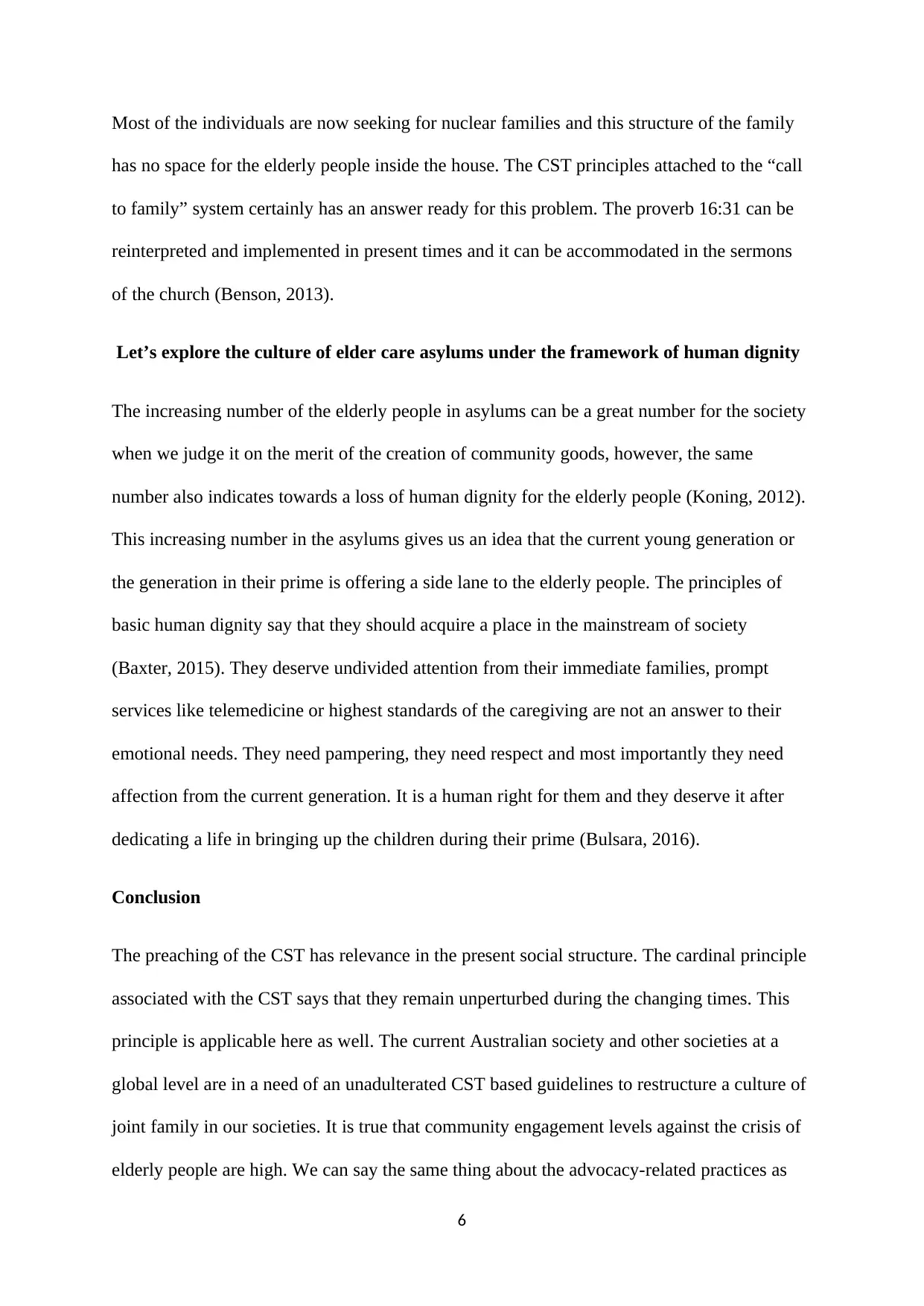
Most of the individuals are now seeking for nuclear families and this structure of the family
has no space for the elderly people inside the house. The CST principles attached to the “call
to family” system certainly has an answer ready for this problem. The proverb 16:31 can be
reinterpreted and implemented in present times and it can be accommodated in the sermons
of the church (Benson, 2013).
Let’s explore the culture of elder care asylums under the framework of human dignity
The increasing number of the elderly people in asylums can be a great number for the society
when we judge it on the merit of the creation of community goods, however, the same
number also indicates towards a loss of human dignity for the elderly people (Koning, 2012).
This increasing number in the asylums gives us an idea that the current young generation or
the generation in their prime is offering a side lane to the elderly people. The principles of
basic human dignity say that they should acquire a place in the mainstream of society
(Baxter, 2015). They deserve undivided attention from their immediate families, prompt
services like telemedicine or highest standards of the caregiving are not an answer to their
emotional needs. They need pampering, they need respect and most importantly they need
affection from the current generation. It is a human right for them and they deserve it after
dedicating a life in bringing up the children during their prime (Bulsara, 2016).
Conclusion
The preaching of the CST has relevance in the present social structure. The cardinal principle
associated with the CST says that they remain unperturbed during the changing times. This
principle is applicable here as well. The current Australian society and other societies at a
global level are in a need of an unadulterated CST based guidelines to restructure a culture of
joint family in our societies. It is true that community engagement levels against the crisis of
elderly people are high. We can say the same thing about the advocacy-related practices as
6
Document Page
well. However, it is the area of the call to a family where our society needs a new booster to
settle a few things in favor of the human dignity of the elderly people.
7
tabler-icon-diamond-filled.svg

Paraphrase This Document

Need a fresh take? Get an instant paraphrase of this document with our AI Paraphraser
Document Page
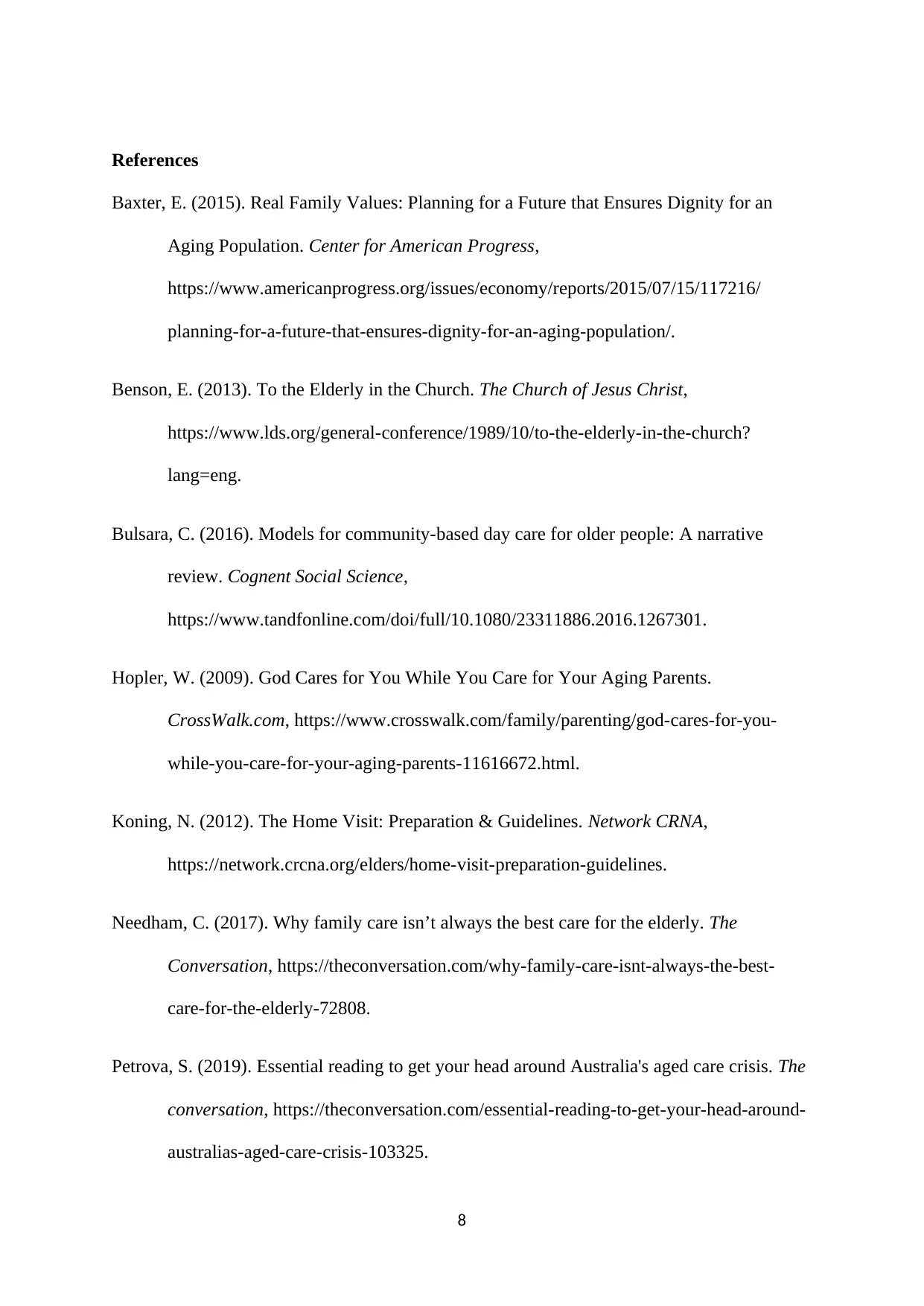
References
Baxter, E. (2015). Real Family Values: Planning for a Future that Ensures Dignity for an
Aging Population. Center for American Progress,
https://www.americanprogress.org/issues/economy/reports/2015/07/15/117216/
planning-for-a-future-that-ensures-dignity-for-an-aging-population/.
Benson, E. (2013). To the Elderly in the Church. The Church of Jesus Christ,
https://www.lds.org/general-conference/1989/10/to-the-elderly-in-the-church?
lang=eng.
Bulsara, C. (2016). Models for community-based day care for older people: A narrative
review. Cognent Social Science,
https://www.tandfonline.com/doi/full/10.1080/23311886.2016.1267301.
Hopler, W. (2009). God Cares for You While You Care for Your Aging Parents.
CrossWalk.com, https://www.crosswalk.com/family/parenting/god-cares-for-you-
while-you-care-for-your-aging-parents-11616672.html.
Koning, N. (2012). The Home Visit: Preparation & Guidelines. Network CRNA,
https://network.crcna.org/elders/home-visit-preparation-guidelines.
Needham, C. (2017). Why family care isn’t always the best care for the elderly. The
Conversation, https://theconversation.com/why-family-care-isnt-always-the-best-
care-for-the-elderly-72808.
Petrova, S. (2019). Essential reading to get your head around Australia's aged care crisis. The
conversation, https://theconversation.com/essential-reading-to-get-your-head-around-
australias-aged-care-crisis-103325.
8
Document Page
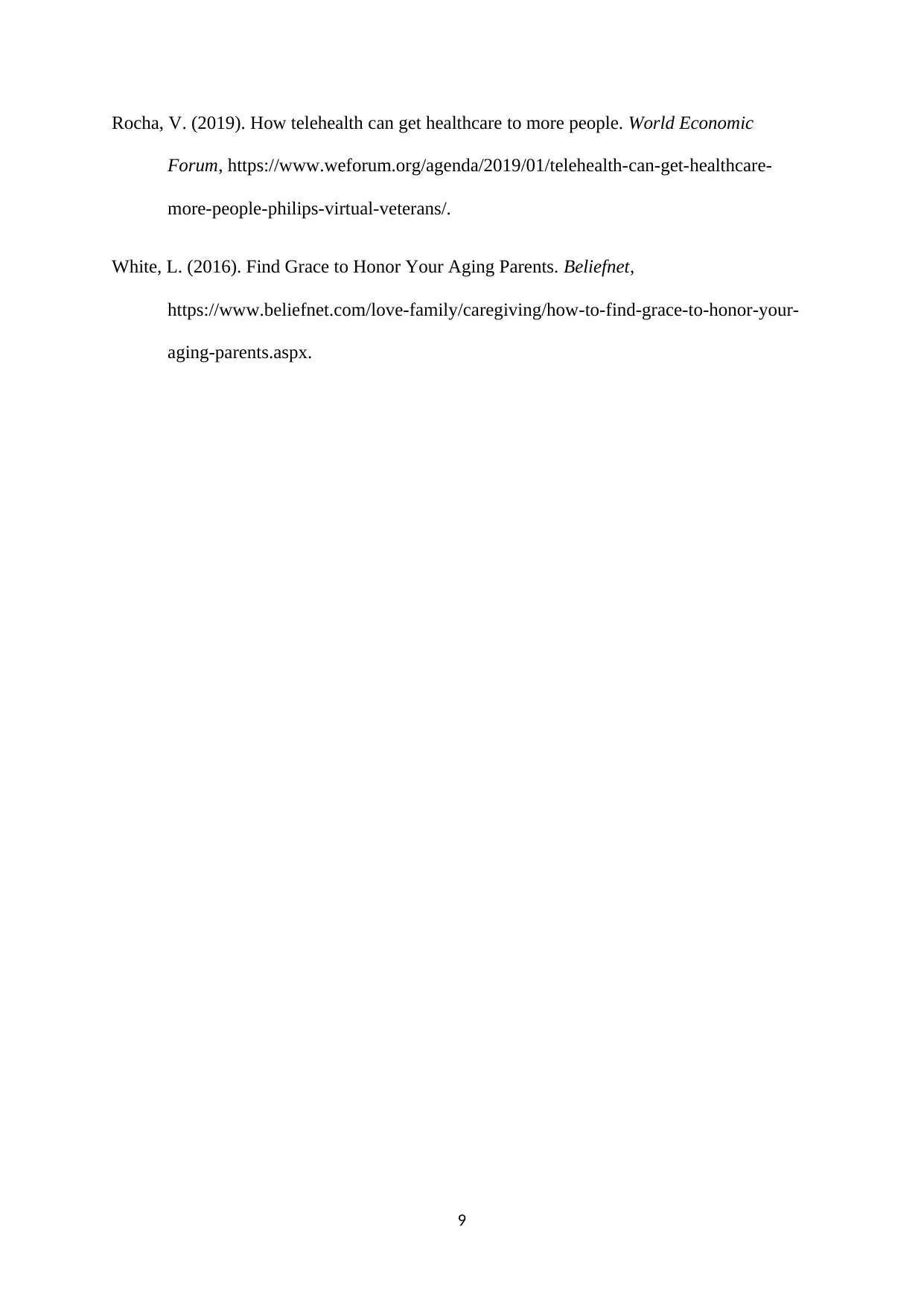
Rocha, V. (2019). How telehealth can get healthcare to more people. World Economic
Forum, https://www.weforum.org/agenda/2019/01/telehealth-can-get-healthcare-
more-people-philips-virtual-veterans/.
White, L. (2016). Find Grace to Honor Your Aging Parents. Beliefnet,
https://www.beliefnet.com/love-family/caregiving/how-to-find-grace-to-honor-your-
aging-parents.aspx.
9
chevron_up_icon
1 out of 9
circle_padding
hide_on_mobile
zoom_out_icon
[object Object]