Air Accidents: A Comparative Report on Algerian Air Disasters
VerifiedAdded on 2023/06/14
|12
|2548
|431
Report
AI Summary
This report provides a comparative analysis of two significant air accidents: Air Algerie Flight 6289 and the Algerian Air Force II-76 crash. It examines the circumstances surrounding each accident, including potential causes such as technical errors, machine failures, and the absence of human factors. The report applies the Swiss Cheese Model to the Air Algerie crash and the SHELL model to the Algerian Air Force crash to understand the contributing factors. It identifies similarities between the two incidents, such as crashes occurring shortly after takeoff and a high number of fatalities. Furthermore, the report discusses crucial lessons learned, emphasizing the need for enhanced crew training, advanced aircraft technology, and the importance of remaining calm in emergency situations. The report also touches upon the Dirty Dozen model, highlighting common human errors that can lead to accidents, such as lack of communication, complacency, and fatigue. The conclusion underscores the importance of continuous improvement in aviation safety to mitigate the risk of future accidents.
Comparative Report
Involving Air Accidents
Involving Air Accidents

Paraphrase This Document
Need a fresh take? Get an instant paraphrase of this document with our AI Paraphraser
Table of Contents
INTRODUCTION ..........................................................................................................................4
Air accidents.............................................................................................................................4.1
Second Accident( Algerian Air Force II-76 crash)..................................................................4.2
Swiss Cheese Model.................................................................................................................4.
Shell Model................................................................................................................................6
Similarities between the crash of Air Algerie flight 6289 and Algerian Air Force Ilyushin Il-
76.................................................................................................................................................7
Lessons learned from both these crashes....................................................................................8
CONCLUSION ...............................................................................................................................8
REFERENCES..............................................................................................................................10
INTRODUCTION ..........................................................................................................................4
Air accidents.............................................................................................................................4.1
Second Accident( Algerian Air Force II-76 crash)..................................................................4.2
Swiss Cheese Model.................................................................................................................4.
Shell Model................................................................................................................................6
Similarities between the crash of Air Algerie flight 6289 and Algerian Air Force Ilyushin Il-
76.................................................................................................................................................7
Lessons learned from both these crashes....................................................................................8
CONCLUSION ...............................................................................................................................8
REFERENCES..............................................................................................................................10
INTRODUCTION
Human factor in aviation basically refers to the better understanding that in which
manner humans can save themselves into more efficient manner with the integrated technology.
This type of understanding basically translated into training, design, procedures or policies to
support humans to perform into better manner. Within the aviation sector, the main human
factors are physiological, physical, psychological and psychosocial factors as well. The role of
human factors within the aviation industry is very significant because they have an impact on the
parameter of safety and in which manner people interact with each other and also act as an
important part of management of safety. The report will cover discussion about the two major air
accidents within the aviation industry. The first accident is about Air Alegerie flight 6289 and
another accident is about Algerian Air Force II-76 crash.
Air accidents
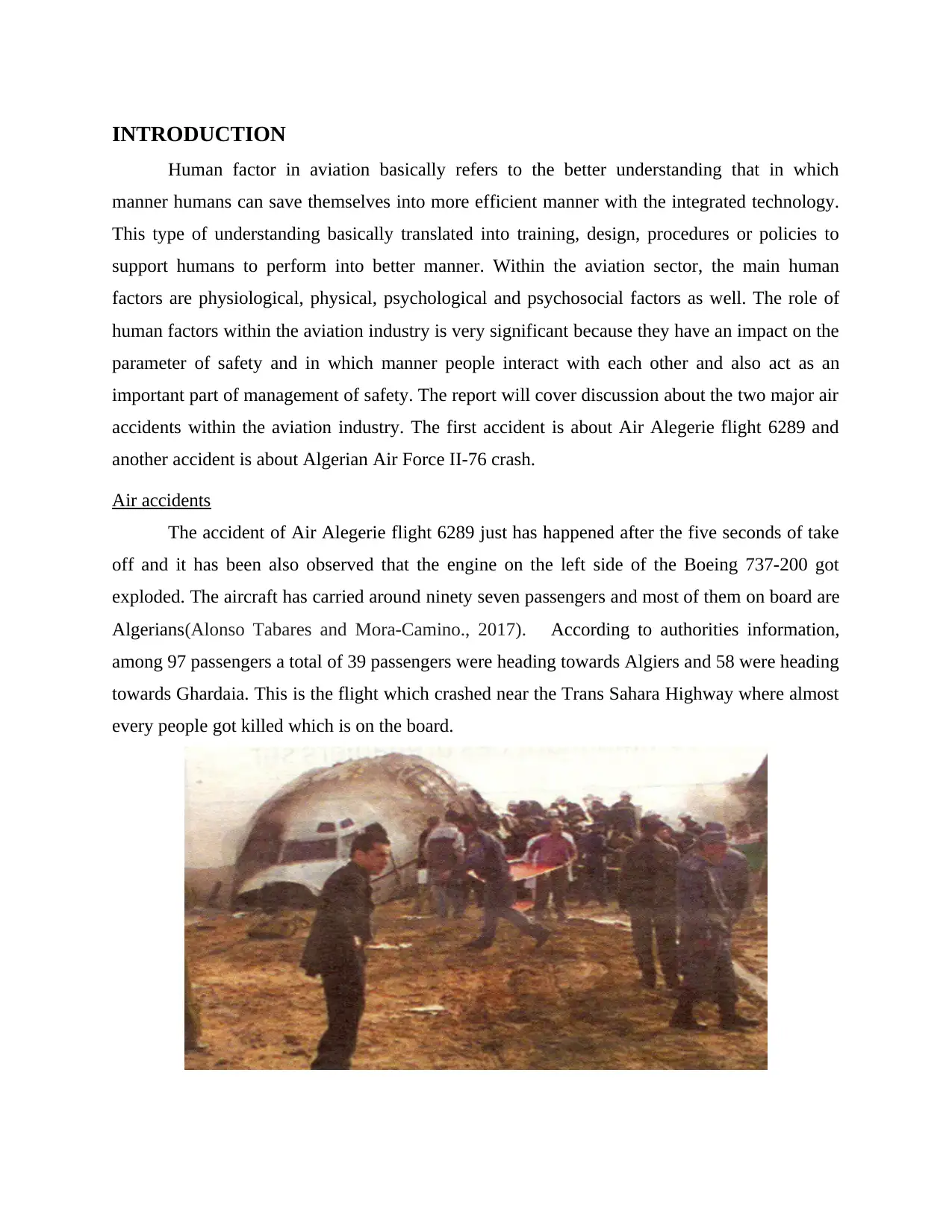
The accident of Air Alegerie flight 6289 just has happened after the five seconds of take
off and it has been also observed that the engine on the left side of the Boeing 737-200 got
exploded. The aircraft has carried around ninety seven passengers and most of them on board are
Algerians(Alonso Tabares and Mora-Camino., 2017). According to authorities information,
among 97 passengers a total of 39 passengers were heading towards Algiers and 58 were heading
towards Ghardaia. This is the flight which crashed near the Trans Sahara Highway where almost
every people got killed which is on the board.
Human factor in aviation basically refers to the better understanding that in which
manner humans can save themselves into more efficient manner with the integrated technology.
This type of understanding basically translated into training, design, procedures or policies to
support humans to perform into better manner. Within the aviation sector, the main human
factors are physiological, physical, psychological and psychosocial factors as well. The role of
human factors within the aviation industry is very significant because they have an impact on the
parameter of safety and in which manner people interact with each other and also act as an
important part of management of safety. The report will cover discussion about the two major air
accidents within the aviation industry. The first accident is about Air Alegerie flight 6289 and
another accident is about Algerian Air Force II-76 crash.
Air accidents
The accident of Air Alegerie flight 6289 just has happened after the five seconds of take
off and it has been also observed that the engine on the left side of the Boeing 737-200 got
exploded. The aircraft has carried around ninety seven passengers and most of them on board are
Algerians(Alonso Tabares and Mora-Camino., 2017). According to authorities information,
among 97 passengers a total of 39 passengers were heading towards Algiers and 58 were heading
towards Ghardaia. This is the flight which crashed near the Trans Sahara Highway where almost
every people got killed which is on the board.
⊘ This is a preview!⊘
Do you want full access?
Subscribe today to unlock all pages.

Trusted by 1+ million students worldwide
Second Accident( Algerian Air Force II-76 crash)
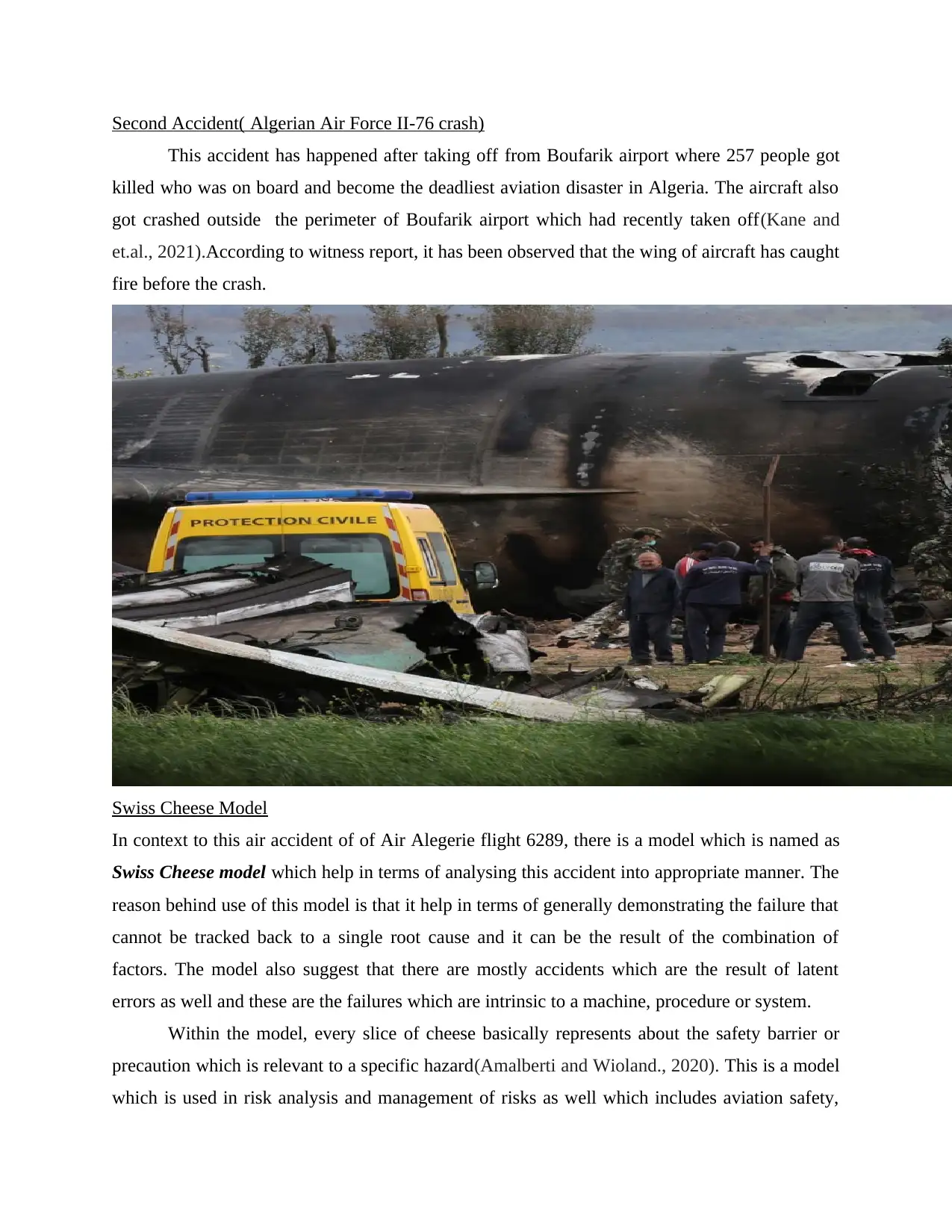
This accident has happened after taking off from Boufarik airport where 257 people got
killed who was on board and become the deadliest aviation disaster in Algeria. The aircraft also
got crashed outside the perimeter of Boufarik airport which had recently taken off(Kane and
et.al., 2021).According to witness report, it has been observed that the wing of aircraft has caught
fire before the crash.
Swiss Cheese Model
In context to this air accident of of Air Alegerie flight 6289, there is a model which is named as
Swiss Cheese model which help in terms of analysing this accident into appropriate manner. The
reason behind use of this model is that it help in terms of generally demonstrating the failure that
cannot be tracked back to a single root cause and it can be the result of the combination of
factors. The model also suggest that there are mostly accidents which are the result of latent
errors as well and these are the failures which are intrinsic to a machine, procedure or system.
Within the model, every slice of cheese basically represents about the safety barrier or
precaution which is relevant to a specific hazard(Amalberti and Wioland., 2020). This is a model
which is used in risk analysis and management of risks as well which includes aviation safety,
This accident has happened after taking off from Boufarik airport where 257 people got
killed who was on board and become the deadliest aviation disaster in Algeria. The aircraft also
got crashed outside the perimeter of Boufarik airport which had recently taken off(Kane and
et.al., 2021).According to witness report, it has been observed that the wing of aircraft has caught
fire before the crash.
Swiss Cheese Model
In context to this air accident of of Air Alegerie flight 6289, there is a model which is named as
Swiss Cheese model which help in terms of analysing this accident into appropriate manner. The
reason behind use of this model is that it help in terms of generally demonstrating the failure that
cannot be tracked back to a single root cause and it can be the result of the combination of
factors. The model also suggest that there are mostly accidents which are the result of latent
errors as well and these are the failures which are intrinsic to a machine, procedure or system.
Within the model, every slice of cheese basically represents about the safety barrier or
precaution which is relevant to a specific hazard(Amalberti and Wioland., 2020). This is a model
which is used in risk analysis and management of risks as well which includes aviation safety,
Paraphrase This Document
Need a fresh take? Get an instant paraphrase of this document with our AI Paraphraser
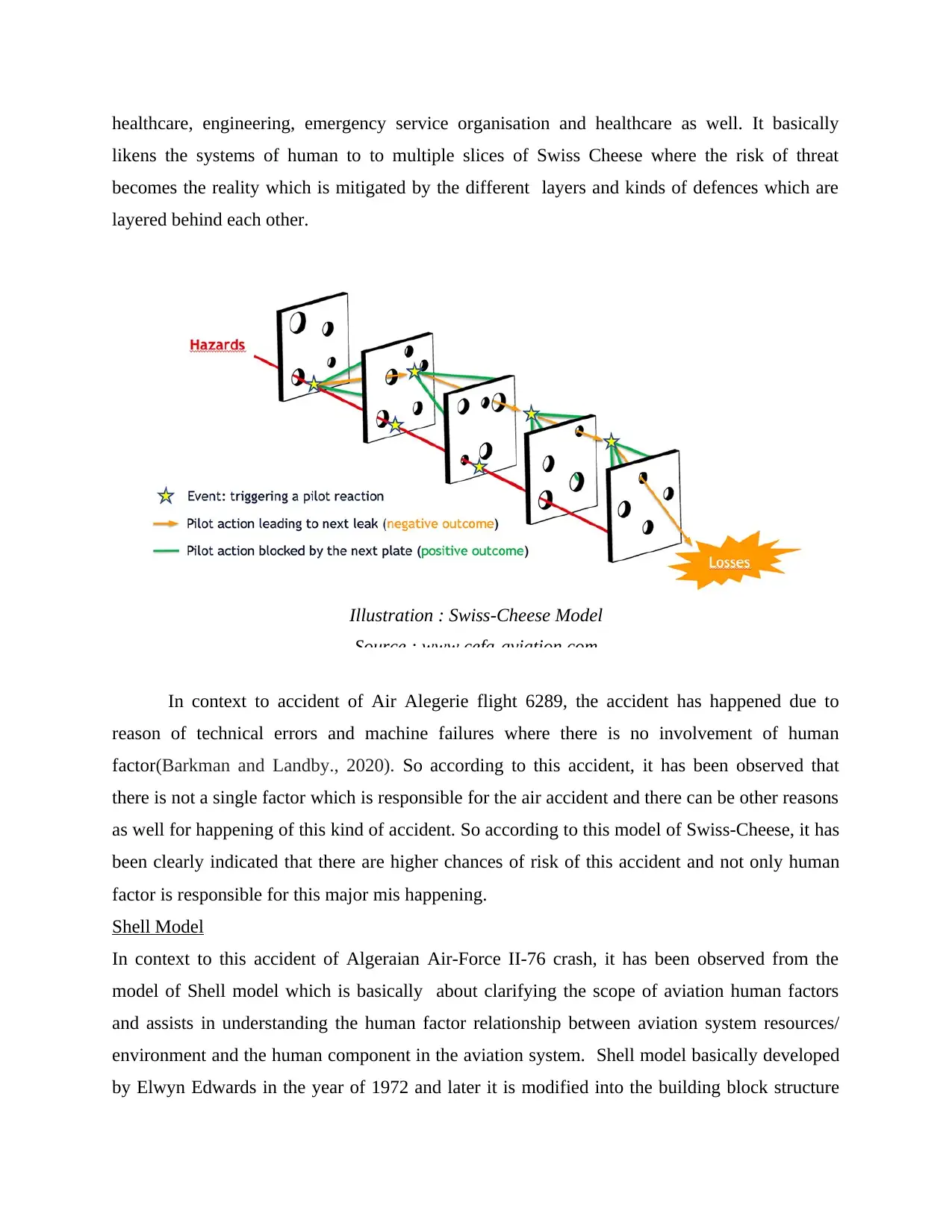
healthcare, engineering, emergency service organisation and healthcare as well. It basically
likens the systems of human to to multiple slices of Swiss Cheese where the risk of threat
becomes the reality which is mitigated by the different layers and kinds of defences which are
layered behind each other.
In context to accident of Air Alegerie flight 6289, the accident has happened due to
reason of technical errors and machine failures where there is no involvement of human
factor(Barkman and Landby., 2020). So according to this accident, it has been observed that
there is not a single factor which is responsible for the air accident and there can be other reasons
as well for happening of this kind of accident. So according to this model of Swiss-Cheese, it has
been clearly indicated that there are higher chances of risk of this accident and not only human
factor is responsible for this major mis happening.
Shell Model
In context to this accident of Algeraian Air-Force II-76 crash, it has been observed from the
model of Shell model which is basically about clarifying the scope of aviation human factors
and assists in understanding the human factor relationship between aviation system resources/
environment and the human component in the aviation system. Shell model basically developed
by Elwyn Edwards in the year of 1972 and later it is modified into the building block structure
Illustration : Swiss-Cheese Model
Source : www.cefa-aviation.com
likens the systems of human to to multiple slices of Swiss Cheese where the risk of threat
becomes the reality which is mitigated by the different layers and kinds of defences which are
layered behind each other.
In context to accident of Air Alegerie flight 6289, the accident has happened due to
reason of technical errors and machine failures where there is no involvement of human
factor(Barkman and Landby., 2020). So according to this accident, it has been observed that
there is not a single factor which is responsible for the air accident and there can be other reasons
as well for happening of this kind of accident. So according to this model of Swiss-Cheese, it has
been clearly indicated that there are higher chances of risk of this accident and not only human
factor is responsible for this major mis happening.
Shell Model
In context to this accident of Algeraian Air-Force II-76 crash, it has been observed from the
model of Shell model which is basically about clarifying the scope of aviation human factors
and assists in understanding the human factor relationship between aviation system resources/
environment and the human component in the aviation system. Shell model basically developed
by Elwyn Edwards in the year of 1972 and later it is modified into the building block structure
Illustration : Swiss-Cheese Model
Source : www.cefa-aviation.com
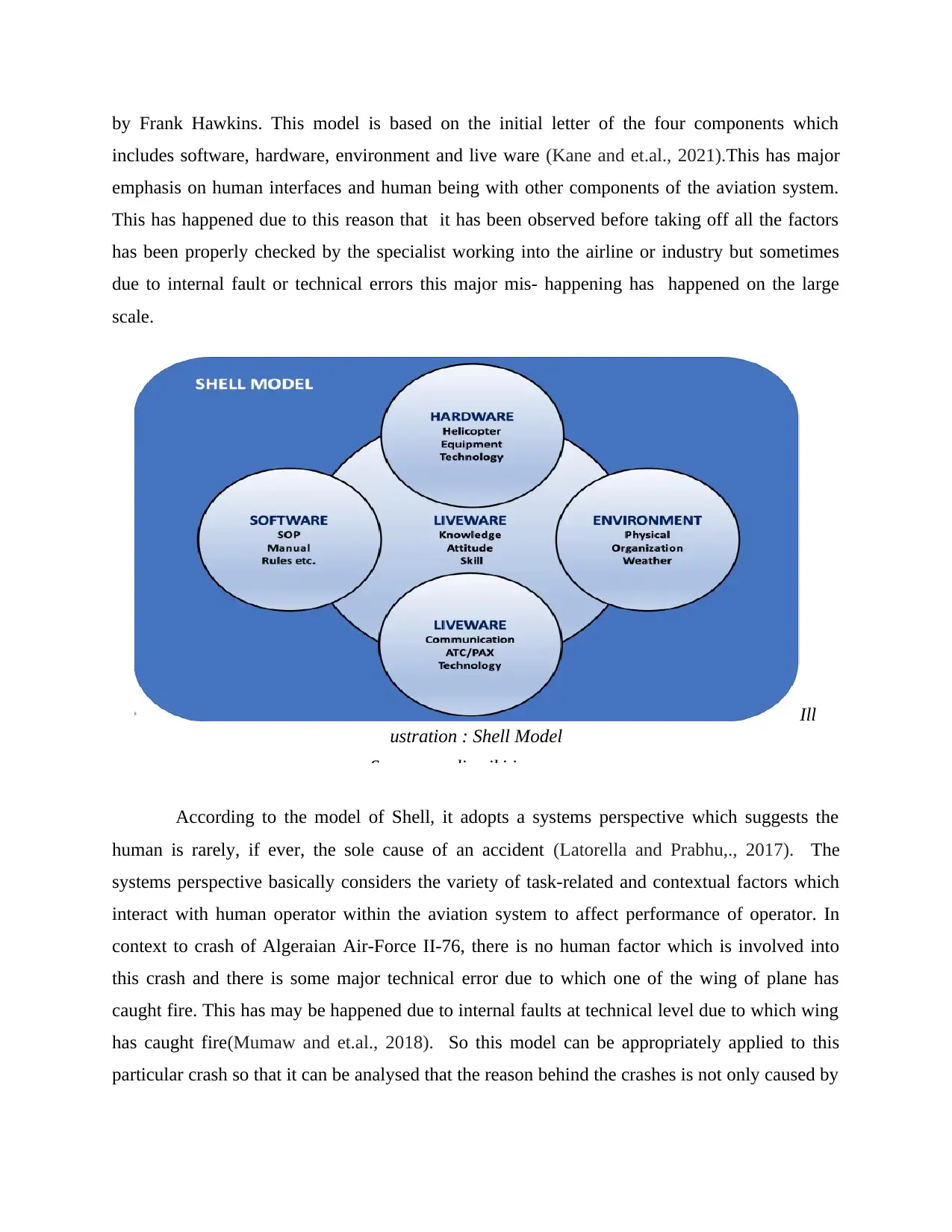
by Frank Hawkins. This model is based on the initial letter of the four components which
includes software, hardware, environment and live ware (Kane and et.al., 2021).This has major
emphasis on human interfaces and human being with other components of the aviation system.
This has happened due to this reason that it has been observed before taking off all the factors
has been properly checked by the specialist working into the airline or industry but sometimes
due to internal fault or technical errors this major mis- happening has happened on the large
scale.
According to the model of Shell, it adopts a systems perspective which suggests the
human is rarely, if ever, the sole cause of an accident (Latorella and Prabhu,., 2017). The
systems perspective basically considers the variety of task-related and contextual factors which
interact with human operator within the aviation system to affect performance of operator. In
context to crash of Algeraian Air-Force II-76, there is no human factor which is involved into
this crash and there is some major technical error due to which one of the wing of plane has
caught fire. This has may be happened due to internal faults at technical level due to which wing
has caught fire(Mumaw and et.al., 2018). So this model can be appropriately applied to this
particular crash so that it can be analysed that the reason behind the crashes is not only caused by
Ill
ustration : Shell Model
Souce : mediawiki.ivao.aero
includes software, hardware, environment and live ware (Kane and et.al., 2021).This has major
emphasis on human interfaces and human being with other components of the aviation system.
This has happened due to this reason that it has been observed before taking off all the factors
has been properly checked by the specialist working into the airline or industry but sometimes
due to internal fault or technical errors this major mis- happening has happened on the large
scale.
According to the model of Shell, it adopts a systems perspective which suggests the
human is rarely, if ever, the sole cause of an accident (Latorella and Prabhu,., 2017). The
systems perspective basically considers the variety of task-related and contextual factors which
interact with human operator within the aviation system to affect performance of operator. In
context to crash of Algeraian Air-Force II-76, there is no human factor which is involved into
this crash and there is some major technical error due to which one of the wing of plane has
caught fire. This has may be happened due to internal faults at technical level due to which wing
has caught fire(Mumaw and et.al., 2018). So this model can be appropriately applied to this
particular crash so that it can be analysed that the reason behind the crashes is not only caused by
Ill
ustration : Shell Model
Souce : mediawiki.ivao.aero
⊘ This is a preview!⊘
Do you want full access?
Subscribe today to unlock all pages.
Trusted by 1+ million students worldwide
the human factor. There can be machines and technical faults which are responsible for this kind
of major mis- happening.
Similarities between the crash of Air Algerie flight 6289 and Algerian Air Force Ilyushin Il-76
There are various similarities between both the crashes due to which both the flights have
to face various causalities on large scale. According to report of both the crashes, both flights got
crashed after take off due to careless nature of not checking the flights into appropriate manner.
In both the crashes almost all the people got killed who are on the board condition. In both the
flights have experienced pilots but they can't handle the situation into appropriate manner. In
both the flights have appropriate crew members who also can't handle such large number of
passengers and both have tried to cooperate with each other but still they can't be successful in
terms of stopping this situation from this big causality. Both flights were from Algeria country.
In both these crashes, it was basically the deadliest aviation disaster in the soil of Algeria.
It has been observed that in both these crashes, appropriate corrective actions can't be
taken and if the corrective actions has been taken but they can't be implemented into successful
manner. In both the crashes, all crew members and passengers were killed and there were many
families who lost the lives of their family members. The major point of similarity was that the
crash has happened after take off of the flight. In the first air accident case, the crash has been
happened due to error of flight crew which was followed by the failure of an engine shortly after
take off. In the second air accident case, the crash has been happened due to reason that one of
the wing of aircraft caught fire. Both these crashes showed that it was a kind of action which was
happened due to not checking all the parameters with corrective actions and it also showed that
due to lack of training and experience both the crashes has been happened and they can't save
themselves from this big causality.
Lessons learned from both these crashes
The lessons learned from both these crashes is that the crew members and pilot have to be
trained enough and the training should be like in this manner that it should be very strict and
handling the real life situations(Wiegmann and Shappell., 2017). From both these crashes, it has
been observed that the planes should be more technically advanced so that they can handle any
kind of problem on the immediate basis. The Algerian planes have to made amendments in their
designs and needs to be equipped from latest technologies so that they can handle any kind of
causality at the time of flying. It has been observed that accidents of flight got fired in one of the
of major mis- happening.
Similarities between the crash of Air Algerie flight 6289 and Algerian Air Force Ilyushin Il-76
There are various similarities between both the crashes due to which both the flights have
to face various causalities on large scale. According to report of both the crashes, both flights got
crashed after take off due to careless nature of not checking the flights into appropriate manner.
In both the crashes almost all the people got killed who are on the board condition. In both the
flights have experienced pilots but they can't handle the situation into appropriate manner. In
both the flights have appropriate crew members who also can't handle such large number of
passengers and both have tried to cooperate with each other but still they can't be successful in
terms of stopping this situation from this big causality. Both flights were from Algeria country.
In both these crashes, it was basically the deadliest aviation disaster in the soil of Algeria.
It has been observed that in both these crashes, appropriate corrective actions can't be
taken and if the corrective actions has been taken but they can't be implemented into successful
manner. In both the crashes, all crew members and passengers were killed and there were many
families who lost the lives of their family members. The major point of similarity was that the
crash has happened after take off of the flight. In the first air accident case, the crash has been
happened due to error of flight crew which was followed by the failure of an engine shortly after
take off. In the second air accident case, the crash has been happened due to reason that one of
the wing of aircraft caught fire. Both these crashes showed that it was a kind of action which was
happened due to not checking all the parameters with corrective actions and it also showed that
due to lack of training and experience both the crashes has been happened and they can't save
themselves from this big causality.
Lessons learned from both these crashes
The lessons learned from both these crashes is that the crew members and pilot have to be
trained enough and the training should be like in this manner that it should be very strict and
handling the real life situations(Wiegmann and Shappell., 2017). From both these crashes, it has
been observed that the planes should be more technically advanced so that they can handle any
kind of problem on the immediate basis. The Algerian planes have to made amendments in their
designs and needs to be equipped from latest technologies so that they can handle any kind of
causality at the time of flying. It has been observed that accidents of flight got fired in one of the
Paraphrase This Document
Need a fresh take? Get an instant paraphrase of this document with our AI Paraphraser
wing and this is very common so for that purpose aviation industry has to work with their
technical team so that this problem can be resolved on the priority basis.
The lesson learned from both these crashes was that members who are associated with
this industry have to build a nature of remaining calm in every kind of situation so that they can
handle situation into appropriate manner. Pilots should be more trained with more real life
situations and should have enough experience of handling with these real life accident situations.
According to the analyst of aviation, there should be a rule made regarding crew members and
they have to be in cockpit so that they can handle the situation in the case of emergency into the
cooperative manner.
According to Dirty dozen model, it basically refers to the twelve most common errors of
human preconditions or the conditions which act as precursors to incidents or accidents. These
factors basically defined into the following manner:
Lack of communication: It is the parameter which is a result of incorrect or faulty
maintenance where it can't be assumed that work has been completed. In case of verbal
communication a very short percentage of information has been received and understood
by either side in a conversation.
Complacency: Under this head, over confidence lead towards complacency.
Lack of knowledge: It means that shortage of training information and ability to perform
into successful manner.
Distractions: It is the parameter where that draws the attention of an individual away
from the task which is into the hands.
Lack of team work: It is basically the result of to work together to accomplish a shared
goal and it basically involves everyone's understanding and agreeing on the actions to be
taken.
Fatigue: It is the human factor which has contributed to many mainteance errroes as a
result of accidents.
Lack of resources: It basically include not having enough equipment, manpowetr,
documentation, parts, time in order to complete the task.
Pressure: The maintenance tasks of aviation basically requires that individual has to
perform under pressure in an environment into consistent manner to do things in a faster
and better manner without making any mistakes.
technical team so that this problem can be resolved on the priority basis.
The lesson learned from both these crashes was that members who are associated with
this industry have to build a nature of remaining calm in every kind of situation so that they can
handle situation into appropriate manner. Pilots should be more trained with more real life
situations and should have enough experience of handling with these real life accident situations.
According to the analyst of aviation, there should be a rule made regarding crew members and
they have to be in cockpit so that they can handle the situation in the case of emergency into the
cooperative manner.
According to Dirty dozen model, it basically refers to the twelve most common errors of
human preconditions or the conditions which act as precursors to incidents or accidents. These
factors basically defined into the following manner:
Lack of communication: It is the parameter which is a result of incorrect or faulty
maintenance where it can't be assumed that work has been completed. In case of verbal
communication a very short percentage of information has been received and understood
by either side in a conversation.
Complacency: Under this head, over confidence lead towards complacency.
Lack of knowledge: It means that shortage of training information and ability to perform
into successful manner.
Distractions: It is the parameter where that draws the attention of an individual away
from the task which is into the hands.
Lack of team work: It is basically the result of to work together to accomplish a shared
goal and it basically involves everyone's understanding and agreeing on the actions to be
taken.
Fatigue: It is the human factor which has contributed to many mainteance errroes as a
result of accidents.
Lack of resources: It basically include not having enough equipment, manpowetr,
documentation, parts, time in order to complete the task.
Pressure: The maintenance tasks of aviation basically requires that individual has to
perform under pressure in an environment into consistent manner to do things in a faster
and better manner without making any mistakes.
Lack of assertiveness: It occurs when person is not self confident which is enough to
speak up for their ideas and rights.
Stress: It is a chemical, physical or emotional factor which causes mental tension or
physical aspect.
Lack of awareness: It is a failure to recognise the situation, understand what it is and
predict the possible results.
Norms: These are basically unwritten rules which are followed or tolerated by most of
the organisation.
CONCLUSION
The above stated report concludes that according to current period of time air accidents
are very common issue due to which aviation industry has to made themselves more aware about
these major mis happening. It has been concluded that the air accidents has been caused by
various reasons which includes manual error, technical error and human error etc. According to
different reports, it has been observed that the major accidents has happened due to reason of
technical problems and errors. It has been determined that there are very few incidents or crashes
where chances of similarities of reason behind these crashes are similar. It has been concluded
that it is necessary that the crew members have enough experience and cockpit members have
enough experience about tackling the real life situations into appropriate manner so that these
crashes can be minimized through smart actions into positive manner. These lessons act as
advantages for the airlines that the mistakes can't be repeated on the frequent basis and aviation
industry also needs to work into deeper manner for their technical parameters.
speak up for their ideas and rights.
Stress: It is a chemical, physical or emotional factor which causes mental tension or
physical aspect.
Lack of awareness: It is a failure to recognise the situation, understand what it is and
predict the possible results.
Norms: These are basically unwritten rules which are followed or tolerated by most of
the organisation.
CONCLUSION
The above stated report concludes that according to current period of time air accidents
are very common issue due to which aviation industry has to made themselves more aware about
these major mis happening. It has been concluded that the air accidents has been caused by
various reasons which includes manual error, technical error and human error etc. According to
different reports, it has been observed that the major accidents has happened due to reason of
technical problems and errors. It has been determined that there are very few incidents or crashes
where chances of similarities of reason behind these crashes are similar. It has been concluded
that it is necessary that the crew members have enough experience and cockpit members have
enough experience about tackling the real life situations into appropriate manner so that these
crashes can be minimized through smart actions into positive manner. These lessons act as
advantages for the airlines that the mistakes can't be repeated on the frequent basis and aviation
industry also needs to work into deeper manner for their technical parameters.
⊘ This is a preview!⊘
Do you want full access?
Subscribe today to unlock all pages.
Trusted by 1+ million students worldwide
REFERENCES
Books and Journals
Alonso Tabares, D. and Mora-Camino, F., 2017. Aircraft ground handling: analysis for
automation. In 17th AIAA Aviation Technology, Integration, and Operations
Conference (p. 3425).
Amalberti, R. and Wioland, L. I. E. N., 2020. Human error in aviation. In Aviation safety (pp.
91-108). CRC Press.
Barkman, B. and Landby, J., 2020. Landar flygplanstillverkarna säkert när flygplanen kraschar?
En händelsestudie av flygolyckors påverkan på flygplanstillverkarnas aktiekurs.
Kane and et.al., 2021, December. Review of Aircraft Crash Reports and Engine Pod Location.
In 2021 IEEE Pune Section International Conference (PuneCon) (pp. 1-9). IEEE.
Kane and et.al., 2021, December. Review of Aircraft Crash Reports and Engine Pod Location.
In 2021 IEEE Pune Section International Conference (PuneCon) (pp. 1-9). IEEE.
Latorella, K. A. and Prabhu, P. V., 2017. A review of human error in aviation maintenance and
inspection. Human Error in Aviation, pp.521-549.
Mumaw and et.al., 2018. The role of alerting system failures in loss of control accidents. CAST
SE-210 Output 2 Report 3 of 6.
Wiegmann, D. A. and Shappell, S. A., 2017. A human error approach to aviation accident
analysis: The human factors analysis and classification system. Routledge.
Books and Journals
Alonso Tabares, D. and Mora-Camino, F., 2017. Aircraft ground handling: analysis for
automation. In 17th AIAA Aviation Technology, Integration, and Operations
Conference (p. 3425).
Amalberti, R. and Wioland, L. I. E. N., 2020. Human error in aviation. In Aviation safety (pp.
91-108). CRC Press.
Barkman, B. and Landby, J., 2020. Landar flygplanstillverkarna säkert när flygplanen kraschar?
En händelsestudie av flygolyckors påverkan på flygplanstillverkarnas aktiekurs.
Kane and et.al., 2021, December. Review of Aircraft Crash Reports and Engine Pod Location.
In 2021 IEEE Pune Section International Conference (PuneCon) (pp. 1-9). IEEE.
Kane and et.al., 2021, December. Review of Aircraft Crash Reports and Engine Pod Location.
In 2021 IEEE Pune Section International Conference (PuneCon) (pp. 1-9). IEEE.
Latorella, K. A. and Prabhu, P. V., 2017. A review of human error in aviation maintenance and
inspection. Human Error in Aviation, pp.521-549.
Mumaw and et.al., 2018. The role of alerting system failures in loss of control accidents. CAST
SE-210 Output 2 Report 3 of 6.
Wiegmann, D. A. and Shappell, S. A., 2017. A human error approach to aviation accident
analysis: The human factors analysis and classification system. Routledge.
Paraphrase This Document
Need a fresh take? Get an instant paraphrase of this document with our AI Paraphraser


⊘ This is a preview!⊘
Do you want full access?
Subscribe today to unlock all pages.
Trusted by 1+ million students worldwide

1 out of 12


Related Documents


Your All-in-One AI-Powered Toolkit for Academic Success.
+13062052269
info@desklib.com
Available 24*7 on WhatsApp / Email
![[object Object]](/_next/static/media/star-bottom.7253800d.svg)
Unlock your academic potential
Copyright © 2020–2026 A2Z Services. All Rights Reserved. Developed and managed by ZUCOL.