A Study of Air Pollution and Deforestation: Environmental Impact

Verified

Added on  2023/06/11

|9
|1945
|318
Essay
AI Summary
This essay discusses the failure of governments and organizations, particularly in developing countries, to adequately address the environmental issues of air pollution and deforestation. It highlights how the pursuit of economic growth often leads to increased industrialization and urbanization, exacerbating these problems. The essay references the Volkswagen emission scandal as an example of corporate negligence and discusses the role of companies and governments in addressing these issues. It also examines the problem of deforestation in countries like Indonesia and Brazil, noting both failures and successes in policy implementation. Despite some progress, the essay concludes that more stringent measures and greater corporate responsibility are needed to mitigate the negative impacts of air pollution and deforestation on the global environment. Desklib provides access to a wealth of study resources for students.
Document Page
Running head: AIR POLLUTION AND DEFORESTATION
AIR POLLUTION AND DEFORESTATION
name of the student:
name of University:
Author's note:
tabler-icon-diamond-filled.svg

Paraphrase This Document

Need a fresh take? Get an instant paraphrase of this document with our AI Paraphraser
Document Page
1AIR POLLUTION AND DEFORESTATION
The government of the developing countries especially the Asian and south American
nations as well as the organizations operating there have failed to meet all the requirements of
limiting environmental issues. Among many issues regarding the degradation of environment,
deforestation and air pollution are most important problems which are directly connected
with the danger of global warming. The policies of the organization both domestic as well as
international have lacked knowledge as well as motive to issue policies to prevent air
pollution through their industrial wastes. The governments in order to have economic growth
in the countries are allowing to deforest a vast portion of their land. This not only harming the
global climate, but also is giving birth to different kinds of diseases for which the human
body or medical science are not ready yet. In addition to these, both air pollution as well as
deforestation have been affecting the balanced ecosystem of that particular place where the
incidents are happening and gradually affecting the global ecology.
Deforestation and air pollution need more attention from the part of the environments
and the global companies so that the earth does not became lifeless.
The government of the developing countries like India, China, Indonesia, Srilanka,
Brazil which are full of natural resources, need to be more concerned about the fast-
increasing air pollution due to extensive industrializing as well as urbanization. On the other
hand, the companies are also not playing a supportive role even if the governments of these
countries have acts to prevent air pollution. In this context the Volkswagen’s unethical case
related to emission scandal can be refer. In this case this particular international company has
breached the maximum emission standard in the year 2015 in one of the more developed
countries like the US. The company used technology innovatively in order to fake the
emission limit of their cars. It introduced Turbocharged direct injection(TDI) engine to active
innovative method of carbon emission control. These engines only showed standard emission
Document Page
2AIR POLLUTION AND DEFORESTATION
during the laboratory testing but in reality, emit more air polluting gases beyond standard
(Cavico and Mujtaba 2016).
However, the critics like Fang, Chan and Yao (2009) have discussed that the
developing countries like China which is recording a huge economic growth, have introduced
more effective policies so that they can act collaboratively with the industries operating in
their country in order to limit the air polluting gas or chemical emotions efficiently. The
social activists along with the eminent environmentalists have been to constantly reiterating
the drastic consequences of air pollution in the environment (Zhang et al. 2016). The
governments of the developing countries have become more aware than before and they have
taken initiatives to balance initialization with preservation of the environment. The critics like
Wu et al (2010), have found out, the scientists along with policy maker of China have been
working hand in hand to introduce more informal protection efforts so that the companies’
CSR paly supportive role in developing new policies by the governments. High efficient
technologies are being used to reduce volatile organic compounds (VOCs) in the factories so
that it does not affect the normal environment of the industrial areas and create breathing or
other issues in human health.
Document Page
3AIR POLLUTION AND DEFORESTATION
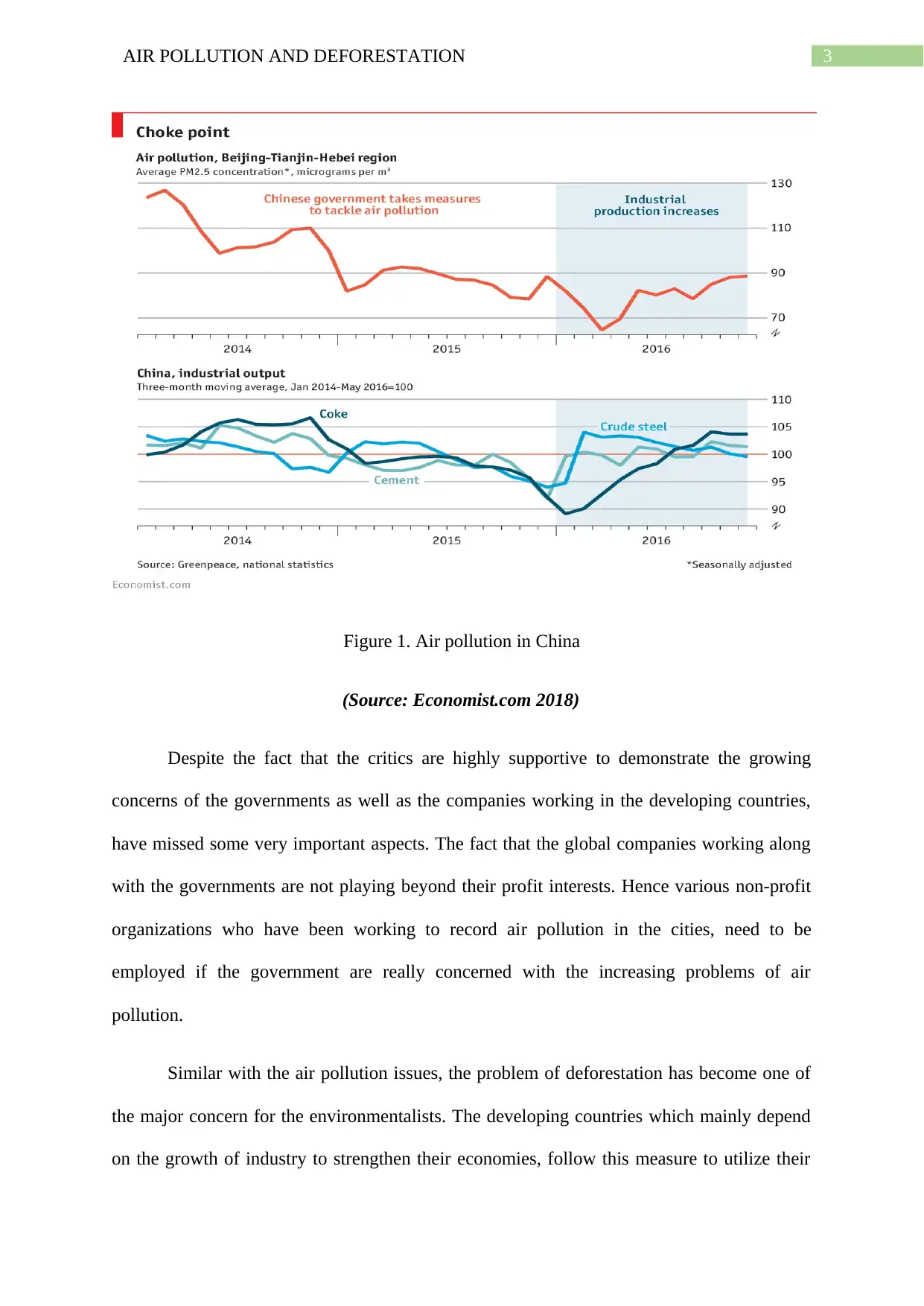
Figure 1. Air pollution in China
(Source: Economist.com 2018)
Despite the fact that the critics are highly supportive to demonstrate the growing
concerns of the governments as well as the companies working in the developing countries,
have missed some very important aspects. The fact that the global companies working along
with the governments are not playing beyond their profit interests. Hence various non-profit
organizations who have been working to record air pollution in the cities, need to be
employed if the government are really concerned with the increasing problems of air
pollution.
Similar with the air pollution issues, the problem of deforestation has become one of
the major concern for the environmentalists. The developing countries which mainly depend
on the growth of industry to strengthen their economies, follow this measure to utilize their
tabler-icon-diamond-filled.svg

Paraphrase This Document

Need a fresh take? Get an instant paraphrase of this document with our AI Paraphraser
Document Page
4AIR POLLUTION AND DEFORESTATION
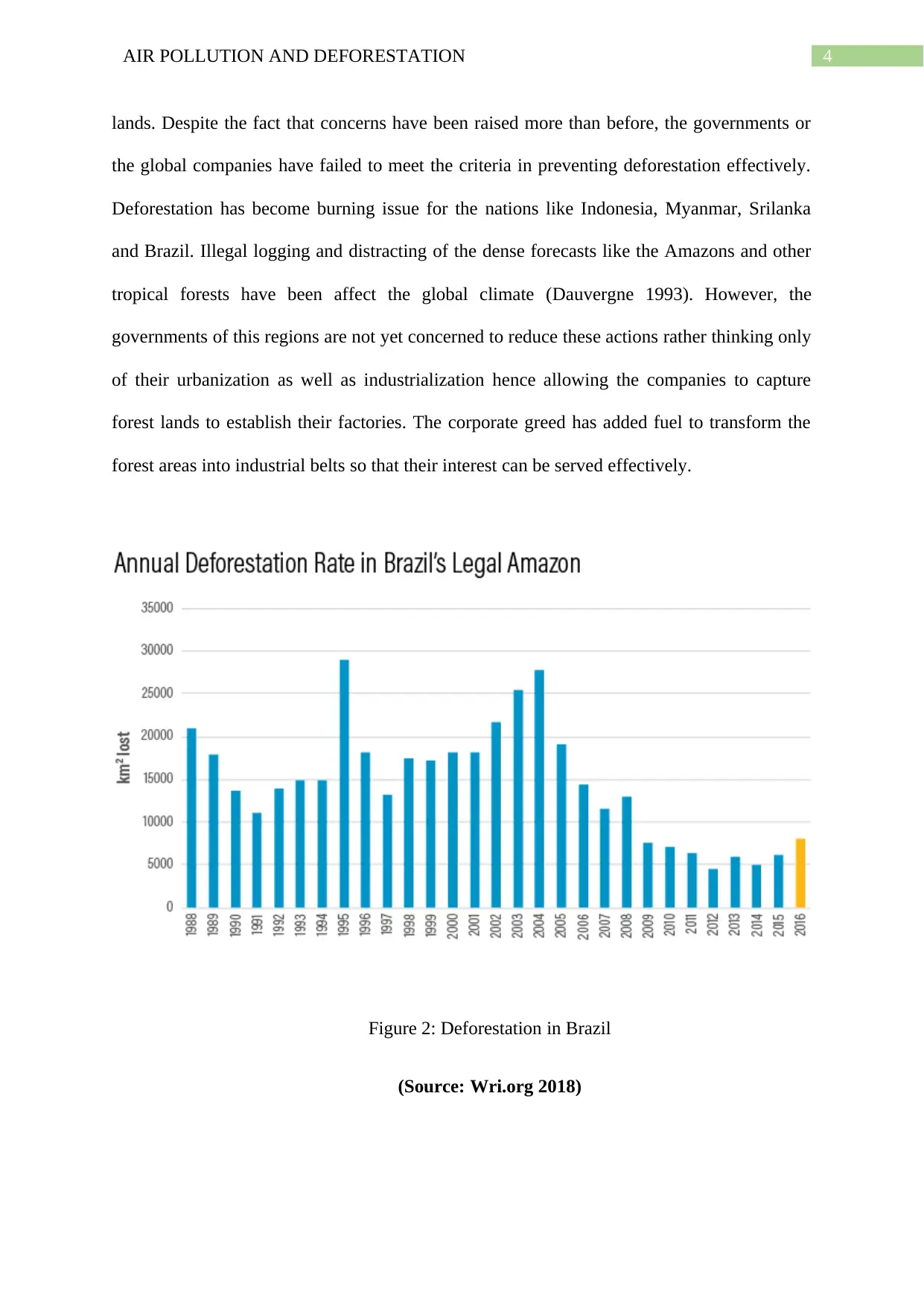
lands. Despite the fact that concerns have been raised more than before, the governments or
the global companies have failed to meet the criteria in preventing deforestation effectively.
Deforestation has become burning issue for the nations like Indonesia, Myanmar, Srilanka
and Brazil. Illegal logging and distracting of the dense forecasts like the Amazons and other
tropical forests have been affect the global climate (Dauvergne 1993). However, the
governments of this regions are not yet concerned to reduce these actions rather thinking only
of their urbanization as well as industrialization hence allowing the companies to capture
forest lands to establish their factories. The corporate greed has added fuel to transform the
forest areas into industrial belts so that their interest can be served effectively.
Figure 2: Deforestation in Brazil
(Source: Wri.org 2018)
Document Page
5AIR POLLUTION AND DEFORESTATION
On the contrary, the scholars like Boucher, Roquemore and Fitzhugh (2013) have
found out the government of Brazil have successfully addressed the issue of deforestation in
the Amazon rainforest area. They have issues policies to protect the forest from the illegal
poachers and other interest groups. The companies such as Nestlé, Procter & Gamble Co. and
Kao Corp. which are operating globally as well as largely depend on the forest grown
products like wood, coco, fruits, have been working collaboratively with the governments to
reduce deforestation. In addition to this, these companies are supporting reforestation projects
of the governments in the harm areas (Aide et al. 2013). The governs, various environment
organisations and these companies have invested a lot of efforts as well as money to maintain
the expected forest lives and restore ecological balance (Stoy 2018). The movements have
been introducing new policies and laws so that the companies take responsibility equally. The
importance of sustainable development measures is taken to focus on the devastating effect of
deforestation on the forest-dwelling people as well as wildlife.
Figure 2: GHG emission in Brazil
(Source: Wri.org 2018)
Document Page
6AIR POLLUTION AND DEFORESTATION
Despite all these measures, the government of the other developing countries like
Indonesia, Cambodia, Myanmar, Laos have not been able to prevent deforestation in their
lands. Despite the fact that various international NGOs have been working with these
governments to introduce new methods of agriculture for gaining sustainability, but these
measures are not adequate to mitigate the burning problem of deforestation (Davin and
Noblet-Ducoudré 2010). These measures are also not enough to secure the rights of the forest
people or the animals living in these forests. The acts to punish illegal logging and poaching
of forest materials are not quite strict to prevent this action. Moreover, in this context also the
industries are always working to serve their own profit interests hence taking opportunities of
various gonorrheal acts to clearing forests and not supporting reforestation to replenish the
gap (Dias 2014). The governments also keep silence as based on these companies the nations
will have economic growth.
Therefore, it can be concluded that the movement of the developing countries have
failed to manage the actions of the companies to control the environmental issues of air
pollution as well as deforestation. These issues are affecting the global environment in the
most negative manner for which the awareness and proper steps need to be taken
immediately. In order to grow economically ad, secure the future of the nations the leaders of
the countries are supporting the global corporates blindly and creating scope for utilizing own
natural resources like forests extensively. These companies do not have any concern that they
are using the resources without any responsibility as there is a very limited scope to get
punished by the national acts. However, some scholars have found out growing awareness on
the parts of the governments to prevent air pollution and deforestation but those are not
adequate.
tabler-icon-diamond-filled.svg

Paraphrase This Document

Need a fresh take? Get an instant paraphrase of this document with our AI Paraphraser
Document Page
7AIR POLLUTION AND DEFORESTATION
References:
Aide, T.M., Clark, M.L., Grau, H.R., LópezCarr, D., Levy, M.A., Redo, D., Bonilla
Moheno, M., Riner, G., AndradeNúñez, M.J. and Muñiz, M. 2013, "Deforestation and
Reforestation of Latin America and the Caribbean (2001–2010)", Biotropica, vol. 45, no. 2,
pp. 262-271.
Boucher, D., Roquemore, S. and Fitzhugh, E., 2013. Brazil's success in reducing
deforestation. Tropical Conservation Science, 6(3), pp.426-445.
Cavico, F.J. and Mujtaba, B.G., 2016. Volkswagen emissions scandal: a global case study of
legal, ethical, and practical consequences and recommendations for sustainable
management. Global Journal of Research in Business & Management, 4(2), pp.303-311.
Dauvergne, P., 1993. The politics of deforestation in Indonesia. Pacific Affairs, pp.497-518.
Davin, E.L. and Noblet-Ducoudré, N.d. 2010, "Climatic Impact of Global-Scale
Deforestation: Radiative versus Nonradiative Processes", Journal of Climate, vol. 23, no. 1,
pp. 97-112.
Dias, B. 2014, "Targeting deforestation", Science, vol. 343, no. 6168, pp. 248-249.
Economist.com (2018). Why China’s air pollution is on the rise again. [online] The
Economist. Available at: https://www.economist.com/graphic-detail/2017/01/04/why-chinas-
air-pollution-is-on-the-rise-again [Accessed 12 Jun. 2018].
Fang, M., Chan, C.K. and Yao, X., 2009. Managing air quality in a rapidly developing
nation: China. Atmospheric Environment, 43(1), pp.79-86.
Stoy, P.C. 2018, "Deforestation intensifies hot days", Nature Climate Change, vol. 8, no. 5,
pp. 366-368.
Document Page
8AIR POLLUTION AND DEFORESTATION
Wri.org (2018). Will Brazil Meet Its Climate Targets? | World Resources Institute. [online]
Wri.org. Available at: http://www.wri.org/blog/2017/07/will-brazil-meet-its-climate-targets
[Accessed 12 Jun. 2018].
Wu, Y., Wang, R., Zhou, Y., Lin, B., Fu, L., He, K. and Hao, J., 2010. On-road vehicle
emission control in Beijing: past, present, and future.
Zhang, H., Wang, S., Hao, J., Wang, X., Wang, S., Chai, F. and Li, M., 2016. Air pollution
and control action in Beijing. Journal of Cleaner Production, 112, pp.1519-1527.
chevron_up_icon
1 out of 9
circle_padding
hide_on_mobile
zoom_out_icon
[object Object]