Analyzing Air Pollution and its Effects on Kuwait's Sustainable Goals
VerifiedAdded on 2022/03/28
|23
|5020
|41
Report
AI Summary
This report provides a detailed analysis of air pollution in Kuwait and its impact on the country's Sustainable Development Goals (SDGs). It begins with an introduction to the issue and a problem statement highlighting the challenges Kuwait faces due to climate change, including increased sea levels, desertification, and high temperatures. The report then delves into the analysis, focusing on the key air quality indicator, particulate matter (PM), and its sources, including emissions from vehicles, industries, dust storms, and oil refineries. It highlights the seasonal variations in pollution levels and the areas with extremely high levels of air pollution. The report also discusses the financing of industrialization in Kuwait and its reliance on fossil fuels, which contributes significantly to air pollution. It examines the connection between air pollution and specific SDGs, such as Good Health and Well-being, Sustainable Cities and Communities, and Climate Action. The report concludes by discussing government interventions and policy gaps in addressing air pollution and achieving climate action. The report emphasizes the need for transitioning to renewable energy, reducing air-polluting vehicles, and phasing out subsidies for fossil fuel industries to improve air quality and achieve sustainable development goals.
1
Air Pollution and the SDGs of Kuwait
Student's Name
Institutional Affiliation
Course Number and Name
Instructor Name
Due Date
Contents
Air Pollution and the SDGs of Kuwait
Student's Name
Institutional Affiliation
Course Number and Name
Instructor Name
Due Date
Contents

Paraphrase This Document
Need a fresh take? Get an instant paraphrase of this document with our AI Paraphraser
2
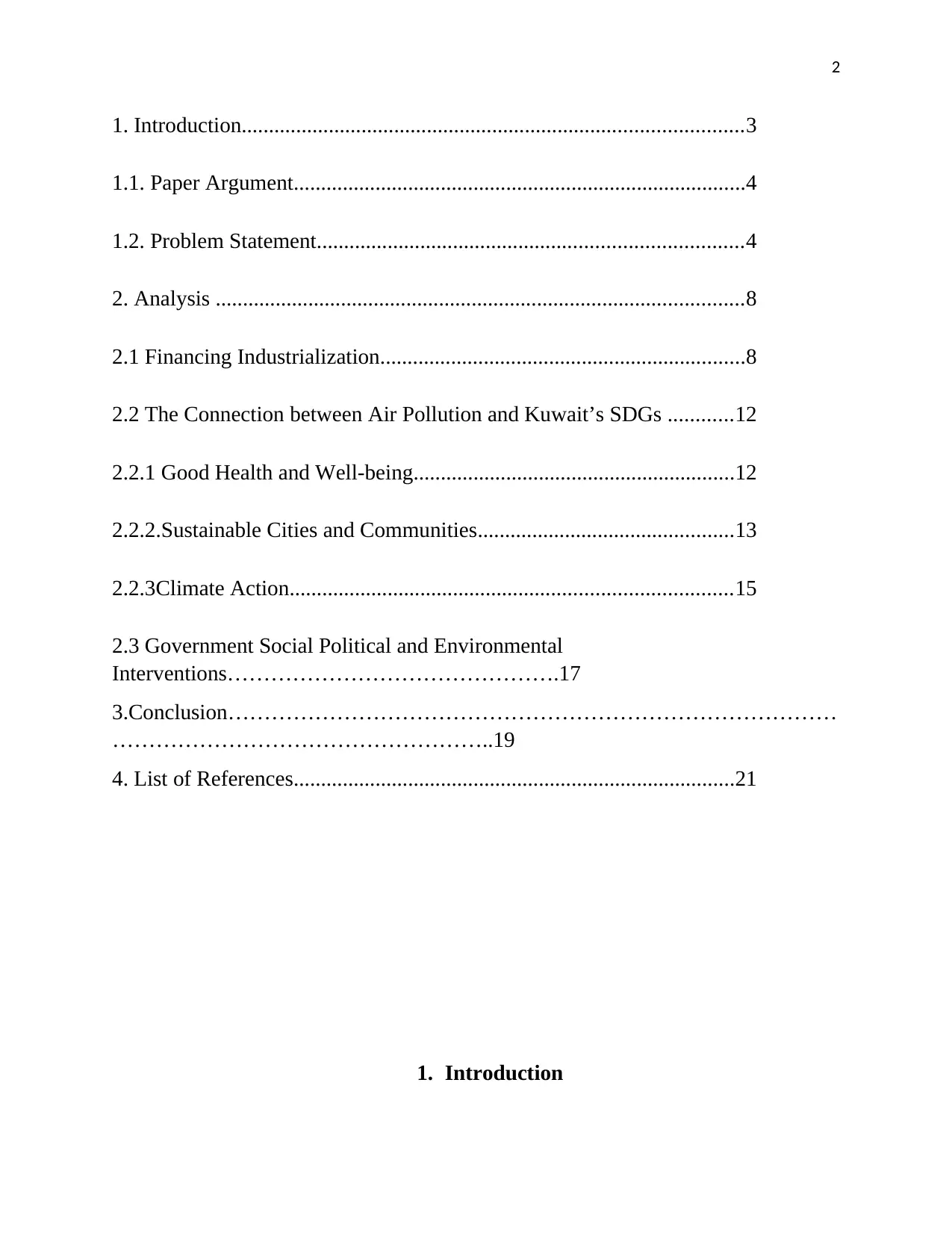
1. Introduction............................................................................................3
1.1. Paper Argument...................................................................................4
1.2. Problem Statement..............................................................................4
2. Analysis .................................................................................................8
2.1 Financing Industrialization...................................................................8
2.2 The Connection between Air Pollution and Kuwait’s SDGs ............12
2.2.1 Good Health and Well-being...........................................................12
2.2.2.Sustainable Cities and Communities...............................................13
2.2.3Climate Action.................................................................................15
2.3 Government Social Political and Environmental
Interventions……………………………………….17
3.Conclusion…………………………………………………………………………
……………………………………………..19
4. List of References.................................................................................21
1. Introduction
1. Introduction............................................................................................3
1.1. Paper Argument...................................................................................4
1.2. Problem Statement..............................................................................4
2. Analysis .................................................................................................8
2.1 Financing Industrialization...................................................................8
2.2 The Connection between Air Pollution and Kuwait’s SDGs ............12
2.2.1 Good Health and Well-being...........................................................12
2.2.2.Sustainable Cities and Communities...............................................13
2.2.3Climate Action.................................................................................15
2.3 Government Social Political and Environmental
Interventions……………………………………….17
3.Conclusion…………………………………………………………………………
……………………………………………..19
4. List of References.................................................................................21
1. Introduction
3
The state of Kuwait had achieved important millennium development goals
before adopting the sustainable development goals. The country's rich supply of
natural resources, particularly oil and gas, had made it possible to achieve success
in providing universal education, ending hunger and poverty, and enhancing
gender balance in education and other sectors of society. The country had attained
universal healthcare and made significant social and economic development
(Mohammed & Ali, 2017). In September 2015, the government adopted the SDGs
and undertook decisions aligned with its development plan for vision 2035
(NSDGICK, 2019; Asem & Samira, 2020). Kuwait followed the adoption of the
SDGs with plans, budgets, and a governance structure that engaged the civil
society, the private sector, government entities, and various stakeholders at
institutional and policy levels. The 13th SDG, which is the focus of this study, is
one area that has proven a big challenge for Kuwait, just like its counterparts
across the globe. The challenges posed by climate change have led to global
problems like floods, cyclones, heatwaves, wildfires, droughts, landslides, and
hurricanes.
1.1 Paper Argument
The state of Kuwait had achieved important millennium development goals
before adopting the sustainable development goals. The country's rich supply of
natural resources, particularly oil and gas, had made it possible to achieve success
in providing universal education, ending hunger and poverty, and enhancing
gender balance in education and other sectors of society. The country had attained
universal healthcare and made significant social and economic development
(Mohammed & Ali, 2017). In September 2015, the government adopted the SDGs
and undertook decisions aligned with its development plan for vision 2035
(NSDGICK, 2019; Asem & Samira, 2020). Kuwait followed the adoption of the
SDGs with plans, budgets, and a governance structure that engaged the civil
society, the private sector, government entities, and various stakeholders at
institutional and policy levels. The 13th SDG, which is the focus of this study, is
one area that has proven a big challenge for Kuwait, just like its counterparts
across the globe. The challenges posed by climate change have led to global
problems like floods, cyclones, heatwaves, wildfires, droughts, landslides, and
hurricanes.
1.1 Paper Argument
⊘ This is a preview!⊘
Do you want full access?
Subscribe today to unlock all pages.

Trusted by 1+ million students worldwide
4
Under the five stage model of economic development as proposed by
Rostow, Kuwait falls at the Mass Consumption stage. The economy of this wealthy
nation has undergone progressive industrialization and rapid urbanization leading
to high standards of living for the people (Mohammed & Ali, 2017). With this
stage of development comes various industries leading in durable consumer goods
production adding to new sectors of economic development. This stage of
development has been achieved sequentially following the discovery of fuel and
fossil oil in the gulf region in 1900’s leading to increased revenue for economic
development (Rajan, 2019). This stage however, brings with it serious
environmental conservation challenges as this paper illustrates. These industries
majorly rely on oil and fuel energy for production; subsequently, they use the
transport sector for movement of their products into the market which also rely on
oil and gas. The resultant effect is a serious environmental and air pollution
problem.
1.2 Problem Statement
The specific challenges Kuwait faces due to climate change include;
increased sea levels, loss of biodiversity, desertification, and high temperatures.
The country is regarded as highly vulnerable to policy changes that developed
countries could implement, especially in relation to oil (Asem & Samira, 2020).
For example, climate changes could result in sea level changes that affect aquatic
Under the five stage model of economic development as proposed by
Rostow, Kuwait falls at the Mass Consumption stage. The economy of this wealthy
nation has undergone progressive industrialization and rapid urbanization leading
to high standards of living for the people (Mohammed & Ali, 2017). With this
stage of development comes various industries leading in durable consumer goods
production adding to new sectors of economic development. This stage of
development has been achieved sequentially following the discovery of fuel and
fossil oil in the gulf region in 1900’s leading to increased revenue for economic
development (Rajan, 2019). This stage however, brings with it serious
environmental conservation challenges as this paper illustrates. These industries
majorly rely on oil and fuel energy for production; subsequently, they use the
transport sector for movement of their products into the market which also rely on
oil and gas. The resultant effect is a serious environmental and air pollution
problem.
1.2 Problem Statement
The specific challenges Kuwait faces due to climate change include;
increased sea levels, loss of biodiversity, desertification, and high temperatures.
The country is regarded as highly vulnerable to policy changes that developed
countries could implement, especially in relation to oil (Asem & Samira, 2020).
For example, climate changes could result in sea level changes that affect aquatic
Paraphrase This Document
Need a fresh take? Get an instant paraphrase of this document with our AI Paraphraser
5
life. The country's reliance on oil and gas for economic sustainability means that its
vital threat to achieving effective climate action is the rising CO2 emissions
resulting from air pollution (Achilleos et al., 2019). Kuwait's geographical location
means that problems associated with air pollution could have devastating
consequences if not adequately addressed. Climatic changes resulting from air
pollution will have a long-term effect on the quality of life, health, and well-being
of the people in this country. This paper looks into the air pollution problem for the
government to provide a detailed analysis of the situation.
2. Analysis
The key air quality indicator under the provisions of the World Health
Organization is the concentration of particulate matter (PM). It is the most
common form of air pollution that has implications on both the victims' short-term
and longter health. In the air quality analysis, the specialists use two sizes of
particulate matter, namely, fine particles and coarse particles (Al-Hemoud et al.,
2019). Fine particles have a diameter of 2.5 um or PM2.5. On the other hand,
coarse particles have a diameter of less than 10um or PM10. The small size of
PM2.5 allows the particles to travel deep into the cardiopulmonary system. This
makes it the most concerning as it could result in serious healthcare dilemmas. As
part of the global SDG under the thirteenth goal or objective, health status, age,
season need to be considered when implementing mitigation policies that relate to
life. The country's reliance on oil and gas for economic sustainability means that its
vital threat to achieving effective climate action is the rising CO2 emissions
resulting from air pollution (Achilleos et al., 2019). Kuwait's geographical location
means that problems associated with air pollution could have devastating
consequences if not adequately addressed. Climatic changes resulting from air
pollution will have a long-term effect on the quality of life, health, and well-being
of the people in this country. This paper looks into the air pollution problem for the
government to provide a detailed analysis of the situation.
2. Analysis
The key air quality indicator under the provisions of the World Health
Organization is the concentration of particulate matter (PM). It is the most
common form of air pollution that has implications on both the victims' short-term
and longter health. In the air quality analysis, the specialists use two sizes of
particulate matter, namely, fine particles and coarse particles (Al-Hemoud et al.,
2019). Fine particles have a diameter of 2.5 um or PM2.5. On the other hand,
coarse particles have a diameter of less than 10um or PM10. The small size of
PM2.5 allows the particles to travel deep into the cardiopulmonary system. This
makes it the most concerning as it could result in serious healthcare dilemmas. As
part of the global SDG under the thirteenth goal or objective, health status, age,
season need to be considered when implementing mitigation policies that relate to
6
air pollution and its destructions (Al-Hemoud et al., 2019; Achilleos et al., 2019).
Like many other countries and cities across the world, Kuwait is significantly
affected by air pollution.
Air quality in Kuwait is not considered safe according to the guidelines of
the World Health Organization. Recent data indicate that the country has an annual
mean concentration of PM2.5 of 61ug/m3, which is much higher than the WHO's
recommendation of 10 ug/m3. The contributors to this poor air quality in the
country include emissions from vehicles and industries, dust storms, and oil
refineries. There is seasonal variation in pollution with higher concentrations
experienced in the winter and the summer (Al-Hemoud et al., 2019). The particular
areas with extremely high levels of air pollution include Saad Al-Jahra and Al-
Ahmadi. The outdoor air pollution in these areas is a mix of chemicals, particulate
matter, and biological elements brought about by the high energy consumption and
poor waste management strategies in oil-related industries. Therefore, people in
these areas are subjected to chronic diseases, premature mortality, breathing
problems, and increased rates of hospitalization.
To put the matter into context, WHO data indicate that the gulf region has
cities with the worst form of air pollution in the world. Experts argue there is a
need for urgent action as the majority of the population in that region depend on
burning solid fuels to meet the energy needs of household (Achilleos et al., 2019).
air pollution and its destructions (Al-Hemoud et al., 2019; Achilleos et al., 2019).
Like many other countries and cities across the world, Kuwait is significantly
affected by air pollution.
Air quality in Kuwait is not considered safe according to the guidelines of
the World Health Organization. Recent data indicate that the country has an annual
mean concentration of PM2.5 of 61ug/m3, which is much higher than the WHO's
recommendation of 10 ug/m3. The contributors to this poor air quality in the
country include emissions from vehicles and industries, dust storms, and oil
refineries. There is seasonal variation in pollution with higher concentrations
experienced in the winter and the summer (Al-Hemoud et al., 2019). The particular
areas with extremely high levels of air pollution include Saad Al-Jahra and Al-
Ahmadi. The outdoor air pollution in these areas is a mix of chemicals, particulate
matter, and biological elements brought about by the high energy consumption and
poor waste management strategies in oil-related industries. Therefore, people in
these areas are subjected to chronic diseases, premature mortality, breathing
problems, and increased rates of hospitalization.
To put the matter into context, WHO data indicate that the gulf region has
cities with the worst form of air pollution in the world. Experts argue there is a
need for urgent action as the majority of the population in that region depend on
burning solid fuels to meet the energy needs of household (Achilleos et al., 2019).
⊘ This is a preview!⊘
Do you want full access?
Subscribe today to unlock all pages.
Trusted by 1+ million students worldwide
7
Reports also indicate that air pollution costs the global economy significant losses
annually in relation to welfare costs. The desert climate in the Gulf region is also
largely to be blamed for the air pollution problem in countries like Kuwait.
Therefore, climate change is likely to result in a significant rise in temperature
levels that could become unbearable. This could potentially lead to increased
atmospheric pollution and devastating health implications. At the moment, air
pollution is one of the biggest threats to public health being confronted by Kuwait,
the Gulf, and the entire globe. WHO data also show over seven million global
premature deaths attributable to air pollution.
Ambient air pollution is the most reported form of air pollution in Kuwait,
accounting for most premature deaths associated with the phenomenon. Data from
the Global Air Report 2019 showed that Kuwait and the Gulf countries' average
pollution exposure is above the average levels in China. The burning of fossil oil in
refineries, factories, and power plants is the leading cause of the air pollution
problem (Asem & Samira, 2020; Achilleos et al., 2019). The second most
prominent source of air pollution for Kuwait is soil dust. This is principally natural
but can increase as a result of changes in climate as a result of drought or
desertification. Such problems are likely to grow as the global demand and use of
fuel products continue to rise. In the Gulf region, oil consumption increased by
25% in the seven years between 2010 and 2017. Because of abundant sunshine in
Reports also indicate that air pollution costs the global economy significant losses
annually in relation to welfare costs. The desert climate in the Gulf region is also
largely to be blamed for the air pollution problem in countries like Kuwait.
Therefore, climate change is likely to result in a significant rise in temperature
levels that could become unbearable. This could potentially lead to increased
atmospheric pollution and devastating health implications. At the moment, air
pollution is one of the biggest threats to public health being confronted by Kuwait,
the Gulf, and the entire globe. WHO data also show over seven million global
premature deaths attributable to air pollution.
Ambient air pollution is the most reported form of air pollution in Kuwait,
accounting for most premature deaths associated with the phenomenon. Data from
the Global Air Report 2019 showed that Kuwait and the Gulf countries' average
pollution exposure is above the average levels in China. The burning of fossil oil in
refineries, factories, and power plants is the leading cause of the air pollution
problem (Asem & Samira, 2020; Achilleos et al., 2019). The second most
prominent source of air pollution for Kuwait is soil dust. This is principally natural
but can increase as a result of changes in climate as a result of drought or
desertification. Such problems are likely to grow as the global demand and use of
fuel products continue to rise. In the Gulf region, oil consumption increased by
25% in the seven years between 2010 and 2017. Because of abundant sunshine in
Paraphrase This Document
Need a fresh take? Get an instant paraphrase of this document with our AI Paraphraser
8
Kuwait, policymakers should view the sky as the nation's true wealth and not
underground. The country should prioritize transitioning to renewable energy that
is cheap and clean to deal with local pollution.
Kuwait must consider global recommendations on climate action that have
shown that large-scale use of renewable energy has massive potential in changing
ambient air quality to sustainable levels. For example, in the UAE, they have
invested in enormous power plants that could now supplement the energy
consumption needs of its citizens (Al-Saidi, 2021). The transport sector, which is a
significant cause of air pollution through the emission of burnt gas from petroleum,
should also be examined. Kuwait should focus on reducing the amount of air-
polluting cars in the country's road networks. This means that investments should
be made towards public transport that is more electrified, purchase of engine
vehicles with minimal internal combustion, and more shared mobility. Experts also
argue that the subsidies provided to the fossil oil industries should undergo
significant phase-outs. Similarly, significant factories and power plants using oil
should install effective devices for emission control.
2.1 Financing Industrialization
Kuwait, policymakers should view the sky as the nation's true wealth and not
underground. The country should prioritize transitioning to renewable energy that
is cheap and clean to deal with local pollution.
Kuwait must consider global recommendations on climate action that have
shown that large-scale use of renewable energy has massive potential in changing
ambient air quality to sustainable levels. For example, in the UAE, they have
invested in enormous power plants that could now supplement the energy
consumption needs of its citizens (Al-Saidi, 2021). The transport sector, which is a
significant cause of air pollution through the emission of burnt gas from petroleum,
should also be examined. Kuwait should focus on reducing the amount of air-
polluting cars in the country's road networks. This means that investments should
be made towards public transport that is more electrified, purchase of engine
vehicles with minimal internal combustion, and more shared mobility. Experts also
argue that the subsidies provided to the fossil oil industries should undergo
significant phase-outs. Similarly, significant factories and power plants using oil
should install effective devices for emission control.
2.1 Financing Industrialization
9
As seen in recent decades, industrialization in Kuwait has been achieved
mainly through fossil fuel-driven production methods. However, this
industrialization phenomenom is contradictory to the contemporary global
objective of realizing low growth in carbon. More than ninety percent of the
domestic energy consumption in the economy of Kuwait is accounted for by fossil
fuels (Al-Saidi, 2021). Therefore, CO2 emission dynamics in the country have
been inevitably linked with its GDP per capita. The growth patterns in
industrialization have also been characterized by inefficient utilization of the
available resources (Asem & Samira, 2020). This further causes a bigger carbon
footprint which also combines with the growing energy needs resulting from rising
living standards and a growing population. If the country fails to take a proactive
approach to its growth patterns, its SDGs may not be realized. This is mainly
because there are doubts as to whether the long-term climate resilience of Kuwait
could sustain its future trajectory of growth.
As already mentioned, the country is currently facing a series of severe
climatic challenges. It is known for its hot weather, regular sand storms, and harsh
climate. All these climatic problems threaten the well-being of the citizens and are
also associated with unfavorable dynamics in the country's socio-economic
activities. Increased temperatures in sea surface waters are particularly a severe
threat to the marine environment in Kuwait (Environmental Public Authority,
As seen in recent decades, industrialization in Kuwait has been achieved
mainly through fossil fuel-driven production methods. However, this
industrialization phenomenom is contradictory to the contemporary global
objective of realizing low growth in carbon. More than ninety percent of the
domestic energy consumption in the economy of Kuwait is accounted for by fossil
fuels (Al-Saidi, 2021). Therefore, CO2 emission dynamics in the country have
been inevitably linked with its GDP per capita. The growth patterns in
industrialization have also been characterized by inefficient utilization of the
available resources (Asem & Samira, 2020). This further causes a bigger carbon
footprint which also combines with the growing energy needs resulting from rising
living standards and a growing population. If the country fails to take a proactive
approach to its growth patterns, its SDGs may not be realized. This is mainly
because there are doubts as to whether the long-term climate resilience of Kuwait
could sustain its future trajectory of growth.
As already mentioned, the country is currently facing a series of severe
climatic challenges. It is known for its hot weather, regular sand storms, and harsh
climate. All these climatic problems threaten the well-being of the citizens and are
also associated with unfavorable dynamics in the country's socio-economic
activities. Increased temperatures in sea surface waters are particularly a severe
threat to the marine environment in Kuwait (Environmental Public Authority,
⊘ This is a preview!⊘
Do you want full access?
Subscribe today to unlock all pages.
Trusted by 1+ million students worldwide
10
2019; Al-Saidi, 2021). This threatens the fishery industry, which is the second
largest for the country after oil and gas. The small amounts of rainfall experienced
to make the country's soil unfavorable and inadequate for farming. The country's
food security is also at risk because of the restrained usable quantity of land for
agriculture as well as the number of crops capable of surviving in the area (Al-
Saidi, 2021). There is also the challenge of limited freshwater attributes to
Kuwait's geographical features. The country has limited amounts of rainfall and no
rivers.
Kuwait's air population problem is a big one as both its per capita energy
consumption and waste generation rates are among the highest among the world
economies. The key contributors to this problem are the climatic challenges
already mentioned in this study. However, the government has made significant
efforts in its response to these stylized challenges related to climate. The Kuwait
government has designed and implemented a number of quality-enhancing
programs and projects for the environment. The country has invested in energy
desalination plants for its electricity sustainability initiative (NSDGICK, 2019; Al-
Saidi, 2021). There are also projects on solar and wind energy parks whose
objective is to increase the economy's share of renewable energy in the electricity
supply. At the same time, there are ongoing constructions of wastewater treatment
2019; Al-Saidi, 2021). This threatens the fishery industry, which is the second
largest for the country after oil and gas. The small amounts of rainfall experienced
to make the country's soil unfavorable and inadequate for farming. The country's
food security is also at risk because of the restrained usable quantity of land for
agriculture as well as the number of crops capable of surviving in the area (Al-
Saidi, 2021). There is also the challenge of limited freshwater attributes to
Kuwait's geographical features. The country has limited amounts of rainfall and no
rivers.
Kuwait's air population problem is a big one as both its per capita energy
consumption and waste generation rates are among the highest among the world
economies. The key contributors to this problem are the climatic challenges
already mentioned in this study. However, the government has made significant
efforts in its response to these stylized challenges related to climate. The Kuwait
government has designed and implemented a number of quality-enhancing
programs and projects for the environment. The country has invested in energy
desalination plants for its electricity sustainability initiative (NSDGICK, 2019; Al-
Saidi, 2021). There are also projects on solar and wind energy parks whose
objective is to increase the economy's share of renewable energy in the electricity
supply. At the same time, there are ongoing constructions of wastewater treatment
Paraphrase This Document
Need a fresh take? Get an instant paraphrase of this document with our AI Paraphraser
11
plants for industrial use. This water will also aid in the irrigation of green spaces
getting built in the push for climate conservation.
The government of Kuwait has also invested in awareness creation
initiatives in a bid to enhance behavior change towards air pollution and general
environmental conservation. Kuwait's government collaborates with various non-
profit organizations and the private sector to improve the sustainable use of water
resources (Al-Saidi, 2021). This collaboration also focuses on enhancing recycling
at the individual level and changing the community's waste management practices
to environmentally responsible ones (Asem & Samira, 2020). Even though the
government efforts are loadable, several policy gaps still exist in its push to
achieve practical climate actions. These policy gaps are shown by; the prominent
high levels of energy consumption and air pollution, there is a relative lack of
modern technology used in its projects on seawater desalination, waste
management, and wastewater treatment, the country lacks proactive measures
against climate change, and they also exist a lack of understanding of the
complexity between socio-economic dimensions and climate change.
The policy gap in relation to waste management and air pollution can be
associated with the macro-level strategies in the industries. In contrast, the other
three gaps can be addressed effectively if the focus shifts to enhancing sustainable
finance practices. In doing so, the country will succeed in strengthening its private
plants for industrial use. This water will also aid in the irrigation of green spaces
getting built in the push for climate conservation.
The government of Kuwait has also invested in awareness creation
initiatives in a bid to enhance behavior change towards air pollution and general
environmental conservation. Kuwait's government collaborates with various non-
profit organizations and the private sector to improve the sustainable use of water
resources (Al-Saidi, 2021). This collaboration also focuses on enhancing recycling
at the individual level and changing the community's waste management practices
to environmentally responsible ones (Asem & Samira, 2020). Even though the
government efforts are loadable, several policy gaps still exist in its push to
achieve practical climate actions. These policy gaps are shown by; the prominent
high levels of energy consumption and air pollution, there is a relative lack of
modern technology used in its projects on seawater desalination, waste
management, and wastewater treatment, the country lacks proactive measures
against climate change, and they also exist a lack of understanding of the
complexity between socio-economic dimensions and climate change.
The policy gap in relation to waste management and air pollution can be
associated with the macro-level strategies in the industries. In contrast, the other
three gaps can be addressed effectively if the focus shifts to enhancing sustainable
finance practices. In doing so, the country will succeed in strengthening its private
12
sector engagements. These measures are greatly important for areas with high
population densities and massive urbanization because of the many lives that can
be saved or improved by effective climate action (Asem & Samira, 2020).
Attaining this would culminate in environmentally friendly processes, particularly
in the field of technology. As the country engages in sustainable finance practices,
continuous efforts must be made towards promoting the culture of responsibility
and recycling (Al-Hurban et al., 2021). This should be done both at the individual
and community levels to ensure the maximum realization of the potential benefits
to the community.
2.2 The Connection between Air Pollution and Kuwait's SDGs
Air pollution is now regarded as the third-highest cause of death globally
and is closely related to climate change, human health, and energy production. The
national life expectancy of growing children is significantly shortened due to the
high level of air pollution. Because of the strong association between sustainability
and air pollution, the impact of air pollution on various sustainable development
goals must be assessed (Al-Hurban et al., 2021). The United Nations agencies, part
of the UN Development Group, support independent campaigns to communicate
the SDGs to the global audience. These communications aim to make cities and
human settlements safe, resilient, inclusive, and sustainable. For these SDGs to be
attained by all member-states by 2030 as agreed, Kuwait and its counterparts must
sector engagements. These measures are greatly important for areas with high
population densities and massive urbanization because of the many lives that can
be saved or improved by effective climate action (Asem & Samira, 2020).
Attaining this would culminate in environmentally friendly processes, particularly
in the field of technology. As the country engages in sustainable finance practices,
continuous efforts must be made towards promoting the culture of responsibility
and recycling (Al-Hurban et al., 2021). This should be done both at the individual
and community levels to ensure the maximum realization of the potential benefits
to the community.
2.2 The Connection between Air Pollution and Kuwait's SDGs
Air pollution is now regarded as the third-highest cause of death globally
and is closely related to climate change, human health, and energy production. The
national life expectancy of growing children is significantly shortened due to the
high level of air pollution. Because of the strong association between sustainability
and air pollution, the impact of air pollution on various sustainable development
goals must be assessed (Al-Hurban et al., 2021). The United Nations agencies, part
of the UN Development Group, support independent campaigns to communicate
the SDGs to the global audience. These communications aim to make cities and
human settlements safe, resilient, inclusive, and sustainable. For these SDGs to be
attained by all member-states by 2030 as agreed, Kuwait and its counterparts must
⊘ This is a preview!⊘
Do you want full access?
Subscribe today to unlock all pages.
Trusted by 1+ million students worldwide

1 out of 23


Related Documents


Your All-in-One AI-Powered Toolkit for Academic Success.
+13062052269
info@desklib.com
Available 24*7 on WhatsApp / Email
![[object Object]](/_next/static/media/star-bottom.7253800d.svg)
Unlock your academic potential
Copyright © 2020–2026 A2Z Services. All Rights Reserved. Developed and managed by ZUCOL.