Business Strategy of AirAsia Berhad: A Comprehensive Analysis Report
VerifiedAdded on 2022/08/23
|27
|7248
|15
Report
AI Summary
This report provides a comprehensive analysis of AirAsia Berhad's business strategy. It begins with an executive summary, followed by an introduction to AirAsia Berhad, highlighting its key activities, current growth phase, and brand positioning. The report then delves into the corporate, business, and growth strategies of the company, critically evaluating them using relevant models and theories, including Porter's generic strategies. It identifies the core competencies of AirAsia Berhad based on its tangible and intangible resources, and explains how the company achieves a sustainable competitive advantage in the airline industry. Furthermore, the report analyzes the competitive environment using Porter's Five Forces and discusses the company's CSR strategy and its alignment with the United Nations' Sustainable Development Goals. Finally, the report concludes with recommendations for achieving sustainable competitive advantage in the next three years.
Running head: BUSINESS STRATEGY
BUSINESS STRATEGY
Student’s Name
University Name
Author note
BUSINESS STRATEGY
Student’s Name
University Name
Author note

Paraphrase This Document
Need a fresh take? Get an instant paraphrase of this document with our AI Paraphraser
1BUSINESS STRATEGY
Executive Summary
The significant objective of the report is to provide an analysis on the functioning of the
public listed company in Malaysia, AirAsia Berhad. The report highlights the current growth
phase of the company in its business life cycle and its present brand positioning on the basis of
its key activities. The corporate, business, and growth strategies of the organization have also
been discussed with reference to the theories of Porter’s generic strategies. The core
competencies of the company have also been identified on the basis of the intangible and
intangible resources available and utilized by them. Furthermore, the method in which the
company achieves a sustainable competitive advantage in the airline industry of Malaysia has
also been highlighted in the report. The report analyzes the competitive situation prevailing in
the airlines industry using Porters Five Force Analyses. It determines the CSR strategy of the
chosen PLC Air Asia and its alignment with United Nation’s Sustainable Development Goals of
Agenda 2030. Lastly, it provides recommendations to achieve sustainable competitive advantage
for the next three years and concludes the report.
Executive Summary
The significant objective of the report is to provide an analysis on the functioning of the
public listed company in Malaysia, AirAsia Berhad. The report highlights the current growth
phase of the company in its business life cycle and its present brand positioning on the basis of
its key activities. The corporate, business, and growth strategies of the organization have also
been discussed with reference to the theories of Porter’s generic strategies. The core
competencies of the company have also been identified on the basis of the intangible and
intangible resources available and utilized by them. Furthermore, the method in which the
company achieves a sustainable competitive advantage in the airline industry of Malaysia has
also been highlighted in the report. The report analyzes the competitive situation prevailing in
the airlines industry using Porters Five Force Analyses. It determines the CSR strategy of the
chosen PLC Air Asia and its alignment with United Nation’s Sustainable Development Goals of
Agenda 2030. Lastly, it provides recommendations to achieve sustainable competitive advantage
for the next three years and concludes the report.
2BUSINESS STRATEGY
Introduction
AirAsia Berhad is identified as one of the major low-cost airlines of Malaysia with its
headquarters located in Kuala Lumpur. The airlines company provides domestic as well as
international flight services to its customers in more than 23 hubs spanning across more than 150
destinations (Newsroom.airasia.com 2020). There are several airline chains affiliated with
AirAsia Berhad including Thai AirAsia, Philippines AirAsia, India AirAsia and Indonesia
AirAsia. The company was established in the year 1993 after which it commenced it operations
on 18th of November, 1996. The current strength of the company comprises over 22,000 highly
skilled staff engaged in over 11,000 flights on a weekly basis (Newsroom.airasia.com 2020).
The primary mission of the AirAsia Berhad airlines company is to provide high quality of
flight services to its customers at the lowest fares. The operations of the company thereby caters
to the requirements of over 600 million guests all over the Asia Pacific (Newsroom.airasia.com
2020). In order to ensure sustainable business operations and functions, AirAsia Berhad ensures
its responsibility towards its numerous stakeholders by conducting its activities with integrity
and safety (Newsroom.airasia.com 2020).
Business Life Cycle
Observing the progression of the business activities of AirAsia Berhad, it can be
identified that the company is currently at the growth phase of its business life cycle. It is so
because the company is still seeking to expand the scope of its business through the
incorporation of changes and introduction of additional services through online mediums. During
Introduction
AirAsia Berhad is identified as one of the major low-cost airlines of Malaysia with its
headquarters located in Kuala Lumpur. The airlines company provides domestic as well as
international flight services to its customers in more than 23 hubs spanning across more than 150
destinations (Newsroom.airasia.com 2020). There are several airline chains affiliated with
AirAsia Berhad including Thai AirAsia, Philippines AirAsia, India AirAsia and Indonesia
AirAsia. The company was established in the year 1993 after which it commenced it operations
on 18th of November, 1996. The current strength of the company comprises over 22,000 highly
skilled staff engaged in over 11,000 flights on a weekly basis (Newsroom.airasia.com 2020).
The primary mission of the AirAsia Berhad airlines company is to provide high quality of
flight services to its customers at the lowest fares. The operations of the company thereby caters
to the requirements of over 600 million guests all over the Asia Pacific (Newsroom.airasia.com
2020). In order to ensure sustainable business operations and functions, AirAsia Berhad ensures
its responsibility towards its numerous stakeholders by conducting its activities with integrity
and safety (Newsroom.airasia.com 2020).
Business Life Cycle
Observing the progression of the business activities of AirAsia Berhad, it can be
identified that the company is currently at the growth phase of its business life cycle. It is so
because the company is still seeking to expand the scope of its business through the
incorporation of changes and introduction of additional services through online mediums. During
⊘ This is a preview!⊘
Do you want full access?
Subscribe today to unlock all pages.

Trusted by 1+ million students worldwide
3BUSINESS STRATEGY
the growth phase the business organization undergoes a rapid growth in its net sales and thereby
its profits (Muzellec, Ronteau and Lambkin 2015).
Figure 1: Business Life Cycle
(Source: author)
Brand Positioning
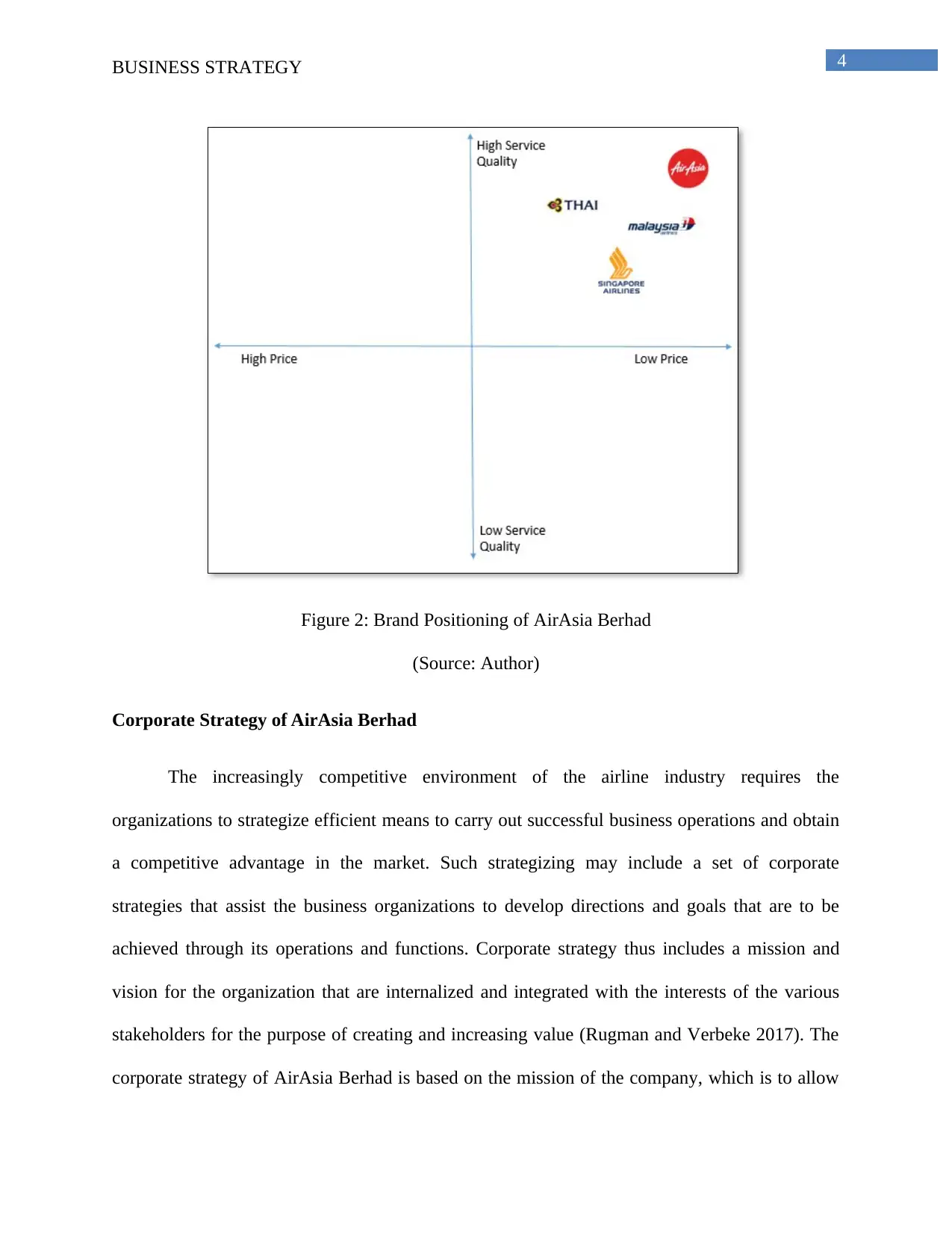
The positioning of AirAsia Berhad in the airlines industry is characterized by a
competitive advantage obtained with the help of high quality of services provided at low costs to
its customers (Niyomsart and Khamwon 2015). Among the various competitors of the company
in the airline industry like Malaysia Airlines, THAI and Singapore Airlines, AirAsia Berhad
provides its customers with the highest quality of services at the lowest possible fares (Eng and
Vichitsarawong 2019). The brand positioning of a business organization in the industry provides
an insight on the competitive environment present and the methods in which the company may
acquire a competitive advantage (Singh, Kalafatis and Ledden 2014). The figure provided below
identifies the position of AirAsia Berhad in the airlines industry of Malaysia:
the growth phase the business organization undergoes a rapid growth in its net sales and thereby
its profits (Muzellec, Ronteau and Lambkin 2015).
Figure 1: Business Life Cycle
(Source: author)
Brand Positioning
The positioning of AirAsia Berhad in the airlines industry is characterized by a
competitive advantage obtained with the help of high quality of services provided at low costs to
its customers (Niyomsart and Khamwon 2015). Among the various competitors of the company
in the airline industry like Malaysia Airlines, THAI and Singapore Airlines, AirAsia Berhad
provides its customers with the highest quality of services at the lowest possible fares (Eng and
Vichitsarawong 2019). The brand positioning of a business organization in the industry provides
an insight on the competitive environment present and the methods in which the company may
acquire a competitive advantage (Singh, Kalafatis and Ledden 2014). The figure provided below
identifies the position of AirAsia Berhad in the airlines industry of Malaysia:
Paraphrase This Document
Need a fresh take? Get an instant paraphrase of this document with our AI Paraphraser
4BUSINESS STRATEGY
Figure 2: Brand Positioning of AirAsia Berhad
(Source: Author)
Corporate Strategy of AirAsia Berhad
The increasingly competitive environment of the airline industry requires the
organizations to strategize efficient means to carry out successful business operations and obtain
a competitive advantage in the market. Such strategizing may include a set of corporate
strategies that assist the business organizations to develop directions and goals that are to be
achieved through its operations and functions. Corporate strategy thus includes a mission and
vision for the organization that are internalized and integrated with the interests of the various
stakeholders for the purpose of creating and increasing value (Rugman and Verbeke 2017). The
corporate strategy of AirAsia Berhad is based on the mission of the company, which is to allow
Figure 2: Brand Positioning of AirAsia Berhad
(Source: Author)
Corporate Strategy of AirAsia Berhad
The increasingly competitive environment of the airline industry requires the
organizations to strategize efficient means to carry out successful business operations and obtain
a competitive advantage in the market. Such strategizing may include a set of corporate
strategies that assist the business organizations to develop directions and goals that are to be
achieved through its operations and functions. Corporate strategy thus includes a mission and
vision for the organization that are internalized and integrated with the interests of the various
stakeholders for the purpose of creating and increasing value (Rugman and Verbeke 2017). The
corporate strategy of AirAsia Berhad is based on the mission of the company, which is to allow
5BUSINESS STRATEGY
everyone to fly. This mission of the company is based on the provision of high quality services to
the customers at low fares. In this regard, it can be noted that the primary corporate strategy of
AirAsia Berhad is to increase the scope of its business through maximization of productivity and
efficiency along with the reduction of operations cost (Sugiarto 2014). The corporate strategy of
the company further involves the vision of establishing and maintaining their position as the
lowest cost airline in the market. In order to achieve this, the company engages in focusing its
activities towards obtaining high margins along with sustainability of growth (Ir.airasia.com
2020).
AirAsia Berhad follows the corporate strategy of horizontal integration. This strategy
involves a process of increasing the services and goods produced by a business organization
along with an expansion of the supply chain. Such horizontal integration may be done with the
help of either internal expansion or through mergers and acquisitions. In the case of AirAsia, the
organization has increased the scope of its business with the help on expansion into the markets
of various nations like Philippines, Indonesia, India and Thailand. AirAsia has purchased Zest
Airlines of the Philippines in order to create AirAsia Zest (Centreforaviation.com 2020). The
growth of the company in the airline industry and the obtaining of a competitive advantage in the
market has been facilitated by the strategy of low-cost adopted by AirAsia Berhad (Adler et al.
2017). The Chief Executive Officer of the company, Tony Fernandes has stressed upon the
provision of high quality of customer service in order to obtain maximum customer satisfaction
and loyalty. The low cost strategy adopted by the company aims at reducing the cost of
operations at all levels of the business activities. Furthermore, the corporate strategy of the
company also involves an adequate utilization of resources and assets available to them. Such a
everyone to fly. This mission of the company is based on the provision of high quality services to
the customers at low fares. In this regard, it can be noted that the primary corporate strategy of
AirAsia Berhad is to increase the scope of its business through maximization of productivity and
efficiency along with the reduction of operations cost (Sugiarto 2014). The corporate strategy of
the company further involves the vision of establishing and maintaining their position as the
lowest cost airline in the market. In order to achieve this, the company engages in focusing its
activities towards obtaining high margins along with sustainability of growth (Ir.airasia.com
2020).
AirAsia Berhad follows the corporate strategy of horizontal integration. This strategy
involves a process of increasing the services and goods produced by a business organization
along with an expansion of the supply chain. Such horizontal integration may be done with the
help of either internal expansion or through mergers and acquisitions. In the case of AirAsia, the
organization has increased the scope of its business with the help on expansion into the markets
of various nations like Philippines, Indonesia, India and Thailand. AirAsia has purchased Zest
Airlines of the Philippines in order to create AirAsia Zest (Centreforaviation.com 2020). The
growth of the company in the airline industry and the obtaining of a competitive advantage in the
market has been facilitated by the strategy of low-cost adopted by AirAsia Berhad (Adler et al.
2017). The Chief Executive Officer of the company, Tony Fernandes has stressed upon the
provision of high quality of customer service in order to obtain maximum customer satisfaction
and loyalty. The low cost strategy adopted by the company aims at reducing the cost of
operations at all levels of the business activities. Furthermore, the corporate strategy of the
company also involves an adequate utilization of resources and assets available to them. Such a
⊘ This is a preview!⊘
Do you want full access?
Subscribe today to unlock all pages.
Trusted by 1+ million students worldwide
6BUSINESS STRATEGY
low cost strategy thereby increases the efficiency of the organization through the process of
stimulating new markets (Ir.airasia.com 2020).
Business Strategy of AirAsia Berhad
The incorporation of an efficient business strategy is essential for business organizations
as it helps in creating goals and targets on the basis of its operations and enhancing the
productivity and profitability. The decision making process in the organizations and
identification of strengths and weaknesses within the scope of its business are enhanced by
strategizing means to utilize resources in an efficient and sustainable manner (Alstete 2014).
There are different types of strategies that can be adopted by business organizations including
cost leadership, cost focus, differentiation and differentiation focus.
The business strategy adopted by AirAsia Berhad is that of cost leadership. The strategy
of cost leadership helps in the establishment and maintaining if a competitive advantage in the
market by lowering the cost of operations of a business organization. The primary purpose of
adopting the business strategy of cost leadership is to exploit the scales of production of good
and services. This in turn helps the organization to obtain significant market shares. The concept
of cost leadership was developed by Michael E. Porter to identify the methods through which a
business organization may be able to obtain a competitive advantage in the market. These
methods were identified to be the reduction of production costs, thereby increasing the profits of
the business organizations through the sale of their good and services. The second method
pertained to the increase of market shares with the help of selling the products and services at
low prices while making significant profits due to the reduced costs of production. However,
reducing the costs of the goods and services alone cannot ensure the increase in the overall sales
for the business organization. This also requires the maintenance of high quality standards so as
low cost strategy thereby increases the efficiency of the organization through the process of
stimulating new markets (Ir.airasia.com 2020).
Business Strategy of AirAsia Berhad
The incorporation of an efficient business strategy is essential for business organizations
as it helps in creating goals and targets on the basis of its operations and enhancing the
productivity and profitability. The decision making process in the organizations and
identification of strengths and weaknesses within the scope of its business are enhanced by
strategizing means to utilize resources in an efficient and sustainable manner (Alstete 2014).
There are different types of strategies that can be adopted by business organizations including
cost leadership, cost focus, differentiation and differentiation focus.
The business strategy adopted by AirAsia Berhad is that of cost leadership. The strategy
of cost leadership helps in the establishment and maintaining if a competitive advantage in the
market by lowering the cost of operations of a business organization. The primary purpose of
adopting the business strategy of cost leadership is to exploit the scales of production of good
and services. This in turn helps the organization to obtain significant market shares. The concept
of cost leadership was developed by Michael E. Porter to identify the methods through which a
business organization may be able to obtain a competitive advantage in the market. These
methods were identified to be the reduction of production costs, thereby increasing the profits of
the business organizations through the sale of their good and services. The second method
pertained to the increase of market shares with the help of selling the products and services at
low prices while making significant profits due to the reduced costs of production. However,
reducing the costs of the goods and services alone cannot ensure the increase in the overall sales
for the business organization. This also requires the maintenance of high quality standards so as
Paraphrase This Document
Need a fresh take? Get an instant paraphrase of this document with our AI Paraphraser
7BUSINESS STRATEGY
to obtain maximum customer satisfaction. The presence of a low cost base for labor and other
resources along with efficient logistics and easy accessibility to the capital required to invest in
advanced and resource efficient technology is also essential to ensure the success of a cost
leadership strategy.
The airline transportation service was previously considered to be a luxury that was
affordable only to the high income groups of individuals. However, due to the development of
the cost leadership strategy, AirAsia has resulted in the facilitation of flight services to customers
from different income groups. In this regard, it may be identified that the cost leadership
business strategy adopted by AirAsia Berhad has enabled it to increase its market not only in
Malaysia but also in several other countries in the Asia Pacific (Pearson et al. 2015). The low
cost carrier business strategy further enables the organization to efficiently utilize the resources
available to them through high utilization of aircraft (Jeddi et al. 2014). This means that the
airlines company commences its services to the customers from early morning till late at night in
order to ensure maximum sales of flight tickets. Furthermore, the company also does not provide
free food or beverage services to the customers during the flight, thereby reducing the cost of
their operation. The customers are also not given any specific or assigned seating, however they
may be able to choose their seats by paying extra for the ticket. Cost efficiency in the operations
of the company is also ensured through the system of ticketless travelling, thereby saving the
cost of printing and distributing the tickets to the customers. The company also does not provide
any refunds to the customers for cancellation of tickets (Dostaler and Fiset 2015). Within the
scope of the organizational structure, the employees and staff of AirAsia Berhad are trained for
limited types of aircrafts, thereby saving the costs of training, learning and acquiring different
to obtain maximum customer satisfaction. The presence of a low cost base for labor and other
resources along with efficient logistics and easy accessibility to the capital required to invest in
advanced and resource efficient technology is also essential to ensure the success of a cost
leadership strategy.
The airline transportation service was previously considered to be a luxury that was
affordable only to the high income groups of individuals. However, due to the development of
the cost leadership strategy, AirAsia has resulted in the facilitation of flight services to customers
from different income groups. In this regard, it may be identified that the cost leadership
business strategy adopted by AirAsia Berhad has enabled it to increase its market not only in
Malaysia but also in several other countries in the Asia Pacific (Pearson et al. 2015). The low
cost carrier business strategy further enables the organization to efficiently utilize the resources
available to them through high utilization of aircraft (Jeddi et al. 2014). This means that the
airlines company commences its services to the customers from early morning till late at night in
order to ensure maximum sales of flight tickets. Furthermore, the company also does not provide
free food or beverage services to the customers during the flight, thereby reducing the cost of
their operation. The customers are also not given any specific or assigned seating, however they
may be able to choose their seats by paying extra for the ticket. Cost efficiency in the operations
of the company is also ensured through the system of ticketless travelling, thereby saving the
cost of printing and distributing the tickets to the customers. The company also does not provide
any refunds to the customers for cancellation of tickets (Dostaler and Fiset 2015). Within the
scope of the organizational structure, the employees and staff of AirAsia Berhad are trained for
limited types of aircrafts, thereby saving the costs of training, learning and acquiring different
8BUSINESS STRATEGY
types of spare parts. Homogeneity of services is also maintained by the airlines company by
ensuring a similar level of competency for all the staff and employees.
Growth Strategy of AirAsia Berhad
Due to the ever increasing scope of the travelling and hospitality industry, there has been
an observable growth in the airline industry as well. In order to keep up with the market trends,
the organizations operating within the industry must also strategize means for the growth of their
business. There are various strategies that can be adopted by such business organization for the
purpose of bringing about growth and development. Such strategies include market penetration,
market expansion, product expansion, growth with the help of diversification and acquisitions or
mergers (Schmidt, Spann and Zeithammer 2014).
The growth strategy adopted by AirAsia Berhad is that of market penetration. The growth
strategy of market penetration entails the marketing of existing products and services of a
business organization in the market, thereby aiming at increasing the market share. The business
strategy of cost leadership adopted by AirAsia enables the organization to reduce its cost of
operations thereby allowing it to acquire a greater market share in the airline industry of
Malaysia (Homsombat, Lei and Fu 2014). Lowering the cost of operations provides the scope for
the acquisition of larger shares of the existing market, as well as those in the different countries
where the company operates. The company additionally engages in price adjustment for the
provision of its services at low costs to the customers. This strategy in turn provides a
competitive advantage to the company over its rivals thereby helping it to acquire a larger market
share. Other means of obtaining greater market shares adopted by the company include an
efficient analysis of the risks and challenges that may be faced by AirAsia in the airline industry
of Malaysia, helping them to capitalize on the opportunities.
types of spare parts. Homogeneity of services is also maintained by the airlines company by
ensuring a similar level of competency for all the staff and employees.
Growth Strategy of AirAsia Berhad
Due to the ever increasing scope of the travelling and hospitality industry, there has been
an observable growth in the airline industry as well. In order to keep up with the market trends,
the organizations operating within the industry must also strategize means for the growth of their
business. There are various strategies that can be adopted by such business organization for the
purpose of bringing about growth and development. Such strategies include market penetration,
market expansion, product expansion, growth with the help of diversification and acquisitions or
mergers (Schmidt, Spann and Zeithammer 2014).
The growth strategy adopted by AirAsia Berhad is that of market penetration. The growth
strategy of market penetration entails the marketing of existing products and services of a
business organization in the market, thereby aiming at increasing the market share. The business
strategy of cost leadership adopted by AirAsia enables the organization to reduce its cost of
operations thereby allowing it to acquire a greater market share in the airline industry of
Malaysia (Homsombat, Lei and Fu 2014). Lowering the cost of operations provides the scope for
the acquisition of larger shares of the existing market, as well as those in the different countries
where the company operates. The company additionally engages in price adjustment for the
provision of its services at low costs to the customers. This strategy in turn provides a
competitive advantage to the company over its rivals thereby helping it to acquire a larger market
share. Other means of obtaining greater market shares adopted by the company include an
efficient analysis of the risks and challenges that may be faced by AirAsia in the airline industry
of Malaysia, helping them to capitalize on the opportunities.
⊘ This is a preview!⊘
Do you want full access?
Subscribe today to unlock all pages.
Trusted by 1+ million students worldwide
9BUSINESS STRATEGY
Ensuring the maximization of customer satisfaction through the maintenance of high
standards of quality of the services provided to the customers builds a positive brand identity of
the company and engages the participation of a greater number of customers to resort to the
services of the company over its competitors in the market. Such positive brand identity and
maximization of customer satisfaction also helps the company in capturing a greater market
share. Strategic alliances and joint ventures with other airline companies through the Asia Pacific
has also helped the company to develop its market share in the global airline industry. Such joint
ventures may be identified to include AirAsia Zest in Philippines and collaborations with other
airline companies in Indonesia (Centreforaviation.com 2020).
Core Competencies and Sustainable Competitive Advantage
For the successful operation of business activities organizations are required to efficiently
utilize the resources available to them. These resources may be categorized into two sections,
namely tangible resources and intangible resources. Tangible resources are the physical assets of
an organization and may include its inventory, infrastructure, equipment, vehicles and the like.
Intangible resources on the other hand are those that are non-existent in a physical form but are
considered to be important assets to the organization, including expenses, goodwill, services of
the employees, brand identity and goodwill.
An analysis of the method in which the tangible and intangible resources available to a
business organization are utilized can help in the assessment of the core competencies of the
company. In this regard, it may be said that there are several tangible and intangible resources
available to AirAsia Berhad that are cost efficiently utilized by the company, thereby serving as
its core competencies in the highly competitive environment of the airline industry of Malaysia.
The tangible resources of the company include the infrastructure of the hubs located in the
Ensuring the maximization of customer satisfaction through the maintenance of high
standards of quality of the services provided to the customers builds a positive brand identity of
the company and engages the participation of a greater number of customers to resort to the
services of the company over its competitors in the market. Such positive brand identity and
maximization of customer satisfaction also helps the company in capturing a greater market
share. Strategic alliances and joint ventures with other airline companies through the Asia Pacific
has also helped the company to develop its market share in the global airline industry. Such joint
ventures may be identified to include AirAsia Zest in Philippines and collaborations with other
airline companies in Indonesia (Centreforaviation.com 2020).
Core Competencies and Sustainable Competitive Advantage
For the successful operation of business activities organizations are required to efficiently
utilize the resources available to them. These resources may be categorized into two sections,
namely tangible resources and intangible resources. Tangible resources are the physical assets of
an organization and may include its inventory, infrastructure, equipment, vehicles and the like.
Intangible resources on the other hand are those that are non-existent in a physical form but are
considered to be important assets to the organization, including expenses, goodwill, services of
the employees, brand identity and goodwill.
An analysis of the method in which the tangible and intangible resources available to a
business organization are utilized can help in the assessment of the core competencies of the
company. In this regard, it may be said that there are several tangible and intangible resources
available to AirAsia Berhad that are cost efficiently utilized by the company, thereby serving as
its core competencies in the highly competitive environment of the airline industry of Malaysia.
The tangible resources of the company include the infrastructure of the hubs located in the
Paraphrase This Document
Need a fresh take? Get an instant paraphrase of this document with our AI Paraphraser
10BUSINESS STRATEGY
different locations across the country of Malaysia, the fleet size comprising of Airbus A320,
Airbus A321neo and Airbus A330, and the equipment used for the maintenance of the fleet and
customer services (Newsroom.airasia.com 2020). The intangible resources of the company
include the skills and competencies of over 22,000 staff and employees, the positive brand
identity of the company in the Malaysian airline industry and the goodwill of the company
towards its various internal and external stakeholders including the various customers throughout
the world and particularly that of the Asia Pacific where the services of the company are made
available. The utilization of these resources in an efficient manner happens to be one of the
major core competencies of the airline company, thereby allowing them to capture a major
portion of the airline market share in Malaysia.
The cost efficiency in the utilization of these resources further depends on the manner in
which technology is developed according to the changing trends of market, industry and
customer demands and requirements. Such cost efficiency in the utilization of resources thereby
proves to be a competitive advantage to the company in the Malaysian airline industry. In this
regard, it can be pointed out that acquiring a competitive advantage alone cannot ensure the
success of business operations and activities of an organizations. In order for the organization to
develop and grow in the industry it is essential that the competitive advantage thus established is
sustainable in nature. Sustainable competitive advantage can be acquired by a business
organization through the utilization of its resources in a manner that cannot be easily duplicated
by its rivals or competitors.
AirAsia Berhad ensures a sustainable competitive advantage while conducting its
business operations by providing low cost carrier services to its customers. Such a service is
provided to them through the efficient utilization of the tangible and intangible resources
different locations across the country of Malaysia, the fleet size comprising of Airbus A320,
Airbus A321neo and Airbus A330, and the equipment used for the maintenance of the fleet and
customer services (Newsroom.airasia.com 2020). The intangible resources of the company
include the skills and competencies of over 22,000 staff and employees, the positive brand
identity of the company in the Malaysian airline industry and the goodwill of the company
towards its various internal and external stakeholders including the various customers throughout
the world and particularly that of the Asia Pacific where the services of the company are made
available. The utilization of these resources in an efficient manner happens to be one of the
major core competencies of the airline company, thereby allowing them to capture a major
portion of the airline market share in Malaysia.
The cost efficiency in the utilization of these resources further depends on the manner in
which technology is developed according to the changing trends of market, industry and
customer demands and requirements. Such cost efficiency in the utilization of resources thereby
proves to be a competitive advantage to the company in the Malaysian airline industry. In this
regard, it can be pointed out that acquiring a competitive advantage alone cannot ensure the
success of business operations and activities of an organizations. In order for the organization to
develop and grow in the industry it is essential that the competitive advantage thus established is
sustainable in nature. Sustainable competitive advantage can be acquired by a business
organization through the utilization of its resources in a manner that cannot be easily duplicated
by its rivals or competitors.
AirAsia Berhad ensures a sustainable competitive advantage while conducting its
business operations by providing low cost carrier services to its customers. Such a service is
provided to them through the efficient utilization of the tangible and intangible resources
11BUSINESS STRATEGY
available to them, so as to reduce the cost of production. As discussed earlier, the company
ensures cost efficiency in its operations through a variety of methods that include the provision
of high quality of services to the customers that are chargeable if customized according to the
needs and requirements of the customers. Therefore, the two factors that significantly contribute
to the sustainable competitive advantage of AirAsia Berhad in the airline industry of Malaysia
are cost efficiency and effectiveness of operations. The highly skilled staff and employees of the
company further contribute to the provision of outstanding quality to customer services that in
turn engages maximum customer satisfaction and a positive brand identity that in turn helps in
the development of a trust and loyalty from the customers. These factors together combine to
ensure that the company acquires a greater market share in the market of the airline industry of
Malaysia, above its competitors like Malaysia Airlines, Singapore Airlines and THAI airlines.
available to them, so as to reduce the cost of production. As discussed earlier, the company
ensures cost efficiency in its operations through a variety of methods that include the provision
of high quality of services to the customers that are chargeable if customized according to the
needs and requirements of the customers. Therefore, the two factors that significantly contribute
to the sustainable competitive advantage of AirAsia Berhad in the airline industry of Malaysia
are cost efficiency and effectiveness of operations. The highly skilled staff and employees of the
company further contribute to the provision of outstanding quality to customer services that in
turn engages maximum customer satisfaction and a positive brand identity that in turn helps in
the development of a trust and loyalty from the customers. These factors together combine to
ensure that the company acquires a greater market share in the market of the airline industry of
Malaysia, above its competitors like Malaysia Airlines, Singapore Airlines and THAI airlines.
⊘ This is a preview!⊘
Do you want full access?
Subscribe today to unlock all pages.
Trusted by 1+ million students worldwide

1 out of 27


Related Documents


Your All-in-One AI-Powered Toolkit for Academic Success.
+13062052269
info@desklib.com
Available 24*7 on WhatsApp / Email
![[object Object]](/_next/static/media/star-bottom.7253800d.svg)
Unlock your academic potential
Copyright © 2020–2026 A2Z Services. All Rights Reserved. Developed and managed by ZUCOL.