Strategic Management Report: Competitive Strategy of AirAsia in Asia
VerifiedAdded on 2023/01/13
|25
|6069
|79
Report
AI Summary
This report provides a comprehensive analysis of AirAsia's competitive strategy, focusing on its success as a top budget airline in Asia. It begins with an introduction and an overview of the budget airline industry in Asia, followed by an internal analysis of AirAsia, highlighting its strengths and weaknesses. An external analysis is then conducted using PESTEL and Porter's five forces models to assess the industry landscape and identify major competitors. The report summarizes the findings through a SWOT framework, evaluating how AirAsia aligns its core competencies with external opportunities and threats. AirAsia's competitive positioning is then examined using the strategy clock framework. The report concludes with recommendations to overcome weaknesses and enhance AirAsia's market leadership, providing a detailed and strategic assessment of the airline's operations and competitive positioning.
Competitive Strategy of AirAsia
[Document subtitle]
Student’s Name:
Student’s ID:
Subject:
[Document subtitle]
Student’s Name:
Student’s ID:
Subject:

Paraphrase This Document
Need a fresh take? Get an instant paraphrase of this document with our AI Paraphraser
1
Table of Contents
Introduction.................................................................................................................................................2
Internal analysis of Air Asia........................................................................................................................2
PESTEL analysis of Air Asia......................................................................................................................3
The PESTEL analysis of Air Asia in Asia are discussed in more detail as follows:....................................5
Industry analysis of Air Asia using Porter's five forces model....................................................................7
Major competitors and their key characteristics (comparative table).........................................................10
Summary of the results of internal and external analysis using the SWOT framework.............................13
Summary of internal analysis....................................................................................................................14
The positioning of Air Asia's competitive strategy on the strategy clock framework................................16
Recommendations.....................................................................................................................................17
Conclusion.................................................................................................................................................18
Appendices................................................................................................................................................19
References.................................................................................................................................................21
Table of Contents
Introduction.................................................................................................................................................2
Internal analysis of Air Asia........................................................................................................................2
PESTEL analysis of Air Asia......................................................................................................................3
The PESTEL analysis of Air Asia in Asia are discussed in more detail as follows:....................................5
Industry analysis of Air Asia using Porter's five forces model....................................................................7
Major competitors and their key characteristics (comparative table).........................................................10
Summary of the results of internal and external analysis using the SWOT framework.............................13
Summary of internal analysis....................................................................................................................14
The positioning of Air Asia's competitive strategy on the strategy clock framework................................16
Recommendations.....................................................................................................................................17
Conclusion.................................................................................................................................................18
Appendices................................................................................................................................................19
References.................................................................................................................................................21
2
Introduction
The primary purpose of the paper is to investigate about Air Asia and how it has managed to its
competitive advantage to become a top budget airline in Asia. Air Asia was founded in 1993
which provides commercial operations. It is popularly known as Asia's largest no frills, no fare
airline, and Malaysia's cost airline. It gives aircraft benefits globally as well as locally. Its vision
is to become the highest low-cost airline in Asia and to assist 3 billion individuals dealing with
high fares and low connectivity.
Therefore, the paper will conduct an internal analysis of Air Asia by highlighting its strengths
and weaknesses. It will also conduct an external analysis with the help of PESTEL and Porter's
five forces model. It will help in identifying the major competitors of Air Asia in the airline
industry. The paper will provide a summary of the results of internal and external analysis and
will discuss how effectively it manages its internal core competencies. Moreover, it will discuss
the competitive positioning strategy used by the company to become a budget airline in Asia.
Therefore, based on its weaknesses, the paper will also provide recommendations that will be
helpful for the company to become a market leader in the airline industry.
Internal analysis of Air Asia
The internal analysis of Air Asia based on its strengths and weaknesses are as follows:
Strengths
Strengths refer to each business operations which gives it an upper hand over its rivals. There
possess some of the unique strengths of Air Asia that other organizations are unable to beat
them. Its significant strengths are its low maintenance and operational cost that helps the
company to implement a low-cost fare model for enhancing satisfaction of customer. The
company’s low operational cost is on account of utilization of quick check, no frill and online
reservation system that helps Air Asia to minimize its operational cost (Pearson, Pitfield and
Ryley, 2015). The company also possess effective management team where its operation is
managed by the director of the company who has the experience of minimizing the expenditures
in the low-cost environment.
Introduction
The primary purpose of the paper is to investigate about Air Asia and how it has managed to its
competitive advantage to become a top budget airline in Asia. Air Asia was founded in 1993
which provides commercial operations. It is popularly known as Asia's largest no frills, no fare
airline, and Malaysia's cost airline. It gives aircraft benefits globally as well as locally. Its vision
is to become the highest low-cost airline in Asia and to assist 3 billion individuals dealing with
high fares and low connectivity.
Therefore, the paper will conduct an internal analysis of Air Asia by highlighting its strengths
and weaknesses. It will also conduct an external analysis with the help of PESTEL and Porter's
five forces model. It will help in identifying the major competitors of Air Asia in the airline
industry. The paper will provide a summary of the results of internal and external analysis and
will discuss how effectively it manages its internal core competencies. Moreover, it will discuss
the competitive positioning strategy used by the company to become a budget airline in Asia.
Therefore, based on its weaknesses, the paper will also provide recommendations that will be
helpful for the company to become a market leader in the airline industry.
Internal analysis of Air Asia
The internal analysis of Air Asia based on its strengths and weaknesses are as follows:
Strengths
Strengths refer to each business operations which gives it an upper hand over its rivals. There
possess some of the unique strengths of Air Asia that other organizations are unable to beat
them. Its significant strengths are its low maintenance and operational cost that helps the
company to implement a low-cost fare model for enhancing satisfaction of customer. The
company’s low operational cost is on account of utilization of quick check, no frill and online
reservation system that helps Air Asia to minimize its operational cost (Pearson, Pitfield and
Ryley, 2015). The company also possess effective management team where its operation is
managed by the director of the company who has the experience of minimizing the expenditures
in the low-cost environment.
⊘ This is a preview!⊘
Do you want full access?
Subscribe today to unlock all pages.

Trusted by 1+ million students worldwide
3
Air Asia has amazing technology substructure which helps execute the business within the low-
cost market. Another strength of the organization is its low traveling cost of 0.23% per kilometer
and a breakdown load factor of 52% across the world. Due to its low cost, it can target
consumers who prefer using non-craft modes such as, car, trains, bus to travel to distances. The
company has a compelling media and promoter of advertising (Pereira and Caetano, 2015). The
promotional events of Air Asia attract a wide range of consumers. Furthermore, it also provides
cleanliness environment, secure safety and comfortable seats for the passengers.
Weaknesses
The significant weakness of Air Asia is the adoption of expensive modern technologies that need
a great amount of investment. On the other hand, increasing oil price is also determined to be a
possible threat for the company as it maximizes its operative cost. As a result, because of such a
low-cost approach, the organization possess less number of employees than other competitors in
the market. The flight times of Air Asia are restricted to 2.5 hours, thus they are unable to
operate extended duration flights without any frill (Ko, 2016). Hence, it becomes impossible for
the company to implement no-frill for passengers. Moreover, the company does not possess its
maintenance, repair, and overhaul (MRO) facility.
The company is required to take adequate actions of confirmation like constant maintenance of
planes by maintaining the entire cost. This is considered to be a competitive disadvantage that
the company does not possess its personal belongings of MRO facility that creates various
difficult situations. At the same time, the company receives various complaints from its
consumers regarding their services (Sengpoh, 2015). For example, Air Asia receives complaints
related to flight delays, unable to provide refund or change flight if consumers could not make it
and be charged for several things. Air Asia does not have too many routes as compared to their
rivals.
PESTEL analysis of Air Asia
SR/
No.
Factors Description
1. Political factors Challenging to fly outside Malaysia
Bilateral agreements affect Pan-Asia budget
Air Asia has amazing technology substructure which helps execute the business within the low-
cost market. Another strength of the organization is its low traveling cost of 0.23% per kilometer
and a breakdown load factor of 52% across the world. Due to its low cost, it can target
consumers who prefer using non-craft modes such as, car, trains, bus to travel to distances. The
company has a compelling media and promoter of advertising (Pereira and Caetano, 2015). The
promotional events of Air Asia attract a wide range of consumers. Furthermore, it also provides
cleanliness environment, secure safety and comfortable seats for the passengers.
Weaknesses
The significant weakness of Air Asia is the adoption of expensive modern technologies that need
a great amount of investment. On the other hand, increasing oil price is also determined to be a
possible threat for the company as it maximizes its operative cost. As a result, because of such a
low-cost approach, the organization possess less number of employees than other competitors in
the market. The flight times of Air Asia are restricted to 2.5 hours, thus they are unable to
operate extended duration flights without any frill (Ko, 2016). Hence, it becomes impossible for
the company to implement no-frill for passengers. Moreover, the company does not possess its
maintenance, repair, and overhaul (MRO) facility.
The company is required to take adequate actions of confirmation like constant maintenance of
planes by maintaining the entire cost. This is considered to be a competitive disadvantage that
the company does not possess its personal belongings of MRO facility that creates various
difficult situations. At the same time, the company receives various complaints from its
consumers regarding their services (Sengpoh, 2015). For example, Air Asia receives complaints
related to flight delays, unable to provide refund or change flight if consumers could not make it
and be charged for several things. Air Asia does not have too many routes as compared to their
rivals.
PESTEL analysis of Air Asia
SR/
No.
Factors Description
1. Political factors Challenging to fly outside Malaysia
Bilateral agreements affect Pan-Asia budget
Paraphrase This Document
Need a fresh take? Get an instant paraphrase of this document with our AI Paraphraser
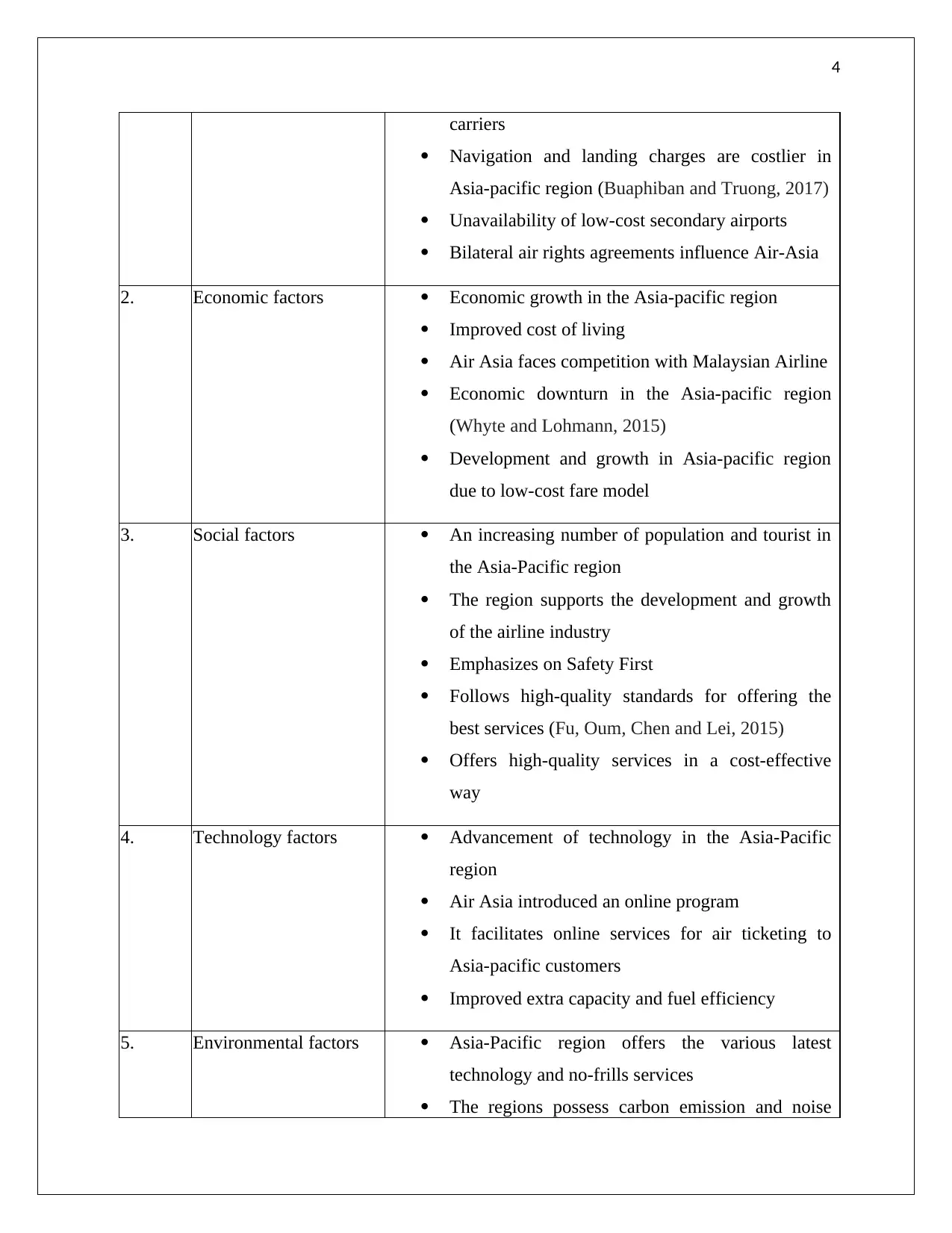
4
carriers
Navigation and landing charges are costlier in
Asia-pacific region (Buaphiban and Truong, 2017)
Unavailability of low-cost secondary airports
Bilateral air rights agreements influence Air-Asia
2. Economic factors Economic growth in the Asia-pacific region
Improved cost of living
Air Asia faces competition with Malaysian Airline
Economic downturn in the Asia-pacific region
(Whyte and Lohmann, 2015)
Development and growth in Asia-pacific region
due to low-cost fare model
3. Social factors An increasing number of population and tourist in
the Asia-Pacific region
The region supports the development and growth
of the airline industry
Emphasizes on Safety First
Follows high-quality standards for offering the
best services (Fu, Oum, Chen and Lei, 2015)
Offers high-quality services in a cost-effective
way
4. Technology factors Advancement of technology in the Asia-Pacific
region
Air Asia introduced an online program
It facilitates online services for air ticketing to
Asia-pacific customers
Improved extra capacity and fuel efficiency
5. Environmental factors Asia-Pacific region offers the various latest
technology and no-frills services
The regions possess carbon emission and noise
carriers
Navigation and landing charges are costlier in
Asia-pacific region (Buaphiban and Truong, 2017)
Unavailability of low-cost secondary airports
Bilateral air rights agreements influence Air-Asia
2. Economic factors Economic growth in the Asia-pacific region
Improved cost of living
Air Asia faces competition with Malaysian Airline
Economic downturn in the Asia-pacific region
(Whyte and Lohmann, 2015)
Development and growth in Asia-pacific region
due to low-cost fare model
3. Social factors An increasing number of population and tourist in
the Asia-Pacific region
The region supports the development and growth
of the airline industry
Emphasizes on Safety First
Follows high-quality standards for offering the
best services (Fu, Oum, Chen and Lei, 2015)
Offers high-quality services in a cost-effective
way
4. Technology factors Advancement of technology in the Asia-Pacific
region
Air Asia introduced an online program
It facilitates online services for air ticketing to
Asia-pacific customers
Improved extra capacity and fuel efficiency
5. Environmental factors Asia-Pacific region offers the various latest
technology and no-frills services
The regions possess carbon emission and noise
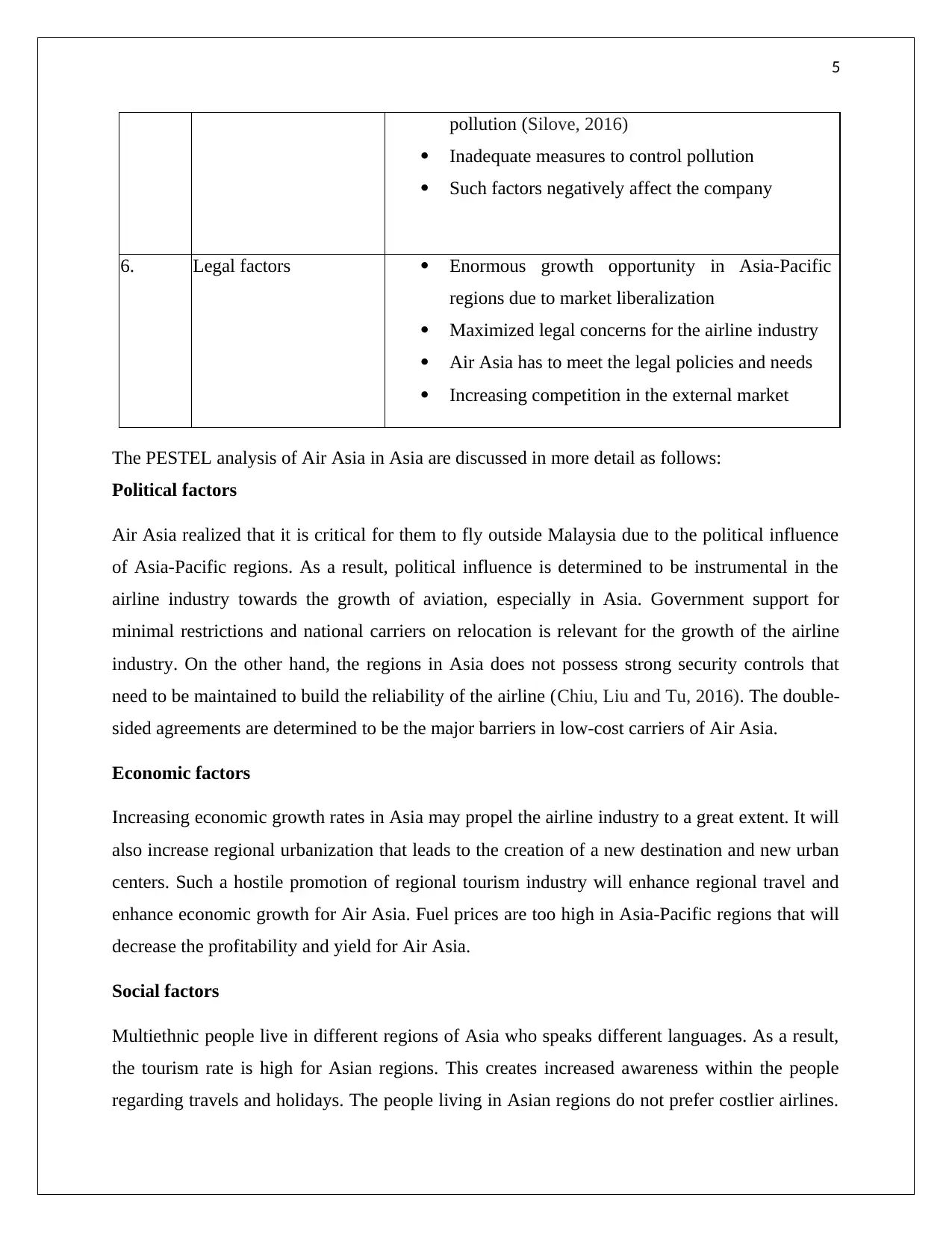
5
pollution (Silove, 2016)
Inadequate measures to control pollution
Such factors negatively affect the company
6. Legal factors Enormous growth opportunity in Asia-Pacific
regions due to market liberalization
Maximized legal concerns for the airline industry
Air Asia has to meet the legal policies and needs
Increasing competition in the external market
The PESTEL analysis of Air Asia in Asia are discussed in more detail as follows:
Political factors
Air Asia realized that it is critical for them to fly outside Malaysia due to the political influence
of Asia-Pacific regions. As a result, political influence is determined to be instrumental in the
airline industry towards the growth of aviation, especially in Asia. Government support for
minimal restrictions and national carriers on relocation is relevant for the growth of the airline
industry. On the other hand, the regions in Asia does not possess strong security controls that
need to be maintained to build the reliability of the airline (Chiu, Liu and Tu, 2016). The double-
sided agreements are determined to be the major barriers in low-cost carriers of Air Asia.
Economic factors
Increasing economic growth rates in Asia may propel the airline industry to a great extent. It will
also increase regional urbanization that leads to the creation of a new destination and new urban
centers. Such a hostile promotion of regional tourism industry will enhance regional travel and
enhance economic growth for Air Asia. Fuel prices are too high in Asia-Pacific regions that will
decrease the profitability and yield for Air Asia.
Social factors
Multiethnic people live in different regions of Asia who speaks different languages. As a result,
the tourism rate is high for Asian regions. This creates increased awareness within the people
regarding travels and holidays. The people living in Asian regions do not prefer costlier airlines.
pollution (Silove, 2016)
Inadequate measures to control pollution
Such factors negatively affect the company
6. Legal factors Enormous growth opportunity in Asia-Pacific
regions due to market liberalization
Maximized legal concerns for the airline industry
Air Asia has to meet the legal policies and needs
Increasing competition in the external market
The PESTEL analysis of Air Asia in Asia are discussed in more detail as follows:
Political factors
Air Asia realized that it is critical for them to fly outside Malaysia due to the political influence
of Asia-Pacific regions. As a result, political influence is determined to be instrumental in the
airline industry towards the growth of aviation, especially in Asia. Government support for
minimal restrictions and national carriers on relocation is relevant for the growth of the airline
industry. On the other hand, the regions in Asia does not possess strong security controls that
need to be maintained to build the reliability of the airline (Chiu, Liu and Tu, 2016). The double-
sided agreements are determined to be the major barriers in low-cost carriers of Air Asia.
Economic factors
Increasing economic growth rates in Asia may propel the airline industry to a great extent. It will
also increase regional urbanization that leads to the creation of a new destination and new urban
centers. Such a hostile promotion of regional tourism industry will enhance regional travel and
enhance economic growth for Air Asia. Fuel prices are too high in Asia-Pacific regions that will
decrease the profitability and yield for Air Asia.
Social factors
Multiethnic people live in different regions of Asia who speaks different languages. As a result,
the tourism rate is high for Asian regions. This creates increased awareness within the people
regarding travels and holidays. The people living in Asian regions do not prefer costlier airlines.
⊘ This is a preview!⊘
Do you want full access?
Subscribe today to unlock all pages.
Trusted by 1+ million students worldwide
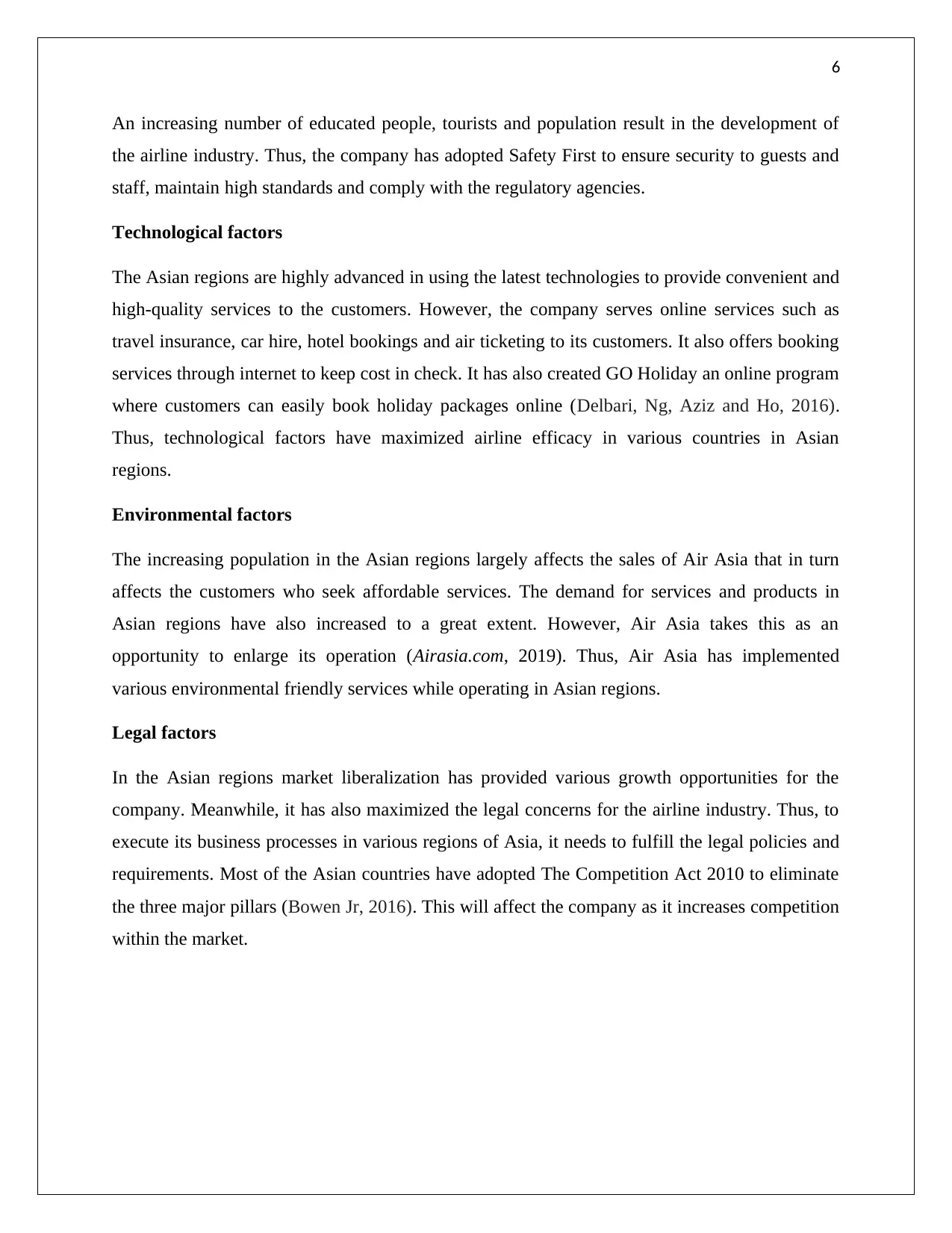
6
An increasing number of educated people, tourists and population result in the development of
the airline industry. Thus, the company has adopted Safety First to ensure security to guests and
staff, maintain high standards and comply with the regulatory agencies.
Technological factors
The Asian regions are highly advanced in using the latest technologies to provide convenient and
high-quality services to the customers. However, the company serves online services such as
travel insurance, car hire, hotel bookings and air ticketing to its customers. It also offers booking
services through internet to keep cost in check. It has also created GO Holiday an online program
where customers can easily book holiday packages online (Delbari, Ng, Aziz and Ho, 2016).
Thus, technological factors have maximized airline efficacy in various countries in Asian
regions.
Environmental factors
The increasing population in the Asian regions largely affects the sales of Air Asia that in turn
affects the customers who seek affordable services. The demand for services and products in
Asian regions have also increased to a great extent. However, Air Asia takes this as an
opportunity to enlarge its operation (Airasia.com, 2019). Thus, Air Asia has implemented
various environmental friendly services while operating in Asian regions.
Legal factors
In the Asian regions market liberalization has provided various growth opportunities for the
company. Meanwhile, it has also maximized the legal concerns for the airline industry. Thus, to
execute its business processes in various regions of Asia, it needs to fulfill the legal policies and
requirements. Most of the Asian countries have adopted The Competition Act 2010 to eliminate
the three major pillars (Bowen Jr, 2016). This will affect the company as it increases competition
within the market.
An increasing number of educated people, tourists and population result in the development of
the airline industry. Thus, the company has adopted Safety First to ensure security to guests and
staff, maintain high standards and comply with the regulatory agencies.
Technological factors
The Asian regions are highly advanced in using the latest technologies to provide convenient and
high-quality services to the customers. However, the company serves online services such as
travel insurance, car hire, hotel bookings and air ticketing to its customers. It also offers booking
services through internet to keep cost in check. It has also created GO Holiday an online program
where customers can easily book holiday packages online (Delbari, Ng, Aziz and Ho, 2016).
Thus, technological factors have maximized airline efficacy in various countries in Asian
regions.
Environmental factors
The increasing population in the Asian regions largely affects the sales of Air Asia that in turn
affects the customers who seek affordable services. The demand for services and products in
Asian regions have also increased to a great extent. However, Air Asia takes this as an
opportunity to enlarge its operation (Airasia.com, 2019). Thus, Air Asia has implemented
various environmental friendly services while operating in Asian regions.
Legal factors
In the Asian regions market liberalization has provided various growth opportunities for the
company. Meanwhile, it has also maximized the legal concerns for the airline industry. Thus, to
execute its business processes in various regions of Asia, it needs to fulfill the legal policies and
requirements. Most of the Asian countries have adopted The Competition Act 2010 to eliminate
the three major pillars (Bowen Jr, 2016). This will affect the company as it increases competition
within the market.
Paraphrase This Document
Need a fresh take? Get an instant paraphrase of this document with our AI Paraphraser
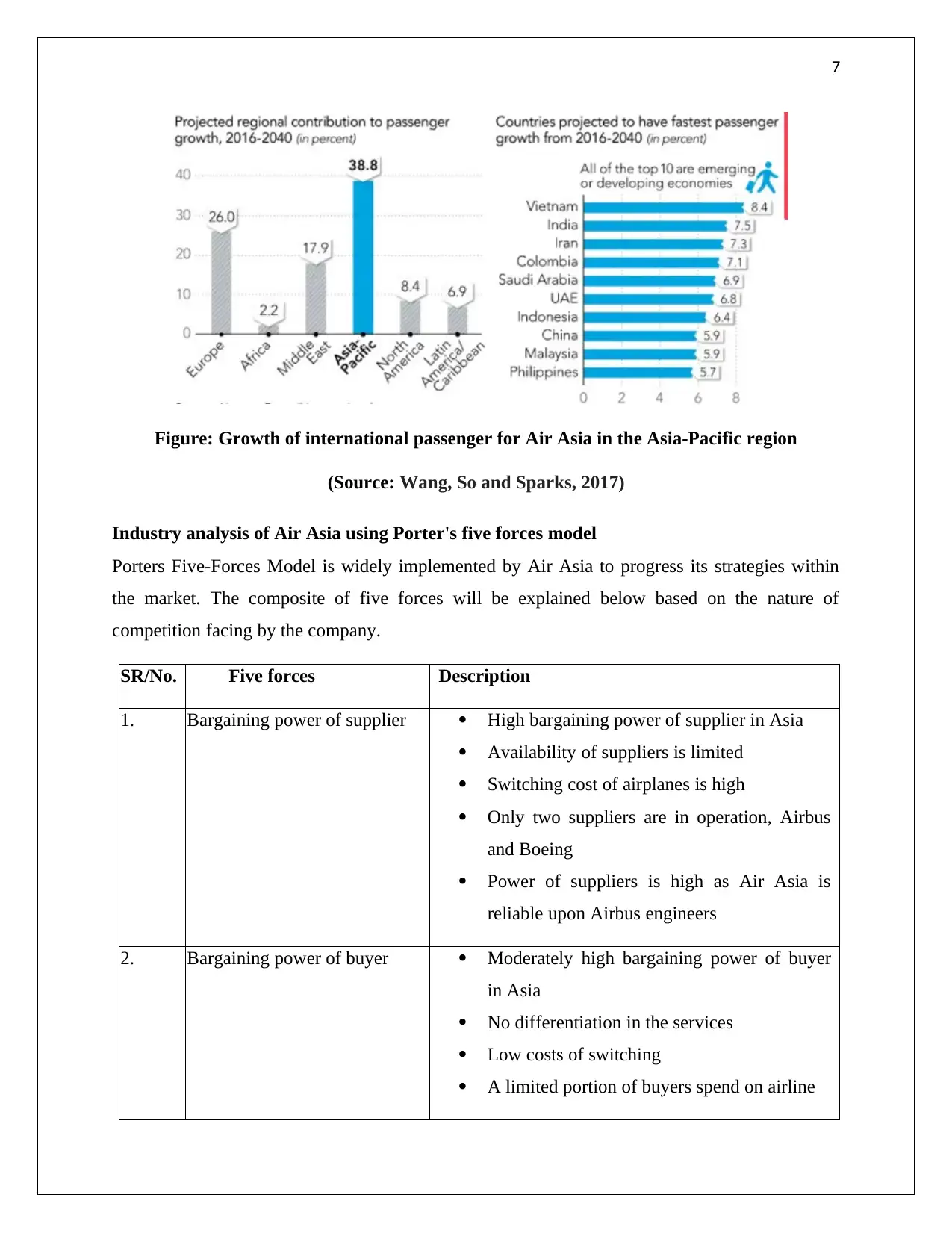
7
Figure: Growth of international passenger for Air Asia in the Asia-Pacific region
(Source: Wang, So and Sparks, 2017)
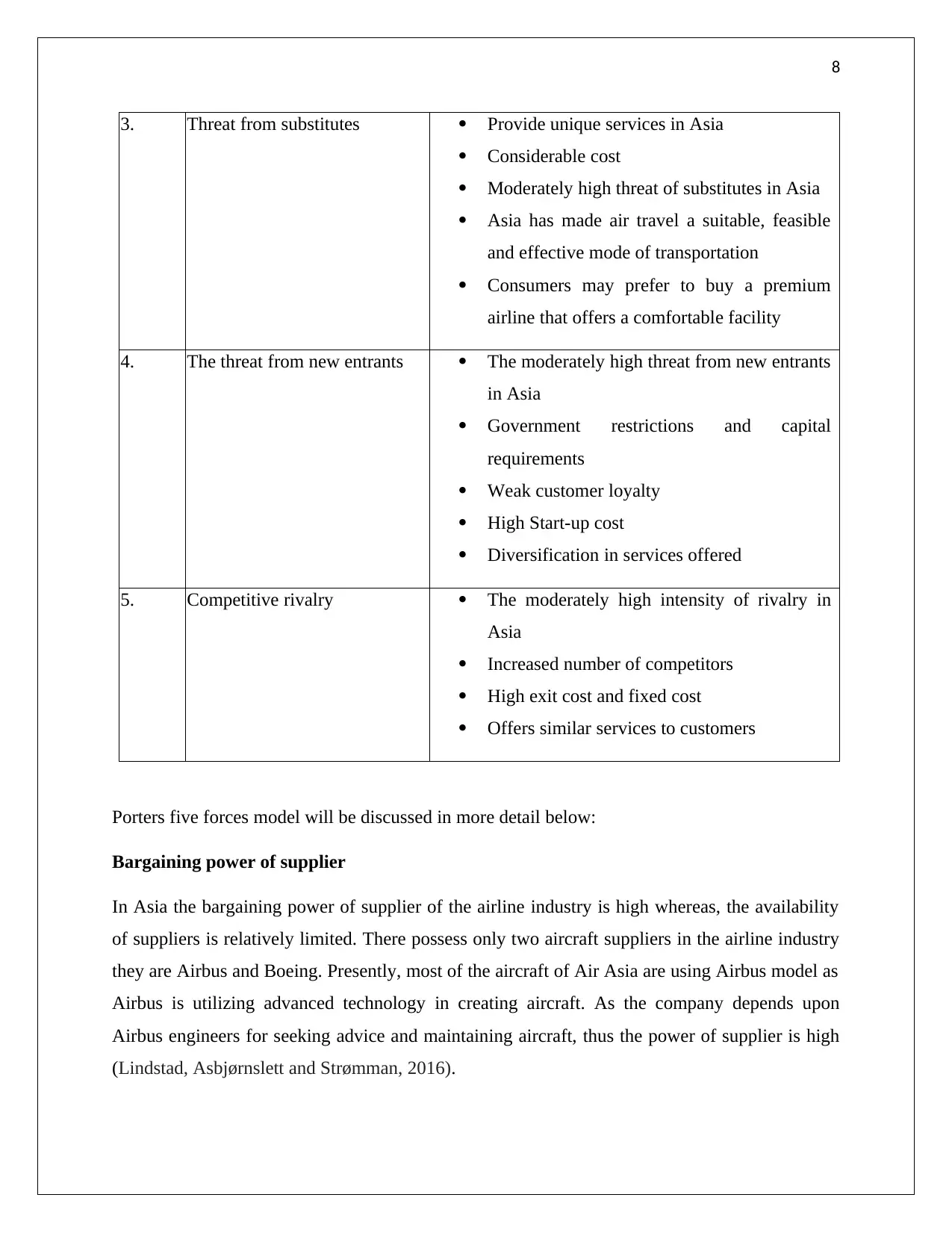
Industry analysis of Air Asia using Porter's five forces model
Porters Five-Forces Model is widely implemented by Air Asia to progress its strategies within
the market. The composite of five forces will be explained below based on the nature of
competition facing by the company.
SR/No. Five forces Description
1. Bargaining power of supplier High bargaining power of supplier in Asia
Availability of suppliers is limited
Switching cost of airplanes is high
Only two suppliers are in operation, Airbus
and Boeing
Power of suppliers is high as Air Asia is
reliable upon Airbus engineers
2. Bargaining power of buyer Moderately high bargaining power of buyer
in Asia
No differentiation in the services
Low costs of switching
A limited portion of buyers spend on airline
Figure: Growth of international passenger for Air Asia in the Asia-Pacific region
(Source: Wang, So and Sparks, 2017)
Industry analysis of Air Asia using Porter's five forces model
Porters Five-Forces Model is widely implemented by Air Asia to progress its strategies within
the market. The composite of five forces will be explained below based on the nature of
competition facing by the company.
SR/No. Five forces Description
1. Bargaining power of supplier High bargaining power of supplier in Asia
Availability of suppliers is limited
Switching cost of airplanes is high
Only two suppliers are in operation, Airbus
and Boeing
Power of suppliers is high as Air Asia is
reliable upon Airbus engineers
2. Bargaining power of buyer Moderately high bargaining power of buyer
in Asia
No differentiation in the services
Low costs of switching
A limited portion of buyers spend on airline
8
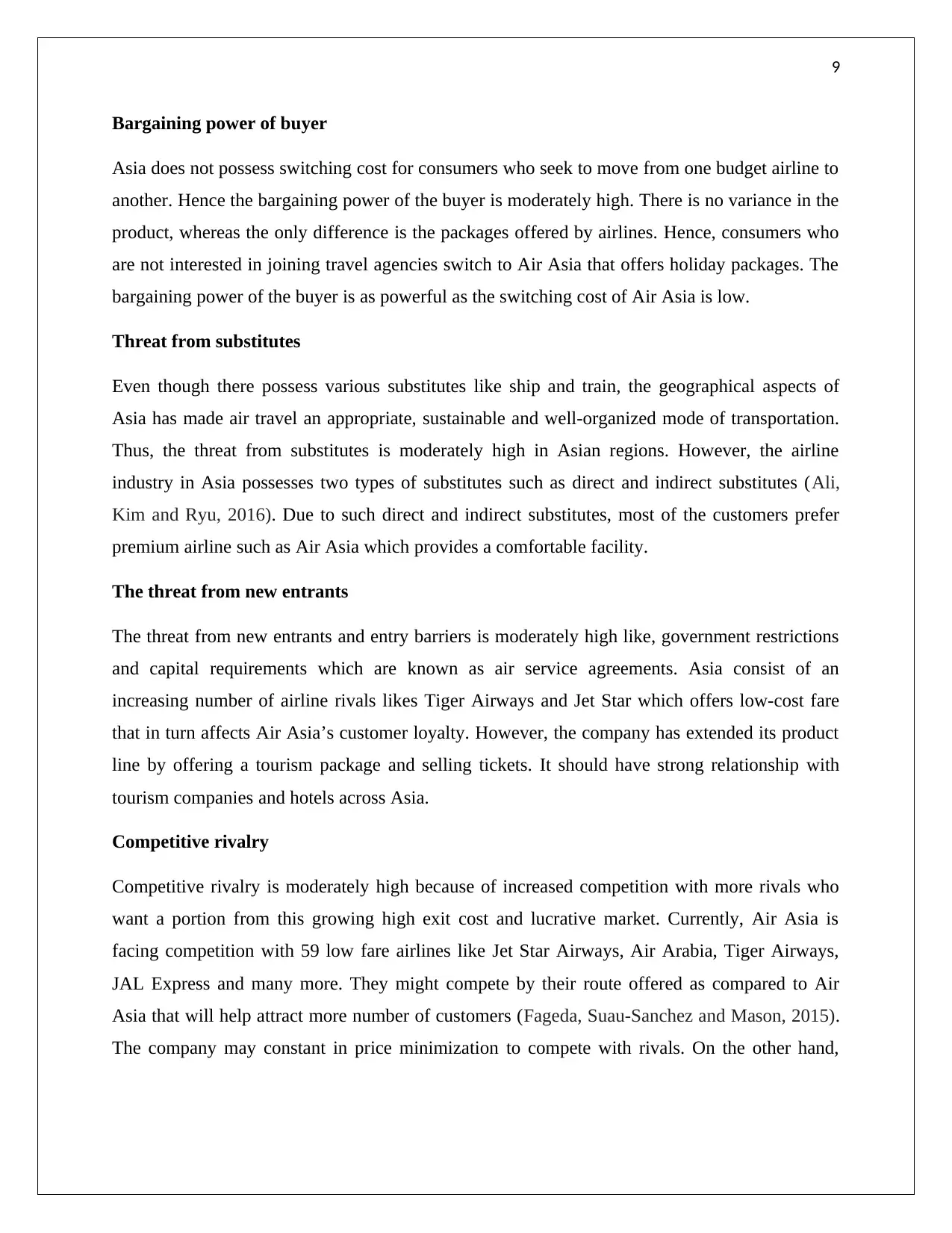
3. Threat from substitutes Provide unique services in Asia
Considerable cost
Moderately high threat of substitutes in Asia
Asia has made air travel a suitable, feasible
and effective mode of transportation
Consumers may prefer to buy a premium
airline that offers a comfortable facility
4. The threat from new entrants The moderately high threat from new entrants
in Asia
Government restrictions and capital
requirements
Weak customer loyalty
High Start-up cost
Diversification in services offered
5. Competitive rivalry The moderately high intensity of rivalry in
Asia
Increased number of competitors
High exit cost and fixed cost
Offers similar services to customers
Porters five forces model will be discussed in more detail below:
Bargaining power of supplier
In Asia the bargaining power of supplier of the airline industry is high whereas, the availability
of suppliers is relatively limited. There possess only two aircraft suppliers in the airline industry
they are Airbus and Boeing. Presently, most of the aircraft of Air Asia are using Airbus model as
Airbus is utilizing advanced technology in creating aircraft. As the company depends upon
Airbus engineers for seeking advice and maintaining aircraft, thus the power of supplier is high
(Lindstad, Asbjørnslett and Strømman, 2016).
3. Threat from substitutes Provide unique services in Asia
Considerable cost
Moderately high threat of substitutes in Asia
Asia has made air travel a suitable, feasible
and effective mode of transportation
Consumers may prefer to buy a premium
airline that offers a comfortable facility
4. The threat from new entrants The moderately high threat from new entrants
in Asia
Government restrictions and capital
requirements
Weak customer loyalty
High Start-up cost
Diversification in services offered
5. Competitive rivalry The moderately high intensity of rivalry in
Asia
Increased number of competitors
High exit cost and fixed cost
Offers similar services to customers
Porters five forces model will be discussed in more detail below:
Bargaining power of supplier
In Asia the bargaining power of supplier of the airline industry is high whereas, the availability
of suppliers is relatively limited. There possess only two aircraft suppliers in the airline industry
they are Airbus and Boeing. Presently, most of the aircraft of Air Asia are using Airbus model as
Airbus is utilizing advanced technology in creating aircraft. As the company depends upon
Airbus engineers for seeking advice and maintaining aircraft, thus the power of supplier is high
(Lindstad, Asbjørnslett and Strømman, 2016).
⊘ This is a preview!⊘
Do you want full access?
Subscribe today to unlock all pages.
Trusted by 1+ million students worldwide
9
Bargaining power of buyer
Asia does not possess switching cost for consumers who seek to move from one budget airline to
another. Hence the bargaining power of the buyer is moderately high. There is no variance in the
product, whereas the only difference is the packages offered by airlines. Hence, consumers who
are not interested in joining travel agencies switch to Air Asia that offers holiday packages. The
bargaining power of the buyer is as powerful as the switching cost of Air Asia is low.
Threat from substitutes
Even though there possess various substitutes like ship and train, the geographical aspects of
Asia has made air travel an appropriate, sustainable and well-organized mode of transportation.
Thus, the threat from substitutes is moderately high in Asian regions. However, the airline
industry in Asia possesses two types of substitutes such as direct and indirect substitutes (Ali,
Kim and Ryu, 2016). Due to such direct and indirect substitutes, most of the customers prefer
premium airline such as Air Asia which provides a comfortable facility.
The threat from new entrants
The threat from new entrants and entry barriers is moderately high like, government restrictions
and capital requirements which are known as air service agreements. Asia consist of an
increasing number of airline rivals likes Tiger Airways and Jet Star which offers low-cost fare
that in turn affects Air Asia’s customer loyalty. However, the company has extended its product
line by offering a tourism package and selling tickets. It should have strong relationship with
tourism companies and hotels across Asia.
Competitive rivalry
Competitive rivalry is moderately high because of increased competition with more rivals who
want a portion from this growing high exit cost and lucrative market. Currently, Air Asia is
facing competition with 59 low fare airlines like Jet Star Airways, Air Arabia, Tiger Airways,
JAL Express and many more. They might compete by their route offered as compared to Air
Asia that will help attract more number of customers (Fageda, Suau-Sanchez and Mason, 2015).
The company may constant in price minimization to compete with rivals. On the other hand,
Bargaining power of buyer
Asia does not possess switching cost for consumers who seek to move from one budget airline to
another. Hence the bargaining power of the buyer is moderately high. There is no variance in the
product, whereas the only difference is the packages offered by airlines. Hence, consumers who
are not interested in joining travel agencies switch to Air Asia that offers holiday packages. The
bargaining power of the buyer is as powerful as the switching cost of Air Asia is low.
Threat from substitutes
Even though there possess various substitutes like ship and train, the geographical aspects of
Asia has made air travel an appropriate, sustainable and well-organized mode of transportation.
Thus, the threat from substitutes is moderately high in Asian regions. However, the airline
industry in Asia possesses two types of substitutes such as direct and indirect substitutes (Ali,
Kim and Ryu, 2016). Due to such direct and indirect substitutes, most of the customers prefer
premium airline such as Air Asia which provides a comfortable facility.
The threat from new entrants
The threat from new entrants and entry barriers is moderately high like, government restrictions
and capital requirements which are known as air service agreements. Asia consist of an
increasing number of airline rivals likes Tiger Airways and Jet Star which offers low-cost fare
that in turn affects Air Asia’s customer loyalty. However, the company has extended its product
line by offering a tourism package and selling tickets. It should have strong relationship with
tourism companies and hotels across Asia.
Competitive rivalry
Competitive rivalry is moderately high because of increased competition with more rivals who
want a portion from this growing high exit cost and lucrative market. Currently, Air Asia is
facing competition with 59 low fare airlines like Jet Star Airways, Air Arabia, Tiger Airways,
JAL Express and many more. They might compete by their route offered as compared to Air
Asia that will help attract more number of customers (Fageda, Suau-Sanchez and Mason, 2015).
The company may constant in price minimization to compete with rivals. On the other hand,
Paraphrase This Document
Need a fresh take? Get an instant paraphrase of this document with our AI Paraphraser
10
high exit cost makes the airline industry very competitive. As a result, the company has extended
its hotel booking services.
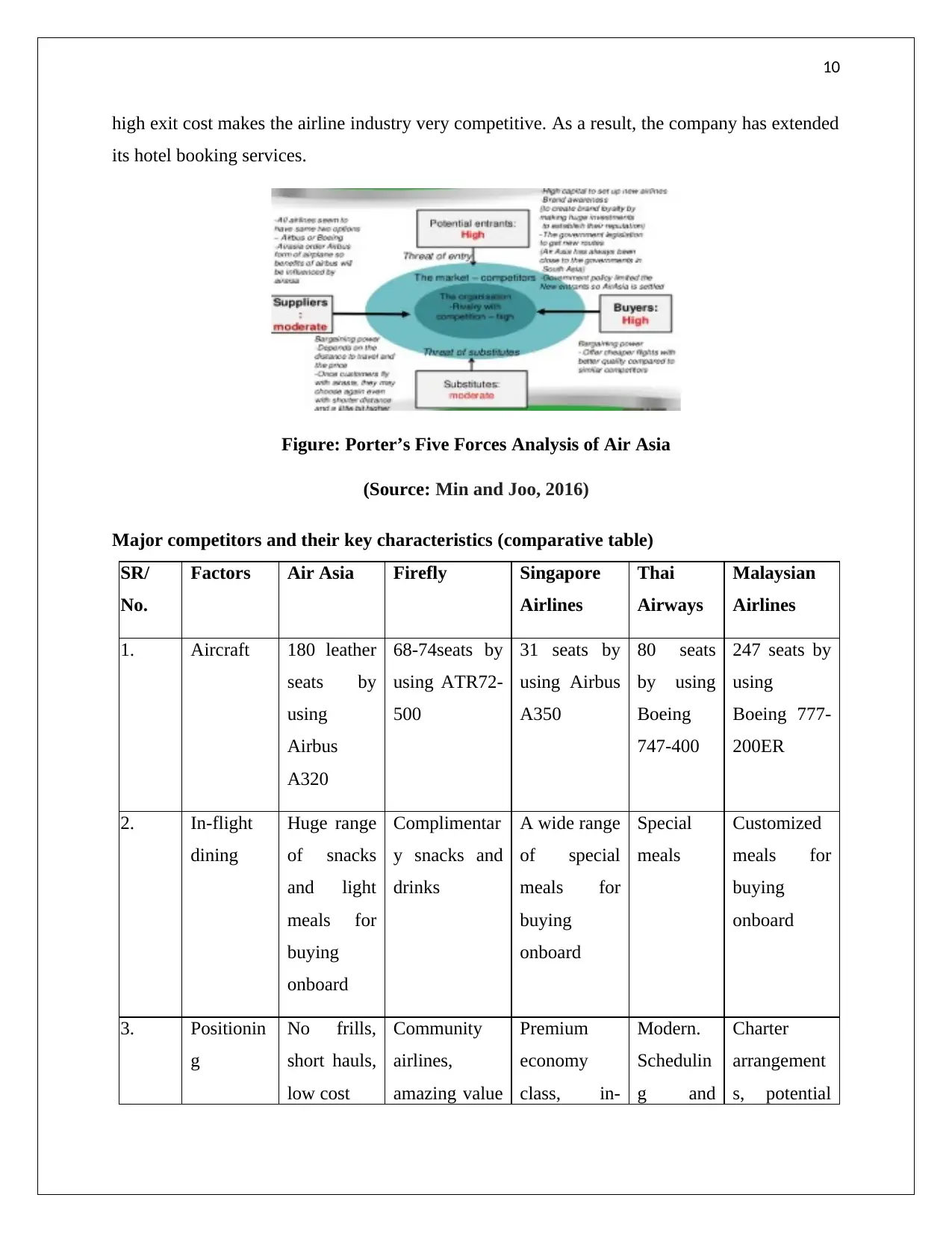
Figure: Porter’s Five Forces Analysis of Air Asia
(Source: Min and Joo, 2016)
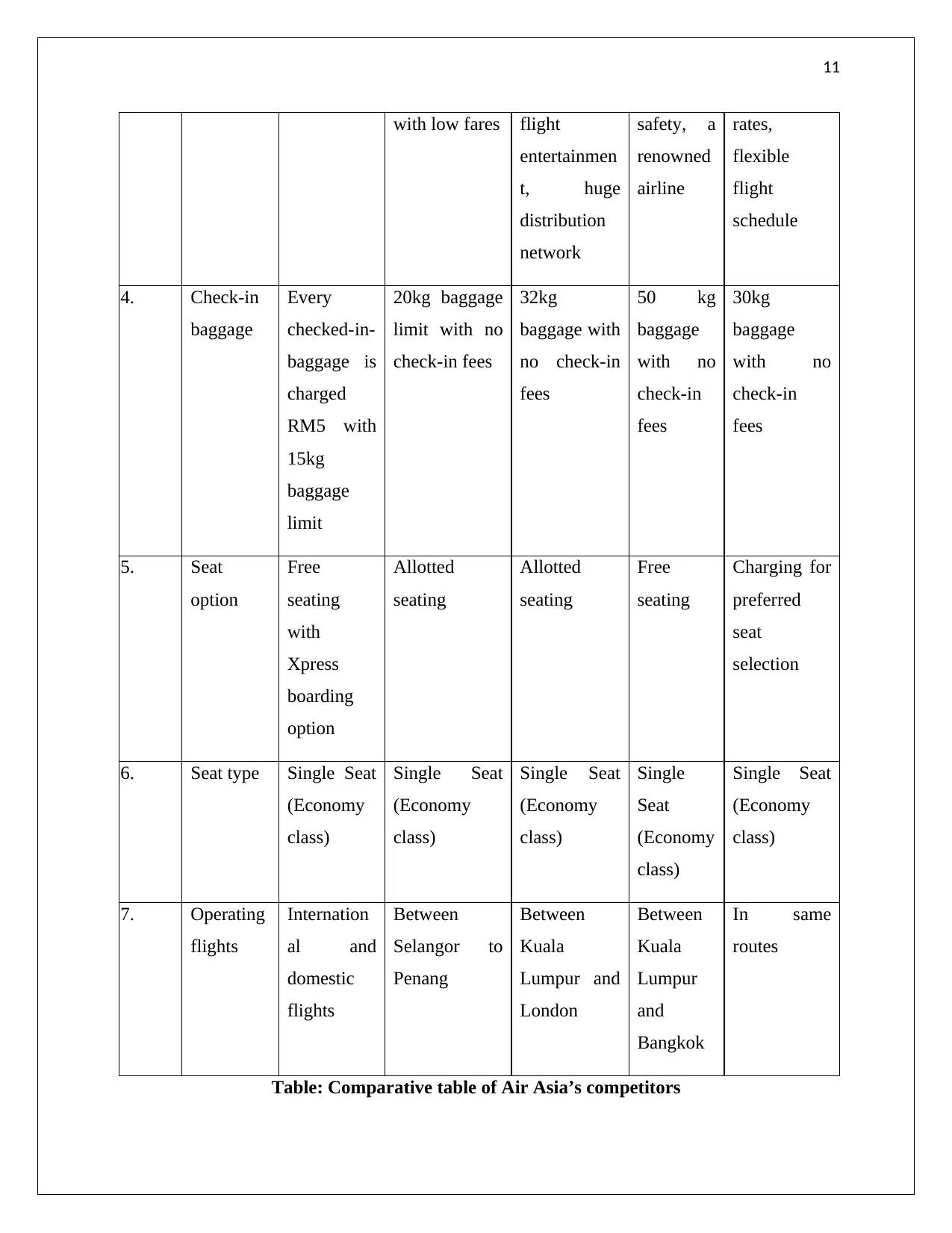
Major competitors and their key characteristics (comparative table)
SR/
No.
Factors Air Asia Firefly Singapore
Airlines
Thai
Airways
Malaysian
Airlines
1. Aircraft 180 leather
seats by
using
Airbus
A320
68-74seats by
using ATR72-
500
31 seats by
using Airbus
A350
80 seats
by using
Boeing
747-400
247 seats by
using
Boeing 777-
200ER
2. In-flight
dining
Huge range
of snacks
and light
meals for
buying
onboard
Complimentar
y snacks and
drinks
A wide range
of special
meals for
buying
onboard
Special
meals
Customized
meals for
buying
onboard
3. Positionin
g
No frills,
short hauls,
low cost
Community
airlines,
amazing value
Premium
economy
class, in-
Modern.
Schedulin
g and
Charter
arrangement
s, potential
high exit cost makes the airline industry very competitive. As a result, the company has extended
its hotel booking services.
Figure: Porter’s Five Forces Analysis of Air Asia
(Source: Min and Joo, 2016)
Major competitors and their key characteristics (comparative table)
SR/
No.
Factors Air Asia Firefly Singapore
Airlines
Thai
Airways
Malaysian
Airlines
1. Aircraft 180 leather
seats by
using
Airbus
A320
68-74seats by
using ATR72-
500
31 seats by
using Airbus
A350
80 seats
by using
Boeing
747-400
247 seats by
using
Boeing 777-
200ER
2. In-flight
dining
Huge range
of snacks
and light
meals for
buying
onboard
Complimentar
y snacks and
drinks
A wide range
of special
meals for
buying
onboard
Special
meals
Customized
meals for
buying
onboard
3. Positionin
g
No frills,
short hauls,
low cost
Community
airlines,
amazing value
Premium
economy
class, in-
Modern.
Schedulin
g and
Charter
arrangement
s, potential
11
with low fares flight
entertainmen
t, huge
distribution
network
safety, a
renowned
airline
rates,
flexible
flight
schedule
4. Check-in
baggage
Every
checked-in-
baggage is
charged
RM5 with
15kg
baggage
limit
20kg baggage
limit with no
check-in fees
32kg
baggage with
no check-in
fees
50 kg
baggage
with no
check-in
fees
30kg
baggage
with no
check-in
fees
5. Seat
option
Free
seating
with
Xpress
boarding
option
Allotted
seating
Allotted
seating
Free
seating
Charging for
preferred
seat
selection
6. Seat type Single Seat
(Economy
class)
Single Seat
(Economy
class)
Single Seat
(Economy
class)
Single
Seat
(Economy
class)
Single Seat
(Economy
class)
7. Operating
flights
Internation
al and
domestic
flights
Between
Selangor to
Penang
Between
Kuala
Lumpur and
London
Between
Kuala
Lumpur
and
Bangkok
In same
routes
Table: Comparative table of Air Asia’s competitors
with low fares flight
entertainmen
t, huge
distribution
network
safety, a
renowned
airline
rates,
flexible
flight
schedule
4. Check-in
baggage
Every
checked-in-
baggage is
charged
RM5 with
15kg
baggage
limit
20kg baggage
limit with no
check-in fees
32kg
baggage with
no check-in
fees
50 kg
baggage
with no
check-in
fees
30kg
baggage
with no
check-in
fees
5. Seat
option
Free
seating
with
Xpress
boarding
option
Allotted
seating
Allotted
seating
Free
seating
Charging for
preferred
seat
selection
6. Seat type Single Seat
(Economy
class)
Single Seat
(Economy
class)
Single Seat
(Economy
class)
Single
Seat
(Economy
class)
Single Seat
(Economy
class)
7. Operating
flights
Internation
al and
domestic
flights
Between
Selangor to
Penang
Between
Kuala
Lumpur and
London
Between
Kuala
Lumpur
and
Bangkok
In same
routes
Table: Comparative table of Air Asia’s competitors
⊘ This is a preview!⊘
Do you want full access?
Subscribe today to unlock all pages.
Trusted by 1+ million students worldwide

1 out of 25


Related Documents


Your All-in-One AI-Powered Toolkit for Academic Success.
+13062052269
info@desklib.com
Available 24*7 on WhatsApp / Email
![[object Object]](/_next/static/media/star-bottom.7253800d.svg)
Unlock your academic potential
Copyright © 2020–2026 A2Z Services. All Rights Reserved. Developed and managed by ZUCOL.