An Analysis of AirAsia's Cultural Communication Challenges and Issues
VerifiedAdded on 2023/04/22
|17
|4703
|419
Report
AI Summary
This report delves into the cultural challenges faced by AirAsia, focusing on communication issues within the organization. It begins with a background of AirAsia and its environment, highlighting its rapid growth and diverse workforce. The report identifies communication barriers, including misunderstandings, differences in norms, beliefs, and values, as major challenges. Hofstede's cultural dimensions are chosen as the theoretical framework to analyze these issues, with an explanation of each dimension. The analysis examines how these dimensions impact AirAsia's workplace, leading to miscommunication and behavioral differences among employees. The report concludes with recommendations to improve communication and address cultural challenges within AirAsia, supporting a more cohesive and productive work environment. The report uses APA format and includes 30 references.
Running head: MANAGEMENT
Management
Name of the Student
Name of the University
Author Note
Management
Name of the Student
Name of the University
Author Note

Paraphrase This Document
Need a fresh take? Get an instant paraphrase of this document with our AI Paraphraser
1MANAGEMENT
Background of the organization and its environment
Founded in the year 1993 by the government of Malaysia, the second airliner, Air
Asia started its journey in the year 1996. During the consecutive 5 years, the airline industry
failed to bring profit resulting in a great amount of debt of about USD $37 million in the year
2001. The company came in the hands of Dato’ Sri Dr Tony Fernandes and Dato’ Pahamin
Rejab there after foregoing all the debts of the airline. Air Asia started is new journey with an
innovative goal of making the airline much more affordable so that everyone can fly. The
airline was re-launched and re branded with a new life of two Boeing planes (Nugraha,
2016). Air Asia hence for the made a tremendous success in the airline industry and achieved
some of the fantastic outcomes. The mission and the vision of the company are to continue
being the lowest cost airline in the market together with being the best company for working.
The company furthermore aims to maintain the highest product quality with the embracing of
the technology for the reduction of the cost and enhancement of the service level to the
customers. It continues to spread out the way for the low cost aviation through the passionate,
innovation and efficient approaches towards the business. With the aim of the largest low
cost airline, the company serves more than 3 billion people with poor connectivity and high
price ranges (Kaliannan & Adjovu, 2015). The company operates with the lowest cost of the
unit cost near about US $0.030 and the rate of passenger breakdown load factor of 55%. The
company serves a high level of productivity from the crew members that are higher than the
Malaysia Airlines. In the context of the environment of the organization, the CEO of the
company illustrates the importance of the employees of the organization since they form the
backbone of the business. The mission of Air Asia includes developing and creating a
globally recognised ASEAN brand image to (Sharma, 2018). The founding principle of the
organization in the domain of the organizational background projects to be aware at all the
time regarding the engagement in the business platform where the responsibility of the
Background of the organization and its environment
Founded in the year 1993 by the government of Malaysia, the second airliner, Air
Asia started its journey in the year 1996. During the consecutive 5 years, the airline industry
failed to bring profit resulting in a great amount of debt of about USD $37 million in the year
2001. The company came in the hands of Dato’ Sri Dr Tony Fernandes and Dato’ Pahamin
Rejab there after foregoing all the debts of the airline. Air Asia started is new journey with an
innovative goal of making the airline much more affordable so that everyone can fly. The
airline was re-launched and re branded with a new life of two Boeing planes (Nugraha,
2016). Air Asia hence for the made a tremendous success in the airline industry and achieved
some of the fantastic outcomes. The mission and the vision of the company are to continue
being the lowest cost airline in the market together with being the best company for working.
The company furthermore aims to maintain the highest product quality with the embracing of
the technology for the reduction of the cost and enhancement of the service level to the
customers. It continues to spread out the way for the low cost aviation through the passionate,
innovation and efficient approaches towards the business. With the aim of the largest low
cost airline, the company serves more than 3 billion people with poor connectivity and high
price ranges (Kaliannan & Adjovu, 2015). The company operates with the lowest cost of the
unit cost near about US $0.030 and the rate of passenger breakdown load factor of 55%. The
company serves a high level of productivity from the crew members that are higher than the
Malaysia Airlines. In the context of the environment of the organization, the CEO of the
company illustrates the importance of the employees of the organization since they form the
backbone of the business. The mission of Air Asia includes developing and creating a
globally recognised ASEAN brand image to (Sharma, 2018). The founding principle of the
organization in the domain of the organizational background projects to be aware at all the
time regarding the engagement in the business platform where the responsibility of the
2MANAGEMENT
customers relies on the company. Some of the safety values of the organization include first
class training session of the employees, high level of job integrity and well maintained
equipments. As per the macro environmental analysis there lays a huge range of scope for
growth for Air Asia (Adapa & Roy, 2017). The environmental factors furthermore anticipated
that for the reason of the rapid urbanization trends the market of Air Asia will continue to
grow at a very fast pace. In the context of micro environment analysis, it can be concluded
that the power of suppliers is high for the reason of limited number of suppliers and the
industrial monopolization. Air Asia with its costs range of lowest range has a competitive
advantage over its rivals.
Introduction
The report will focus on the main cultural challenges faced by the organization of Air
Asia while expanding their business in the global context. It will highlight on the language
and the cultural barriers within the organization as reported by Air Asia (Adler et al., 2017).
One of the many facets of the factor of the human is the presence of a diverse and the
multicultural taskforce in the industry of aviation. The issues or the challenges became more
evident in the organization over the last years move of the migration of the people around the
countries (Huang & Crotts, 2019). Furthermore with the affordable range of the flying and
the increasing demand for the international travel induces the company to hire more people
from different cultures, origins and languages. Organizational culture represents the overall
structure, life style of the company. In the context of the organization of Air Asia , the
perspectives of the culture in the company includes or involves a wide range of the variety of
the elements that including both internal and external collaborators (Wood et al., 2015). Some
of the factors involved in the culture of the organization of Air Asia are the working methods
of the company, the level of the social engagement of the employees of the organization, the
working environment inside Air Asia, the team work, the well being and the motivational
customers relies on the company. Some of the safety values of the organization include first
class training session of the employees, high level of job integrity and well maintained
equipments. As per the macro environmental analysis there lays a huge range of scope for
growth for Air Asia (Adapa & Roy, 2017). The environmental factors furthermore anticipated
that for the reason of the rapid urbanization trends the market of Air Asia will continue to
grow at a very fast pace. In the context of micro environment analysis, it can be concluded
that the power of suppliers is high for the reason of limited number of suppliers and the
industrial monopolization. Air Asia with its costs range of lowest range has a competitive
advantage over its rivals.
Introduction
The report will focus on the main cultural challenges faced by the organization of Air
Asia while expanding their business in the global context. It will highlight on the language
and the cultural barriers within the organization as reported by Air Asia (Adler et al., 2017).
One of the many facets of the factor of the human is the presence of a diverse and the
multicultural taskforce in the industry of aviation. The issues or the challenges became more
evident in the organization over the last years move of the migration of the people around the
countries (Huang & Crotts, 2019). Furthermore with the affordable range of the flying and
the increasing demand for the international travel induces the company to hire more people
from different cultures, origins and languages. Organizational culture represents the overall
structure, life style of the company. In the context of the organization of Air Asia , the
perspectives of the culture in the company includes or involves a wide range of the variety of
the elements that including both internal and external collaborators (Wood et al., 2015). Some
of the factors involved in the culture of the organization of Air Asia are the working methods
of the company, the level of the social engagement of the employees of the organization, the
working environment inside Air Asia, the team work, the well being and the motivational
⊘ This is a preview!⊘
Do you want full access?
Subscribe today to unlock all pages.

Trusted by 1+ million students worldwide
3MANAGEMENT
factors of the employees in the organization. The rising airline of the Malaysia strived to
diversify their workforce by the recruitment of hiring workers varying from different
nationalities and cultural backgrounds. The company aimed towards the benefit of the
achievement of wide range of perspectives and higher ability of the competencies in the
global marketplace (Pounian & Green, 2015). But as per the current reports and the survey
regarding the employee satisfaction at the workplace, Air Asia there has been report of
increased communication challenges, behavioural issues and differences in the personality
leading to miscommunication among the employees of Air Asia.
Explanation of the chosen theoretical framework - Hofstede’s cultural
dimensions
Dimension and the theoretical framework of culture are important aspects of the
international business. The theory of Hofstede’s cultural dimensions includes the framework
that revolves around the factor of the cross cultural communication that has been devised by
Geert Hofstede. This particular report illustrating the cultural barriers and the issues in the
communication of the languages among the organization of Air Asia will include the analysis
of the theoretical framework of Hofstede’s cultural dimensions. The theory looks at some of
the unique aspects of the cultures and analyse the factors disrupting the workplace balance
and the cultural rhythm of the organization of Air Asia (Burns, 2016). This is because this
particular dimension collectively tends to portray the effect of the culture ingrained in the
organization regarding the values of the employees of Air Asia. This theoretical framework is
efficient as compared to the other probable framework analysing the culture since it studies
the significant aspects of the culture providing the factors in a rating scale which is easy for
calculation and understanding.
factors of the employees in the organization. The rising airline of the Malaysia strived to
diversify their workforce by the recruitment of hiring workers varying from different
nationalities and cultural backgrounds. The company aimed towards the benefit of the
achievement of wide range of perspectives and higher ability of the competencies in the
global marketplace (Pounian & Green, 2015). But as per the current reports and the survey
regarding the employee satisfaction at the workplace, Air Asia there has been report of
increased communication challenges, behavioural issues and differences in the personality
leading to miscommunication among the employees of Air Asia.
Explanation of the chosen theoretical framework - Hofstede’s cultural
dimensions
Dimension and the theoretical framework of culture are important aspects of the
international business. The theory of Hofstede’s cultural dimensions includes the framework
that revolves around the factor of the cross cultural communication that has been devised by
Geert Hofstede. This particular report illustrating the cultural barriers and the issues in the
communication of the languages among the organization of Air Asia will include the analysis
of the theoretical framework of Hofstede’s cultural dimensions. The theory looks at some of
the unique aspects of the cultures and analyse the factors disrupting the workplace balance
and the cultural rhythm of the organization of Air Asia (Burns, 2016). This is because this
particular dimension collectively tends to portray the effect of the culture ingrained in the
organization regarding the values of the employees of Air Asia. This theoretical framework is
efficient as compared to the other probable framework analysing the culture since it studies
the significant aspects of the culture providing the factors in a rating scale which is easy for
calculation and understanding.
Paraphrase This Document
Need a fresh take? Get an instant paraphrase of this document with our AI Paraphraser
4MANAGEMENT
Theoretical framework
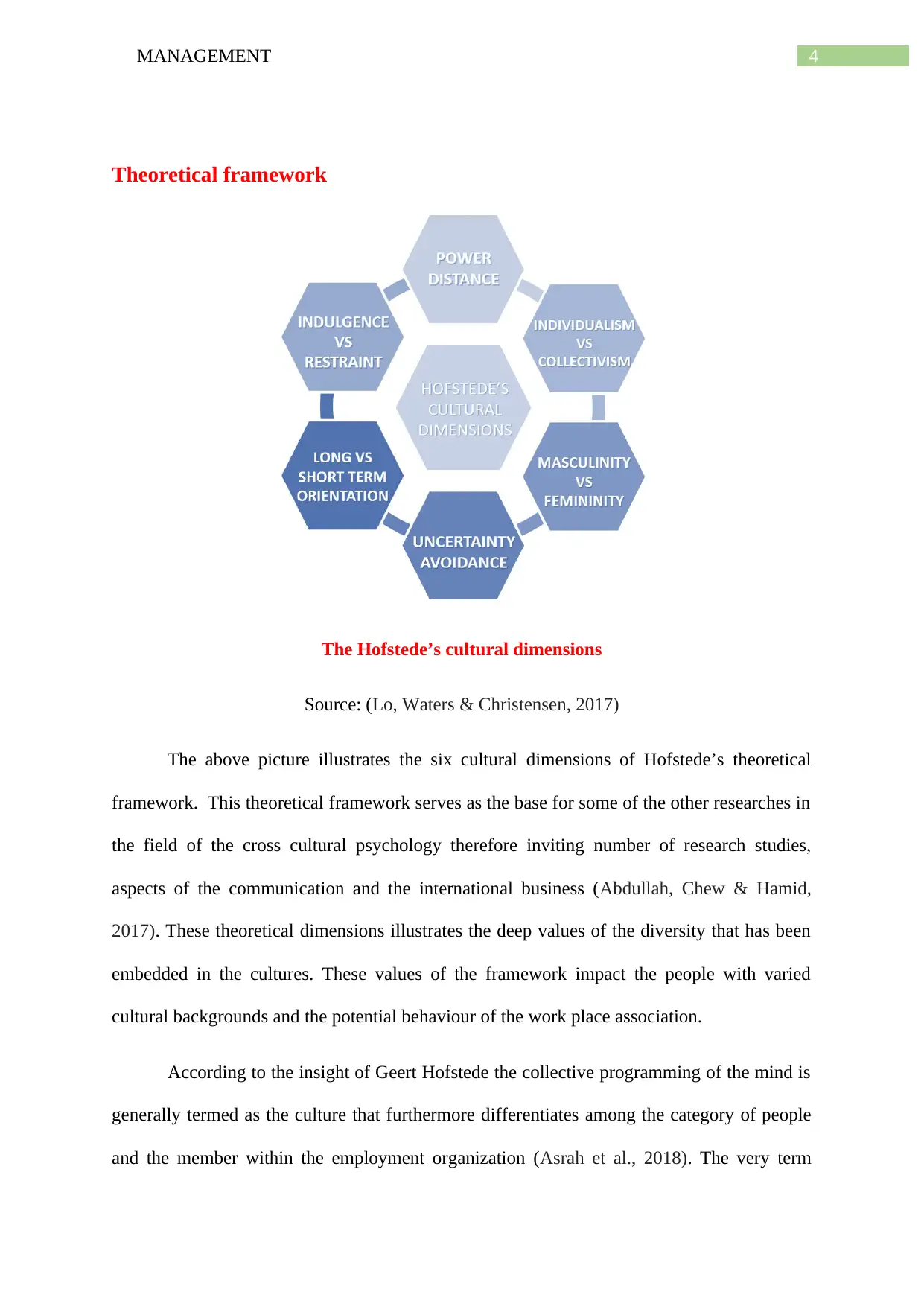
The Hofstede’s cultural dimensions
Source: (Lo, Waters & Christensen, 2017)
The above picture illustrates the six cultural dimensions of Hofstede’s theoretical
framework. This theoretical framework serves as the base for some of the other researches in
the field of the cross cultural psychology therefore inviting number of research studies,
aspects of the communication and the international business (Abdullah, Chew & Hamid,
2017). These theoretical dimensions illustrates the deep values of the diversity that has been
embedded in the cultures. These values of the framework impact the people with varied
cultural backgrounds and the potential behaviour of the work place association.
According to the insight of Geert Hofstede the collective programming of the mind is
generally termed as the culture that furthermore differentiates among the category of people
and the member within the employment organization (Asrah et al., 2018). The very term
Theoretical framework
The Hofstede’s cultural dimensions
Source: (Lo, Waters & Christensen, 2017)
The above picture illustrates the six cultural dimensions of Hofstede’s theoretical
framework. This theoretical framework serves as the base for some of the other researches in
the field of the cross cultural psychology therefore inviting number of research studies,
aspects of the communication and the international business (Abdullah, Chew & Hamid,
2017). These theoretical dimensions illustrates the deep values of the diversity that has been
embedded in the cultures. These values of the framework impact the people with varied
cultural backgrounds and the potential behaviour of the work place association.
According to the insight of Geert Hofstede the collective programming of the mind is
generally termed as the culture that furthermore differentiates among the category of people
and the member within the employment organization (Asrah et al., 2018). The very term
5MANAGEMENT
category includes the factors of religion, nationality, ethnicities, gender and the occupational
position.
Power Distance - This factor of the theoretical framework stands for the inequality
that is defined. This dimension illustrates the extent to which the members who holds
a less powerful position on the organization accept and also expect the unequal
distribution of the powers (Laudon & Laudon, 2016). In short this dimension of the
theoretical model is the extent to which the organizations and the societies accept the
differential powers. The organizations with a large distance of the power are generally
characterized by some of the following features including leadership autocracy,
centralization of the authority, the paternalistic way of the management within the
organization, the number of the levels of the hierarchy, the supervisory staff and
finally the expectations of the differences of the power and inequality.
Uncertainty Avoidance - This dimension describes the extent to which the people in
the organization are not at the ease with the uncertainty and the ambiguity. In short
this dimension is the extent to which the members or the employees of the
organization are capable of copying with the uncertainty of the future of the
organization without taking any sort of stress (Gerede, 2015). Some of the features in
the domain of the weak uncertainty include the factor of undertaking risks, flexibility
and tolerance towards differing behaviours and opinions. Factors such tendency
towards avoiding of the risk, standardized procedures towards the clear and delineated
structures, strong requirement for consensus and respect for the authority and the
promotion depends upon the age or seniority.
Collectivism vs Individualism – The aim or focus of this dimension is on the question
on the context whether the people have some of the preferences for being left alone in
the closely knitted network. The cultures of the individualist are characterized by
category includes the factors of religion, nationality, ethnicities, gender and the occupational
position.
Power Distance - This factor of the theoretical framework stands for the inequality
that is defined. This dimension illustrates the extent to which the members who holds
a less powerful position on the organization accept and also expect the unequal
distribution of the powers (Laudon & Laudon, 2016). In short this dimension of the
theoretical model is the extent to which the organizations and the societies accept the
differential powers. The organizations with a large distance of the power are generally
characterized by some of the following features including leadership autocracy,
centralization of the authority, the paternalistic way of the management within the
organization, the number of the levels of the hierarchy, the supervisory staff and
finally the expectations of the differences of the power and inequality.
Uncertainty Avoidance - This dimension describes the extent to which the people in
the organization are not at the ease with the uncertainty and the ambiguity. In short
this dimension is the extent to which the members or the employees of the
organization are capable of copying with the uncertainty of the future of the
organization without taking any sort of stress (Gerede, 2015). Some of the features in
the domain of the weak uncertainty include the factor of undertaking risks, flexibility
and tolerance towards differing behaviours and opinions. Factors such tendency
towards avoiding of the risk, standardized procedures towards the clear and delineated
structures, strong requirement for consensus and respect for the authority and the
promotion depends upon the age or seniority.
Collectivism vs Individualism – The aim or focus of this dimension is on the question
on the context whether the people have some of the preferences for being left alone in
the closely knitted network. The cultures of the individualist are characterized by
⊘ This is a preview!⊘
Do you want full access?
Subscribe today to unlock all pages.
Trusted by 1+ million students worldwide
6MANAGEMENT
fostering of the contractual relation revolving around the fundamentals of exchange.
Furthermore emphasis on the personal fun, enjoyment, pleasure and the social norms
are part of the individualist culture (Gumanti et al., 2018). On the other hand, the
collectivist cultures are characterized by the norms of the sharing of the resources and
the readiness towards giving up some of the personal interest keeping the collective
interest. Furthermore factors such as increased concern regarding the in groups of the
organization and the showcase of the hostility of the indifference towards the out
group members includes in the collective cultures.
Masculinity vs Femininity - The factors of masculinity and femininity revolves
around the role of the emotions that are distributed among the genders that is again
one of the primary issues in number of societies (Helmreich & Merritt, 2017). The
culture of masculinity includes some of the major characteristics like clear distinct
gender roles, expectations and assertive concentration towards the material
achievements. The culture of femininity includes factors like overlapping of the social
rules of the gender, emphasis on the non materialistic angles regarding success and
the preferred traits in the masculine gender in the organization.
Long term vs short term orientation – This factors is based on the Confucian
dynamism. The focus of this particular dimension regarding the long term orientation
describes the inclination of the society towards searching for the virtue (Stone &
Deadrick, 2015). The factors of the short term orientation pertain to the societies that
are most strongly inclines towards the effective establishment of the absolute truth. As
per the teachings of the Confucius, the factors of long or the short term orientation are
evident towards the unequal existing relationships among the people towards the
ensuring of the stability of the society, the virtuous behaviours involving the meted
treatments in a similar manner.
fostering of the contractual relation revolving around the fundamentals of exchange.
Furthermore emphasis on the personal fun, enjoyment, pleasure and the social norms
are part of the individualist culture (Gumanti et al., 2018). On the other hand, the
collectivist cultures are characterized by the norms of the sharing of the resources and
the readiness towards giving up some of the personal interest keeping the collective
interest. Furthermore factors such as increased concern regarding the in groups of the
organization and the showcase of the hostility of the indifference towards the out
group members includes in the collective cultures.
Masculinity vs Femininity - The factors of masculinity and femininity revolves
around the role of the emotions that are distributed among the genders that is again
one of the primary issues in number of societies (Helmreich & Merritt, 2017). The
culture of masculinity includes some of the major characteristics like clear distinct
gender roles, expectations and assertive concentration towards the material
achievements. The culture of femininity includes factors like overlapping of the social
rules of the gender, emphasis on the non materialistic angles regarding success and
the preferred traits in the masculine gender in the organization.
Long term vs short term orientation – This factors is based on the Confucian
dynamism. The focus of this particular dimension regarding the long term orientation
describes the inclination of the society towards searching for the virtue (Stone &
Deadrick, 2015). The factors of the short term orientation pertain to the societies that
are most strongly inclines towards the effective establishment of the absolute truth. As
per the teachings of the Confucius, the factors of long or the short term orientation are
evident towards the unequal existing relationships among the people towards the
ensuring of the stability of the society, the virtuous behaviours involving the meted
treatments in a similar manner.
Paraphrase This Document
Need a fresh take? Get an instant paraphrase of this document with our AI Paraphraser
7MANAGEMENT
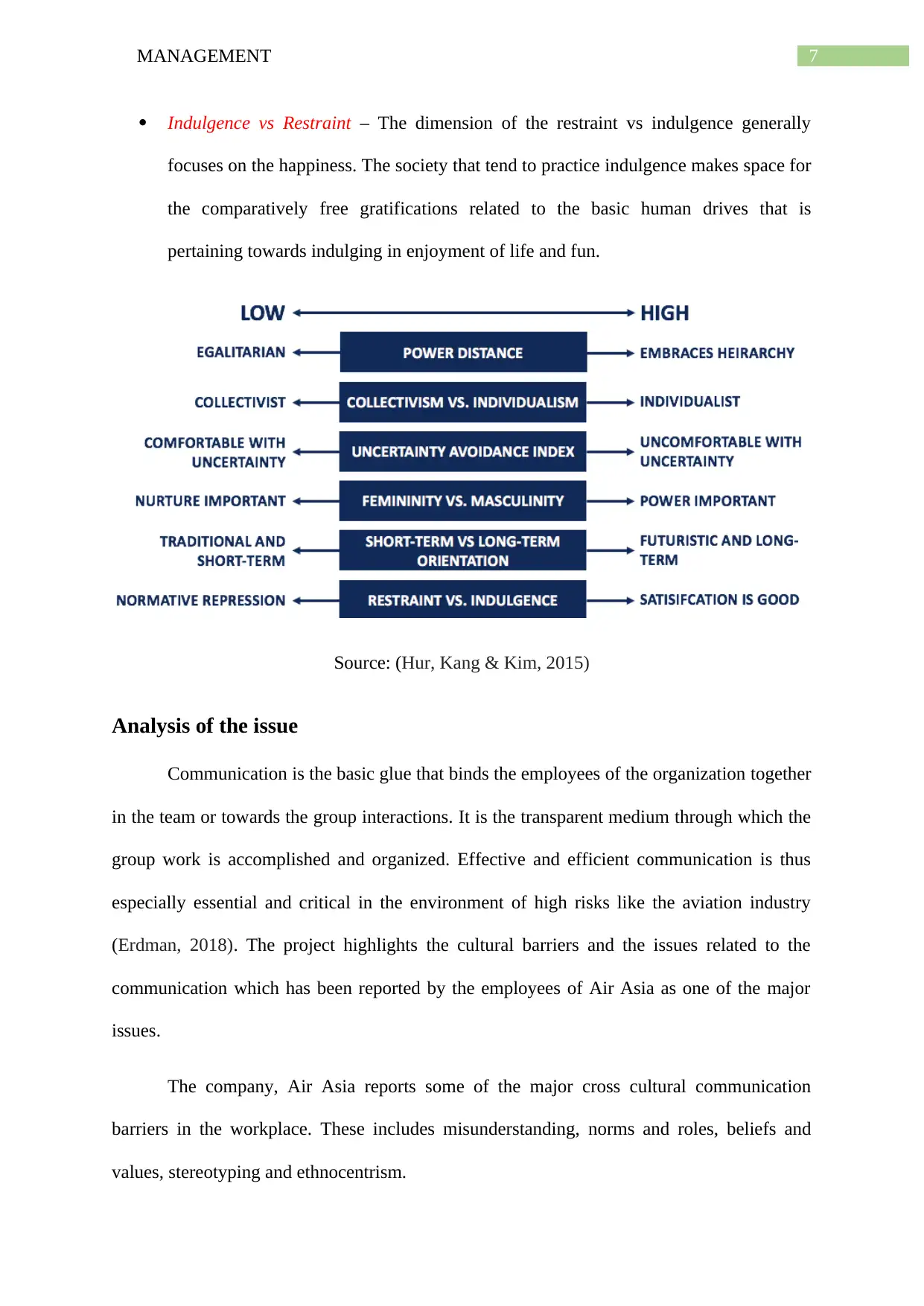
Indulgence vs Restraint – The dimension of the restraint vs indulgence generally
focuses on the happiness. The society that tend to practice indulgence makes space for
the comparatively free gratifications related to the basic human drives that is
pertaining towards indulging in enjoyment of life and fun.
Source: (Hur, Kang & Kim, 2015)
Analysis of the issue
Communication is the basic glue that binds the employees of the organization together
in the team or towards the group interactions. It is the transparent medium through which the
group work is accomplished and organized. Effective and efficient communication is thus
especially essential and critical in the environment of high risks like the aviation industry
(Erdman, 2018). The project highlights the cultural barriers and the issues related to the
communication which has been reported by the employees of Air Asia as one of the major
issues.
The company, Air Asia reports some of the major cross cultural communication
barriers in the workplace. These includes misunderstanding, norms and roles, beliefs and
values, stereotyping and ethnocentrism.
Indulgence vs Restraint – The dimension of the restraint vs indulgence generally
focuses on the happiness. The society that tend to practice indulgence makes space for
the comparatively free gratifications related to the basic human drives that is
pertaining towards indulging in enjoyment of life and fun.
Source: (Hur, Kang & Kim, 2015)
Analysis of the issue
Communication is the basic glue that binds the employees of the organization together
in the team or towards the group interactions. It is the transparent medium through which the
group work is accomplished and organized. Effective and efficient communication is thus
especially essential and critical in the environment of high risks like the aviation industry
(Erdman, 2018). The project highlights the cultural barriers and the issues related to the
communication which has been reported by the employees of Air Asia as one of the major
issues.
The company, Air Asia reports some of the major cross cultural communication
barriers in the workplace. These includes misunderstanding, norms and roles, beliefs and
values, stereotyping and ethnocentrism.
8MANAGEMENT
Misunderstanding is the foremost barrier towards the communication in
organizational structure in Air Asia. This is common since Air Asia includes people of
different cultural backgrounds whose beliefs and values vary widely. The variations in
different cultures among the employees of the organization results in high anxiety and
uncertainty (Betancourt et al., 2016).
Roles and norms – Each and every culture has its own norms and they have their own
appropriate and acceptable range of behaviours. The employees working in Air Asia often
fail towards the understanding of the norms of other cultures furthermore leading to anxiety
and interruption in the process of communication.
Values and beliefs – These factors differ from one person to another person. As
reported by Air Asia, the values and the beliefs of the employees depends on their culture
(Helmreich & Merritt, 2017). This cross cultural belief and the values posses ineffective
barriers towards the communication among the employees of the organization.
Stereotyping – The value judgements about other people tends to affect the workplace
culture. Air Asia reported that inadequate information or data regarding the people leads
towards unintelligent choices regarding cross cultural communication. Exaggeration of
cultural stereotypes and the overgeneralization of the people often tends to issues in
communication among the organization (Brannen, Piekkari & Tietze, 2017). Air Asia
reported that the stereotypes are the some of the major reasons for the differences of opinions
regarding the opposite cultures that leads towards miscommunication.
The issues of cultural and communication barriers is one of the major issues since it
furthermore tends to disrupt the safety in the flight. The operations related to the safety of the
flight of the Air Asia has been reported to be repeatedly been jeopardized by poor
Misunderstanding is the foremost barrier towards the communication in
organizational structure in Air Asia. This is common since Air Asia includes people of
different cultural backgrounds whose beliefs and values vary widely. The variations in
different cultures among the employees of the organization results in high anxiety and
uncertainty (Betancourt et al., 2016).
Roles and norms – Each and every culture has its own norms and they have their own
appropriate and acceptable range of behaviours. The employees working in Air Asia often
fail towards the understanding of the norms of other cultures furthermore leading to anxiety
and interruption in the process of communication.
Values and beliefs – These factors differ from one person to another person. As
reported by Air Asia, the values and the beliefs of the employees depends on their culture
(Helmreich & Merritt, 2017). This cross cultural belief and the values posses ineffective
barriers towards the communication among the employees of the organization.
Stereotyping – The value judgements about other people tends to affect the workplace
culture. Air Asia reported that inadequate information or data regarding the people leads
towards unintelligent choices regarding cross cultural communication. Exaggeration of
cultural stereotypes and the overgeneralization of the people often tends to issues in
communication among the organization (Brannen, Piekkari & Tietze, 2017). Air Asia
reported that the stereotypes are the some of the major reasons for the differences of opinions
regarding the opposite cultures that leads towards miscommunication.
The issues of cultural and communication barriers is one of the major issues since it
furthermore tends to disrupt the safety in the flight. The operations related to the safety of the
flight of the Air Asia has been reported to be repeatedly been jeopardized by poor
⊘ This is a preview!⊘
Do you want full access?
Subscribe today to unlock all pages.
Trusted by 1+ million students worldwide
9MANAGEMENT
communication and cultural differences among the members of the crew and the ground staff
of Air Asia.
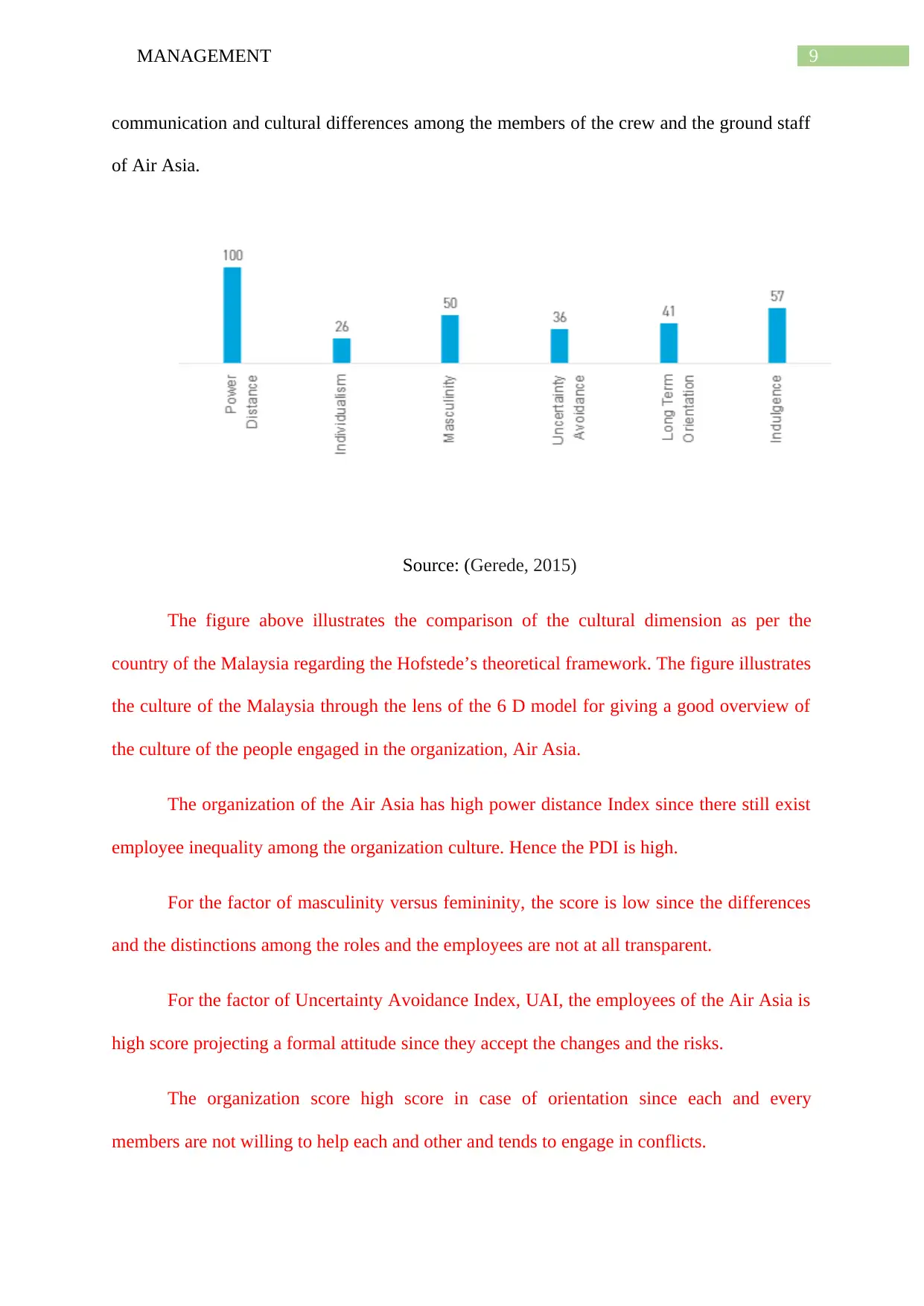
Source: (Gerede, 2015)
The figure above illustrates the comparison of the cultural dimension as per the
country of the Malaysia regarding the Hofstede’s theoretical framework. The figure illustrates
the culture of the Malaysia through the lens of the 6 D model for giving a good overview of
the culture of the people engaged in the organization, Air Asia.
The organization of the Air Asia has high power distance Index since there still exist
employee inequality among the organization culture. Hence the PDI is high.
For the factor of masculinity versus femininity, the score is low since the differences
and the distinctions among the roles and the employees are not at all transparent.
For the factor of Uncertainty Avoidance Index, UAI, the employees of the Air Asia is
high score projecting a formal attitude since they accept the changes and the risks.
The organization score high score in case of orientation since each and every
members are not willing to help each and other and tends to engage in conflicts.
communication and cultural differences among the members of the crew and the ground staff
of Air Asia.
Source: (Gerede, 2015)
The figure above illustrates the comparison of the cultural dimension as per the
country of the Malaysia regarding the Hofstede’s theoretical framework. The figure illustrates
the culture of the Malaysia through the lens of the 6 D model for giving a good overview of
the culture of the people engaged in the organization, Air Asia.
The organization of the Air Asia has high power distance Index since there still exist
employee inequality among the organization culture. Hence the PDI is high.
For the factor of masculinity versus femininity, the score is low since the differences
and the distinctions among the roles and the employees are not at all transparent.
For the factor of Uncertainty Avoidance Index, UAI, the employees of the Air Asia is
high score projecting a formal attitude since they accept the changes and the risks.
The organization score high score in case of orientation since each and every
members are not willing to help each and other and tends to engage in conflicts.
Paraphrase This Document
Need a fresh take? Get an instant paraphrase of this document with our AI Paraphraser
10MANAGEMENT
The low cost travel flight company aims towards the maximisation of the benefit of
the travellers and hired innumerable number of migrants from different cultural backgrounds
in the last few years (Lee & Kramer, 2016). The employees of the organization have cultural
differences within the workplace furthermore resulting in hampering and disrupting the
smooth operations both on and off the board of Air Asia, thus creating a risk towards the life
of the passengers. The company reported how the consequences of the cultural barriers,
stereotyping, gender differences and the communication errors can be quite deadly in nature
(Voinea et al., 2015). It disrupts the maintenance of the accurate situational awareness during
the flight for the ego, and communication gap among the crew members. Cultural barriers
and the lack of effective communication among the employees of the Air Asia often disrupts
the essential factors of the building of the shared understanding of the problems of the flight.
In the examples of the case where the employees and the members of the Air Asia are
from some of the other cultures, miscommunication regarding various conception of the
organization and the structures of the interactions on a professional basis has been reported to
have occurred (Peltokorpi & Vaara, 2017). As per the above stated theoretical frame of
Hofstede’s cultural dimensions, the factors of power distance among the employees who are
engage in communication often influences the strategies of the communication of the member
of both the individualistic and the collectivist culture. Furthermore lower statuses conversant
are identified to be more indirect regarding their pattern of communication towards the high
status conversant. The factors of cross cultural work furthermore suggest how the status
impacts on the pronunciations in case of the collectivistic culture. Towards the factor of
power distance, uncertainty avoidance, the analysis revealed how the lack of the effective
communication raised due to cultural and diversity among the employees contributes to the
lack of collectivism approach. Issues within the gender discrimination among the employees
furthermore contribute to the factor of masculinity and femininity. The company must
The low cost travel flight company aims towards the maximisation of the benefit of
the travellers and hired innumerable number of migrants from different cultural backgrounds
in the last few years (Lee & Kramer, 2016). The employees of the organization have cultural
differences within the workplace furthermore resulting in hampering and disrupting the
smooth operations both on and off the board of Air Asia, thus creating a risk towards the life
of the passengers. The company reported how the consequences of the cultural barriers,
stereotyping, gender differences and the communication errors can be quite deadly in nature
(Voinea et al., 2015). It disrupts the maintenance of the accurate situational awareness during
the flight for the ego, and communication gap among the crew members. Cultural barriers
and the lack of effective communication among the employees of the Air Asia often disrupts
the essential factors of the building of the shared understanding of the problems of the flight.
In the examples of the case where the employees and the members of the Air Asia are
from some of the other cultures, miscommunication regarding various conception of the
organization and the structures of the interactions on a professional basis has been reported to
have occurred (Peltokorpi & Vaara, 2017). As per the above stated theoretical frame of
Hofstede’s cultural dimensions, the factors of power distance among the employees who are
engage in communication often influences the strategies of the communication of the member
of both the individualistic and the collectivist culture. Furthermore lower statuses conversant
are identified to be more indirect regarding their pattern of communication towards the high
status conversant. The factors of cross cultural work furthermore suggest how the status
impacts on the pronunciations in case of the collectivistic culture. Towards the factor of
power distance, uncertainty avoidance, the analysis revealed how the lack of the effective
communication raised due to cultural and diversity among the employees contributes to the
lack of collectivism approach. Issues within the gender discrimination among the employees
furthermore contribute to the factor of masculinity and femininity. The company must
11MANAGEMENT
furthermore contribute to the long term approach highlighting the category of the indulgence
or restraint.
Thus it can be stated that the barriers in language go together with the differences in
the culture furthermore posing additional issues and misunderstanding as reported by Air
Asia in their organization (Busse et al., 2016). The cultural and the language barriers in the
organization thus posses a major impact in the work performance due to misconstruction of
the system of management. According to researchers, 65% of the respondents of Air Asia
reported that the cultural clashes and communication barriers existing inside the organization
is leading to inefficiency making difficulty in collaboration and hampering the productivity of
the employees and the dedication towards the safety of the passengers during the flight
(Alvesson & Sveningsson, 2015). Furthermore the existing practise of gender stereotyping
among the organization is another factor that has been reported by the employees of Air Asia
that effects the workplace productivity among the female employees.
Conclusion
The report illustrated the use of the famous theoretical framework of Hofstede’s
cultural dimensions for analysing the issues of the cultural barriers of the business. The issues
or the challenges became more evident in the organization over the last years move of the
migration of the people around the countries. Furthermore with the affordable range of the
flying and the increasing demand for the international travel induces the company to hire
more people from different cultures, origins and languages. The rising airline of the Malaysia
strived to diversify their workforce by the recruitment of hiring workers varying from
different nationalities and cultural backgrounds. The company aimed towards the benefit of
the achievement of wide range of perspectives and higher ability of the competencies in the
global marketplace. The cultural international efforts towards the efficiency and the safety in
furthermore contribute to the long term approach highlighting the category of the indulgence
or restraint.
Thus it can be stated that the barriers in language go together with the differences in
the culture furthermore posing additional issues and misunderstanding as reported by Air
Asia in their organization (Busse et al., 2016). The cultural and the language barriers in the
organization thus posses a major impact in the work performance due to misconstruction of
the system of management. According to researchers, 65% of the respondents of Air Asia
reported that the cultural clashes and communication barriers existing inside the organization
is leading to inefficiency making difficulty in collaboration and hampering the productivity of
the employees and the dedication towards the safety of the passengers during the flight
(Alvesson & Sveningsson, 2015). Furthermore the existing practise of gender stereotyping
among the organization is another factor that has been reported by the employees of Air Asia
that effects the workplace productivity among the female employees.
Conclusion
The report illustrated the use of the famous theoretical framework of Hofstede’s
cultural dimensions for analysing the issues of the cultural barriers of the business. The issues
or the challenges became more evident in the organization over the last years move of the
migration of the people around the countries. Furthermore with the affordable range of the
flying and the increasing demand for the international travel induces the company to hire
more people from different cultures, origins and languages. The rising airline of the Malaysia
strived to diversify their workforce by the recruitment of hiring workers varying from
different nationalities and cultural backgrounds. The company aimed towards the benefit of
the achievement of wide range of perspectives and higher ability of the competencies in the
global marketplace. The cultural international efforts towards the efficiency and the safety in
⊘ This is a preview!⊘
Do you want full access?
Subscribe today to unlock all pages.
Trusted by 1+ million students worldwide

1 out of 17


Related Documents


Your All-in-One AI-Powered Toolkit for Academic Success.
+13062052269
info@desklib.com
Available 24*7 on WhatsApp / Email
![[object Object]](/_next/static/media/star-bottom.7253800d.svg)
Unlock your academic potential
Copyright © 2020–2026 A2Z Services. All Rights Reserved. Developed and managed by ZUCOL.