Assignment 4: Aircraft Stability and Control, Mechanical Engineering
VerifiedAdded on 2022/11/14
|20
|2857
|225
Homework Assignment
AI Summary
This assignment delves into the critical aspects of aircraft stability and control, covering both static and dynamic stability in the longitudinal, lateral, and directional axes. It explores various control surfaces such as the rudder, elevator, and ailerons, along with their functions in maintaining aircraft equilibrium and maneuverability. The document also examines specialized control mechanisms like trim tabs, elevons, flaperons, and air brakes, detailing their operational principles and advantages. Furthermore, the assignment analyzes canard control systems, all-moving tails, and aerodynamic balancing techniques to enhance flight performance and control. The analysis includes discussions on the impact of different design elements on aircraft stability and efficiency, providing a comprehensive overview of the subject matter.
1
Assignment 4: Stability and Control
Name:
College:
Date:
Assignment 4: Stability and Control
Name:
College:
Date:

Paraphrase This Document
Need a fresh take? Get an instant paraphrase of this document with our AI Paraphraser
2
TASK 1
Question 1
a)
Longitudinal static stability is a term used to describe the stability of an aircraft in the
pitching plane under normal flight conditions. The pitching plane defines the position of an
aircraft’s tail in relation to its nose. An aircraft is considered to be longitudinally stable if
increasing the angle of attack slightly causes the pitching moment to change in such a way
that the angle of attack is restored (Ghalami, 2014). Similarly, the pitching moment should
change in such a way as to increase the angle of attack if it was decreasing. The longitudinal
b)
TASK 1
Question 1
a)
Longitudinal static stability is a term used to describe the stability of an aircraft in the
pitching plane under normal flight conditions. The pitching plane defines the position of an
aircraft’s tail in relation to its nose. An aircraft is considered to be longitudinally stable if
increasing the angle of attack slightly causes the pitching moment to change in such a way
that the angle of attack is restored (Ghalami, 2014). Similarly, the pitching moment should
change in such a way as to increase the angle of attack if it was decreasing. The longitudinal
b)
3
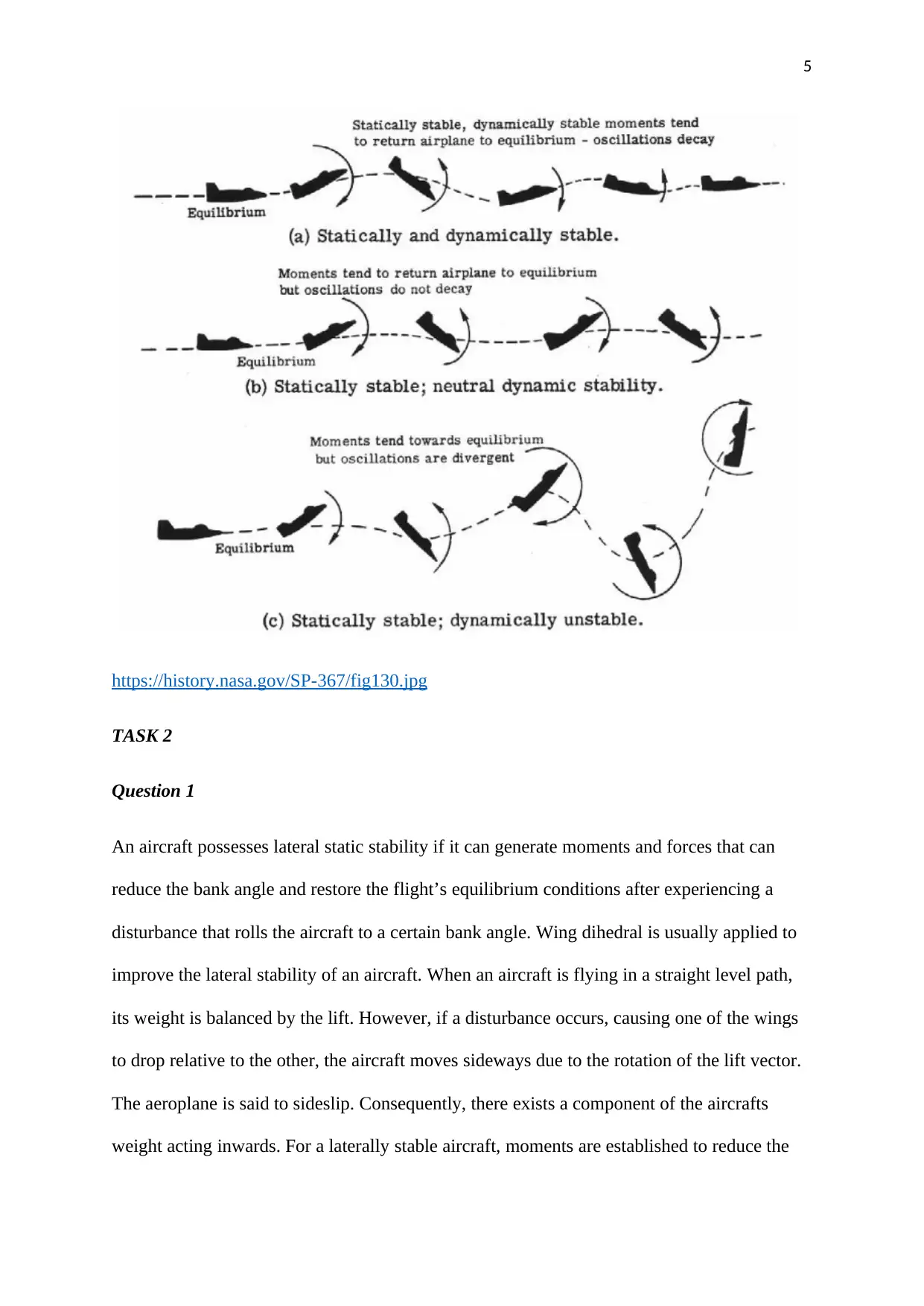
On the other hand, dynamic longitudinal stability is concerned with the response of an
aircraft to a disturbance as time evolves. There are three types of longitudinal dynamic
stabilities. These include positive, negative and neutral stabilities (Ghalami, 2014). If an
aircraft has a positive dynamic stability, a disturbance will produce oscillations that die out
over time. If the aircraft has neutral dynamic stability, a disturbance will produce oscillations
which never die out. Finally, if the aircraft has negative dynamic stability, a disturbance will
produce oscillations that grow in amplitude as time progresses. The aircraft would then
become unstable and may crash.
Question 2
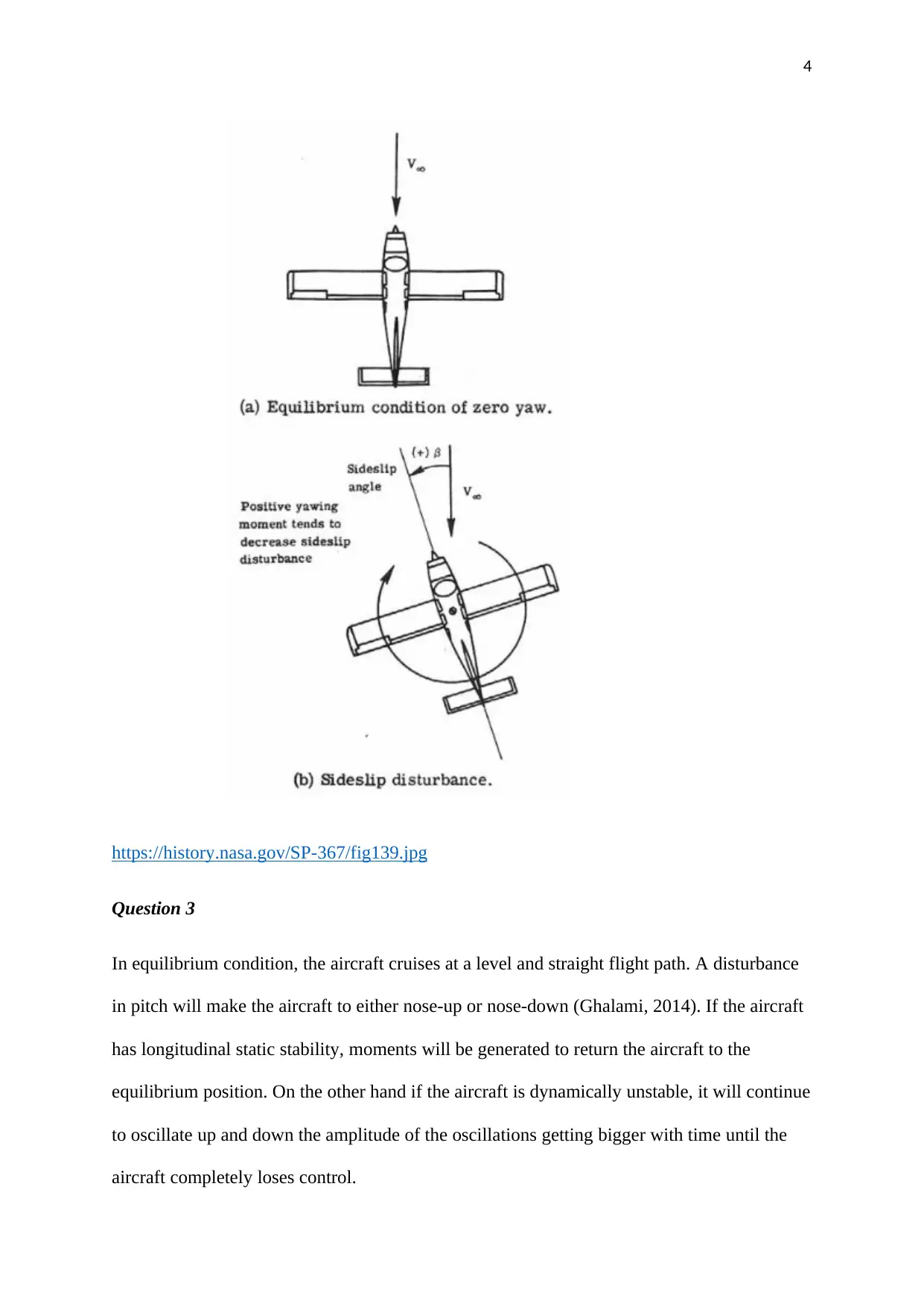
Normally, in equilibrium an aircraft’s yaw angle is zero. If the aircraft experiences a
disturbance resulting in a negative yaw angle, a positive yawing moment is generated in order
to have static directional stability (Ghalami, 2014).
On the other hand, dynamic longitudinal stability is concerned with the response of an
aircraft to a disturbance as time evolves. There are three types of longitudinal dynamic
stabilities. These include positive, negative and neutral stabilities (Ghalami, 2014). If an
aircraft has a positive dynamic stability, a disturbance will produce oscillations that die out
over time. If the aircraft has neutral dynamic stability, a disturbance will produce oscillations
which never die out. Finally, if the aircraft has negative dynamic stability, a disturbance will
produce oscillations that grow in amplitude as time progresses. The aircraft would then
become unstable and may crash.
Question 2
Normally, in equilibrium an aircraft’s yaw angle is zero. If the aircraft experiences a
disturbance resulting in a negative yaw angle, a positive yawing moment is generated in order
to have static directional stability (Ghalami, 2014).
⊘ This is a preview!⊘
Do you want full access?
Subscribe today to unlock all pages.

Trusted by 1+ million students worldwide
4
https://history.nasa.gov/SP-367/fig139.jpg
Question 3
In equilibrium condition, the aircraft cruises at a level and straight flight path. A disturbance
in pitch will make the aircraft to either nose-up or nose-down (Ghalami, 2014). If the aircraft
has longitudinal static stability, moments will be generated to return the aircraft to the
equilibrium position. On the other hand if the aircraft is dynamically unstable, it will continue
to oscillate up and down the amplitude of the oscillations getting bigger with time until the
aircraft completely loses control.
https://history.nasa.gov/SP-367/fig139.jpg
Question 3
In equilibrium condition, the aircraft cruises at a level and straight flight path. A disturbance
in pitch will make the aircraft to either nose-up or nose-down (Ghalami, 2014). If the aircraft
has longitudinal static stability, moments will be generated to return the aircraft to the
equilibrium position. On the other hand if the aircraft is dynamically unstable, it will continue
to oscillate up and down the amplitude of the oscillations getting bigger with time until the
aircraft completely loses control.
Paraphrase This Document
Need a fresh take? Get an instant paraphrase of this document with our AI Paraphraser
5
https://history.nasa.gov/SP-367/fig130.jpg
TASK 2
Question 1
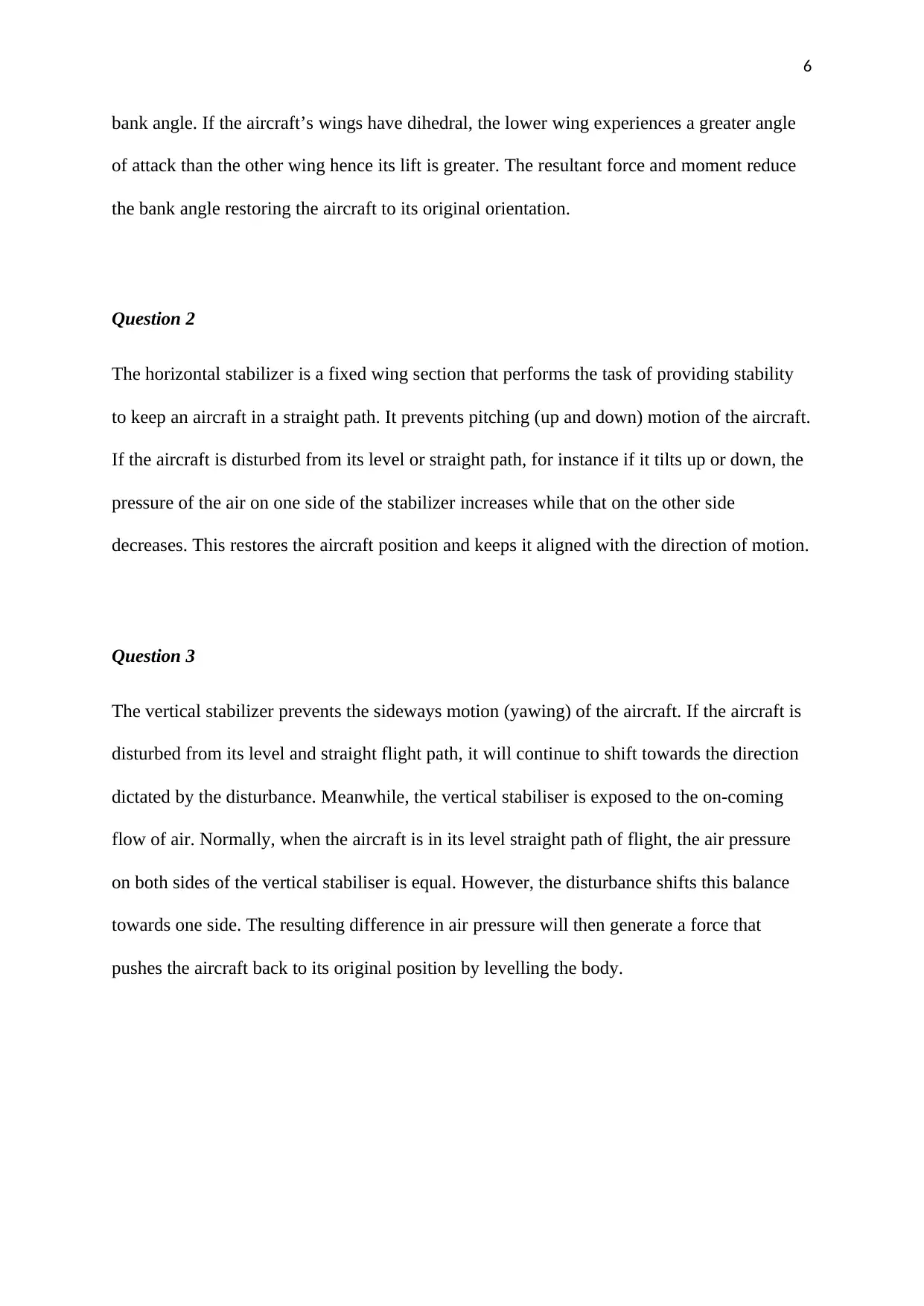
An aircraft possesses lateral static stability if it can generate moments and forces that can
reduce the bank angle and restore the flight’s equilibrium conditions after experiencing a
disturbance that rolls the aircraft to a certain bank angle. Wing dihedral is usually applied to
improve the lateral stability of an aircraft. When an aircraft is flying in a straight level path,
its weight is balanced by the lift. However, if a disturbance occurs, causing one of the wings
to drop relative to the other, the aircraft moves sideways due to the rotation of the lift vector.
The aeroplane is said to sideslip. Consequently, there exists a component of the aircrafts
weight acting inwards. For a laterally stable aircraft, moments are established to reduce the
https://history.nasa.gov/SP-367/fig130.jpg
TASK 2
Question 1
An aircraft possesses lateral static stability if it can generate moments and forces that can
reduce the bank angle and restore the flight’s equilibrium conditions after experiencing a
disturbance that rolls the aircraft to a certain bank angle. Wing dihedral is usually applied to
improve the lateral stability of an aircraft. When an aircraft is flying in a straight level path,
its weight is balanced by the lift. However, if a disturbance occurs, causing one of the wings
to drop relative to the other, the aircraft moves sideways due to the rotation of the lift vector.
The aeroplane is said to sideslip. Consequently, there exists a component of the aircrafts
weight acting inwards. For a laterally stable aircraft, moments are established to reduce the
6
bank angle. If the aircraft’s wings have dihedral, the lower wing experiences a greater angle
of attack than the other wing hence its lift is greater. The resultant force and moment reduce
the bank angle restoring the aircraft to its original orientation.
Question 2
The horizontal stabilizer is a fixed wing section that performs the task of providing stability
to keep an aircraft in a straight path. It prevents pitching (up and down) motion of the aircraft.
If the aircraft is disturbed from its level or straight path, for instance if it tilts up or down, the
pressure of the air on one side of the stabilizer increases while that on the other side
decreases. This restores the aircraft position and keeps it aligned with the direction of motion.
Question 3
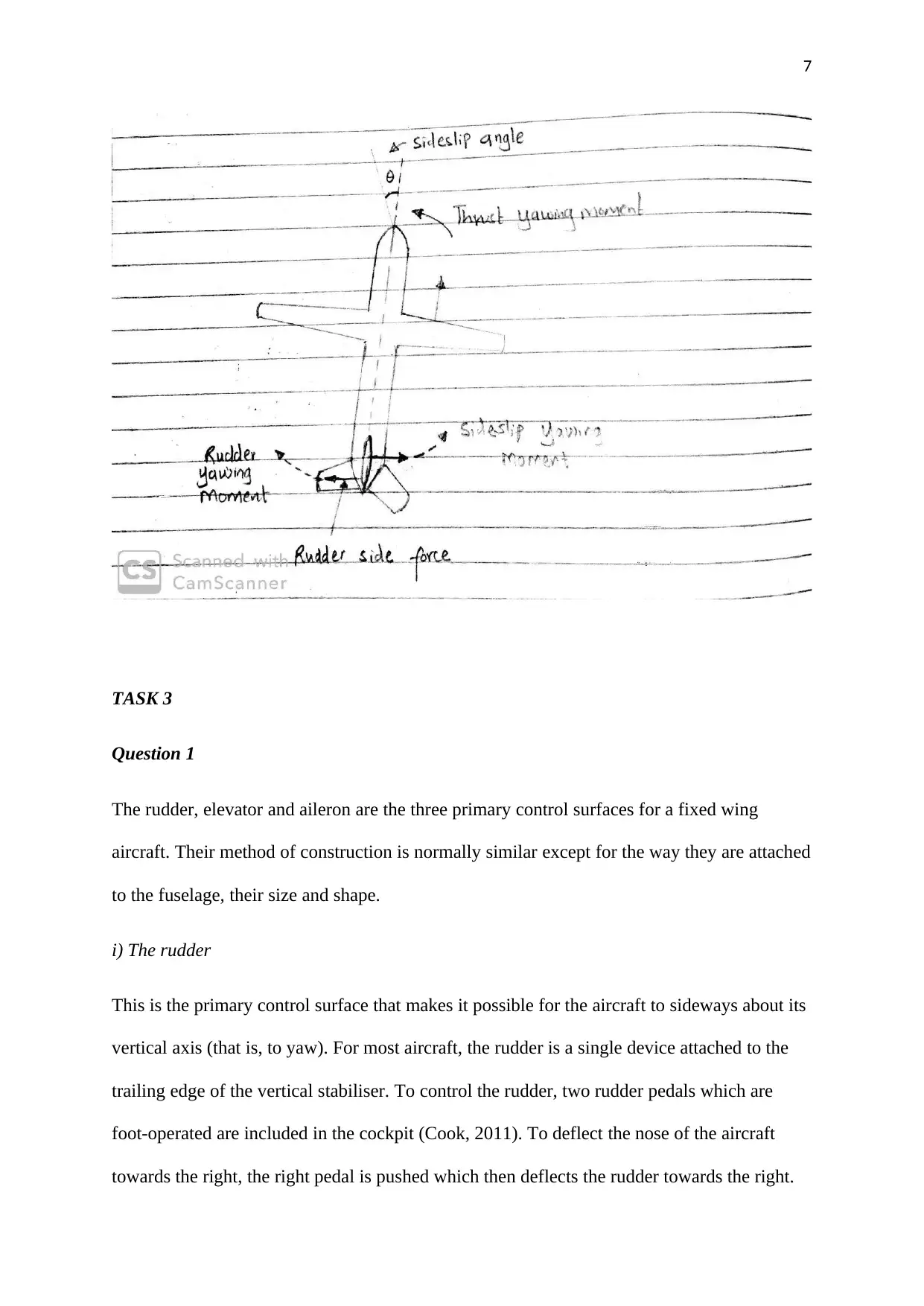
The vertical stabilizer prevents the sideways motion (yawing) of the aircraft. If the aircraft is
disturbed from its level and straight flight path, it will continue to shift towards the direction
dictated by the disturbance. Meanwhile, the vertical stabiliser is exposed to the on-coming
flow of air. Normally, when the aircraft is in its level straight path of flight, the air pressure
on both sides of the vertical stabiliser is equal. However, the disturbance shifts this balance
towards one side. The resulting difference in air pressure will then generate a force that
pushes the aircraft back to its original position by levelling the body.
bank angle. If the aircraft’s wings have dihedral, the lower wing experiences a greater angle
of attack than the other wing hence its lift is greater. The resultant force and moment reduce
the bank angle restoring the aircraft to its original orientation.
Question 2
The horizontal stabilizer is a fixed wing section that performs the task of providing stability
to keep an aircraft in a straight path. It prevents pitching (up and down) motion of the aircraft.
If the aircraft is disturbed from its level or straight path, for instance if it tilts up or down, the
pressure of the air on one side of the stabilizer increases while that on the other side
decreases. This restores the aircraft position and keeps it aligned with the direction of motion.
Question 3
The vertical stabilizer prevents the sideways motion (yawing) of the aircraft. If the aircraft is
disturbed from its level and straight flight path, it will continue to shift towards the direction
dictated by the disturbance. Meanwhile, the vertical stabiliser is exposed to the on-coming
flow of air. Normally, when the aircraft is in its level straight path of flight, the air pressure
on both sides of the vertical stabiliser is equal. However, the disturbance shifts this balance
towards one side. The resulting difference in air pressure will then generate a force that
pushes the aircraft back to its original position by levelling the body.
⊘ This is a preview!⊘
Do you want full access?
Subscribe today to unlock all pages.
Trusted by 1+ million students worldwide
7
TASK 3
Question 1
The rudder, elevator and aileron are the three primary control surfaces for a fixed wing
aircraft. Their method of construction is normally similar except for the way they are attached
to the fuselage, their size and shape.
i) The rudder
This is the primary control surface that makes it possible for the aircraft to sideways about its
vertical axis (that is, to yaw). For most aircraft, the rudder is a single device attached to the
trailing edge of the vertical stabiliser. To control the rudder, two rudder pedals which are
foot-operated are included in the cockpit (Cook, 2011). To deflect the nose of the aircraft
towards the right, the right pedal is pushed which then deflects the rudder towards the right.
TASK 3
Question 1
The rudder, elevator and aileron are the three primary control surfaces for a fixed wing
aircraft. Their method of construction is normally similar except for the way they are attached
to the fuselage, their size and shape.
i) The rudder
This is the primary control surface that makes it possible for the aircraft to sideways about its
vertical axis (that is, to yaw). For most aircraft, the rudder is a single device attached to the
trailing edge of the vertical stabiliser. To control the rudder, two rudder pedals which are
foot-operated are included in the cockpit (Cook, 2011). To deflect the nose of the aircraft
towards the right, the right pedal is pushed which then deflects the rudder towards the right.
Paraphrase This Document
Need a fresh take? Get an instant paraphrase of this document with our AI Paraphraser
8
The left pedal on the other hand controls the left movement of the aircraft when it is pushed
forward.
ii) The elevator
The elevator controls the up and down movement of the nose which is commonly referred to
as pitching. The elevator is attached to the trailing edge of the aircraft’s horizontal stabiliser.
To control the elevator, a control yoke or aft which can be pulled or pushed is included in the
cockpit. The mechanism used to translate inputs from the cockpit to the elevator depends on
the type of aircraft. For light aircraft, control pulleys and cables are used while in high
performance aircraft, more complex mechanisms such as hydraulics are employed.
iii) Ailerons
These control surfaces control the movement of the aircraft about the longitudinal surfaces.
They control the roll of the aircraft in other words. Normally, each trailing edge of an
aircraft’s wing contains an aileron. They are considered as part of the wing’s surface area.
The control stick in the cockpit controls the ailerons through its side to side motion (Cook,
2011). The downward deflection of one aileron causes the aileron on the opposite wing to
deflect in the opposite direction and vice versa. As a result, the aircraft’s longitudinal
movement is amplified. This is because the wing on which the aileron is moved down
experiences more lift due to increased camber while the raised aileron on the opposite wing
reduce lift. The mechanism of the transmission of the pilot’s inputs to the ailerons can be
effected by use of pulleys and cables, hydraulics or electric control.
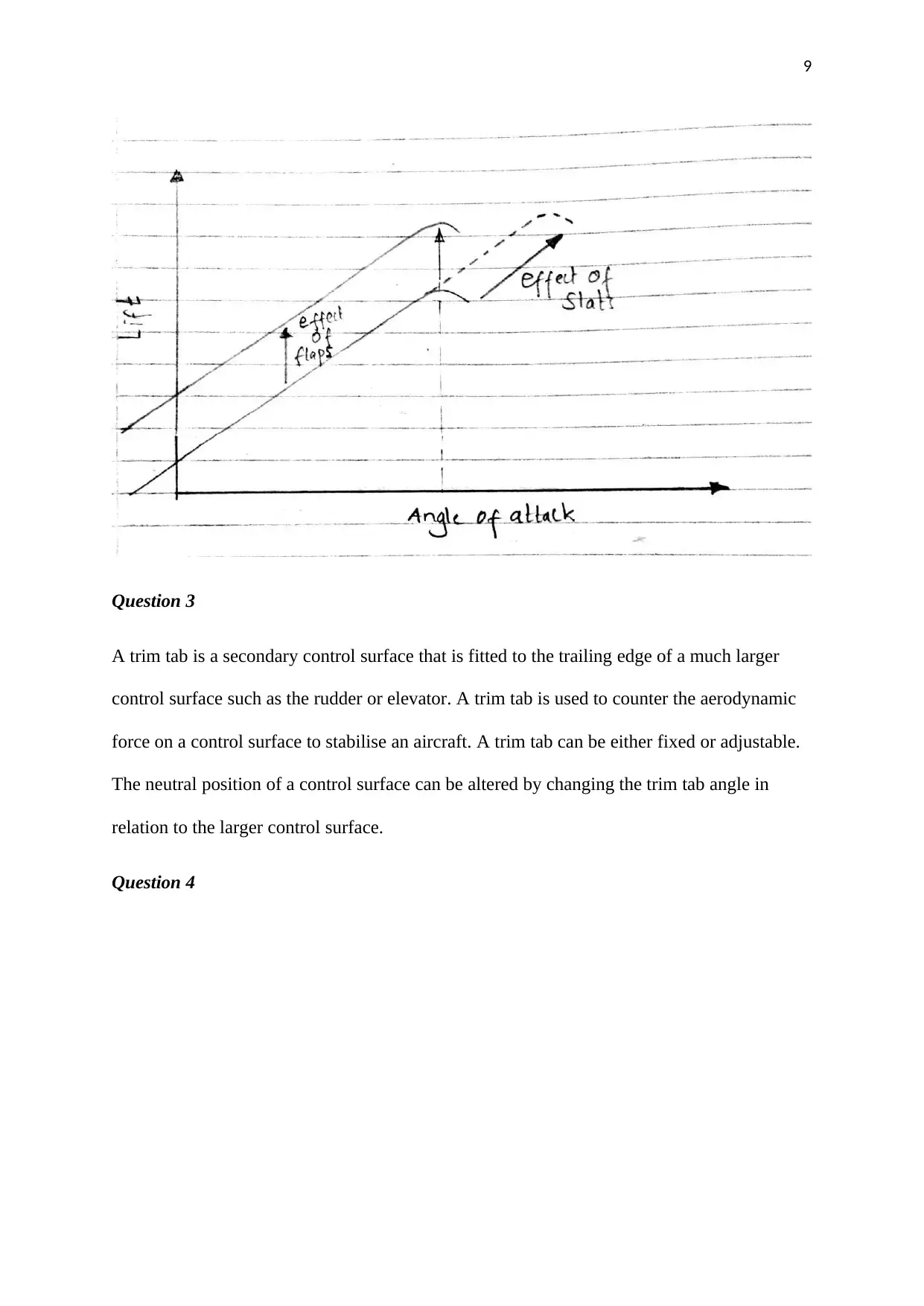
Question 2
The left pedal on the other hand controls the left movement of the aircraft when it is pushed
forward.
ii) The elevator
The elevator controls the up and down movement of the nose which is commonly referred to
as pitching. The elevator is attached to the trailing edge of the aircraft’s horizontal stabiliser.
To control the elevator, a control yoke or aft which can be pulled or pushed is included in the
cockpit. The mechanism used to translate inputs from the cockpit to the elevator depends on
the type of aircraft. For light aircraft, control pulleys and cables are used while in high
performance aircraft, more complex mechanisms such as hydraulics are employed.
iii) Ailerons
These control surfaces control the movement of the aircraft about the longitudinal surfaces.
They control the roll of the aircraft in other words. Normally, each trailing edge of an
aircraft’s wing contains an aileron. They are considered as part of the wing’s surface area.
The control stick in the cockpit controls the ailerons through its side to side motion (Cook,
2011). The downward deflection of one aileron causes the aileron on the opposite wing to
deflect in the opposite direction and vice versa. As a result, the aircraft’s longitudinal
movement is amplified. This is because the wing on which the aileron is moved down
experiences more lift due to increased camber while the raised aileron on the opposite wing
reduce lift. The mechanism of the transmission of the pilot’s inputs to the ailerons can be
effected by use of pulleys and cables, hydraulics or electric control.
Question 2
9
Question 3
A trim tab is a secondary control surface that is fitted to the trailing edge of a much larger
control surface such as the rudder or elevator. A trim tab is used to counter the aerodynamic
force on a control surface to stabilise an aircraft. A trim tab can be either fixed or adjustable.
The neutral position of a control surface can be altered by changing the trim tab angle in
relation to the larger control surface.
Question 4
Question 3
A trim tab is a secondary control surface that is fitted to the trailing edge of a much larger
control surface such as the rudder or elevator. A trim tab is used to counter the aerodynamic
force on a control surface to stabilise an aircraft. A trim tab can be either fixed or adjustable.
The neutral position of a control surface can be altered by changing the trim tab angle in
relation to the larger control surface.
Question 4
⊘ This is a preview!⊘
Do you want full access?
Subscribe today to unlock all pages.
Trusted by 1+ million students worldwide
10
An elevon is a flap on an aircraft that controls the pitch as well as the roll of the aircraft.
Therefore, the elevon is a multipurpose structure that performs the functions of both an
elevator and aileron (Cook, 2011). Elevons are located on the trailing edge of the aircraft
wings. The pilot controls the elevons by using a joystick. To control the aircraft’s pitch, the
elevons are moved in the same direction. To perform a roll or a turn, one of the elevons is
raised while the other is moved downwards.
Question 5
Split flaps are used to increase an aircraft’s lift by increasing the camber of the wings. a split
flap further decreases the speed of the air beneath the wings increasing the pressure of the air
beneath hence the available lift. However, split flaps also significantly increase the amount
of drag on the aircraft
Question 6
The fowler flap is a split flap that is designed to slide backwards for some distance before
hinging downwards. Therefore, initially it increases the chord and the surface area of the
wing and thereafter increases the camber.
Advantages
i) It can be used for both short take offs and extended ones
ii) It provides more lift compared to the plain flap
iii) It produces less drag compared to the plain flap
Disadvantages
i) The rearward extension produces greater pitching moments.
Question 7
An elevon is a flap on an aircraft that controls the pitch as well as the roll of the aircraft.
Therefore, the elevon is a multipurpose structure that performs the functions of both an
elevator and aileron (Cook, 2011). Elevons are located on the trailing edge of the aircraft
wings. The pilot controls the elevons by using a joystick. To control the aircraft’s pitch, the
elevons are moved in the same direction. To perform a roll or a turn, one of the elevons is
raised while the other is moved downwards.
Question 5
Split flaps are used to increase an aircraft’s lift by increasing the camber of the wings. a split
flap further decreases the speed of the air beneath the wings increasing the pressure of the air
beneath hence the available lift. However, split flaps also significantly increase the amount
of drag on the aircraft
Question 6
The fowler flap is a split flap that is designed to slide backwards for some distance before
hinging downwards. Therefore, initially it increases the chord and the surface area of the
wing and thereafter increases the camber.
Advantages
i) It can be used for both short take offs and extended ones
ii) It provides more lift compared to the plain flap
iii) It produces less drag compared to the plain flap
Disadvantages
i) The rearward extension produces greater pitching moments.
Question 7
Paraphrase This Document
Need a fresh take? Get an instant paraphrase of this document with our AI Paraphraser
11
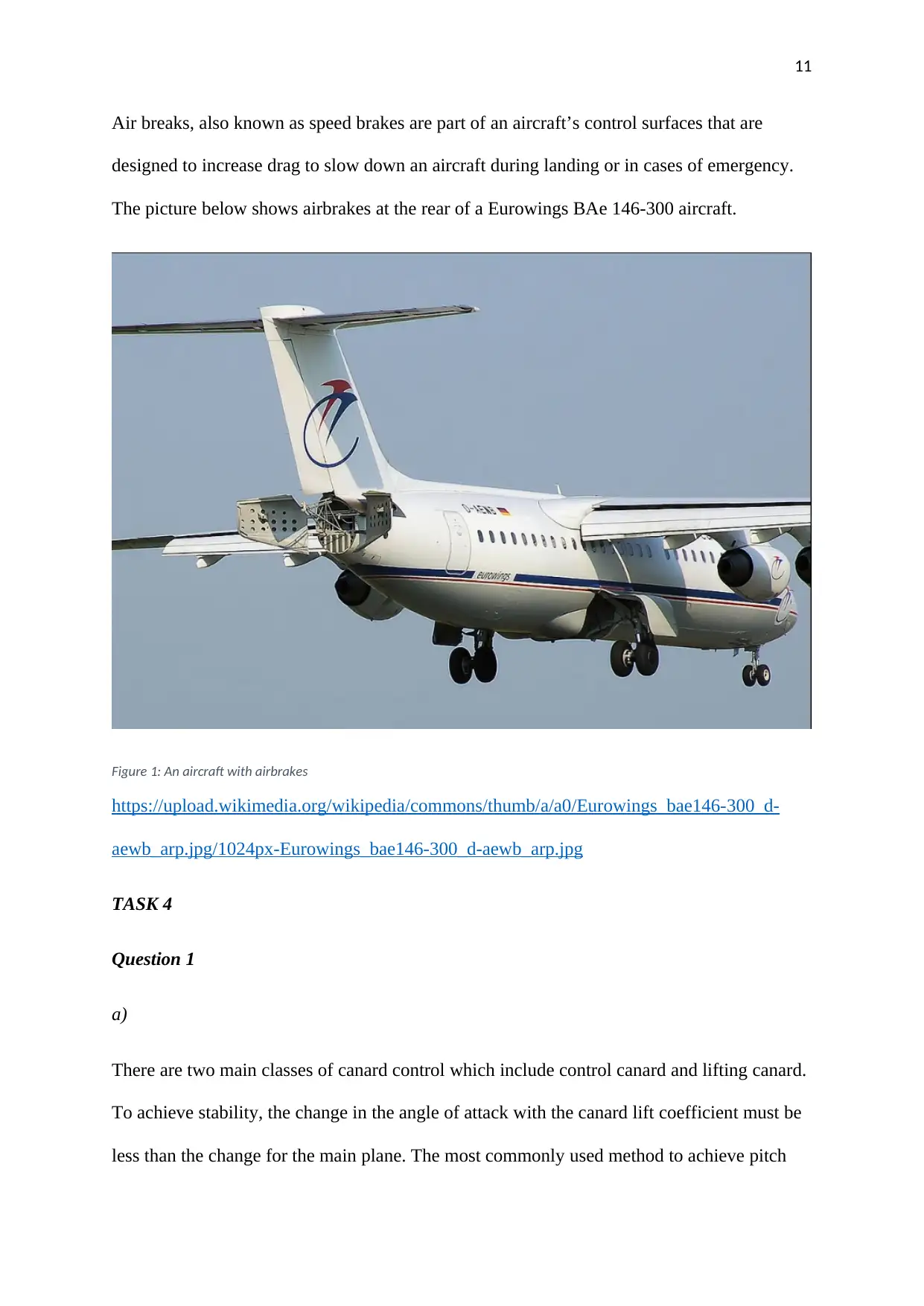
Air breaks, also known as speed brakes are part of an aircraft’s control surfaces that are
designed to increase drag to slow down an aircraft during landing or in cases of emergency.
The picture below shows airbrakes at the rear of a Eurowings BAe 146-300 aircraft.
Figure 1: An aircraft with airbrakes
https://upload.wikimedia.org/wikipedia/commons/thumb/a/a0/Eurowings_bae146-300_d-
aewb_arp.jpg/1024px-Eurowings_bae146-300_d-aewb_arp.jpg
TASK 4
Question 1
a)
There are two main classes of canard control which include control canard and lifting canard.
To achieve stability, the change in the angle of attack with the canard lift coefficient must be
less than the change for the main plane. The most commonly used method to achieve pitch
Air breaks, also known as speed brakes are part of an aircraft’s control surfaces that are
designed to increase drag to slow down an aircraft during landing or in cases of emergency.
The picture below shows airbrakes at the rear of a Eurowings BAe 146-300 aircraft.
Figure 1: An aircraft with airbrakes
https://upload.wikimedia.org/wikipedia/commons/thumb/a/a0/Eurowings_bae146-300_d-
aewb_arp.jpg/1024px-Eurowings_bae146-300_d-aewb_arp.jpg
TASK 4
Question 1
a)
There are two main classes of canard control which include control canard and lifting canard.
To achieve stability, the change in the angle of attack with the canard lift coefficient must be
less than the change for the main plane. The most commonly used method to achieve pitch
12
stability is by increasing the lift coefficient of the canard. This has the tendency to increase
the lift-induced drag of the foreplane whose aspect ratio can be increased to reduce drag.
b)
A foreplane improves the fuel efficiency of an aircraft by reducing drag which then means
that the engines have to develop less thrust to propel the aircraft. A foreplane reduces drag by
reducing the total amount of lift needed to keep the aircraft in flight. The foreplane produces
a force acting upwards to oppose weight hence increasing lift.
c)
A foreplane can improve the manoeuvrability of an aircraft by introducing some instability
which then makes turning the aircraft easier. This has been exploited in the design of
fighter jets.
Question 2
a)
An all moving tail is also known as a stabilator. It performs the combined functions of the
elevator and the horizontal stabilizer. It provides stability in the longitudinal axis as well as
being very effective at high Mach numbers (Kundu, Price, & Riordan, 2016). An all moving
tail allows the pilot to use a lower control force in order to generate a particular pitching
moment.
b)
Unlike an all moving tail plane, a taileron can perform the additional function of roll control
which is a task for the ailerons. An example of an aircraft that uses a taileron is the F-117A
Nighthawk.
stability is by increasing the lift coefficient of the canard. This has the tendency to increase
the lift-induced drag of the foreplane whose aspect ratio can be increased to reduce drag.
b)
A foreplane improves the fuel efficiency of an aircraft by reducing drag which then means
that the engines have to develop less thrust to propel the aircraft. A foreplane reduces drag by
reducing the total amount of lift needed to keep the aircraft in flight. The foreplane produces
a force acting upwards to oppose weight hence increasing lift.
c)
A foreplane can improve the manoeuvrability of an aircraft by introducing some instability
which then makes turning the aircraft easier. This has been exploited in the design of
fighter jets.
Question 2
a)
An all moving tail is also known as a stabilator. It performs the combined functions of the
elevator and the horizontal stabilizer. It provides stability in the longitudinal axis as well as
being very effective at high Mach numbers (Kundu, Price, & Riordan, 2016). An all moving
tail allows the pilot to use a lower control force in order to generate a particular pitching
moment.
b)
Unlike an all moving tail plane, a taileron can perform the additional function of roll control
which is a task for the ailerons. An example of an aircraft that uses a taileron is the F-117A
Nighthawk.
⊘ This is a preview!⊘
Do you want full access?
Subscribe today to unlock all pages.
Trusted by 1+ million students worldwide

1 out of 20


Your All-in-One AI-Powered Toolkit for Academic Success.
+13062052269
info@desklib.com
Available 24*7 on WhatsApp / Email
![[object Object]](/_next/static/media/star-bottom.7253800d.svg)
Unlock your academic potential
Copyright © 2020–2026 A2Z Services. All Rights Reserved. Developed and managed by ZUCOL.