Designing Flexible Work Strategies for Airline Employees

Verified

Added on  2021/04/17

|9
|2080
|53
Essay
AI Summary
This essay examines the design of flexible work arrangements within the context of an airline organization. It explores the different types of workers, including full-time, part-time, and casual employees, and their varying needs for work-life balance. The essay highlights the importance of tailoring work patterns to meet employee needs, offering recommendations for flexible scheduling, benefits, and support systems. It emphasizes strategies such as flexible hours, paid leave, childcare facilities, and career development opportunities to enhance employee satisfaction and retention. Furthermore, the essay considers how these flexible work policies can contribute to the airline's competitive advantage by fostering a motivated and productive workforce. The analysis also touches upon the financial implications of these strategies, advocating for cost-effective measures that yield high returns on investment through improved employee performance and customer service. The Ansoff's Matrix is also used to illustrate the airline's strategic approach. Ultimately, the essay concludes that a robust approach to flexible work design is critical for the organization's success.
Document Page
Running head: DESIGNING FLEXIBLE WORK
Designing Flexible Work
Name of the Student
Name of the University
Author Note
tabler-icon-diamond-filled.svg

Paraphrase This Document

Need a fresh take? Get an instant paraphrase of this document with our AI Paraphraser
Document Page
1
DESIGNING FLEXIBLE WORK
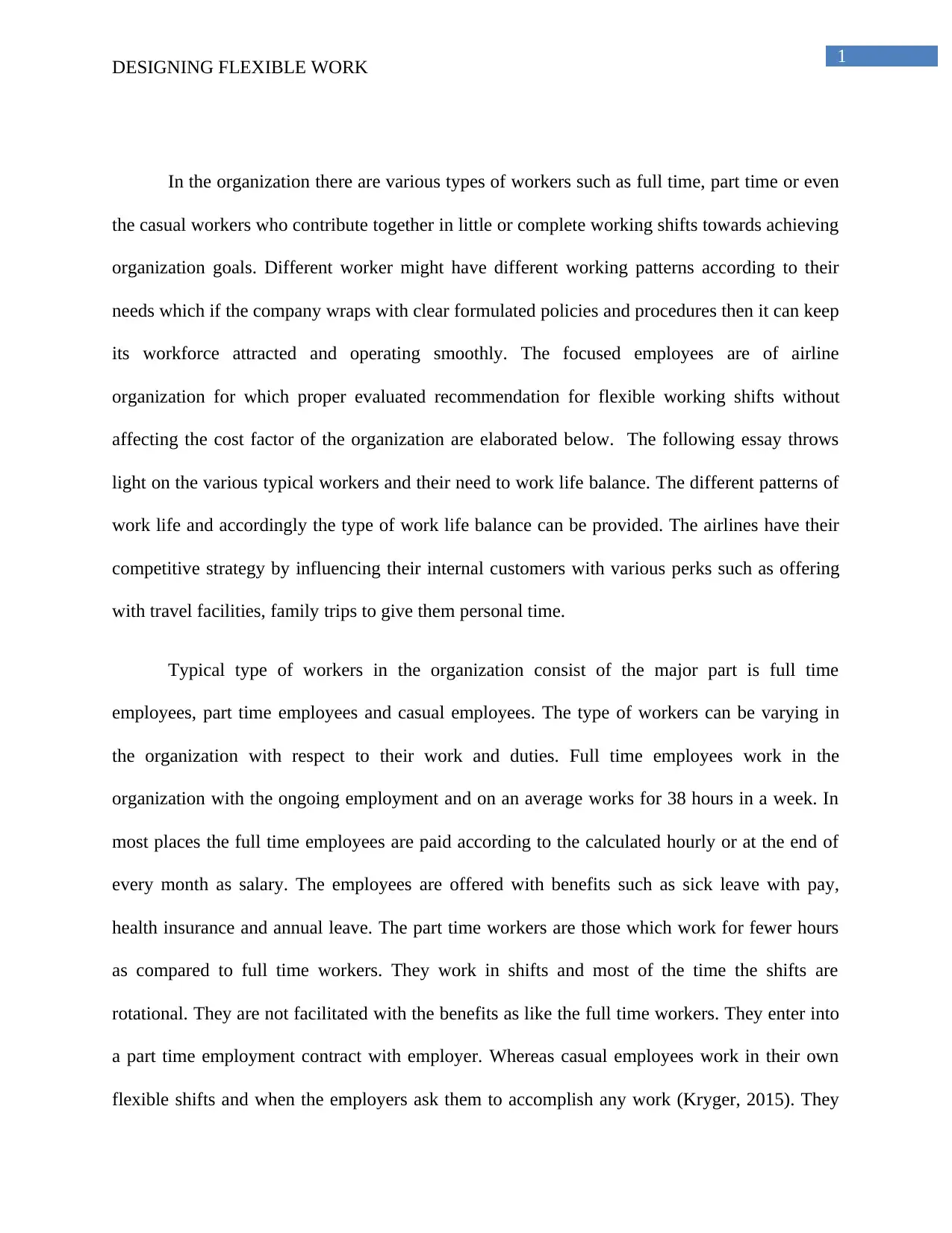
In the organization there are various types of workers such as full time, part time or even
the casual workers who contribute together in little or complete working shifts towards achieving
organization goals. Different worker might have different working patterns according to their
needs which if the company wraps with clear formulated policies and procedures then it can keep
its workforce attracted and operating smoothly. The focused employees are of airline
organization for which proper evaluated recommendation for flexible working shifts without
affecting the cost factor of the organization are elaborated below. The following essay throws
light on the various typical workers and their need to work life balance. The different patterns of
work life and accordingly the type of work life balance can be provided. The airlines have their
competitive strategy by influencing their internal customers with various perks such as offering
with travel facilities, family trips to give them personal time.
Typical type of workers in the organization consist of the major part is full time
employees, part time employees and casual employees. The type of workers can be varying in
the organization with respect to their work and duties. Full time employees work in the
organization with the ongoing employment and on an average works for 38 hours in a week. In
most places the full time employees are paid according to the calculated hourly or at the end of
every month as salary. The employees are offered with benefits such as sick leave with pay,
health insurance and annual leave. The part time workers are those which work for fewer hours
as compared to full time workers. They work in shifts and most of the time the shifts are
rotational. They are not facilitated with the benefits as like the full time workers. They enter into
a part time employment contract with employer. Whereas casual employees work in their own
flexible shifts and when the employers ask them to accomplish any work (Kryger, 2015). They
Document Page
2
DESIGNING FLEXIBLE WORK
are completely different from full and part timer. They are independent to refuse the task when
they do not feel like to do.
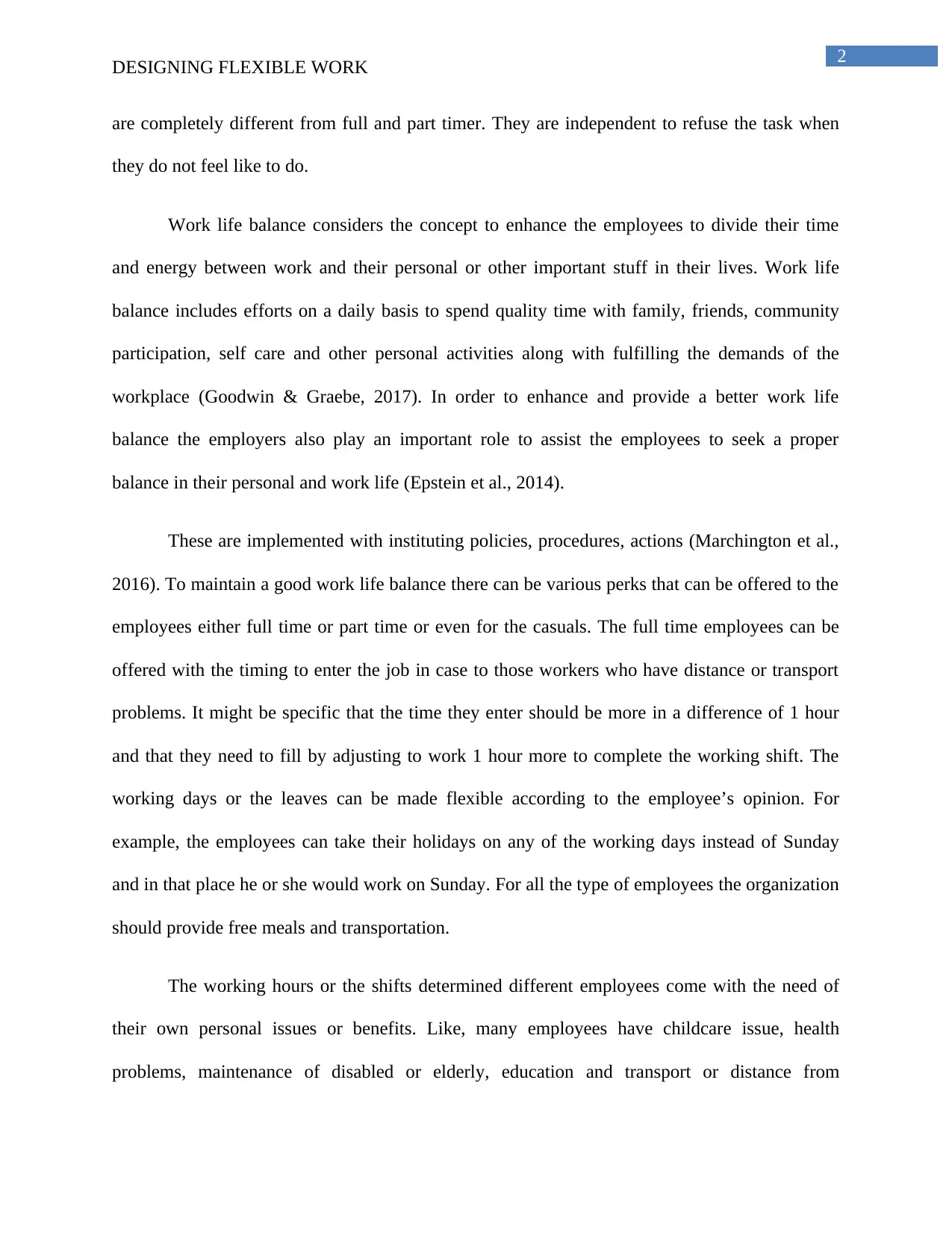
Work life balance considers the concept to enhance the employees to divide their time
and energy between work and their personal or other important stuff in their lives. Work life
balance includes efforts on a daily basis to spend quality time with family, friends, community
participation, self care and other personal activities along with fulfilling the demands of the
workplace (Goodwin & Graebe, 2017). In order to enhance and provide a better work life
balance the employers also play an important role to assist the employees to seek a proper
balance in their personal and work life (Epstein et al., 2014).
These are implemented with instituting policies, procedures, actions (Marchington et al.,
2016). To maintain a good work life balance there can be various perks that can be offered to the
employees either full time or part time or even for the casuals. The full time employees can be
offered with the timing to enter the job in case to those workers who have distance or transport
problems. It might be specific that the time they enter should be more in a difference of 1 hour
and that they need to fill by adjusting to work 1 hour more to complete the working shift. The
working days or the leaves can be made flexible according to the employee’s opinion. For
example, the employees can take their holidays on any of the working days instead of Sunday
and in that place he or she would work on Sunday. For all the type of employees the organization
should provide free meals and transportation.
The working hours or the shifts determined different employees come with the need of
their own personal issues or benefits. Like, many employees have childcare issue, health
problems, maintenance of disabled or elderly, education and transport or distance from
Document Page
3
DESIGNING FLEXIBLE WORK
workplace. These problems may arise mostly for the working women, parents and the old
employees of the organization.
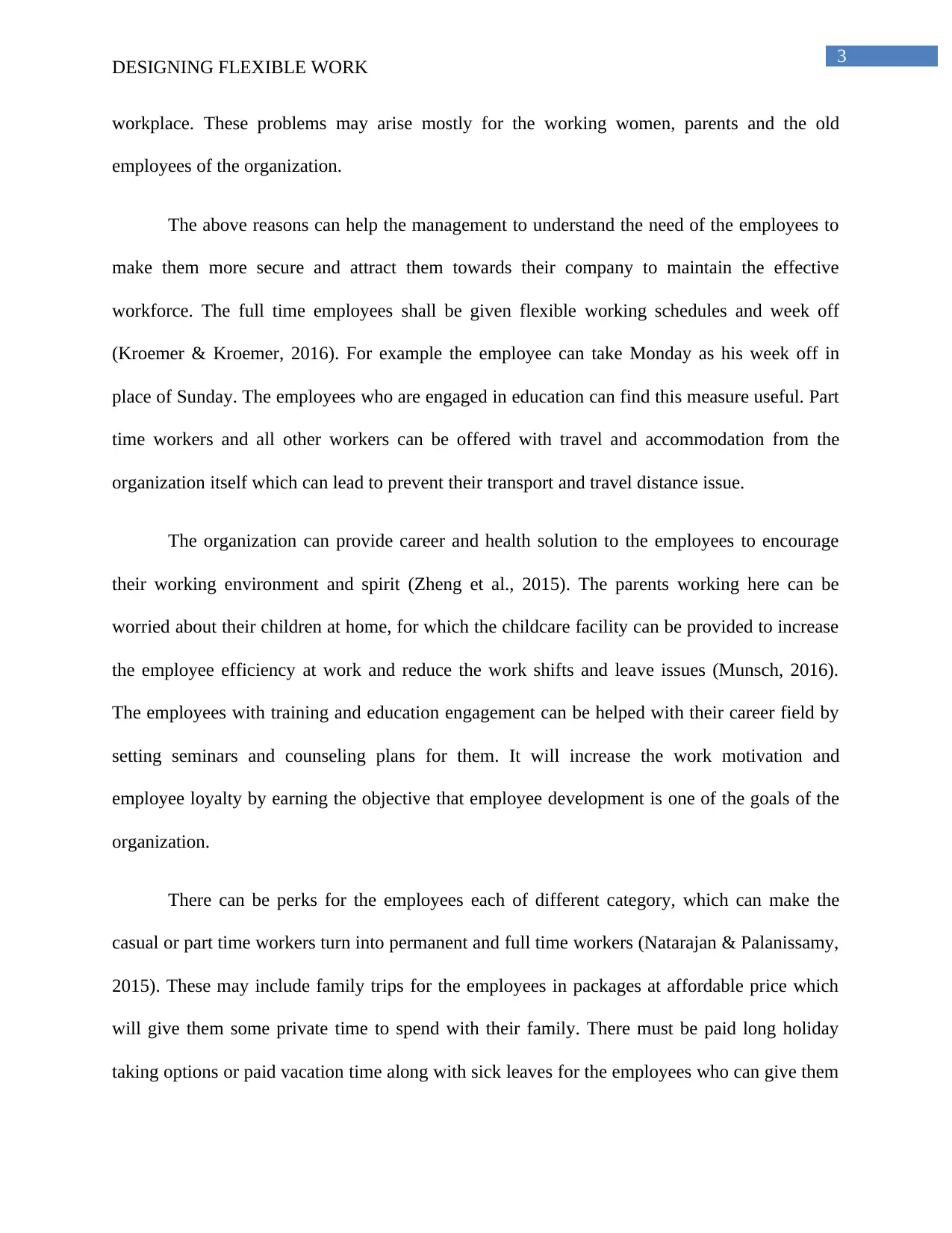
The above reasons can help the management to understand the need of the employees to
make them more secure and attract them towards their company to maintain the effective
workforce. The full time employees shall be given flexible working schedules and week off
(Kroemer & Kroemer, 2016). For example the employee can take Monday as his week off in
place of Sunday. The employees who are engaged in education can find this measure useful. Part
time workers and all other workers can be offered with travel and accommodation from the
organization itself which can lead to prevent their transport and travel distance issue.
The organization can provide career and health solution to the employees to encourage
their working environment and spirit (Zheng et al., 2015). The parents working here can be
worried about their children at home, for which the childcare facility can be provided to increase
the employee efficiency at work and reduce the work shifts and leave issues (Munsch, 2016).
The employees with training and education engagement can be helped with their career field by
setting seminars and counseling plans for them. It will increase the work motivation and
employee loyalty by earning the objective that employee development is one of the goals of the
organization.
There can be perks for the employees each of different category, which can make the
casual or part time workers turn into permanent and full time workers (Natarajan & Palanissamy,
2015). These may include family trips for the employees in packages at affordable price which
will give them some private time to spend with their family. There must be paid long holiday
taking options or paid vacation time along with sick leaves for the employees who can give them
tabler-icon-diamond-filled.svg

Paraphrase This Document

Need a fresh take? Get an instant paraphrase of this document with our AI Paraphraser
Document Page
4
DESIGNING FLEXIBLE WORK
allowance of personal space (Romich, 2015). The part timers once complete their 90 days of
work in the organization could be eligible for health insurance such as dental and vision. For the
part timers the flexible time shifts can be made to encourage the college students to work.
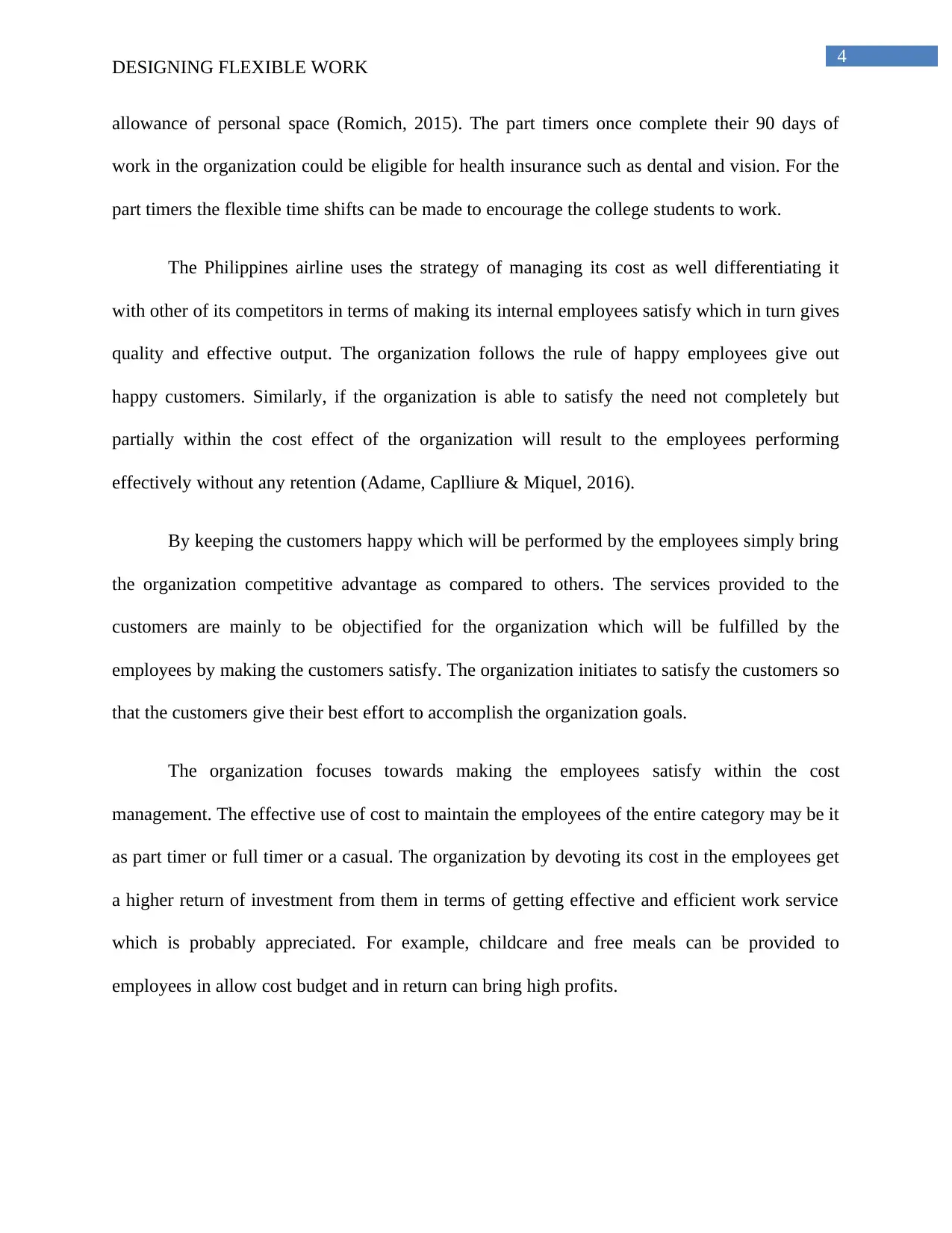
The Philippines airline uses the strategy of managing its cost as well differentiating it
with other of its competitors in terms of making its internal employees satisfy which in turn gives
quality and effective output. The organization follows the rule of happy employees give out
happy customers. Similarly, if the organization is able to satisfy the need not completely but
partially within the cost effect of the organization will result to the employees performing
effectively without any retention (Adame, Caplliure & Miquel, 2016).
By keeping the customers happy which will be performed by the employees simply bring
the organization competitive advantage as compared to others. The services provided to the
customers are mainly to be objectified for the organization which will be fulfilled by the
employees by making the customers satisfy. The organization initiates to satisfy the customers so
that the customers give their best effort to accomplish the organization goals.
The organization focuses towards making the employees satisfy within the cost
management. The effective use of cost to maintain the employees of the entire category may be it
as part timer or full timer or a casual. The organization by devoting its cost in the employees get
a higher return of investment from them in terms of getting effective and efficient work service
which is probably appreciated. For example, childcare and free meals can be provided to
employees in allow cost budget and in return can bring high profits.
Document Page
5
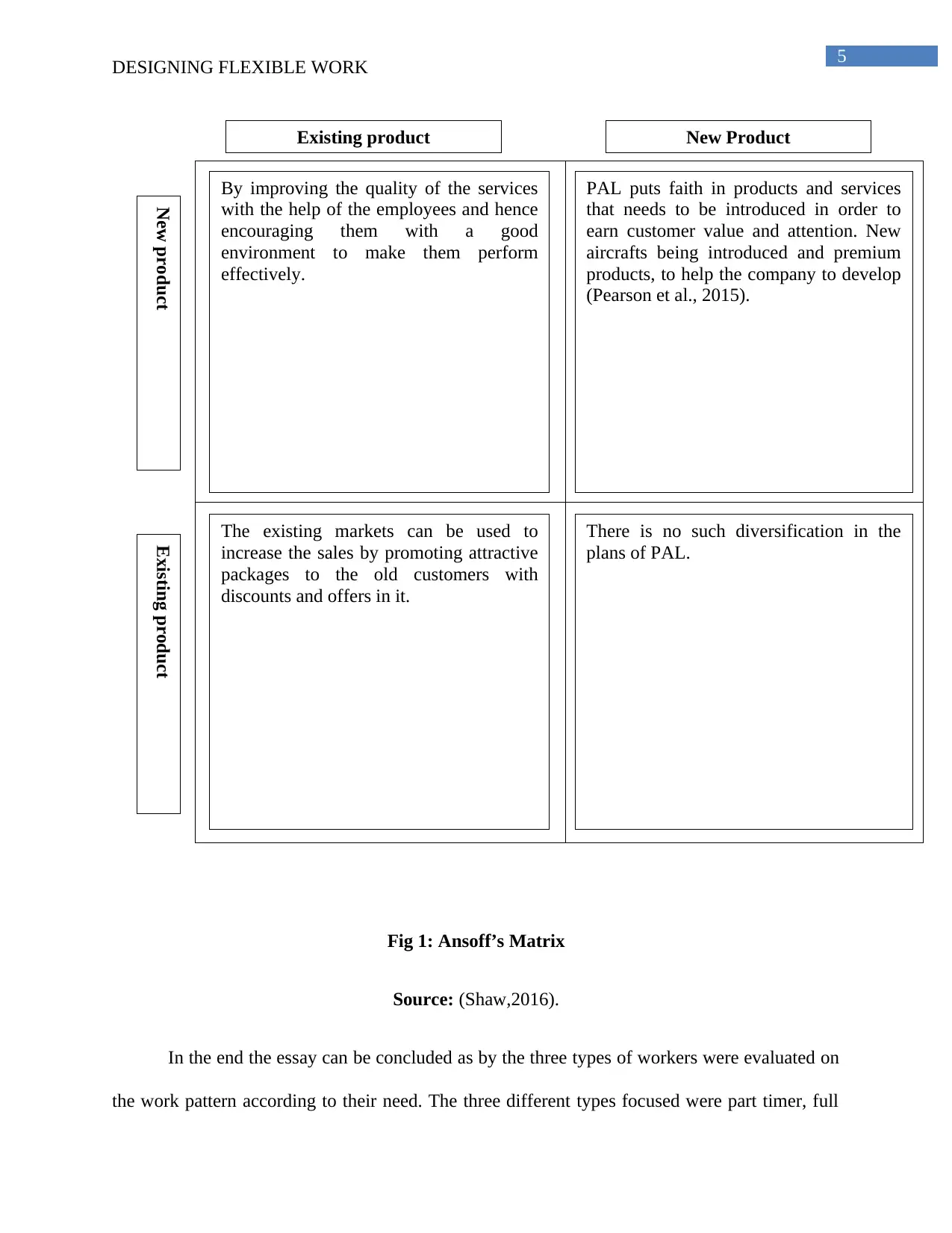
By improving the quality of the services
with the help of the employees and hence
encouraging them with a good
environment to make them perform
effectively.
PAL puts faith in products and services
that needs to be introduced in order to
earn customer value and attention. New
aircrafts being introduced and premium
products, to help the company to develop
(Pearson et al., 2015).
The existing markets can be used to
increase the sales by promoting attractive
packages to the old customers with
discounts and offers in it.
There is no such diversification in the
plans of PAL.
Existing product New Product
New product Existing product
DESIGNING FLEXIBLE WORK
Fig 1: Ansoff’s Matrix
Source: (Shaw,2016).
In the end the essay can be concluded as by the three types of workers were evaluated on
the work pattern according to their need. The three different types focused were part timer, full
Document Page
6
DESIGNING FLEXIBLE WORK
timer and casual workers. The workers of different category may sort under different problems
like, education, childcare or elder care, health issues and many more. However, the organization
can serve with many work life balance techniques which can prove out to be useful such as paid
vacation times, leave arrangement for sick purpose, personal purpose and many others as within
the cost of the organization. This way the competitive strategy can be made through the use of a
strong and effective workforce which will enable the organization to serve with premium quality
of services. The organization deals with premium products to facilitate its customer to enrich
with the best quality service and to promote offers and discounts to increase its sales.
tabler-icon-diamond-filled.svg

Paraphrase This Document

Need a fresh take? Get an instant paraphrase of this document with our AI Paraphraser
Document Page
7
DESIGNING FLEXIBLE WORK
Reference
Adame, C., Caplliure, E. M., & Miquel, M. J. (2016). Work–life balance and firms: A matter of
women?. Journal of Business Research, 69(4), 1379-1383.
Epstein, C. F., Seron, C., Oglensky, B., & Saute, R. (2014). The part-time paradox: Time norms,
professional life, family and gender. Routledge.
Goodwin, G. C., & Graebe, S. F. (2017). Work-Life Balance. In A Doctorate and Beyond (pp.
179-185). Springer, Cham.
Kroemer, A. D., & Kroemer, K. H. (2016). Office Ergonomics: Ease and Efficiency at Work.
CRC Press.
Kryger, T. (2015). Casual employment in Australia: A quick guide. Parliamentary Library.
Marchington, M., Wilkinson, A., Donnelly, R., & Kynighou, A. (2016). Human resource
management at work. Kogan Page Publishers.
Munsch, C. L. (2016). Flexible work, flexible penalties: the effect of gender, childcare, and type
of request on the flexibility bias. Social Forces, 94(4), 1567-1591.
Natarajan, S. D., & Palanissamy, A. (2015). Employee Motivation & Encouraging Retention in
the Workplace: A Critical Study. International Journal of Management Sciences, 5(10),
709-715.
Pearson, J., O’Connell, J. F., Pitfield, D. E., & Ryley, T. (2015). Competition Between Asian
Network Airlines and Low-Cost Carriers: Strategic Analysis. Transportation Research
Record: Journal of the Transportation Research Board, (2501), 56-65.
Document Page
8
DESIGNING FLEXIBLE WORK
Romich, J. L. (2015). Paid leave mandates may fail to reach part-time workers. American journal
of public health, 105(5), e1.
Shaw, S. (2016). Airline marketing and management. Routledge.
Zheng, C., Molineux, J., Mirshekary, S., & Scarparo, S. (2015). Developing individual and
organisational work-life balance strategies to improve employee health and
wellbeing. Employee Relations, 37(3), 354-379.
chevron_up_icon
1 out of 9
circle_padding
hide_on_mobile
zoom_out_icon
[object Object]