Accounting Information System and Decision Making in Australia
VerifiedAdded on 2020/05/08
|13
|2450
|74
Report
AI Summary
This report examines the impact of Accounting Information Systems (AIS) on decision-making within the food and beverage industry in Australia. It explores the role of AIS in enhancing organizational performance, improving financial reporting, and facilitating effective internal controls. The research methodology includes a literature review, outlining the conceptual and empirical frameworks, and a survey of employees from food product companies. The study investigates the relationship between AIS implementation and decision-making effectiveness, testing the hypothesis that there is a significant association between the two. Data analysis techniques, including correlation and regression, are employed to analyze the survey responses and draw conclusions. The report also discusses the ethical considerations, contributions, and limitations of the research, providing insights into how AIS can be leveraged to improve decision-making processes, manage uncertainty, and enhance competitive advantages in the food and beverage sector. The research highlights the importance of AIS in supporting managers and improving the quality of financial information.
Running head: ACCOUNTING INFORMATION SYSTEM IN DECISION MAKING
Accounting Information System as an Aid to Decision Making In Food and
Beverages Companies in Australia
Name of the University:
Name of the Student:
Authors Note:
Accounting Information System as an Aid to Decision Making In Food and
Beverages Companies in Australia
Name of the University:
Name of the Student:
Authors Note:

Paraphrase This Document
Need a fresh take? Get an instant paraphrase of this document with our AI Paraphraser
1ACCOUNTING INFORMATION SYSTEM IN DECISION MAKING
Abstract
The research tends to explain that in managing a company along with implementing internal
control system, effect of accounting information system is important. The findings are also
deemed to reveal that with the growing years, increasing number of companies must consider
using effective information technology for improving and increasing their competitive
advantages in highly competitive industry. It will be gathered from completion of the research
that accounting information can facilitate the managers in understanding their work in a better
manner along with decreasing uncertainty in order to make effective decisions.
Abstract
The research tends to explain that in managing a company along with implementing internal
control system, effect of accounting information system is important. The findings are also
deemed to reveal that with the growing years, increasing number of companies must consider
using effective information technology for improving and increasing their competitive
advantages in highly competitive industry. It will be gathered from completion of the research
that accounting information can facilitate the managers in understanding their work in a better
manner along with decreasing uncertainty in order to make effective decisions.
2ACCOUNTING INFORMATION SYSTEM IN DECISION MAKING
Table of Contents
1. Introduction......................................................................................................................3
2. Literature Review............................................................................................................3
2.1. Impact of AIS on Organizational Decision Making.................................................3
2.2. Conceptual Framework.............................................................................................3
2.3. Value Relevance.......................................................................................................4
2.4. Empirical Framework...............................................................................................4
3. Research Objectives and Hypothesis...............................................................................5
4. Research Method.............................................................................................................5
4.1. Scope of Research.....................................................................................................5
4.2. Sampling Frame........................................................................................................6
4.3. Research Technique..................................................................................................6
4.4. Data Analysis Technique..........................................................................................7
4.5. Ethical Consideration................................................................................................7
5. Contributions and Limitations.........................................................................................8
References............................................................................................................................9
Appendix............................................................................................................................11
Table of Contents
1. Introduction......................................................................................................................3
2. Literature Review............................................................................................................3
2.1. Impact of AIS on Organizational Decision Making.................................................3
2.2. Conceptual Framework.............................................................................................3
2.3. Value Relevance.......................................................................................................4
2.4. Empirical Framework...............................................................................................4
3. Research Objectives and Hypothesis...............................................................................5
4. Research Method.............................................................................................................5
4.1. Scope of Research.....................................................................................................5
4.2. Sampling Frame........................................................................................................6
4.3. Research Technique..................................................................................................6
4.4. Data Analysis Technique..........................................................................................7
4.5. Ethical Consideration................................................................................................7
5. Contributions and Limitations.........................................................................................8
References............................................................................................................................9
Appendix............................................................................................................................11
⊘ This is a preview!⊘
Do you want full access?
Subscribe today to unlock all pages.

Trusted by 1+ million students worldwide
3ACCOUNTING INFORMATION SYSTEM IN DECISION MAKING
1. Introduction
In the current era, certain developments in the information systems all through the world
have necessitated the companies to invest resources in this part if they decide to compete
successfully in the local and international market. In the recent years, accounting systems are
likely to act as an information system that does not get affected by data or financial information
limits (Alamin, Matthew and Scott 2015). Moreover, the modified accounting informant system
encompasses quantitative and descriptive information that supports decision making of the users.
Users of data gathered from accounting information system are consumers, suppliers, investors
and government in order to develop a goal based in the gathered accounting information.
2. Literature Review
2.1. Impact of AIS on Organizational Decision Making
Caria and Lídia (2016) Indicated that AIS serves as an effective decision making tool in
order to control and coordinate all the activities of a company. It is also gathered that AIS is
highly important to production of quality accounting information on a timely manner along with
communication of the same information to the decision makers. AIS is most vital system for a
company as accounting information has an important role in realizing the financial position of
the company. Collier (2015) argued that integrating accounting information systems results in
organizational coordination that further enhances the quality of information.
2.2. Conceptual Framework
Dutta, Raef and David (2015) explained that the conceptual framework is segmented in
two parts. The first part analyses the usefulness and concept of accounting information systems
1. Introduction
In the current era, certain developments in the information systems all through the world
have necessitated the companies to invest resources in this part if they decide to compete
successfully in the local and international market. In the recent years, accounting systems are
likely to act as an information system that does not get affected by data or financial information
limits (Alamin, Matthew and Scott 2015). Moreover, the modified accounting informant system
encompasses quantitative and descriptive information that supports decision making of the users.
Users of data gathered from accounting information system are consumers, suppliers, investors
and government in order to develop a goal based in the gathered accounting information.
2. Literature Review
2.1. Impact of AIS on Organizational Decision Making
Caria and Lídia (2016) Indicated that AIS serves as an effective decision making tool in
order to control and coordinate all the activities of a company. It is also gathered that AIS is
highly important to production of quality accounting information on a timely manner along with
communication of the same information to the decision makers. AIS is most vital system for a
company as accounting information has an important role in realizing the financial position of
the company. Collier (2015) argued that integrating accounting information systems results in
organizational coordination that further enhances the quality of information.
2.2. Conceptual Framework
Dutta, Raef and David (2015) explained that the conceptual framework is segmented in
two parts. The first part analyses the usefulness and concept of accounting information systems
Paraphrase This Document
Need a fresh take? Get an instant paraphrase of this document with our AI Paraphraser
4ACCOUNTING INFORMATION SYSTEM IN DECISION MAKING
within companies and the second part analyses the relevance value of accounting information in
supporting investors to take investment decisions. Galliers, Robert and Dorothy (2014) revealed
that efficiency of accounting information systems are relied on the perception of decision makers
regarding information usefulness that is generated from system for satisfying operations
processes information needs. Consequently, it can be said that accounting information system’s
effectiveness not only relies on the systems purpose but also relies on contingency factors of
every organization. Accounting systems are vital aspects of the organizational life and these are
required to be analyzed in broader organizational, managerial and environmental context.
2.3. Value Relevance
Ijiri (2014) explained that value relevance is the capability of financial statement
information for gathering and summering organizational value. This is also observed to
investigate the link between a security price dependent variable and independent accounting
variables set. The definitions presented by several researchers on value relevance explain a
common thing that an accounting amount is observed to be value relevant if it has considerable
link with security market value. Laudon, Kenneth and Jane (2014) stated that the information
aspect of value relevance is employed in this research to evaluate the accounting data value
relevance of selected organizations. Informational aspect measures the usefulness of accounting
for the individual users devoid of excessive focus on detailed structure of relation between firm
value and accounting data.
2.4. Empirical Framework
Previous literature provides detailed evidence of relationship among accounting
information system and its impact on financial performance of companies. Prasad and Peter
(2015) discovered positive association between accounting information system (AIS) design and
within companies and the second part analyses the relevance value of accounting information in
supporting investors to take investment decisions. Galliers, Robert and Dorothy (2014) revealed
that efficiency of accounting information systems are relied on the perception of decision makers
regarding information usefulness that is generated from system for satisfying operations
processes information needs. Consequently, it can be said that accounting information system’s
effectiveness not only relies on the systems purpose but also relies on contingency factors of
every organization. Accounting systems are vital aspects of the organizational life and these are
required to be analyzed in broader organizational, managerial and environmental context.
2.3. Value Relevance
Ijiri (2014) explained that value relevance is the capability of financial statement
information for gathering and summering organizational value. This is also observed to
investigate the link between a security price dependent variable and independent accounting
variables set. The definitions presented by several researchers on value relevance explain a
common thing that an accounting amount is observed to be value relevant if it has considerable
link with security market value. Laudon, Kenneth and Jane (2014) stated that the information
aspect of value relevance is employed in this research to evaluate the accounting data value
relevance of selected organizations. Informational aspect measures the usefulness of accounting
for the individual users devoid of excessive focus on detailed structure of relation between firm
value and accounting data.
2.4. Empirical Framework
Previous literature provides detailed evidence of relationship among accounting
information system and its impact on financial performance of companies. Prasad and Peter
(2015) discovered positive association between accounting information system (AIS) design and
5ACCOUNTING INFORMATION SYSTEM IN DECISION MAKING
organizational strategy with performance. For such treasons, successful implementation of AIS
can save money and time of shareholders. Information usefulness can be understood as the extent
to which information supports decision making. This includes the following:
Subject’s demand for product
The extent to which the product impacts the subject’s forecast
The extent to which the product results in effective forecasting
The extent to which a product impacts the subject’s decisions, and
The extent to which the product leads in effective decision making
3. Research Objectives and Hypothesis
The objective of the paper will be to analyze the ways in which accounting information
systems serves as an aid in decision making of food and beverages companies in Australia. The
hypotheses those are set and are to be tested through the current research are mentioned below:
H0: There is no significant association between effective decision making and use of
accounting information system
H1: There is a significant association between effective decision making and use of
accounting information system
4. Research Method
4.1. Scope of Research
The research tends to explain that in managing a company along with implementing
internal control system, effect of accounting information system is important (Schaltegger, Roger
and Joanne 2015). Advantages of accounting information system might be accessed through its
organizational strategy with performance. For such treasons, successful implementation of AIS
can save money and time of shareholders. Information usefulness can be understood as the extent
to which information supports decision making. This includes the following:
Subject’s demand for product
The extent to which the product impacts the subject’s forecast
The extent to which the product results in effective forecasting
The extent to which a product impacts the subject’s decisions, and
The extent to which the product leads in effective decision making
3. Research Objectives and Hypothesis
The objective of the paper will be to analyze the ways in which accounting information
systems serves as an aid in decision making of food and beverages companies in Australia. The
hypotheses those are set and are to be tested through the current research are mentioned below:
H0: There is no significant association between effective decision making and use of
accounting information system
H1: There is a significant association between effective decision making and use of
accounting information system
4. Research Method
4.1. Scope of Research
The research tends to explain that in managing a company along with implementing
internal control system, effect of accounting information system is important (Schaltegger, Roger
and Joanne 2015). Advantages of accounting information system might be accessed through its
⊘ This is a preview!⊘
Do you want full access?
Subscribe today to unlock all pages.
Trusted by 1+ million students worldwide
6ACCOUNTING INFORMATION SYSTEM IN DECISION MAKING
effects on enhancing the decision making process, accounting information quality, performance
analysis along with facilitating organizational transactions. Moreover, the research intends to
explain the ways in which appropriate implementation of accounting information can facilitate
managers to understand tasks properly and decrease uncertainty before making certain decisions
(Simkin and Jacob 2014).
4.2. Sampling Frame
The sampling technique that is used in the current research is simple random sampling.
This sampling technique is used for the reason that this serves as most effective way in gathering
a representative sample from the population. It is also gathered that random sampling is a
technique through which all the members from the population can have an equal opportunity to
get selected from the sample (Simkin and Jacob 2014). This sampling method is also deemed to
be highly relevant for the reason that in this process selection of a person for the sample does not
impact the chances of any individual being selected. Additionally, opinion of several investors,
portfolio managers, and stock brokers along with investment advisors within a stock exchange
might be sought.
The sample of the study includes several employees within the food products companies
in Australia. 100 major employees from selected seven food product companies are selected.
These employees are particularly peopling that use accounting information system in
accomplishing their job responsibilities.
4.3. Research Technique
In the current research, relevant data will be gathered from important primary sources.
The primary sources of important data are the questionnaires those are developed efficiently and
effects on enhancing the decision making process, accounting information quality, performance
analysis along with facilitating organizational transactions. Moreover, the research intends to
explain the ways in which appropriate implementation of accounting information can facilitate
managers to understand tasks properly and decrease uncertainty before making certain decisions
(Simkin and Jacob 2014).
4.2. Sampling Frame
The sampling technique that is used in the current research is simple random sampling.
This sampling technique is used for the reason that this serves as most effective way in gathering
a representative sample from the population. It is also gathered that random sampling is a
technique through which all the members from the population can have an equal opportunity to
get selected from the sample (Simkin and Jacob 2014). This sampling method is also deemed to
be highly relevant for the reason that in this process selection of a person for the sample does not
impact the chances of any individual being selected. Additionally, opinion of several investors,
portfolio managers, and stock brokers along with investment advisors within a stock exchange
might be sought.
The sample of the study includes several employees within the food products companies
in Australia. 100 major employees from selected seven food product companies are selected.
These employees are particularly peopling that use accounting information system in
accomplishing their job responsibilities.
4.3. Research Technique
In the current research, relevant data will be gathered from important primary sources.
The primary sources of important data are the questionnaires those are developed efficiently and
Paraphrase This Document
Need a fresh take? Get an instant paraphrase of this document with our AI Paraphraser
7ACCOUNTING INFORMATION SYSTEM IN DECISION MAKING
provided to the target respondents of 100 employees from selected organizations. The questions
within the questionnaire will be both open and close ended that makes sure responses from the
survey is gathered from using five point likert scale questions. The developed questionnaire
includes twenty questions that are designed carefully in gathering important data. The research
instrument was put under pilot study by expert planner that encompasses important members of
the company (Xu 2015). From the survey, 45 questionnaires returned successfully with complete
answers and the rest 5 questionnaires arrived with inadequate information. Therefore, total 45
questionnaires were available for analysis of data.
4.4. Data Analysis Technique
For the reason that the sampling technique that was considered suitable for this research
is probability sampling method, correlation and regression data analysis technique is adopted.
These analyses were carried out in consideration to value of 0.05% significance along with 95%
level of confidence (Schaltegger, Roger and Joanne 2015). Hypothesis testing is conducted based
on the results of correlation and regression analysis of the gathered questionnaire responses.
Analysis of data was carried out through Karl Pearson’s product moment correlation.
4.5. Ethical Consideration
While accomplishing the current research, several ethical considerations was taken into
account by the researcher in order to ensure reliability of the study. At the time of completing the
research, the researcher has made sure that confidentiality of information related to survey
participants was mentioned (Dutta, Raef and David 2015). Moreover, willful consent of the
participants was gathered at the time of developing survey questionnaire. Additionally, the
researcher has also focused on the fact that the entire research is a sole work of the researcher.
provided to the target respondents of 100 employees from selected organizations. The questions
within the questionnaire will be both open and close ended that makes sure responses from the
survey is gathered from using five point likert scale questions. The developed questionnaire
includes twenty questions that are designed carefully in gathering important data. The research
instrument was put under pilot study by expert planner that encompasses important members of
the company (Xu 2015). From the survey, 45 questionnaires returned successfully with complete
answers and the rest 5 questionnaires arrived with inadequate information. Therefore, total 45
questionnaires were available for analysis of data.
4.4. Data Analysis Technique
For the reason that the sampling technique that was considered suitable for this research
is probability sampling method, correlation and regression data analysis technique is adopted.
These analyses were carried out in consideration to value of 0.05% significance along with 95%
level of confidence (Schaltegger, Roger and Joanne 2015). Hypothesis testing is conducted based
on the results of correlation and regression analysis of the gathered questionnaire responses.
Analysis of data was carried out through Karl Pearson’s product moment correlation.
4.5. Ethical Consideration
While accomplishing the current research, several ethical considerations was taken into
account by the researcher in order to ensure reliability of the study. At the time of completing the
research, the researcher has made sure that confidentiality of information related to survey
participants was mentioned (Dutta, Raef and David 2015). Moreover, willful consent of the
participants was gathered at the time of developing survey questionnaire. Additionally, the
researcher has also focused on the fact that the entire research is a sole work of the researcher.
8ACCOUNTING INFORMATION SYSTEM IN DECISION MAKING
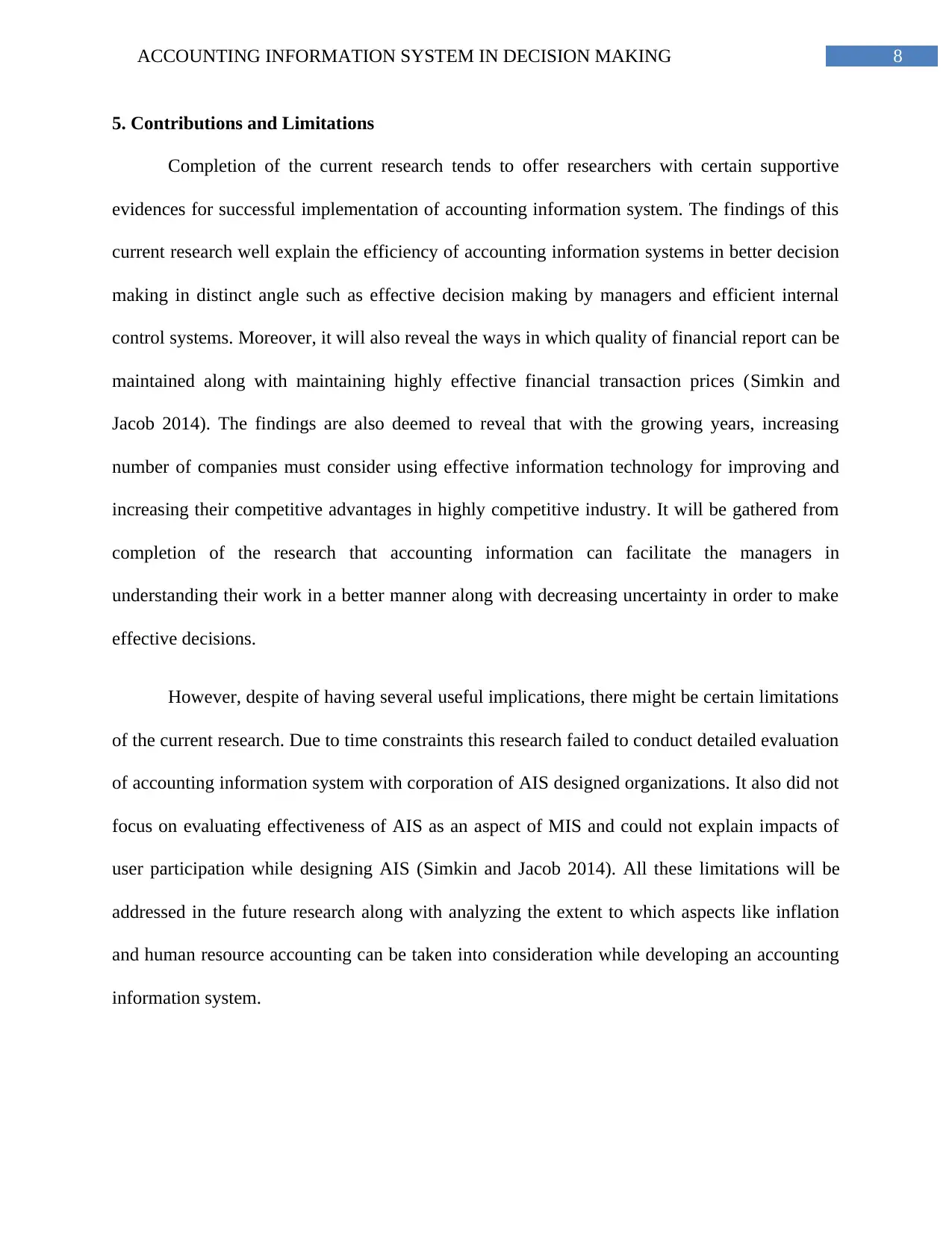
5. Contributions and Limitations
Completion of the current research tends to offer researchers with certain supportive
evidences for successful implementation of accounting information system. The findings of this
current research well explain the efficiency of accounting information systems in better decision
making in distinct angle such as effective decision making by managers and efficient internal
control systems. Moreover, it will also reveal the ways in which quality of financial report can be
maintained along with maintaining highly effective financial transaction prices (Simkin and
Jacob 2014). The findings are also deemed to reveal that with the growing years, increasing
number of companies must consider using effective information technology for improving and
increasing their competitive advantages in highly competitive industry. It will be gathered from
completion of the research that accounting information can facilitate the managers in
understanding their work in a better manner along with decreasing uncertainty in order to make
effective decisions.
However, despite of having several useful implications, there might be certain limitations
of the current research. Due to time constraints this research failed to conduct detailed evaluation
of accounting information system with corporation of AIS designed organizations. It also did not
focus on evaluating effectiveness of AIS as an aspect of MIS and could not explain impacts of
user participation while designing AIS (Simkin and Jacob 2014). All these limitations will be
addressed in the future research along with analyzing the extent to which aspects like inflation
and human resource accounting can be taken into consideration while developing an accounting
information system.
5. Contributions and Limitations
Completion of the current research tends to offer researchers with certain supportive
evidences for successful implementation of accounting information system. The findings of this
current research well explain the efficiency of accounting information systems in better decision
making in distinct angle such as effective decision making by managers and efficient internal
control systems. Moreover, it will also reveal the ways in which quality of financial report can be
maintained along with maintaining highly effective financial transaction prices (Simkin and
Jacob 2014). The findings are also deemed to reveal that with the growing years, increasing
number of companies must consider using effective information technology for improving and
increasing their competitive advantages in highly competitive industry. It will be gathered from
completion of the research that accounting information can facilitate the managers in
understanding their work in a better manner along with decreasing uncertainty in order to make
effective decisions.
However, despite of having several useful implications, there might be certain limitations
of the current research. Due to time constraints this research failed to conduct detailed evaluation
of accounting information system with corporation of AIS designed organizations. It also did not
focus on evaluating effectiveness of AIS as an aspect of MIS and could not explain impacts of
user participation while designing AIS (Simkin and Jacob 2014). All these limitations will be
addressed in the future research along with analyzing the extent to which aspects like inflation
and human resource accounting can be taken into consideration while developing an accounting
information system.
⊘ This is a preview!⊘
Do you want full access?
Subscribe today to unlock all pages.
Trusted by 1+ million students worldwide
9ACCOUNTING INFORMATION SYSTEM IN DECISION MAKING
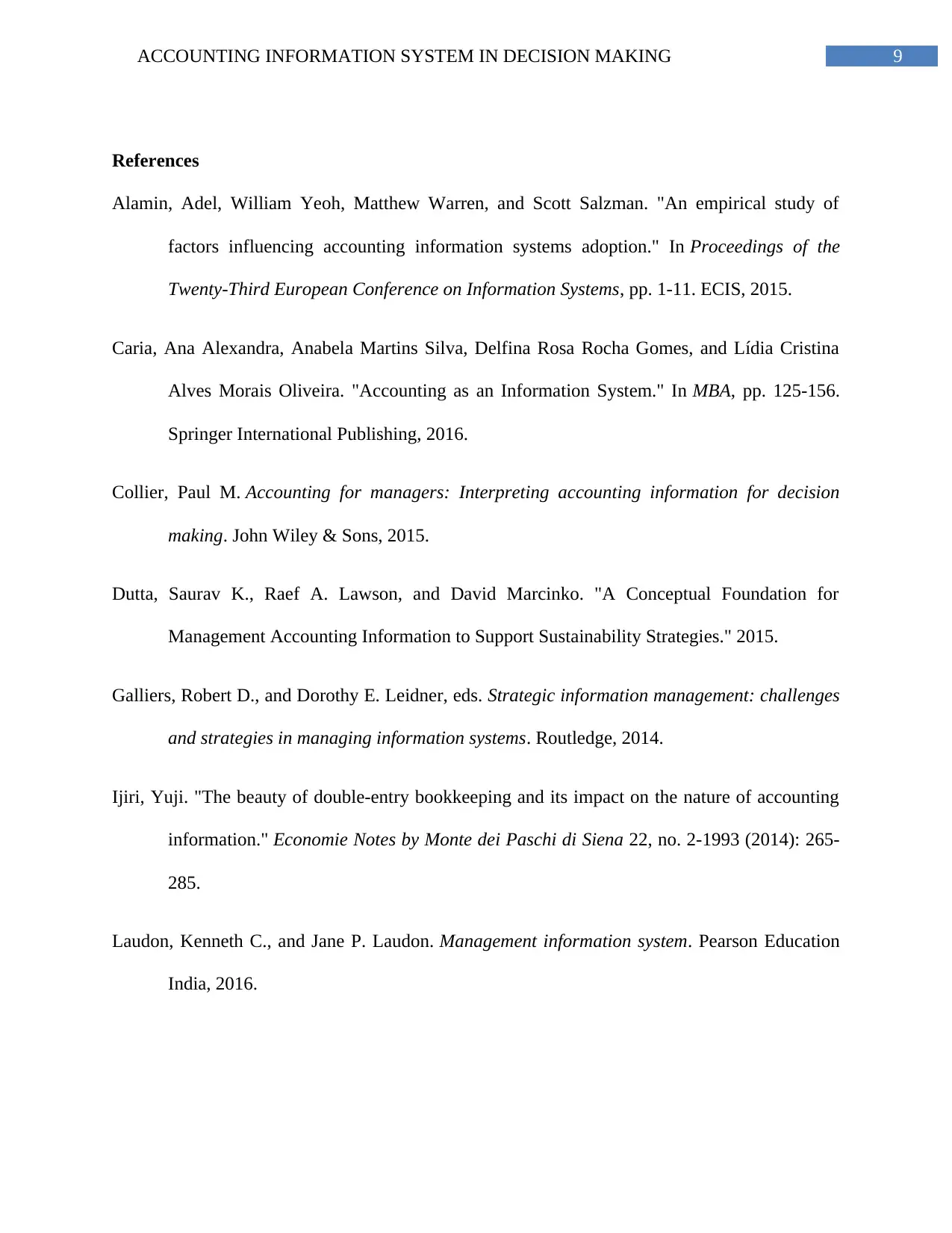
References
Alamin, Adel, William Yeoh, Matthew Warren, and Scott Salzman. "An empirical study of
factors influencing accounting information systems adoption." In Proceedings of the
Twenty-Third European Conference on Information Systems, pp. 1-11. ECIS, 2015.
Caria, Ana Alexandra, Anabela Martins Silva, Delfina Rosa Rocha Gomes, and Lídia Cristina
Alves Morais Oliveira. "Accounting as an Information System." In MBA, pp. 125-156.
Springer International Publishing, 2016.
Collier, Paul M. Accounting for managers: Interpreting accounting information for decision
making. John Wiley & Sons, 2015.
Dutta, Saurav K., Raef A. Lawson, and David Marcinko. "A Conceptual Foundation for
Management Accounting Information to Support Sustainability Strategies." 2015.
Galliers, Robert D., and Dorothy E. Leidner, eds. Strategic information management: challenges
and strategies in managing information systems. Routledge, 2014.
Ijiri, Yuji. "The beauty of double-entry bookkeeping and its impact on the nature of accounting
information." Economie Notes by Monte dei Paschi di Siena 22, no. 2-1993 (2014): 265-
285.
Laudon, Kenneth C., and Jane P. Laudon. Management information system. Pearson Education
India, 2016.
References
Alamin, Adel, William Yeoh, Matthew Warren, and Scott Salzman. "An empirical study of
factors influencing accounting information systems adoption." In Proceedings of the
Twenty-Third European Conference on Information Systems, pp. 1-11. ECIS, 2015.
Caria, Ana Alexandra, Anabela Martins Silva, Delfina Rosa Rocha Gomes, and Lídia Cristina
Alves Morais Oliveira. "Accounting as an Information System." In MBA, pp. 125-156.
Springer International Publishing, 2016.
Collier, Paul M. Accounting for managers: Interpreting accounting information for decision
making. John Wiley & Sons, 2015.
Dutta, Saurav K., Raef A. Lawson, and David Marcinko. "A Conceptual Foundation for
Management Accounting Information to Support Sustainability Strategies." 2015.
Galliers, Robert D., and Dorothy E. Leidner, eds. Strategic information management: challenges
and strategies in managing information systems. Routledge, 2014.
Ijiri, Yuji. "The beauty of double-entry bookkeeping and its impact on the nature of accounting
information." Economie Notes by Monte dei Paschi di Siena 22, no. 2-1993 (2014): 265-
285.
Laudon, Kenneth C., and Jane P. Laudon. Management information system. Pearson Education
India, 2016.
Paraphrase This Document
Need a fresh take? Get an instant paraphrase of this document with our AI Paraphraser
10ACCOUNTING INFORMATION SYSTEM IN DECISION MAKING
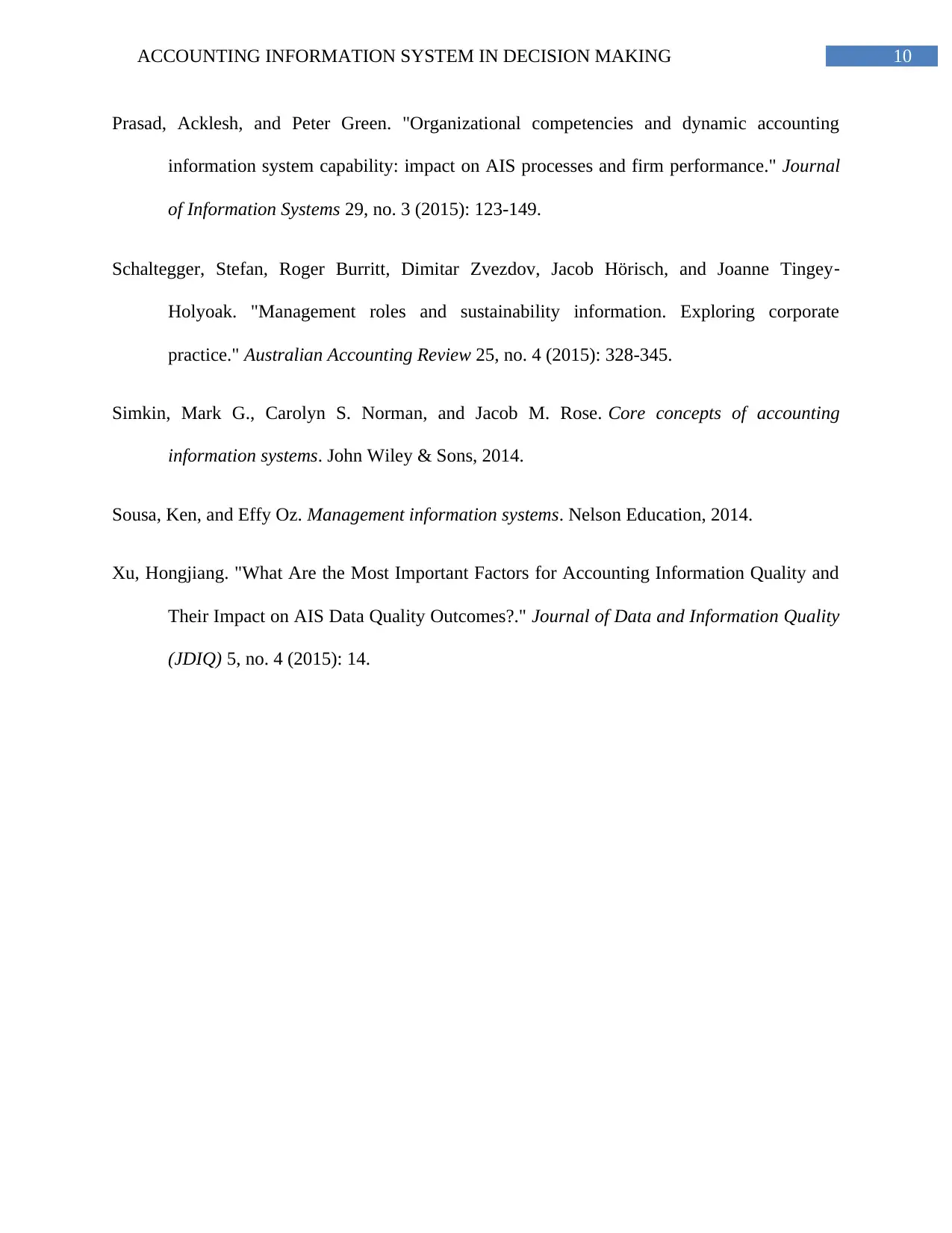
Prasad, Acklesh, and Peter Green. "Organizational competencies and dynamic accounting
information system capability: impact on AIS processes and firm performance." Journal
of Information Systems 29, no. 3 (2015): 123-149.
Schaltegger, Stefan, Roger Burritt, Dimitar Zvezdov, Jacob Hörisch, and Joanne Tingey‐
Holyoak. "Management roles and sustainability information. Exploring corporate
practice." Australian Accounting Review 25, no. 4 (2015): 328-345.
Simkin, Mark G., Carolyn S. Norman, and Jacob M. Rose. Core concepts of accounting
information systems. John Wiley & Sons, 2014.
Sousa, Ken, and Effy Oz. Management information systems. Nelson Education, 2014.
Xu, Hongjiang. "What Are the Most Important Factors for Accounting Information Quality and
Their Impact on AIS Data Quality Outcomes?." Journal of Data and Information Quality
(JDIQ) 5, no. 4 (2015): 14.
Prasad, Acklesh, and Peter Green. "Organizational competencies and dynamic accounting
information system capability: impact on AIS processes and firm performance." Journal
of Information Systems 29, no. 3 (2015): 123-149.
Schaltegger, Stefan, Roger Burritt, Dimitar Zvezdov, Jacob Hörisch, and Joanne Tingey‐
Holyoak. "Management roles and sustainability information. Exploring corporate
practice." Australian Accounting Review 25, no. 4 (2015): 328-345.
Simkin, Mark G., Carolyn S. Norman, and Jacob M. Rose. Core concepts of accounting
information systems. John Wiley & Sons, 2014.
Sousa, Ken, and Effy Oz. Management information systems. Nelson Education, 2014.
Xu, Hongjiang. "What Are the Most Important Factors for Accounting Information Quality and
Their Impact on AIS Data Quality Outcomes?." Journal of Data and Information Quality
(JDIQ) 5, no. 4 (2015): 14.
11ACCOUNTING INFORMATION SYSTEM IN DECISION MAKING
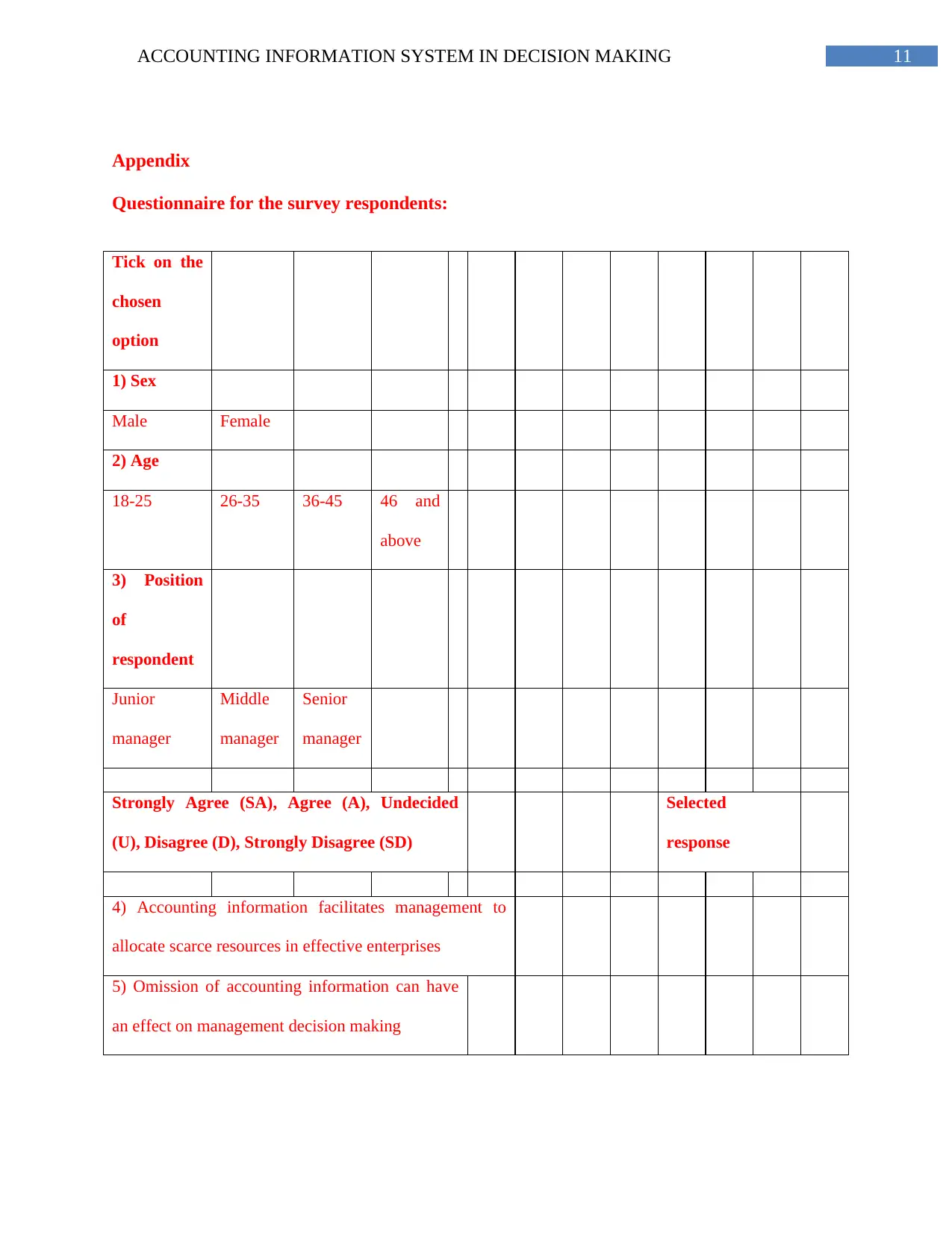
Appendix
Questionnaire for the survey respondents:
Tick on the
chosen
option
1) Sex
Male Female
2) Age
18-25 26-35 36-45 46 and
above
3) Position
of
respondent
Junior
manager
Middle
manager
Senior
manager
Strongly Agree (SA), Agree (A), Undecided
(U), Disagree (D), Strongly Disagree (SD)
Selected
response
4) Accounting information facilitates management to
allocate scarce resources in effective enterprises
5) Omission of accounting information can have
an effect on management decision making
Appendix
Questionnaire for the survey respondents:
Tick on the
chosen
option
1) Sex
Male Female
2) Age
18-25 26-35 36-45 46 and
above
3) Position
of
respondent
Junior
manager
Middle
manager
Senior
manager
Strongly Agree (SA), Agree (A), Undecided
(U), Disagree (D), Strongly Disagree (SD)
Selected
response
4) Accounting information facilitates management to
allocate scarce resources in effective enterprises
5) Omission of accounting information can have
an effect on management decision making
⊘ This is a preview!⊘
Do you want full access?
Subscribe today to unlock all pages.
Trusted by 1+ million students worldwide

1 out of 13


Related Documents


Your All-in-One AI-Powered Toolkit for Academic Success.
+13062052269
info@desklib.com
Available 24*7 on WhatsApp / Email
![[object Object]](/_next/static/media/star-bottom.7253800d.svg)
Unlock your academic potential
Copyright © 2020–2026 A2Z Services. All Rights Reserved. Developed and managed by ZUCOL.