Comprehensive Stock Management Report: AITT Assessment, January 2017
VerifiedAdded on 2023/04/21
|11
|2708
|303
Report
AI Summary
This report, an assessment from the Australian Institute of Technical Training (AITT), details a comprehensive approach to stock management. It covers essential aspects of warehousing, including preparation of storage areas conforming to food safety, hygiene, and WHS requirements, emphasizing the importance of maintaining appropriate temperatures for various food items. The report outlines the receiving process, ensuring quality and quantity specifications are met, including recording requirements and handling discrepancies. It further discusses storage requirements, such as labeling, moving items, security, and the application of FIFO principles. The monitoring section emphasizes recording storage temperatures, monitoring existing stock, and preventing wastage. Finally, the report addresses stock disposal, including the identification of hazardous substances and procedures for their safe disposal. The report analyzes the management of six different stock deliveries, including Heinz Tomato Ketchup, Cremica Mayonnaise, Lirah Vinegar, Australian Hot & Spicy BBQ Sauce, Bega Peanut Butter, and Persian Fetta Classic, providing a practical guide to effective inventory control.
RECEIVE AND STORE STOCK
Australian Institute of Technical Training (AITT) Assessment, Jan - 2017
CRICOS ID: 02868J Version 1.0
RTO ID: 21978 Page 1 of 11
Australian Institute of Technical Training (AITT) Assessment, Jan - 2017
CRICOS ID: 02868J Version 1.0
RTO ID: 21978 Page 1 of 11

Paraphrase This Document
Need a fresh take? Get an instant paraphrase of this document with our AI Paraphraser
Table of Contents
Introduction......................................................................................................................................3
Preparation.......................................................................................................................................3
Receiving Process............................................................................................................................5
Storage.............................................................................................................................................6
Monitoring.......................................................................................................................................8
Disposal...........................................................................................................................................9
Conclusion.......................................................................................................................................9
References......................................................................................................................................10
Australian Institute of Technical Training (AITT) Assessment, Jan - 2017
CRICOS ID: 02868J Version 1.0
RTO ID: 21978 Page 2 of 11
Introduction......................................................................................................................................3
Preparation.......................................................................................................................................3
Receiving Process............................................................................................................................5
Storage.............................................................................................................................................6
Monitoring.......................................................................................................................................8
Disposal...........................................................................................................................................9
Conclusion.......................................................................................................................................9
References......................................................................................................................................10
Australian Institute of Technical Training (AITT) Assessment, Jan - 2017
CRICOS ID: 02868J Version 1.0
RTO ID: 21978 Page 2 of 11
Introduction
Effective warehousing system includes receiving operations and is a critical aspect towards
maintenance and integrity of inventory systems (Richards, 2017). In absence of an effective
receiving system, items will fall through cracks and might not be counted or do not receive
appropriate inspection hence, they are not able to provide evidence regarding problems that
impact profitability. A comprehensive management program ensures businesses are able to
eliminate wastes along with inefficiencies that arise in operations. Supply chain success that
includes warehouse management has direct consequences on the profitability of the entire
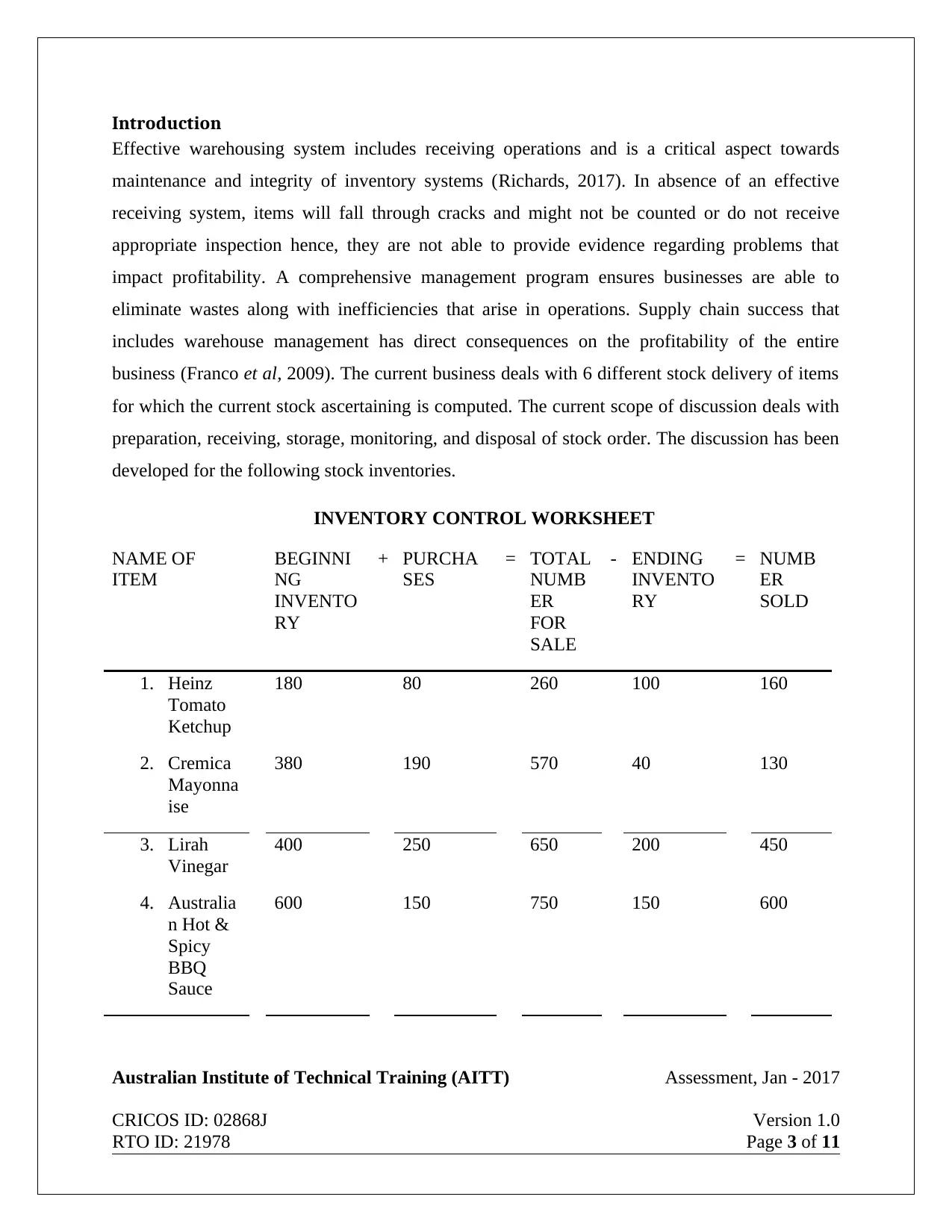
business (Franco et al, 2009). The current business deals with 6 different stock delivery of items
for which the current stock ascertaining is computed. The current scope of discussion deals with
preparation, receiving, storage, monitoring, and disposal of stock order. The discussion has been
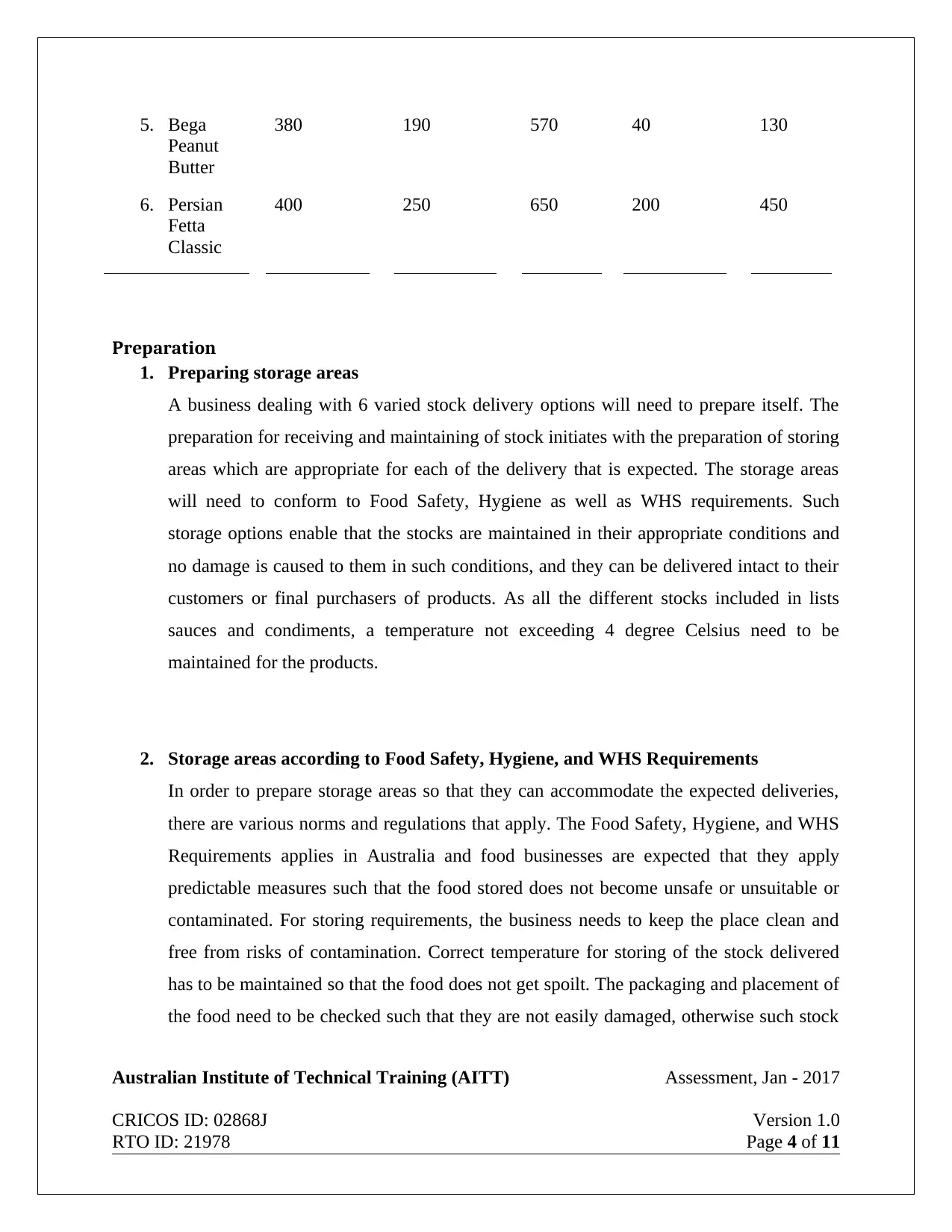
developed for the following stock inventories.
INVENTORY CONTROL WORKSHEET
NAME OF
ITEM
BEGINNI
NG
INVENTO
RY
+ PURCHA
SES
= TOTAL
NUMB
ER
FOR
SALE
- ENDING
INVENTO
RY
= NUMB
ER
SOLD
1. Heinz
Tomato
Ketchup
180 80 260 100 160
2. Cremica
Mayonna
ise
380 190 570 40 130
3. Lirah
Vinegar
400 250 650 200 450
4. Australia
n Hot &
Spicy
BBQ
Sauce
600 150 750 150 600
Australian Institute of Technical Training (AITT) Assessment, Jan - 2017
CRICOS ID: 02868J Version 1.0
RTO ID: 21978 Page 3 of 11
Effective warehousing system includes receiving operations and is a critical aspect towards
maintenance and integrity of inventory systems (Richards, 2017). In absence of an effective
receiving system, items will fall through cracks and might not be counted or do not receive
appropriate inspection hence, they are not able to provide evidence regarding problems that
impact profitability. A comprehensive management program ensures businesses are able to
eliminate wastes along with inefficiencies that arise in operations. Supply chain success that
includes warehouse management has direct consequences on the profitability of the entire
business (Franco et al, 2009). The current business deals with 6 different stock delivery of items
for which the current stock ascertaining is computed. The current scope of discussion deals with
preparation, receiving, storage, monitoring, and disposal of stock order. The discussion has been
developed for the following stock inventories.
INVENTORY CONTROL WORKSHEET
NAME OF
ITEM
BEGINNI
NG
INVENTO
RY
+ PURCHA
SES
= TOTAL
NUMB
ER
FOR
SALE
- ENDING
INVENTO
RY
= NUMB
ER
SOLD
1. Heinz
Tomato
Ketchup
180 80 260 100 160
2. Cremica
Mayonna
ise
380 190 570 40 130
3. Lirah
Vinegar
400 250 650 200 450
4. Australia
n Hot &
Spicy
BBQ
Sauce
600 150 750 150 600
Australian Institute of Technical Training (AITT) Assessment, Jan - 2017
CRICOS ID: 02868J Version 1.0
RTO ID: 21978 Page 3 of 11
⊘ This is a preview!⊘
Do you want full access?
Subscribe today to unlock all pages.

Trusted by 1+ million students worldwide
5. Bega
Peanut
Butter
380 190 570 40 130
6. Persian
Fetta
Classic
400 250 650 200 450
Preparation
1. Preparing storage areas
A business dealing with 6 varied stock delivery options will need to prepare itself. The
preparation for receiving and maintaining of stock initiates with the preparation of storing
areas which are appropriate for each of the delivery that is expected. The storage areas
will need to conform to Food Safety, Hygiene as well as WHS requirements. Such
storage options enable that the stocks are maintained in their appropriate conditions and
no damage is caused to them in such conditions, and they can be delivered intact to their
customers or final purchasers of products. As all the different stocks included in lists
sauces and condiments, a temperature not exceeding 4 degree Celsius need to be
maintained for the products.
2. Storage areas according to Food Safety, Hygiene, and WHS Requirements
In order to prepare storage areas so that they can accommodate the expected deliveries,
there are various norms and regulations that apply. The Food Safety, Hygiene, and WHS
Requirements applies in Australia and food businesses are expected that they apply
predictable measures such that the food stored does not become unsafe or unsuitable or
contaminated. For storing requirements, the business needs to keep the place clean and
free from risks of contamination. Correct temperature for storing of the stock delivered
has to be maintained so that the food does not get spoilt. The packaging and placement of
the food need to be checked such that they are not easily damaged, otherwise such stock
Australian Institute of Technical Training (AITT) Assessment, Jan - 2017
CRICOS ID: 02868J Version 1.0
RTO ID: 21978 Page 4 of 11
Peanut
Butter
380 190 570 40 130
6. Persian
Fetta
Classic
400 250 650 200 450
Preparation
1. Preparing storage areas
A business dealing with 6 varied stock delivery options will need to prepare itself. The
preparation for receiving and maintaining of stock initiates with the preparation of storing
areas which are appropriate for each of the delivery that is expected. The storage areas
will need to conform to Food Safety, Hygiene as well as WHS requirements. Such
storage options enable that the stocks are maintained in their appropriate conditions and
no damage is caused to them in such conditions, and they can be delivered intact to their
customers or final purchasers of products. As all the different stocks included in lists
sauces and condiments, a temperature not exceeding 4 degree Celsius need to be
maintained for the products.
2. Storage areas according to Food Safety, Hygiene, and WHS Requirements
In order to prepare storage areas so that they can accommodate the expected deliveries,
there are various norms and regulations that apply. The Food Safety, Hygiene, and WHS
Requirements applies in Australia and food businesses are expected that they apply
predictable measures such that the food stored does not become unsafe or unsuitable or
contaminated. For storing requirements, the business needs to keep the place clean and
free from risks of contamination. Correct temperature for storing of the stock delivered
has to be maintained so that the food does not get spoilt. The packaging and placement of
the food need to be checked such that they are not easily damaged, otherwise such stock
Australian Institute of Technical Training (AITT) Assessment, Jan - 2017
CRICOS ID: 02868J Version 1.0
RTO ID: 21978 Page 4 of 11
Paraphrase This Document
Need a fresh take? Get an instant paraphrase of this document with our AI Paraphraser
needs to be rejected. To ascertain safety precautionary measures, food contaminations
need to be avoided and allergens containing food need to be placed separately.
3. Storage conditions
The storage condition needs to be checked for ambient storage areas. In most cases,
potentially hazardous food needs to be delivered at chilled temperatures and maintained
in certain conditions (Schapler, Adler and Epp, SAP SE, 2015). The storage requirement
for certain food products such as temperature control and safety time limits need to be
checked. In case such ambient storage condition is not available then such food stocks
need to be rejected.
4. Recording tools and equipment for incoming stock
The recording tool and equipment for receiving and checking incoming stock is a barcode
scanner (Gupta, Ramaiyer, Shore and Xiao, 2009). It allows to scan barcodes easily for
each and every stock and then record it in Excel or any stock maintaining table. It allows
keeping a record for incoming as well as remaining stocks.
5. Equipment to move stock into storage
In order that stock is moved into storage, there might be a requirement of specific
equipment. A good storage design plan will ensure the safe movement of stock and
reduce accidents. A business might make use of overhead rails, floor rails, vehicles, and
other equipment in order to place their stock of goods.
Receiving Process
6. Processing the delivery ensuring quality and quantities
The delivery process needs to ensure all items meet specifications of quality and quantity
that has been ordered and received. Receiving includes the transfer of ownership of
stocks that includes the transfer of financial liability. Appropriate documentation and
reporting of what has been received can have a direct impact on the payout for goods and
Australian Institute of Technical Training (AITT) Assessment, Jan - 2017
CRICOS ID: 02868J Version 1.0
RTO ID: 21978 Page 5 of 11
need to be avoided and allergens containing food need to be placed separately.
3. Storage conditions
The storage condition needs to be checked for ambient storage areas. In most cases,
potentially hazardous food needs to be delivered at chilled temperatures and maintained
in certain conditions (Schapler, Adler and Epp, SAP SE, 2015). The storage requirement
for certain food products such as temperature control and safety time limits need to be
checked. In case such ambient storage condition is not available then such food stocks
need to be rejected.
4. Recording tools and equipment for incoming stock
The recording tool and equipment for receiving and checking incoming stock is a barcode
scanner (Gupta, Ramaiyer, Shore and Xiao, 2009). It allows to scan barcodes easily for
each and every stock and then record it in Excel or any stock maintaining table. It allows
keeping a record for incoming as well as remaining stocks.
5. Equipment to move stock into storage
In order that stock is moved into storage, there might be a requirement of specific
equipment. A good storage design plan will ensure the safe movement of stock and
reduce accidents. A business might make use of overhead rails, floor rails, vehicles, and
other equipment in order to place their stock of goods.
Receiving Process
6. Processing the delivery ensuring quality and quantities
The delivery process needs to ensure all items meet specifications of quality and quantity
that has been ordered and received. Receiving includes the transfer of ownership of
stocks that includes the transfer of financial liability. Appropriate documentation and
reporting of what has been received can have a direct impact on the payout for goods and
Australian Institute of Technical Training (AITT) Assessment, Jan - 2017
CRICOS ID: 02868J Version 1.0
RTO ID: 21978 Page 5 of 11
accounting. Accurate counting and reporting of damaged, missing items ensure that the
business bottom line is catered to.
7. Recording requirements
The receiving of the stock need to meet all recording requirements, that ensures
warehouse efficiency improvement. The document which records stock has to include
defected, damaged and misplaced items, this ensures reporting in regards to quality of the
stock (Ernesti, Grabowski and Schalper, SAP SE, 2010). Any inaccuracy or mismatch
between stock ordered and received has to be recorded and reported so as to impact the
profitability of the Company in a positive manner.
8. Discrepancies
In case of discrepancy between inaccuracy in ordered quantity or damaged goods, reports
should be made for the same. Discrepancies could arise in contaminated items or leaking
chemicals, during such instances active questioning has to be posed and a report needs to
be developed. Active questioning has to encompass various aspects and levels of the
stock and product.
Storage
9. Storage requirements
The storage requirement for different items varies depending upon the nature of each
item. The storage area requirement is similar for all the 6 different products that have
been identified. As all our food products, including sauces and condiments, there need to
be appropriate temperatures maintained, below 4 degree Celsius. Moreover, the storage
area has to be kept clean and kept free of pests and harmful chemicals to prevent
contamination of items.
Australian Institute of Technical Training (AITT) Assessment, Jan - 2017
CRICOS ID: 02868J Version 1.0
RTO ID: 21978 Page 6 of 11
business bottom line is catered to.
7. Recording requirements
The receiving of the stock need to meet all recording requirements, that ensures
warehouse efficiency improvement. The document which records stock has to include
defected, damaged and misplaced items, this ensures reporting in regards to quality of the
stock (Ernesti, Grabowski and Schalper, SAP SE, 2010). Any inaccuracy or mismatch
between stock ordered and received has to be recorded and reported so as to impact the
profitability of the Company in a positive manner.
8. Discrepancies
In case of discrepancy between inaccuracy in ordered quantity or damaged goods, reports
should be made for the same. Discrepancies could arise in contaminated items or leaking
chemicals, during such instances active questioning has to be posed and a report needs to
be developed. Active questioning has to encompass various aspects and levels of the
stock and product.
Storage
9. Storage requirements
The storage requirement for different items varies depending upon the nature of each
item. The storage area requirement is similar for all the 6 different products that have
been identified. As all our food products, including sauces and condiments, there need to
be appropriate temperatures maintained, below 4 degree Celsius. Moreover, the storage
area has to be kept clean and kept free of pests and harmful chemicals to prevent
contamination of items.
Australian Institute of Technical Training (AITT) Assessment, Jan - 2017
CRICOS ID: 02868J Version 1.0
RTO ID: 21978 Page 6 of 11
⊘ This is a preview!⊘
Do you want full access?
Subscribe today to unlock all pages.
Trusted by 1+ million students worldwide
10. Labeling
Each of the stock items will need to be appropriately labeled. The labeling requirement
for each and every product has to encompass date of purchase, dates of expiry, product
detail information and manufacturer details (Gillen and Hensley, 2014). Any allergy-
related information or any other crucial product detail will need to be included in the
labeling information.
11. Moving item into storage
The stock item needs to be moved into storage such as to ensure quality is maintained at
all the times. The storage place will include appropriate temperature and conditions such
that the product quality remains intact. A truck will be made available which will be
deployed for moving incoming goods into storage areas.
12. Ensure the security of stock items
It is integral that the security of stock items in transit and in storage areas is maintained at
all the time (Bruns, Grabowski and Schalper, SAP SE, 2010). Such security can be
provided by installing CCTV cameras at various locations of the storage and incoming
areas, employing full-time security personnel along with having a stock inspector to keep
period checks on the stock that are incoming and the area in storage areas.
13. Store and arrange
The stocks need to be maintained according to storage principles of FIFO or any other
specified techniques. Keeping stock according to specific principles allows selling items
that have come in first, in the first place. FIFO (first in first out) principle ensures that the
stock which comes in first in the store inventory is taken out for sales first. This ensures
freshness of the stock especially in case of food items. In order to store and arrange
Australian Institute of Technical Training (AITT) Assessment, Jan - 2017
CRICOS ID: 02868J Version 1.0
RTO ID: 21978 Page 7 of 11
Each of the stock items will need to be appropriately labeled. The labeling requirement
for each and every product has to encompass date of purchase, dates of expiry, product
detail information and manufacturer details (Gillen and Hensley, 2014). Any allergy-
related information or any other crucial product detail will need to be included in the
labeling information.
11. Moving item into storage
The stock item needs to be moved into storage such as to ensure quality is maintained at
all the times. The storage place will include appropriate temperature and conditions such
that the product quality remains intact. A truck will be made available which will be
deployed for moving incoming goods into storage areas.
12. Ensure the security of stock items
It is integral that the security of stock items in transit and in storage areas is maintained at
all the time (Bruns, Grabowski and Schalper, SAP SE, 2010). Such security can be
provided by installing CCTV cameras at various locations of the storage and incoming
areas, employing full-time security personnel along with having a stock inspector to keep
period checks on the stock that are incoming and the area in storage areas.
13. Store and arrange
The stocks need to be maintained according to storage principles of FIFO or any other
specified techniques. Keeping stock according to specific principles allows selling items
that have come in first, in the first place. FIFO (first in first out) principle ensures that the
stock which comes in first in the store inventory is taken out for sales first. This ensures
freshness of the stock especially in case of food items. In order to store and arrange
Australian Institute of Technical Training (AITT) Assessment, Jan - 2017
CRICOS ID: 02868J Version 1.0
RTO ID: 21978 Page 7 of 11
Paraphrase This Document
Need a fresh take? Get an instant paraphrase of this document with our AI Paraphraser
stocked items according to FIFO principles, the stock that comes in first need to be
placed at the initiation point of sales, this will ensure that it is drawn first.
14. Ensure older stock usage
The stock that is older has to be used before dates prior to new stock. This would ensure
that the before the new stock is received or any deficiency is reported, the old stock is
totally exhausted. Adopting the FIFO principle will allow removing old stock prior to the
removal of new stocks. The FIFO method ensures that the stocks which are placed first
are taken out first from storage areas for use or for the purpose of sales.
Monitoring
15. Record the storage temperatures
The temperatures at all areas of the storage place need to be kept at constant. All the food
items are either sauces or condiments. All these products need to be maintained at a
constant temperature to prevent any changes being brought about to their composition.
The storage temperature throughout the storage needs to be maintained at 4 degree
Celsius. All the products need to be maintained at refrigerated conditions. There have to
be thermometers installed at various places of the storage such that temperature within
the storage areas can easily be monitored. The temperature has to be monitored on a
continuous basis during various times during the day.
16. Demonstrate how you will monitor existing stock in storage
The monitoring of existing stock that is kept in storage has to be conducted on a regular
basis. The monitoring of such stocks ensures that a minimum amount of wastage or
damage occurs to the products (Mierau and Seeler, 2010). The monitoring will include
checking for the date of expiry, monitoring temperatures during various times of the day,
Australian Institute of Technical Training (AITT) Assessment, Jan - 2017
CRICOS ID: 02868J Version 1.0
RTO ID: 21978 Page 8 of 11
placed at the initiation point of sales, this will ensure that it is drawn first.
14. Ensure older stock usage
The stock that is older has to be used before dates prior to new stock. This would ensure
that the before the new stock is received or any deficiency is reported, the old stock is
totally exhausted. Adopting the FIFO principle will allow removing old stock prior to the
removal of new stocks. The FIFO method ensures that the stocks which are placed first
are taken out first from storage areas for use or for the purpose of sales.
Monitoring
15. Record the storage temperatures
The temperatures at all areas of the storage place need to be kept at constant. All the food
items are either sauces or condiments. All these products need to be maintained at a
constant temperature to prevent any changes being brought about to their composition.
The storage temperature throughout the storage needs to be maintained at 4 degree
Celsius. All the products need to be maintained at refrigerated conditions. There have to
be thermometers installed at various places of the storage such that temperature within
the storage areas can easily be monitored. The temperature has to be monitored on a
continuous basis during various times during the day.
16. Demonstrate how you will monitor existing stock in storage
The monitoring of existing stock that is kept in storage has to be conducted on a regular
basis. The monitoring of such stocks ensures that a minimum amount of wastage or
damage occurs to the products (Mierau and Seeler, 2010). The monitoring will include
checking for the date of expiry, monitoring temperatures during various times of the day,
Australian Institute of Technical Training (AITT) Assessment, Jan - 2017
CRICOS ID: 02868J Version 1.0
RTO ID: 21978 Page 8 of 11
and check for pests and other harmful chemicals. An evaluation procedure will need to be
recorded at various times during the day, through the entire period in a month.
17. Preventing wastages
The stock needs to be maintained such that ones that are close to expiry are used and
wastages are prevented. FIFO principles will ensure the stocks that are close to expiry is
used before the new stocks. Regular monitoring procedures will also ensure that the stock
prior to expiry is used such that wastages are prevented or minimized.
Disposal
18. Dispose of any stock
Stocks will be monitored on a regular basis. This will ensure identification and disposing
of a stock that has been damaged or date of expiry has been reached. Organizational
procedure to disposing of stock include segregating and separating the damaged or
expired stock and then arranging for a vehicle to get such stock out of the storage area.
The disposed of the bar code will be removed from the record for stock.
19. Identify any hazardous substances which require disposal and explain the
procedures for safe disposal of these.
In presence of hazardous substances requiring disposal, there need to be procedures
specified. A procedure for safe disposal of a hazardous substance has to be identified. It
calls for preventing contamination or in spreading of a hazardous substance from causing
harm to any stock. A safe procedure includes placing the hazardous substance in an
enclosed place and then sealing off before transporting it outside of the warehouse.
Australian Institute of Technical Training (AITT) Assessment, Jan - 2017
CRICOS ID: 02868J Version 1.0
RTO ID: 21978 Page 9 of 11
recorded at various times during the day, through the entire period in a month.
17. Preventing wastages
The stock needs to be maintained such that ones that are close to expiry are used and
wastages are prevented. FIFO principles will ensure the stocks that are close to expiry is
used before the new stocks. Regular monitoring procedures will also ensure that the stock
prior to expiry is used such that wastages are prevented or minimized.
Disposal
18. Dispose of any stock
Stocks will be monitored on a regular basis. This will ensure identification and disposing
of a stock that has been damaged or date of expiry has been reached. Organizational
procedure to disposing of stock include segregating and separating the damaged or
expired stock and then arranging for a vehicle to get such stock out of the storage area.
The disposed of the bar code will be removed from the record for stock.
19. Identify any hazardous substances which require disposal and explain the
procedures for safe disposal of these.
In presence of hazardous substances requiring disposal, there need to be procedures
specified. A procedure for safe disposal of a hazardous substance has to be identified. It
calls for preventing contamination or in spreading of a hazardous substance from causing
harm to any stock. A safe procedure includes placing the hazardous substance in an
enclosed place and then sealing off before transporting it outside of the warehouse.
Australian Institute of Technical Training (AITT) Assessment, Jan - 2017
CRICOS ID: 02868J Version 1.0
RTO ID: 21978 Page 9 of 11
⊘ This is a preview!⊘
Do you want full access?
Subscribe today to unlock all pages.
Trusted by 1+ million students worldwide
Conclusion
The stock storing, receiving and maintaining procedures include a wide range of complex
procedures. Stocks within storage has to be maintained adequately and monitored on a
continuous basis such as to keep the stock intact and prevent any potential loss from happening.
References
Bruns, A.D., Grabowski, S. and Schalper, D., SAP SE, 2010. Methods and systems for managing
stock transportation. U.S. Patent 7,770,792. Accessed from
https://patents.google.com/patent/US7770792B2/en
Ernesti, B., Grabowski, S. and Schalper, D., SAP SE, 2010. Methods and system for managing
stock. U.S. Patent 7,669,763. Accessed from https://patents.google.com/patent/US7669763B2/en
Franco, L.M., Rose, F.L., Brittan, P.S., Cunningham, M., Bulkin, A., Baskin, M. and Blonder,
G., Droplets Inc, 2009. System and method for delivering remotely stored applications and
information. U.S. Patent 7,502,838. Accessed from
https://patents.google.com/patent/US7502838B2/en
Gillen, R.J. and Hensley, R.W., United Parcel Service of America Inc, 2014. Systems and
methods for delivery of an item. U.S. Patent Application 13/839,398. Accessed from
https://patents.google.com/patent/US20140180959A1/en
Gupta, A., Ramaiyer, K., Shore, M. and Xiao, J., Oracle International Corp, 2009. Methods and
apparatus for maintaining consistency during analysis of large data sets. U.S. Patent 7,571,192.
Accessed from https://patents.google.com/patent/US7571192B2/en
Mierau, P. and Seeler, R.S., Adobe Systems Inc, 2010. Adding metadata to a stock content item.
U.S. Patent 7,853,564. Accessed from https://patents.google.com/patent/US7853564B2/en
Australian Institute of Technical Training (AITT) Assessment, Jan - 2017
CRICOS ID: 02868J Version 1.0
RTO ID: 21978 Page 10 of 11
The stock storing, receiving and maintaining procedures include a wide range of complex
procedures. Stocks within storage has to be maintained adequately and monitored on a
continuous basis such as to keep the stock intact and prevent any potential loss from happening.
References
Bruns, A.D., Grabowski, S. and Schalper, D., SAP SE, 2010. Methods and systems for managing
stock transportation. U.S. Patent 7,770,792. Accessed from
https://patents.google.com/patent/US7770792B2/en
Ernesti, B., Grabowski, S. and Schalper, D., SAP SE, 2010. Methods and system for managing
stock. U.S. Patent 7,669,763. Accessed from https://patents.google.com/patent/US7669763B2/en
Franco, L.M., Rose, F.L., Brittan, P.S., Cunningham, M., Bulkin, A., Baskin, M. and Blonder,
G., Droplets Inc, 2009. System and method for delivering remotely stored applications and
information. U.S. Patent 7,502,838. Accessed from
https://patents.google.com/patent/US7502838B2/en
Gillen, R.J. and Hensley, R.W., United Parcel Service of America Inc, 2014. Systems and
methods for delivery of an item. U.S. Patent Application 13/839,398. Accessed from
https://patents.google.com/patent/US20140180959A1/en
Gupta, A., Ramaiyer, K., Shore, M. and Xiao, J., Oracle International Corp, 2009. Methods and
apparatus for maintaining consistency during analysis of large data sets. U.S. Patent 7,571,192.
Accessed from https://patents.google.com/patent/US7571192B2/en
Mierau, P. and Seeler, R.S., Adobe Systems Inc, 2010. Adding metadata to a stock content item.
U.S. Patent 7,853,564. Accessed from https://patents.google.com/patent/US7853564B2/en
Australian Institute of Technical Training (AITT) Assessment, Jan - 2017
CRICOS ID: 02868J Version 1.0
RTO ID: 21978 Page 10 of 11
Paraphrase This Document
Need a fresh take? Get an instant paraphrase of this document with our AI Paraphraser
Richards, G., 2017. Warehouse management: a complete guide to improving efficiency and
minimizing costs in the modern warehouse. Kogan Page Publishers. Accessed from
https://books.google.co.in/books?
hl=en&lr=&id=bDw7DwAAQBAJ&oi=fnd&pg=PP1&dq=receive+and+maintain+stock+in+war
ehouse+&ots=zU7RDISTfG&sig=eXWWzPA1esojeMQWryJbuFBBWM0#v=onepage&q=recei
ve%20and%20maintain%20stock%20in%20warehouse&f=false
Schapler, D., Adler, T. and Epp, J., SAP SE, 2015. Methods and systems for processing stock in
a storage facility. U.S. Patent 9,026,455. Accessed from
https://patents.google.com/patent/US9026455B2/en
Australian Institute of Technical Training (AITT) Assessment, Jan - 2017
CRICOS ID: 02868J Version 1.0
RTO ID: 21978 Page 11 of 11
minimizing costs in the modern warehouse. Kogan Page Publishers. Accessed from
https://books.google.co.in/books?
hl=en&lr=&id=bDw7DwAAQBAJ&oi=fnd&pg=PP1&dq=receive+and+maintain+stock+in+war
ehouse+&ots=zU7RDISTfG&sig=eXWWzPA1esojeMQWryJbuFBBWM0#v=onepage&q=recei
ve%20and%20maintain%20stock%20in%20warehouse&f=false
Schapler, D., Adler, T. and Epp, J., SAP SE, 2015. Methods and systems for processing stock in
a storage facility. U.S. Patent 9,026,455. Accessed from
https://patents.google.com/patent/US9026455B2/en
Australian Institute of Technical Training (AITT) Assessment, Jan - 2017
CRICOS ID: 02868J Version 1.0
RTO ID: 21978 Page 11 of 11

1 out of 11


Your All-in-One AI-Powered Toolkit for Academic Success.
+13062052269
info@desklib.com
Available 24*7 on WhatsApp / Email
![[object Object]](/_next/static/media/star-bottom.7253800d.svg)
Unlock your academic potential
Copyright © 2020–2026 A2Z Services. All Rights Reserved. Developed and managed by ZUCOL.