Jurisprudence: Analysis of MacIntyre on Morality and Society Essay

Verified

Added on  2023/01/20

|3
|687
|94
Essay
AI Summary
This essay delves into Alasdair MacIntyre's social philosophy, providing a critical analysis of his views on modern society's moral incoherence and the rise of emotivism. The essay examines MacIntyre's arguments, including his criticism of the value-neutral approach in sociology and his assertion that moral philosophy is inherently linked to sociology. It then discusses the core tenets of MacIntyre's critique, focusing on consumerism, globalization, and pluralism as pillars of modern society. The essay also explores criticisms of MacIntyre's perspective, particularly his portrayal of past communities and his oversight of the growth of human rights and international law. By examining these points, the essay aims to provide a comprehensive understanding of MacIntyre's social philosophy and its relevance to contemporary jurisprudence, drawing on references to various scholars and publications to support its arguments.
Document Page
Page1
JURISPRUDENCE LAW
INTRODUCTION
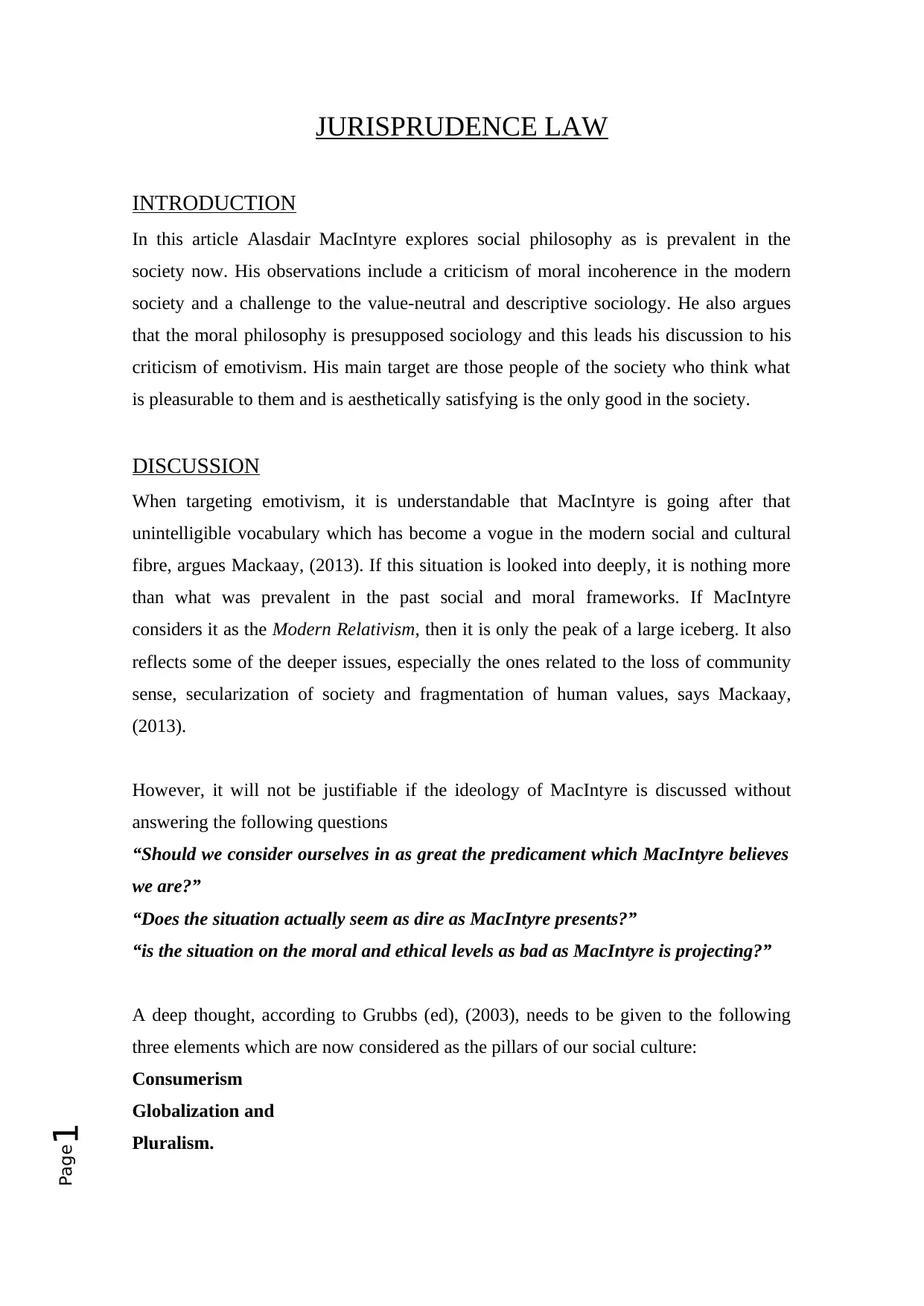
In this article Alasdair MacIntyre explores social philosophy as is prevalent in the
society now. His observations include a criticism of moral incoherence in the modern
society and a challenge to the value-neutral and descriptive sociology. He also argues
that the moral philosophy is presupposed sociology and this leads his discussion to his
criticism of emotivism. His main target are those people of the society who think what
is pleasurable to them and is aesthetically satisfying is the only good in the society.
DISCUSSION
When targeting emotivism, it is understandable that MacIntyre is going after that
unintelligible vocabulary which has become a vogue in the modern social and cultural
fibre, argues Mackaay, (2013). If this situation is looked into deeply, it is nothing more
than what was prevalent in the past social and moral frameworks. If MacIntyre
considers it as the Modern Relativism, then it is only the peak of a large iceberg. It also
reflects some of the deeper issues, especially the ones related to the loss of community
sense, secularization of society and fragmentation of human values, says Mackaay,
(2013).
However, it will not be justifiable if the ideology of MacIntyre is discussed without
answering the following questions
“Should we consider ourselves in as great the predicament which MacIntyre believes
we are?”
“Does the situation actually seem as dire as MacIntyre presents?”
“is the situation on the moral and ethical levels as bad as MacIntyre is projecting?”
A deep thought, according to Grubbs (ed), (2003), needs to be given to the following
three elements which are now considered as the pillars of our social culture:
Consumerism
Globalization and
Pluralism.
tabler-icon-diamond-filled.svg

Paraphrase This Document

Need a fresh take? Get an instant paraphrase of this document with our AI Paraphraser
Document Page
Page2
It is pertinent to point out that the first pillar is the commercial outlook of each
individual within the society. The second pillar creates impact on the proximity of
different communities in the world. Finally, the third pillar affects the thought process
of each individual when it approaches to establish a series of relationship with other
communities, explain Dorland & Charland, (2002). While investigating these social
pillar, MacIntyre turns his attention to the problems attributable to each individual’s
moral context and states that what used to purport as an appeal of objectivity is in fact
the individual’s expressions of his subjective will, argues Mackaay, (2013).
CONCLUSION
MacIntyre in futility tries to illustrate those debates which are on outline of problems
and concern each individual on three levels:
1. First - people have no rational way of weighing claims of one argument against
another.
2. Second - the arguments are purported to be impersonal rational arguments.
3. Third - no moral disagreement, in past, present, or future, can be resolved.
On these analytical notes, it is safe to criticize MacIntyre on the following two grounds:
First – MacIntyre, through his arguments tries to create an irrational picture of
the coherence of past communities.
Secondly - MacIntyre totally overlooks the growth of human rights and the
international laws as instances within a shared moral system which is not based
on emotivism.
This growth of human rights and international laws is proof enough that MacIntyre’s
view of the collapse of a common moral vocabulary is unfounded and unrealistic.
LIST OF REFERENCES
Document Page
Page3
Grubbs, S.R. (ed). 2003. International Civil Procedure. Kluwer Law International B.V.,
The Hague.
Mackaay, E. 2013. Law and Economics for Civil Law Systems. Edward Elgar
Publishing, Cheltenham.
Dorland, M. and Charland, M.R. 2002. Law, Rhetoric and Irony in the Formation of
Canadian Civil Culture. University of Toronto Press, Toronto.
chevron_up_icon
1 out of 3
circle_padding
hide_on_mobile
zoom_out_icon
[object Object]