Analysis of Alcoholic Abuse Among Teenagers in New Zealand

Verified

Added on  2020/05/11

|5
|762
|226
Report
AI Summary
This report addresses the concerning issue of alcohol abuse among teenagers in New Zealand. It begins by highlighting the prevalence of alcohol consumption and its associated health and social risks, referencing WHO statistics that show significant per capita alcohol consumption and a high rate of teenage addiction. The report presents statistical data from the New Zealand Ministry of Health, illustrating the extent of alcohol abuse across different age groups, with a particular focus on the high percentage of alcoholics within the 15-17 and 18-24 age brackets. It then explores the primary factors contributing to this addiction, including peer pressure, parental influence, curiosity, low self-esteem, and rebellion. The report also examines the New Zealand government's approach to tackling alcohol abuse, outlining the National Drug Policy 2015-2020 and the three-pronged strategy focused on problem limitation, demand reduction, and supply control. It details the government's initiatives, such as providing therapeutic services, educational campaigns, and regulations on alcohol trading, to curb alcohol abuse and promote a healthier lifestyle among the population. The report concludes by emphasizing the preventive approaches being implemented to reduce hazardous drinking patterns among young New Zealanders.
Document Page
Running head: ALCOHOLIC ABUSE IN NEW ZEALAND
ALCOHOL ADDICTION AMONG TEENAGERS IN NEW ZEALAND
Name of the Student
Name of the University
Author note
tabler-icon-diamond-filled.svg

Paraphrase This Document

Need a fresh take? Get an instant paraphrase of this document with our AI Paraphraser
Document Page
1
ALCOHOLIC ABUSE IN NEW ZEALAND
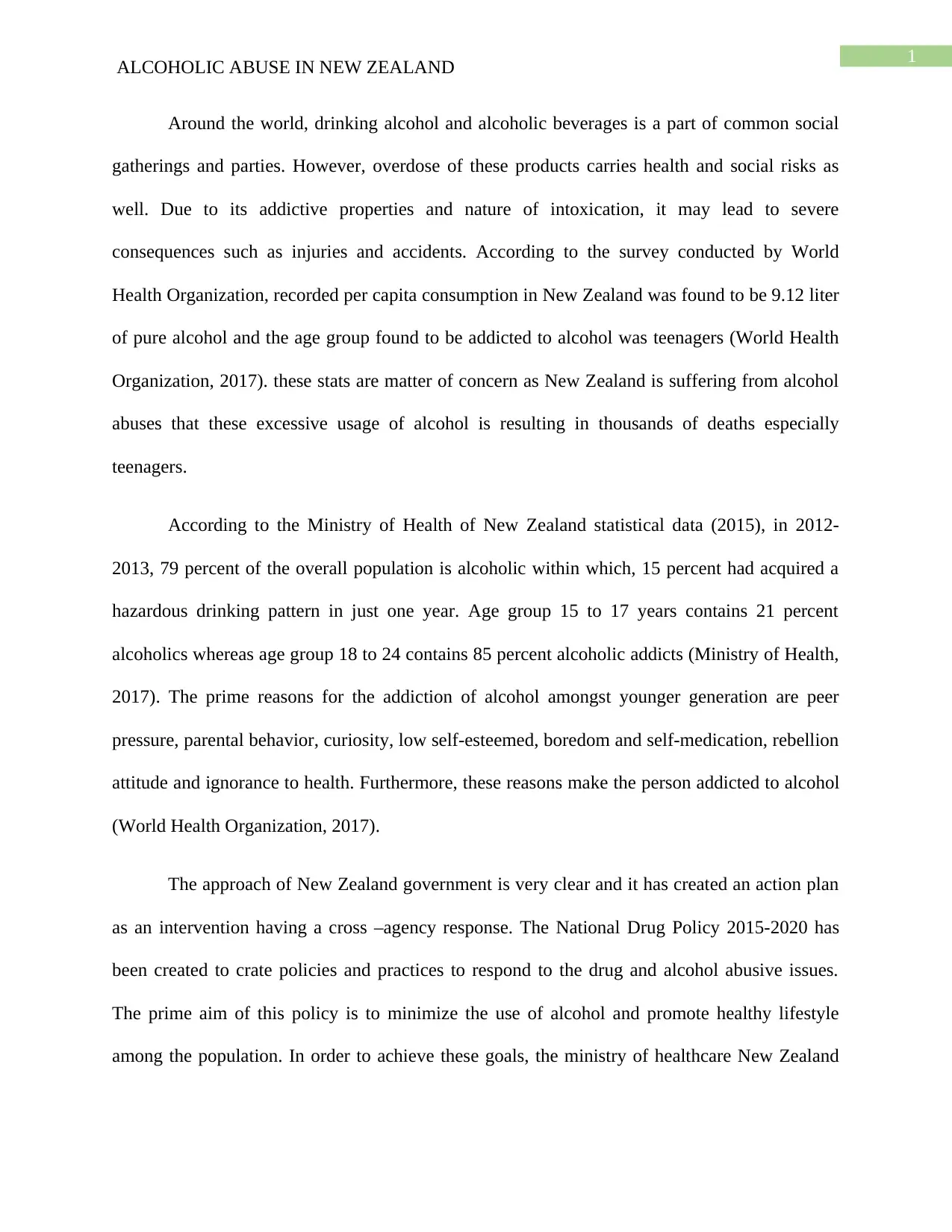
Around the world, drinking alcohol and alcoholic beverages is a part of common social
gatherings and parties. However, overdose of these products carries health and social risks as
well. Due to its addictive properties and nature of intoxication, it may lead to severe
consequences such as injuries and accidents. According to the survey conducted by World
Health Organization, recorded per capita consumption in New Zealand was found to be 9.12 liter
of pure alcohol and the age group found to be addicted to alcohol was teenagers (World Health
Organization, 2017). these stats are matter of concern as New Zealand is suffering from alcohol
abuses that these excessive usage of alcohol is resulting in thousands of deaths especially
teenagers.
According to the Ministry of Health of New Zealand statistical data (2015), in 2012-
2013, 79 percent of the overall population is alcoholic within which, 15 percent had acquired a
hazardous drinking pattern in just one year. Age group 15 to 17 years contains 21 percent
alcoholics whereas age group 18 to 24 contains 85 percent alcoholic addicts (Ministry of Health,
2017). The prime reasons for the addiction of alcohol amongst younger generation are peer
pressure, parental behavior, curiosity, low self-esteemed, boredom and self-medication, rebellion
attitude and ignorance to health. Furthermore, these reasons make the person addicted to alcohol
(World Health Organization, 2017).
The approach of New Zealand government is very clear and it has created an action plan
as an intervention having a cross –agency response. The National Drug Policy 2015-2020 has
been created to crate policies and practices to respond to the drug and alcohol abusive issues.
The prime aim of this policy is to minimize the use of alcohol and promote healthy lifestyle
among the population. In order to achieve these goals, the ministry of healthcare New Zealand
Document Page
2
ALCOHOLIC ABUSE IN NEW ZEALAND
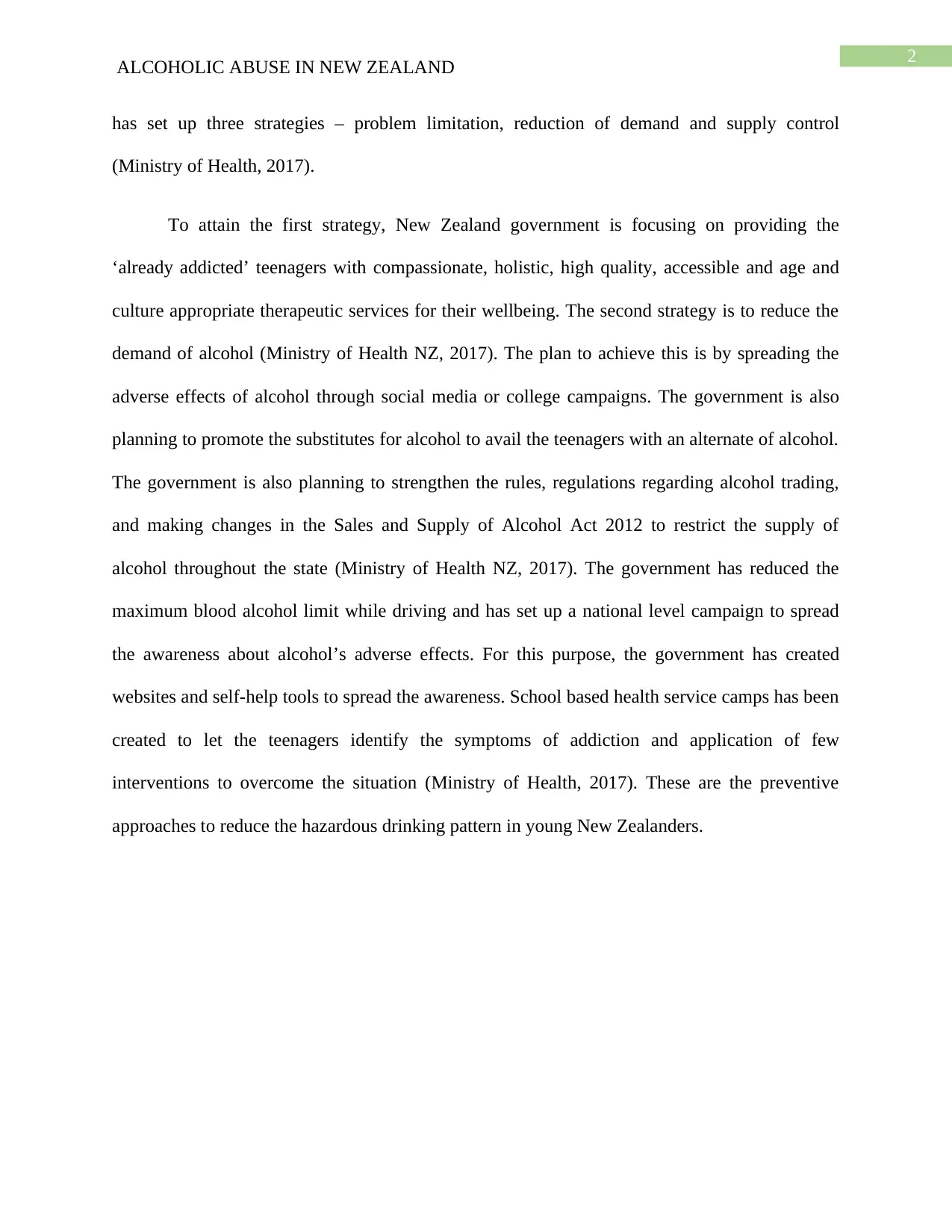
has set up three strategies – problem limitation, reduction of demand and supply control
(Ministry of Health, 2017).
To attain the first strategy, New Zealand government is focusing on providing the
‘already addicted’ teenagers with compassionate, holistic, high quality, accessible and age and
culture appropriate therapeutic services for their wellbeing. The second strategy is to reduce the
demand of alcohol (Ministry of Health NZ, 2017). The plan to achieve this is by spreading the
adverse effects of alcohol through social media or college campaigns. The government is also
planning to promote the substitutes for alcohol to avail the teenagers with an alternate of alcohol.
The government is also planning to strengthen the rules, regulations regarding alcohol trading,
and making changes in the Sales and Supply of Alcohol Act 2012 to restrict the supply of
alcohol throughout the state (Ministry of Health NZ, 2017). The government has reduced the
maximum blood alcohol limit while driving and has set up a national level campaign to spread
the awareness about alcohol’s adverse effects. For this purpose, the government has created
websites and self-help tools to spread the awareness. School based health service camps has been
created to let the teenagers identify the symptoms of addiction and application of few
interventions to overcome the situation (Ministry of Health, 2017). These are the preventive
approaches to reduce the hazardous drinking pattern in young New Zealanders.
Document Page
3
ALCOHOLIC ABUSE IN NEW ZEALAND
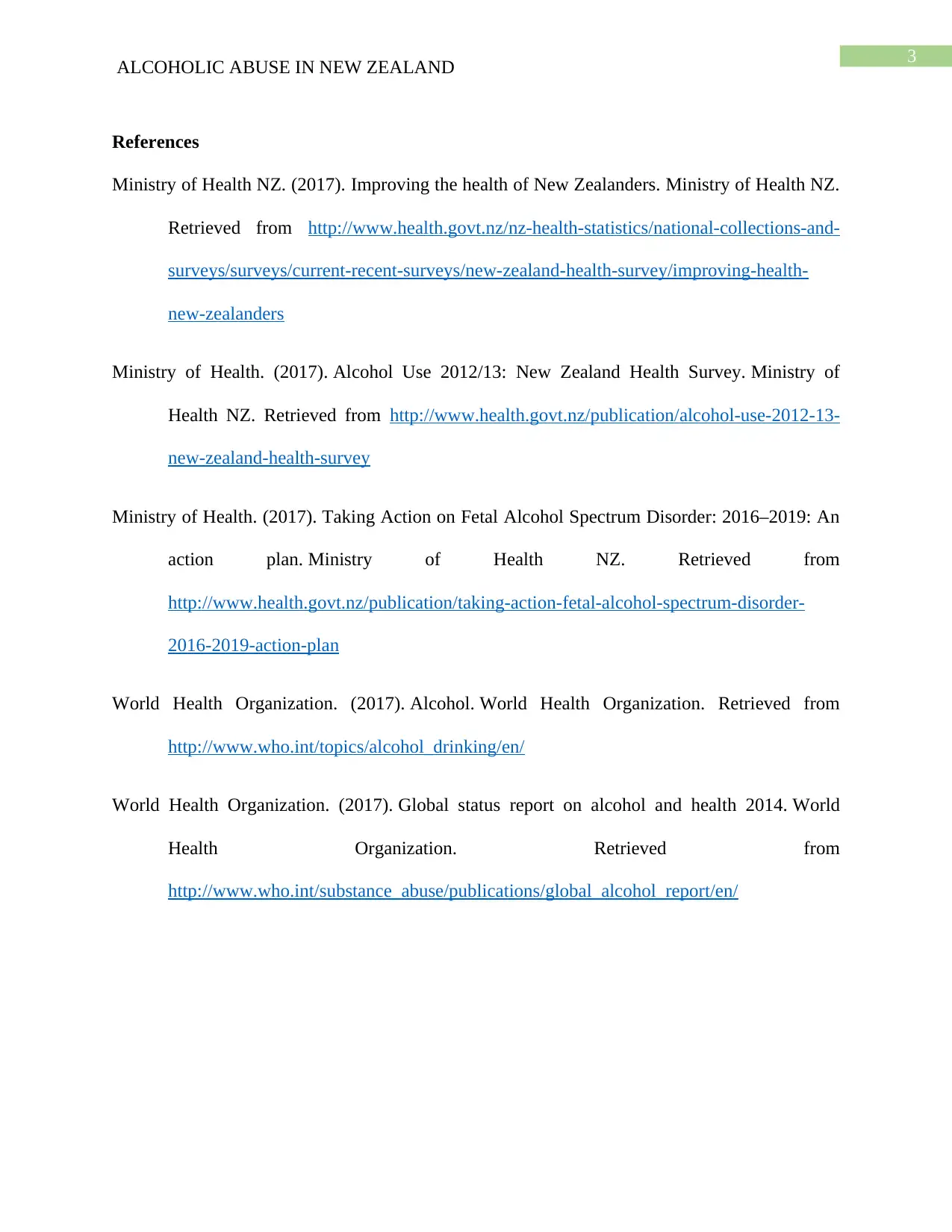
References
Ministry of Health NZ. (2017). Improving the health of New Zealanders. Ministry of Health NZ.
Retrieved from http://www.health.govt.nz/nz-health-statistics/national-collections-and-
surveys/surveys/current-recent-surveys/new-zealand-health-survey/improving-health-
new-zealanders
Ministry of Health. (2017). Alcohol Use 2012/13: New Zealand Health Survey. Ministry of
Health NZ. Retrieved from http://www.health.govt.nz/publication/alcohol-use-2012-13-
new-zealand-health-survey
Ministry of Health. (2017). Taking Action on Fetal Alcohol Spectrum Disorder: 2016–2019: An
action plan. Ministry of Health NZ. Retrieved from
http://www.health.govt.nz/publication/taking-action-fetal-alcohol-spectrum-disorder-
2016-2019-action-plan
World Health Organization. (2017). Alcohol. World Health Organization. Retrieved from
http://www.who.int/topics/alcohol_drinking/en/
World Health Organization. (2017). Global status report on alcohol and health 2014. World
Health Organization. Retrieved from
http://www.who.int/substance_abuse/publications/global_alcohol_report/en/
tabler-icon-diamond-filled.svg

Paraphrase This Document

Need a fresh take? Get an instant paraphrase of this document with our AI Paraphraser
Document Page
4
ALCOHOLIC ABUSE IN NEW ZEALAND
chevron_up_icon
1 out of 5
circle_padding
hide_on_mobile
zoom_out_icon
[object Object]