Criminology Essay: Alcohol's Role in Sexual Assault & Injustice
VerifiedAdded on 2023/06/03
|8
|2134
|108
Essay
AI Summary
This essay examines the correlation between alcohol use and sexual assault, particularly among college students, using the rational choice theory. It asserts that alcohol, gender, and ethnicity play significant roles in sexual assault cases. The essay highlights statistics from the US, Mexico and Australia that indicate a high prevalence of alcohol-related sexual assaults, especially among college women. It also discusses how gender and racial discrimination contribute to increased vulnerability and substance abuse, further elevating the risk of sexual victimization. The analysis emphasizes that addressing alcohol consumption and societal factors like discrimination is crucial in preventing sexual assault. Desklib provides similar solved assignments and study resources for students.
Introduction to Criminology and Criminal Justice 1
INTRODUCTION TO CRIMINOLOGY AND CRIMINAL JUSTICE
by
Student
Name
Course
Institution
Instructor
Town
Date
INTRODUCTION TO CRIMINOLOGY AND CRIMINAL JUSTICE
by
Student
Name
Course
Institution
Instructor
Town
Date

Paraphrase This Document
Need a fresh take? Get an instant paraphrase of this document with our AI Paraphraser
Introduction to Criminology and Criminal Justice 2
Introduction to Criminology and Criminal Justice
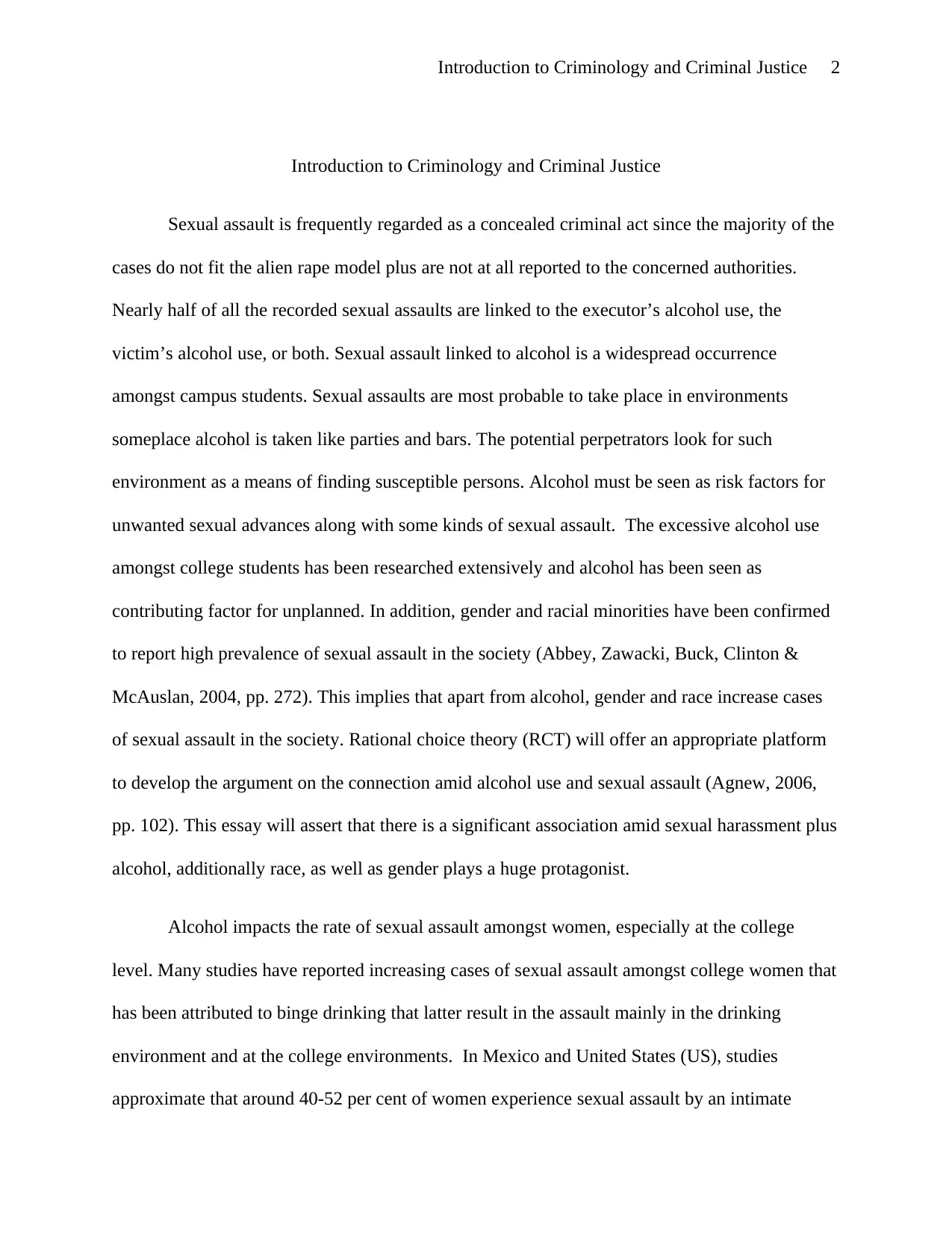
Sexual assault is frequently regarded as a concealed criminal act since the majority of the
cases do not fit the alien rape model plus are not at all reported to the concerned authorities.
Nearly half of all the recorded sexual assaults are linked to the executor’s alcohol use, the
victim’s alcohol use, or both. Sexual assault linked to alcohol is a widespread occurrence
amongst campus students. Sexual assaults are most probable to take place in environments
someplace alcohol is taken like parties and bars. The potential perpetrators look for such
environment as a means of finding susceptible persons. Alcohol must be seen as risk factors for
unwanted sexual advances along with some kinds of sexual assault. The excessive alcohol use
amongst college students has been researched extensively and alcohol has been seen as
contributing factor for unplanned. In addition, gender and racial minorities have been confirmed
to report high prevalence of sexual assault in the society (Abbey, Zawacki, Buck, Clinton &
McAuslan, 2004, pp. 272). This implies that apart from alcohol, gender and race increase cases
of sexual assault in the society. Rational choice theory (RCT) will offer an appropriate platform
to develop the argument on the connection amid alcohol use and sexual assault (Agnew, 2006,
pp. 102). This essay will assert that there is a significant association amid sexual harassment plus
alcohol, additionally race, as well as gender plays a huge protagonist.
Alcohol impacts the rate of sexual assault amongst women, especially at the college
level. Many studies have reported increasing cases of sexual assault amongst college women that
has been attributed to binge drinking that latter result in the assault mainly in the drinking
environment and at the college environments. In Mexico and United States (US), studies
approximate that around 40-52 per cent of women experience sexual assault by an intimate
Introduction to Criminology and Criminal Justice
Sexual assault is frequently regarded as a concealed criminal act since the majority of the
cases do not fit the alien rape model plus are not at all reported to the concerned authorities.
Nearly half of all the recorded sexual assaults are linked to the executor’s alcohol use, the
victim’s alcohol use, or both. Sexual assault linked to alcohol is a widespread occurrence
amongst campus students. Sexual assaults are most probable to take place in environments
someplace alcohol is taken like parties and bars. The potential perpetrators look for such
environment as a means of finding susceptible persons. Alcohol must be seen as risk factors for
unwanted sexual advances along with some kinds of sexual assault. The excessive alcohol use
amongst college students has been researched extensively and alcohol has been seen as
contributing factor for unplanned. In addition, gender and racial minorities have been confirmed
to report high prevalence of sexual assault in the society (Abbey, Zawacki, Buck, Clinton &
McAuslan, 2004, pp. 272). This implies that apart from alcohol, gender and race increase cases
of sexual assault in the society. Rational choice theory (RCT) will offer an appropriate platform
to develop the argument on the connection amid alcohol use and sexual assault (Agnew, 2006,
pp. 102). This essay will assert that there is a significant association amid sexual harassment plus
alcohol, additionally race, as well as gender plays a huge protagonist.
Alcohol impacts the rate of sexual assault amongst women, especially at the college
level. Many studies have reported increasing cases of sexual assault amongst college women that
has been attributed to binge drinking that latter result in the assault mainly in the drinking
environment and at the college environments. In Mexico and United States (US), studies
approximate that around 40-52 per cent of women experience sexual assault by an intimate
Introduction to Criminology and Criminal Justice 3
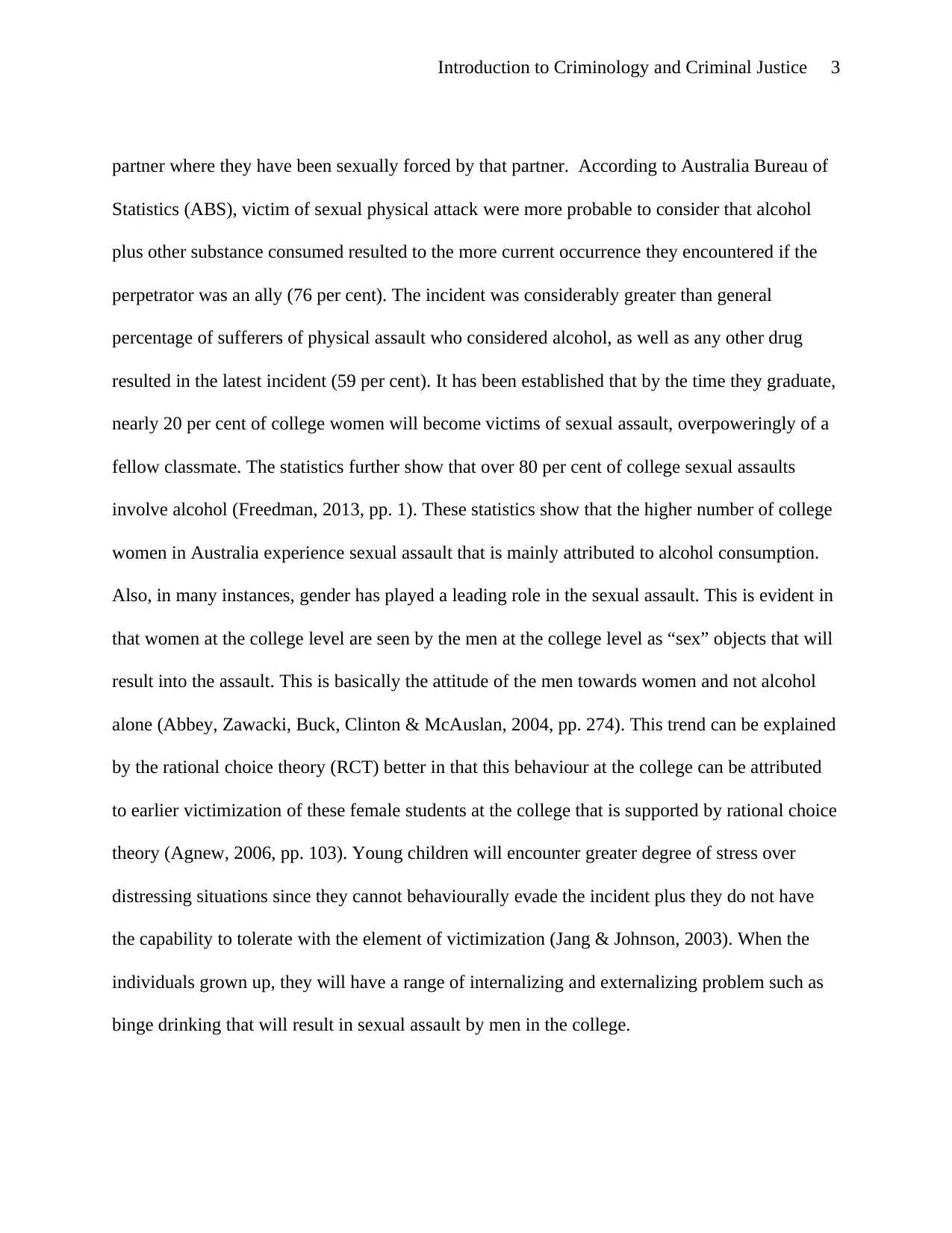
partner where they have been sexually forced by that partner. According to Australia Bureau of
Statistics (ABS), victim of sexual physical attack were more probable to consider that alcohol
plus other substance consumed resulted to the more current occurrence they encountered if the
perpetrator was an ally (76 per cent). The incident was considerably greater than general
percentage of sufferers of physical assault who considered alcohol, as well as any other drug
resulted in the latest incident (59 per cent). It has been established that by the time they graduate,
nearly 20 per cent of college women will become victims of sexual assault, overpoweringly of a
fellow classmate. The statistics further show that over 80 per cent of college sexual assaults
involve alcohol (Freedman, 2013, pp. 1). These statistics show that the higher number of college
women in Australia experience sexual assault that is mainly attributed to alcohol consumption.
Also, in many instances, gender has played a leading role in the sexual assault. This is evident in
that women at the college level are seen by the men at the college level as “sex” objects that will
result into the assault. This is basically the attitude of the men towards women and not alcohol
alone (Abbey, Zawacki, Buck, Clinton & McAuslan, 2004, pp. 274). This trend can be explained
by the rational choice theory (RCT) better in that this behaviour at the college can be attributed
to earlier victimization of these female students at the college that is supported by rational choice
theory (Agnew, 2006, pp. 103). Young children will encounter greater degree of stress over
distressing situations since they cannot behaviourally evade the incident plus they do not have
the capability to tolerate with the element of victimization (Jang & Johnson, 2003). When the
individuals grown up, they will have a range of internalizing and externalizing problem such as
binge drinking that will result in sexual assault by men in the college.
partner where they have been sexually forced by that partner. According to Australia Bureau of
Statistics (ABS), victim of sexual physical attack were more probable to consider that alcohol
plus other substance consumed resulted to the more current occurrence they encountered if the
perpetrator was an ally (76 per cent). The incident was considerably greater than general
percentage of sufferers of physical assault who considered alcohol, as well as any other drug
resulted in the latest incident (59 per cent). It has been established that by the time they graduate,
nearly 20 per cent of college women will become victims of sexual assault, overpoweringly of a
fellow classmate. The statistics further show that over 80 per cent of college sexual assaults
involve alcohol (Freedman, 2013, pp. 1). These statistics show that the higher number of college
women in Australia experience sexual assault that is mainly attributed to alcohol consumption.
Also, in many instances, gender has played a leading role in the sexual assault. This is evident in
that women at the college level are seen by the men at the college level as “sex” objects that will
result into the assault. This is basically the attitude of the men towards women and not alcohol
alone (Abbey, Zawacki, Buck, Clinton & McAuslan, 2004, pp. 274). This trend can be explained
by the rational choice theory (RCT) better in that this behaviour at the college can be attributed
to earlier victimization of these female students at the college that is supported by rational choice
theory (Agnew, 2006, pp. 103). Young children will encounter greater degree of stress over
distressing situations since they cannot behaviourally evade the incident plus they do not have
the capability to tolerate with the element of victimization (Jang & Johnson, 2003). When the
individuals grown up, they will have a range of internalizing and externalizing problem such as
binge drinking that will result in sexual assault by men in the college.
⊘ This is a preview!⊘
Do you want full access?
Subscribe today to unlock all pages.

Trusted by 1+ million students worldwide
Introduction to Criminology and Criminal Justice 4
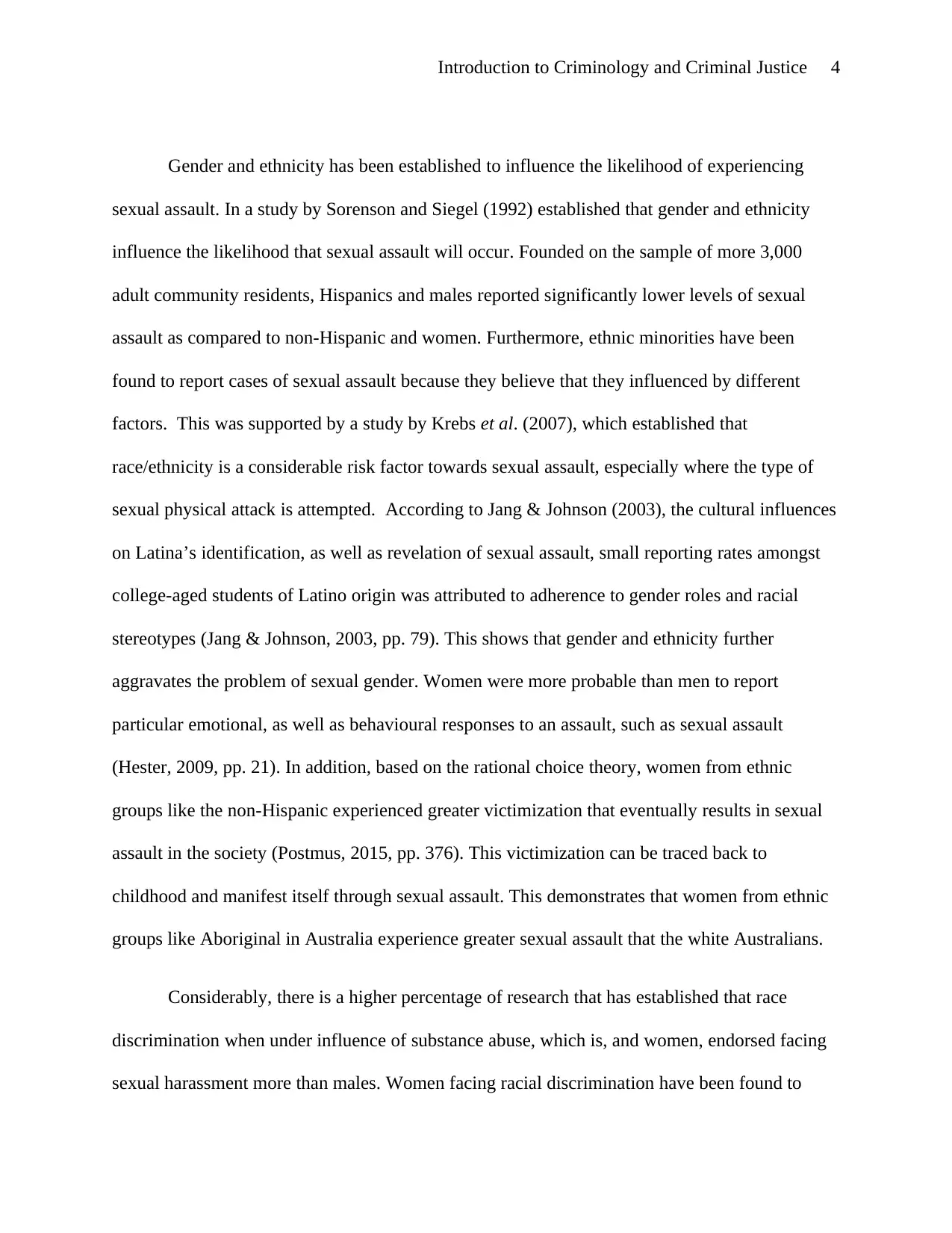
Gender and ethnicity has been established to influence the likelihood of experiencing
sexual assault. In a study by Sorenson and Siegel (1992) established that gender and ethnicity
influence the likelihood that sexual assault will occur. Founded on the sample of more 3,000
adult community residents, Hispanics and males reported significantly lower levels of sexual
assault as compared to non-Hispanic and women. Furthermore, ethnic minorities have been
found to report cases of sexual assault because they believe that they influenced by different
factors. This was supported by a study by Krebs et al. (2007), which established that
race/ethnicity is a considerable risk factor towards sexual assault, especially where the type of
sexual physical attack is attempted. According to Jang & Johnson (2003), the cultural influences
on Latina’s identification, as well as revelation of sexual assault, small reporting rates amongst
college-aged students of Latino origin was attributed to adherence to gender roles and racial
stereotypes (Jang & Johnson, 2003, pp. 79). This shows that gender and ethnicity further
aggravates the problem of sexual gender. Women were more probable than men to report
particular emotional, as well as behavioural responses to an assault, such as sexual assault
(Hester, 2009, pp. 21). In addition, based on the rational choice theory, women from ethnic
groups like the non-Hispanic experienced greater victimization that eventually results in sexual
assault in the society (Postmus, 2015, pp. 376). This victimization can be traced back to
childhood and manifest itself through sexual assault. This demonstrates that women from ethnic
groups like Aboriginal in Australia experience greater sexual assault that the white Australians.
Considerably, there is a higher percentage of research that has established that race
discrimination when under influence of substance abuse, which is, and women, endorsed facing
sexual harassment more than males. Women facing racial discrimination have been found to
Gender and ethnicity has been established to influence the likelihood of experiencing
sexual assault. In a study by Sorenson and Siegel (1992) established that gender and ethnicity
influence the likelihood that sexual assault will occur. Founded on the sample of more 3,000
adult community residents, Hispanics and males reported significantly lower levels of sexual
assault as compared to non-Hispanic and women. Furthermore, ethnic minorities have been
found to report cases of sexual assault because they believe that they influenced by different
factors. This was supported by a study by Krebs et al. (2007), which established that
race/ethnicity is a considerable risk factor towards sexual assault, especially where the type of
sexual physical attack is attempted. According to Jang & Johnson (2003), the cultural influences
on Latina’s identification, as well as revelation of sexual assault, small reporting rates amongst
college-aged students of Latino origin was attributed to adherence to gender roles and racial
stereotypes (Jang & Johnson, 2003, pp. 79). This shows that gender and ethnicity further
aggravates the problem of sexual gender. Women were more probable than men to report
particular emotional, as well as behavioural responses to an assault, such as sexual assault
(Hester, 2009, pp. 21). In addition, based on the rational choice theory, women from ethnic
groups like the non-Hispanic experienced greater victimization that eventually results in sexual
assault in the society (Postmus, 2015, pp. 376). This victimization can be traced back to
childhood and manifest itself through sexual assault. This demonstrates that women from ethnic
groups like Aboriginal in Australia experience greater sexual assault that the white Australians.
Considerably, there is a higher percentage of research that has established that race
discrimination when under influence of substance abuse, which is, and women, endorsed facing
sexual harassment more than males. Women facing racial discrimination have been found to
Paraphrase This Document
Need a fresh take? Get an instant paraphrase of this document with our AI Paraphraser
Introduction to Criminology and Criminal Justice 5
have greater risks of sexual assault as compared to women not facing racial discrimination. This
has been attributed to the race factor where the women are seen are always victimized because of
their status being from minorities that makes them more vulnerable as compared to men. In
addition, women facing discrimination are more likely to abuse substances and alcohol that
makes them a “soft” target for men, where they experience greater incidents of sexual
harassment than non-discriminated women in the society. The rational choice theory individuals
experiencing traumatic events like victimization will response through aggression, which may
seem as the discharge of aggravation at the incident or as a replication of the user. The physical
abuse that the person experienced earlier in life will lead one to indulge in activities that may
result in dangerous events such as sexual harassment (Fagan, 2005, pp. 280). Thus, the alcohol
and substance abuse among the racial discriminated individuals will increase the risk of sexual
victimization where they may date a partner that will eventually result in sexual assault. The use
of substances among the racial minorities influences sexual risk behaviour, decreasing the
perceptions of individual risk that amplifies the chance of sexual assault (Nguyen, Kaysen m&
Dillworth, 2010, pp. 919).
The considerable rise in sexual assault among the youth is associated with the alcohol
consumption. Hazardous and harmful alcohol uses are risk factors for being victimized besides
perpetrating youth violence. Thus, the youth violence takes different forms that include sexual
hostility plus assaults in streets, bars, as well as nightclubs. The alcohol use will significantly
increase the rate of crimes among the youth increasing the likelihood of sexual assault. Many
adolescents have become victims, as well as perpetrators of sexual assault because of the alcohol
consumption where the alcohol affects their “growing” brain. Alcohol affects cognitive along
have greater risks of sexual assault as compared to women not facing racial discrimination. This
has been attributed to the race factor where the women are seen are always victimized because of
their status being from minorities that makes them more vulnerable as compared to men. In
addition, women facing discrimination are more likely to abuse substances and alcohol that
makes them a “soft” target for men, where they experience greater incidents of sexual
harassment than non-discriminated women in the society. The rational choice theory individuals
experiencing traumatic events like victimization will response through aggression, which may
seem as the discharge of aggravation at the incident or as a replication of the user. The physical
abuse that the person experienced earlier in life will lead one to indulge in activities that may
result in dangerous events such as sexual harassment (Fagan, 2005, pp. 280). Thus, the alcohol
and substance abuse among the racial discriminated individuals will increase the risk of sexual
victimization where they may date a partner that will eventually result in sexual assault. The use
of substances among the racial minorities influences sexual risk behaviour, decreasing the
perceptions of individual risk that amplifies the chance of sexual assault (Nguyen, Kaysen m&
Dillworth, 2010, pp. 919).
The considerable rise in sexual assault among the youth is associated with the alcohol
consumption. Hazardous and harmful alcohol uses are risk factors for being victimized besides
perpetrating youth violence. Thus, the youth violence takes different forms that include sexual
hostility plus assaults in streets, bars, as well as nightclubs. The alcohol use will significantly
increase the rate of crimes among the youth increasing the likelihood of sexual assault. Many
adolescents have become victims, as well as perpetrators of sexual assault because of the alcohol
consumption where the alcohol affects their “growing” brain. Alcohol affects cognitive along
Introduction to Criminology and Criminal Justice 6
with physical functions that increases the threat of sexual assault. Thus, hazardous alcohol
consumption among the adolescents has been linked to increased cases of sexual assault where
intimate relationships and alcohol use result in these assaults (Howard, Qiu & Boekeloo, 2003,
pp. 11).
In conclusion, it is evident that alcohol consumption is significantly associated to sexual
assault and harassment, especially among college students. Women in colleges have been the
primary victims of sexual assault because the environment predisposes them to these assaults.
Gender and ethnicity has also become protagonist factors that results in sexual assault cases.
Youth has become victims besides perpetrators of sexual assault because of the use of alcohol.
Race is also another aspect that contributes to the growing degree of sexual assault in the society
because of victimization founded on the rational choice theory (Agnew, 2006, pp. 106).
Therefore, this discussion supports the thesis of the paper that there is a noteworthy association
between sexual harassment with alcohol, moreover race, as well as gender plays a huge
protagonist.
with physical functions that increases the threat of sexual assault. Thus, hazardous alcohol
consumption among the adolescents has been linked to increased cases of sexual assault where
intimate relationships and alcohol use result in these assaults (Howard, Qiu & Boekeloo, 2003,
pp. 11).
In conclusion, it is evident that alcohol consumption is significantly associated to sexual
assault and harassment, especially among college students. Women in colleges have been the
primary victims of sexual assault because the environment predisposes them to these assaults.
Gender and ethnicity has also become protagonist factors that results in sexual assault cases.
Youth has become victims besides perpetrators of sexual assault because of the use of alcohol.
Race is also another aspect that contributes to the growing degree of sexual assault in the society
because of victimization founded on the rational choice theory (Agnew, 2006, pp. 106).
Therefore, this discussion supports the thesis of the paper that there is a noteworthy association
between sexual harassment with alcohol, moreover race, as well as gender plays a huge
protagonist.
⊘ This is a preview!⊘
Do you want full access?
Subscribe today to unlock all pages.
Trusted by 1+ million students worldwide
Introduction to Criminology and Criminal Justice 7
References
Abbey, A., Zawacki ,T., Buck, P.O., Clinton, A.M. & McAuslan, P. (2004). Sexual assault and
alcohol consumption: what do we know about their relationship and what types of research are
still needed? Aggress Violent Behav. 9(3): 271-303.
Agnew, R. (2006). General strain theory: Current status and directions for further research. In
Cullen, Wright, & Blevins (Eds.), Taking stock: The status of criminological theory. (Vol. 15,
pp. 101-126). New Brunswick, NJ: Transaction.
Fagan, A.A. (2005). The relationship between adolescent physical abuse and criminal offending:
Support for an enduring and generalized cycle of violence. Journal of Family Violence,
20(2), 279-290.
Freedman, M. (2013). This isn't victim-blaming. This is common sense. Mamamia. [Accessed
23.10.2010].
Hester. M. (2009). Who Does What to Whom? Gender and Domestic Violence Perpetrators.
Bristol: University of Bristol in association with the Northern Rock Foundation.
Hingson, R.W. (2010). Magnitude and prevention of college drinking and related problems.
Alcohol Research & Health. 33(4):45–54.
Howard, D.E., Qiu, Y. & Boekeloo, B. (2003). Personal and social contextual correlates of
adolescent dating violence. J Adolesc Hlth. 33(5):9–17.
Jang, S.J., & Johnson, B.R. (2003). Strain, negative emotions, and deviant coping among African
Americans: A test of general strain theory. Journal of Quantitative Criminology, 19(2), 79-105.
References
Abbey, A., Zawacki ,T., Buck, P.O., Clinton, A.M. & McAuslan, P. (2004). Sexual assault and
alcohol consumption: what do we know about their relationship and what types of research are
still needed? Aggress Violent Behav. 9(3): 271-303.
Agnew, R. (2006). General strain theory: Current status and directions for further research. In
Cullen, Wright, & Blevins (Eds.), Taking stock: The status of criminological theory. (Vol. 15,
pp. 101-126). New Brunswick, NJ: Transaction.
Fagan, A.A. (2005). The relationship between adolescent physical abuse and criminal offending:
Support for an enduring and generalized cycle of violence. Journal of Family Violence,
20(2), 279-290.
Freedman, M. (2013). This isn't victim-blaming. This is common sense. Mamamia. [Accessed
23.10.2010].
Hester. M. (2009). Who Does What to Whom? Gender and Domestic Violence Perpetrators.
Bristol: University of Bristol in association with the Northern Rock Foundation.
Hingson, R.W. (2010). Magnitude and prevention of college drinking and related problems.
Alcohol Research & Health. 33(4):45–54.
Howard, D.E., Qiu, Y. & Boekeloo, B. (2003). Personal and social contextual correlates of
adolescent dating violence. J Adolesc Hlth. 33(5):9–17.
Jang, S.J., & Johnson, B.R. (2003). Strain, negative emotions, and deviant coping among African
Americans: A test of general strain theory. Journal of Quantitative Criminology, 19(2), 79-105.
Paraphrase This Document
Need a fresh take? Get an instant paraphrase of this document with our AI Paraphraser
Introduction to Criminology and Criminal Justice 8
Krebs, C. P., Lindquist, C.H., Warner, T., Fisher, B.S & Martin, S.L. (2009). College women's
experiences with physically forced, alcohol - or other drug-enabled, and drug-facilitated sexual
assault before and since entering college. Journal of American College Health. 57 (6): 639–647.
Nguyen, H.V., Kaysen, D. & Dillworth, T.M. (2010). Incapacitated Rape and Alcohol Use in
White and Asian American College Women. Violence against Women. 2010;16:919–33.
Postmus, J.L. (2015). Women From Different Ethnic Groups and Their Experiences With
Victimization and Seeking Help. Violence Against Women. 21(3); 376.
Krebs, C. P., Lindquist, C.H., Warner, T., Fisher, B.S & Martin, S.L. (2009). College women's
experiences with physically forced, alcohol - or other drug-enabled, and drug-facilitated sexual
assault before and since entering college. Journal of American College Health. 57 (6): 639–647.
Nguyen, H.V., Kaysen, D. & Dillworth, T.M. (2010). Incapacitated Rape and Alcohol Use in
White and Asian American College Women. Violence against Women. 2010;16:919–33.
Postmus, J.L. (2015). Women From Different Ethnic Groups and Their Experiences With
Victimization and Seeking Help. Violence Against Women. 21(3); 376.

1 out of 8


Your All-in-One AI-Powered Toolkit for Academic Success.
+13062052269
info@desklib.com
Available 24*7 on WhatsApp / Email
![[object Object]](/_next/static/media/star-bottom.7253800d.svg)
Unlock your academic potential
Copyright © 2020–2026 A2Z Services. All Rights Reserved. Developed and managed by ZUCOL.