Commercial Law Case Study: Aldi's Negligence and Customer Injury Claim

Verified

Added on  2022/11/11

|8
|1550
|138
Case Study
AI Summary
This case study analyzes a commercial law scenario involving Aldi's potential liability for negligence. The assignment examines the elements of negligence, including duty of care, breach of duty, causation, and remoteness of damages, using the case of Tamara, a customer injured in an Aldi supermarket, as the focal point. The analysis applies legal principles established in cases like Donoghue v Stevenson, Paris v Stepney Borough Council, and The Wagon Mound No 1. It explores whether Aldi owed a duty of care, breached that duty, and whether the resulting injuries were foreseeable. Furthermore, the study assesses potential legal defenses for Aldi, such as contributory negligence and voluntary assumption of risk, examining how these defenses could impact the outcome of a negligence claim. The conclusion addresses the likelihood of success for Tamara's claim, considering the application of the law to the facts presented.
Document Page
0
Commercial Law
tabler-icon-diamond-filled.svg

Paraphrase This Document

Need a fresh take? Get an instant paraphrase of this document with our AI Paraphraser
Document Page
1
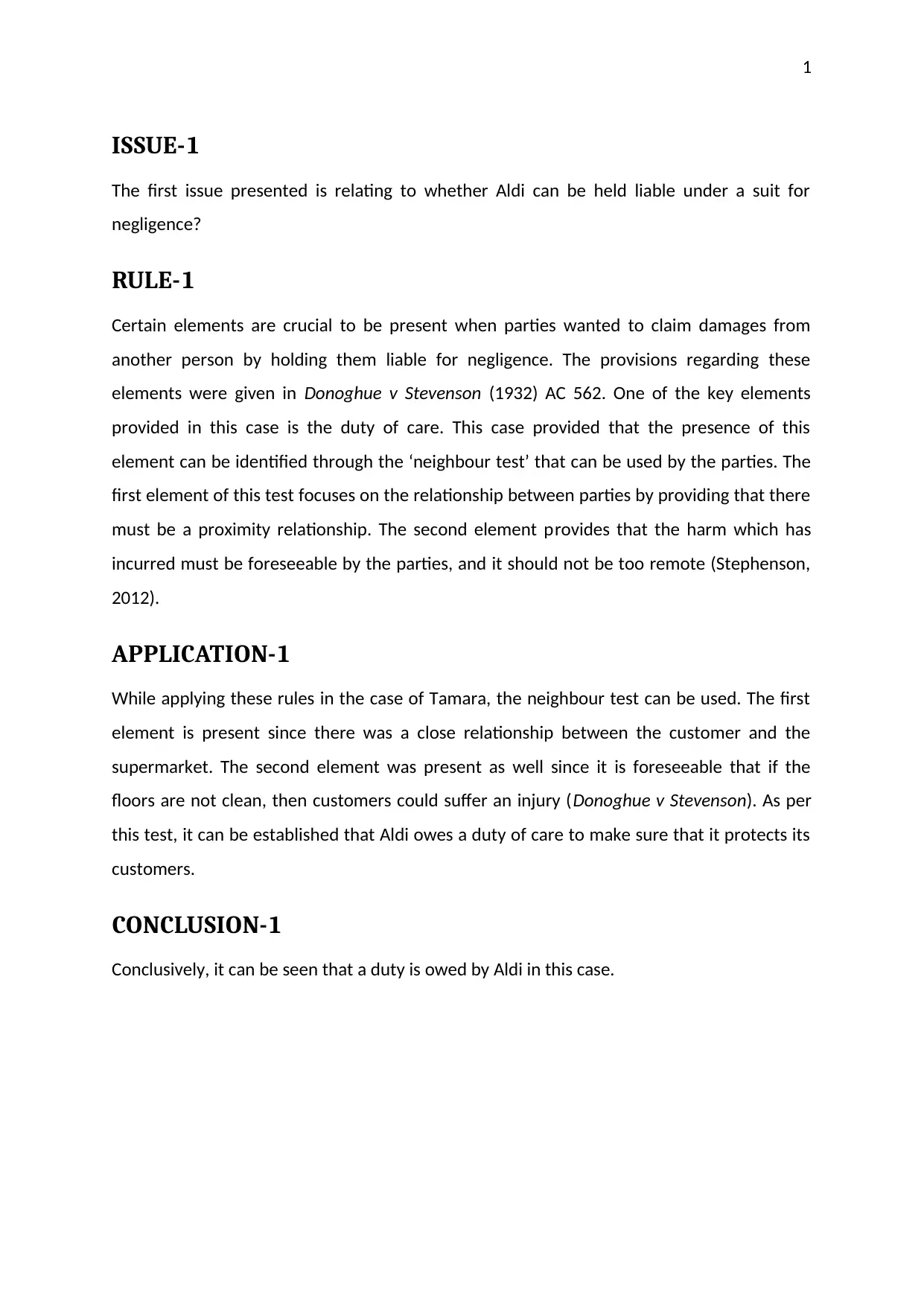
ISSUE-1
The first issue presented is relating to whether Aldi can be held liable under a suit for
negligence?
RULE-1
Certain elements are crucial to be present when parties wanted to claim damages from
another person by holding them liable for negligence. The provisions regarding these
elements were given in Donoghue v Stevenson (1932) AC 562. One of the key elements
provided in this case is the duty of care. This case provided that the presence of this
element can be identified through the ‘neighbour test’ that can be used by the parties. The
first element of this test focuses on the relationship between parties by providing that there
must be a proximity relationship. The second element provides that the harm which has
incurred must be foreseeable by the parties, and it should not be too remote (Stephenson,
2012).
APPLICATION-1
While applying these rules in the case of Tamara, the neighbour test can be used. The first
element is present since there was a close relationship between the customer and the
supermarket. The second element was present as well since it is foreseeable that if the
floors are not clean, then customers could suffer an injury (Donoghue v Stevenson). As per
this test, it can be established that Aldi owes a duty of care to make sure that it protects its
customers.
CONCLUSION-1
Conclusively, it can be seen that a duty is owed by Aldi in this case.
Document Page
2
ISSUE-2
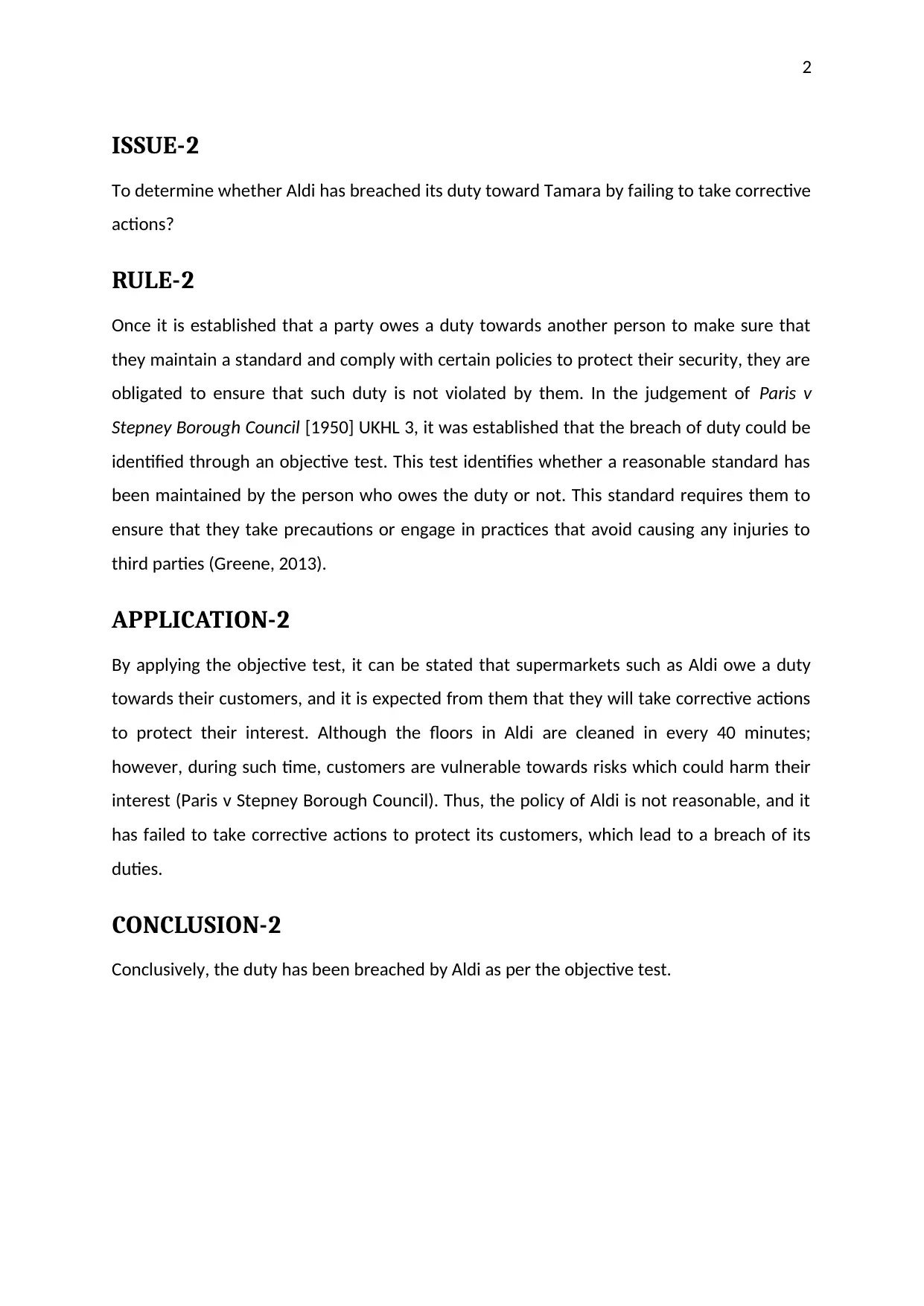
To determine whether Aldi has breached its duty toward Tamara by failing to take corrective
actions?
RULE-2
Once it is established that a party owes a duty towards another person to make sure that
they maintain a standard and comply with certain policies to protect their security, they are
obligated to ensure that such duty is not violated by them. In the judgement of Paris v
Stepney Borough Council [1950] UKHL 3, it was established that the breach of duty could be
identified through an objective test. This test identifies whether a reasonable standard has
been maintained by the person who owes the duty or not. This standard requires them to
ensure that they take precautions or engage in practices that avoid causing any injuries to
third parties (Greene, 2013).
APPLICATION-2
By applying the objective test, it can be stated that supermarkets such as Aldi owe a duty
towards their customers, and it is expected from them that they will take corrective actions
to protect their interest. Although the floors in Aldi are cleaned in every 40 minutes;
however, during such time, customers are vulnerable towards risks which could harm their
interest (Paris v Stepney Borough Council). Thus, the policy of Aldi is not reasonable, and it
has failed to take corrective actions to protect its customers, which lead to a breach of its
duties.
CONCLUSION-2
Conclusively, the duty has been breached by Aldi as per the objective test.
Document Page
3
ISSUE-3
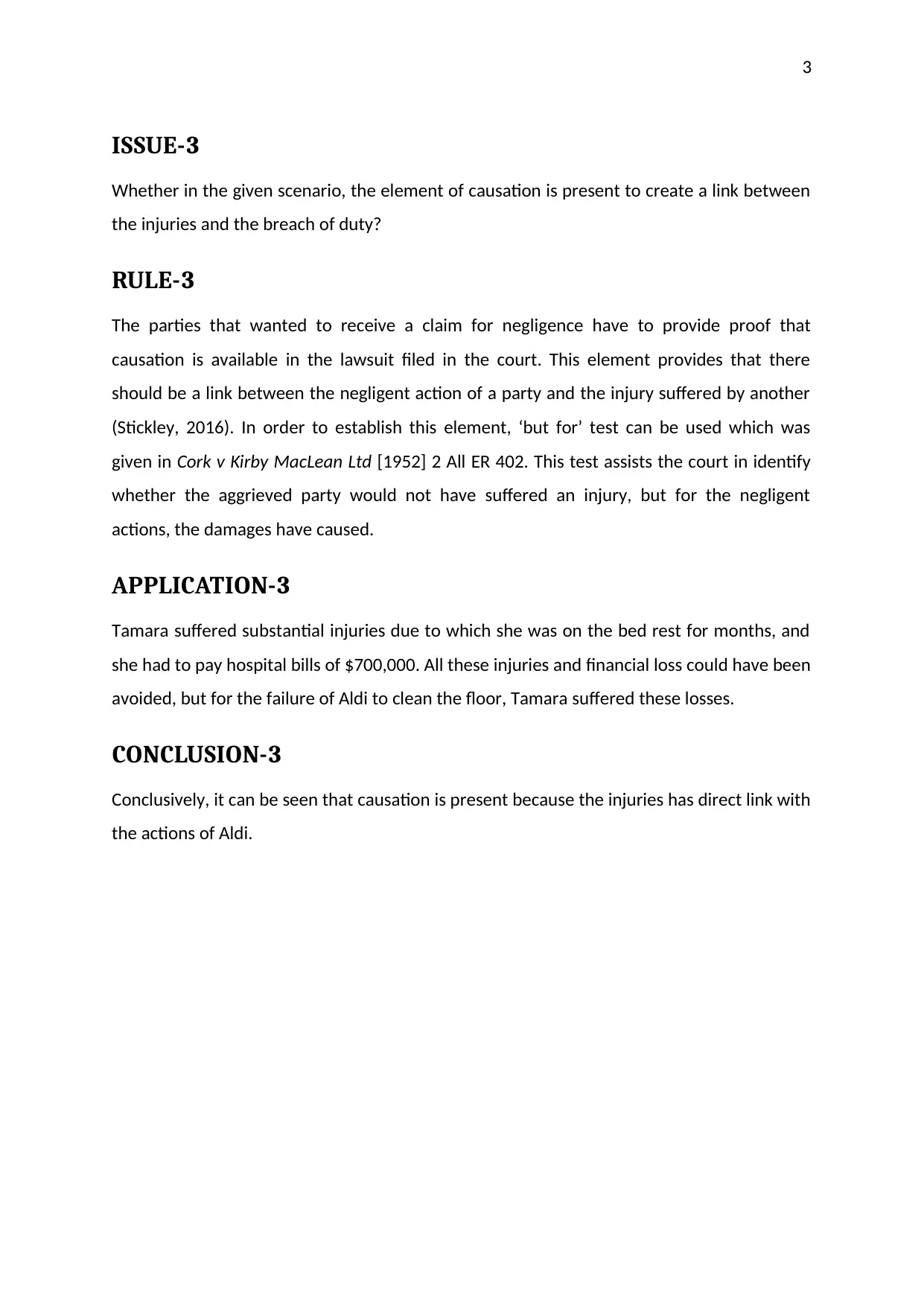
Whether in the given scenario, the element of causation is present to create a link between
the injuries and the breach of duty?
RULE-3
The parties that wanted to receive a claim for negligence have to provide proof that
causation is available in the lawsuit filed in the court. This element provides that there
should be a link between the negligent action of a party and the injury suffered by another
(Stickley, 2016). In order to establish this element, ‘but for’ test can be used which was
given in Cork v Kirby MacLean Ltd [1952] 2 All ER 402. This test assists the court in identify
whether the aggrieved party would not have suffered an injury, but for the negligent
actions, the damages have caused.
APPLICATION-3
Tamara suffered substantial injuries due to which she was on the bed rest for months, and
she had to pay hospital bills of $700,000. All these injuries and financial loss could have been
avoided, but for the failure of Aldi to clean the floor, Tamara suffered these losses.
CONCLUSION-3
Conclusively, it can be seen that causation is present because the injuries has direct link with
the actions of Aldi.
tabler-icon-diamond-filled.svg

Paraphrase This Document

Need a fresh take? Get an instant paraphrase of this document with our AI Paraphraser
Document Page
4
ISSUE-4
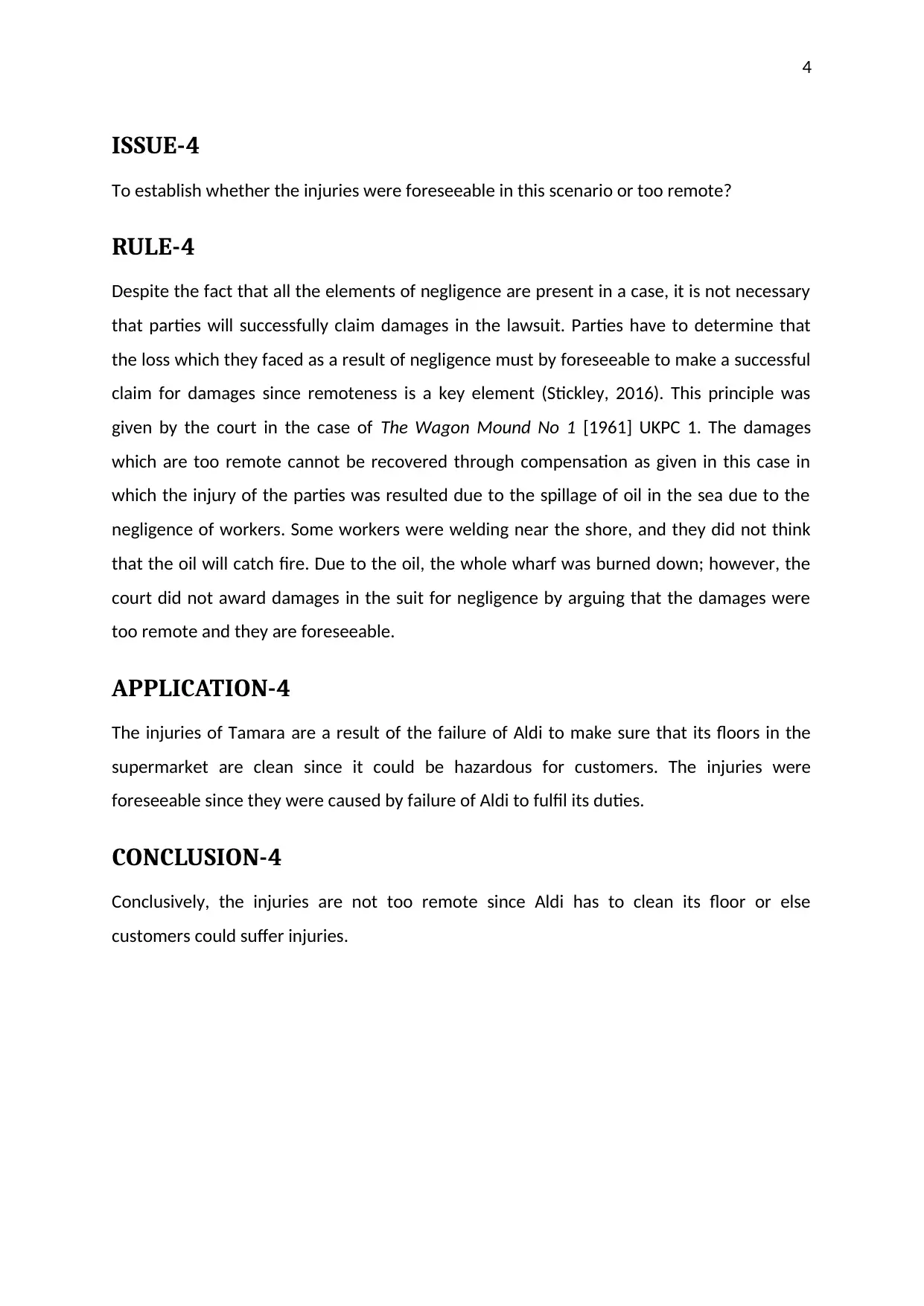
To establish whether the injuries were foreseeable in this scenario or too remote?
RULE-4
Despite the fact that all the elements of negligence are present in a case, it is not necessary
that parties will successfully claim damages in the lawsuit. Parties have to determine that
the loss which they faced as a result of negligence must by foreseeable to make a successful
claim for damages since remoteness is a key element (Stickley, 2016). This principle was
given by the court in the case of The Wagon Mound No 1 [1961] UKPC 1. The damages
which are too remote cannot be recovered through compensation as given in this case in
which the injury of the parties was resulted due to the spillage of oil in the sea due to the
negligence of workers. Some workers were welding near the shore, and they did not think
that the oil will catch fire. Due to the oil, the whole wharf was burned down; however, the
court did not award damages in the suit for negligence by arguing that the damages were
too remote and they are foreseeable.
APPLICATION-4
The injuries of Tamara are a result of the failure of Aldi to make sure that its floors in the
supermarket are clean since it could be hazardous for customers. The injuries were
foreseeable since they were caused by failure of Aldi to fulfil its duties.
CONCLUSION-4
Conclusively, the injuries are not too remote since Aldi has to clean its floor or else
customers could suffer injuries.
Document Page
5
ISSUE-5
To determine whether Aldi can make a claim for contributory negligence to reduce
damages?
RULE-5
While facing a suit for negligence, the defendant has the right to reduce their damages
through contributory negligence. This is a relevant defence which provides that if the
aggrieved party failed to take action in order to protect him, then they contribute in the
negligence and the amount of damages reduced to a certain extent by the court as given in
Imbree v McNeilly [2008] HCA 40. Certain elements must be present to apply this defence,
which includes not maintaining proper care by the aggrieved party and the contribution of
their actions in the injury (Greene, 2013).
APPLICATION-5
When Tamara went to the supermarket for purchasing the chocolate, it was raining outside.
However, she still ran towards the chocolate in a careless manner to purchase it. These
factors show that she has failed to take proper care, and her actions contributed to the
injury.
CONCLUSION-5
Conclusively, the elements of the defence are available based on which the amount of
damages can be reduced by on the contribution of Tamara.
Document Page
6
ISSUE-6
To determine whether Aldi can claim voluntary assumption of risk to completely remove its
liability?
RULE-6
Parties can completely remove their liabilities in a suit for negligence in case the aggrieved
parties agree to accept the risks involved in a particular scenario or act in such case they
lose their right to make a claim for damages under a suit of negligence when they suffered
injuries due to such act. In Wooldridge v Summer & Anor (1963) 2 QB 43 held that certain
elements must be present. It is important that aggrieved party must give his/her concept by
forming an agreement in which they must give their express consent to accept the risks. The
party that is giving his/her permission must be aware regarding the extent and nature of the
risks involved in the particular scenario.
APPLICATION-6
Tamara did not give her express permission to Aldi, and no agreement was formed between
the parties in order to give their acceptance to the risks. She was not aware of the extent
and nature of the risk as well.
CONCLUSION-6
Conclusively, this defence cannot be used by Aldi to eliminate its liability.
tabler-icon-diamond-filled.svg

Paraphrase This Document

Need a fresh take? Get an instant paraphrase of this document with our AI Paraphraser
Document Page
7
REFERENCES
Cork v Kirby MacLean Ltd [1952] 2 All ER 402
Donoghue v Stevenson (1932) AC 562
Greene, B. (2013) Course Notes: Tort Law. Abingdon: Routledge.
Imbree v McNeilly [2008] HCA 40
Paris v Stepney Borough Council [1950] UKHL 3
Stephenson, G. (2012) Sourcebook on Tort Law 2/e. Abingdon: Routledge.
Stickley, A.P. (2016) Australian torts law. New York: LexisNexis Butterworths.
The Wagon Mound No 1 [1961] UKPC 1
Wooldridge v Summer & Anor (1963) 2 QB 43
chevron_up_icon
1 out of 8
circle_padding
hide_on_mobile
zoom_out_icon
[object Object]