Financial Crime and Risk Management: A Strategic Plan for Aldi
VerifiedAdded on 2020/05/28
|18
|5885
|52
Report
AI Summary
This report presents a comprehensive strategic plan for Aldi to address financial crime and risk management. It begins by outlining the current state of financial crime in Australia, highlighting the rising incidents and costs associated with fraud, emphasizing the need for robust strategies. The report then details Aldi's approach, aligning with the AS 8001-2008 standard, and focuses on prevention, detection, and response strategies. The prevention plan includes risk assessment, integrity structure maintenance, governance arrangements, management commitment, ethical structure, accountability, internal controls, employee awareness, and community awareness. The detection plan emphasizes the use of varied data sources, data cleaning, ontology systems, real-time transaction monitoring, customer profiling, and link analysis. The response strategy focuses on risk exposure, operating models, and infrastructure. The report provides detailed steps for each strategy, incorporating automated approaches and proactive measures to mitigate financial crime risks and ensure compliance.
Running head: FINANCIAL CRIME AND RISK MANAGEMENT
FINANCIAL CRIME AND RISK MANGEMENT
Name of the Student:
Name of the University:
Author’s Note:
FINANCIAL CRIME AND RISK MANGEMENT
Name of the Student:
Name of the University:
Author’s Note:

Paraphrase This Document
Need a fresh take? Get an instant paraphrase of this document with our AI Paraphraser
1FINANCIAL CRIME AND RISK MANAGEMENT
Strategic Plan for the organization Aldi to deal with financial crime
The problems of financial crime can be considered to be a popular and at the same time
widespread issue that influences brand vaue as well as reputation, company’s goodwill
together with revenue of corporations. Several studies as well as surveys of financial crime
within the Australian nation reveals the fact that costs of fraud is no less than $3 billion every
year.,
Current State of Affairs of financial crime in Australia
Essentially, as mentioned in AS 8001-2008, the fraud incidents particularly within the
Australian economy is rising year after year with approximately 63% of the Australian
nations experiencing financial crime (Gottschalk, 2016). Reports also suggest that the larger
the size of the corporation, the higher is the probability to suffer from financial crime at
certain point in the business cycle (Deloitte.com, 2018). Results of survey also indicate that
Australian corporations might suffer a greater rate of reported fraud than the worldwide
average. Research in this area suggest that primary source of fraudulent actions stem from
within the business concern in which internal factors stand for 75% of the events as well as
value of loss suffered. Several Australian corporations are therefore not properly prepared to
identify and avert financial crime (Leong, 2016).
Key observations:
There is need to appropriately handle financial crime holistically and recognized certain
issues that are vital to the process of formulation of financial crime strategy:
Increase in the regulatory necessities from regional, transnational as well as local
stakeholders. Increase in need for an analytical comprehension of financial crime can be
observed(Masciandaro, 2017). Intricacy is present in the process of implementation as well as
on-going administration of financial crime evaluation and reporting is all the time becoming
major concern for corporations. Again, technology is an important key in the process of
focussing probable areas of risk and permits them to be more concentrated or else targeted in
their endeavours to avert financial crime (Wilson, 2017). Approaches of corporations in
Australia to handle financial crime is constantly altering and transforming to handle newly
identified issues (Pratt & Peters, 2017).
Fraud and financial crime management strategy
Strategic Plan for the organization Aldi to deal with financial crime
The problems of financial crime can be considered to be a popular and at the same time
widespread issue that influences brand vaue as well as reputation, company’s goodwill
together with revenue of corporations. Several studies as well as surveys of financial crime
within the Australian nation reveals the fact that costs of fraud is no less than $3 billion every
year.,
Current State of Affairs of financial crime in Australia
Essentially, as mentioned in AS 8001-2008, the fraud incidents particularly within the
Australian economy is rising year after year with approximately 63% of the Australian
nations experiencing financial crime (Gottschalk, 2016). Reports also suggest that the larger
the size of the corporation, the higher is the probability to suffer from financial crime at
certain point in the business cycle (Deloitte.com, 2018). Results of survey also indicate that
Australian corporations might suffer a greater rate of reported fraud than the worldwide
average. Research in this area suggest that primary source of fraudulent actions stem from
within the business concern in which internal factors stand for 75% of the events as well as
value of loss suffered. Several Australian corporations are therefore not properly prepared to
identify and avert financial crime (Leong, 2016).
Key observations:
There is need to appropriately handle financial crime holistically and recognized certain
issues that are vital to the process of formulation of financial crime strategy:
Increase in the regulatory necessities from regional, transnational as well as local
stakeholders. Increase in need for an analytical comprehension of financial crime can be
observed(Masciandaro, 2017). Intricacy is present in the process of implementation as well as
on-going administration of financial crime evaluation and reporting is all the time becoming
major concern for corporations. Again, technology is an important key in the process of
focussing probable areas of risk and permits them to be more concentrated or else targeted in
their endeavours to avert financial crime (Wilson, 2017). Approaches of corporations in
Australia to handle financial crime is constantly altering and transforming to handle newly
identified issues (Pratt & Peters, 2017).
Fraud and financial crime management strategy
2FINANCIAL CRIME AND RISK MANAGEMENT
Aldi, a leading worldwide supermarket chain is necessarily subject to mandatory regulations
of both financial as well as risk management (Gregson & Crang, 2017). In essence, the
Standards Australia AS 8001-2008 (Fraud and Corruption Control Standard) can be
considered to be practice resource that the corporation can adopt for development of robust
tactic to avert financial crime (Wilson, 2014).
Strategies for fraud development of financial crime combating plan comprises of :
Prevention
The strategy is to develop proactive emasures for lessening the fraud risk and corruption
occurring in the first place (Brody et al., 2016).
Detection
The strategy involves formulation of measures categorically designed to unearth incidents of
financial crime at the time when they take place
Aldi, a leading worldwide supermarket chain is necessarily subject to mandatory regulations
of both financial as well as risk management (Gregson & Crang, 2017). In essence, the
Standards Australia AS 8001-2008 (Fraud and Corruption Control Standard) can be
considered to be practice resource that the corporation can adopt for development of robust
tactic to avert financial crime (Wilson, 2014).
Strategies for fraud development of financial crime combating plan comprises of :
Prevention
The strategy is to develop proactive emasures for lessening the fraud risk and corruption
occurring in the first place (Brody et al., 2016).
Detection
The strategy involves formulation of measures categorically designed to unearth incidents of
financial crime at the time when they take place
⊘ This is a preview!⊘
Do you want full access?
Subscribe today to unlock all pages.

Trusted by 1+ million students worldwide
3FINANCIAL CRIME AND RISK MANAGEMENT
Response
The specific stratagem includes development of measures that can be designed for the
purpose of divising corrective actions as well as remedies for the caused harm occurring
owing to financial crime or fraud (Kuhlmann et al., 2016).
Detailed presentation of prevention plan:
Approach of the corporation Aldi to handle the risks of financial crime have the need to be
underpinned by a complete organuzational policy structure, with suitable benchmarks that are
instituted against best practice programs as well as standards (Gottschalk, 2014). The
strategic plan for combating financial crime that can be adopted by Aldi can be described as
follows:
Stage 1: Assessment of risk of financial crime:
Consideration need to be given to the overall size as well as functionalities of the corporation
Aldi, any alteration in the overall framework otherwise function, both internal as well as
external risks of fraud, new as well we emerging fraud risks (Holtfreter, 2015). In addition to
this, it is also important to take into account wider organizational operating environment risks
for the purpose of development of profile of financial crime risk. As per regulations of AS
8001-2008, the approach to controlling fraud is in line with the objective of the regulation
(Merkel et al., 2016).
Stage 2: Execution and maintenance of integrity structure
The company have the need to adopt corruption prevention principles for the the purpose of
forming an important part of corporate, functional planning procedures as well as strategic
procedures, both yearly and long term basis (Deloitte.com, 2018). Corruption prevention
principles can be adopted for project planning, business procedures and processes of review
of services. In addition to this, management of the firm Aldi can carry out independent
reviews of different operations and efficacy of systems of internal control for making certain
adequate prevention, deterrence as well as detection of major financial crime (Stowell et al.,
2017).
Stage 3: Development of governance arrangements for controlling financial crime
Response
The specific stratagem includes development of measures that can be designed for the
purpose of divising corrective actions as well as remedies for the caused harm occurring
owing to financial crime or fraud (Kuhlmann et al., 2016).
Detailed presentation of prevention plan:
Approach of the corporation Aldi to handle the risks of financial crime have the need to be
underpinned by a complete organuzational policy structure, with suitable benchmarks that are
instituted against best practice programs as well as standards (Gottschalk, 2014). The
strategic plan for combating financial crime that can be adopted by Aldi can be described as
follows:
Stage 1: Assessment of risk of financial crime:
Consideration need to be given to the overall size as well as functionalities of the corporation
Aldi, any alteration in the overall framework otherwise function, both internal as well as
external risks of fraud, new as well we emerging fraud risks (Holtfreter, 2015). In addition to
this, it is also important to take into account wider organizational operating environment risks
for the purpose of development of profile of financial crime risk. As per regulations of AS
8001-2008, the approach to controlling fraud is in line with the objective of the regulation
(Merkel et al., 2016).
Stage 2: Execution and maintenance of integrity structure
The company have the need to adopt corruption prevention principles for the the purpose of
forming an important part of corporate, functional planning procedures as well as strategic
procedures, both yearly and long term basis (Deloitte.com, 2018). Corruption prevention
principles can be adopted for project planning, business procedures and processes of review
of services. In addition to this, management of the firm Aldi can carry out independent
reviews of different operations and efficacy of systems of internal control for making certain
adequate prevention, deterrence as well as detection of major financial crime (Stowell et al.,
2017).
Stage 3: Development of governance arrangements for controlling financial crime
Paraphrase This Document
Need a fresh take? Get an instant paraphrase of this document with our AI Paraphraser
4FINANCIAL CRIME AND RISK MANAGEMENT
A particular member of the manmagement can be considered to be the important point of
contact for financial crime control policies within the firm. This policy can help in
communicating the commitment of the corporation to specifically fraud as well as control of
corruption.
Stage 4: Commitment of management to control the risk of financial crime
Fundamentally, ethics, financial crime prevention objectives need to be included in the
measures of performamce against which cokmpany’s managers can be appraised (Kim et al.,
2014).
Stage 5: Development of ethical structure
An ethical code of conduct can be designed that can act as a standard that employees need to
be meet.
Stage 6: Development of accountability of line management
Individuals in high risk positions, namely procurement of raw materials, receipt of revenue,
delivering exemptions or else having discretionary decision making authority need to be
properly trained, monitored and supported (Chambers-Jones & Hillman, 2014).
Stage 7: Establishment of internal controls
The prevention plan can also include uses of internal audit for the purpose of actively
assessing system of risk management as well as control, and arranging the same in a line that
matches with the risk profile of the firm. The organization can prevent the financial crime by
way of systematically monitoring and reporting different efficacies of fraud control
stratagems and present clearly documented processes for carrying out high risk actions.
Stage 8: Creation of awareness among employees
In order to prevent financial crime in the future period, the management of Aldi can provide
awareness training to employees regarding financial crime in order to ensure that they are
capable to undertake proper actions (Ryder, 2014).
Stage 9: Generation of awareness among client as well as community
The customers of the firm Aldi as well as the community need to be made aware regarding
the fact that business concerns shall not tolerate fraudulent actions and financial crimes
A particular member of the manmagement can be considered to be the important point of
contact for financial crime control policies within the firm. This policy can help in
communicating the commitment of the corporation to specifically fraud as well as control of
corruption.
Stage 4: Commitment of management to control the risk of financial crime
Fundamentally, ethics, financial crime prevention objectives need to be included in the
measures of performamce against which cokmpany’s managers can be appraised (Kim et al.,
2014).
Stage 5: Development of ethical structure
An ethical code of conduct can be designed that can act as a standard that employees need to
be meet.
Stage 6: Development of accountability of line management
Individuals in high risk positions, namely procurement of raw materials, receipt of revenue,
delivering exemptions or else having discretionary decision making authority need to be
properly trained, monitored and supported (Chambers-Jones & Hillman, 2014).
Stage 7: Establishment of internal controls
The prevention plan can also include uses of internal audit for the purpose of actively
assessing system of risk management as well as control, and arranging the same in a line that
matches with the risk profile of the firm. The organization can prevent the financial crime by
way of systematically monitoring and reporting different efficacies of fraud control
stratagems and present clearly documented processes for carrying out high risk actions.
Stage 8: Creation of awareness among employees
In order to prevent financial crime in the future period, the management of Aldi can provide
awareness training to employees regarding financial crime in order to ensure that they are
capable to undertake proper actions (Ryder, 2014).
Stage 9: Generation of awareness among client as well as community
The customers of the firm Aldi as well as the community need to be made aware regarding
the fact that business concerns shall not tolerate fraudulent actions and financial crimes
5FINANCIAL CRIME AND RISK MANAGEMENT
Stage 10: Development of avenues for the purpose of reporting diverse suspected events
A wide range of internal as well as external mechanisms of reporting can be instituted for the
purpose of reporting financial crime (Rahman & Rahman, 2016).
Stage 11: Providing protection for specific disclosures
Specific mechanisms, strategies as well as procedures for the purpose of supporting and at the
same time shielding disclosures can be instituted as per the obligations of the Protected
Disclosures Act of the year 2012. As such, stringent system of maintaining confidentiality is
important for receiving and at the same time processing of declarations of financial crime.
Stage 10: Development of avenues for the purpose of reporting diverse suspected events
A wide range of internal as well as external mechanisms of reporting can be instituted for the
purpose of reporting financial crime (Rahman & Rahman, 2016).
Stage 11: Providing protection for specific disclosures
Specific mechanisms, strategies as well as procedures for the purpose of supporting and at the
same time shielding disclosures can be instituted as per the obligations of the Protected
Disclosures Act of the year 2012. As such, stringent system of maintaining confidentiality is
important for receiving and at the same time processing of declarations of financial crime.
⊘ This is a preview!⊘
Do you want full access?
Subscribe today to unlock all pages.
Trusted by 1+ million students worldwide
6FINANCIAL CRIME AND RISK MANAGEMENT
Detailed presentation of detection plan
This essentially includes establishment of monitoring activities that refers to fraud and social
network analysis. As such, automated approaches can be used for detection of financial
crime.
Steps in strategic plan for detection of financial crime
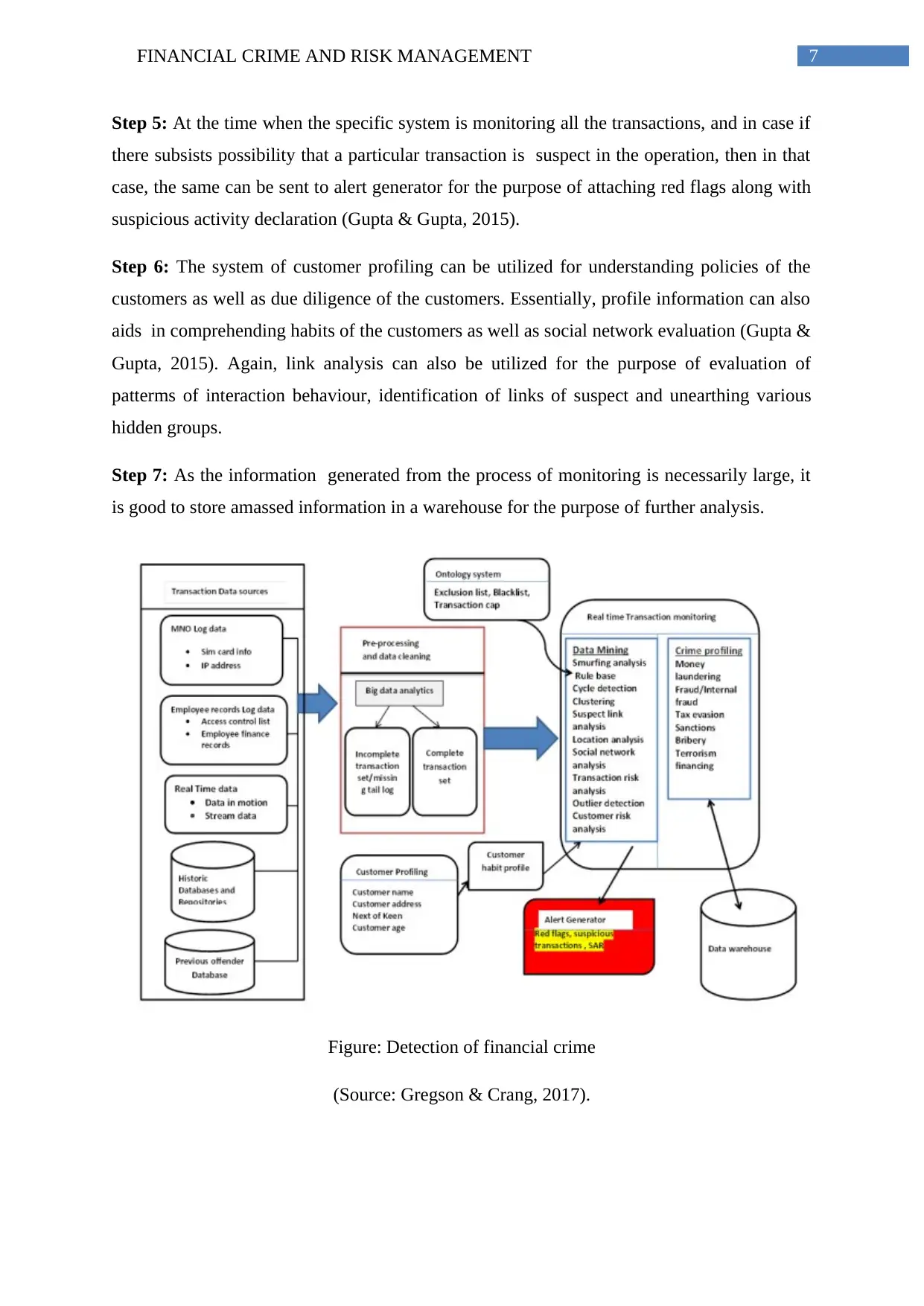
Step 1: Varied sources of information can be used for processing of data. The management of
the company can analyse the transaction data sources namely MNO log data, employee
records log data, real time data, historic databases and prior offender databases (Holtfreter,
2015).
Step 2: Transaction data that are in action need to be subjected to data cleaning in which
successful and failed transactions need to be cleaned for the purpose of processing. Data
amassed have the need to be cleaned for reviewing incomplete transactions. As such,
management of the Aldi can implement big data tools of analytics as the data might perhaps
be in motion and data might be huge. However, complete transactions can be forwarded for
the purpose of monitoring.
Step 3: Ontologies can be considered to be domain associated to intensional models
developed for the purpose of capturing information and knowledge. Ontology can be
considered as necessarily a knowledge based scheme that utilizes a declarative knowledge
foundation containing diverse themes and associations that subsist in a specific domain
(Baker, 2018). Thus, it can be hereby stated that the system of ontology can help in producing
the exclusion list, black list as well as transaction cap for the firm Aldi.
Step 4: Thereafter, management of the firm Aldi can adopt the real time transaction
monitoring. In this connection it can be stated that majority of the tools of detection and
mechanisms are necessarily passive in character. However, in the current proposed structure,
the specified module can examine suspicious transactions and that too at a real time basis.
Further, specific techniques of data mining can be utilized for examining diverse offenses by
means of clustering, deduced analysis of link, analysis of location in which system can
review both geographical location as well as habits of customers. In case if a specific
transaction is considered to be suspect, it can be profiled relying upon possibilities of the
variable as well as rank (Reurink, 2016).
Detailed presentation of detection plan
This essentially includes establishment of monitoring activities that refers to fraud and social
network analysis. As such, automated approaches can be used for detection of financial
crime.
Steps in strategic plan for detection of financial crime
Step 1: Varied sources of information can be used for processing of data. The management of
the company can analyse the transaction data sources namely MNO log data, employee
records log data, real time data, historic databases and prior offender databases (Holtfreter,
2015).
Step 2: Transaction data that are in action need to be subjected to data cleaning in which
successful and failed transactions need to be cleaned for the purpose of processing. Data
amassed have the need to be cleaned for reviewing incomplete transactions. As such,
management of the Aldi can implement big data tools of analytics as the data might perhaps
be in motion and data might be huge. However, complete transactions can be forwarded for
the purpose of monitoring.
Step 3: Ontologies can be considered to be domain associated to intensional models
developed for the purpose of capturing information and knowledge. Ontology can be
considered as necessarily a knowledge based scheme that utilizes a declarative knowledge
foundation containing diverse themes and associations that subsist in a specific domain
(Baker, 2018). Thus, it can be hereby stated that the system of ontology can help in producing
the exclusion list, black list as well as transaction cap for the firm Aldi.
Step 4: Thereafter, management of the firm Aldi can adopt the real time transaction
monitoring. In this connection it can be stated that majority of the tools of detection and
mechanisms are necessarily passive in character. However, in the current proposed structure,
the specified module can examine suspicious transactions and that too at a real time basis.
Further, specific techniques of data mining can be utilized for examining diverse offenses by
means of clustering, deduced analysis of link, analysis of location in which system can
review both geographical location as well as habits of customers. In case if a specific
transaction is considered to be suspect, it can be profiled relying upon possibilities of the
variable as well as rank (Reurink, 2016).
Paraphrase This Document
Need a fresh take? Get an instant paraphrase of this document with our AI Paraphraser
7FINANCIAL CRIME AND RISK MANAGEMENT
Step 5: At the time when the specific system is monitoring all the transactions, and in case if
there subsists possibility that a particular transaction is suspect in the operation, then in that
case, the same can be sent to alert generator for the purpose of attaching red flags along with
suspicious activity declaration (Gupta & Gupta, 2015).
Step 6: The system of customer profiling can be utilized for understanding policies of the
customers as well as due diligence of the customers. Essentially, profile information can also
aids in comprehending habits of the customers as well as social network evaluation (Gupta &
Gupta, 2015). Again, link analysis can also be utilized for the purpose of evaluation of
patterms of interaction behaviour, identification of links of suspect and unearthing various
hidden groups.
Step 7: As the information generated from the process of monitoring is necessarily large, it
is good to store amassed information in a warehouse for the purpose of further analysis.
Figure: Detection of financial crime
(Source: Gregson & Crang, 2017).
Step 5: At the time when the specific system is monitoring all the transactions, and in case if
there subsists possibility that a particular transaction is suspect in the operation, then in that
case, the same can be sent to alert generator for the purpose of attaching red flags along with
suspicious activity declaration (Gupta & Gupta, 2015).
Step 6: The system of customer profiling can be utilized for understanding policies of the
customers as well as due diligence of the customers. Essentially, profile information can also
aids in comprehending habits of the customers as well as social network evaluation (Gupta &
Gupta, 2015). Again, link analysis can also be utilized for the purpose of evaluation of
patterms of interaction behaviour, identification of links of suspect and unearthing various
hidden groups.
Step 7: As the information generated from the process of monitoring is necessarily large, it
is good to store amassed information in a warehouse for the purpose of further analysis.
Figure: Detection of financial crime
(Source: Gregson & Crang, 2017).
8FINANCIAL CRIME AND RISK MANAGEMENT
Response Strategy with special orientation to the operations of Aldi
Risk exposure
As per reports presented by Deloitte Consulting, majority of respondents operating in three
different cities of Australia can classify financial crime risk exposure. According to them,
regulatory framework in which business operates, geographies in which the firm operates,
customer type and business type characterise risk exposure of firm to financial crime.
Strikingly, delegtes in Sydney classified risk as per business type at particularly higher rate
than that of the respondents in Melbourne. Therefore, based on amassed data (both internal
and external data) management of the firm Aldi can aptly respond appropriately after gauging
risk exposure of the firm based on type of businesses (Gregson & Crang, 2017).
Operating model and infrastructure
Business concerns still do not have functional convergence program for the purpose of
integrating fraud as well as financial crime groups even after recognizing the fact that
operating framework was a potential barrier in the way of attaining holistic financial crime
approach. There exists a gap in the operational groups of the corporation’s fraud as well as
financial crime. For example, the lack of an appropriate IT system might increase the risks of
becoming a victim of financial crime. Particularly, in Melbourne, reports presented by
Fianncial Solutions Lead recommended that diverse technology tools can provide
corporations a more appropriate view of the data, focussing probable quarters of risk and
permit them to become more focussed in the process of fighting the financial crime
encountered by the corporation (Saiglobal.com, 2018). Thus, it can be hereby identified that
technology is a chief aspect in the process of handling the management and examination of
the origin as well as cause of cyber incidents. In addition to this, business concern also do not
have appropriate infrastructure for future as well as constantly altering legislations, for
instance, FATCA. Therefore, the management of Aldi can consider proper response of
combating financial crime by developing apposite infrastructure that can support the process.
Incidence of cyber incidence and data violation
In addition to this, another state of affairs that affects conditions financial crime of the
supermarket chains in the Australia include data breaches as a specific issue. Panel
conversation identified the fact that data violation lead to financial crime. In essence,
criminals as well as organized groups have got to know the way of using technology in their
Response Strategy with special orientation to the operations of Aldi
Risk exposure
As per reports presented by Deloitte Consulting, majority of respondents operating in three
different cities of Australia can classify financial crime risk exposure. According to them,
regulatory framework in which business operates, geographies in which the firm operates,
customer type and business type characterise risk exposure of firm to financial crime.
Strikingly, delegtes in Sydney classified risk as per business type at particularly higher rate
than that of the respondents in Melbourne. Therefore, based on amassed data (both internal
and external data) management of the firm Aldi can aptly respond appropriately after gauging
risk exposure of the firm based on type of businesses (Gregson & Crang, 2017).
Operating model and infrastructure
Business concerns still do not have functional convergence program for the purpose of
integrating fraud as well as financial crime groups even after recognizing the fact that
operating framework was a potential barrier in the way of attaining holistic financial crime
approach. There exists a gap in the operational groups of the corporation’s fraud as well as
financial crime. For example, the lack of an appropriate IT system might increase the risks of
becoming a victim of financial crime. Particularly, in Melbourne, reports presented by
Fianncial Solutions Lead recommended that diverse technology tools can provide
corporations a more appropriate view of the data, focussing probable quarters of risk and
permit them to become more focussed in the process of fighting the financial crime
encountered by the corporation (Saiglobal.com, 2018). Thus, it can be hereby identified that
technology is a chief aspect in the process of handling the management and examination of
the origin as well as cause of cyber incidents. In addition to this, business concern also do not
have appropriate infrastructure for future as well as constantly altering legislations, for
instance, FATCA. Therefore, the management of Aldi can consider proper response of
combating financial crime by developing apposite infrastructure that can support the process.
Incidence of cyber incidence and data violation
In addition to this, another state of affairs that affects conditions financial crime of the
supermarket chains in the Australia include data breaches as a specific issue. Panel
conversation identified the fact that data violation lead to financial crime. In essence,
criminals as well as organized groups have got to know the way of using technology in their
⊘ This is a preview!⊘
Do you want full access?
Subscribe today to unlock all pages.
Trusted by 1+ million students worldwide
9FINANCIAL CRIME AND RISK MANAGEMENT
favour for making their own products even more sophisticated. Credit card fraud has become
also common in the retaining industry in which Aldi operates. For this reason, upgrading the
existing company infrastructure particularly technology as well as intelligence can be
considered to be important for the purpose of combating novel fraud (Deloitte.com, 2018).
Responding to fake invoices
Financial crime in the online payment system and use of fake invoices is reported in case of
the retail business. Thus, this issue of financial crime that involves false invoicing has been
seen in Aldi that led to claim for payments of goods as well as services that is actually not
delivered by the company. The company can address the problem by proper internal control.
The e-platforms, digital money as well as other electronic platforms is a playing field for
financial crime owing to the speed at which money gets transferred, inadequate physical
contact, potential of layering multiple stages of transactions. As per AS 8001-2008, this is an
issue and challenge associated to use of technology and admittance to banking services that
lead to financial crime and need to be addressed (Deloitte.com, 2018). In this case, the
management of the firm encounters threat to security of data and financial crime. In this
regard, management of the firm Aldi can consider implementation of fraud detection tools for
the purpose of countering this specific financial crime. As per requirement of Corruption
Perception Index mentioned in AS 8001-2008, it is important to maintain transparency
(Saiglobal.com, 2018). In line with the scope of the corruption control program as considered
by the Standard AS 8001-2008, the management of the firm can also respond to the detected
issues by maintenance of transparency, release of required information for non-financial
purpose. As stated in the section “managing the risks” under AS 8001-2008, the business
entity Aldi too can adopt approach to manage the fraud risks by underpinning the corporation
wide policy designed with both internal as well as external consultation with apposite
benchmarking (Deloitte.com, 2018). This benchmark or yardstick is necessarily against
instituted best practice prevention as well as detection programs along with standards and
needs to apply sound ways of risk management.
favour for making their own products even more sophisticated. Credit card fraud has become
also common in the retaining industry in which Aldi operates. For this reason, upgrading the
existing company infrastructure particularly technology as well as intelligence can be
considered to be important for the purpose of combating novel fraud (Deloitte.com, 2018).
Responding to fake invoices
Financial crime in the online payment system and use of fake invoices is reported in case of
the retail business. Thus, this issue of financial crime that involves false invoicing has been
seen in Aldi that led to claim for payments of goods as well as services that is actually not
delivered by the company. The company can address the problem by proper internal control.
The e-platforms, digital money as well as other electronic platforms is a playing field for
financial crime owing to the speed at which money gets transferred, inadequate physical
contact, potential of layering multiple stages of transactions. As per AS 8001-2008, this is an
issue and challenge associated to use of technology and admittance to banking services that
lead to financial crime and need to be addressed (Deloitte.com, 2018). In this case, the
management of the firm encounters threat to security of data and financial crime. In this
regard, management of the firm Aldi can consider implementation of fraud detection tools for
the purpose of countering this specific financial crime. As per requirement of Corruption
Perception Index mentioned in AS 8001-2008, it is important to maintain transparency
(Saiglobal.com, 2018). In line with the scope of the corruption control program as considered
by the Standard AS 8001-2008, the management of the firm can also respond to the detected
issues by maintenance of transparency, release of required information for non-financial
purpose. As stated in the section “managing the risks” under AS 8001-2008, the business
entity Aldi too can adopt approach to manage the fraud risks by underpinning the corporation
wide policy designed with both internal as well as external consultation with apposite
benchmarking (Deloitte.com, 2018). This benchmark or yardstick is necessarily against
instituted best practice prevention as well as detection programs along with standards and
needs to apply sound ways of risk management.
Paraphrase This Document
Need a fresh take? Get an instant paraphrase of this document with our AI Paraphraser
10FINANCIAL CRIME AND RISK MANAGEMENT
The company selected for the purpose of the analysis of financial crime is Aldi. Aldi
is a global brand which is a leading global discount supermarket chain which has more than
10000 stores in around 18 countries in the world. The estimated turnover of the company is
around €50 billion. The brand has two leading brands of supermarket chains which owns
more than 10000 stores over 18 countries. The original brand was established and founded in
1913 and then the brand was split in two parts in 1960 which were given the names Aldi
Nord and Aldi Sud. The chain was founded by karl and Theo Albrecht in 1946. The grocery
chain has its headquarters situated in Germany. The company’s earliest traces can be found
when the owners of the company opened a small store in Essen. The Aldi Nord group
independently controls 35 regional branches which has approximately around 2500 stores.
Aldi Sud group has around 31 companies under its control which has approximately 1600
stores. Aldi Sud operates in Australia, United States, Austria and Ireland.
Some of the common practices of the Aldi group are metal gates, turnstiles which
forces customers to exit through checkouts and charging customers for the shopping bags
which is provided by the company. The company followed the policy of accepting payments
only in cash but in some countries like Australia, UK the use of credit cards for making
payments is also allowed. The grocery chain specialises in items such as food, beverages,
sanitary articles and other widely used household items. The most of the items which the
company keeps in the stores are own brands of Aldi. The discount grocery chain supermarket
Aldi is performing well in Australian market as the company has no or little competition in
this industry in Australia. The company has been maintained around 12.6% market shares as
per the estimates of the 2016 and the discount chain grocery market is growing rapidly. Aldi
also has the policy of offering special offers to its customers on weekends on some of the
expensive items such as appliances, electronic products. The company also provides
discounts on items like clothes, toys, gifts provided a strict quantity of the product has been
purchased from the store. Besides this Aldi is the largest wine retailer in Germany and also
has options of alcohol for its customers in Australian markets. Another policy of the company
which is easily identifiable is that the company generally sells products which are exclusively
or custom branded. Therefore it can be established that the company maintains certain
standards when it comes selling products in the market. Another characteristic which can be
identified with the Aldi group is that the company establishes relationship with the local
The company selected for the purpose of the analysis of financial crime is Aldi. Aldi
is a global brand which is a leading global discount supermarket chain which has more than
10000 stores in around 18 countries in the world. The estimated turnover of the company is
around €50 billion. The brand has two leading brands of supermarket chains which owns
more than 10000 stores over 18 countries. The original brand was established and founded in
1913 and then the brand was split in two parts in 1960 which were given the names Aldi
Nord and Aldi Sud. The chain was founded by karl and Theo Albrecht in 1946. The grocery
chain has its headquarters situated in Germany. The company’s earliest traces can be found
when the owners of the company opened a small store in Essen. The Aldi Nord group
independently controls 35 regional branches which has approximately around 2500 stores.
Aldi Sud group has around 31 companies under its control which has approximately 1600
stores. Aldi Sud operates in Australia, United States, Austria and Ireland.
Some of the common practices of the Aldi group are metal gates, turnstiles which
forces customers to exit through checkouts and charging customers for the shopping bags
which is provided by the company. The company followed the policy of accepting payments
only in cash but in some countries like Australia, UK the use of credit cards for making
payments is also allowed. The grocery chain specialises in items such as food, beverages,
sanitary articles and other widely used household items. The most of the items which the
company keeps in the stores are own brands of Aldi. The discount grocery chain supermarket
Aldi is performing well in Australian market as the company has no or little competition in
this industry in Australia. The company has been maintained around 12.6% market shares as
per the estimates of the 2016 and the discount chain grocery market is growing rapidly. Aldi
also has the policy of offering special offers to its customers on weekends on some of the
expensive items such as appliances, electronic products. The company also provides
discounts on items like clothes, toys, gifts provided a strict quantity of the product has been
purchased from the store. Besides this Aldi is the largest wine retailer in Germany and also
has options of alcohol for its customers in Australian markets. Another policy of the company
which is easily identifiable is that the company generally sells products which are exclusively
or custom branded. Therefore it can be established that the company maintains certain
standards when it comes selling products in the market. Another characteristic which can be
identified with the Aldi group is that the company establishes relationship with the local
11FINANCIAL CRIME AND RISK MANAGEMENT
farmers of the country in which the grocery chain is established in order to acquire fresh
vegetables and food products from the local farmers.
The discount chain grocery firm Aldi is operating well in Australia. The first store of
Aldi was established in the year 2001 in Australia and since the brand is growing rapidly and
maintained a 12.6% market shares in the Industry. However the company faces certain risks
and problems which need to be overcome in order for smooth running of the business. In the
wake of financial frauds which have been occurring in various companies the management of
Aldi wants to ensure that the company is prepared to face such risks. The company wants to
incorporate a strategy which could tackle the financial risks which the business is exposed
around (Vona, 2012). The company wants to formulate a strategy which will be according to
the Australian Standard on Corporate Governance which is AS 8001 which deals with Fraud
and Corruption Control which was introduced in 2008. The problem which the grocery chain
faces is that fake invoices are used by employee which causes loss to the company. As seen
in most of the company employees are present in the store for a larger time period and they
get accesses to the various areas of the store. These employees are expected to perform their
duties smoothly and therefore have access to entire store. In some of the cases such
employees engages themselves in fraudulent activities in order for personal gains. In such
cases the employee who has the access to the revenue department can issue a fake invoice
and take cash or goods on the basis of such fake invoices. The management of the company
cannot identify such losses as these are generally of small amounts and are generally
continued for a longer period unless such unethical behaviours are noticed by the
management of the business. The management of Aldi has faced such an issue where the
employee is accused of internal thief. Some of the other unethical shrink which can be caused
by internal means are theft, vandalism, wastage of grocery items of business, abuse of
position in a business (Lotta, & Bogue, 2015). Nowadays this has become common as the
employees have access to the entire building and for a longer period of time, therefore they
can cause significant losses to the company during non business hours. Even though cash
misappropriations are a bit easy to identify, the same is not the case when the grocery
products of the company are stolen. These kinds of losses are not easy to identify. Therefore
the Aldi chain wants to revise their strategic plans and security and incorporate a new
mechanism which will prevent or discourage such a loss. The mechanism that will be
introduced will also mitigate the financial risks which the business is prone to face. Another
farmers of the country in which the grocery chain is established in order to acquire fresh
vegetables and food products from the local farmers.
The discount chain grocery firm Aldi is operating well in Australia. The first store of
Aldi was established in the year 2001 in Australia and since the brand is growing rapidly and
maintained a 12.6% market shares in the Industry. However the company faces certain risks
and problems which need to be overcome in order for smooth running of the business. In the
wake of financial frauds which have been occurring in various companies the management of
Aldi wants to ensure that the company is prepared to face such risks. The company wants to
incorporate a strategy which could tackle the financial risks which the business is exposed
around (Vona, 2012). The company wants to formulate a strategy which will be according to
the Australian Standard on Corporate Governance which is AS 8001 which deals with Fraud
and Corruption Control which was introduced in 2008. The problem which the grocery chain
faces is that fake invoices are used by employee which causes loss to the company. As seen
in most of the company employees are present in the store for a larger time period and they
get accesses to the various areas of the store. These employees are expected to perform their
duties smoothly and therefore have access to entire store. In some of the cases such
employees engages themselves in fraudulent activities in order for personal gains. In such
cases the employee who has the access to the revenue department can issue a fake invoice
and take cash or goods on the basis of such fake invoices. The management of the company
cannot identify such losses as these are generally of small amounts and are generally
continued for a longer period unless such unethical behaviours are noticed by the
management of the business. The management of Aldi has faced such an issue where the
employee is accused of internal thief. Some of the other unethical shrink which can be caused
by internal means are theft, vandalism, wastage of grocery items of business, abuse of
position in a business (Lotta, & Bogue, 2015). Nowadays this has become common as the
employees have access to the entire building and for a longer period of time, therefore they
can cause significant losses to the company during non business hours. Even though cash
misappropriations are a bit easy to identify, the same is not the case when the grocery
products of the company are stolen. These kinds of losses are not easy to identify. Therefore
the Aldi chain wants to revise their strategic plans and security and incorporate a new
mechanism which will prevent or discourage such a loss. The mechanism that will be
introduced will also mitigate the financial risks which the business is prone to face. Another
⊘ This is a preview!⊘
Do you want full access?
Subscribe today to unlock all pages.
Trusted by 1+ million students worldwide

1 out of 18


Related Documents


Your All-in-One AI-Powered Toolkit for Academic Success.
+13062052269
info@desklib.com
Available 24*7 on WhatsApp / Email
![[object Object]](/_next/static/media/star-bottom.7253800d.svg)
Unlock your academic potential
Copyright © 2020–2026 A2Z Services. All Rights Reserved. Developed and managed by ZUCOL.