ALDI: Leadership, Management, Theories, and Environmental Factors
VerifiedAdded on 2021/04/21
|10
|2639
|21
Report
AI Summary
This report provides an in-depth analysis of leadership and management within ALDI, exploring the distinct roles and characteristics of leaders and managers. It examines various theories and models, including situational leadership, transactional leadership, and management by objectives, to illustrate how leaders and managers function in different contexts, such as allocating tasks, increasing employee retention, and driving productivity. The report also discusses the impact of factors within the business environment, including political, economic, social, and technological influences, on decision-making and operational management. Furthermore, it highlights factors affecting decision-making, such as CSR, ROI, ethics, culture, and stakeholder interests. The conclusion emphasizes the importance of effective operational management and highlights the need to consider various internal and external factors for sustained organizational growth.
OPERATIONS
AND
MANAGEMENT
AND
MANAGEMENT

Paraphrase This Document
Need a fresh take? Get an instant paraphrase of this document with our AI Paraphraser
2
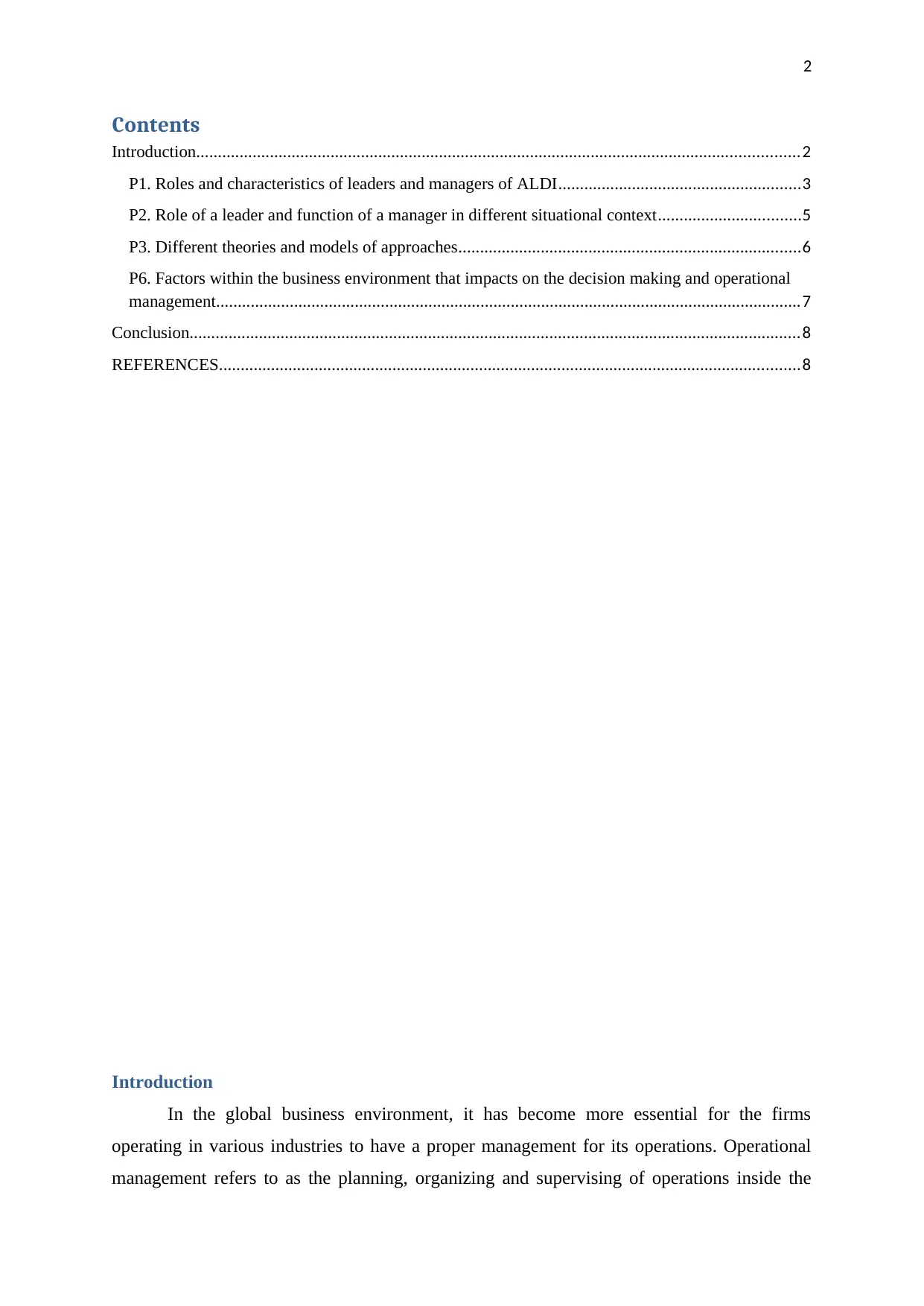
Contents
Introduction...........................................................................................................................................2
P1. Roles and characteristics of leaders and managers of ALDI........................................................3
P2. Role of a leader and function of a manager in different situational context.................................5
P3. Different theories and models of approaches...............................................................................6
P6. Factors within the business environment that impacts on the decision making and operational
management.......................................................................................................................................7
Conclusion.............................................................................................................................................8
REFERENCES......................................................................................................................................8
Introduction
In the global business environment, it has become more essential for the firms
operating in various industries to have a proper management for its operations. Operational
management refers to as the planning, organizing and supervising of operations inside the
Contents
Introduction...........................................................................................................................................2
P1. Roles and characteristics of leaders and managers of ALDI........................................................3
P2. Role of a leader and function of a manager in different situational context.................................5
P3. Different theories and models of approaches...............................................................................6
P6. Factors within the business environment that impacts on the decision making and operational
management.......................................................................................................................................7
Conclusion.............................................................................................................................................8
REFERENCES......................................................................................................................................8
Introduction
In the global business environment, it has become more essential for the firms
operating in various industries to have a proper management for its operations. Operational
management refers to as the planning, organizing and supervising of operations inside the
3
firm (Sanders, 2018). Leaders and managers have different set of roles for managing
operations inside the firm. Various theories and concepts have been given by various
researchers explaining the role of leaders and managers in different situations. This report
highlights the role of the leaders and managers in different situations as well as the theories
that explains their roles. It also explains the factors that have impact on the decision making
and operational management within the firm.
P1. Roles and characteristics of leaders and managers of ALDI
Leader is considered to be as the individual that sets the goals and objectives of an
organization and motivate their subordinates to achieve them easily (Brown, Bessant and
Lamming, 2013). They do it by using their communication skills as well as the vision they
have. On the other hand managers are the individuals who work on the predetermined goals
set by the company. They have the responsibility to arrange the available resources in such a
way that maximum efficiency can be brought to the work.
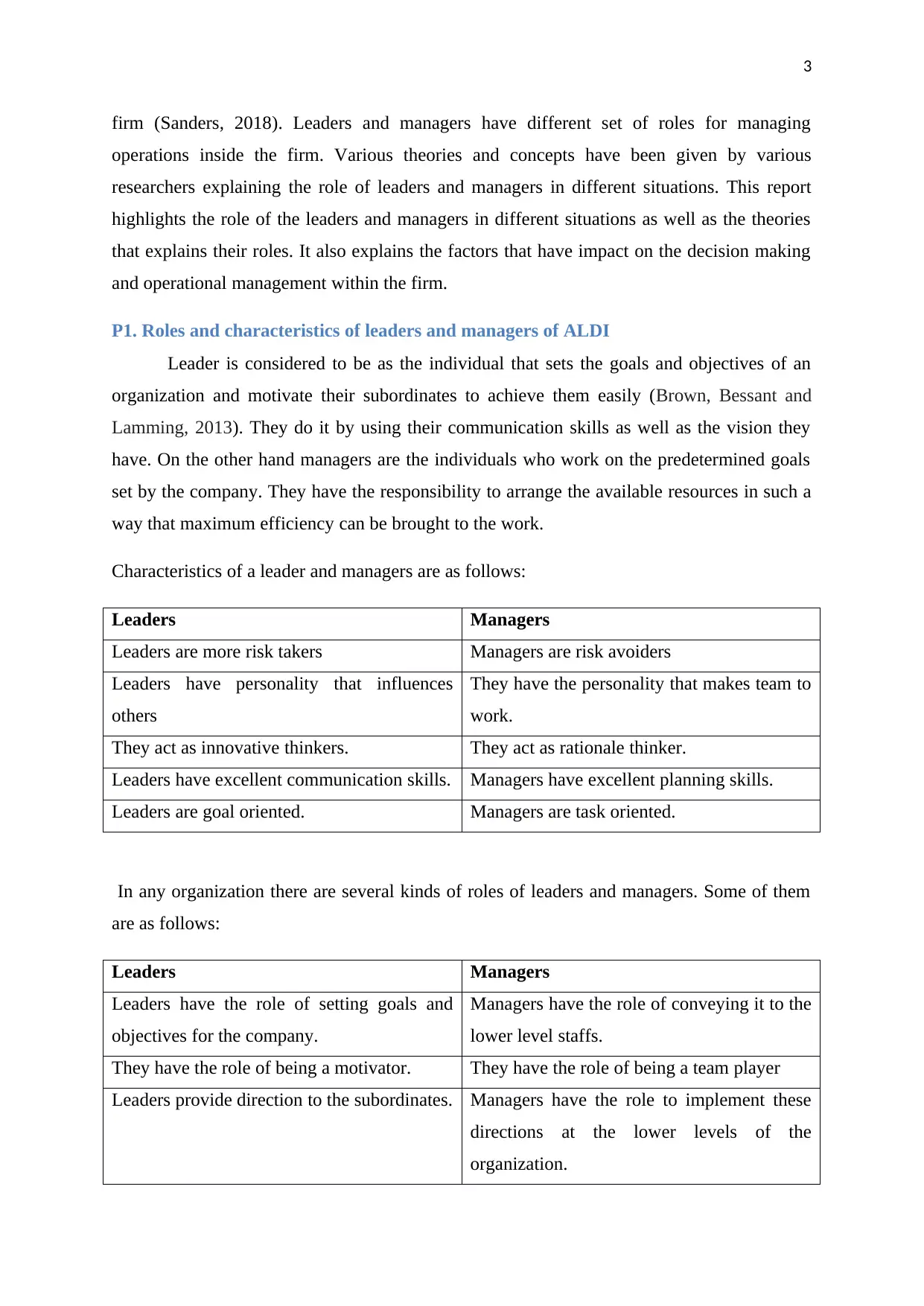
Characteristics of a leader and managers are as follows:
Leaders Managers
Leaders are more risk takers Managers are risk avoiders
Leaders have personality that influences
others
They have the personality that makes team to
work.
They act as innovative thinkers. They act as rationale thinker.
Leaders have excellent communication skills. Managers have excellent planning skills.
Leaders are goal oriented. Managers are task oriented.
In any organization there are several kinds of roles of leaders and managers. Some of them
are as follows:
Leaders Managers
Leaders have the role of setting goals and
objectives for the company.
Managers have the role of conveying it to the
lower level staffs.
They have the role of being a motivator. They have the role of being a team player
Leaders provide direction to the subordinates. Managers have the role to implement these
directions at the lower levels of the
organization.
firm (Sanders, 2018). Leaders and managers have different set of roles for managing
operations inside the firm. Various theories and concepts have been given by various
researchers explaining the role of leaders and managers in different situations. This report
highlights the role of the leaders and managers in different situations as well as the theories
that explains their roles. It also explains the factors that have impact on the decision making
and operational management within the firm.
P1. Roles and characteristics of leaders and managers of ALDI
Leader is considered to be as the individual that sets the goals and objectives of an
organization and motivate their subordinates to achieve them easily (Brown, Bessant and
Lamming, 2013). They do it by using their communication skills as well as the vision they
have. On the other hand managers are the individuals who work on the predetermined goals
set by the company. They have the responsibility to arrange the available resources in such a
way that maximum efficiency can be brought to the work.
Characteristics of a leader and managers are as follows:
Leaders Managers
Leaders are more risk takers Managers are risk avoiders
Leaders have personality that influences
others
They have the personality that makes team to
work.
They act as innovative thinkers. They act as rationale thinker.
Leaders have excellent communication skills. Managers have excellent planning skills.
Leaders are goal oriented. Managers are task oriented.
In any organization there are several kinds of roles of leaders and managers. Some of them
are as follows:
Leaders Managers
Leaders have the role of setting goals and
objectives for the company.
Managers have the role of conveying it to the
lower level staffs.
They have the role of being a motivator. They have the role of being a team player
Leaders provide direction to the subordinates. Managers have the role to implement these
directions at the lower levels of the
organization.
⊘ This is a preview!⊘
Do you want full access?
Subscribe today to unlock all pages.

Trusted by 1+ million students worldwide
4
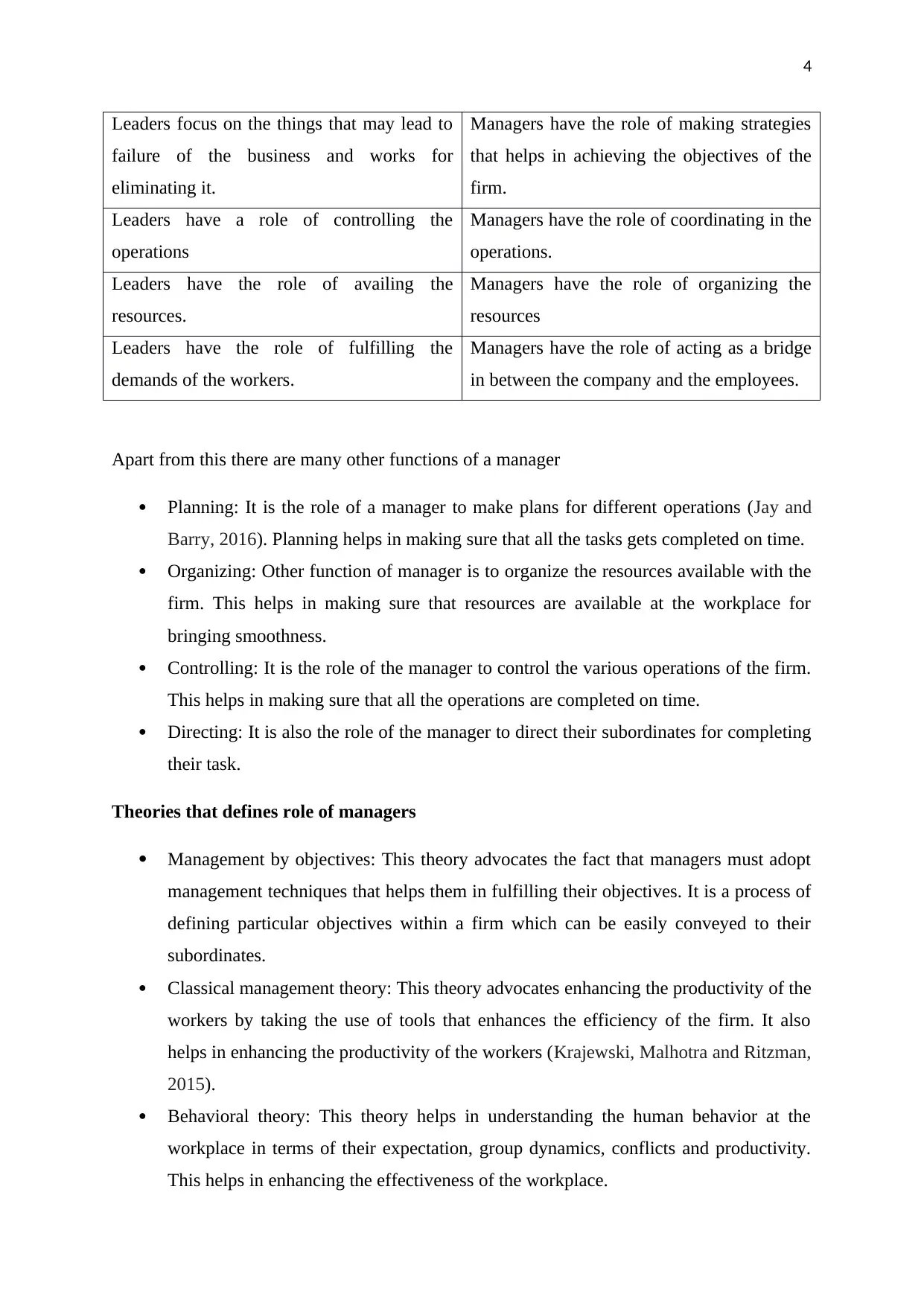
Leaders focus on the things that may lead to
failure of the business and works for
eliminating it.
Managers have the role of making strategies
that helps in achieving the objectives of the
firm.
Leaders have a role of controlling the
operations
Managers have the role of coordinating in the
operations.
Leaders have the role of availing the
resources.
Managers have the role of organizing the
resources
Leaders have the role of fulfilling the
demands of the workers.
Managers have the role of acting as a bridge
in between the company and the employees.
Apart from this there are many other functions of a manager
Planning: It is the role of a manager to make plans for different operations (Jay and
Barry, 2016). Planning helps in making sure that all the tasks gets completed on time.
Organizing: Other function of manager is to organize the resources available with the
firm. This helps in making sure that resources are available at the workplace for
bringing smoothness.
Controlling: It is the role of the manager to control the various operations of the firm.
This helps in making sure that all the operations are completed on time.
Directing: It is also the role of the manager to direct their subordinates for completing
their task.
Theories that defines role of managers
Management by objectives: This theory advocates the fact that managers must adopt
management techniques that helps them in fulfilling their objectives. It is a process of
defining particular objectives within a firm which can be easily conveyed to their
subordinates.
Classical management theory: This theory advocates enhancing the productivity of the
workers by taking the use of tools that enhances the efficiency of the firm. It also
helps in enhancing the productivity of the workers (Krajewski, Malhotra and Ritzman,
2015).
Behavioral theory: This theory helps in understanding the human behavior at the
workplace in terms of their expectation, group dynamics, conflicts and productivity.
This helps in enhancing the effectiveness of the workplace.
Leaders focus on the things that may lead to
failure of the business and works for
eliminating it.
Managers have the role of making strategies
that helps in achieving the objectives of the
firm.
Leaders have a role of controlling the
operations
Managers have the role of coordinating in the
operations.
Leaders have the role of availing the
resources.
Managers have the role of organizing the
resources
Leaders have the role of fulfilling the
demands of the workers.
Managers have the role of acting as a bridge
in between the company and the employees.
Apart from this there are many other functions of a manager
Planning: It is the role of a manager to make plans for different operations (Jay and
Barry, 2016). Planning helps in making sure that all the tasks gets completed on time.
Organizing: Other function of manager is to organize the resources available with the
firm. This helps in making sure that resources are available at the workplace for
bringing smoothness.
Controlling: It is the role of the manager to control the various operations of the firm.
This helps in making sure that all the operations are completed on time.
Directing: It is also the role of the manager to direct their subordinates for completing
their task.
Theories that defines role of managers
Management by objectives: This theory advocates the fact that managers must adopt
management techniques that helps them in fulfilling their objectives. It is a process of
defining particular objectives within a firm which can be easily conveyed to their
subordinates.
Classical management theory: This theory advocates enhancing the productivity of the
workers by taking the use of tools that enhances the efficiency of the firm. It also
helps in enhancing the productivity of the workers (Krajewski, Malhotra and Ritzman,
2015).
Behavioral theory: This theory helps in understanding the human behavior at the
workplace in terms of their expectation, group dynamics, conflicts and productivity.
This helps in enhancing the effectiveness of the workplace.
Paraphrase This Document
Need a fresh take? Get an instant paraphrase of this document with our AI Paraphraser
5
Contingency theory of management: This theory suggests that management
effectiveness is contingent and its success depends on the interplay between specific
situation and application of management behavior.
Theories of leadership that defines their role
Transactional leadership: This theory suggests the managers to focus on supervision,
organization and performance. This is highly effective at the time of crisis (Pinson,
2013).
Transformational: This theory suggests that it is the role of the leaders to bring
collective sense in the workers. They also need to identify the required changes,
creating a vision for that and then implementing the change with the help of
committed members of group (Cole and Kelly, 2011).
Action centered leadership: This theory suggests that leadership has three important
roles first to achieve the tasks; second one was to manage the groups or teams and
third to manage the individuals.
P2. Role of a leader and function of a manager in different situational context
In any organization there are many situations that arise from time to time (Annarelli
and Nonino, 2016). It is the role of the leader or function of managers to make sure that they
have the plan to handle these situations. Some of the situations are:
Situation 1: Allocating new task and getting it done
In this situation it is the role of the leadership to assign the responsibility to the individuals.
This allocation of task depends on the skills that are present with the employees (Dima, et al.,
2011). It helps in completing the task with more efficiency. On the other hand function of the
manager is to guide the sub-ordinates to complete this task. They also need to give training to
the employees so as to enhance their skills for completing any task.
Situation 2: Increasing employee retention by enhancing their loyalty towards the firm.
It is the role of the leaders to make sure that they understand the requirements of the
employees and fulfill them (Dima and Grabara, 2013). They can use theories of motivation
for this purpose. On the other hand it is the function of the manager to build loyalty towards
the firm in the minds of employees. They can do it by communicating them about the
objectives of the company.
Contingency theory of management: This theory suggests that management
effectiveness is contingent and its success depends on the interplay between specific
situation and application of management behavior.
Theories of leadership that defines their role
Transactional leadership: This theory suggests the managers to focus on supervision,
organization and performance. This is highly effective at the time of crisis (Pinson,
2013).
Transformational: This theory suggests that it is the role of the leaders to bring
collective sense in the workers. They also need to identify the required changes,
creating a vision for that and then implementing the change with the help of
committed members of group (Cole and Kelly, 2011).
Action centered leadership: This theory suggests that leadership has three important
roles first to achieve the tasks; second one was to manage the groups or teams and
third to manage the individuals.
P2. Role of a leader and function of a manager in different situational context
In any organization there are many situations that arise from time to time (Annarelli
and Nonino, 2016). It is the role of the leader or function of managers to make sure that they
have the plan to handle these situations. Some of the situations are:
Situation 1: Allocating new task and getting it done
In this situation it is the role of the leadership to assign the responsibility to the individuals.
This allocation of task depends on the skills that are present with the employees (Dima, et al.,
2011). It helps in completing the task with more efficiency. On the other hand function of the
manager is to guide the sub-ordinates to complete this task. They also need to give training to
the employees so as to enhance their skills for completing any task.
Situation 2: Increasing employee retention by enhancing their loyalty towards the firm.
It is the role of the leaders to make sure that they understand the requirements of the
employees and fulfill them (Dima and Grabara, 2013). They can use theories of motivation
for this purpose. On the other hand it is the function of the manager to build loyalty towards
the firm in the minds of employees. They can do it by communicating them about the
objectives of the company.
6
Situation 3: For increasing productivity
It is the role of the leaders to create vision for enhancing the productivity of the firm while it
is the function of the managers to provide training and applying management tools for
enhancing the productivity.
Situation 4: Making changes as per the requirement of the firm
It is the role of the leaders to make plans for making the changes inside the firm as per the
requirement of the organization (Annarelli and Nonino, 2016). Apart from this it is the
function of the manager to make sure that they organize all the resources for implementing
these changes.
Situation 5: Bringing smoothness to the work
It is the role of the leaders to make sure that all the resources are available at the workplace
so that there is no interruption in completing the task. Apart from this it is the function of the
manager to organize all these resources so as to avoid last moment chaos.
P3. Different theories and models of approaches
There are many theories and models of approaches have been given by different
researchers which explain the role of leadership and management.
Situational leadership: This theory suggests a leader to bring flexibility in his or her
approach. There must not be any rigidness in his approach. It suggests of four stage
leadership:
S1: It is a directing stage in which leaders provides the role of individuals and give them what
they desire.
S2: It is a coaching stage where leaders give assistance to workers for completing their task.
S3: It is supporting stage in which leaders gives support to the workers in terms of decision
making for completing the task.
S4: It is delegating stage where leaders are only involved in the process of decision making
for others.
System leadership: This is theory which considers organization as a system where various
inputs in the form of resources is given on which several operations are done taking use of
Situation 3: For increasing productivity
It is the role of the leaders to create vision for enhancing the productivity of the firm while it
is the function of the managers to provide training and applying management tools for
enhancing the productivity.
Situation 4: Making changes as per the requirement of the firm
It is the role of the leaders to make plans for making the changes inside the firm as per the
requirement of the organization (Annarelli and Nonino, 2016). Apart from this it is the
function of the manager to make sure that they organize all the resources for implementing
these changes.
Situation 5: Bringing smoothness to the work
It is the role of the leaders to make sure that all the resources are available at the workplace
so that there is no interruption in completing the task. Apart from this it is the function of the
manager to organize all these resources so as to avoid last moment chaos.
P3. Different theories and models of approaches
There are many theories and models of approaches have been given by different
researchers which explain the role of leadership and management.
Situational leadership: This theory suggests a leader to bring flexibility in his or her
approach. There must not be any rigidness in his approach. It suggests of four stage
leadership:
S1: It is a directing stage in which leaders provides the role of individuals and give them what
they desire.
S2: It is a coaching stage where leaders give assistance to workers for completing their task.
S3: It is supporting stage in which leaders gives support to the workers in terms of decision
making for completing the task.
S4: It is delegating stage where leaders are only involved in the process of decision making
for others.
System leadership: This is theory which considers organization as a system where various
inputs in the form of resources is given on which several operations are done taking use of
⊘ This is a preview!⊘
Do you want full access?
Subscribe today to unlock all pages.
Trusted by 1+ million students worldwide
7
the management tools so as to produce desired outputs. Like any open system it gets affected
by the environment surrounding the company (Oakland, 2014).
Contingency approach: This is an approach which advocates that there is no leadership
model that is perfect hence leadership style must be adopted as per the situation that company
is facing. For achieving best results, leadership must be task or relationship oriented.
Chaos theory: This theory suggests that changes in the industry are uncertain which tends to
create disturbances. For such situations leaders must be ready with different plans. It is the
role of the leader or manager to manage the operations in such a manner that they are able to
adapt all these changes. A leader should find the nature of chaos and implement the tools for
eliminating it (Montgomery, 2011).
P6. Factors within the business environment that impacts on the decision making and
operational management
There are several factors that are present in the business environment which is having direct
impact on the operational management.
Political: Any change in the political policies has direct impact on the operational
management of the firm. Since the political scenarios all across the globe is changing
and hence it impacts on the operational management of the firm.
Economic: There is economic instability in many parts of the world (Kato, et al.,
2014). These instabilities have affected the operations of the firms. It has become
essential for the companies to make sure that they have proper plans so that
operational management can be done at lower cost.
Social: Society needs have changed and hence companies are changing. Its impact can
be seen on the operational management.
Technological: Shift in the technology used inside the firm has forced them to change
their operational management.
Sustainability: It has become crucial for the firm to manage its resources in such a
way that they have enough left for their future business. A sustainable use of
resources has forced companies to make change in their operational management
(Osei-Kyei and Chan, 2017).
Factors that affects the decision making of a firm:
the management tools so as to produce desired outputs. Like any open system it gets affected
by the environment surrounding the company (Oakland, 2014).
Contingency approach: This is an approach which advocates that there is no leadership
model that is perfect hence leadership style must be adopted as per the situation that company
is facing. For achieving best results, leadership must be task or relationship oriented.
Chaos theory: This theory suggests that changes in the industry are uncertain which tends to
create disturbances. For such situations leaders must be ready with different plans. It is the
role of the leader or manager to manage the operations in such a manner that they are able to
adapt all these changes. A leader should find the nature of chaos and implement the tools for
eliminating it (Montgomery, 2011).
P6. Factors within the business environment that impacts on the decision making and
operational management
There are several factors that are present in the business environment which is having direct
impact on the operational management.
Political: Any change in the political policies has direct impact on the operational
management of the firm. Since the political scenarios all across the globe is changing
and hence it impacts on the operational management of the firm.
Economic: There is economic instability in many parts of the world (Kato, et al.,
2014). These instabilities have affected the operations of the firms. It has become
essential for the companies to make sure that they have proper plans so that
operational management can be done at lower cost.
Social: Society needs have changed and hence companies are changing. Its impact can
be seen on the operational management.
Technological: Shift in the technology used inside the firm has forced them to change
their operational management.
Sustainability: It has become crucial for the firm to manage its resources in such a
way that they have enough left for their future business. A sustainable use of
resources has forced companies to make change in their operational management
(Osei-Kyei and Chan, 2017).
Factors that affects the decision making of a firm:
Paraphrase This Document
Need a fresh take? Get an instant paraphrase of this document with our AI Paraphraser
8
CSR: It has become crucial for the firms to make sure there decisions are in the favor
of the society for which they are operating.
Return on Investment: Any financial decisions must be made checking the returns it
provides on investment. This helps in increasing the profit margins of the company.
Ethics: The ethical guidelines made by the firm for themselves has a direct impact on
the decision making of the firm as leaders cannot make decisions violating it (Derue,
et al., 2011).
Culture: The type of culture that a firm has adopted has direct effect on the decision
making of the firm.
Interests of stakeholders: Any decision must be made keeping in the mind the interest
of its stakeholders and the impact it has on them.
Conclusion
From the above report it can be concluded that operational management is necessary for
ensuring high speed growth of the firm. There are several roles and functions of a manager in
different situations. Many theories and approaches given by different researchers explain
these roles. There are several factors which are directly effecting the operational management
and the decision making of the firm. All these factors have to be properly evaluated for
understanding the impact it has on the operations of the firm.
REFERENCES
Annarelli, A. and Nonino, F., (2016) Strategic and operational management of organizational
resilience: Current state of research and future directions. Omega, 62, pp.1-18.
Brown, S., Bessant, J.R. and Lamming, R., (2013) Strategic operations management.
Routledge.
Cole, G.A. and Kelly, P., (2011) Management theory and practice. South-Western Cengage
Learning.
CSR: It has become crucial for the firms to make sure there decisions are in the favor
of the society for which they are operating.
Return on Investment: Any financial decisions must be made checking the returns it
provides on investment. This helps in increasing the profit margins of the company.
Ethics: The ethical guidelines made by the firm for themselves has a direct impact on
the decision making of the firm as leaders cannot make decisions violating it (Derue,
et al., 2011).
Culture: The type of culture that a firm has adopted has direct effect on the decision
making of the firm.
Interests of stakeholders: Any decision must be made keeping in the mind the interest
of its stakeholders and the impact it has on them.
Conclusion
From the above report it can be concluded that operational management is necessary for
ensuring high speed growth of the firm. There are several roles and functions of a manager in
different situations. Many theories and approaches given by different researchers explain
these roles. There are several factors which are directly effecting the operational management
and the decision making of the firm. All these factors have to be properly evaluated for
understanding the impact it has on the operations of the firm.
REFERENCES
Annarelli, A. and Nonino, F., (2016) Strategic and operational management of organizational
resilience: Current state of research and future directions. Omega, 62, pp.1-18.
Brown, S., Bessant, J.R. and Lamming, R., (2013) Strategic operations management.
Routledge.
Cole, G.A. and Kelly, P., (2011) Management theory and practice. South-Western Cengage
Learning.
9
Derue, D.S., Nahrgang, J.D., Wellman, N.E.D. and Humphrey, S.E., (2011) Trait and
behavioral theories of leadership: An integration and meta‐analytic test of their relative
validity. Personnel psychology, 64(1), pp.7-52.
Dima, I.C. and Grabara, I., (2013) Elements of logistics used in industrial operational
management. In Industrial Production Management in Flexible Manufacturing Systems (pp.
277-311). IGI Global.
Dima, I.C., Marcincin, I.N., Grabara, J., Pachura, P., Kot, S. and Man, M., (2011)
Operational management systems of the production achieved in flexible manufacturing
cells. Presov, Slovakia: Techinical University of Kosice.
Jay, H. and Barry, R. (2016) Operations Management. Pearson India.
Kato, T., Takahashi, H., Sasai, K., Kitagata, G., Kim, H.M. and Kinoshita, T., (2014)
Priority-based hierarchical operational management for multiagent-based
microgrids. Energies, 7(4), pp.2051-2078.
Krajewski, L.J., Malhotra, M.K. and Ritzman, L.P. (2015) Operations management:
processes and supply chains. Pearson.
Montgomery, C.A. ed. (2011) Resource-based and evolutionary theories of the firm: towards
a synthesis. Springer Science & Business Media.
Oakland, J.S. (2014) Total quality management and operational excellence: text with cases.
Routledge.
Osei-Kyei, R. and Chan, A.P., (2017) Perceptions of stakeholders on the critical success
factors for operational management of public-private partnership projects. Facilities, 35(1/2),
pp.21-38.
Pinson, P., (2013) Wind energy: Forecasting challenges for its operational
management. Statistical Science, pp.564-585.
Sanders, N. (2018) Operation management defined. [Online]. Available at:
http://www.informit.com/articles/article.aspx?p=2167438. [Accessed on: 16th March 2018].
Derue, D.S., Nahrgang, J.D., Wellman, N.E.D. and Humphrey, S.E., (2011) Trait and
behavioral theories of leadership: An integration and meta‐analytic test of their relative
validity. Personnel psychology, 64(1), pp.7-52.
Dima, I.C. and Grabara, I., (2013) Elements of logistics used in industrial operational
management. In Industrial Production Management in Flexible Manufacturing Systems (pp.
277-311). IGI Global.
Dima, I.C., Marcincin, I.N., Grabara, J., Pachura, P., Kot, S. and Man, M., (2011)
Operational management systems of the production achieved in flexible manufacturing
cells. Presov, Slovakia: Techinical University of Kosice.
Jay, H. and Barry, R. (2016) Operations Management. Pearson India.
Kato, T., Takahashi, H., Sasai, K., Kitagata, G., Kim, H.M. and Kinoshita, T., (2014)
Priority-based hierarchical operational management for multiagent-based
microgrids. Energies, 7(4), pp.2051-2078.
Krajewski, L.J., Malhotra, M.K. and Ritzman, L.P. (2015) Operations management:
processes and supply chains. Pearson.
Montgomery, C.A. ed. (2011) Resource-based and evolutionary theories of the firm: towards
a synthesis. Springer Science & Business Media.
Oakland, J.S. (2014) Total quality management and operational excellence: text with cases.
Routledge.
Osei-Kyei, R. and Chan, A.P., (2017) Perceptions of stakeholders on the critical success
factors for operational management of public-private partnership projects. Facilities, 35(1/2),
pp.21-38.
Pinson, P., (2013) Wind energy: Forecasting challenges for its operational
management. Statistical Science, pp.564-585.
Sanders, N. (2018) Operation management defined. [Online]. Available at:
http://www.informit.com/articles/article.aspx?p=2167438. [Accessed on: 16th March 2018].
⊘ This is a preview!⊘
Do you want full access?
Subscribe today to unlock all pages.
Trusted by 1+ million students worldwide

10

1 out of 10


Related Documents


Your All-in-One AI-Powered Toolkit for Academic Success.
+13062052269
info@desklib.com
Available 24*7 on WhatsApp / Email
![[object Object]](/_next/static/media/star-bottom.7253800d.svg)
Unlock your academic potential
Copyright © 2020–2025 A2Z Services. All Rights Reserved. Developed and managed by ZUCOL.