ALDI: Analyzing Strategic and Cultural Issues and Change Strategies
VerifiedAdded on 2020/07/23
|16
|5810
|77
Report
AI Summary
This report provides a comprehensive analysis of ALDI, a prominent retail organization, focusing on its strategic and cultural issues. It begins with an introduction that highlights the importance of well-planned strategies for financial success and the need for a thorough assessment of challenges before developing strategies. The report identifies key issues faced by ALDI, including branding problems, negative perceptions regarding product quality, lack of marketing techniques, and internal environment weaknesses such as employee motivation and leadership effectiveness. It then proposes a change process with eight key stages, including creating urgency, forming a powerful coalition, creating a vision for change, communicating the vision, removing obstacles, creating short-term wins, building on the change, and anchoring the changes in corporate culture. The report also discusses potential challenges that could derail the change process and emphasizes the importance of addressing these obstacles. Overall, the report aims to provide insights into ALDI's strategic and cultural issues and suggest actionable strategies for improvement.
STRATEGY INTO
ACTION
ACTION

Paraphrase This Document
Need a fresh take? Get an instant paraphrase of this document with our AI Paraphraser
TABLE OF CONTENTS
INTRODUCTION ..........................................................................................................................1
Background of selected organisation..........................................................................................1
Key strategic/cultural issues in the entity....................................................................................2
Rationale behind the initiation of the change process developed for the ALDI.........................3
Key Stages involved in change process:.....................................................................................3
Challenges that may derail the change process...........................................................................5
Appropriate models/ theories/ strategies for the mentioned changes .........................................5
Outcomes of the change ...........................................................................................................11
CONCLUSIONS............................................................................................................................13
REFERENCES..............................................................................................................................14
INTRODUCTION ..........................................................................................................................1
Background of selected organisation..........................................................................................1
Key strategic/cultural issues in the entity....................................................................................2
Rationale behind the initiation of the change process developed for the ALDI.........................3
Key Stages involved in change process:.....................................................................................3
Challenges that may derail the change process...........................................................................5
Appropriate models/ theories/ strategies for the mentioned changes .........................................5
Outcomes of the change ...........................................................................................................11
CONCLUSIONS............................................................................................................................13
REFERENCES..............................................................................................................................14
1.0 INTRODUCTION
Financial success is a result of well-planned and performance focused straegies. A
business is formed with the integration of different components and in order to achieve success,
they all are required to be effective. Management, planning, implementation and leadership in an
organisation are all required to be planned strategically (Scholes, 2015). However, it should be
recognised that a detailed assessment of all the issues that are being faced by an entity are
required to be done before developing any strategy for them. In addition to this, it should be
noted that every company aims on seeking maximum profit by using optimum resources.
This report covers the major strategic and cultural issues faced by an entity. On the basis
of these challenges, different change process will be described. Further, rationale behind their
development will be mentioned. This undertaking will moreover cover all the stages that will be
covered in the change process. In addition to this, there exist some forces that may impact the
effectiveness of the process. These hurdles will also be discussed in the assignment. Lastly, the
most significant section of the report will discuss about the appropriate tools that can be used by
the chosen organisation to takes strategies into action. Following the outcomes from these
analytical tools, findings will be explained.
1.1 Company Profile:
For developing effective business strategies to boost the performance of organisation, it is
first required to undertake a complete evaluation of all the laws existing. In present context, it
has been observed that the chosen company ALDI lacks in some factors. With the help of
appropriate tools, these issues can be identified. Despite of the fact that the entity is working at
various locations and on international level, it is relatively small as compared to the other brand
such as Tesco (Armstrong, and et. al., 2015). In addition to this, the organisation is requiring to
work on branding. The other major rivals of the selected firm are having a strong brand image.
These less efforts given to the brand development is impacting the overall business vale of the fir
either be it in terms of finance or recognition. In addition to this, the major issue that the entity is
faced is that its strong strategies on the basis of which they are promoting their business are
getting reverse criticism. For instance: The organisation positioned itself as provider of the retail
services at affordable process. However, to this, people claims that the reason behind the low
pricing structure is this that they are having poor quality products. Also, the store is sometimes
allegedly regarded as cheap. It has been further found that the entity does not have any marketing
1
Financial success is a result of well-planned and performance focused straegies. A
business is formed with the integration of different components and in order to achieve success,
they all are required to be effective. Management, planning, implementation and leadership in an
organisation are all required to be planned strategically (Scholes, 2015). However, it should be
recognised that a detailed assessment of all the issues that are being faced by an entity are
required to be done before developing any strategy for them. In addition to this, it should be
noted that every company aims on seeking maximum profit by using optimum resources.
This report covers the major strategic and cultural issues faced by an entity. On the basis
of these challenges, different change process will be described. Further, rationale behind their
development will be mentioned. This undertaking will moreover cover all the stages that will be
covered in the change process. In addition to this, there exist some forces that may impact the
effectiveness of the process. These hurdles will also be discussed in the assignment. Lastly, the
most significant section of the report will discuss about the appropriate tools that can be used by
the chosen organisation to takes strategies into action. Following the outcomes from these
analytical tools, findings will be explained.
1.1 Company Profile:
For developing effective business strategies to boost the performance of organisation, it is
first required to undertake a complete evaluation of all the laws existing. In present context, it
has been observed that the chosen company ALDI lacks in some factors. With the help of
appropriate tools, these issues can be identified. Despite of the fact that the entity is working at
various locations and on international level, it is relatively small as compared to the other brand
such as Tesco (Armstrong, and et. al., 2015). In addition to this, the organisation is requiring to
work on branding. The other major rivals of the selected firm are having a strong brand image.
These less efforts given to the brand development is impacting the overall business vale of the fir
either be it in terms of finance or recognition. In addition to this, the major issue that the entity is
faced is that its strong strategies on the basis of which they are promoting their business are
getting reverse criticism. For instance: The organisation positioned itself as provider of the retail
services at affordable process. However, to this, people claims that the reason behind the low
pricing structure is this that they are having poor quality products. Also, the store is sometimes
allegedly regarded as cheap. It has been further found that the entity does not have any marketing
1
⊘ This is a preview!⊘
Do you want full access?
Subscribe today to unlock all pages.

Trusted by 1+ million students worldwide
techniques. In the prevents era of high competition in the retail sector, its is crucial to develop
effective promotional tactics to increase the company sales.
Also, it should be recognised that the lack of attention of the development of new
produces will affect the consumer base by not satisfying them with their needs and demands. It
has been further observed that the company is requited to maintain a good quality in its product.
On the other hand, it has been observed that the internal environment of the firm is also not much
effective. From the benchmarking, it has been found that there are various effective techniques
which other competitors are using to motivate their employees ( Leonidou, and et. al., 2015).The
business culture of ALDI is also required to be change in order to gain the desired work
effectiveness. The cited company is not having effective leaders that can get work done on the
right track. Also, the entity should aim on effective way to lead the employees. Thus, the major
elements and areas that the selected organisation should made some change are the leaders,
employee motivation, quality of products, market expansion strategies, product expansion, and
marketing. All of them does belong to different organisational sector. These factors can fit into
three different categories which are strategy, change and organisational culture.
1.2 Main Business Problems
Strategic plans will help the entity top provide long-term coherence and direction. For
this, key choices will be documented down and a "big picture" direction will be focused. In
present context, there exist various reasons due to which the change process has been initiated.
First of all as every organisation seeks for maximum profit so these change plans will help in
increasing overall revenue of the firm (Gamble, and Thompson, 2014). In present case, it has
been observed that the employees of the firm lacks in having required motivation. This
weaknesses will thus later affect on the work effectiveness and overall business performance.
Further, the change process is developed to replace the existing leaders which are not much
effective for the business operations. In context to ALDI, the quality of products has always been
judged and hence, this tool will help in change this error too. Also, this process will render
assistance to the selected company for the market expansion that will further help in increasing
the business value. Thus, these are the major reasons behind the initiation of change process
developed for the ALDI.
2
effective promotional tactics to increase the company sales.
Also, it should be recognised that the lack of attention of the development of new
produces will affect the consumer base by not satisfying them with their needs and demands. It
has been further observed that the company is requited to maintain a good quality in its product.
On the other hand, it has been observed that the internal environment of the firm is also not much
effective. From the benchmarking, it has been found that there are various effective techniques
which other competitors are using to motivate their employees ( Leonidou, and et. al., 2015).The
business culture of ALDI is also required to be change in order to gain the desired work
effectiveness. The cited company is not having effective leaders that can get work done on the
right track. Also, the entity should aim on effective way to lead the employees. Thus, the major
elements and areas that the selected organisation should made some change are the leaders,
employee motivation, quality of products, market expansion strategies, product expansion, and
marketing. All of them does belong to different organisational sector. These factors can fit into
three different categories which are strategy, change and organisational culture.
1.2 Main Business Problems
Strategic plans will help the entity top provide long-term coherence and direction. For
this, key choices will be documented down and a "big picture" direction will be focused. In
present context, there exist various reasons due to which the change process has been initiated.
First of all as every organisation seeks for maximum profit so these change plans will help in
increasing overall revenue of the firm (Gamble, and Thompson, 2014). In present case, it has
been observed that the employees of the firm lacks in having required motivation. This
weaknesses will thus later affect on the work effectiveness and overall business performance.
Further, the change process is developed to replace the existing leaders which are not much
effective for the business operations. In context to ALDI, the quality of products has always been
judged and hence, this tool will help in change this error too. Also, this process will render
assistance to the selected company for the market expansion that will further help in increasing
the business value. Thus, these are the major reasons behind the initiation of change process
developed for the ALDI.
2
Paraphrase This Document
Need a fresh take? Get an instant paraphrase of this document with our AI Paraphraser
1.3 Purpose of the research
For the present report, the organisation selected is ALDI, a retail organisation that belong to
prove sector. The entity was founded on 23 June, 1913 that is 104 years ago in Germany. This
long span of the time in the sector has made the company a renowned name. Initially, the entity
was a small store present in Essen but later with the market expansion, it has widen its roots.
Basically, it is the brand of two leading global supermarket chains namely ALDI Nord and ALDI
Sud. This split is done in 1946. However, it should be recognised that in context to UK, the
business is maintained by ALDI Sud. This segment of the group does further possess 5,105
stores in total. The firm keeps a strong brand recognition (Bharadwaj and et. al., 2013). The
major products that are sold by the company are food, beverage, sanitary articles and other
household goods. The cited firm operates globally at various developed and developing countries
such as Australia, Ireland, etc. The number of people that are working in the ALDI according to
the reports of 2015, are 162579. There are around 8000 store in Europe and other countries that
are helpful on increasing business value of the cited firm. In addition to this, it has been
observed that the organisations doing well since the time it is established. However, there are
some flaws in the effective strategic business plans. In this report, these weaknesses will be
analysed and an impelling change plan will be developed to evacuate them. Further, the
outcomes that will be generated from this analysis will also be discussed so that the selected
entity can implement them to improve the business procedures.
1.4 Scope of the research
Overall research provides the various facilities and advantages for the company
betterment through which they can take better action plan and decision making process. On the
other side research is the very significant feature for every company to overcome from the issues
and problems facing by the organisation, it also helps to measure the company actual position in
the competitive market. Along with that research also helps to innovate new services and
attractive ideas for the organisation.
1.5 Overview of the company
Overview of the research will cover the main objective and plans of the organisation. On
the other side it also helps to explain the literature review and different approaches and styles to
enhance the company profit revenue.
3
For the present report, the organisation selected is ALDI, a retail organisation that belong to
prove sector. The entity was founded on 23 June, 1913 that is 104 years ago in Germany. This
long span of the time in the sector has made the company a renowned name. Initially, the entity
was a small store present in Essen but later with the market expansion, it has widen its roots.
Basically, it is the brand of two leading global supermarket chains namely ALDI Nord and ALDI
Sud. This split is done in 1946. However, it should be recognised that in context to UK, the
business is maintained by ALDI Sud. This segment of the group does further possess 5,105
stores in total. The firm keeps a strong brand recognition (Bharadwaj and et. al., 2013). The
major products that are sold by the company are food, beverage, sanitary articles and other
household goods. The cited firm operates globally at various developed and developing countries
such as Australia, Ireland, etc. The number of people that are working in the ALDI according to
the reports of 2015, are 162579. There are around 8000 store in Europe and other countries that
are helpful on increasing business value of the cited firm. In addition to this, it has been
observed that the organisations doing well since the time it is established. However, there are
some flaws in the effective strategic business plans. In this report, these weaknesses will be
analysed and an impelling change plan will be developed to evacuate them. Further, the
outcomes that will be generated from this analysis will also be discussed so that the selected
entity can implement them to improve the business procedures.
1.4 Scope of the research
Overall research provides the various facilities and advantages for the company
betterment through which they can take better action plan and decision making process. On the
other side research is the very significant feature for every company to overcome from the issues
and problems facing by the organisation, it also helps to measure the company actual position in
the competitive market. Along with that research also helps to innovate new services and
attractive ideas for the organisation.
1.5 Overview of the company
Overview of the research will cover the main objective and plans of the organisation. On
the other side it also helps to explain the literature review and different approaches and styles to
enhance the company profit revenue.
3
2.0 LITERATURE REVIEW
2.1 Key Stages involved in change process:
As per the view of (Gurcaylilar-Yenidogan, and Aksoy,2018) In order to implement the
desired changes in an organisation, it is necessary to follow an effective plan. For
implementation of any business strategy by changing the existing one there present a procedures
which is required to be followed by the organisation. With regards to the above changes that are
mentioned to bring effectiveness in the business operations of ALDI, a good change process
should be followed. For this, below present a suitable model comprising of the key stages that
should be followed by the chosen organisation for change process:
Stage 1: Create Urgency: In this step of the change process, the potential threats are identified
and following in scenarios are developed to evaluate the results of these challenges. Further,
opportunities that could be exploited are examined . Later, honest communications takes place
to analyse the need of the changes. Also, the decisions to support this change are taken in this
stage.
Step 2: Form a Powerful Coalition: This is the most important phase of the change
management. It provides the key resources that will be required in the undertaking plan. Initially,
true leaders are selected in this along with the major stakeholders. Later, these people are asked
for emotional commitment with the plan. Late, worked is carried with this change coalition.
Step 3: Create a Vision for Change: In this step, the values which are central to the change are
examined. Further, a short summary is prepared to see the future of the planned objectives. Later,
a strategy will be prepared to achieve the setted goals.
Step 4: Communicate the Vision: It is always effective to get discussed the planned ideas with
as many people It helps in generating effective ideas that can boost the effectiveness of the
change plan. For this, ALDI should address the concern of people, openly and honestly. Later, by
applying visions to all aspects of the operation, they can be performed (Darroch, 2014).
Step 5: Remove Obstacles: By removing obstacle from the path of change management, the
organisation can achieve effectiveness in the business process. This can be doe by identifying all
the factors that can impact the change plan. Also, by observing the organisational structure the
flaws can be understand. Later, by developing effective strategies to cope up with these hurdles,
they can be removed easily.
4
2.1 Key Stages involved in change process:
As per the view of (Gurcaylilar-Yenidogan, and Aksoy,2018) In order to implement the
desired changes in an organisation, it is necessary to follow an effective plan. For
implementation of any business strategy by changing the existing one there present a procedures
which is required to be followed by the organisation. With regards to the above changes that are
mentioned to bring effectiveness in the business operations of ALDI, a good change process
should be followed. For this, below present a suitable model comprising of the key stages that
should be followed by the chosen organisation for change process:
Stage 1: Create Urgency: In this step of the change process, the potential threats are identified
and following in scenarios are developed to evaluate the results of these challenges. Further,
opportunities that could be exploited are examined . Later, honest communications takes place
to analyse the need of the changes. Also, the decisions to support this change are taken in this
stage.
Step 2: Form a Powerful Coalition: This is the most important phase of the change
management. It provides the key resources that will be required in the undertaking plan. Initially,
true leaders are selected in this along with the major stakeholders. Later, these people are asked
for emotional commitment with the plan. Late, worked is carried with this change coalition.
Step 3: Create a Vision for Change: In this step, the values which are central to the change are
examined. Further, a short summary is prepared to see the future of the planned objectives. Later,
a strategy will be prepared to achieve the setted goals.
Step 4: Communicate the Vision: It is always effective to get discussed the planned ideas with
as many people It helps in generating effective ideas that can boost the effectiveness of the
change plan. For this, ALDI should address the concern of people, openly and honestly. Later, by
applying visions to all aspects of the operation, they can be performed (Darroch, 2014).
Step 5: Remove Obstacles: By removing obstacle from the path of change management, the
organisation can achieve effectiveness in the business process. This can be doe by identifying all
the factors that can impact the change plan. Also, by observing the organisational structure the
flaws can be understand. Later, by developing effective strategies to cope up with these hurdles,
they can be removed easily.
4
⊘ This is a preview!⊘
Do you want full access?
Subscribe today to unlock all pages.
Trusted by 1+ million students worldwide
Step 6: Create Short-Term Wins: This step of the change plan is necessary to segregate wok in
shorter tasks. Thee divided tasks are easy to archive. Also, they are more effective as compare to
the work which is done as whole. So, ALDI should create short-term goals that are to be
achieved.
Step 7: Build on the Change: After setting the short term goals, it is analysed that what went
right and what not. Also, the factor that need improvement are assessed. Further, goals are settled
to build on the momentum that is achieved by attaining he previous goals. Moreover, for this, the
Kaizen tool can also be used by the ALDI. This will assist in getting consistent improvement.
Step 8: Anchor the Changes in Corporate Culture: All the actions that are achieved by
making use of the change plan are discussed here. Also, various it includes various change ideals
and values when hiring and training new staff
As per the view of (Chiang, Chen, and Ho, 2016.) Thus, these are the key stages that
should be followed by the ALDO for executing the change planned developed to eliminate the
flaws of the organisation. Also, this process will bring effectiveness in the business processes.
2.2Challenges that may derail the change process
It is not necessary that the things will always be in favour with the business objectives.
There may exists some factor that can derail the change process (Chiang, Chen, and Ho, 2016).
These are the major obstacles that restricts the effectiveness of the planned process. First of all,
the entity is required to aim on the accomplishment of the tasks within a stipulated time-frame.
In case, if the planning operation will take more then the overall effectiveness of the business
procedures will be damaged. It should also be noted that all these business processes will require
a huge amount of investment that will increase the company expenses (Stephan, Patterson,
Kelly, and Mair, 2016). Henceforth, the net profit of the firm will be reduced. This can cause
many financial problems to the entity. Further, in case of product development, it is required
that effective and innovative ideas are been taken. If they will not be liked by he consumers then
ALDI will have to suffer double losses. Also, in case when old leaders will be replaced with the
new ones then it may create conflicts between them. This can later affect the working
environment and thus, the effectiveness of the business. Hence, these are the major changes that
can derail the change process planned for the selected entity.
5
shorter tasks. Thee divided tasks are easy to archive. Also, they are more effective as compare to
the work which is done as whole. So, ALDI should create short-term goals that are to be
achieved.
Step 7: Build on the Change: After setting the short term goals, it is analysed that what went
right and what not. Also, the factor that need improvement are assessed. Further, goals are settled
to build on the momentum that is achieved by attaining he previous goals. Moreover, for this, the
Kaizen tool can also be used by the ALDI. This will assist in getting consistent improvement.
Step 8: Anchor the Changes in Corporate Culture: All the actions that are achieved by
making use of the change plan are discussed here. Also, various it includes various change ideals
and values when hiring and training new staff
As per the view of (Chiang, Chen, and Ho, 2016.) Thus, these are the key stages that
should be followed by the ALDO for executing the change planned developed to eliminate the
flaws of the organisation. Also, this process will bring effectiveness in the business processes.
2.2Challenges that may derail the change process
It is not necessary that the things will always be in favour with the business objectives.
There may exists some factor that can derail the change process (Chiang, Chen, and Ho, 2016).
These are the major obstacles that restricts the effectiveness of the planned process. First of all,
the entity is required to aim on the accomplishment of the tasks within a stipulated time-frame.
In case, if the planning operation will take more then the overall effectiveness of the business
procedures will be damaged. It should also be noted that all these business processes will require
a huge amount of investment that will increase the company expenses (Stephan, Patterson,
Kelly, and Mair, 2016). Henceforth, the net profit of the firm will be reduced. This can cause
many financial problems to the entity. Further, in case of product development, it is required
that effective and innovative ideas are been taken. If they will not be liked by he consumers then
ALDI will have to suffer double losses. Also, in case when old leaders will be replaced with the
new ones then it may create conflicts between them. This can later affect the working
environment and thus, the effectiveness of the business. Hence, these are the major changes that
can derail the change process planned for the selected entity.
5
Paraphrase This Document
Need a fresh take? Get an instant paraphrase of this document with our AI Paraphraser
2.3 Appropriate models/ theories/ strategies for the mentioned changes
On the basis of (Van Dam, and et. al., 2014) The major elements and areas that the
selected organisation should made some change are the leaders, employee motivation, quality of
products, market expansion strategies, product expansion, and marketing. All of them does
belong to different organisational sector. These factors can fit into three different categories
which are strategy, change and culture. However, it should be recognised that in order to
implement these changes effectively in the business, appropriate tools should be chosen (. Thus,
below are some strategies/ techniques in which ALDI can improve its operations:
Improving culture of ALDI
Leadership: It is the ability of an individual to lead other people working in the firm. As per
above evaluation it has been observed that the leaders of the entity are not much effective in
terms of their behaviour with the employees. Also, they lacks in taking effective decisions for the
organisational welfare. Hence, the entity should follow the leadership skill explained further:
Transformational Leadership theory: According to the selected leadership theory, a leader is
a person who interacts with others and creates strong relationship with them. The communication
skills used by these leaders are productive and enhance the creation of effective relations. In
present context, if ALDI follows this leadership theory, then the leaders of the firm can achieve
trust of the lower level employees. This will later help in an increased level of motivation of
workforce (Bettmann, Russell, and Parry, 2013)
Employee Motivation: Employees are the key asset of an organisation and thus, they are required
to be kept motivated. This is due to the fact that such workers are more committed and dedicated
to the work. Also, motivate employed do perform better as compared the others. The selected
organisation should execute Maslow's Hierarchy of needs to motivate the people working in the
company. This theory is as follows:
Maslow's Hierarchy of needs: This theory is proposed by Abraham Maslow in 1943. As per
the concepts of this, there are certain needs of a human which when fulfilled by the organisation,
its employees can get motivated. There are five basic needs which are self-actualisation, esteem,
love/belonging, safety and psychological.
6
On the basis of (Van Dam, and et. al., 2014) The major elements and areas that the
selected organisation should made some change are the leaders, employee motivation, quality of
products, market expansion strategies, product expansion, and marketing. All of them does
belong to different organisational sector. These factors can fit into three different categories
which are strategy, change and culture. However, it should be recognised that in order to
implement these changes effectively in the business, appropriate tools should be chosen (. Thus,
below are some strategies/ techniques in which ALDI can improve its operations:
Improving culture of ALDI
Leadership: It is the ability of an individual to lead other people working in the firm. As per
above evaluation it has been observed that the leaders of the entity are not much effective in
terms of their behaviour with the employees. Also, they lacks in taking effective decisions for the
organisational welfare. Hence, the entity should follow the leadership skill explained further:
Transformational Leadership theory: According to the selected leadership theory, a leader is
a person who interacts with others and creates strong relationship with them. The communication
skills used by these leaders are productive and enhance the creation of effective relations. In
present context, if ALDI follows this leadership theory, then the leaders of the firm can achieve
trust of the lower level employees. This will later help in an increased level of motivation of
workforce (Bettmann, Russell, and Parry, 2013)
Employee Motivation: Employees are the key asset of an organisation and thus, they are required
to be kept motivated. This is due to the fact that such workers are more committed and dedicated
to the work. Also, motivate employed do perform better as compared the others. The selected
organisation should execute Maslow's Hierarchy of needs to motivate the people working in the
company. This theory is as follows:
Maslow's Hierarchy of needs: This theory is proposed by Abraham Maslow in 1943. As per
the concepts of this, there are certain needs of a human which when fulfilled by the organisation,
its employees can get motivated. There are five basic needs which are self-actualisation, esteem,
love/belonging, safety and psychological.
6
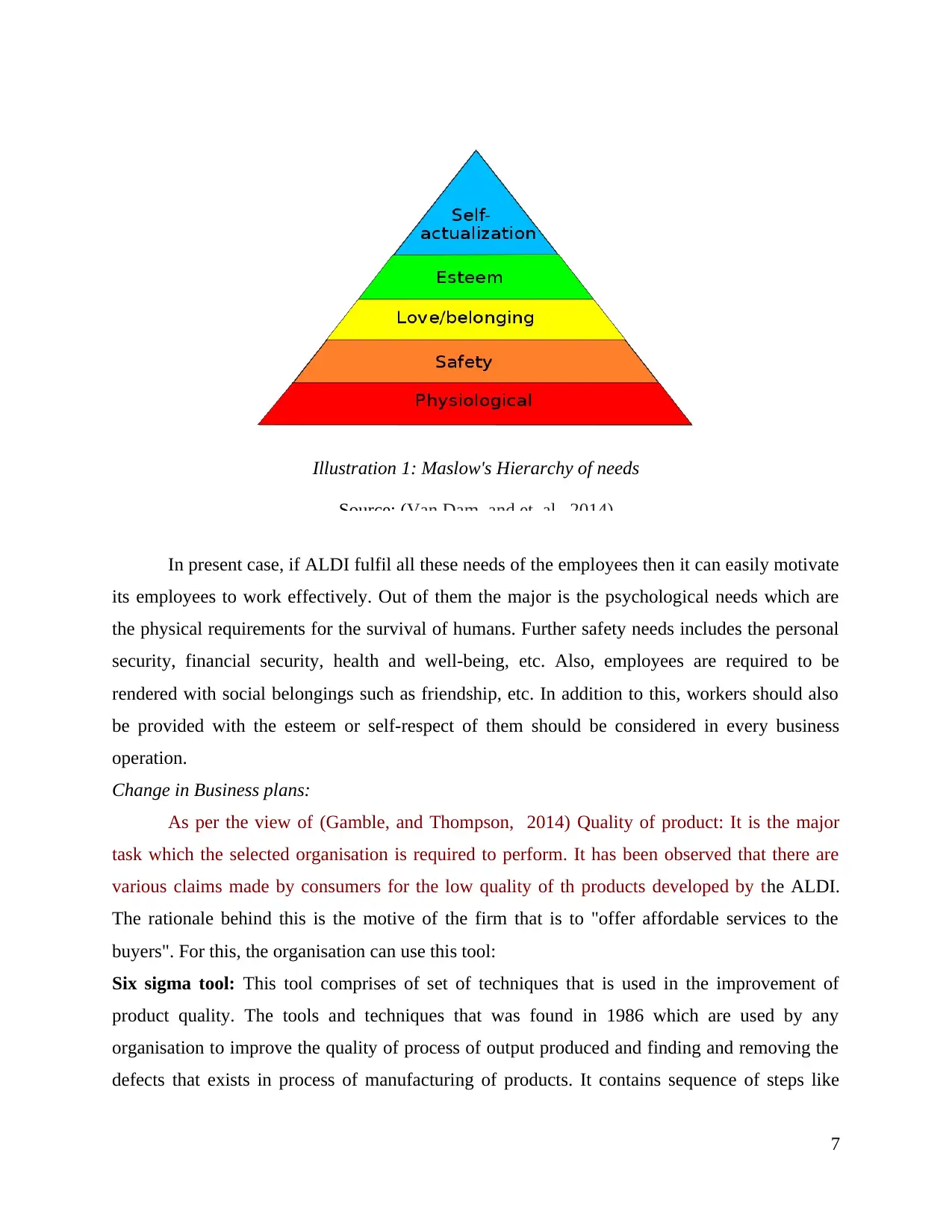
In present case, if ALDI fulfil all these needs of the employees then it can easily motivate
its employees to work effectively. Out of them the major is the psychological needs which are
the physical requirements for the survival of humans. Further safety needs includes the personal
security, financial security, health and well-being, etc. Also, employees are required to be
rendered with social belongings such as friendship, etc. In addition to this, workers should also
be provided with the esteem or self-respect of them should be considered in every business
operation.
Change in Business plans:
As per the view of (Gamble, and Thompson, 2014) Quality of product: It is the major
task which the selected organisation is required to perform. It has been observed that there are
various claims made by consumers for the low quality of th products developed by the ALDI.
The rationale behind this is the motive of the firm that is to "offer affordable services to the
buyers". For this, the organisation can use this tool:
Six sigma tool: This tool comprises of set of techniques that is used in the improvement of
product quality. The tools and techniques that was found in 1986 which are used by any
organisation to improve the quality of process of output produced and finding and removing the
defects that exists in process of manufacturing of products. It contains sequence of steps like
7
Illustration 1: Maslow's Hierarchy of needs
Source: (Van Dam, and et. al., 2014)
its employees to work effectively. Out of them the major is the psychological needs which are
the physical requirements for the survival of humans. Further safety needs includes the personal
security, financial security, health and well-being, etc. Also, employees are required to be
rendered with social belongings such as friendship, etc. In addition to this, workers should also
be provided with the esteem or self-respect of them should be considered in every business
operation.
Change in Business plans:
As per the view of (Gamble, and Thompson, 2014) Quality of product: It is the major
task which the selected organisation is required to perform. It has been observed that there are
various claims made by consumers for the low quality of th products developed by the ALDI.
The rationale behind this is the motive of the firm that is to "offer affordable services to the
buyers". For this, the organisation can use this tool:
Six sigma tool: This tool comprises of set of techniques that is used in the improvement of
product quality. The tools and techniques that was found in 1986 which are used by any
organisation to improve the quality of process of output produced and finding and removing the
defects that exists in process of manufacturing of products. It contains sequence of steps like
7
Illustration 1: Maslow's Hierarchy of needs
Source: (Van Dam, and et. al., 2014)
⊘ This is a preview!⊘
Do you want full access?
Subscribe today to unlock all pages.
Trusted by 1+ million students worldwide
reduce costs, reduce cycle time, reduce pollution, increase customer satisfaction, increase
profits,etc. It has production ratio of 0.06 that is out of 100 units produced only .06 will be
defective.
The tools of six sigma are:-
Identifying problem –In any system the first step is to identify a problem. After it
problem is defined in brief and then next step is taken. first of all it is important to briefly
know what the problem is and where it is occurring. Until and unless if the problem is not
identified it is not possible to take any further step . For this we have to evaluate the
entire process which can also hamper the production goods for a while.
Measuring process performance- if the above given production ratio varies then there
occurs a problem. Therefore to avoid this type of problem the performance of overall
production process should be revised or checked. The process should be analysed to
determine root cause of variation, defects or poor performance. After this process should
be improved by solving or fixing the root cause of problem. For this a detailed new ERP
(enterprise resource planning) should be done with means what will be resources that are
needed in next level of production, how effectively ERP will have impact in production
process .
Controlling the process for future performance- at last to measure the efficiency of
process it is necessary to have good control on it so that it can used to evaluate the future
performance of enterprise. If process is not controlled then there are chances of having
some other problem again. By controlling it we can easily identify the loop holes in it.
Experts are needed to control a particular process. The future productivity is entirely
dependent on the performance of the system.
Under this quality management approach, there are two methodologies for ensuring effective
quality of the products. They are as follows:
DMAIC:
DMADV or DFSS
Business strategy for implementation: (Growth)
Growth strategy:
8
profits,etc. It has production ratio of 0.06 that is out of 100 units produced only .06 will be
defective.
The tools of six sigma are:-
Identifying problem –In any system the first step is to identify a problem. After it
problem is defined in brief and then next step is taken. first of all it is important to briefly
know what the problem is and where it is occurring. Until and unless if the problem is not
identified it is not possible to take any further step . For this we have to evaluate the
entire process which can also hamper the production goods for a while.
Measuring process performance- if the above given production ratio varies then there
occurs a problem. Therefore to avoid this type of problem the performance of overall
production process should be revised or checked. The process should be analysed to
determine root cause of variation, defects or poor performance. After this process should
be improved by solving or fixing the root cause of problem. For this a detailed new ERP
(enterprise resource planning) should be done with means what will be resources that are
needed in next level of production, how effectively ERP will have impact in production
process .
Controlling the process for future performance- at last to measure the efficiency of
process it is necessary to have good control on it so that it can used to evaluate the future
performance of enterprise. If process is not controlled then there are chances of having
some other problem again. By controlling it we can easily identify the loop holes in it.
Experts are needed to control a particular process. The future productivity is entirely
dependent on the performance of the system.
Under this quality management approach, there are two methodologies for ensuring effective
quality of the products. They are as follows:
DMAIC:
DMADV or DFSS
Business strategy for implementation: (Growth)
Growth strategy:
8
Paraphrase This Document
Need a fresh take? Get an instant paraphrase of this document with our AI Paraphraser
As per the view of (Gurcaylilar-Yenidogan, and Aksoy,2018) In addition to this, the best
suited strategy that should be implemented by the selected firm is Growth strategy. This tactic
helps in winning larger market share even with the expense of short-term earnings. This tool is
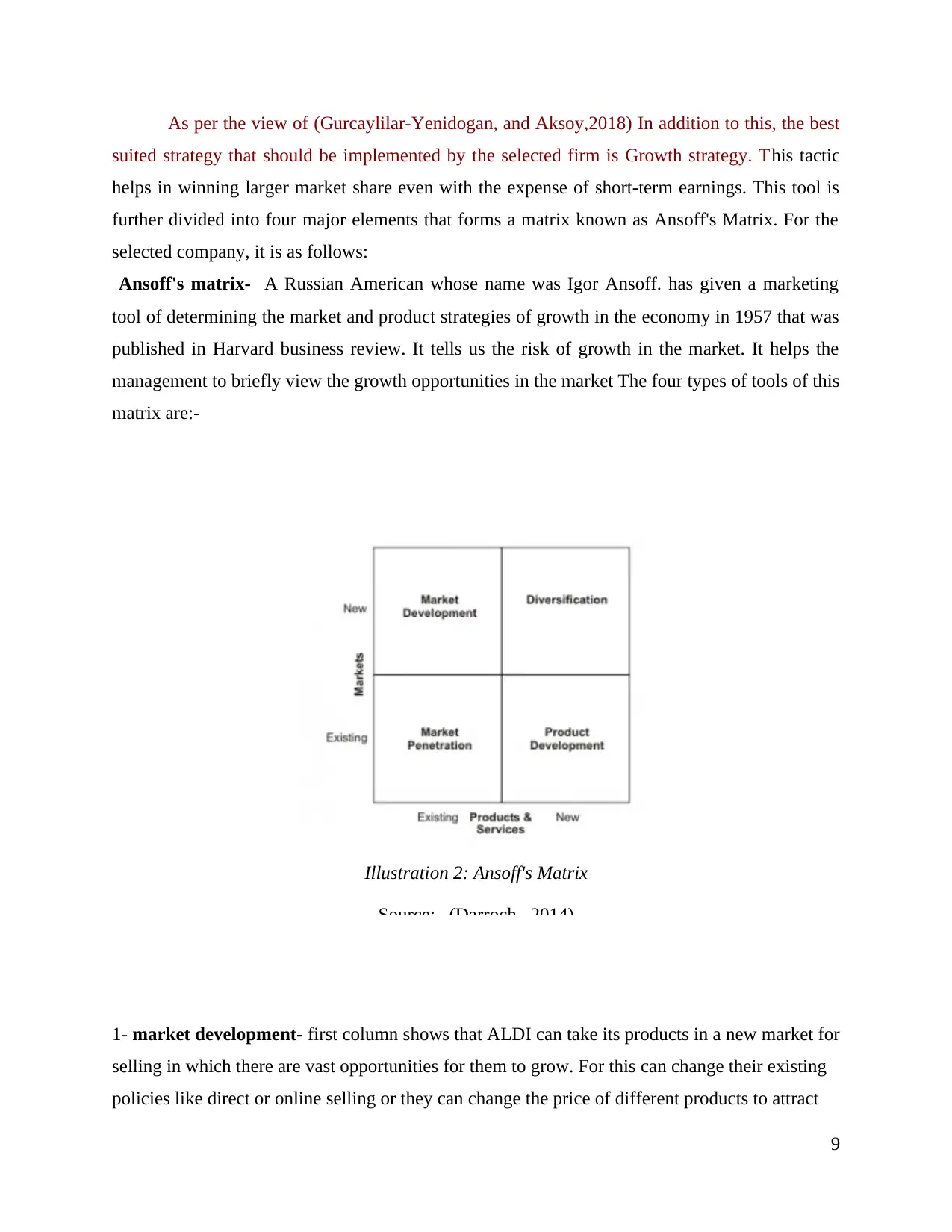
further divided into four major elements that forms a matrix known as Ansoff's Matrix. For the
selected company, it is as follows:
Ansoff's matrix- A Russian American whose name was Igor Ansoff. has given a marketing
tool of determining the market and product strategies of growth in the economy in 1957 that was
published in Harvard business review. It tells us the risk of growth in the market. It helps the
management to briefly view the growth opportunities in the market The four types of tools of this
matrix are:-
Illustration 2: Ansoff's Matrix
Source: (Darroch, 2014)
1- market development- first column shows that ALDI can take its products in a new market for
selling in which there are vast opportunities for them to grow. For this can change their existing
policies like direct or online selling or they can change the price of different products to attract
9
suited strategy that should be implemented by the selected firm is Growth strategy. This tactic
helps in winning larger market share even with the expense of short-term earnings. This tool is
further divided into four major elements that forms a matrix known as Ansoff's Matrix. For the
selected company, it is as follows:
Ansoff's matrix- A Russian American whose name was Igor Ansoff. has given a marketing
tool of determining the market and product strategies of growth in the economy in 1957 that was
published in Harvard business review. It tells us the risk of growth in the market. It helps the
management to briefly view the growth opportunities in the market The four types of tools of this
matrix are:-
Illustration 2: Ansoff's Matrix
Source: (Darroch, 2014)
1- market development- first column shows that ALDI can take its products in a new market for
selling in which there are vast opportunities for them to grow. For this can change their existing
policies like direct or online selling or they can change the price of different products to attract
9
new customers or they can create a new market segments for customers. They can use agents
which can help them to sell their products in new markets. By effectively using the marketing
mix technique .
2- market penetration- As per the view of ( Leonidou, and et. al., 2015) it is often recognised
as a strategy where ALDI needs a growth in existing market. To increase its market share ALDI
should focus on the products that are already in the markets (Darroch, 2014). This will help
them for further growth of company. This can be done by various strategies like increasing sales
force activities, sales promotion, lucky draws, free coupons, discounts, advertising, etc. Personal
selling can be most beneficial in this stage where people are encouraged to buy their product.
3- diversification- A completely new strategy for a ALDI whereby developing new market and
creating new product for that market will be a quiet difficult task for ALDI. A large amount of
risk is involved in entering into new market without any experience or research. ALDI should
have a clear idea and strategy that what will be their future growth in this market. Higher the
amount of risk higher will be chance of success of ALDI. This can sometimes be profitable to
company and sometimes can be very harsh.
4- product development- as the name suggests it means developing new products into existing
markets. By introducing new products the ALDI can expand it's market share. When the product
is at level of saturation there is need of introducing new product as customer base is very good.
In this either the products is modified or innovated after a deep research. If ALDI thinks that they
have a strong base of loyal customers then they can go for the launch of new products so this will
help them increase their market share. In this market development will not work as they don't
want to lose its current market share by entering into new market
As per the view of (Gurcaylilar-Yenidogan, and Aksoy,2018). However, the major
among them that are included in the change plan are as follows: Market Expansion and Product
Development. The selected organisation is required to pay major attention on these two elements
of the growth strategy proposed by Ansoff.
10
which can help them to sell their products in new markets. By effectively using the marketing
mix technique .
2- market penetration- As per the view of ( Leonidou, and et. al., 2015) it is often recognised
as a strategy where ALDI needs a growth in existing market. To increase its market share ALDI
should focus on the products that are already in the markets (Darroch, 2014). This will help
them for further growth of company. This can be done by various strategies like increasing sales
force activities, sales promotion, lucky draws, free coupons, discounts, advertising, etc. Personal
selling can be most beneficial in this stage where people are encouraged to buy their product.
3- diversification- A completely new strategy for a ALDI whereby developing new market and
creating new product for that market will be a quiet difficult task for ALDI. A large amount of
risk is involved in entering into new market without any experience or research. ALDI should
have a clear idea and strategy that what will be their future growth in this market. Higher the
amount of risk higher will be chance of success of ALDI. This can sometimes be profitable to
company and sometimes can be very harsh.
4- product development- as the name suggests it means developing new products into existing
markets. By introducing new products the ALDI can expand it's market share. When the product
is at level of saturation there is need of introducing new product as customer base is very good.
In this either the products is modified or innovated after a deep research. If ALDI thinks that they
have a strong base of loyal customers then they can go for the launch of new products so this will
help them increase their market share. In this market development will not work as they don't
want to lose its current market share by entering into new market
As per the view of (Gurcaylilar-Yenidogan, and Aksoy,2018). However, the major
among them that are included in the change plan are as follows: Market Expansion and Product
Development. The selected organisation is required to pay major attention on these two elements
of the growth strategy proposed by Ansoff.
10
⊘ This is a preview!⊘
Do you want full access?
Subscribe today to unlock all pages.
Trusted by 1+ million students worldwide

1 out of 16


Related Documents


Your All-in-One AI-Powered Toolkit for Academic Success.
+13062052269
info@desklib.com
Available 24*7 on WhatsApp / Email
![[object Object]](/_next/static/media/star-bottom.7253800d.svg)
Unlock your academic potential
Copyright © 2020–2026 A2Z Services. All Rights Reserved. Developed and managed by ZUCOL.