Algorithm Development for Hydraulic System Design: Report
VerifiedAdded on 2020/01/07
|16
|4120
|146
Report
AI Summary
This report presents the development of an algorithm for hydraulic system design. It begins with an introduction to hydraulic systems, including their components, applications, and the underlying principles based on Pascal's law. The report outlines the objectives, significance, and organization of the study. It then delves into the background of hydraulic systems, including their different types (open center, closed center, and load sensing systems), components (pumps, valves, cylinders, and motors), and hydraulic fluids. The report also describes the development of the algorithm, outlining the steps involved in the design process. This includes analyzing the system, developing a program for the algorithm, and planning its implementation. The algorithm is designed to improve the efficiency, accuracy, and overall performance of hydraulic systems. The report concludes with a discussion of the algorithm's outcomes, impacts, and recommendations for future improvements in hydraulic system design and functionality. The report emphasizes the advantages of hydraulic systems, such as high power density and ease of control, while also acknowledging their limitations, such as potential fluid leakage and fire hazards.
Development of an algorithm for design
of hydraulic system
of hydraulic system

Paraphrase This Document
Need a fresh take? Get an instant paraphrase of this document with our AI Paraphraser
TABLE OF CONTENTS
1. INTRODUCTION.......................................................................................................................3
1.1 Introduction............................................................................................................................3
1.2 Objectives..............................................................................................................................4
1.3 Significance...........................................................................................................................4
1.4 Report organization................................................................................................................6
BACKGROUND.............................................................................................................................6
Chapter 1......................................................................................................................................6
Chapter 2......................................................................................................................................8
REFERENCES..............................................................................................................................16
2
1. INTRODUCTION.......................................................................................................................3
1.1 Introduction............................................................................................................................3
1.2 Objectives..............................................................................................................................4
1.3 Significance...........................................................................................................................4
1.4 Report organization................................................................................................................6
BACKGROUND.............................................................................................................................6
Chapter 1......................................................................................................................................6
Chapter 2......................................................................................................................................8
REFERENCES..............................................................................................................................16
2
1. INTRODUCTION
1.1 Introduction
The hydraulic system can also be referred as transmission system, which uses the
pressurized fluid (hydraulic), to drive the hydraulic machines. The genuine term hydro-static is
used which means the transfer of different form of energy from pressure and flow, excluding the
kinetic energy. The hydraulic system is mainly having three parts; first one is the generator that
is a hydraulic pump (Smettem and et.al., 2016). Second part is the electric motor, which will
drive the generator. Third part is the combustion engine, which will be used to run the
machinery. All the hydraulic system's are based on the Pascal's law.
The pascal's law can be stated that, “As the system pressure is same, the force which is
given by the fluid to the surroundings will be equal to the product of pressure and area (pressure
* area). Therefore, a piston with small diameter will feel small force and the large piston will be
facing with the large force. Most of the hydraulic system will be having the hydraulic cylinder,
which will be coming in use (Lee and et.al., 2014). The same principle is used here, like very
small torque is inherited into very large force. If anyone want to change the transmission ratio,
then by the throttling the fluid in between the part of the generator and motor part or by the use
of different motors which will be having swept volume that can be adjusted, it can be done. The
major advantage of such hydraulic system is the high power density. The total mass of the
hydraulic system is many times smaller than the electric drive mass, which will be producing
same power.
These hydraulic drives are mainly divided into three grades;
Mobile hydraulics
Industrial hydraulics
Aircraft hydraulics
this classification is done, because all the components are divided into three categories. But
sometimes there can be a overlap between the mobile and industrial hydraulics. Air craft
hydraulics elements are very specific and specialized (Chen and et.al., 2014). This is due to their
extreme requirement of weight and accuracy. In developing the hydraulic system which is a
complex one, then it is mandatory that they must have suitable and accurate advancement-
3
1.1 Introduction
The hydraulic system can also be referred as transmission system, which uses the
pressurized fluid (hydraulic), to drive the hydraulic machines. The genuine term hydro-static is
used which means the transfer of different form of energy from pressure and flow, excluding the
kinetic energy. The hydraulic system is mainly having three parts; first one is the generator that
is a hydraulic pump (Smettem and et.al., 2016). Second part is the electric motor, which will
drive the generator. Third part is the combustion engine, which will be used to run the
machinery. All the hydraulic system's are based on the Pascal's law.
The pascal's law can be stated that, “As the system pressure is same, the force which is
given by the fluid to the surroundings will be equal to the product of pressure and area (pressure
* area). Therefore, a piston with small diameter will feel small force and the large piston will be
facing with the large force. Most of the hydraulic system will be having the hydraulic cylinder,
which will be coming in use (Lee and et.al., 2014). The same principle is used here, like very
small torque is inherited into very large force. If anyone want to change the transmission ratio,
then by the throttling the fluid in between the part of the generator and motor part or by the use
of different motors which will be having swept volume that can be adjusted, it can be done. The
major advantage of such hydraulic system is the high power density. The total mass of the
hydraulic system is many times smaller than the electric drive mass, which will be producing
same power.
These hydraulic drives are mainly divided into three grades;
Mobile hydraulics
Industrial hydraulics
Aircraft hydraulics
this classification is done, because all the components are divided into three categories. But
sometimes there can be a overlap between the mobile and industrial hydraulics. Air craft
hydraulics elements are very specific and specialized (Chen and et.al., 2014). This is due to their
extreme requirement of weight and accuracy. In developing the hydraulic system which is a
complex one, then it is mandatory that they must have suitable and accurate advancement-
3
⊘ This is a preview!⊘
Do you want full access?
Subscribe today to unlock all pages.

Trusted by 1+ million students worldwide
methodology. This accurate methodology is used to reach the results which are necessary in
short and quick time duration.
Applications of the hydraulic system are as follows;
In car brakes- when the driver push the brake pedal, a small piston is pushes back.
the pressure is applied on the brake fluid by the large piston, this pushes the brake
pads, and that pad comes in contact with brake drum (Taylor, Banks and Watson,
2016). This will slow down the speed of the car and after few seconds make the
car stand still.
Air planes- To lower the barking system and adjusting the wind blades, the
hydraulic system can be used.
Heavy equipment like truck and other machinery, in unloading this system is
used.
1.2 Objectives
The following objectives are covered in this report;
To analyze different hydraulic system.
To identify the most common steps involved in setting up the hydraulic system.
To develop the algorithm applicable to hydraulic system.
To analyze the desired hydraulic circuit using software.
To develop a program for an algorithm.
1.3 Significance
The hydraulic system is the core technology backside several industrial companies. Life
would not be that easy and possible without the hydraulic system. These technology is
everywhere, from home to work, from stationary to mobile. If the hydraulic system is not there,
the construction vehicle will not work, cable cars will not do proper functioning, trucks will not
be able to unload their goods, no theater stage would rotate (Lin, Shi and Burton, 2013). The
professional as well as the personal life will be very inconvenient. All the hydraulic systems are
becoming more and more advanced, which is all due to the new ways of thinking and various
approaches of development. Their main focus is on the hydraulic system, so that this technology
will become more versatile, more efficient and become more accurate and precise.
4
short and quick time duration.
Applications of the hydraulic system are as follows;
In car brakes- when the driver push the brake pedal, a small piston is pushes back.
the pressure is applied on the brake fluid by the large piston, this pushes the brake
pads, and that pad comes in contact with brake drum (Taylor, Banks and Watson,
2016). This will slow down the speed of the car and after few seconds make the
car stand still.
Air planes- To lower the barking system and adjusting the wind blades, the
hydraulic system can be used.
Heavy equipment like truck and other machinery, in unloading this system is
used.
1.2 Objectives
The following objectives are covered in this report;
To analyze different hydraulic system.
To identify the most common steps involved in setting up the hydraulic system.
To develop the algorithm applicable to hydraulic system.
To analyze the desired hydraulic circuit using software.
To develop a program for an algorithm.
1.3 Significance
The hydraulic system is the core technology backside several industrial companies. Life
would not be that easy and possible without the hydraulic system. These technology is
everywhere, from home to work, from stationary to mobile. If the hydraulic system is not there,
the construction vehicle will not work, cable cars will not do proper functioning, trucks will not
be able to unload their goods, no theater stage would rotate (Lin, Shi and Burton, 2013). The
professional as well as the personal life will be very inconvenient. All the hydraulic systems are
becoming more and more advanced, which is all due to the new ways of thinking and various
approaches of development. Their main focus is on the hydraulic system, so that this technology
will become more versatile, more efficient and become more accurate and precise.
4
Paraphrase This Document
Need a fresh take? Get an instant paraphrase of this document with our AI Paraphraser
By the use of performance electronics and various software, these hydraulic systems are
becoming more and more intelligent and advanced. The development of such new technologies
and the use of advanced software, all these complex systems are transforming and changing, so
that it will be very easy to use (Yao, Jiao and Ma, 2014). There will be further improvement in
the technology. The high performance sensors will be very helpful in the self-monitoring of the
systems. The maintenance will not be on the frequent basis because the equipment's are very
long lasting and the maintenance will be dynamically. The hydraulic system will have some
benefits and advantages which will make it more efficient in power transmission, they are;
The system can be controlled with very ease. The accuracy is also high. This can be done
just by the use of simple levers and some push buttons.
The system can be very easily starts, stop, slow down and speed up.
The force multiplication can be done, the power system driven by fluid can multiply the
forces very simply and in more efficient way from a portion of pound to various tons of
output.
The force and torque is constant- only hydraulic system is capable enough to provide the
force and torque in constant way. This is regardless of the changes in the speed.
The hydraulic system is very simple, more safe and economical. The moving parts are
very few in relation with other mechanical and electrical transmission system. Therefore,
the maintenance is very easy and simple.
Despite having all the highly desirable features, this system is having some negative impacts as
well. They are;
The hydraulic oil handling is very messy job (Ko and et.al., 2015). The leakage will
always be there, and it is close to negligible to eliminate the leakage from the system.
The hydraulic lines will always be having high pressure. So these lines can burst at any
point of time, which can cause the injury to human.
The hydraulic oil which is leaking is having a tendency of catching the fire. This risk will
be more when the system is working in hot regions.
1.4 Report organization
This report consist of 5 different chapters, which will cover up the entire development of
the entire algorithm process and its use in hydraulic systems.
5
becoming more and more intelligent and advanced. The development of such new technologies
and the use of advanced software, all these complex systems are transforming and changing, so
that it will be very easy to use (Yao, Jiao and Ma, 2014). There will be further improvement in
the technology. The high performance sensors will be very helpful in the self-monitoring of the
systems. The maintenance will not be on the frequent basis because the equipment's are very
long lasting and the maintenance will be dynamically. The hydraulic system will have some
benefits and advantages which will make it more efficient in power transmission, they are;
The system can be controlled with very ease. The accuracy is also high. This can be done
just by the use of simple levers and some push buttons.
The system can be very easily starts, stop, slow down and speed up.
The force multiplication can be done, the power system driven by fluid can multiply the
forces very simply and in more efficient way from a portion of pound to various tons of
output.
The force and torque is constant- only hydraulic system is capable enough to provide the
force and torque in constant way. This is regardless of the changes in the speed.
The hydraulic system is very simple, more safe and economical. The moving parts are
very few in relation with other mechanical and electrical transmission system. Therefore,
the maintenance is very easy and simple.
Despite having all the highly desirable features, this system is having some negative impacts as
well. They are;
The hydraulic oil handling is very messy job (Ko and et.al., 2015). The leakage will
always be there, and it is close to negligible to eliminate the leakage from the system.
The hydraulic lines will always be having high pressure. So these lines can burst at any
point of time, which can cause the injury to human.
The hydraulic oil which is leaking is having a tendency of catching the fire. This risk will
be more when the system is working in hot regions.
1.4 Report organization
This report consist of 5 different chapters, which will cover up the entire development of
the entire algorithm process and its use in hydraulic systems.
5
Chapter 1 will provide the information of hydraulics, the hydraulic fluid which is
commonly used and the several hydraulic systems which are used in day to day life.
Chapter 2 is consisting of the development of the hydraulics system and the processes by
which the system is being made. This will include different procedures and types of different
hydraulic system.
Chapter 3 will describe the algorithm and how it is developed. There are certain steps,
which are involved in the make up of algorithm, so this has been discussed in this chapter.
Chapter 4 presents the planning and the uses of this algorithm. How the algorithm is
planned and implemented in the systems.
Chapter 5 will be the final part and it is the conclusion. In this whole report what are the
outcomes, and the impacts and some recommendations regarding the hydraulic system will be
covered in this chapter.
BACKGROUND
Chapter 1
Hydraulics system is a function of mechanical engineering, which uses the force of liquid
pressure to operate. In such type of systems, the movement of the components is produced with
the help of contained liquid, which will be passing through the cylinders moving piston. The
hydraulic system is the combination of mechanical, electronics and the software engineering,
also known as mechatronics. This is used in designing and manufacturing of various parts or
products. Some basic hydraulic system uses only water as a fluid medium. They uses the force of
gravity to create the pressure of water (Wang, T. and Wang, Q., 2014). Some of the more
complex systems uses the pumps in which the piston is moving inside a cylinder, so that the oil
gets pressurized. The valves are there, to control the flow of liquid.
These hydraulic systems are very much similar to the pneumatic systems. Both these uses
the fluids, but pneumatic uses gases and hydraulic uses fluids. The hydraulic system is capable
enough to generate the pressure up to 10000 pounds per square inch, and the pneumatic can only
generate about 100 psi. Some of the components of such hydraulic system are as follows;
Hydraulic pump: The pump uses the form of mechanical energy and converts it
into hydraulic energy. The change in the form of energy is done by the movement
of fluid, which is used as the medium of transmission. The hydraulic pumps may
6
commonly used and the several hydraulic systems which are used in day to day life.
Chapter 2 is consisting of the development of the hydraulics system and the processes by
which the system is being made. This will include different procedures and types of different
hydraulic system.
Chapter 3 will describe the algorithm and how it is developed. There are certain steps,
which are involved in the make up of algorithm, so this has been discussed in this chapter.
Chapter 4 presents the planning and the uses of this algorithm. How the algorithm is
planned and implemented in the systems.
Chapter 5 will be the final part and it is the conclusion. In this whole report what are the
outcomes, and the impacts and some recommendations regarding the hydraulic system will be
covered in this chapter.
BACKGROUND
Chapter 1
Hydraulics system is a function of mechanical engineering, which uses the force of liquid
pressure to operate. In such type of systems, the movement of the components is produced with
the help of contained liquid, which will be passing through the cylinders moving piston. The
hydraulic system is the combination of mechanical, electronics and the software engineering,
also known as mechatronics. This is used in designing and manufacturing of various parts or
products. Some basic hydraulic system uses only water as a fluid medium. They uses the force of
gravity to create the pressure of water (Wang, T. and Wang, Q., 2014). Some of the more
complex systems uses the pumps in which the piston is moving inside a cylinder, so that the oil
gets pressurized. The valves are there, to control the flow of liquid.
These hydraulic systems are very much similar to the pneumatic systems. Both these uses
the fluids, but pneumatic uses gases and hydraulic uses fluids. The hydraulic system is capable
enough to generate the pressure up to 10000 pounds per square inch, and the pneumatic can only
generate about 100 psi. Some of the components of such hydraulic system are as follows;
Hydraulic pump: The pump uses the form of mechanical energy and converts it
into hydraulic energy. The change in the form of energy is done by the movement
of fluid, which is used as the medium of transmission. The hydraulic pumps may
6
⊘ This is a preview!⊘
Do you want full access?
Subscribe today to unlock all pages.
Trusted by 1+ million students worldwide
have gear pump, vane pump and also the piston. All such kind of pumps will
have their specific application like variable displacement pump, bent-axis piston
pump etc. The main function of all these pumps are same, which is the
displacement of the fluid against friction and pressure.
Valves: Hydraulic valves are used to start or stop the system. These can also be
used to direct the flow of fluid. These valves are having spools and poppets. All
these can be actuated by the means of pneumatically, electrically, hydraulically
or mechanically.
Cylinder: The hydraulic cylinder are basically the actuators. They are the end
result of the Pascal law. In such actuators, the hydraulic energy gets converted to
again in mechanical energy. This is done by the help of hydraulic cylinders. In
such cylinders, the hydraulic energy is converted into the linear motion and work.
For this purpose, the hydraulic motors can also be used.
All these hydraulic systems are using the hydraulic fluids. The main function of all these fluids is
to give smooth operation and easy energy transmission (Ben-Galim and et.al., 2016). These
fluids are used for the lubrication purpose, the control of contamination and for the transfer of
heat. Some of the frequently used hydraulic fluids are;
The mineral based fuel or the petroleum based fuels. These are the most used
hydraulic fluids. The quality and the performance of such kind of fuel is totally
dependent on the process of refinery or the additives which are being used. The
additives will have certain properties like, the rust and oxidant inhibitors, anti
corrosion agents. These fluids are low on cost and the quality is also high and is
always available.
The second one are based on water. These are used to contain the fire because they
are having high water content. These are available in water oil emulsion or oil water
emulsions, some times in water glycol bends.
Synthetic fluids are made by man, and these fluids are having excellent characteristics
of lubrication even in high temperature and high pressure systems. The main
advantages of such fluids are; more fire resistance property, high thermal stability and
7
have their specific application like variable displacement pump, bent-axis piston
pump etc. The main function of all these pumps are same, which is the
displacement of the fluid against friction and pressure.
Valves: Hydraulic valves are used to start or stop the system. These can also be
used to direct the flow of fluid. These valves are having spools and poppets. All
these can be actuated by the means of pneumatically, electrically, hydraulically
or mechanically.
Cylinder: The hydraulic cylinder are basically the actuators. They are the end
result of the Pascal law. In such actuators, the hydraulic energy gets converted to
again in mechanical energy. This is done by the help of hydraulic cylinders. In
such cylinders, the hydraulic energy is converted into the linear motion and work.
For this purpose, the hydraulic motors can also be used.
All these hydraulic systems are using the hydraulic fluids. The main function of all these fluids is
to give smooth operation and easy energy transmission (Ben-Galim and et.al., 2016). These
fluids are used for the lubrication purpose, the control of contamination and for the transfer of
heat. Some of the frequently used hydraulic fluids are;
The mineral based fuel or the petroleum based fuels. These are the most used
hydraulic fluids. The quality and the performance of such kind of fuel is totally
dependent on the process of refinery or the additives which are being used. The
additives will have certain properties like, the rust and oxidant inhibitors, anti
corrosion agents. These fluids are low on cost and the quality is also high and is
always available.
The second one are based on water. These are used to contain the fire because they
are having high water content. These are available in water oil emulsion or oil water
emulsions, some times in water glycol bends.
Synthetic fluids are made by man, and these fluids are having excellent characteristics
of lubrication even in high temperature and high pressure systems. The main
advantages of such fluids are; more fire resistance property, high thermal stability and
7
Paraphrase This Document
Need a fresh take? Get an instant paraphrase of this document with our AI Paraphraser
reduction of friction. But these fluids are more expensive than the other two fluids.
These fluids sometimes mat be a little toxic in nature so they require special
arrangements of disposal.
Chapter 2
The hydraulic systems uses the power of fluid under very high pressure to lift the load. So on the
basis of this, there are three main types of hydraulic systems;
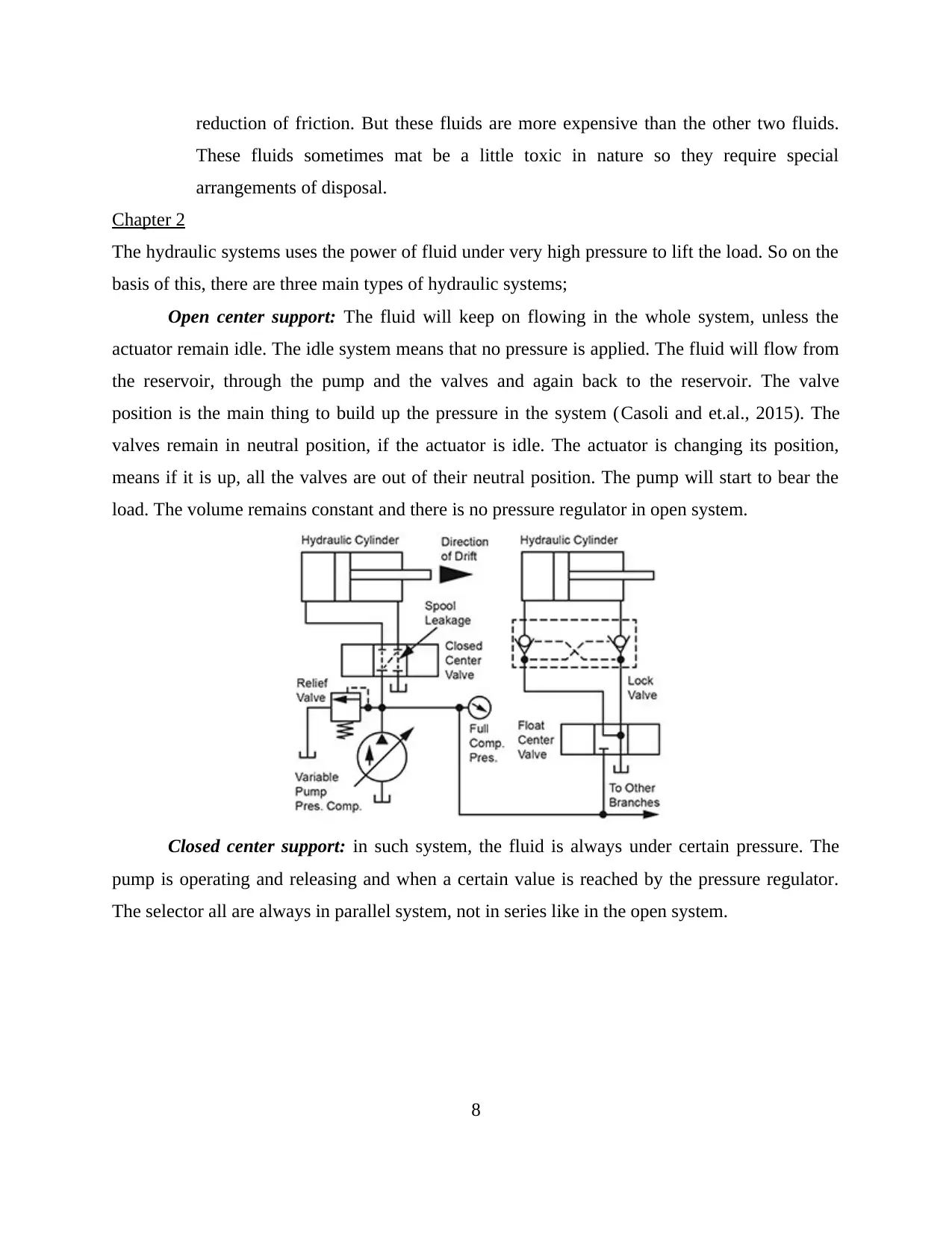
Open center support: The fluid will keep on flowing in the whole system, unless the
actuator remain idle. The idle system means that no pressure is applied. The fluid will flow from
the reservoir, through the pump and the valves and again back to the reservoir. The valve
position is the main thing to build up the pressure in the system (Casoli and et.al., 2015). The
valves remain in neutral position, if the actuator is idle. The actuator is changing its position,
means if it is up, all the valves are out of their neutral position. The pump will start to bear the
load. The volume remains constant and there is no pressure regulator in open system.
Closed center support: in such system, the fluid is always under certain pressure. The
pump is operating and releasing and when a certain value is reached by the pressure regulator.
The selector all are always in parallel system, not in series like in the open system.
8
These fluids sometimes mat be a little toxic in nature so they require special
arrangements of disposal.
Chapter 2
The hydraulic systems uses the power of fluid under very high pressure to lift the load. So on the
basis of this, there are three main types of hydraulic systems;
Open center support: The fluid will keep on flowing in the whole system, unless the
actuator remain idle. The idle system means that no pressure is applied. The fluid will flow from
the reservoir, through the pump and the valves and again back to the reservoir. The valve
position is the main thing to build up the pressure in the system (Casoli and et.al., 2015). The
valves remain in neutral position, if the actuator is idle. The actuator is changing its position,
means if it is up, all the valves are out of their neutral position. The pump will start to bear the
load. The volume remains constant and there is no pressure regulator in open system.
Closed center support: in such system, the fluid is always under certain pressure. The
pump is operating and releasing and when a certain value is reached by the pressure regulator.
The selector all are always in parallel system, not in series like in the open system.
8
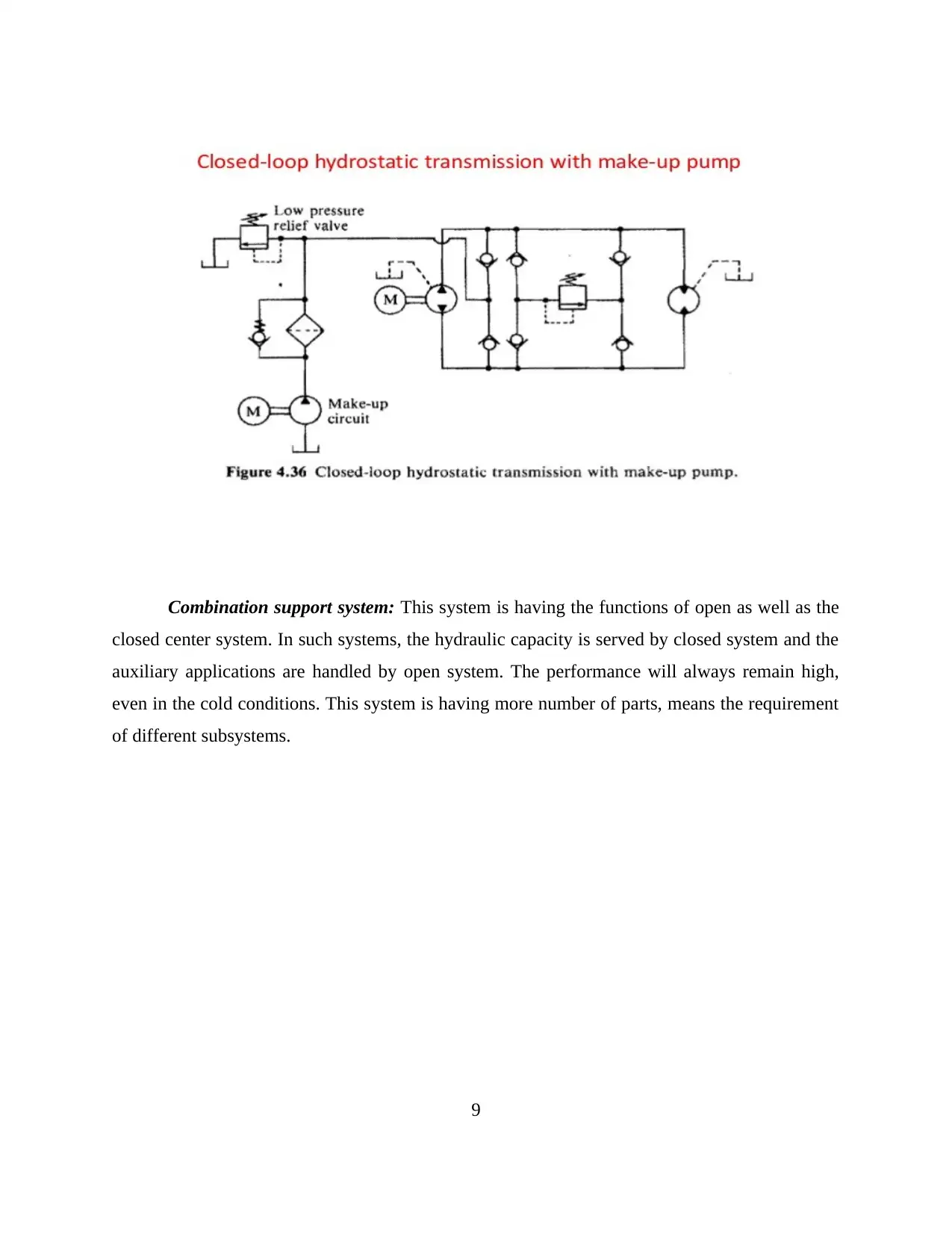
Combination support system: This system is having the functions of open as well as the
closed center system. In such systems, the hydraulic capacity is served by closed system and the
auxiliary applications are handled by open system. The performance will always remain high,
even in the cold conditions. This system is having more number of parts, means the requirement
of different subsystems.
9
closed center system. In such systems, the hydraulic capacity is served by closed system and the
auxiliary applications are handled by open system. The performance will always remain high,
even in the cold conditions. This system is having more number of parts, means the requirement
of different subsystems.
9
⊘ This is a preview!⊘
Do you want full access?
Subscribe today to unlock all pages.
Trusted by 1+ million students worldwide
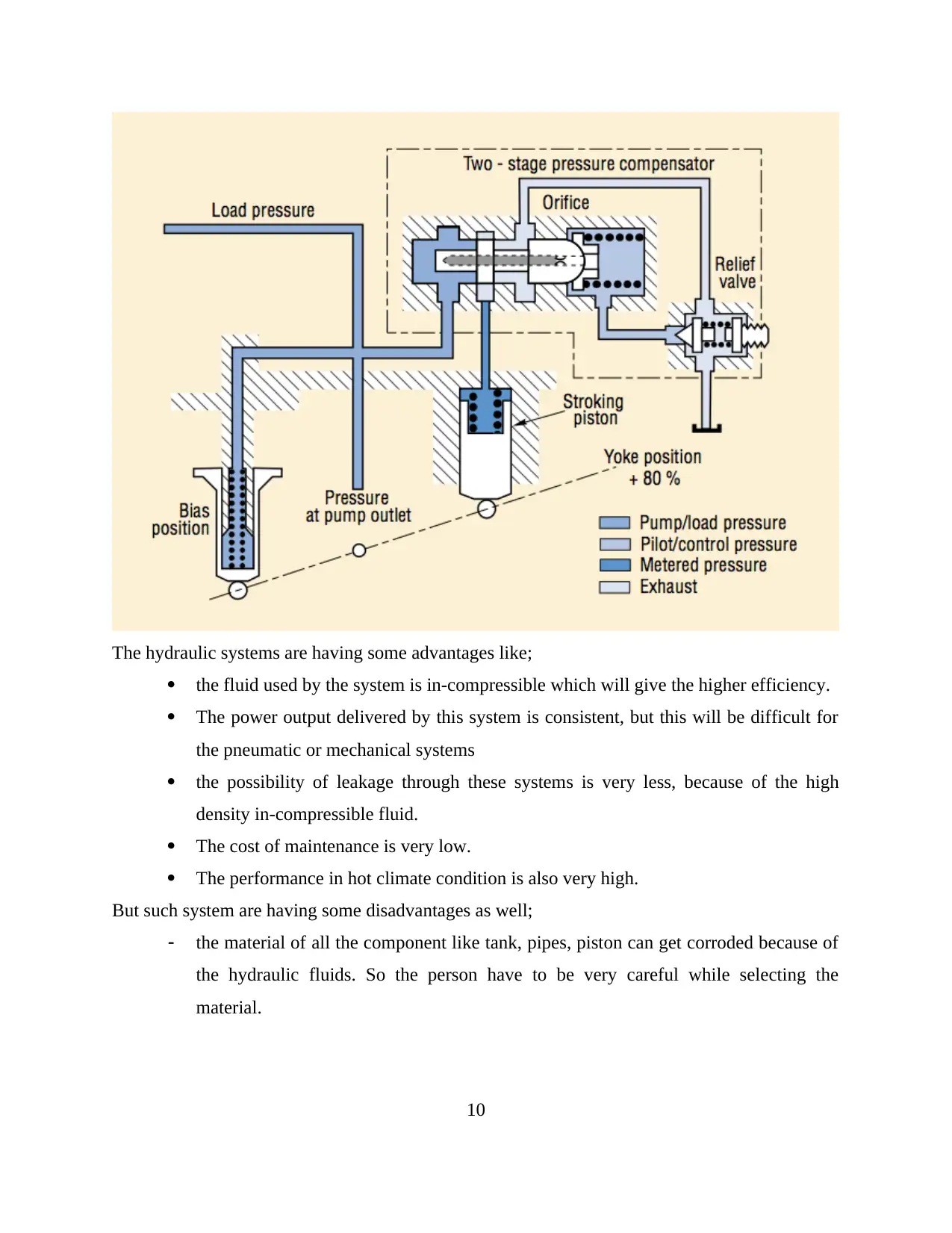
The hydraulic systems are having some advantages like;
the fluid used by the system is in-compressible which will give the higher efficiency.
The power output delivered by this system is consistent, but this will be difficult for
the pneumatic or mechanical systems
the possibility of leakage through these systems is very less, because of the high
density in-compressible fluid.
The cost of maintenance is very low.
The performance in hot climate condition is also very high.
But such system are having some disadvantages as well;
the material of all the component like tank, pipes, piston can get corroded because of
the hydraulic fluids. So the person have to be very careful while selecting the
material.
10
the fluid used by the system is in-compressible which will give the higher efficiency.
The power output delivered by this system is consistent, but this will be difficult for
the pneumatic or mechanical systems
the possibility of leakage through these systems is very less, because of the high
density in-compressible fluid.
The cost of maintenance is very low.
The performance in hot climate condition is also very high.
But such system are having some disadvantages as well;
the material of all the component like tank, pipes, piston can get corroded because of
the hydraulic fluids. So the person have to be very careful while selecting the
material.
10
Paraphrase This Document
Need a fresh take? Get an instant paraphrase of this document with our AI Paraphraser
The size and weight of the system is very high, so it is not suitable for the small
equipment.
Very small impurity can damage the whole system permanently, so the size of micron
filter should be very careful.
The leakage can cause fire, so use of proper seals is required.
Such fluid is hard to dispose, and this can be very harmful to the environment.
If anyone is having any kind of hydraulic system, then it is mandatory to understand the use of
hydraulic pumps (Editors of Hydraulics & Pneumatics, 2012). There are different types of
hydraulic pumps;
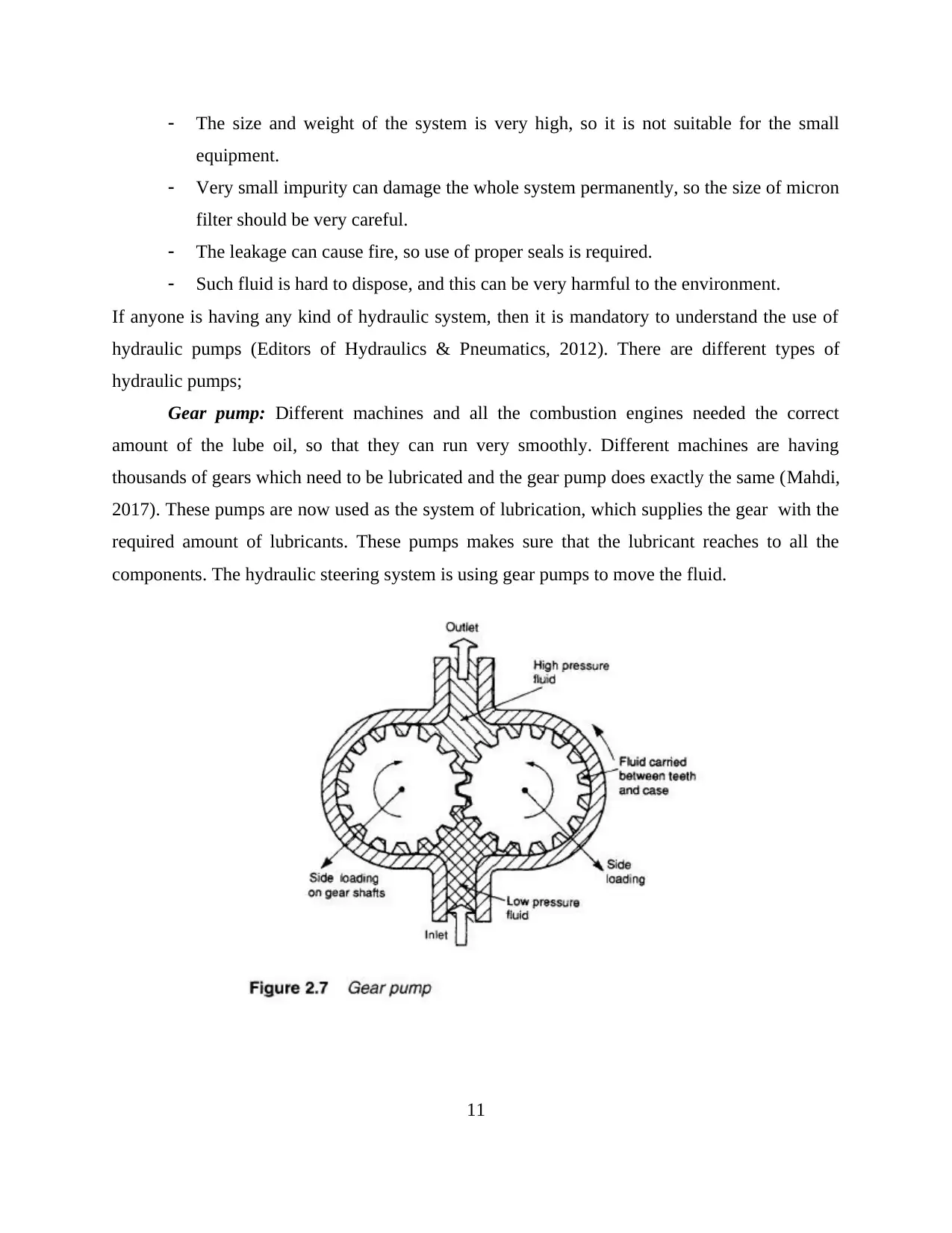
Gear pump: Different machines and all the combustion engines needed the correct
amount of the lube oil, so that they can run very smoothly. Different machines are having
thousands of gears which need to be lubricated and the gear pump does exactly the same (Mahdi,
2017). These pumps are now used as the system of lubrication, which supplies the gear with the
required amount of lubricants. These pumps makes sure that the lubricant reaches to all the
components. The hydraulic steering system is using gear pumps to move the fluid.
11
equipment.
Very small impurity can damage the whole system permanently, so the size of micron
filter should be very careful.
The leakage can cause fire, so use of proper seals is required.
Such fluid is hard to dispose, and this can be very harmful to the environment.
If anyone is having any kind of hydraulic system, then it is mandatory to understand the use of
hydraulic pumps (Editors of Hydraulics & Pneumatics, 2012). There are different types of
hydraulic pumps;
Gear pump: Different machines and all the combustion engines needed the correct
amount of the lube oil, so that they can run very smoothly. Different machines are having
thousands of gears which need to be lubricated and the gear pump does exactly the same (Mahdi,
2017). These pumps are now used as the system of lubrication, which supplies the gear with the
required amount of lubricants. These pumps makes sure that the lubricant reaches to all the
components. The hydraulic steering system is using gear pumps to move the fluid.
11
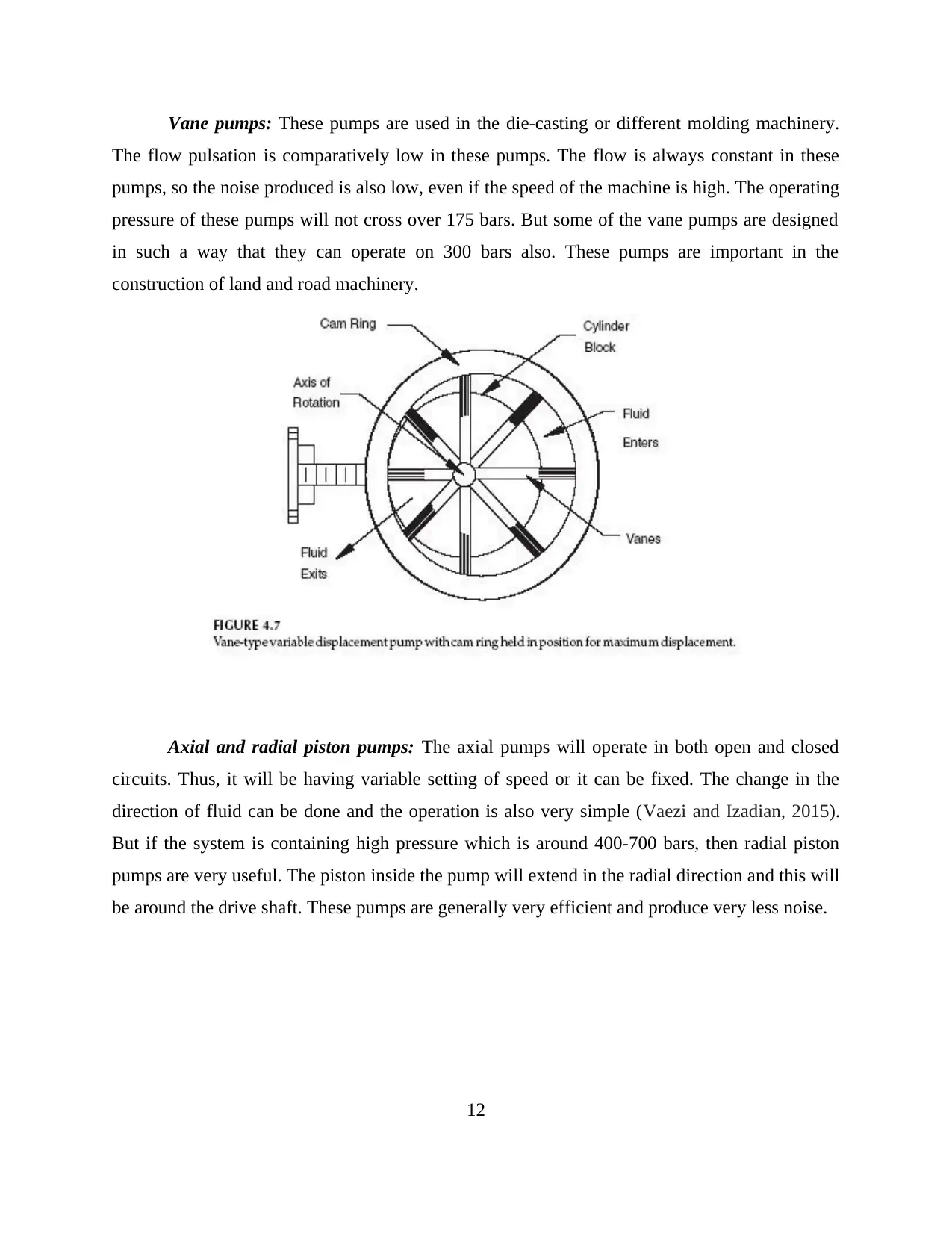
Vane pumps: These pumps are used in the die-casting or different molding machinery.
The flow pulsation is comparatively low in these pumps. The flow is always constant in these
pumps, so the noise produced is also low, even if the speed of the machine is high. The operating
pressure of these pumps will not cross over 175 bars. But some of the vane pumps are designed
in such a way that they can operate on 300 bars also. These pumps are important in the
construction of land and road machinery.
Axial and radial piston pumps: The axial pumps will operate in both open and closed
circuits. Thus, it will be having variable setting of speed or it can be fixed. The change in the
direction of fluid can be done and the operation is also very simple (Vaezi and Izadian, 2015).
But if the system is containing high pressure which is around 400-700 bars, then radial piston
pumps are very useful. The piston inside the pump will extend in the radial direction and this will
be around the drive shaft. These pumps are generally very efficient and produce very less noise.
12
The flow pulsation is comparatively low in these pumps. The flow is always constant in these
pumps, so the noise produced is also low, even if the speed of the machine is high. The operating
pressure of these pumps will not cross over 175 bars. But some of the vane pumps are designed
in such a way that they can operate on 300 bars also. These pumps are important in the
construction of land and road machinery.
Axial and radial piston pumps: The axial pumps will operate in both open and closed
circuits. Thus, it will be having variable setting of speed or it can be fixed. The change in the
direction of fluid can be done and the operation is also very simple (Vaezi and Izadian, 2015).
But if the system is containing high pressure which is around 400-700 bars, then radial piston
pumps are very useful. The piston inside the pump will extend in the radial direction and this will
be around the drive shaft. These pumps are generally very efficient and produce very less noise.
12
⊘ This is a preview!⊘
Do you want full access?
Subscribe today to unlock all pages.
Trusted by 1+ million students worldwide

1 out of 16


Related Documents


Your All-in-One AI-Powered Toolkit for Academic Success.
+13062052269
info@desklib.com
Available 24*7 on WhatsApp / Email
![[object Object]](/_next/static/media/star-bottom.7253800d.svg)
Unlock your academic potential
Copyright © 2020–2026 A2Z Services. All Rights Reserved. Developed and managed by ZUCOL.