Legal Analysis of Ali's Visa Application and Alternative Options
VerifiedAdded on 2022/09/14
|11
|2200
|11
Report
AI Summary
This report analyzes the case of Ali, an Afghan citizen in Australia on a visitor visa, and his potential visa options. It examines the validity of a potential partner visa based on his relationship with Michael, an Australian citizen, referencing the Migration Act 1958, Marriage Act 1961, and Marriage Regulations 2017. The analysis highlights legal barriers due to the absence of a legally recognized marriage and explores alternative visa subclasses, including protection visas and temporary partner visas (subclass 820). The report assesses Ali's eligibility for these visas, considering factors like his fear of persecution due to his sexual preference and his relationship with Michael, which qualifies as a de facto relationship. The report concludes with recommendations for Ali, including exploring alternative visa options and seeking advice from immigration offices.
Migration in Australia
Student Name
Student Number
Supervisor
Institutional Affiliation
Student Name
Student Number
Supervisor
Institutional Affiliation

Paraphrase This Document
Need a fresh take? Get an instant paraphrase of this document with our AI Paraphraser
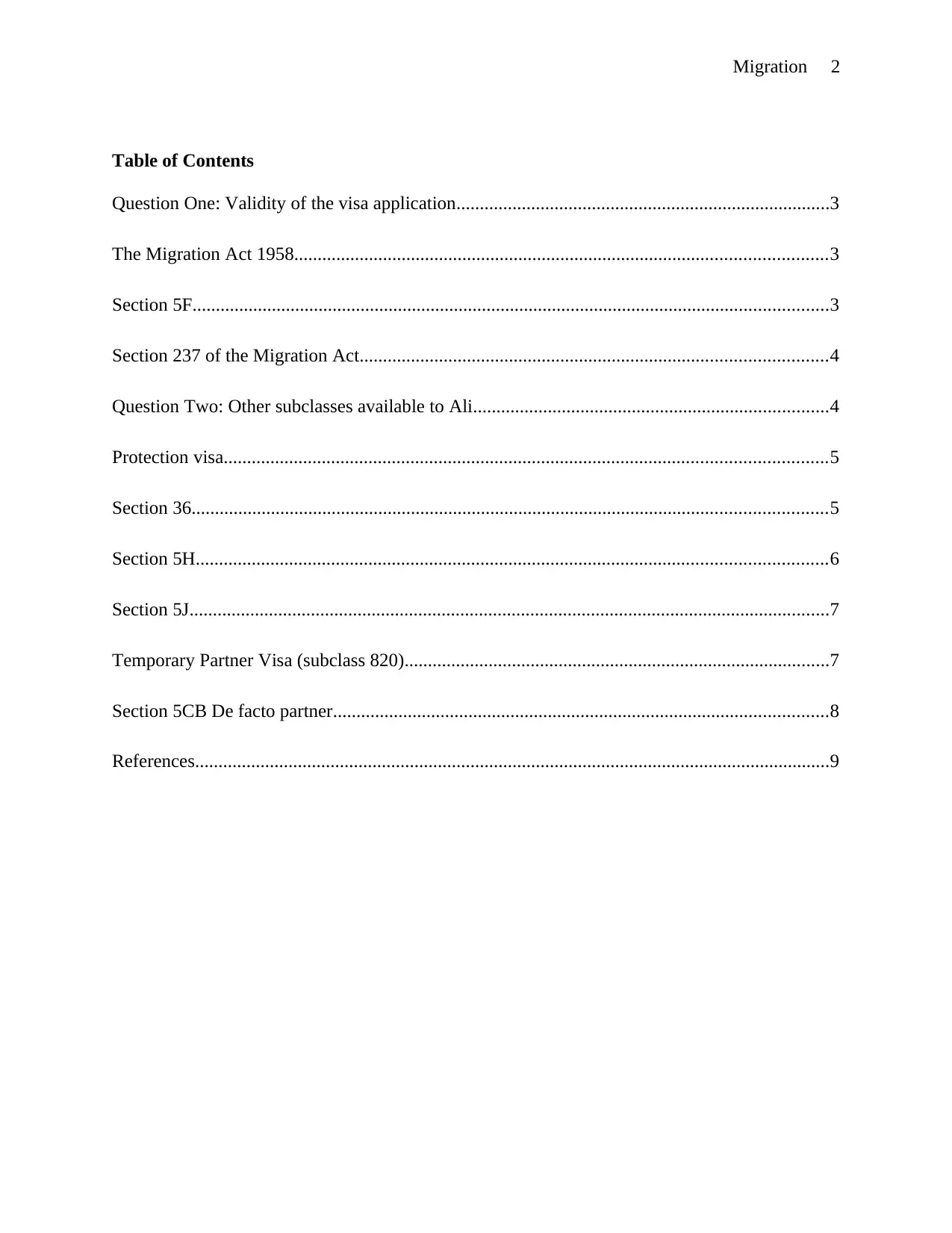
Migration 2
Table of Contents
Question One: Validity of the visa application................................................................................3
The Migration Act 1958..................................................................................................................3
Section 5F........................................................................................................................................3
Section 237 of the Migration Act....................................................................................................4
Question Two: Other subclasses available to Ali............................................................................4
Protection visa.................................................................................................................................5
Section 36........................................................................................................................................5
Section 5H.......................................................................................................................................6
Section 5J.........................................................................................................................................7
Temporary Partner Visa (subclass 820)...........................................................................................7
Section 5CB De facto partner..........................................................................................................8
References........................................................................................................................................9
Table of Contents
Question One: Validity of the visa application................................................................................3
The Migration Act 1958..................................................................................................................3
Section 5F........................................................................................................................................3
Section 237 of the Migration Act....................................................................................................4
Question Two: Other subclasses available to Ali............................................................................4
Protection visa.................................................................................................................................5
Section 36........................................................................................................................................5
Section 5H.......................................................................................................................................6
Section 5J.........................................................................................................................................7
Temporary Partner Visa (subclass 820)...........................................................................................7
Section 5CB De facto partner..........................................................................................................8
References........................................................................................................................................9
Migration 3
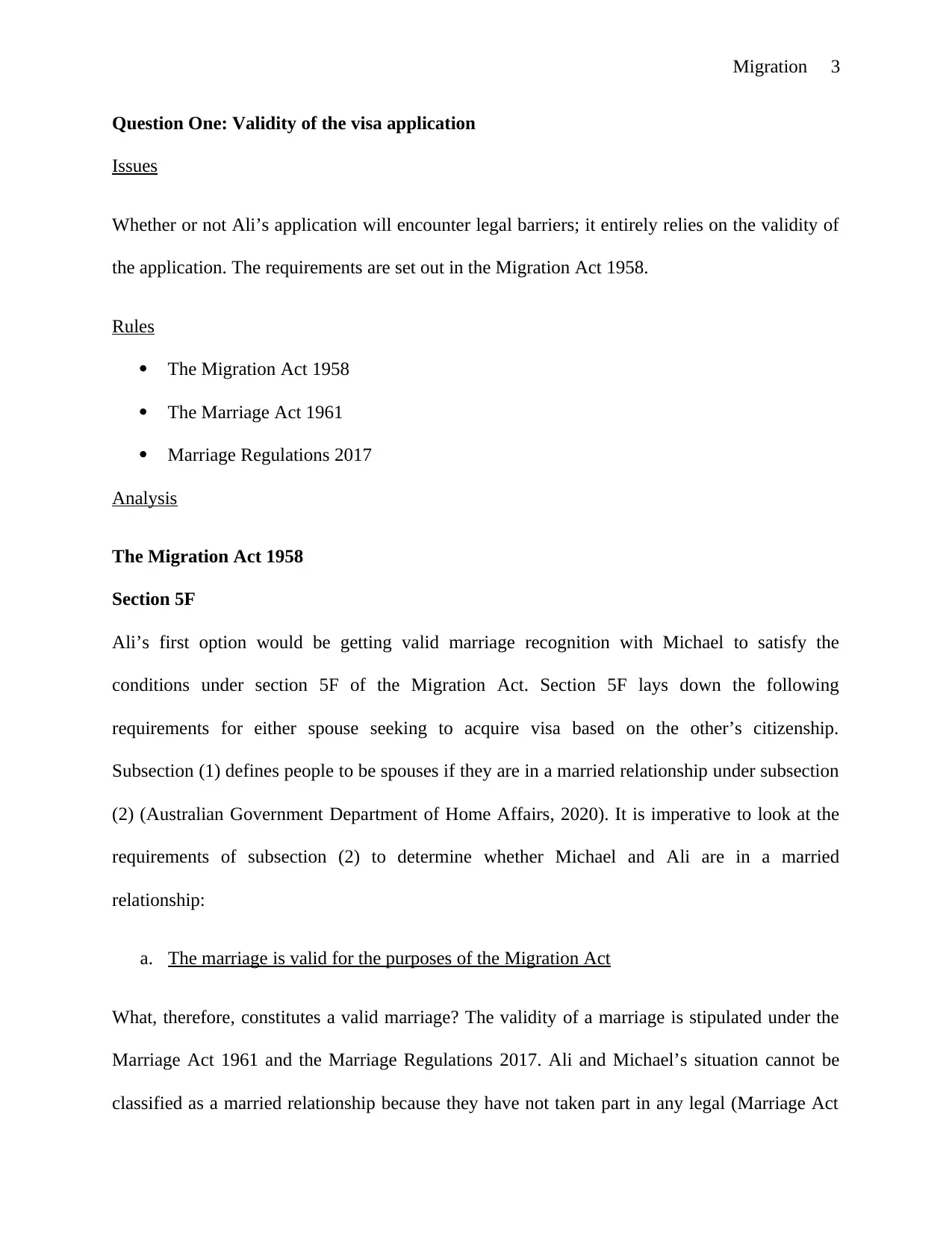
Question One: Validity of the visa application
Issues
Whether or not Ali’s application will encounter legal barriers; it entirely relies on the validity of
the application. The requirements are set out in the Migration Act 1958.
Rules
The Migration Act 1958
The Marriage Act 1961
Marriage Regulations 2017
Analysis
The Migration Act 1958
Section 5F
Ali’s first option would be getting valid marriage recognition with Michael to satisfy the
conditions under section 5F of the Migration Act. Section 5F lays down the following
requirements for either spouse seeking to acquire visa based on the other’s citizenship.
Subsection (1) defines people to be spouses if they are in a married relationship under subsection
(2) (Australian Government Department of Home Affairs, 2020). It is imperative to look at the
requirements of subsection (2) to determine whether Michael and Ali are in a married
relationship:
a. The marriage is valid for the purposes of the Migration Act
What, therefore, constitutes a valid marriage? The validity of a marriage is stipulated under the
Marriage Act 1961 and the Marriage Regulations 2017. Ali and Michael’s situation cannot be
classified as a married relationship because they have not taken part in any legal (Marriage Act
Question One: Validity of the visa application
Issues
Whether or not Ali’s application will encounter legal barriers; it entirely relies on the validity of
the application. The requirements are set out in the Migration Act 1958.
Rules
The Migration Act 1958
The Marriage Act 1961
Marriage Regulations 2017
Analysis
The Migration Act 1958
Section 5F
Ali’s first option would be getting valid marriage recognition with Michael to satisfy the
conditions under section 5F of the Migration Act. Section 5F lays down the following
requirements for either spouse seeking to acquire visa based on the other’s citizenship.
Subsection (1) defines people to be spouses if they are in a married relationship under subsection
(2) (Australian Government Department of Home Affairs, 2020). It is imperative to look at the
requirements of subsection (2) to determine whether Michael and Ali are in a married
relationship:
a. The marriage is valid for the purposes of the Migration Act
What, therefore, constitutes a valid marriage? The validity of a marriage is stipulated under the
Marriage Act 1961 and the Marriage Regulations 2017. Ali and Michael’s situation cannot be
classified as a married relationship because they have not taken part in any legal (Marriage Act
⊘ This is a preview!⊘
Do you want full access?
Subscribe today to unlock all pages.

Trusted by 1+ million students worldwide
Migration 4
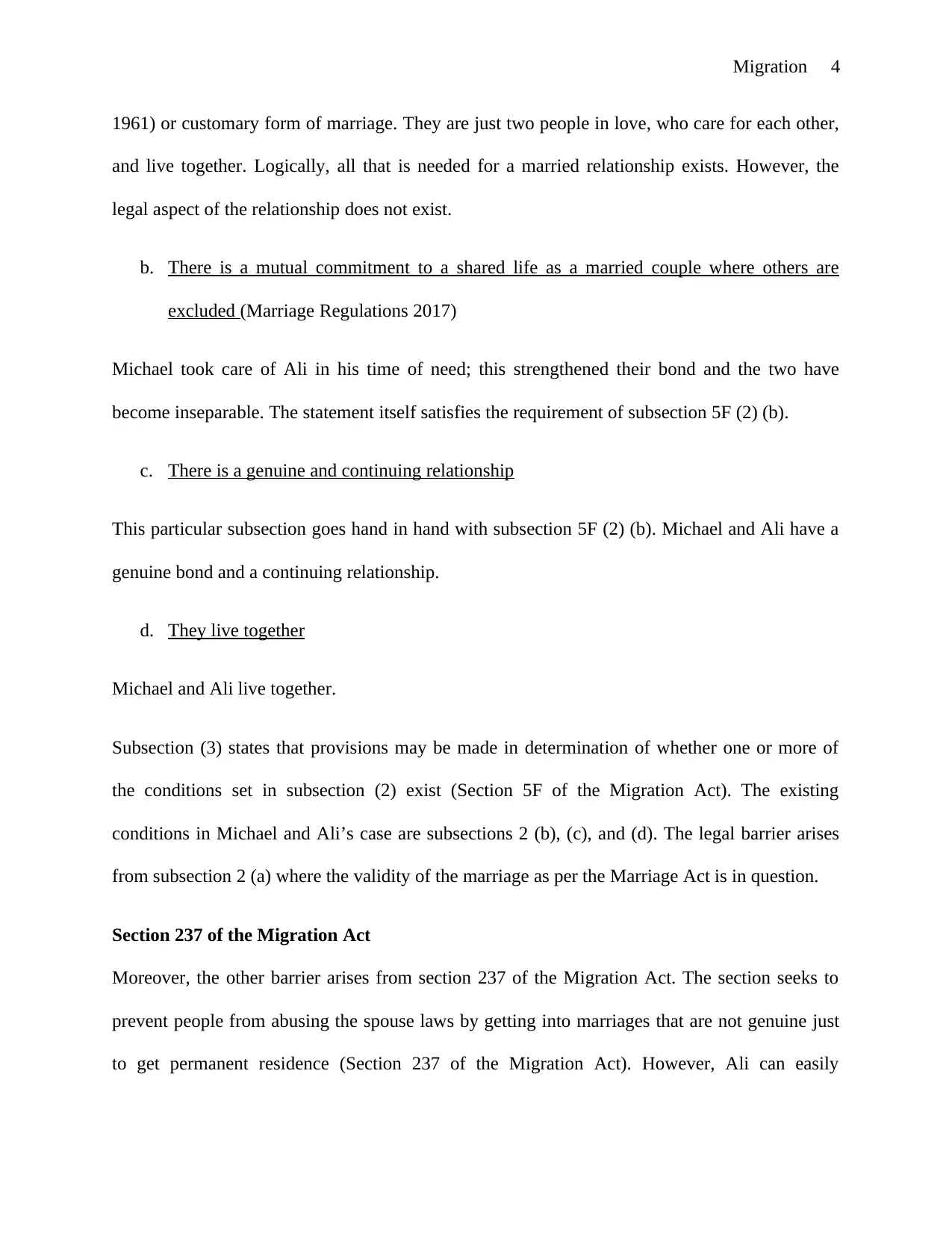
1961) or customary form of marriage. They are just two people in love, who care for each other,
and live together. Logically, all that is needed for a married relationship exists. However, the
legal aspect of the relationship does not exist.
b. There is a mutual commitment to a shared life as a married couple where others are
excluded (Marriage Regulations 2017)
Michael took care of Ali in his time of need; this strengthened their bond and the two have
become inseparable. The statement itself satisfies the requirement of subsection 5F (2) (b).
c. There is a genuine and continuing relationship
This particular subsection goes hand in hand with subsection 5F (2) (b). Michael and Ali have a
genuine bond and a continuing relationship.
d. They live together
Michael and Ali live together.
Subsection (3) states that provisions may be made in determination of whether one or more of
the conditions set in subsection (2) exist (Section 5F of the Migration Act). The existing
conditions in Michael and Ali’s case are subsections 2 (b), (c), and (d). The legal barrier arises
from subsection 2 (a) where the validity of the marriage as per the Marriage Act is in question.
Section 237 of the Migration Act
Moreover, the other barrier arises from section 237 of the Migration Act. The section seeks to
prevent people from abusing the spouse laws by getting into marriages that are not genuine just
to get permanent residence (Section 237 of the Migration Act). However, Ali can easily
1961) or customary form of marriage. They are just two people in love, who care for each other,
and live together. Logically, all that is needed for a married relationship exists. However, the
legal aspect of the relationship does not exist.
b. There is a mutual commitment to a shared life as a married couple where others are
excluded (Marriage Regulations 2017)
Michael took care of Ali in his time of need; this strengthened their bond and the two have
become inseparable. The statement itself satisfies the requirement of subsection 5F (2) (b).
c. There is a genuine and continuing relationship
This particular subsection goes hand in hand with subsection 5F (2) (b). Michael and Ali have a
genuine bond and a continuing relationship.
d. They live together
Michael and Ali live together.
Subsection (3) states that provisions may be made in determination of whether one or more of
the conditions set in subsection (2) exist (Section 5F of the Migration Act). The existing
conditions in Michael and Ali’s case are subsections 2 (b), (c), and (d). The legal barrier arises
from subsection 2 (a) where the validity of the marriage as per the Marriage Act is in question.
Section 237 of the Migration Act
Moreover, the other barrier arises from section 237 of the Migration Act. The section seeks to
prevent people from abusing the spouse laws by getting into marriages that are not genuine just
to get permanent residence (Section 237 of the Migration Act). However, Ali can easily
Paraphrase This Document
Need a fresh take? Get an instant paraphrase of this document with our AI Paraphraser
Migration 5
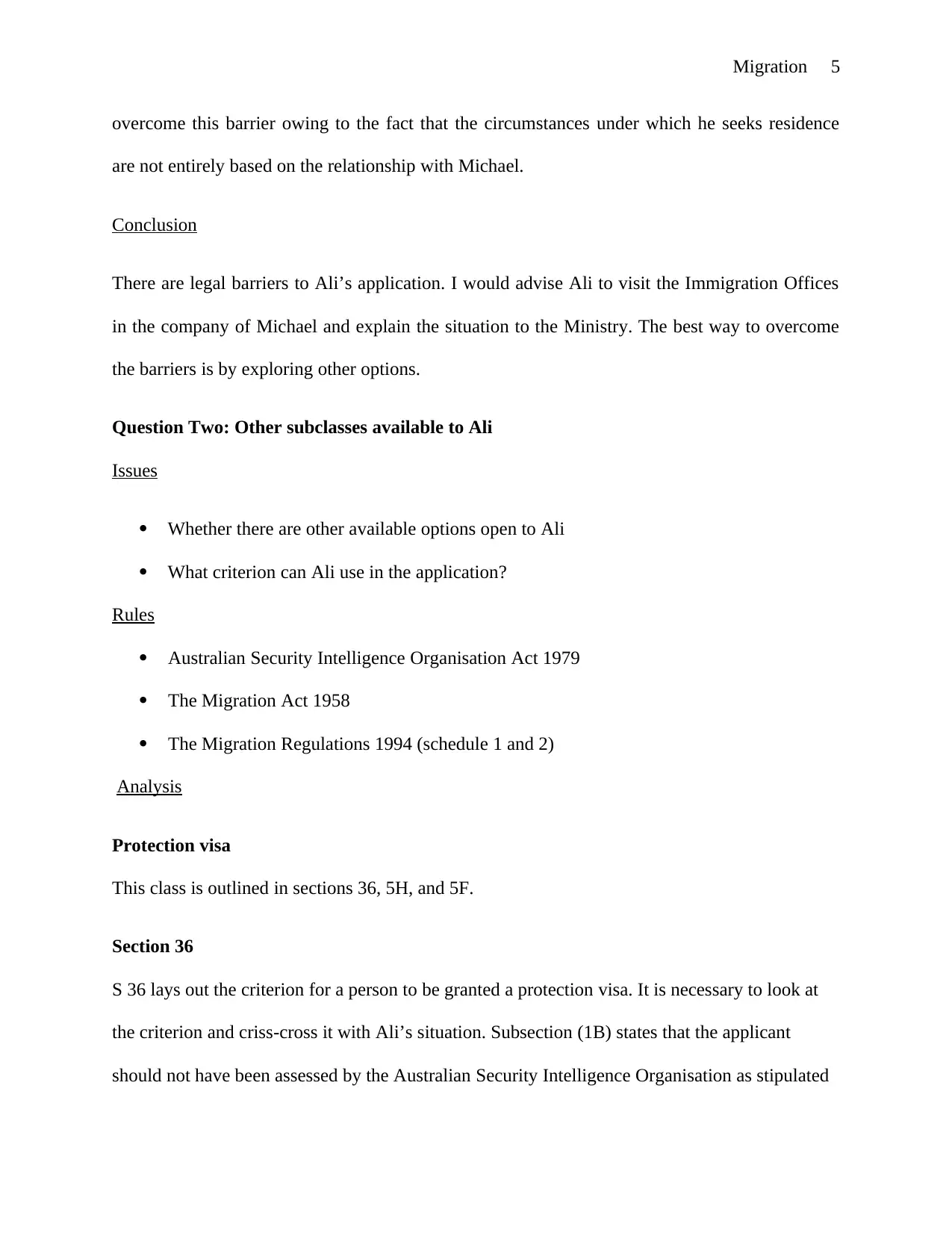
overcome this barrier owing to the fact that the circumstances under which he seeks residence
are not entirely based on the relationship with Michael.
Conclusion
There are legal barriers to Ali’s application. I would advise Ali to visit the Immigration Offices
in the company of Michael and explain the situation to the Ministry. The best way to overcome
the barriers is by exploring other options.
Question Two: Other subclasses available to Ali
Issues
Whether there are other available options open to Ali
What criterion can Ali use in the application?
Rules
Australian Security Intelligence Organisation Act 1979
The Migration Act 1958
The Migration Regulations 1994 (schedule 1 and 2)
Analysis
Protection visa
This class is outlined in sections 36, 5H, and 5F.
Section 36
S 36 lays out the criterion for a person to be granted a protection visa. It is necessary to look at
the criterion and criss-cross it with Ali’s situation. Subsection (1B) states that the applicant
should not have been assessed by the Australian Security Intelligence Organisation as stipulated
overcome this barrier owing to the fact that the circumstances under which he seeks residence
are not entirely based on the relationship with Michael.
Conclusion
There are legal barriers to Ali’s application. I would advise Ali to visit the Immigration Offices
in the company of Michael and explain the situation to the Ministry. The best way to overcome
the barriers is by exploring other options.
Question Two: Other subclasses available to Ali
Issues
Whether there are other available options open to Ali
What criterion can Ali use in the application?
Rules
Australian Security Intelligence Organisation Act 1979
The Migration Act 1958
The Migration Regulations 1994 (schedule 1 and 2)
Analysis
Protection visa
This class is outlined in sections 36, 5H, and 5F.
Section 36
S 36 lays out the criterion for a person to be granted a protection visa. It is necessary to look at
the criterion and criss-cross it with Ali’s situation. Subsection (1B) states that the applicant
should not have been assessed by the Australian Security Intelligence Organisation as stipulated
Migration 6
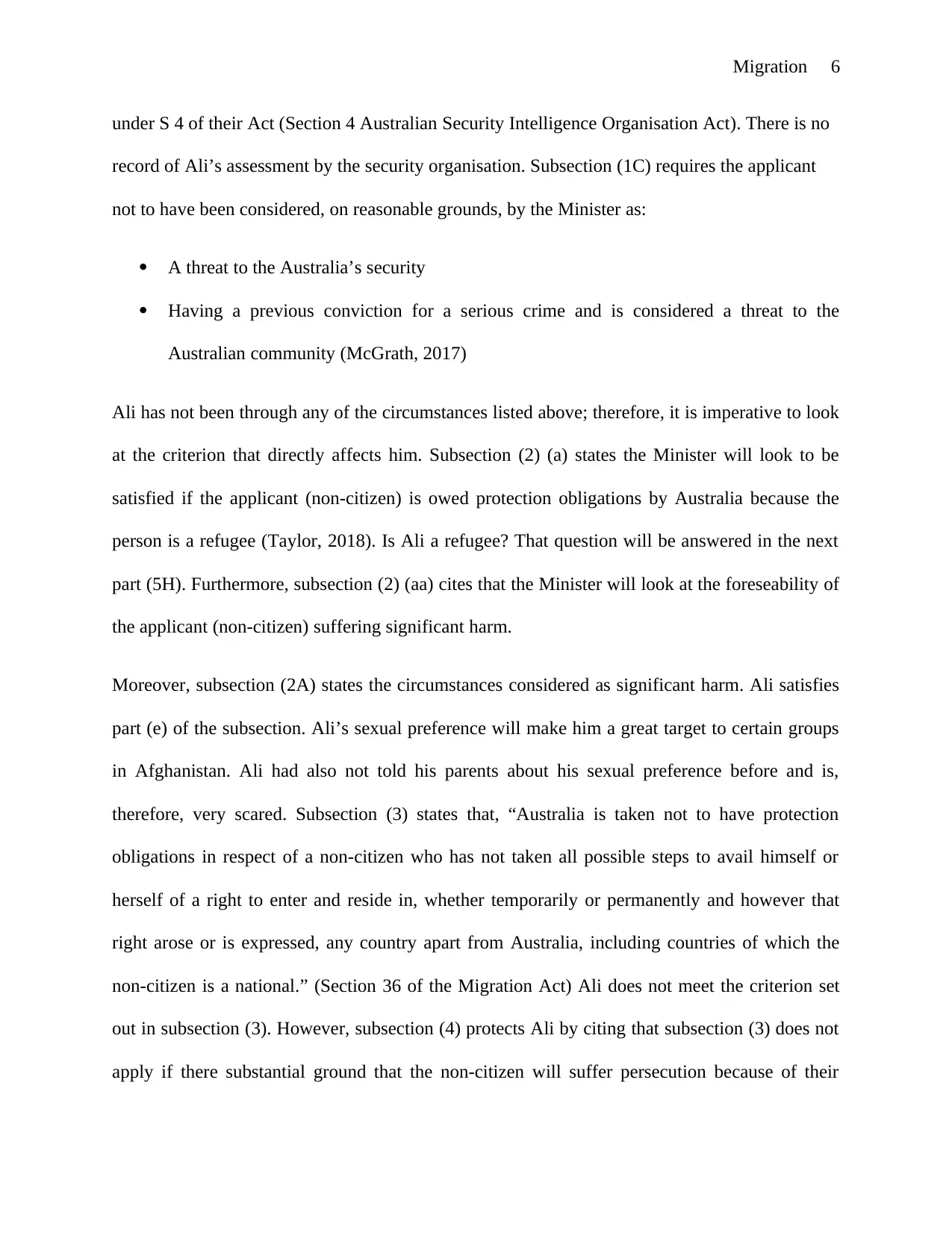
under S 4 of their Act (Section 4 Australian Security Intelligence Organisation Act). There is no
record of Ali’s assessment by the security organisation. Subsection (1C) requires the applicant
not to have been considered, on reasonable grounds, by the Minister as:
A threat to the Australia’s security
Having a previous conviction for a serious crime and is considered a threat to the
Australian community (McGrath, 2017)
Ali has not been through any of the circumstances listed above; therefore, it is imperative to look
at the criterion that directly affects him. Subsection (2) (a) states the Minister will look to be
satisfied if the applicant (non-citizen) is owed protection obligations by Australia because the
person is a refugee (Taylor, 2018). Is Ali a refugee? That question will be answered in the next
part (5H). Furthermore, subsection (2) (aa) cites that the Minister will look at the foreseability of
the applicant (non-citizen) suffering significant harm.
Moreover, subsection (2A) states the circumstances considered as significant harm. Ali satisfies
part (e) of the subsection. Ali’s sexual preference will make him a great target to certain groups
in Afghanistan. Ali had also not told his parents about his sexual preference before and is,
therefore, very scared. Subsection (3) states that, “Australia is taken not to have protection
obligations in respect of a non-citizen who has not taken all possible steps to avail himself or
herself of a right to enter and reside in, whether temporarily or permanently and however that
right arose or is expressed, any country apart from Australia, including countries of which the
non-citizen is a national.” (Section 36 of the Migration Act) Ali does not meet the criterion set
out in subsection (3). However, subsection (4) protects Ali by citing that subsection (3) does not
apply if there substantial ground that the non-citizen will suffer persecution because of their
under S 4 of their Act (Section 4 Australian Security Intelligence Organisation Act). There is no
record of Ali’s assessment by the security organisation. Subsection (1C) requires the applicant
not to have been considered, on reasonable grounds, by the Minister as:
A threat to the Australia’s security
Having a previous conviction for a serious crime and is considered a threat to the
Australian community (McGrath, 2017)
Ali has not been through any of the circumstances listed above; therefore, it is imperative to look
at the criterion that directly affects him. Subsection (2) (a) states the Minister will look to be
satisfied if the applicant (non-citizen) is owed protection obligations by Australia because the
person is a refugee (Taylor, 2018). Is Ali a refugee? That question will be answered in the next
part (5H). Furthermore, subsection (2) (aa) cites that the Minister will look at the foreseability of
the applicant (non-citizen) suffering significant harm.
Moreover, subsection (2A) states the circumstances considered as significant harm. Ali satisfies
part (e) of the subsection. Ali’s sexual preference will make him a great target to certain groups
in Afghanistan. Ali had also not told his parents about his sexual preference before and is,
therefore, very scared. Subsection (3) states that, “Australia is taken not to have protection
obligations in respect of a non-citizen who has not taken all possible steps to avail himself or
herself of a right to enter and reside in, whether temporarily or permanently and however that
right arose or is expressed, any country apart from Australia, including countries of which the
non-citizen is a national.” (Section 36 of the Migration Act) Ali does not meet the criterion set
out in subsection (3). However, subsection (4) protects Ali by citing that subsection (3) does not
apply if there substantial ground that the non-citizen will suffer persecution because of their
⊘ This is a preview!⊘
Do you want full access?
Subscribe today to unlock all pages.
Trusted by 1+ million students worldwide
Migration 7
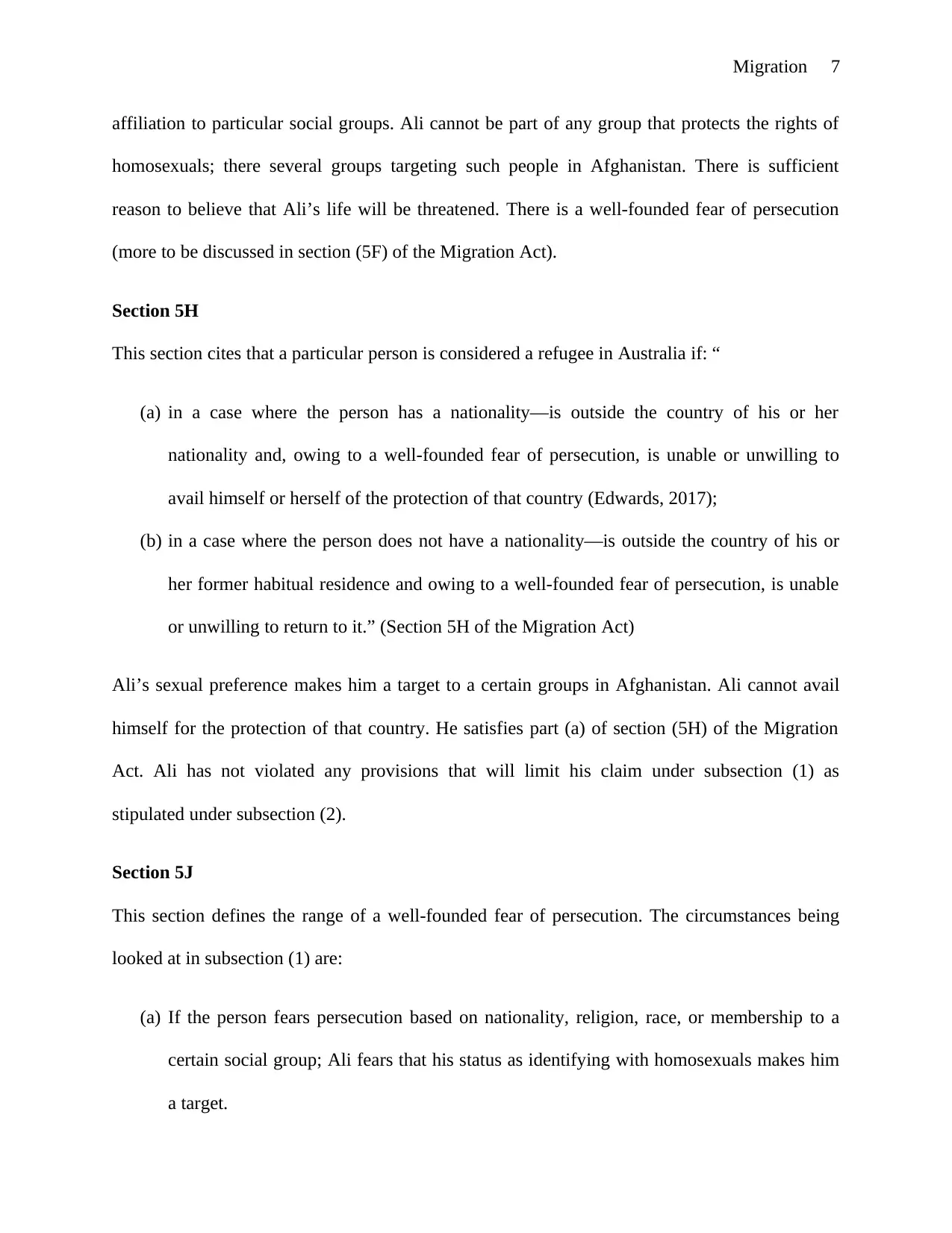
affiliation to particular social groups. Ali cannot be part of any group that protects the rights of
homosexuals; there several groups targeting such people in Afghanistan. There is sufficient
reason to believe that Ali’s life will be threatened. There is a well-founded fear of persecution
(more to be discussed in section (5F) of the Migration Act).
Section 5H
This section cites that a particular person is considered a refugee in Australia if: “
(a) in a case where the person has a nationality—is outside the country of his or her
nationality and, owing to a well-founded fear of persecution, is unable or unwilling to
avail himself or herself of the protection of that country (Edwards, 2017);
(b) in a case where the person does not have a nationality—is outside the country of his or
her former habitual residence and owing to a well-founded fear of persecution, is unable
or unwilling to return to it.” (Section 5H of the Migration Act)
Ali’s sexual preference makes him a target to a certain groups in Afghanistan. Ali cannot avail
himself for the protection of that country. He satisfies part (a) of section (5H) of the Migration
Act. Ali has not violated any provisions that will limit his claim under subsection (1) as
stipulated under subsection (2).
Section 5J
This section defines the range of a well-founded fear of persecution. The circumstances being
looked at in subsection (1) are:
(a) If the person fears persecution based on nationality, religion, race, or membership to a
certain social group; Ali fears that his status as identifying with homosexuals makes him
a target.
affiliation to particular social groups. Ali cannot be part of any group that protects the rights of
homosexuals; there several groups targeting such people in Afghanistan. There is sufficient
reason to believe that Ali’s life will be threatened. There is a well-founded fear of persecution
(more to be discussed in section (5F) of the Migration Act).
Section 5H
This section cites that a particular person is considered a refugee in Australia if: “
(a) in a case where the person has a nationality—is outside the country of his or her
nationality and, owing to a well-founded fear of persecution, is unable or unwilling to
avail himself or herself of the protection of that country (Edwards, 2017);
(b) in a case where the person does not have a nationality—is outside the country of his or
her former habitual residence and owing to a well-founded fear of persecution, is unable
or unwilling to return to it.” (Section 5H of the Migration Act)
Ali’s sexual preference makes him a target to a certain groups in Afghanistan. Ali cannot avail
himself for the protection of that country. He satisfies part (a) of section (5H) of the Migration
Act. Ali has not violated any provisions that will limit his claim under subsection (1) as
stipulated under subsection (2).
Section 5J
This section defines the range of a well-founded fear of persecution. The circumstances being
looked at in subsection (1) are:
(a) If the person fears persecution based on nationality, religion, race, or membership to a
certain social group; Ali fears that his status as identifying with homosexuals makes him
a target.
Paraphrase This Document
Need a fresh take? Get an instant paraphrase of this document with our AI Paraphraser
Migration 8
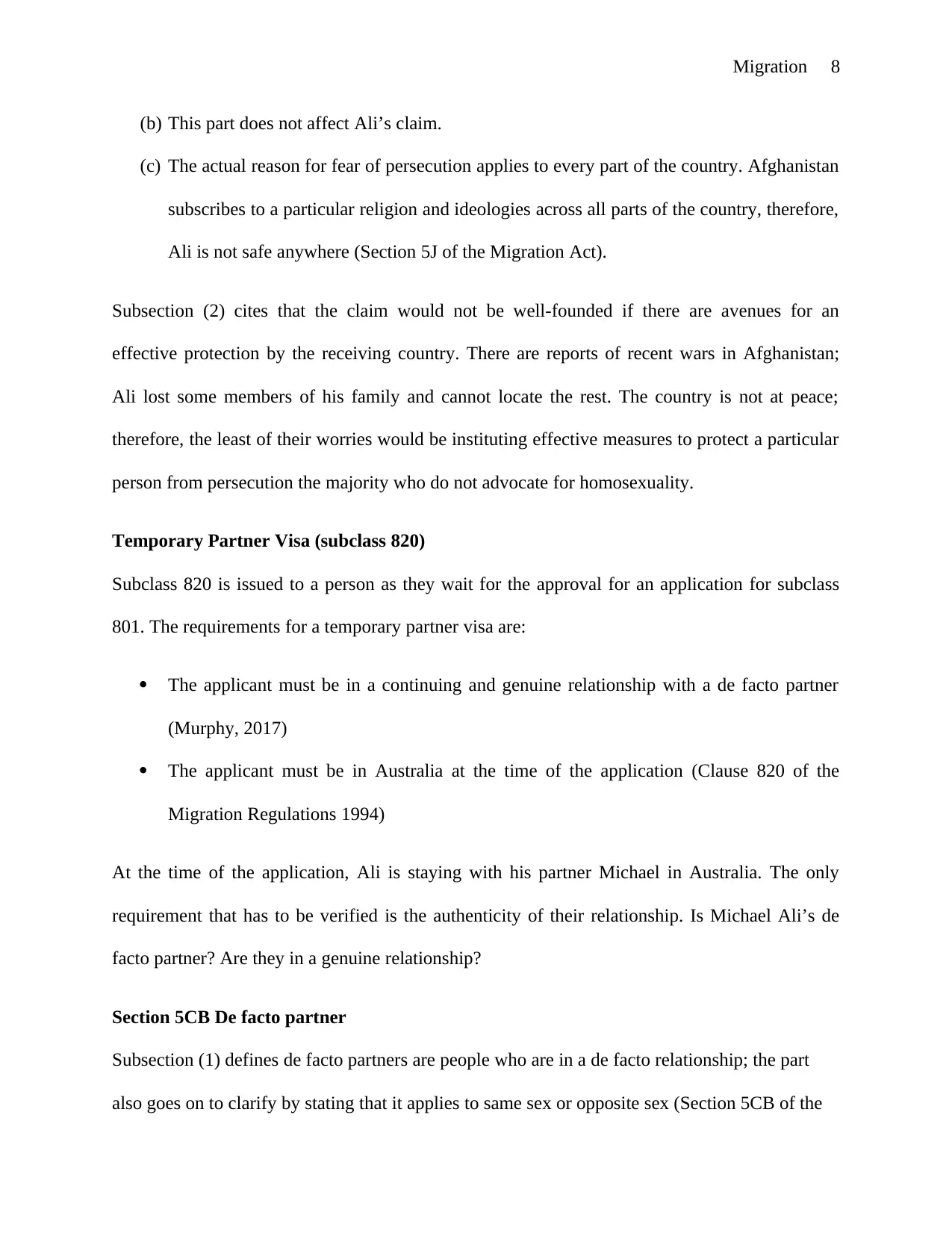
(b) This part does not affect Ali’s claim.
(c) The actual reason for fear of persecution applies to every part of the country. Afghanistan
subscribes to a particular religion and ideologies across all parts of the country, therefore,
Ali is not safe anywhere (Section 5J of the Migration Act).
Subsection (2) cites that the claim would not be well-founded if there are avenues for an
effective protection by the receiving country. There are reports of recent wars in Afghanistan;
Ali lost some members of his family and cannot locate the rest. The country is not at peace;
therefore, the least of their worries would be instituting effective measures to protect a particular
person from persecution the majority who do not advocate for homosexuality.
Temporary Partner Visa (subclass 820)
Subclass 820 is issued to a person as they wait for the approval for an application for subclass
801. The requirements for a temporary partner visa are:
The applicant must be in a continuing and genuine relationship with a de facto partner
(Murphy, 2017)
The applicant must be in Australia at the time of the application (Clause 820 of the
Migration Regulations 1994)
At the time of the application, Ali is staying with his partner Michael in Australia. The only
requirement that has to be verified is the authenticity of their relationship. Is Michael Ali’s de
facto partner? Are they in a genuine relationship?
Section 5CB De facto partner
Subsection (1) defines de facto partners are people who are in a de facto relationship; the part
also goes on to clarify by stating that it applies to same sex or opposite sex (Section 5CB of the
(b) This part does not affect Ali’s claim.
(c) The actual reason for fear of persecution applies to every part of the country. Afghanistan
subscribes to a particular religion and ideologies across all parts of the country, therefore,
Ali is not safe anywhere (Section 5J of the Migration Act).
Subsection (2) cites that the claim would not be well-founded if there are avenues for an
effective protection by the receiving country. There are reports of recent wars in Afghanistan;
Ali lost some members of his family and cannot locate the rest. The country is not at peace;
therefore, the least of their worries would be instituting effective measures to protect a particular
person from persecution the majority who do not advocate for homosexuality.
Temporary Partner Visa (subclass 820)
Subclass 820 is issued to a person as they wait for the approval for an application for subclass
801. The requirements for a temporary partner visa are:
The applicant must be in a continuing and genuine relationship with a de facto partner
(Murphy, 2017)
The applicant must be in Australia at the time of the application (Clause 820 of the
Migration Regulations 1994)
At the time of the application, Ali is staying with his partner Michael in Australia. The only
requirement that has to be verified is the authenticity of their relationship. Is Michael Ali’s de
facto partner? Are they in a genuine relationship?
Section 5CB De facto partner
Subsection (1) defines de facto partners are people who are in a de facto relationship; the part
also goes on to clarify by stating that it applies to same sex or opposite sex (Section 5CB of the
Migration 9
Migration Act). What constitutes a de facto relationship? Subsection (2) stipulates that people are
termed to be in a de facto relationship if they are not in a married relationship as stated in section
(5F), but:
They are mutually committed to a shared life that others are excluded
They have a continuing and genuine relationship
They do not live apart/separately on a permanent basis – they live together
They are not family-related (Changes to Spouse/Partner Visa Sponsorship Immigration to
Australia, 2020)
Michael and Ali’s relationship qualifies to be a de facto relationship. They live together in
Michael’s house. They have been in the relationship genuinely even before Ali had the passport
issue. Michael took leave from his work to look after Ali when Ali lost his dad; the two became
inseparable after that. Ali comes from Afghanistan while Michael is Australian; they are not
from the same family. Ali, therefore, meets the requirements for a temporary partner visa.
Conclusion
There are two other subclasses that Ali could seek to apply for. The subclasses are:
Protection visa
Temporary partner visa (subclasses 801 and 820)
Migration Act). What constitutes a de facto relationship? Subsection (2) stipulates that people are
termed to be in a de facto relationship if they are not in a married relationship as stated in section
(5F), but:
They are mutually committed to a shared life that others are excluded
They have a continuing and genuine relationship
They do not live apart/separately on a permanent basis – they live together
They are not family-related (Changes to Spouse/Partner Visa Sponsorship Immigration to
Australia, 2020)
Michael and Ali’s relationship qualifies to be a de facto relationship. They live together in
Michael’s house. They have been in the relationship genuinely even before Ali had the passport
issue. Michael took leave from his work to look after Ali when Ali lost his dad; the two became
inseparable after that. Ali comes from Afghanistan while Michael is Australian; they are not
from the same family. Ali, therefore, meets the requirements for a temporary partner visa.
Conclusion
There are two other subclasses that Ali could seek to apply for. The subclasses are:
Protection visa
Temporary partner visa (subclasses 801 and 820)
⊘ This is a preview!⊘
Do you want full access?
Subscribe today to unlock all pages.
Trusted by 1+ million students worldwide
Migration 10
References
Articles, Books, and Journals
Edwards, A., 2017. Tampering with refugee protection: the case of Australia. International
Journal of Refugee Law, 15(2), pp.192-211
McGrath, J., 2017. A path of devotion: Migration law and the art of specialising. Bulletin (Law
Society of South Australia), 39(1), p.8.
Murphy, K., 2017. Breaking down the 457 visa changes. Eureka Street, 27(7), p.8.
Taylor, S., 2018. Asylum-seeking children and the Australian protection visa process. In
Protecting Migrant Children. Edward Elgar Publishing.
Legislation
Australian Security Intelligence Organisation Act 1979
Migration Regulations 1994
Marriage Act 1961
Marriage Regulations 2017
The Migration Act 1958
Websites
Australian Government Department of Home Affairs [online] Available at
<https://immi.homeaffairs.gov.au/visas/getting-a-visa/visa-listing/partner-onshore/temporary-
820> [Accessed 8 April 2020]
Victory Law | Barristers & Solicitors in Melbourne 2020. Changes to Spouse/Partner Visa
Sponsorship Immigration to Australia [online] Available at
References
Articles, Books, and Journals
Edwards, A., 2017. Tampering with refugee protection: the case of Australia. International
Journal of Refugee Law, 15(2), pp.192-211
McGrath, J., 2017. A path of devotion: Migration law and the art of specialising. Bulletin (Law
Society of South Australia), 39(1), p.8.
Murphy, K., 2017. Breaking down the 457 visa changes. Eureka Street, 27(7), p.8.
Taylor, S., 2018. Asylum-seeking children and the Australian protection visa process. In
Protecting Migrant Children. Edward Elgar Publishing.
Legislation
Australian Security Intelligence Organisation Act 1979
Migration Regulations 1994
Marriage Act 1961
Marriage Regulations 2017
The Migration Act 1958
Websites
Australian Government Department of Home Affairs [online] Available at
<https://immi.homeaffairs.gov.au/visas/getting-a-visa/visa-listing/partner-onshore/temporary-
820> [Accessed 8 April 2020]
Victory Law | Barristers & Solicitors in Melbourne 2020. Changes to Spouse/Partner Visa
Sponsorship Immigration to Australia [online] Available at
Paraphrase This Document
Need a fresh take? Get an instant paraphrase of this document with our AI Paraphraser
Migration 11
https://www.victorylaw.com.au/articles/migration/australian-visas/partner-spouse-visa-australia/
spouse-partner-visa-prospective-marriage-immigration-australia/ [Accessed 8 April 20202]
https://www.victorylaw.com.au/articles/migration/australian-visas/partner-spouse-visa-australia/
spouse-partner-visa-prospective-marriage-immigration-australia/ [Accessed 8 April 20202]

1 out of 11


Related Documents


![R v Gowda; R v Mashru [2018] QCA 31: A Case Study on Migration Law](/_next/image/?url=https%3A%2F%2Fdesklib.com%2Fmedia%2Fimplications-r-v-gowda-mashru-migration-law_page_2.jpg&w=256&q=75)


Your All-in-One AI-Powered Toolkit for Academic Success.
+13062052269
info@desklib.com
Available 24*7 on WhatsApp / Email
![[object Object]](/_next/static/media/star-bottom.7253800d.svg)
Unlock your academic potential
Copyright © 2020–2026 A2Z Services. All Rights Reserved. Developed and managed by ZUCOL.