Detailed Report on All-Flash FAS Array: NetApp's Storage Technology
VerifiedAdded on 2023/05/30
|15
|1725
|127
Report
AI Summary
This report provides an overview of NetApp's All-Flash FAS (Flash Array Storage) arrays, highlighting their increasing popularity due to greater speed and reduced capacity usage. It emphasizes the advantages of flash storage, such as consolidated apps, lower power consumption, and enhanced performance. The report discusses the benefits of combining enterprise data management with flash technology, focusing on storage efficiency, availability, and performance. It covers the functionalities, advantages, and hardware features of NetApp FAS systems, including de-staged writes, proximal data patterns, and read-ahead caching. The report also contrasts all-flash arrays with hybrid flash arrays, emphasizing the cost-effectiveness and enhanced performance of both. It concludes that both array types offer cloud-ready capabilities, guaranteed availability, and timeless storage, making them valuable solutions for modern data management needs. Desklib provides access to similar reports and solved assignments for students.

1
A L L - F L A S H FA S
A R R AY- N E TA P P
S T U D E N T N A M E
A L L - F L A S H FA S
A R R AY- N E TA P P
S T U D E N T N A M E
Paraphrase This Document
Need a fresh take? Get an instant paraphrase of this document with our AI Paraphraser

2
INTRODUCTION
• Flash storage is gaining popularity at a high rate because of its
greater speed and the ability to utilize less capacity.
• Flash allows organizations to enjoy advantages like consolidated
apps, reduced power consumption per machine, and increased
performance.
• NetApp provides all-flash FAS storage arrays that can be
implemented as a section of scaled-out architecture that is unified
and that bring numerous advantages to the leading industry data
management properties of ONTAP operating system.
• Combining enterprise data management and flash technology
bring benefits to three main areas: storage efficiency, availability,
and performance.
INTRODUCTION
• Flash storage is gaining popularity at a high rate because of its
greater speed and the ability to utilize less capacity.
• Flash allows organizations to enjoy advantages like consolidated
apps, reduced power consumption per machine, and increased
performance.
• NetApp provides all-flash FAS storage arrays that can be
implemented as a section of scaled-out architecture that is unified
and that bring numerous advantages to the leading industry data
management properties of ONTAP operating system.
• Combining enterprise data management and flash technology
bring benefits to three main areas: storage efficiency, availability,
and performance.

3
ALL-FLASH ARRAYS
• Solid state disks (SSDs) stores data in all-flash arrays.
• Flash media is used only for non-volatile and persistent storage- data
that cannot be affected by power failures or blackouts.
• Speed is one key property of all-flash because it has no moving parts
making it easier and faster to carry out I/O operations and quick read
and write. Because of the high performance offered by all-flash
makes it possible to run critical applications that require high-speed
data input.
• It also consumers less power because flash runs on solid state disks
that has no moving part thus requires not or less cooling.
ALL-FLASH ARRAYS
• Solid state disks (SSDs) stores data in all-flash arrays.
• Flash media is used only for non-volatile and persistent storage- data
that cannot be affected by power failures or blackouts.
• Speed is one key property of all-flash because it has no moving parts
making it easier and faster to carry out I/O operations and quick read
and write. Because of the high performance offered by all-flash
makes it possible to run critical applications that require high-speed
data input.
• It also consumers less power because flash runs on solid state disks
that has no moving part thus requires not or less cooling.
⊘ This is a preview!⊘
Do you want full access?
Subscribe today to unlock all pages.

Trusted by 1+ million students worldwide

4
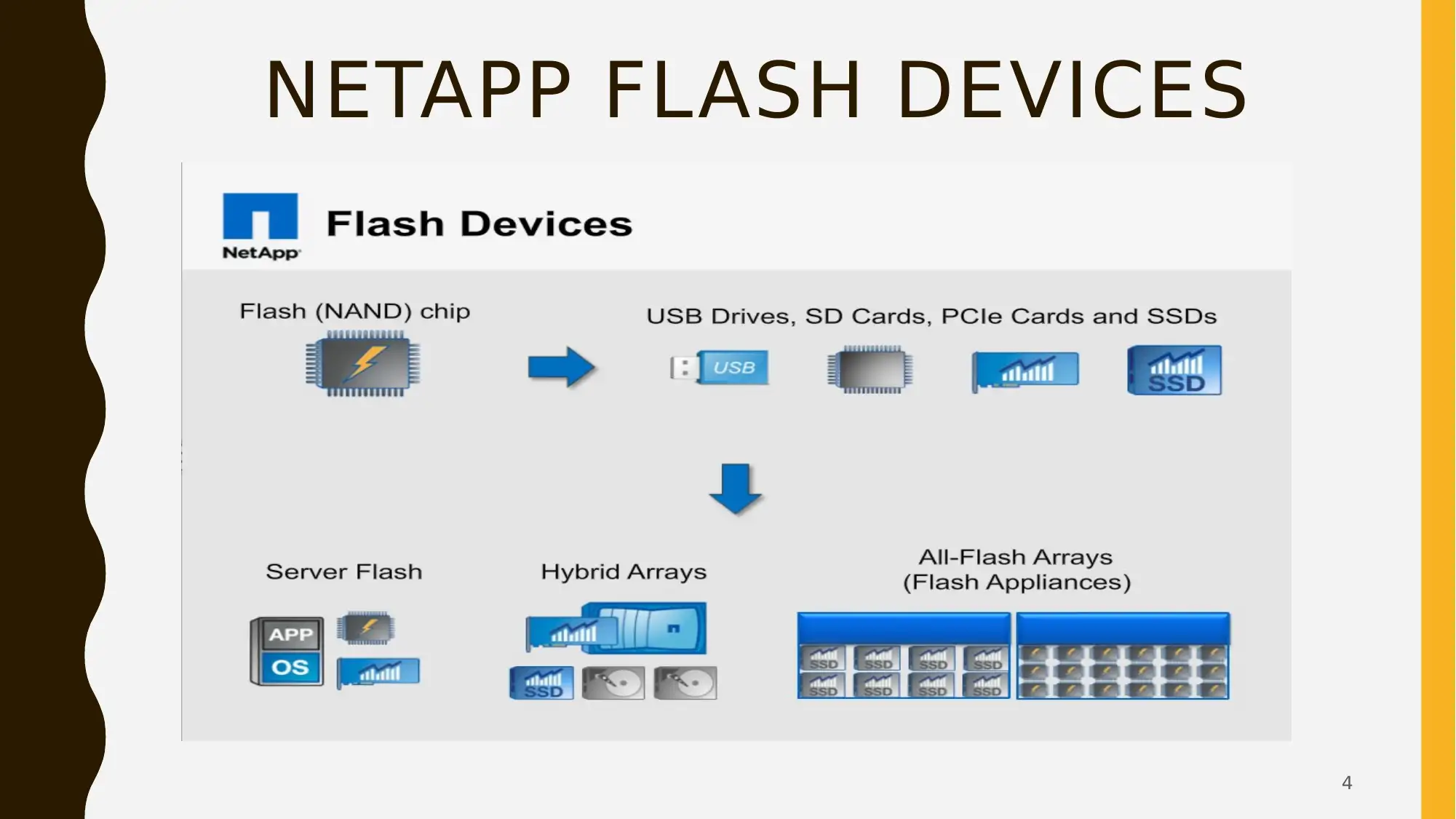
NETAPP FLASH DEVICES
Paraphrase This Document
Need a fresh take? Get an instant paraphrase of this document with our AI Paraphraser

5
ADVANTAGES OF ALL-FLASH ARRAYS
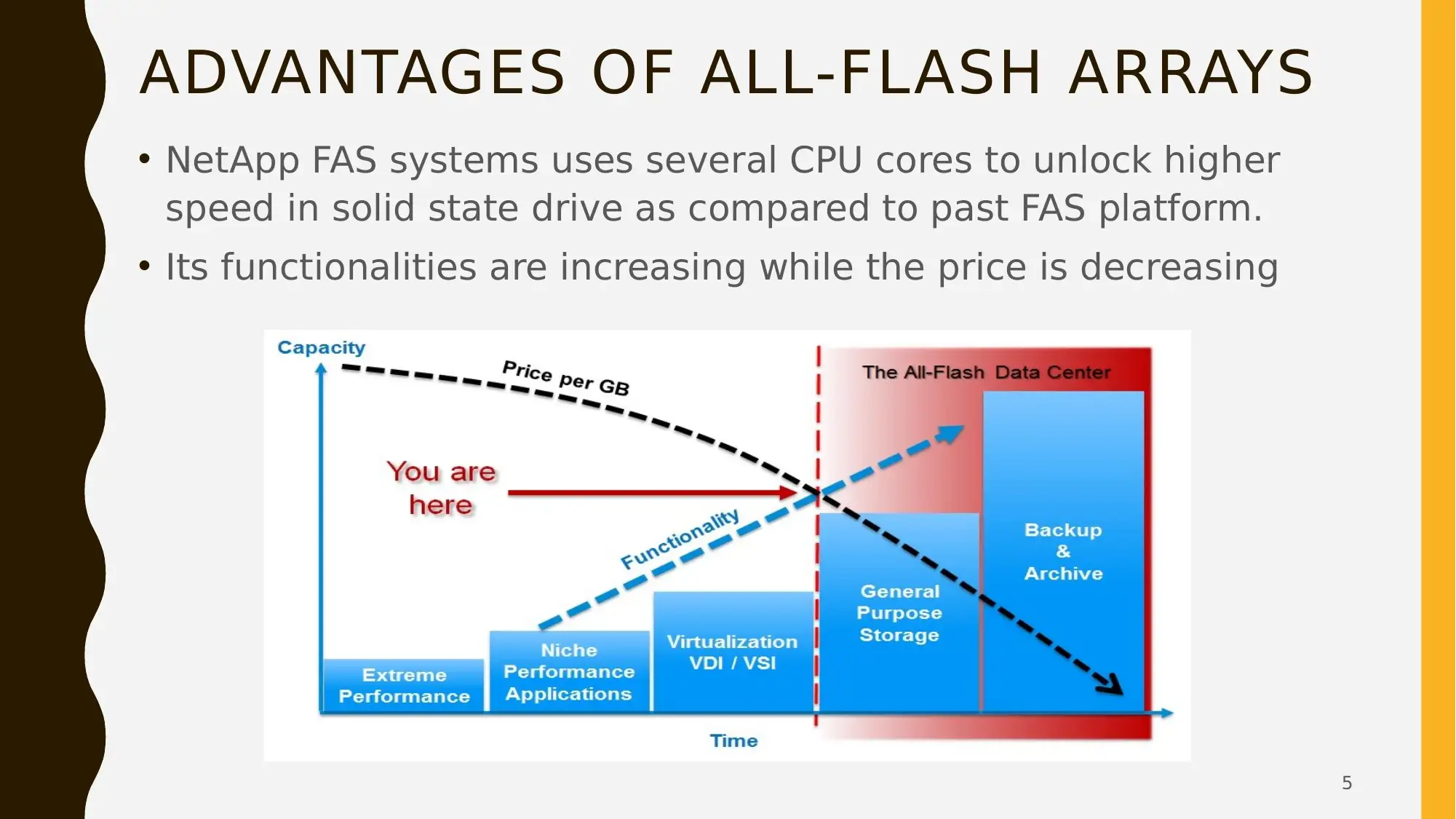
• NetApp FAS systems uses several CPU cores to unlock higher
speed in solid state drive as compared to past FAS platform.
• Its functionalities are increasing while the price is decreasing
ADVANTAGES OF ALL-FLASH ARRAYS
• NetApp FAS systems uses several CPU cores to unlock higher
speed in solid state drive as compared to past FAS platform.
• Its functionalities are increasing while the price is decreasing

6
ADVANTAGES OF ALL-FLASH
ARRAYS• The new hardware features allow NetApp FAS systems to
enhance the performance of solid-state drive including:
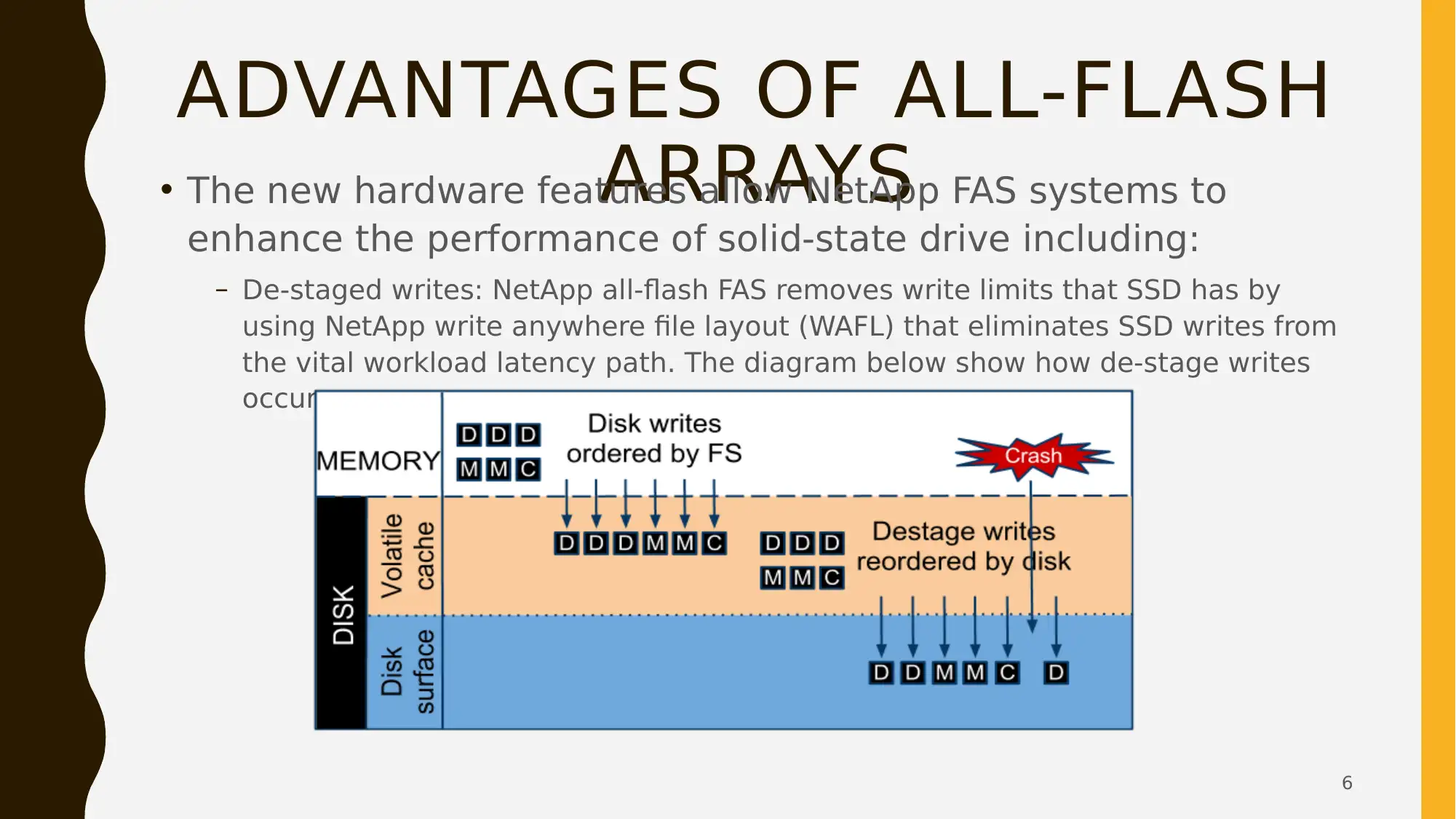
– De-staged writes: NetApp all-flash FAS removes write limits that SSD has by
using NetApp write anywhere file layout (WAFL) that eliminates SSD writes from
the vital workload latency path. The diagram below show how de-stage writes
occur
ADVANTAGES OF ALL-FLASH
ARRAYS• The new hardware features allow NetApp FAS systems to
enhance the performance of solid-state drive including:
– De-staged writes: NetApp all-flash FAS removes write limits that SSD has by
using NetApp write anywhere file layout (WAFL) that eliminates SSD writes from
the vital workload latency path. The diagram below show how de-stage writes
occur
⊘ This is a preview!⊘
Do you want full access?
Subscribe today to unlock all pages.

Trusted by 1+ million students worldwide

7
ADVANTAGES OF ALL-FLASH
ARRAYS• The new hardware features allow NetApp FAS systems to
enhance the performance of solid-state drive including:
– Proximal Data Patterns: to reduce the effects that random operations have on
the SSD, WAFL employs the use of proximal write patterns and a highly flexible
SSD write allocation policies as writes are de-staged to the SSD from the
memory. No blocks are assigned permanently to disked locations that are fixed
by adopting these practices.
ADVANTAGES OF ALL-FLASH
ARRAYS• The new hardware features allow NetApp FAS systems to
enhance the performance of solid-state drive including:
– Proximal Data Patterns: to reduce the effects that random operations have on
the SSD, WAFL employs the use of proximal write patterns and a highly flexible
SSD write allocation policies as writes are de-staged to the SSD from the
memory. No blocks are assigned permanently to disked locations that are fixed
by adopting these practices.
Paraphrase This Document
Need a fresh take? Get an instant paraphrase of this document with our AI Paraphraser

8
ADVANTAGES OF ALL-FLASH
ARRAYS• The new hardware features allow NetApp FAS systems to
enhance the performance of solid-state drive including:
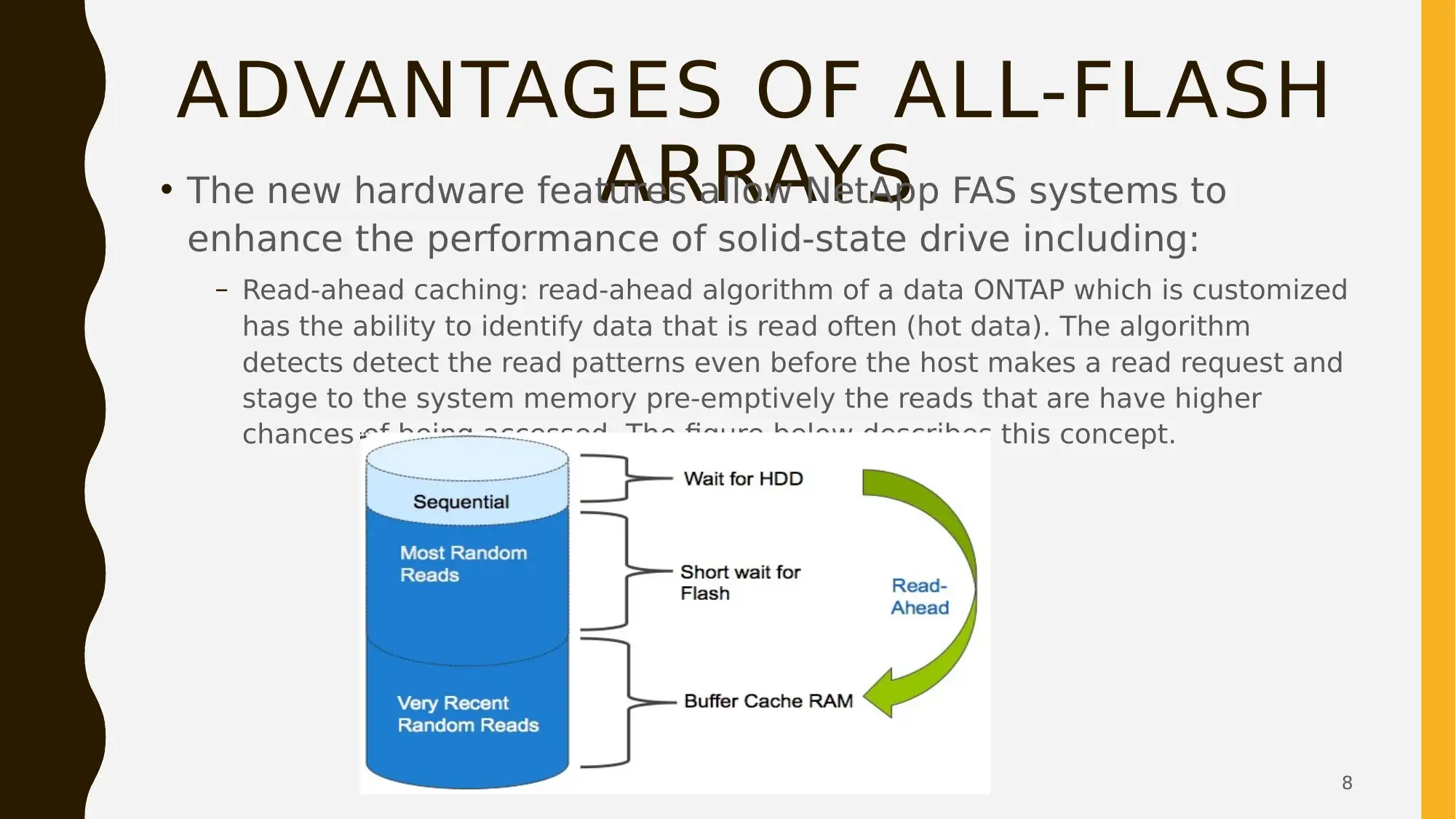
– Read-ahead caching: read-ahead algorithm of a data ONTAP which is customized
has the ability to identify data that is read often (hot data). The algorithm
detects detect the read patterns even before the host makes a read request and
stage to the system memory pre-emptively the reads that are have higher
chances of being accessed. The figure below describes this concept.
ADVANTAGES OF ALL-FLASH
ARRAYS• The new hardware features allow NetApp FAS systems to
enhance the performance of solid-state drive including:
– Read-ahead caching: read-ahead algorithm of a data ONTAP which is customized
has the ability to identify data that is read often (hot data). The algorithm
detects detect the read patterns even before the host makes a read request and
stage to the system memory pre-emptively the reads that are have higher
chances of being accessed. The figure below describes this concept.

9
ADVANTAGES OF ALL-FLASH ARRAYS
• All-flash arrays offer more that 99.99% uptime in production environments.
All-flash arrays, when implemented as a section of a scaled-out cluster,
benefits for operations that has been enabled by DATA ONTAP that is
clustered and are non-disruptive which has been proven to offer more that
99.99% uptime in production environments, thus ensuring enterprise-class
availability
• More benefits are reaped by moving the processes within a cluster with the
ability to expand to 24 nodes.
• Many processing can be executed and run without experiencing downtime.
• The cost of protecting data is also minimized.
ADVANTAGES OF ALL-FLASH ARRAYS
• All-flash arrays offer more that 99.99% uptime in production environments.
All-flash arrays, when implemented as a section of a scaled-out cluster,
benefits for operations that has been enabled by DATA ONTAP that is
clustered and are non-disruptive which has been proven to offer more that
99.99% uptime in production environments, thus ensuring enterprise-class
availability
• More benefits are reaped by moving the processes within a cluster with the
ability to expand to 24 nodes.
• Many processing can be executed and run without experiencing downtime.
• The cost of protecting data is also minimized.
⊘ This is a preview!⊘
Do you want full access?
Subscribe today to unlock all pages.

Trusted by 1+ million students worldwide

10
ADVANTAGES OF ALL-FLASH ARRAYS
• NetApp solid state drives have a high rating based on daily write
operation. It is also easy to monitor the status of the SSD using
CLI commands that are simple and easy to remember and which
provides important information concerning SSD wear.
• The event management system on the Data ONTAP records an
auto support event and notifies to facilitated preventive measures
in the event that the wear threshold of SSD has been surpassed.
• Efficient Storage. Users of NetApp all-flash FAS can use the
following technologies to store active data the exceeds storage
limit of the system: Snapshot technology, Data compression,
RAID-DP, Thin provisioning, storage-efficient replication, FlexClone
technology, and deduplication
ADVANTAGES OF ALL-FLASH ARRAYS
• NetApp solid state drives have a high rating based on daily write
operation. It is also easy to monitor the status of the SSD using
CLI commands that are simple and easy to remember and which
provides important information concerning SSD wear.
• The event management system on the Data ONTAP records an
auto support event and notifies to facilitated preventive measures
in the event that the wear threshold of SSD has been surpassed.
• Efficient Storage. Users of NetApp all-flash FAS can use the
following technologies to store active data the exceeds storage
limit of the system: Snapshot technology, Data compression,
RAID-DP, Thin provisioning, storage-efficient replication, FlexClone
technology, and deduplication
Paraphrase This Document
Need a fresh take? Get an instant paraphrase of this document with our AI Paraphraser

11
ADVANTAGES OF ALL-FLASH ARRAYS
• Reduced cost of SSDs because of techniques of reducing data
such as compression and deduplication. When considering all-
flash array, one of the primary concerns is cost. SSD based
systems are continuously gaining significant premium
compared to hard-disk drive-based system despite the
reducing costs.
• Can store active data that exceeds storage limit of the system.
• NetApp provides a wide range of storage solutions that are
flash-optimized
ADVANTAGES OF ALL-FLASH ARRAYS
• Reduced cost of SSDs because of techniques of reducing data
such as compression and deduplication. When considering all-
flash array, one of the primary concerns is cost. SSD based
systems are continuously gaining significant premium
compared to hard-disk drive-based system despite the
reducing costs.
• Can store active data that exceeds storage limit of the system.
• NetApp provides a wide range of storage solutions that are
flash-optimized

12
HYBRID FLASH ARRAYS
• Hybrid flash arrays is a combination of hard-disk drive and solid-state drive
technologies to enable enterprises to take advantage of the HDD
predictability and SSD high-performance levels.
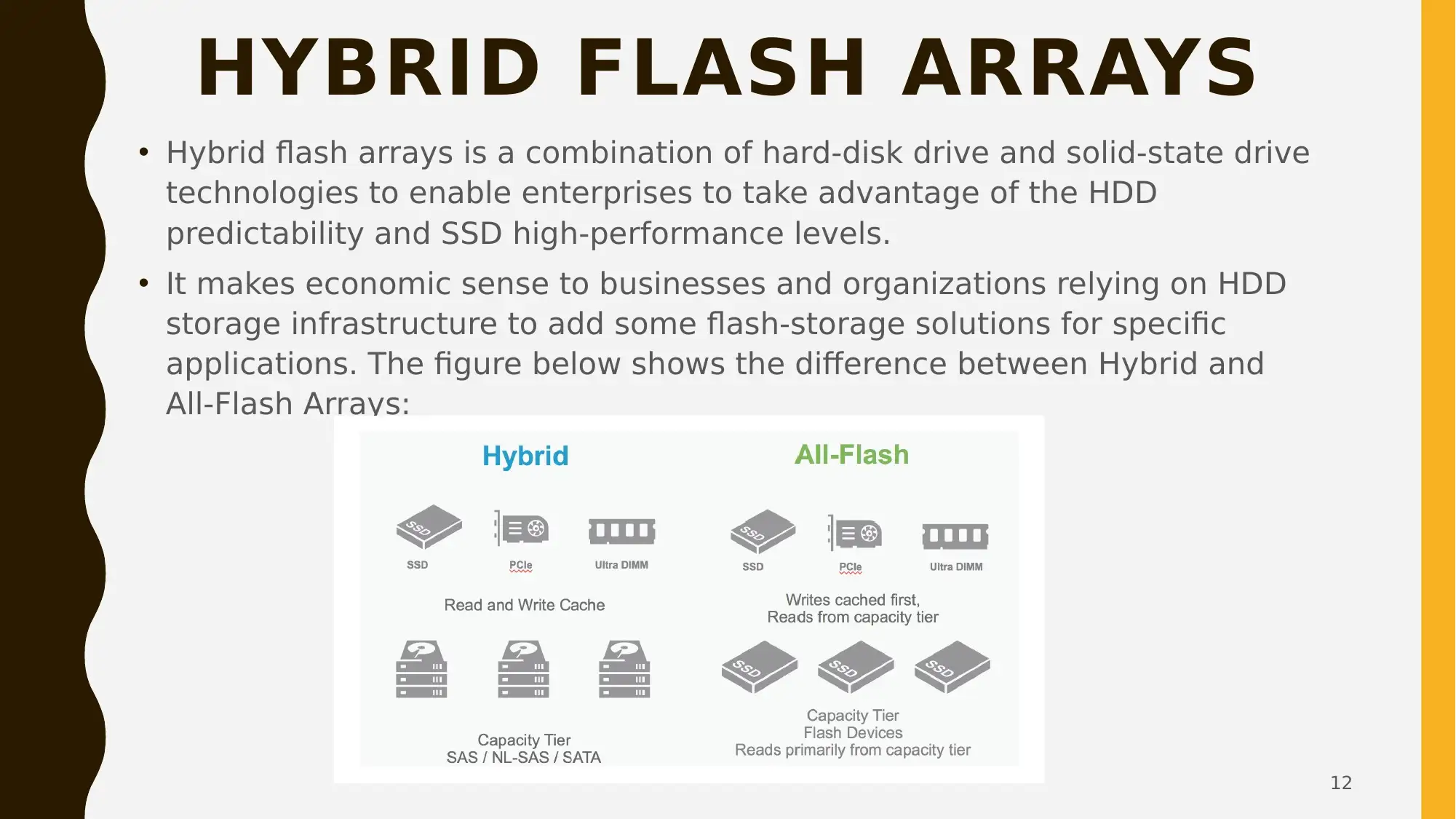
• It makes economic sense to businesses and organizations relying on HDD
storage infrastructure to add some flash-storage solutions for specific
applications. The figure below shows the difference between Hybrid and
All-Flash Arrays:
HYBRID FLASH ARRAYS
• Hybrid flash arrays is a combination of hard-disk drive and solid-state drive
technologies to enable enterprises to take advantage of the HDD
predictability and SSD high-performance levels.
• It makes economic sense to businesses and organizations relying on HDD
storage infrastructure to add some flash-storage solutions for specific
applications. The figure below shows the difference between Hybrid and
All-Flash Arrays:
⊘ This is a preview!⊘
Do you want full access?
Subscribe today to unlock all pages.

Trusted by 1+ million students worldwide
1 out of 15
Related Documents
Your All-in-One AI-Powered Toolkit for Academic Success.
+13062052269
info@desklib.com
Available 24*7 on WhatsApp / Email
Unlock your academic potential
Copyright © 2020–2025 A2Z Services. All Rights Reserved. Developed and managed by ZUCOL.