Digital Health Readiness Among Graduate Allied Health Staff in WA
VerifiedAdded on 2023/06/17
|33
|8963
|409
Dissertation
AI Summary
This dissertation investigates the digital health readiness of graduate allied health staff in country Western Australia. A scoping review methodology was employed, utilizing databases such as ProQuest, Scopus, and CINAHL to identify relevant peer-reviewed articles. The research aims to evaluate the current level of digital health readiness, determine the acceptability and confidence in using telehealth, and identify training needs. The study used specific inclusion and exclusion criteria, resulting in the selection of 10 articles for analysis. The findings contribute to understanding how to promote sustainable e-healthcare services by enhancing the digital competencies of allied health staff, enabling them to effectively use digital technologies for delivering high-quality digital health services. The dissertation covers the introduction, methodology, results, discussion, and conclusion, organized logically to present a comprehensive overview of the topic.

DISSERTATION

Paraphrase This Document
Need a fresh take? Get an instant paraphrase of this document with our AI Paraphraser
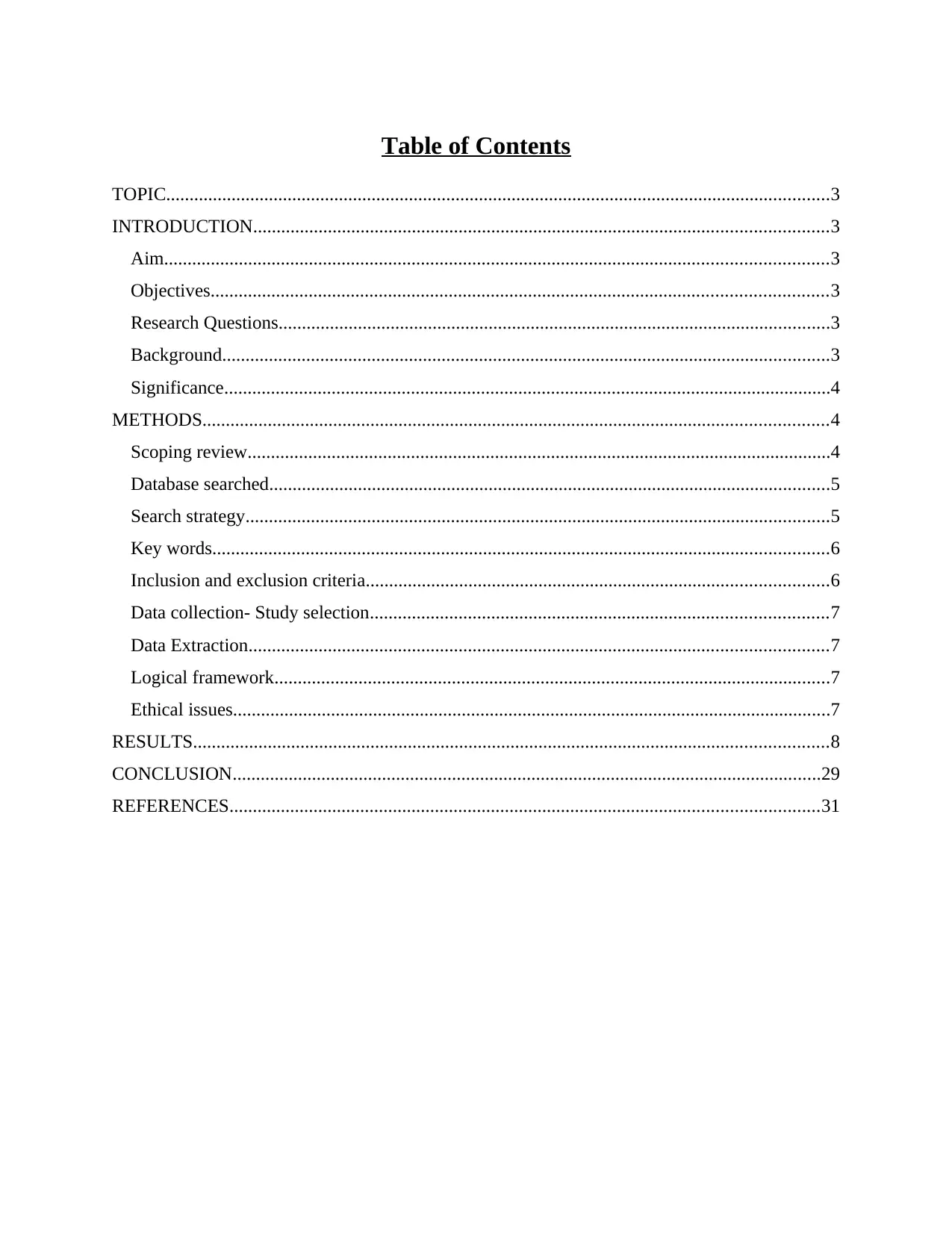
Table of Contents
TOPIC..............................................................................................................................................3
INTRODUCTION...........................................................................................................................3
Aim..............................................................................................................................................3
Objectives....................................................................................................................................3
Research Questions......................................................................................................................3
Background..................................................................................................................................3
Significance..................................................................................................................................4
METHODS......................................................................................................................................4
Scoping review.............................................................................................................................4
Database searched........................................................................................................................5
Search strategy.............................................................................................................................5
Key words....................................................................................................................................6
Inclusion and exclusion criteria...................................................................................................6
Data collection- Study selection..................................................................................................7
Data Extraction............................................................................................................................7
Logical framework.......................................................................................................................7
Ethical issues................................................................................................................................7
RESULTS........................................................................................................................................8
CONCLUSION..............................................................................................................................29
REFERENCES..............................................................................................................................31
TOPIC..............................................................................................................................................3
INTRODUCTION...........................................................................................................................3
Aim..............................................................................................................................................3
Objectives....................................................................................................................................3
Research Questions......................................................................................................................3
Background..................................................................................................................................3
Significance..................................................................................................................................4
METHODS......................................................................................................................................4
Scoping review.............................................................................................................................4
Database searched........................................................................................................................5
Search strategy.............................................................................................................................5
Key words....................................................................................................................................6
Inclusion and exclusion criteria...................................................................................................6
Data collection- Study selection..................................................................................................7
Data Extraction............................................................................................................................7
Logical framework.......................................................................................................................7
Ethical issues................................................................................................................................7
RESULTS........................................................................................................................................8
CONCLUSION..............................................................................................................................29
REFERENCES..............................................................................................................................31
TOPIC
Digital Health Readiness of Graduate Allied Health Staff in Country Western Australia
ABSTRACT
The main aim of this dissertation is to evaluate the current level of digital health
readiness among graduate allied health staff in country Western Australia (WA). All the data for
scoping review for this dissertation has been collected from Proquest, Scopus and from
Cumulative Index to Nursing and Allied Health Literature. All the three of them are electronic
databases. With the help of set inclusion and exclusion criteria for this study 10 peer reviewed
articles were selected to be evaluated for answering main research question which is What is the
current level of digital health readiness among graduate allied health staff in country Western
Australia?
INTRODUCTION
Aim
The main of this dissertation is “To evaluate the current level of digital health readiness
among graduate allied health staff in country Western Australia (WA).”.
Objectives
Following are the main objectives that will be focused upon for achievement of main aim
of the study.
To conduct a scoping review to examine the digital health readiness of allied health staff.
To determine the acceptability and confidence level of using telehealth and digital health
modalities among graduate allied health staff in country WA.
To identify the training needs of graduate allied health staff in country WA in the
delivery of services via telehealth and digital health modalities.
Research Questions
Main question that will be answered in this dissertation is: What is the current level of
digital health readiness among graduate allied health staff in country Western Australia?
Background
Today due to advancement in technology health use is increasing drastically. In fact, today its
use among people has increased in a significant manner and these digital health models are being
used by healthcare professionals, patients etc. healthcare professionals and many other allied
health staff uses these digital health models for delivering high quality clinical and non-clinical
Digital Health Readiness of Graduate Allied Health Staff in Country Western Australia
ABSTRACT
The main aim of this dissertation is to evaluate the current level of digital health
readiness among graduate allied health staff in country Western Australia (WA). All the data for
scoping review for this dissertation has been collected from Proquest, Scopus and from
Cumulative Index to Nursing and Allied Health Literature. All the three of them are electronic
databases. With the help of set inclusion and exclusion criteria for this study 10 peer reviewed
articles were selected to be evaluated for answering main research question which is What is the
current level of digital health readiness among graduate allied health staff in country Western
Australia?
INTRODUCTION
Aim
The main of this dissertation is “To evaluate the current level of digital health readiness
among graduate allied health staff in country Western Australia (WA).”.
Objectives
Following are the main objectives that will be focused upon for achievement of main aim
of the study.
To conduct a scoping review to examine the digital health readiness of allied health staff.
To determine the acceptability and confidence level of using telehealth and digital health
modalities among graduate allied health staff in country WA.
To identify the training needs of graduate allied health staff in country WA in the
delivery of services via telehealth and digital health modalities.
Research Questions
Main question that will be answered in this dissertation is: What is the current level of
digital health readiness among graduate allied health staff in country Western Australia?
Background
Today due to advancement in technology health use is increasing drastically. In fact, today its
use among people has increased in a significant manner and these digital health models are being
used by healthcare professionals, patients etc. healthcare professionals and many other allied
health staff uses these digital health models for delivering high quality clinical and non-clinical
⊘ This is a preview!⊘
Do you want full access?
Subscribe today to unlock all pages.

Trusted by 1+ million students worldwide
services (Avanesova and Shamliyan, 2019). In fact telehealth initiatives were first of all initiated
in Western Australia. Due to globalization today telehealth is being adopted frequently and more
number of allied health staff have started using such kind of digital healthcare systems. As a
result innovation in these digital healthcare technology is increasing drastically in order to bring
continuous improvement within quality of service provided by allied health staff members to
patients.
In current pandemic situation of Covid-19 importance of these telehealth technologies has
increased (Brown and et.al., 2018). Not only this, various different kinds of system have been
introduced for healthcare providers but these allied health staff have not been trained and
educated for using these technologies as a result allied health staff members were facing
difficulty in providing complete benefit of these digital healthcare technologies. Due to this, it
has become important to provide training to these graduate allied health staff members so that
they can successfully provide all kinds of healthcare benefits to patients.
Significance
This topic is important to be focused upon to promote sustainable way of promoting
sustainable e-healthcare services to people in Western Australia so that high quality and instant
service can be provided to people in Western Australia (Butler-Henderson and et.al., 2020). But
these benefits through digital health technologies can only be provided if allied health staff
members are technologically updated and proper training has been provided to graduate allied
health staff members so that e-heath services can be delivered by them in an appropriate and
accurate manner. Due to these reasons this topic has become extremely important to be focused
upon. This dissertation will further focus upon ways in which training can be provided to allied
health staff graduates such that their digital competencies can be enhanced so that they can
effectively use digital technologies for delivering high quality digital health services as well as
they are equipped with right instruments for delivering healthcare services to people of Western
Australia digitally.
METHODS
Scoping review
Scoping review a kind of approach or a tool which is used for determining depth of
literature available for that overall volume of literature and material available. It is a new
approach and tool that can be used to provide an overview of available research without product
in Western Australia. Due to globalization today telehealth is being adopted frequently and more
number of allied health staff have started using such kind of digital healthcare systems. As a
result innovation in these digital healthcare technology is increasing drastically in order to bring
continuous improvement within quality of service provided by allied health staff members to
patients.
In current pandemic situation of Covid-19 importance of these telehealth technologies has
increased (Brown and et.al., 2018). Not only this, various different kinds of system have been
introduced for healthcare providers but these allied health staff have not been trained and
educated for using these technologies as a result allied health staff members were facing
difficulty in providing complete benefit of these digital healthcare technologies. Due to this, it
has become important to provide training to these graduate allied health staff members so that
they can successfully provide all kinds of healthcare benefits to patients.
Significance
This topic is important to be focused upon to promote sustainable way of promoting
sustainable e-healthcare services to people in Western Australia so that high quality and instant
service can be provided to people in Western Australia (Butler-Henderson and et.al., 2020). But
these benefits through digital health technologies can only be provided if allied health staff
members are technologically updated and proper training has been provided to graduate allied
health staff members so that e-heath services can be delivered by them in an appropriate and
accurate manner. Due to these reasons this topic has become extremely important to be focused
upon. This dissertation will further focus upon ways in which training can be provided to allied
health staff graduates such that their digital competencies can be enhanced so that they can
effectively use digital technologies for delivering high quality digital health services as well as
they are equipped with right instruments for delivering healthcare services to people of Western
Australia digitally.
METHODS
Scoping review
Scoping review a kind of approach or a tool which is used for determining depth of
literature available for that overall volume of literature and material available. It is a new
approach and tool that can be used to provide an overview of available research without product
Paraphrase This Document
Need a fresh take? Get an instant paraphrase of this document with our AI Paraphraser
a brief summary of answers to identified research question of dissertation. For this study,
scooping review has been selected as a tool by researcher for identifying readiness of allied
health staff graduates for identifying whether they can provide high quality telehealth services to
people (Connors, 2020). This tool has been used for selecting studies with the help of PRISM
Extension for Scoping review checklist for selection of peer previewed articles. For selection of
these peer reviewed articles inclusion and exclusion criteria was developed. The main purpose
because of which this tool has been selected because it directly helped in mapping literature for
selected research topic as it directly helped in identifying main objectives to be focused upon on
the basis of gaps identified within research.
Database searched
There are many different kinds of databases that can be selected and used for identifying
appropriate and suitable studies that are required to be included for literature review for
summarizing and answering main research questions (Dattakumar and et.al., 2013). Some of the
most important databases used for searching appropriate studies were all electronic databases or
e- libraries. Some of them are: Scopus, PubMed, ProQuest, CINAHL (Cumulative Index to
Nursing and Allied Health Literature).
Search strategy
Search strategy can be defined as an organized and structured way of using key terms for
searching identified databases so that answers for research question can be identified for
achieving accurate results in an appropriate manner (Dratva and et.al., 2019). Search strategy to
search studies written in English has been identified below.
Below given are the search terms used for searching studies from each database have
been explained below:
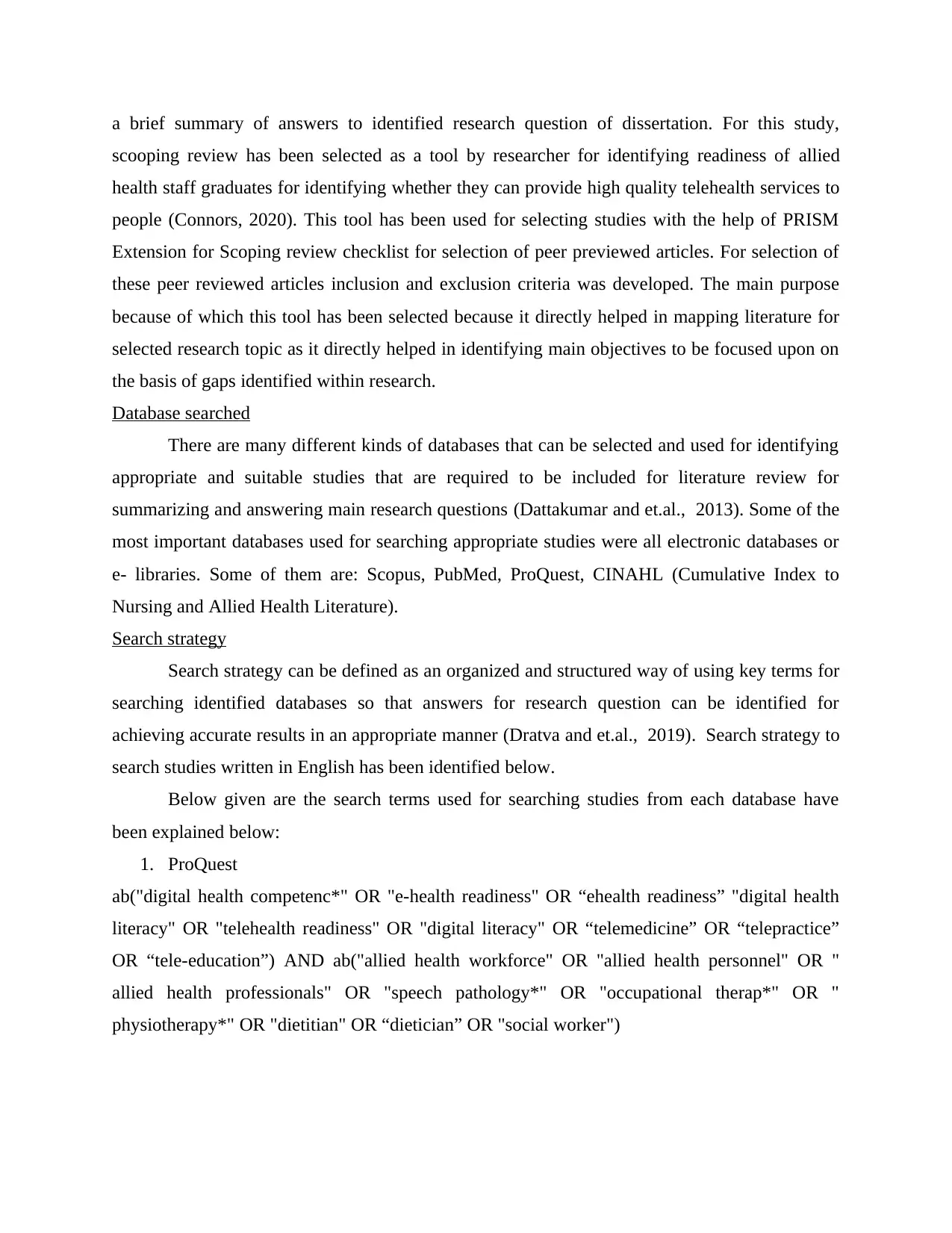
1. ProQuest
ab("digital health competenc*" OR "e-health readiness" OR “ehealth readiness” "digital health
literacy" OR "telehealth readiness" OR "digital literacy" OR “telemedicine” OR “telepractice”
OR “tele-education”) AND ab("allied health workforce" OR "allied health personnel" OR "
allied health professionals" OR "speech pathology*" OR "occupational therap*" OR "
physiotherapy*" OR "dietitian" OR “dietician” OR "social worker")
scooping review has been selected as a tool by researcher for identifying readiness of allied
health staff graduates for identifying whether they can provide high quality telehealth services to
people (Connors, 2020). This tool has been used for selecting studies with the help of PRISM
Extension for Scoping review checklist for selection of peer previewed articles. For selection of
these peer reviewed articles inclusion and exclusion criteria was developed. The main purpose
because of which this tool has been selected because it directly helped in mapping literature for
selected research topic as it directly helped in identifying main objectives to be focused upon on
the basis of gaps identified within research.
Database searched
There are many different kinds of databases that can be selected and used for identifying
appropriate and suitable studies that are required to be included for literature review for
summarizing and answering main research questions (Dattakumar and et.al., 2013). Some of the
most important databases used for searching appropriate studies were all electronic databases or
e- libraries. Some of them are: Scopus, PubMed, ProQuest, CINAHL (Cumulative Index to
Nursing and Allied Health Literature).
Search strategy
Search strategy can be defined as an organized and structured way of using key terms for
searching identified databases so that answers for research question can be identified for
achieving accurate results in an appropriate manner (Dratva and et.al., 2019). Search strategy to
search studies written in English has been identified below.
Below given are the search terms used for searching studies from each database have
been explained below:
1. ProQuest
ab("digital health competenc*" OR "e-health readiness" OR “ehealth readiness” "digital health
literacy" OR "telehealth readiness" OR "digital literacy" OR “telemedicine” OR “telepractice”
OR “tele-education”) AND ab("allied health workforce" OR "allied health personnel" OR "
allied health professionals" OR "speech pathology*" OR "occupational therap*" OR "
physiotherapy*" OR "dietitian" OR “dietician” OR "social worker")
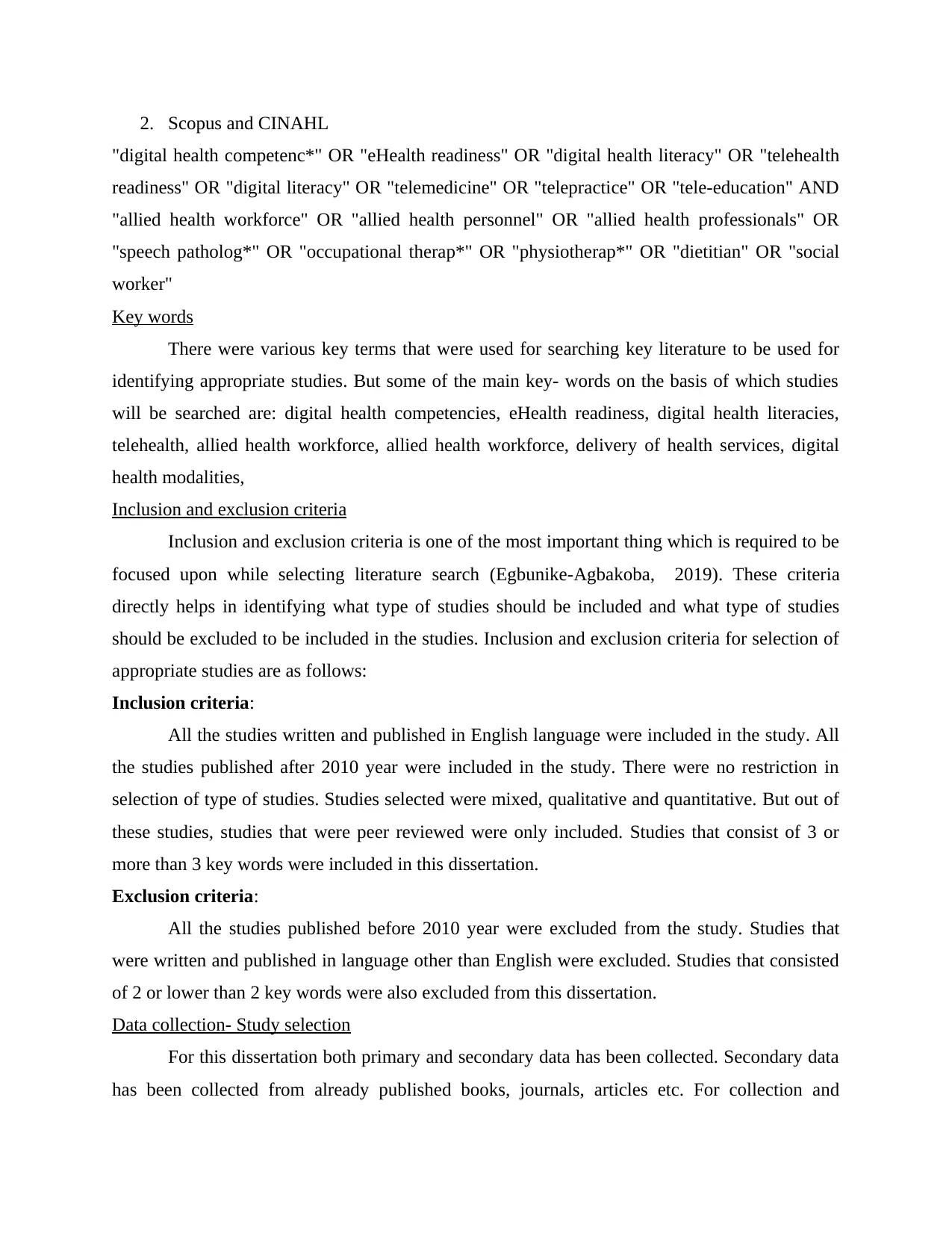
2. Scopus and CINAHL
"digital health competenc*" OR "eHealth readiness" OR "digital health literacy" OR "telehealth
readiness" OR "digital literacy" OR "telemedicine" OR "telepractice" OR "tele-education" AND
"allied health workforce" OR "allied health personnel" OR "allied health professionals" OR
"speech patholog*" OR "occupational therap*" OR "physiotherap*" OR "dietitian" OR "social
worker"
Key words
There were various key terms that were used for searching key literature to be used for
identifying appropriate studies. But some of the main key- words on the basis of which studies
will be searched are: digital health competencies, eHealth readiness, digital health literacies,
telehealth, allied health workforce, allied health workforce, delivery of health services, digital
health modalities,
Inclusion and exclusion criteria
Inclusion and exclusion criteria is one of the most important thing which is required to be
focused upon while selecting literature search (Egbunike-Agbakoba, 2019). These criteria
directly helps in identifying what type of studies should be included and what type of studies
should be excluded to be included in the studies. Inclusion and exclusion criteria for selection of
appropriate studies are as follows:
Inclusion criteria:
All the studies written and published in English language were included in the study. All
the studies published after 2010 year were included in the study. There were no restriction in
selection of type of studies. Studies selected were mixed, qualitative and quantitative. But out of
these studies, studies that were peer reviewed were only included. Studies that consist of 3 or
more than 3 key words were included in this dissertation.
Exclusion criteria:
All the studies published before 2010 year were excluded from the study. Studies that
were written and published in language other than English were excluded. Studies that consisted
of 2 or lower than 2 key words were also excluded from this dissertation.
Data collection- Study selection
For this dissertation both primary and secondary data has been collected. Secondary data
has been collected from already published books, journals, articles etc. For collection and
"digital health competenc*" OR "eHealth readiness" OR "digital health literacy" OR "telehealth
readiness" OR "digital literacy" OR "telemedicine" OR "telepractice" OR "tele-education" AND
"allied health workforce" OR "allied health personnel" OR "allied health professionals" OR
"speech patholog*" OR "occupational therap*" OR "physiotherap*" OR "dietitian" OR "social
worker"
Key words
There were various key terms that were used for searching key literature to be used for
identifying appropriate studies. But some of the main key- words on the basis of which studies
will be searched are: digital health competencies, eHealth readiness, digital health literacies,
telehealth, allied health workforce, allied health workforce, delivery of health services, digital
health modalities,
Inclusion and exclusion criteria
Inclusion and exclusion criteria is one of the most important thing which is required to be
focused upon while selecting literature search (Egbunike-Agbakoba, 2019). These criteria
directly helps in identifying what type of studies should be included and what type of studies
should be excluded to be included in the studies. Inclusion and exclusion criteria for selection of
appropriate studies are as follows:
Inclusion criteria:
All the studies written and published in English language were included in the study. All
the studies published after 2010 year were included in the study. There were no restriction in
selection of type of studies. Studies selected were mixed, qualitative and quantitative. But out of
these studies, studies that were peer reviewed were only included. Studies that consist of 3 or
more than 3 key words were included in this dissertation.
Exclusion criteria:
All the studies published before 2010 year were excluded from the study. Studies that
were written and published in language other than English were excluded. Studies that consisted
of 2 or lower than 2 key words were also excluded from this dissertation.
Data collection- Study selection
For this dissertation both primary and secondary data has been collected. Secondary data
has been collected from already published books, journals, articles etc. For collection and
⊘ This is a preview!⊘
Do you want full access?
Subscribe today to unlock all pages.
Trusted by 1+ million students worldwide
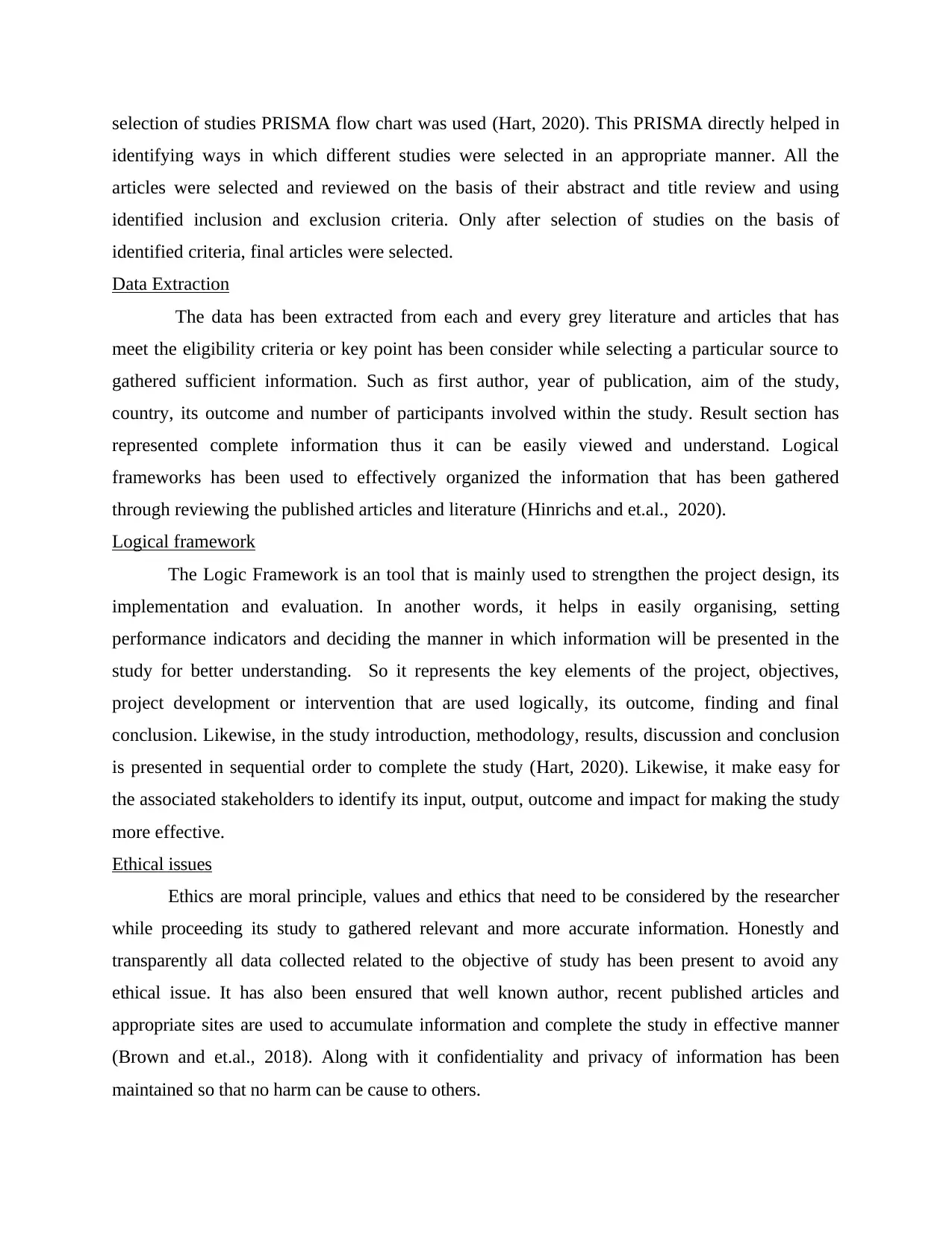
selection of studies PRISMA flow chart was used (Hart, 2020). This PRISMA directly helped in
identifying ways in which different studies were selected in an appropriate manner. All the
articles were selected and reviewed on the basis of their abstract and title review and using
identified inclusion and exclusion criteria. Only after selection of studies on the basis of
identified criteria, final articles were selected.
Data Extraction
The data has been extracted from each and every grey literature and articles that has
meet the eligibility criteria or key point has been consider while selecting a particular source to
gathered sufficient information. Such as first author, year of publication, aim of the study,
country, its outcome and number of participants involved within the study. Result section has
represented complete information thus it can be easily viewed and understand. Logical
frameworks has been used to effectively organized the information that has been gathered
through reviewing the published articles and literature (Hinrichs and et.al., 2020).
Logical framework
The Logic Framework is an tool that is mainly used to strengthen the project design, its
implementation and evaluation. In another words, it helps in easily organising, setting
performance indicators and deciding the manner in which information will be presented in the
study for better understanding. So it represents the key elements of the project, objectives,
project development or intervention that are used logically, its outcome, finding and final
conclusion. Likewise, in the study introduction, methodology, results, discussion and conclusion
is presented in sequential order to complete the study (Hart, 2020). Likewise, it make easy for
the associated stakeholders to identify its input, output, outcome and impact for making the study
more effective.
Ethical issues
Ethics are moral principle, values and ethics that need to be considered by the researcher
while proceeding its study to gathered relevant and more accurate information. Honestly and
transparently all data collected related to the objective of study has been present to avoid any
ethical issue. It has also been ensured that well known author, recent published articles and
appropriate sites are used to accumulate information and complete the study in effective manner
(Brown and et.al., 2018). Along with it confidentiality and privacy of information has been
maintained so that no harm can be cause to others.
identifying ways in which different studies were selected in an appropriate manner. All the
articles were selected and reviewed on the basis of their abstract and title review and using
identified inclusion and exclusion criteria. Only after selection of studies on the basis of
identified criteria, final articles were selected.
Data Extraction
The data has been extracted from each and every grey literature and articles that has
meet the eligibility criteria or key point has been consider while selecting a particular source to
gathered sufficient information. Such as first author, year of publication, aim of the study,
country, its outcome and number of participants involved within the study. Result section has
represented complete information thus it can be easily viewed and understand. Logical
frameworks has been used to effectively organized the information that has been gathered
through reviewing the published articles and literature (Hinrichs and et.al., 2020).
Logical framework
The Logic Framework is an tool that is mainly used to strengthen the project design, its
implementation and evaluation. In another words, it helps in easily organising, setting
performance indicators and deciding the manner in which information will be presented in the
study for better understanding. So it represents the key elements of the project, objectives,
project development or intervention that are used logically, its outcome, finding and final
conclusion. Likewise, in the study introduction, methodology, results, discussion and conclusion
is presented in sequential order to complete the study (Hart, 2020). Likewise, it make easy for
the associated stakeholders to identify its input, output, outcome and impact for making the study
more effective.
Ethical issues
Ethics are moral principle, values and ethics that need to be considered by the researcher
while proceeding its study to gathered relevant and more accurate information. Honestly and
transparently all data collected related to the objective of study has been present to avoid any
ethical issue. It has also been ensured that well known author, recent published articles and
appropriate sites are used to accumulate information and complete the study in effective manner
(Brown and et.al., 2018). Along with it confidentiality and privacy of information has been
maintained so that no harm can be cause to others.
Paraphrase This Document
Need a fresh take? Get an instant paraphrase of this document with our AI Paraphraser
RESULTS
First literature review generated overall 948 results from all three selected databases. This
included all the duplicate articles as well. Then from all the identified articles 103 duplicate
articles were removed and after screening of titles final 845 articles were selected. Then on the
selected articles inclusion and exclusion was applied and on the basis of these criteria 780
articles were excluded and 65 articles were included after screening of articles on the basis of
criteria of inclusion and exclusion. Further when complete text screening of articles was done
then again 34 articles were excluded and only 31 articles were included after complete text
screening. Then from the selected articles further 21 articles were excluded that did not have full
article access, ineligible outcomes and participants voice were not represented. After all the
screening only 10 articles were selected and included for this dissertation.
First literature review generated overall 948 results from all three selected databases. This
included all the duplicate articles as well. Then from all the identified articles 103 duplicate
articles were removed and after screening of titles final 845 articles were selected. Then on the
selected articles inclusion and exclusion was applied and on the basis of these criteria 780
articles were excluded and 65 articles were included after screening of articles on the basis of
criteria of inclusion and exclusion. Further when complete text screening of articles was done
then again 34 articles were excluded and only 31 articles were included after complete text
screening. Then from the selected articles further 21 articles were excluded that did not have full
article access, ineligible outcomes and participants voice were not represented. After all the
screening only 10 articles were selected and included for this dissertation.
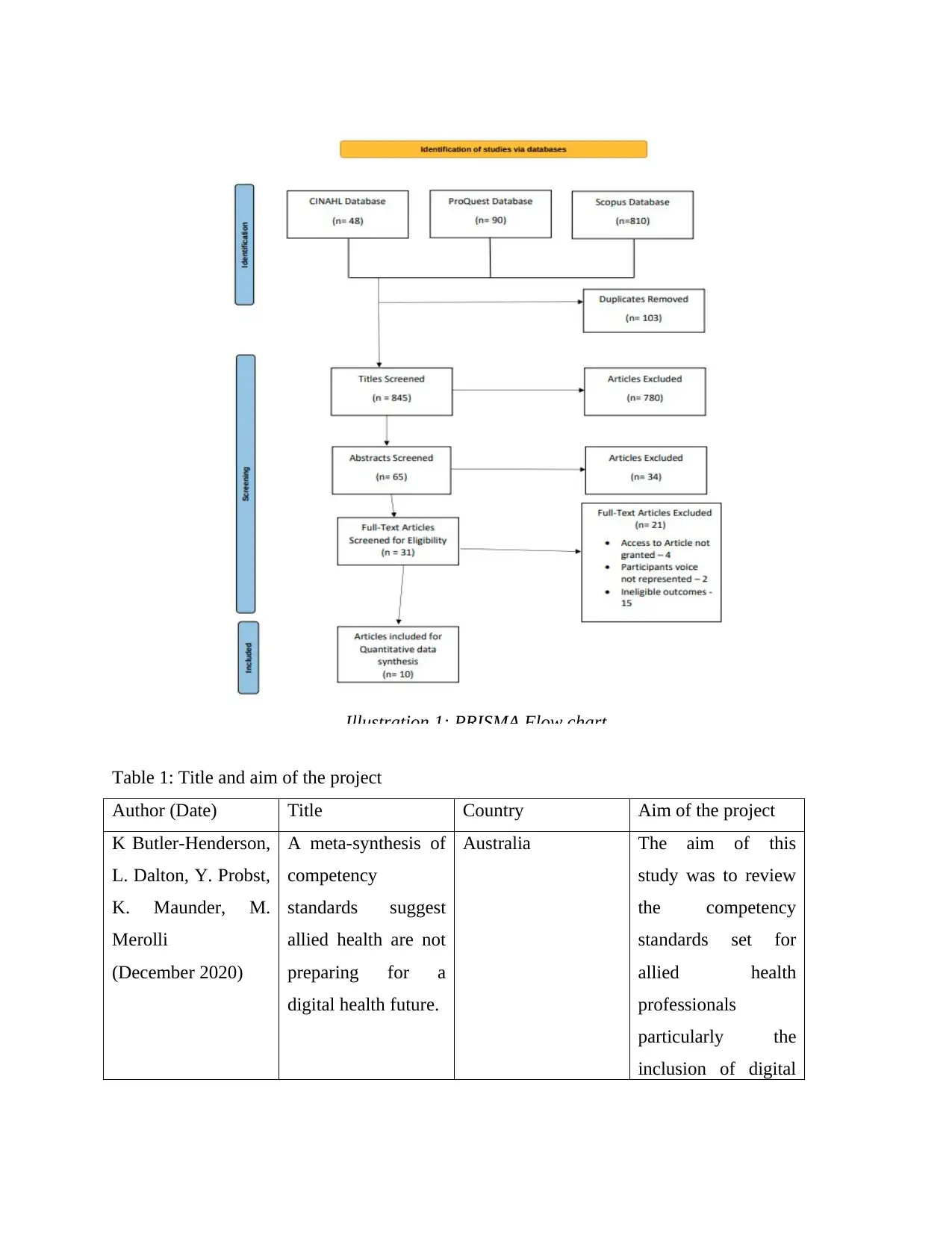
Table 1: Title and aim of the project
Author (Date) Title Country Aim of the project
K Butler-Henderson,
L. Dalton, Y. Probst,
K. Maunder, M.
Merolli
(December 2020)
A meta-synthesis of
competency
standards suggest
allied health are not
preparing for a
digital health future.
Australia The aim of this
study was to review
the competency
standards set for
allied health
professionals
particularly the
inclusion of digital
Illustration 1: PRISMA Flow chart
Author (Date) Title Country Aim of the project
K Butler-Henderson,
L. Dalton, Y. Probst,
K. Maunder, M.
Merolli
(December 2020)
A meta-synthesis of
competency
standards suggest
allied health are not
preparing for a
digital health future.
Australia The aim of this
study was to review
the competency
standards set for
allied health
professionals
particularly the
inclusion of digital
Illustration 1: PRISMA Flow chart
⊘ This is a preview!⊘
Do you want full access?
Subscribe today to unlock all pages.
Trusted by 1+ million students worldwide
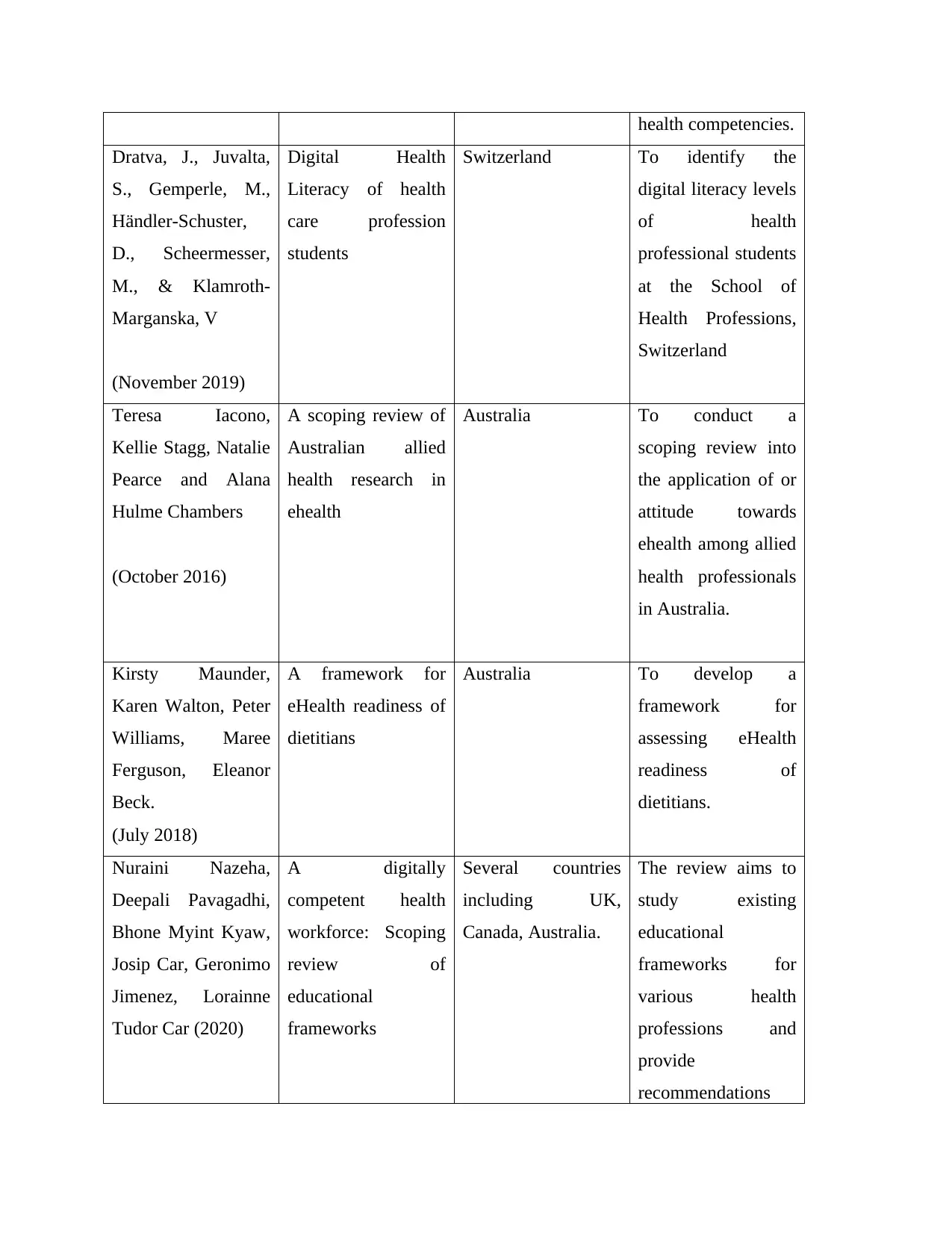
health competencies.
Dratva, J., Juvalta,
S., Gemperle, M.,
Händler-Schuster,
D., Scheermesser,
M., & Klamroth-
Marganska, V
(November 2019)
Digital Health
Literacy of health
care profession
students
Switzerland To identify the
digital literacy levels
of health
professional students
at the School of
Health Professions,
Switzerland
Teresa Iacono,
Kellie Stagg, Natalie
Pearce and Alana
Hulme Chambers
(October 2016)
A scoping review of
Australian allied
health research in
ehealth
Australia To conduct a
scoping review into
the application of or
attitude towards
ehealth among allied
health professionals
in Australia.
Kirsty Maunder,
Karen Walton, Peter
Williams, Maree
Ferguson, Eleanor
Beck.
(July 2018)
A framework for
eHealth readiness of
dietitians
Australia To develop a
framework for
assessing eHealth
readiness of
dietitians.
Nuraini Nazeha,
Deepali Pavagadhi,
Bhone Myint Kyaw,
Josip Car, Geronimo
Jimenez, Lorainne
Tudor Car (2020)
A digitally
competent health
workforce: Scoping
review of
educational
frameworks
Several countries
including UK,
Canada, Australia.
The review aims to
study existing
educational
frameworks for
various health
professions and
provide
recommendations
Dratva, J., Juvalta,
S., Gemperle, M.,
Händler-Schuster,
D., Scheermesser,
M., & Klamroth-
Marganska, V
(November 2019)
Digital Health
Literacy of health
care profession
students
Switzerland To identify the
digital literacy levels
of health
professional students
at the School of
Health Professions,
Switzerland
Teresa Iacono,
Kellie Stagg, Natalie
Pearce and Alana
Hulme Chambers
(October 2016)
A scoping review of
Australian allied
health research in
ehealth
Australia To conduct a
scoping review into
the application of or
attitude towards
ehealth among allied
health professionals
in Australia.
Kirsty Maunder,
Karen Walton, Peter
Williams, Maree
Ferguson, Eleanor
Beck.
(July 2018)
A framework for
eHealth readiness of
dietitians
Australia To develop a
framework for
assessing eHealth
readiness of
dietitians.
Nuraini Nazeha,
Deepali Pavagadhi,
Bhone Myint Kyaw,
Josip Car, Geronimo
Jimenez, Lorainne
Tudor Car (2020)
A digitally
competent health
workforce: Scoping
review of
educational
frameworks
Several countries
including UK,
Canada, Australia.
The review aims to
study existing
educational
frameworks for
various health
professions and
provide
recommendations
Paraphrase This Document
Need a fresh take? Get an instant paraphrase of this document with our AI Paraphraser
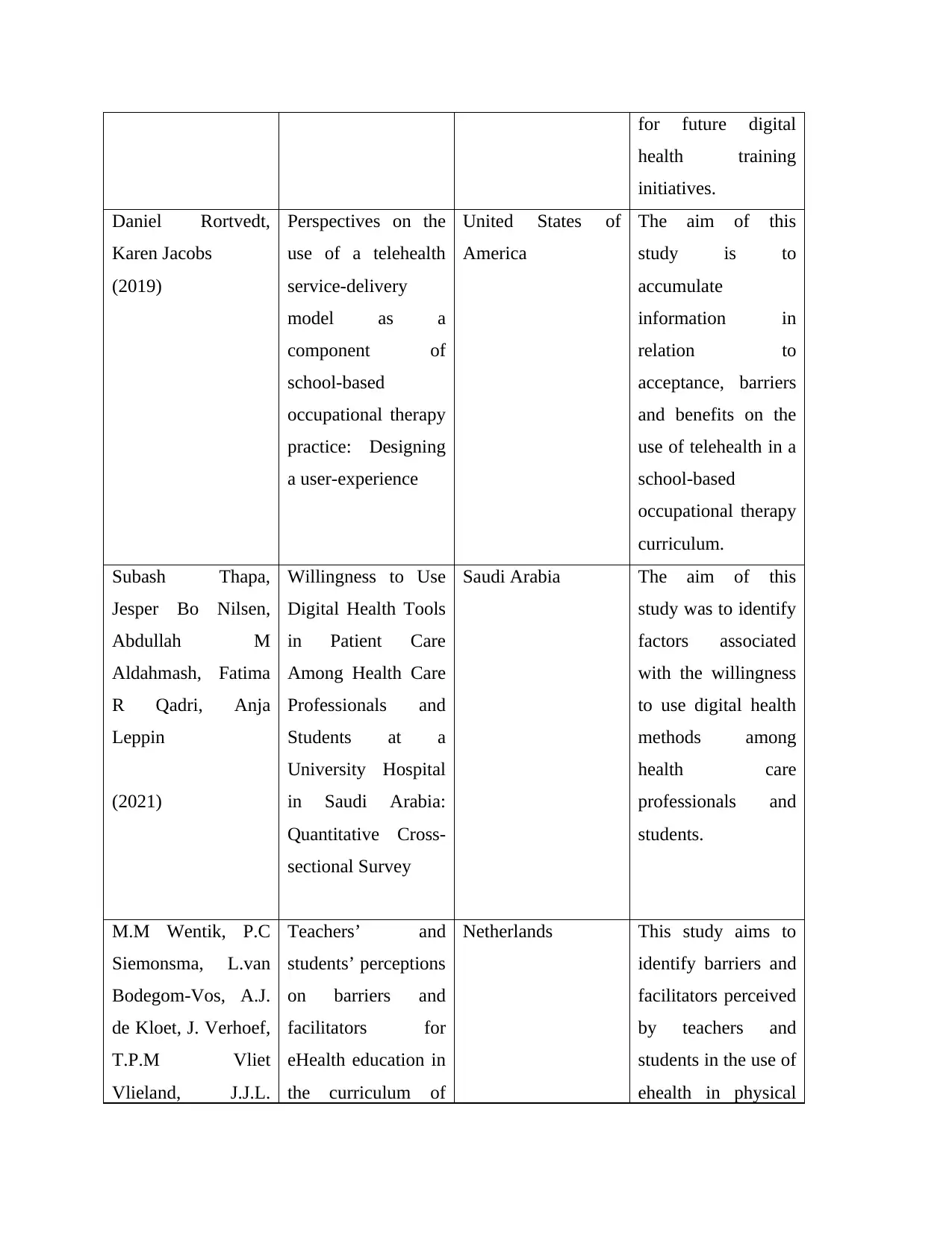
for future digital
health training
initiatives.
Daniel Rortvedt,
Karen Jacobs
(2019)
Perspectives on the
use of a telehealth
service-delivery
model as a
component of
school-based
occupational therapy
practice: Designing
a user-experience
United States of
America
The aim of this
study is to
accumulate
information in
relation to
acceptance, barriers
and benefits on the
use of telehealth in a
school-based
occupational therapy
curriculum.
Subash Thapa,
Jesper Bo Nilsen,
Abdullah M
Aldahmash, Fatima
R Qadri, Anja
Leppin
(2021)
Willingness to Use
Digital Health Tools
in Patient Care
Among Health Care
Professionals and
Students at a
University Hospital
in Saudi Arabia:
Quantitative Cross-
sectional Survey
Saudi Arabia The aim of this
study was to identify
factors associated
with the willingness
to use digital health
methods among
health care
professionals and
students.
M.M Wentik, P.C
Siemonsma, L.van
Bodegom-Vos, A.J.
de Kloet, J. Verhoef,
T.P.M Vliet
Vlieland, J.J.L.
Teachers’ and
students’ perceptions
on barriers and
facilitators for
eHealth education in
the curriculum of
Netherlands This study aims to
identify barriers and
facilitators perceived
by teachers and
students in the use of
ehealth in physical
health training
initiatives.
Daniel Rortvedt,
Karen Jacobs
(2019)
Perspectives on the
use of a telehealth
service-delivery
model as a
component of
school-based
occupational therapy
practice: Designing
a user-experience
United States of
America
The aim of this
study is to
accumulate
information in
relation to
acceptance, barriers
and benefits on the
use of telehealth in a
school-based
occupational therapy
curriculum.
Subash Thapa,
Jesper Bo Nilsen,
Abdullah M
Aldahmash, Fatima
R Qadri, Anja
Leppin
(2021)
Willingness to Use
Digital Health Tools
in Patient Care
Among Health Care
Professionals and
Students at a
University Hospital
in Saudi Arabia:
Quantitative Cross-
sectional Survey
Saudi Arabia The aim of this
study was to identify
factors associated
with the willingness
to use digital health
methods among
health care
professionals and
students.
M.M Wentik, P.C
Siemonsma, L.van
Bodegom-Vos, A.J.
de Kloet, J. Verhoef,
T.P.M Vliet
Vlieland, J.J.L.
Teachers’ and
students’ perceptions
on barriers and
facilitators for
eHealth education in
the curriculum of
Netherlands This study aims to
identify barriers and
facilitators perceived
by teachers and
students in the use of
ehealth in physical
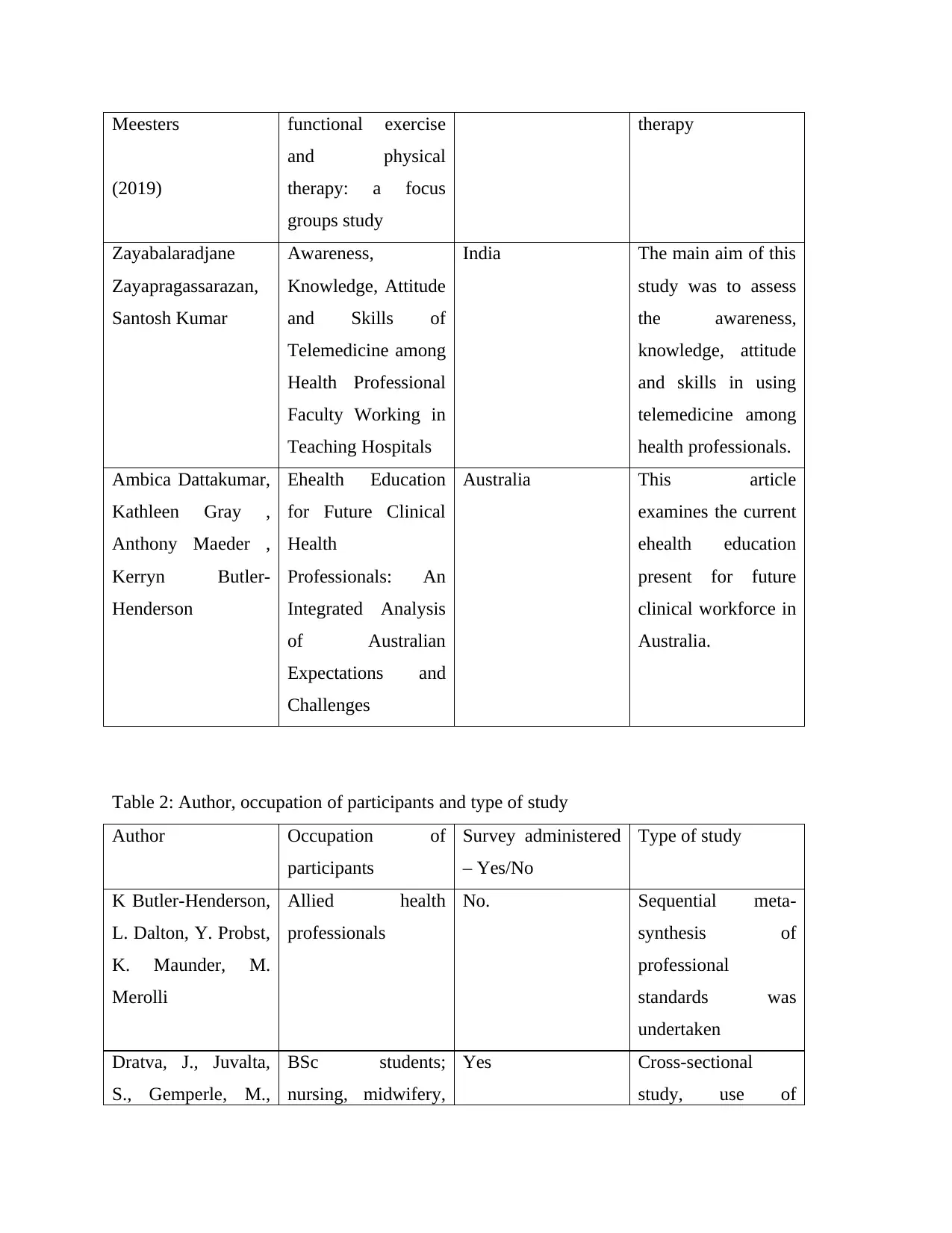
Meesters
(2019)
functional exercise
and physical
therapy: a focus
groups study
therapy
Zayabalaradjane
Zayapragassarazan,
Santosh Kumar
Awareness,
Knowledge, Attitude
and Skills of
Telemedicine among
Health Professional
Faculty Working in
Teaching Hospitals
India The main aim of this
study was to assess
the awareness,
knowledge, attitude
and skills in using
telemedicine among
health professionals.
Ambica Dattakumar,
Kathleen Gray ,
Anthony Maeder ,
Kerryn Butler-
Henderson
Ehealth Education
for Future Clinical
Health
Professionals: An
Integrated Analysis
of Australian
Expectations and
Challenges
Australia This article
examines the current
ehealth education
present for future
clinical workforce in
Australia.
Table 2: Author, occupation of participants and type of study
Author Occupation of
participants
Survey administered
– Yes/No
Type of study
K Butler-Henderson,
L. Dalton, Y. Probst,
K. Maunder, M.
Merolli
Allied health
professionals
No. Sequential meta-
synthesis of
professional
standards was
undertaken
Dratva, J., Juvalta,
S., Gemperle, M.,
BSc students;
nursing, midwifery,
Yes Cross-sectional
study, use of
(2019)
functional exercise
and physical
therapy: a focus
groups study
therapy
Zayabalaradjane
Zayapragassarazan,
Santosh Kumar
Awareness,
Knowledge, Attitude
and Skills of
Telemedicine among
Health Professional
Faculty Working in
Teaching Hospitals
India The main aim of this
study was to assess
the awareness,
knowledge, attitude
and skills in using
telemedicine among
health professionals.
Ambica Dattakumar,
Kathleen Gray ,
Anthony Maeder ,
Kerryn Butler-
Henderson
Ehealth Education
for Future Clinical
Health
Professionals: An
Integrated Analysis
of Australian
Expectations and
Challenges
Australia This article
examines the current
ehealth education
present for future
clinical workforce in
Australia.
Table 2: Author, occupation of participants and type of study
Author Occupation of
participants
Survey administered
– Yes/No
Type of study
K Butler-Henderson,
L. Dalton, Y. Probst,
K. Maunder, M.
Merolli
Allied health
professionals
No. Sequential meta-
synthesis of
professional
standards was
undertaken
Dratva, J., Juvalta,
S., Gemperle, M.,
BSc students;
nursing, midwifery,
Yes Cross-sectional
study, use of
⊘ This is a preview!⊘
Do you want full access?
Subscribe today to unlock all pages.
Trusted by 1+ million students worldwide

1 out of 33


Your All-in-One AI-Powered Toolkit for Academic Success.
+13062052269
info@desklib.com
Available 24*7 on WhatsApp / Email
![[object Object]](/_next/static/media/star-bottom.7253800d.svg)
Unlock your academic potential
Copyright © 2020–2026 A2Z Services. All Rights Reserved. Developed and managed by ZUCOL.