Strategic Management Assessment: Alternative Approaches Report
VerifiedAdded on 2022/10/19
|10
|3724
|424
Report
AI Summary
This report delves into the realm of strategic management, examining various approaches to achieve competitive advantage in the business environment. The report identifies and analyzes three key approaches: the resource-based view (RBV), sustainable approaches (CSR), and industry leadership. The RBV is evaluated using the VRIO framework, demonstrating how Telstra leverages its internal competencies and resources to gain a strong market position. The analysis highlights how Telstra’s innovation, global presence, and strong financial position contribute to its competitive edge. The report then examines Telstra’s CSR initiatives, emphasizing their commitment to environmental sustainability and responsible business practices, illustrating how CSR bolsters brand image and fosters stakeholder trust. Lastly, the report assesses Telstra's industry leadership, showcasing its dominant position in the telecom sector and its strategies for maintaining this leadership through pricing power, brand recognition, and a loyal customer base. The report concludes by summarizing the key findings and the importance of strategic management in the modern business landscape.
Running head: MANAGEMENT
Management
Name of the Student
Name of the University
Author note
Management
Name of the Student
Name of the University
Author note

Paraphrase This Document
Need a fresh take? Get an instant paraphrase of this document with our AI Paraphraser
1MANAGEMENT
Executive Summary
In the present business environment, the different approaches related to strategic management
have been identified and analyzed. In such scenario, the specific company named Telstra
have been selected which has helped them in understanding the overall aspects of the
company in competitive environment. From the VRIO analysis, it has been found that the
company has been successful in gaining sustainable competitiveness in contrast to other
competitors such as Vodafone. Moreover, the CSR based aspects have been analyzed through
which it has been found that there are different certificates achieved by Telstra that has
affected their growth prospects in a positive manner. Lastly, the industry leadership is the last
approach wherein the company has been successful in gaining the competitiveness by
covering more than 80% of the telecom industry. The CSR activities such as the green and
sustainable environment are two major factors which needs to be introduced by Telstra for
improving their position in the company as customers prefer such green environment-based
companies who are sustainably responsible. In addition, the company Telstra and the
management of the company was successful in becoming competitive and the brand image
has been improved through the proper incorporation of the different strategies which are
essential for achieving the competitiveness in overall market in a positive manner.
Executive Summary
In the present business environment, the different approaches related to strategic management
have been identified and analyzed. In such scenario, the specific company named Telstra
have been selected which has helped them in understanding the overall aspects of the
company in competitive environment. From the VRIO analysis, it has been found that the
company has been successful in gaining sustainable competitiveness in contrast to other
competitors such as Vodafone. Moreover, the CSR based aspects have been analyzed through
which it has been found that there are different certificates achieved by Telstra that has
affected their growth prospects in a positive manner. Lastly, the industry leadership is the last
approach wherein the company has been successful in gaining the competitiveness by
covering more than 80% of the telecom industry. The CSR activities such as the green and
sustainable environment are two major factors which needs to be introduced by Telstra for
improving their position in the company as customers prefer such green environment-based
companies who are sustainably responsible. In addition, the company Telstra and the
management of the company was successful in becoming competitive and the brand image
has been improved through the proper incorporation of the different strategies which are
essential for achieving the competitiveness in overall market in a positive manner.
2MANAGEMENT
Table of Contents
Introduction................................................................................................................................3
Identification and Examination of Three Approaches...............................................................3
Resource Based View............................................................................................................3
Sustainable Approach.............................................................................................................4
Industry Leadership................................................................................................................6
Conclusion..................................................................................................................................7
References..................................................................................................................................8
Table of Contents
Introduction................................................................................................................................3
Identification and Examination of Three Approaches...............................................................3
Resource Based View............................................................................................................3
Sustainable Approach.............................................................................................................4
Industry Leadership................................................................................................................6
Conclusion..................................................................................................................................7
References..................................................................................................................................8
⊘ This is a preview!⊘
Do you want full access?
Subscribe today to unlock all pages.

Trusted by 1+ million students worldwide
3MANAGEMENT
Introduction
In the present business environment, the strategic management is critical in staying
competitive in market in the crowded marketplace. The excellent strategy of marketing helps
the management of the company in prioritizing the activities within the organization and the
resources are being spent appropriately. It is the systematic aspect through which the
initiatives of the company can be executed and goals under the proper guidance of leadership
(Viljoen, Roberts-Lombard and Jooste 2015). The respective paper throws light on
identifying the most efficient approaches of strategic management that can be helpful for
making the company more competitive in contrast to other competitors present in the
economy.
Identification and Examination of Three Approaches
Resource Based View
According to Varadarajan (2015), the Resource-Based View is one of the appropriate
strategic management theories which assists in developing and determining the different
types of resources that are available in the firm and it is related with the capabilities of the
firm in silent manner. It is the model that assists in seeing the diverse capitals as the measure
for making performance of company superior in nature against the other companies. When
the resource will be exhibiting the different attributes related to VRIO, it can be efficient for
the firm in empowering firm in sustaining as well as achieving the competitiveness.
Moreover, as opined by Sheth (2017), Resource-Based Theory helps in stating the fact that
proper resources related possession is valuable and difficult for imitating, and it cannot be
substituted as well.
As opined by Rinallo, Bathelt and Golfetto (2017), the main focus of the Resource-
Based View is on the different attributes which are most difficult in nature to imitate as it
allows them in managing superior performance as well as competitive advantage. In case of
VRIO analysis, there are different aspects which are being defined in the following manner:
Value- It assists in evaluating whether the resource is adding value to the different
customers and provides different opportunities or neutralizing competition within the
internal type of capability (Post and Leavell 2019).
Rarity- The different resources are used in the company is scarce or is it is being used
in the similar manner by other companies which are competitors.
Imitability- It helps in determining whether the diverse kind of capitals and the
designs are hard to imitate or note (Papadas et al. 2019)
Organization- It assists in analysing whether the organization have the proper and
organized system of management.
On the contrary, as opined by Ananda, Hernández-García and Lamberti (2016), the
resource-based view has no managerial kind of implications and the applicability of the same
is limited in nature. In addition, as commented by Papadas et al. (2019), under the VRIO
analysis or the Resource-Based View, the sustained competitive advantage is not achievable
and due to the same, it disturbs the operational ability of the company negatively. The
applicability is limited as the sustained competitiveness cannot be based on static resources.
These are the four major aspects in the Resource-Based View which will be suitable
in evaluating the position of organization in contrast to competitors present. The same can be
illustrated with the help of suitable example of Telstra Company which is situated in
Introduction
In the present business environment, the strategic management is critical in staying
competitive in market in the crowded marketplace. The excellent strategy of marketing helps
the management of the company in prioritizing the activities within the organization and the
resources are being spent appropriately. It is the systematic aspect through which the
initiatives of the company can be executed and goals under the proper guidance of leadership
(Viljoen, Roberts-Lombard and Jooste 2015). The respective paper throws light on
identifying the most efficient approaches of strategic management that can be helpful for
making the company more competitive in contrast to other competitors present in the
economy.
Identification and Examination of Three Approaches
Resource Based View
According to Varadarajan (2015), the Resource-Based View is one of the appropriate
strategic management theories which assists in developing and determining the different
types of resources that are available in the firm and it is related with the capabilities of the
firm in silent manner. It is the model that assists in seeing the diverse capitals as the measure
for making performance of company superior in nature against the other companies. When
the resource will be exhibiting the different attributes related to VRIO, it can be efficient for
the firm in empowering firm in sustaining as well as achieving the competitiveness.
Moreover, as opined by Sheth (2017), Resource-Based Theory helps in stating the fact that
proper resources related possession is valuable and difficult for imitating, and it cannot be
substituted as well.
As opined by Rinallo, Bathelt and Golfetto (2017), the main focus of the Resource-
Based View is on the different attributes which are most difficult in nature to imitate as it
allows them in managing superior performance as well as competitive advantage. In case of
VRIO analysis, there are different aspects which are being defined in the following manner:
Value- It assists in evaluating whether the resource is adding value to the different
customers and provides different opportunities or neutralizing competition within the
internal type of capability (Post and Leavell 2019).
Rarity- The different resources are used in the company is scarce or is it is being used
in the similar manner by other companies which are competitors.
Imitability- It helps in determining whether the diverse kind of capitals and the
designs are hard to imitate or note (Papadas et al. 2019)
Organization- It assists in analysing whether the organization have the proper and
organized system of management.
On the contrary, as opined by Ananda, Hernández-García and Lamberti (2016), the
resource-based view has no managerial kind of implications and the applicability of the same
is limited in nature. In addition, as commented by Papadas et al. (2019), under the VRIO
analysis or the Resource-Based View, the sustained competitive advantage is not achievable
and due to the same, it disturbs the operational ability of the company negatively. The
applicability is limited as the sustained competitiveness cannot be based on static resources.
These are the four major aspects in the Resource-Based View which will be suitable
in evaluating the position of organization in contrast to competitors present. The same can be
illustrated with the help of suitable example of Telstra Company which is situated in
Paraphrase This Document
Need a fresh take? Get an instant paraphrase of this document with our AI Paraphraser
4MANAGEMENT
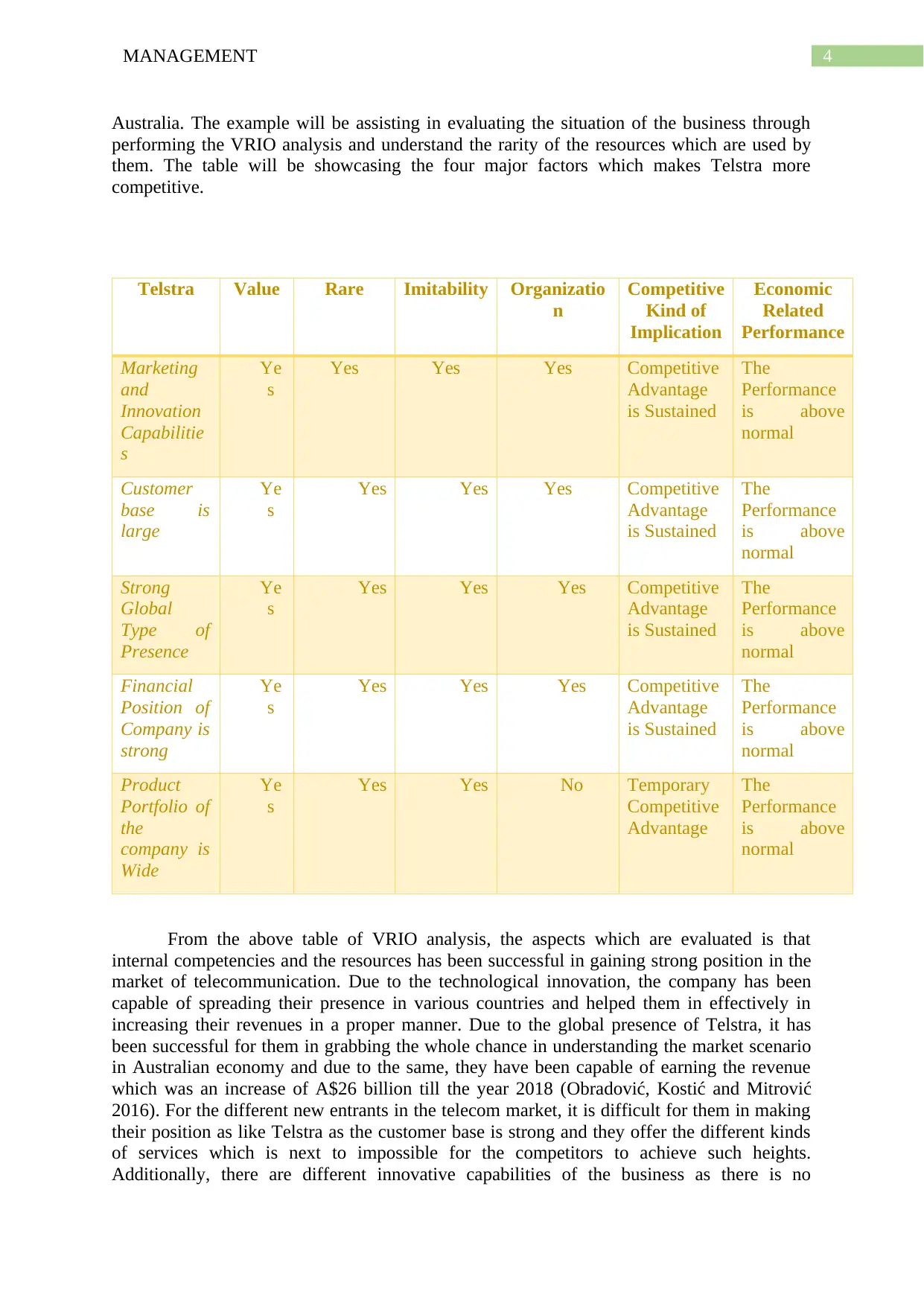
Australia. The example will be assisting in evaluating the situation of the business through
performing the VRIO analysis and understand the rarity of the resources which are used by
them. The table will be showcasing the four major factors which makes Telstra more
competitive.
Telstra Value Rare Imitability Organizatio
n
Competitive
Kind of
Implication
Economic
Related
Performance
Marketing
and
Innovation
Capabilitie
s
Ye
s
Yes Yes Yes Competitive
Advantage
is Sustained
The
Performance
is above
normal
Customer
base is
large
Ye
s
Yes Yes Yes Competitive
Advantage
is Sustained
The
Performance
is above
normal
Strong
Global
Type of
Presence
Ye
s
Yes Yes Yes Competitive
Advantage
is Sustained
The
Performance
is above
normal
Financial
Position of
Company is
strong
Ye
s
Yes Yes Yes Competitive
Advantage
is Sustained
The
Performance
is above
normal
Product
Portfolio of
the
company is
Wide
Ye
s
Yes Yes No Temporary
Competitive
Advantage
The
Performance
is above
normal
From the above table of VRIO analysis, the aspects which are evaluated is that
internal competencies and the resources has been successful in gaining strong position in the
market of telecommunication. Due to the technological innovation, the company has been
capable of spreading their presence in various countries and helped them in effectively in
increasing their revenues in a proper manner. Due to the global presence of Telstra, it has
been successful for them in grabbing the whole chance in understanding the market scenario
in Australian economy and due to the same, they have been capable of earning the revenue
which was an increase of A$26 billion till the year 2018 (Obradović, Kostić and Mitrović
2016). For the different new entrants in the telecom market, it is difficult for them in making
their position as like Telstra as the customer base is strong and they offer the different kinds
of services which is next to impossible for the competitors to achieve such heights.
Additionally, there are different innovative capabilities of the business as there is no
Australia. The example will be assisting in evaluating the situation of the business through
performing the VRIO analysis and understand the rarity of the resources which are used by
them. The table will be showcasing the four major factors which makes Telstra more
competitive.
Telstra Value Rare Imitability Organizatio
n
Competitive
Kind of
Implication
Economic
Related
Performance
Marketing
and
Innovation
Capabilitie
s
Ye
s
Yes Yes Yes Competitive
Advantage
is Sustained
The
Performance
is above
normal
Customer
base is
large
Ye
s
Yes Yes Yes Competitive
Advantage
is Sustained
The
Performance
is above
normal
Strong
Global
Type of
Presence
Ye
s
Yes Yes Yes Competitive
Advantage
is Sustained
The
Performance
is above
normal
Financial
Position of
Company is
strong
Ye
s
Yes Yes Yes Competitive
Advantage
is Sustained
The
Performance
is above
normal
Product
Portfolio of
the
company is
Wide
Ye
s
Yes Yes No Temporary
Competitive
Advantage
The
Performance
is above
normal
From the above table of VRIO analysis, the aspects which are evaluated is that
internal competencies and the resources has been successful in gaining strong position in the
market of telecommunication. Due to the technological innovation, the company has been
capable of spreading their presence in various countries and helped them in effectively in
increasing their revenues in a proper manner. Due to the global presence of Telstra, it has
been successful for them in grabbing the whole chance in understanding the market scenario
in Australian economy and due to the same, they have been capable of earning the revenue
which was an increase of A$26 billion till the year 2018 (Obradović, Kostić and Mitrović
2016). For the different new entrants in the telecom market, it is difficult for them in making
their position as like Telstra as the customer base is strong and they offer the different kinds
of services which is next to impossible for the competitors to achieve such heights.
Additionally, there are different innovative capabilities of the business as there is no
5MANAGEMENT
substitute of Telstra wherein the data packs which are made available to customers are
effective and it is being managed by the company efficiently as well.
Sustainable Approach
As orated by Najafi-Tavani, Sharifi and Najafi-Tavani (2016), the different corporate
social responsibility is considered to be the self-regulating business model ewhich assists the
organization in becoming socially accountable to the stakeholders, itself and the entire public
as well. Through proper practicing of the corporate social responsibility approaches, it is
known as corporate citizenship, in such scenarios, the organizations can be very much
conscious regarding the type of impact they can create on different aspects of the society
which is inclusive of social along with environment aspects. Furthermore, as stated by
McDonald (2015), the companies which are corporate socially responsible in nature, this can
help them in bolstering the image of the company and build their brand in a strong manner.
Moreover, as opined by Kozlenkova et al. (2015), the socially responsibility helps in
empowering the different individuals and employees in leveraging the corporate resources at
their disposal to do good and improve their effectiveness. There is various formal corporate
socially programs help in boosting the morale of employees and leads to the high level of
productivity. CSR has become one of the most standard functions in the corporations as to
create positive impact on the society as a whole while it can maximising creation of shared
values for the different owners of the business, stakeholders, shareholders and the employees
working in the company.
On contrary, as opined by Katsikeas et al. (2016), there is high costs involved in the
implementation of the CSR programs which affects the growth of the company negatively.
There can be clash of the business objectives wherein it can be seen that the main aspect of
the company is generating profitability, however the sustainable approach or the CSR related
initiatives can cause conflict in business objectives which can be difficult for the company in
generating high amount of revenues.
There are various major features and benefits of sustainable development of business
for the company to grow and maintain effectiveness.
It will be operative in ensuring liveable future as sustainability is critical for the
business to survive. There can be inclusion of sustainable supply chain that will be
efficient in managing the business models in the respective manner (Järvinen and
Karjaluoto 2015)
Proper building of resilience is the other strategy that can be incorporated by the
companies for receiving incredible opportunities for improving their brand image.
In occasion of Telstra Corporation, the management of the business believes the
circumstance that CSR is value-based approach for doing business that can be leading them
beyond the legal type of compliance for making the different positive contributions to
industries and communities wherein they participate. The main purpose of CSR programs at
Telstra is building the connected type of future wherein everyone can thrive and the
sustainability strategy which is key in achieving the same. The main strategy on which
Telstra focuses on issues which are essential for business and areas in which they have
expertise for making the world meaningful in nature (Telstra.com.au 2019).
Responsible Business- It will be becoming globally sustainable company that the
different people want to work with and for (Telstra.com.au 2019)
Environment Kind of Solutions- It is the other aspect that is effective for Telstra in
addressing the environmental challenges along with helping the different suppliers,
substitute of Telstra wherein the data packs which are made available to customers are
effective and it is being managed by the company efficiently as well.
Sustainable Approach
As orated by Najafi-Tavani, Sharifi and Najafi-Tavani (2016), the different corporate
social responsibility is considered to be the self-regulating business model ewhich assists the
organization in becoming socially accountable to the stakeholders, itself and the entire public
as well. Through proper practicing of the corporate social responsibility approaches, it is
known as corporate citizenship, in such scenarios, the organizations can be very much
conscious regarding the type of impact they can create on different aspects of the society
which is inclusive of social along with environment aspects. Furthermore, as stated by
McDonald (2015), the companies which are corporate socially responsible in nature, this can
help them in bolstering the image of the company and build their brand in a strong manner.
Moreover, as opined by Kozlenkova et al. (2015), the socially responsibility helps in
empowering the different individuals and employees in leveraging the corporate resources at
their disposal to do good and improve their effectiveness. There is various formal corporate
socially programs help in boosting the morale of employees and leads to the high level of
productivity. CSR has become one of the most standard functions in the corporations as to
create positive impact on the society as a whole while it can maximising creation of shared
values for the different owners of the business, stakeholders, shareholders and the employees
working in the company.
On contrary, as opined by Katsikeas et al. (2016), there is high costs involved in the
implementation of the CSR programs which affects the growth of the company negatively.
There can be clash of the business objectives wherein it can be seen that the main aspect of
the company is generating profitability, however the sustainable approach or the CSR related
initiatives can cause conflict in business objectives which can be difficult for the company in
generating high amount of revenues.
There are various major features and benefits of sustainable development of business
for the company to grow and maintain effectiveness.
It will be operative in ensuring liveable future as sustainability is critical for the
business to survive. There can be inclusion of sustainable supply chain that will be
efficient in managing the business models in the respective manner (Järvinen and
Karjaluoto 2015)
Proper building of resilience is the other strategy that can be incorporated by the
companies for receiving incredible opportunities for improving their brand image.
In occasion of Telstra Corporation, the management of the business believes the
circumstance that CSR is value-based approach for doing business that can be leading them
beyond the legal type of compliance for making the different positive contributions to
industries and communities wherein they participate. The main purpose of CSR programs at
Telstra is building the connected type of future wherein everyone can thrive and the
sustainability strategy which is key in achieving the same. The main strategy on which
Telstra focuses on issues which are essential for business and areas in which they have
expertise for making the world meaningful in nature (Telstra.com.au 2019).
Responsible Business- It will be becoming globally sustainable company that the
different people want to work with and for (Telstra.com.au 2019)
Environment Kind of Solutions- It is the other aspect that is effective for Telstra in
addressing the environmental challenges along with helping the different suppliers,
⊘ This is a preview!⊘
Do you want full access?
Subscribe today to unlock all pages.
Trusted by 1+ million students worldwide
6MANAGEMENT
communities and customers for doing the same. The management of Telstra believes
the fact that business has an essential role to play in addressing the change in climate
and they are committed towards minimising the various impacts across the entire
value chain of the company (Telstra.com.au 2019)
Digital Futures of Business- Moreover, the management of the company has been
successful in fostering strong along with inclusive communities that are properly
empowered in thriving in the digital world (Telstra.com.au 2019).
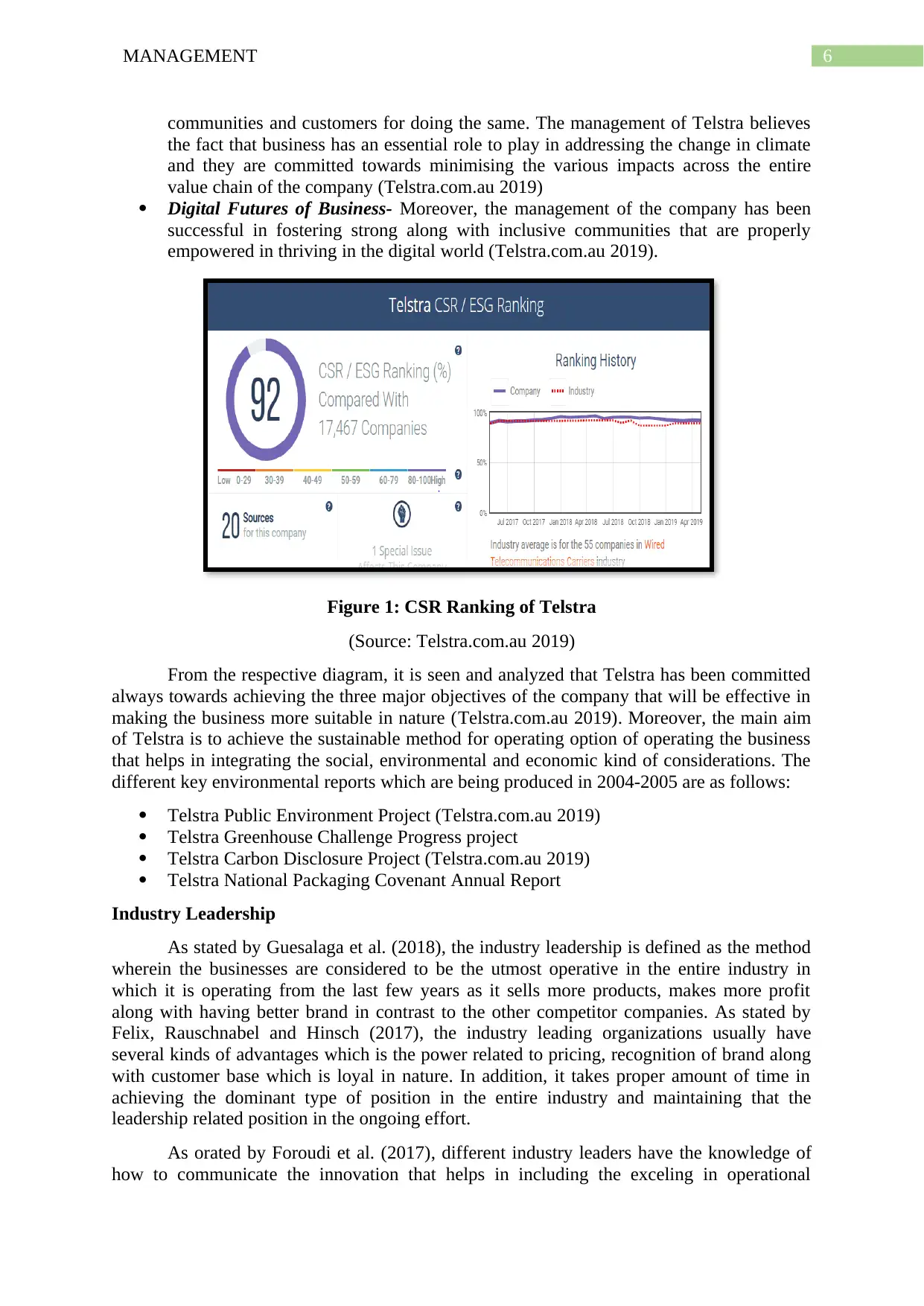
Figure 1: CSR Ranking of Telstra
(Source: Telstra.com.au 2019)
From the respective diagram, it is seen and analyzed that Telstra has been committed
always towards achieving the three major objectives of the company that will be effective in
making the business more suitable in nature (Telstra.com.au 2019). Moreover, the main aim
of Telstra is to achieve the sustainable method for operating option of operating the business
that helps in integrating the social, environmental and economic kind of considerations. The
different key environmental reports which are being produced in 2004-2005 are as follows:
Telstra Public Environment Project (Telstra.com.au 2019)
Telstra Greenhouse Challenge Progress project
Telstra Carbon Disclosure Project (Telstra.com.au 2019)
Telstra National Packaging Covenant Annual Report
Industry Leadership
As stated by Guesalaga et al. (2018), the industry leadership is defined as the method
wherein the businesses are considered to be the utmost operative in the entire industry in
which it is operating from the last few years as it sells more products, makes more profit
along with having better brand in contrast to the other competitor companies. As stated by
Felix, Rauschnabel and Hinsch (2017), the industry leading organizations usually have
several kinds of advantages which is the power related to pricing, recognition of brand along
with customer base which is loyal in nature. In addition, it takes proper amount of time in
achieving the dominant type of position in the entire industry and maintaining that the
leadership related position in the ongoing effort.
As orated by Foroudi et al. (2017), different industry leaders have the knowledge of
how to communicate the innovation that helps in including the exceling in operational
communities and customers for doing the same. The management of Telstra believes
the fact that business has an essential role to play in addressing the change in climate
and they are committed towards minimising the various impacts across the entire
value chain of the company (Telstra.com.au 2019)
Digital Futures of Business- Moreover, the management of the company has been
successful in fostering strong along with inclusive communities that are properly
empowered in thriving in the digital world (Telstra.com.au 2019).
Figure 1: CSR Ranking of Telstra
(Source: Telstra.com.au 2019)
From the respective diagram, it is seen and analyzed that Telstra has been committed
always towards achieving the three major objectives of the company that will be effective in
making the business more suitable in nature (Telstra.com.au 2019). Moreover, the main aim
of Telstra is to achieve the sustainable method for operating option of operating the business
that helps in integrating the social, environmental and economic kind of considerations. The
different key environmental reports which are being produced in 2004-2005 are as follows:
Telstra Public Environment Project (Telstra.com.au 2019)
Telstra Greenhouse Challenge Progress project
Telstra Carbon Disclosure Project (Telstra.com.au 2019)
Telstra National Packaging Covenant Annual Report
Industry Leadership
As stated by Guesalaga et al. (2018), the industry leadership is defined as the method
wherein the businesses are considered to be the utmost operative in the entire industry in
which it is operating from the last few years as it sells more products, makes more profit
along with having better brand in contrast to the other competitor companies. As stated by
Felix, Rauschnabel and Hinsch (2017), the industry leading organizations usually have
several kinds of advantages which is the power related to pricing, recognition of brand along
with customer base which is loyal in nature. In addition, it takes proper amount of time in
achieving the dominant type of position in the entire industry and maintaining that the
leadership related position in the ongoing effort.
As orated by Foroudi et al. (2017), different industry leaders have the knowledge of
how to communicate the innovation that helps in including the exceling in operational
Paraphrase This Document
Need a fresh take? Get an instant paraphrase of this document with our AI Paraphraser
7MANAGEMENT
excellence and strategic management. For instance- In case of Apple, the innovation of
Apple iPod can be considered as the radical innovation which will be making the company
competitive and it will be suitable in gaining more effectiveness in contrast to the other
competitor organizations (Erevelles, Fukawa and Swayne 2016). On contrary, as stated by
Felix, Rauschnabel and Hinsch (2017), becoming the top performer in the entire competitive
market, there is pressure on the companies to be on top and due to the same, the overhead
level is high and it is insignificant for them in being competitive with the various companies
that are considered to be the small competitors.
In case of Telstra Company, the management uses the differentiation aspect in selling
the products in the market in contrast to the other competitors present. Due to the same, they
have been able to gain the dominant position and the customers are attracted towards the
different offers which are being offered by them. Moreover, the wide range of the product
portfolio has been effective measure adapted b y Telstra in understanding the demands of the
customers and try to fulfil the same within the stipulated range of time (Chang, McAleer and
Wong 2018). As Telstra have been successful in gaining a strong market share and revenue of
A$26 billion in the Australian economy and in other countries wherein they have their strong
presence, the company has been considered to be the market leader and it has helped them in
their development predictions (David and David 2017).
In addition, Telstra was successful in delivering the T22 strategy through the proper
usage of machine learning and artificial intelligence which has helped the company in
managing their growth. The CEO of the company has announced that company has been
committed towards working with government as well as industry partners for exploring and
building greater technology talent pipeline within Australia for the overall kind of benefit of
the nation. Moreover, the strategic differentiation by being leader in network has been
achieved by Telstra through considerable kind of investments in transforming next generation
of networks along with in fixed network services. The 4G services covers more than 98% of
the population of Australia and they are on track for reaching more than 99% of the
population by the year 2017 (Ananda, Hernández-García and Lamberti 2016).
Due to the strategic differentiation approach which was being undertaken by Telstra,
the company has been successful in expanding their business in different markets
appropriately. Telstra in the present after becoming the most successful leader in telecom
industry, they are trying to pursue the different opportunities in key markets in Asia such as
Telstra Software group, Telstra Ventures along with Telstra Software Group (Ashley and
Tuten 2015). Additionally, Telstra telecom company communicates on a regular basis with
governments on range of different commercial, regulatory or policy related matters in interest
of the different shareholders and gain competitiveness in the market and improve their
position in the market in comparison to other competitors such as Vodafone. From the
respective aspects, more than 80% of the shares in the market have been gained by Telstra in
comparison to Vodafone and they have been hugely successful in the entire Australian
market and it encouraged their production in the economy as well.
Conclusion
It is inferred that these are the three major approaches related to strategic management
which can be helpful in improving the position of company in the business environment that
is competitive. In the respective case study, Telstra Telecom Company has been considered
which was suitable in understanding their position in the business environment. There are
different CSR programmes which have been included in the company that has affected the
development predictions of the company successfully. In addition, the company has been
excellence and strategic management. For instance- In case of Apple, the innovation of
Apple iPod can be considered as the radical innovation which will be making the company
competitive and it will be suitable in gaining more effectiveness in contrast to the other
competitor organizations (Erevelles, Fukawa and Swayne 2016). On contrary, as stated by
Felix, Rauschnabel and Hinsch (2017), becoming the top performer in the entire competitive
market, there is pressure on the companies to be on top and due to the same, the overhead
level is high and it is insignificant for them in being competitive with the various companies
that are considered to be the small competitors.
In case of Telstra Company, the management uses the differentiation aspect in selling
the products in the market in contrast to the other competitors present. Due to the same, they
have been able to gain the dominant position and the customers are attracted towards the
different offers which are being offered by them. Moreover, the wide range of the product
portfolio has been effective measure adapted b y Telstra in understanding the demands of the
customers and try to fulfil the same within the stipulated range of time (Chang, McAleer and
Wong 2018). As Telstra have been successful in gaining a strong market share and revenue of
A$26 billion in the Australian economy and in other countries wherein they have their strong
presence, the company has been considered to be the market leader and it has helped them in
their development predictions (David and David 2017).
In addition, Telstra was successful in delivering the T22 strategy through the proper
usage of machine learning and artificial intelligence which has helped the company in
managing their growth. The CEO of the company has announced that company has been
committed towards working with government as well as industry partners for exploring and
building greater technology talent pipeline within Australia for the overall kind of benefit of
the nation. Moreover, the strategic differentiation by being leader in network has been
achieved by Telstra through considerable kind of investments in transforming next generation
of networks along with in fixed network services. The 4G services covers more than 98% of
the population of Australia and they are on track for reaching more than 99% of the
population by the year 2017 (Ananda, Hernández-García and Lamberti 2016).
Due to the strategic differentiation approach which was being undertaken by Telstra,
the company has been successful in expanding their business in different markets
appropriately. Telstra in the present after becoming the most successful leader in telecom
industry, they are trying to pursue the different opportunities in key markets in Asia such as
Telstra Software group, Telstra Ventures along with Telstra Software Group (Ashley and
Tuten 2015). Additionally, Telstra telecom company communicates on a regular basis with
governments on range of different commercial, regulatory or policy related matters in interest
of the different shareholders and gain competitiveness in the market and improve their
position in the market in comparison to other competitors such as Vodafone. From the
respective aspects, more than 80% of the shares in the market have been gained by Telstra in
comparison to Vodafone and they have been hugely successful in the entire Australian
market and it encouraged their production in the economy as well.
Conclusion
It is inferred that these are the three major approaches related to strategic management
which can be helpful in improving the position of company in the business environment that
is competitive. In the respective case study, Telstra Telecom Company has been considered
which was suitable in understanding their position in the business environment. There are
different CSR programmes which have been included in the company that has affected the
development predictions of the company successfully. In addition, the company has been
8MANAGEMENT
successful in covering more than 80% of the share in market which has helped them in
becoming more strategic in operations.
References
Ananda, A.S., Hernández-García, Á. and Lamberti, L., 2016. N-REL: A comprehensive
framework of social media marketing strategic actions for marketing organizations. Journal
of Innovation & Knowledge, 1(3), pp.170-180.
Ashley, C. and Tuten, T., 2015. Creative strategies in social media marketing: An exploratory
study of branded social content and consumer engagement. Psychology & Marketing, 32(1),
pp.15-27.
Chang, C.L., McAleer, M. and Wong, W.K., 2018. Big data, computational science,
economics, finance, marketing, management, and psychology: connections. Journal of Risk
and Financial Management, 11(1), p.15.
David, M.E. and David, F.R., 2017. Are key marketing topics adequately covered in strategic
management?. Journal of Strategic Marketing, 25(5-6), pp.405-417.
Erevelles, S., Fukawa, N. and Swayne, L., 2016. Big Data consumer analytics and the
transformation of marketing. Journal of Business Research, 69(2), pp.897-904.
Felix, R., Rauschnabel, P.A. and Hinsch, C., 2017. Elements of strategic social media
marketing: A holistic framework. Journal of Business Research, 70, pp.118-126.
Foroudi, P., Gupta, S., Nazarian, A. and Duda, M., 2017. Digital technology and marketing
management capability: achieving growth in SMEs. Qualitative Market Research: An
International Journal, 20(2), pp.230-246.
Guesalaga, R., Gabrielsson, M., Rogers, B., Ryals, L. and Cuevas, J.M., 2018. Which
resources and capabilities underpin strategic key account management?. Industrial Marketing
Management, 75, pp.160-172.
Järvinen, J. and Karjaluoto, H., 2015. The use of Web analytics for digital marketing
performance measurement. Industrial Marketing Management, 50, pp.117-127.
Katsikeas, C.S., Morgan, N.A., Leonidou, L.C. and Hult, G.T.M., 2016. Assessing
performance outcomes in marketing. Journal of Marketing, 80(2), pp.1-20.
Kozlenkova, I.V., Hult, G.T.M., Lund, D.J., Mena, J.A. and Kekec, P., 2015. The role of
marketing channels in supply chain management. Journal of Retailing, 91(4), pp.586-609.
McDonald, M., 2015. Marketing accountability. Wiley Encyclopedia of Management, pp.1-8.
Najafi-Tavani, S., Sharifi, H. and Najafi-Tavani, Z., 2016. Market orientation, marketing
capability, and new product performance: The moderating role of absorptive
capacity. Journal of Business Research, 69(11), pp.5059-5064.
Obradović, V., Kostić, S.C. and Mitrović, Z., 2016. Rethinking project management–Did we
miss marketing management?. Procedia-Social and Behavioral Sciences, 226, pp.390-397.
Papadas, K.K., Avlonitis, G.J., Carrigan, M. and Piha, L., 2019. The interplay of strategic and
internal green marketing orientation on competitive advantage. Journal of Business
Research, 104, pp.632-643.
successful in covering more than 80% of the share in market which has helped them in
becoming more strategic in operations.
References
Ananda, A.S., Hernández-García, Á. and Lamberti, L., 2016. N-REL: A comprehensive
framework of social media marketing strategic actions for marketing organizations. Journal
of Innovation & Knowledge, 1(3), pp.170-180.
Ashley, C. and Tuten, T., 2015. Creative strategies in social media marketing: An exploratory
study of branded social content and consumer engagement. Psychology & Marketing, 32(1),
pp.15-27.
Chang, C.L., McAleer, M. and Wong, W.K., 2018. Big data, computational science,
economics, finance, marketing, management, and psychology: connections. Journal of Risk
and Financial Management, 11(1), p.15.
David, M.E. and David, F.R., 2017. Are key marketing topics adequately covered in strategic
management?. Journal of Strategic Marketing, 25(5-6), pp.405-417.
Erevelles, S., Fukawa, N. and Swayne, L., 2016. Big Data consumer analytics and the
transformation of marketing. Journal of Business Research, 69(2), pp.897-904.
Felix, R., Rauschnabel, P.A. and Hinsch, C., 2017. Elements of strategic social media
marketing: A holistic framework. Journal of Business Research, 70, pp.118-126.
Foroudi, P., Gupta, S., Nazarian, A. and Duda, M., 2017. Digital technology and marketing
management capability: achieving growth in SMEs. Qualitative Market Research: An
International Journal, 20(2), pp.230-246.
Guesalaga, R., Gabrielsson, M., Rogers, B., Ryals, L. and Cuevas, J.M., 2018. Which
resources and capabilities underpin strategic key account management?. Industrial Marketing
Management, 75, pp.160-172.
Järvinen, J. and Karjaluoto, H., 2015. The use of Web analytics for digital marketing
performance measurement. Industrial Marketing Management, 50, pp.117-127.
Katsikeas, C.S., Morgan, N.A., Leonidou, L.C. and Hult, G.T.M., 2016. Assessing
performance outcomes in marketing. Journal of Marketing, 80(2), pp.1-20.
Kozlenkova, I.V., Hult, G.T.M., Lund, D.J., Mena, J.A. and Kekec, P., 2015. The role of
marketing channels in supply chain management. Journal of Retailing, 91(4), pp.586-609.
McDonald, M., 2015. Marketing accountability. Wiley Encyclopedia of Management, pp.1-8.
Najafi-Tavani, S., Sharifi, H. and Najafi-Tavani, Z., 2016. Market orientation, marketing
capability, and new product performance: The moderating role of absorptive
capacity. Journal of Business Research, 69(11), pp.5059-5064.
Obradović, V., Kostić, S.C. and Mitrović, Z., 2016. Rethinking project management–Did we
miss marketing management?. Procedia-Social and Behavioral Sciences, 226, pp.390-397.
Papadas, K.K., Avlonitis, G.J., Carrigan, M. and Piha, L., 2019. The interplay of strategic and
internal green marketing orientation on competitive advantage. Journal of Business
Research, 104, pp.632-643.
⊘ This is a preview!⊘
Do you want full access?
Subscribe today to unlock all pages.
Trusted by 1+ million students worldwide
9MANAGEMENT
Post, J. and Leavell, J.P., 2019. Diligence-Based Strategy, Strategic Marketing
Ambidexterity, and the Resource-Based View: Informing the Exploitation/Exploration Mode
and Valuing Capabilities.
Rinallo, D., Bathelt, H. and Golfetto, F., 2017. Economic geography and industrial marketing
views on trade shows: Collective marketing and knowledge circulation. Industrial Marketing
Management, 61, pp.93-103.
Sheth, J., 2017. Revitalizing relationship marketing. Journal of Services Marketing, 31(1),
pp.6-10.
Telstra.com.au 2019 Bigger Picture 2019 Sustainability Report (Online) Retrieved from
https://exchange.telstra.com.au/sustainability/ [Accessed on 19th September 2019]
Telstra.com.au 2019 Community and Environment (Online) Retrieved from
https://www.telstra.com.au/aboutus/community-environment [Accessed on 19th September
2019]
Telstra.com.au 2019 Tackling today’s technology challenges with innovation (Online)
Retrieved from https://exchange.telstra.com.au/tackling-todays-technology-challenges-with-
innovation/ [Accessed on 19th September 2019]
Telstra.com.au 2019 Telstra Innovation Challenge winners 2019 (online) Retrieved from
https://exchange.telstra.com.au/telstra-innovation-challenge-winners-2019/ [Accessed on 19th
September 2019]
Varadarajan, R., 2015. Strategic marketing, marketing strategy and market strategy. AMS
review, 5(3-4), pp.78-90.
Viljoen, K., Roberts-Lombard, M. and Jooste, C., 2015. Reintermediation strategies for
disintermediated travel agencies: a strategic marketing perspective. The International
Business & Economics Research Journal (Online), 14(3), p.561.
Post, J. and Leavell, J.P., 2019. Diligence-Based Strategy, Strategic Marketing
Ambidexterity, and the Resource-Based View: Informing the Exploitation/Exploration Mode
and Valuing Capabilities.
Rinallo, D., Bathelt, H. and Golfetto, F., 2017. Economic geography and industrial marketing
views on trade shows: Collective marketing and knowledge circulation. Industrial Marketing
Management, 61, pp.93-103.
Sheth, J., 2017. Revitalizing relationship marketing. Journal of Services Marketing, 31(1),
pp.6-10.
Telstra.com.au 2019 Bigger Picture 2019 Sustainability Report (Online) Retrieved from
https://exchange.telstra.com.au/sustainability/ [Accessed on 19th September 2019]
Telstra.com.au 2019 Community and Environment (Online) Retrieved from
https://www.telstra.com.au/aboutus/community-environment [Accessed on 19th September
2019]
Telstra.com.au 2019 Tackling today’s technology challenges with innovation (Online)
Retrieved from https://exchange.telstra.com.au/tackling-todays-technology-challenges-with-
innovation/ [Accessed on 19th September 2019]
Telstra.com.au 2019 Telstra Innovation Challenge winners 2019 (online) Retrieved from
https://exchange.telstra.com.au/telstra-innovation-challenge-winners-2019/ [Accessed on 19th
September 2019]
Varadarajan, R., 2015. Strategic marketing, marketing strategy and market strategy. AMS
review, 5(3-4), pp.78-90.
Viljoen, K., Roberts-Lombard, M. and Jooste, C., 2015. Reintermediation strategies for
disintermediated travel agencies: a strategic marketing perspective. The International
Business & Economics Research Journal (Online), 14(3), p.561.

1 out of 10


Related Documents


Your All-in-One AI-Powered Toolkit for Academic Success.
+13062052269
info@desklib.com
Available 24*7 on WhatsApp / Email
![[object Object]](/_next/static/media/star-bottom.7253800d.svg)
Unlock your academic potential
Copyright © 2020–2026 A2Z Services. All Rights Reserved. Developed and managed by ZUCOL.