Finalization of Audit: Always Precise Instruments Pty Limited - 2019
VerifiedAdded on 2023/03/20
|14
|3162
|78
Report
AI Summary
This report, prepared by an audit manager at Samway Baker Fitzgerald (SBF), details the audit finalization for Always Precise Instruments Pty Limited (API), a manufacturer of military equipment. The report identifies potential audit risks through ratio analysis, including current ratio, quick asset ratio, return on equity, return on total assets, gross margin percentage, marketing expense, administrative expenses, times interest earned, days in inventory, days in accounts receivables, and debt to equity ratio. Each risk is assessed and paired with the corresponding audit procedure. The report also outlines internal control weaknesses related to inventory, raw material receipt, lack of emergency inventory, manufacture of finished goods, and purchase orders, along with associated audit procedures to mitigate these risks. The analysis is based on API's financial report, budget, and industry benchmarks, aiming to provide a comprehensive overview of the company's financial health and potential areas of concern.
AUDITING
2019
2019

Paraphrase This Document
Need a fresh take? Get an instant paraphrase of this document with our AI Paraphraser
Audit
MEMO TO: Wayne Wiadrowski
FROM: Audit manager at Samway Baker Fitzgerald (SBF)
DATE: May 12, 2019
SUBJECT: Audit finalization of Always Precise Instruments Pty Limited
1. Potential audit risk Identification
Potential audit risks have the ability to impact the overall functioning of an organization and
therefore, it is the duty of an auditor to conduct his audit processes in a manner that these
risks are easily traced. An auditor by means of employing various ratios such as current ratio,
acid test ratio, gross margin percentage, etc can detect the potential audit risks. Identification
of potential risks will allow the management of an organization to take necessary measures to
lessen or reduce the impact arising due to such risks. Potential audit risks are vulnerable for
the financial well being of an organization and therefore, an auditor must exercise due
caution while conducting audit procedure so as to trace the same (Mock et. al, 2013). An
auditor must also report such potential risks to the management of an organization so as to
encourage the latter in adopting such strategies that can reduce or eliminate the impact of the
same. In the following report, the explanation of various ratios together with the audit risk
and procedure is discussed.
1. Identification of Potential risk
Ratio Analysis Audit
Risk
Audit
procedure
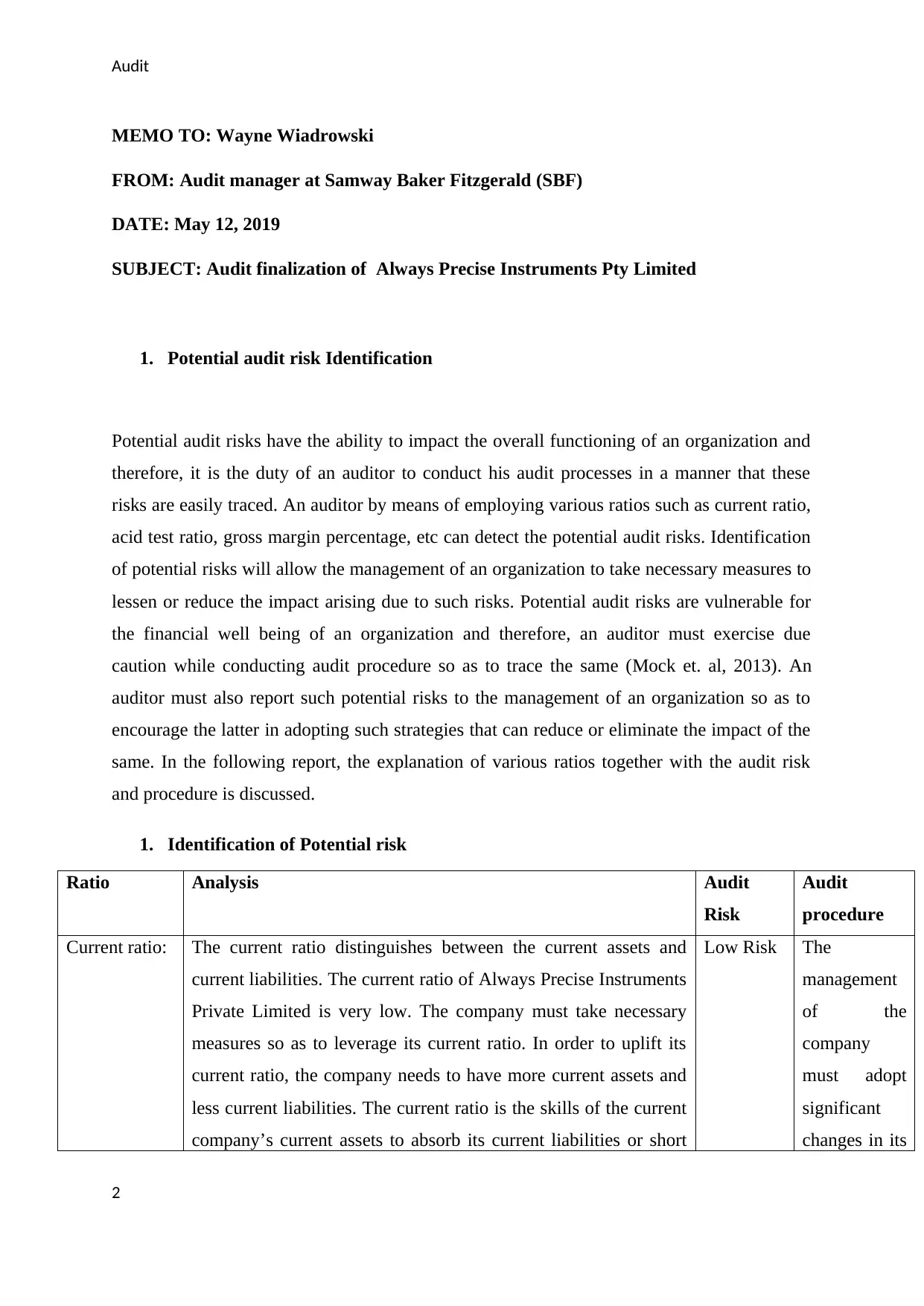
Current ratio: The current ratio distinguishes between the current assets and
current liabilities. The current ratio of Always Precise Instruments
Private Limited is very low. The company must take necessary
measures so as to leverage its current ratio. In order to uplift its
current ratio, the company needs to have more current assets and
less current liabilities. The current ratio is the skills of the current
company’s current assets to absorb its current liabilities or short
Low Risk The
management
of the
company
must adopt
significant
changes in its
2
MEMO TO: Wayne Wiadrowski
FROM: Audit manager at Samway Baker Fitzgerald (SBF)
DATE: May 12, 2019
SUBJECT: Audit finalization of Always Precise Instruments Pty Limited
1. Potential audit risk Identification
Potential audit risks have the ability to impact the overall functioning of an organization and
therefore, it is the duty of an auditor to conduct his audit processes in a manner that these
risks are easily traced. An auditor by means of employing various ratios such as current ratio,
acid test ratio, gross margin percentage, etc can detect the potential audit risks. Identification
of potential risks will allow the management of an organization to take necessary measures to
lessen or reduce the impact arising due to such risks. Potential audit risks are vulnerable for
the financial well being of an organization and therefore, an auditor must exercise due
caution while conducting audit procedure so as to trace the same (Mock et. al, 2013). An
auditor must also report such potential risks to the management of an organization so as to
encourage the latter in adopting such strategies that can reduce or eliminate the impact of the
same. In the following report, the explanation of various ratios together with the audit risk
and procedure is discussed.
1. Identification of Potential risk
Ratio Analysis Audit
Risk
Audit
procedure
Current ratio: The current ratio distinguishes between the current assets and
current liabilities. The current ratio of Always Precise Instruments
Private Limited is very low. The company must take necessary
measures so as to leverage its current ratio. In order to uplift its
current ratio, the company needs to have more current assets and
less current liabilities. The current ratio is the skills of the current
company’s current assets to absorb its current liabilities or short
Low Risk The
management
of the
company
must adopt
significant
changes in its
2
Audit
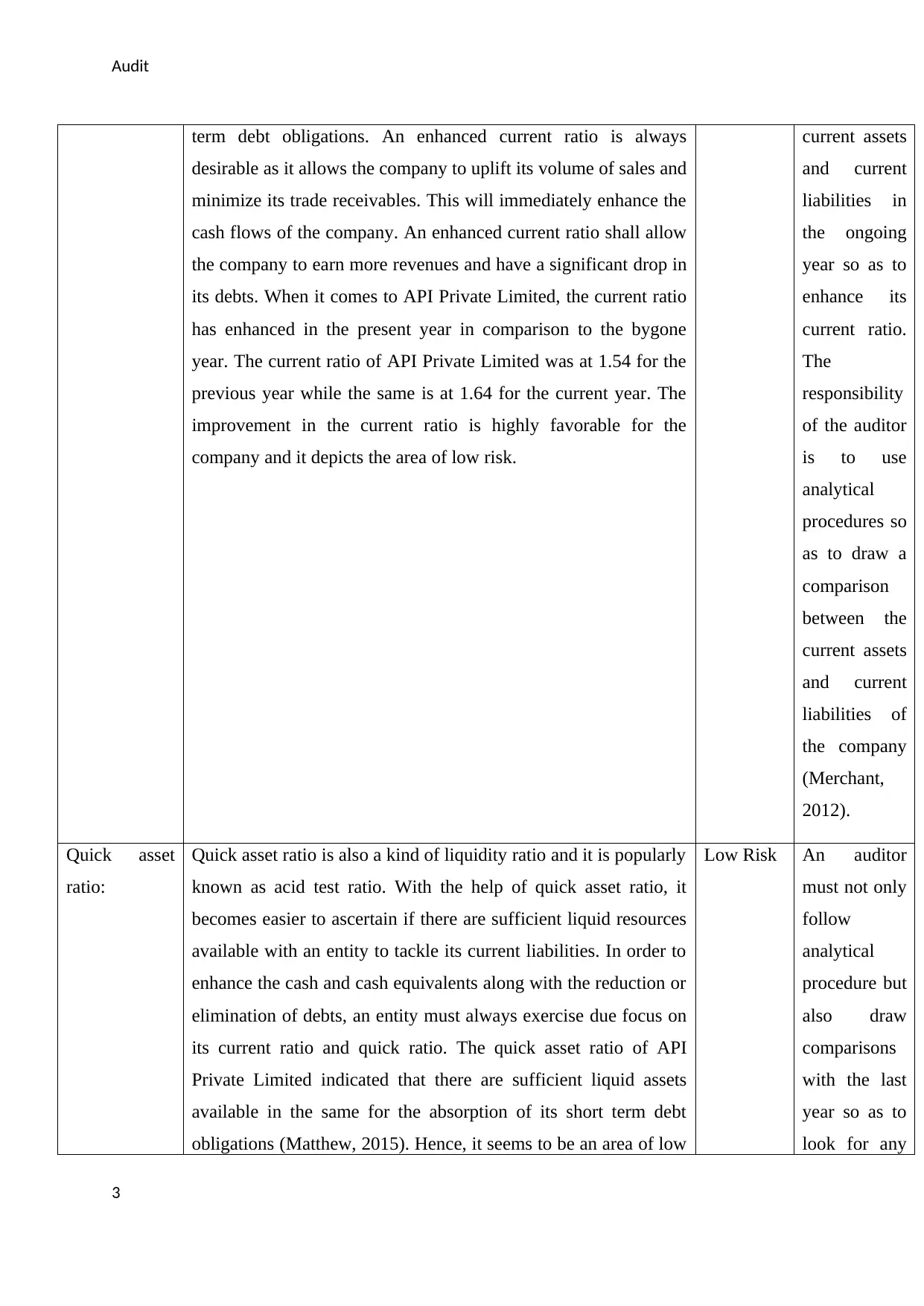
term debt obligations. An enhanced current ratio is always
desirable as it allows the company to uplift its volume of sales and
minimize its trade receivables. This will immediately enhance the
cash flows of the company. An enhanced current ratio shall allow
the company to earn more revenues and have a significant drop in
its debts. When it comes to API Private Limited, the current ratio
has enhanced in the present year in comparison to the bygone
year. The current ratio of API Private Limited was at 1.54 for the
previous year while the same is at 1.64 for the current year. The
improvement in the current ratio is highly favorable for the
company and it depicts the area of low risk.
current assets
and current
liabilities in
the ongoing
year so as to
enhance its
current ratio.
The
responsibility
of the auditor
is to use
analytical
procedures so
as to draw a
comparison
between the
current assets
and current
liabilities of
the company
(Merchant,
2012).
Quick asset
ratio:
Quick asset ratio is also a kind of liquidity ratio and it is popularly
known as acid test ratio. With the help of quick asset ratio, it
becomes easier to ascertain if there are sufficient liquid resources
available with an entity to tackle its current liabilities. In order to
enhance the cash and cash equivalents along with the reduction or
elimination of debts, an entity must always exercise due focus on
its current ratio and quick ratio. The quick asset ratio of API
Private Limited indicated that there are sufficient liquid assets
available in the same for the absorption of its short term debt
obligations (Matthew, 2015). Hence, it seems to be an area of low
Low Risk An auditor
must not only
follow
analytical
procedure but
also draw
comparisons
with the last
year so as to
look for any
3
term debt obligations. An enhanced current ratio is always
desirable as it allows the company to uplift its volume of sales and
minimize its trade receivables. This will immediately enhance the
cash flows of the company. An enhanced current ratio shall allow
the company to earn more revenues and have a significant drop in
its debts. When it comes to API Private Limited, the current ratio
has enhanced in the present year in comparison to the bygone
year. The current ratio of API Private Limited was at 1.54 for the
previous year while the same is at 1.64 for the current year. The
improvement in the current ratio is highly favorable for the
company and it depicts the area of low risk.
current assets
and current
liabilities in
the ongoing
year so as to
enhance its
current ratio.
The
responsibility
of the auditor
is to use
analytical
procedures so
as to draw a
comparison
between the
current assets
and current
liabilities of
the company
(Merchant,
2012).
Quick asset
ratio:
Quick asset ratio is also a kind of liquidity ratio and it is popularly
known as acid test ratio. With the help of quick asset ratio, it
becomes easier to ascertain if there are sufficient liquid resources
available with an entity to tackle its current liabilities. In order to
enhance the cash and cash equivalents along with the reduction or
elimination of debts, an entity must always exercise due focus on
its current ratio and quick ratio. The quick asset ratio of API
Private Limited indicated that there are sufficient liquid assets
available in the same for the absorption of its short term debt
obligations (Matthew, 2015). Hence, it seems to be an area of low
Low Risk An auditor
must not only
follow
analytical
procedure but
also draw
comparisons
with the last
year so as to
look for any
3
⊘ This is a preview!⊘
Do you want full access?
Subscribe today to unlock all pages.

Trusted by 1+ million students worldwide
Audit
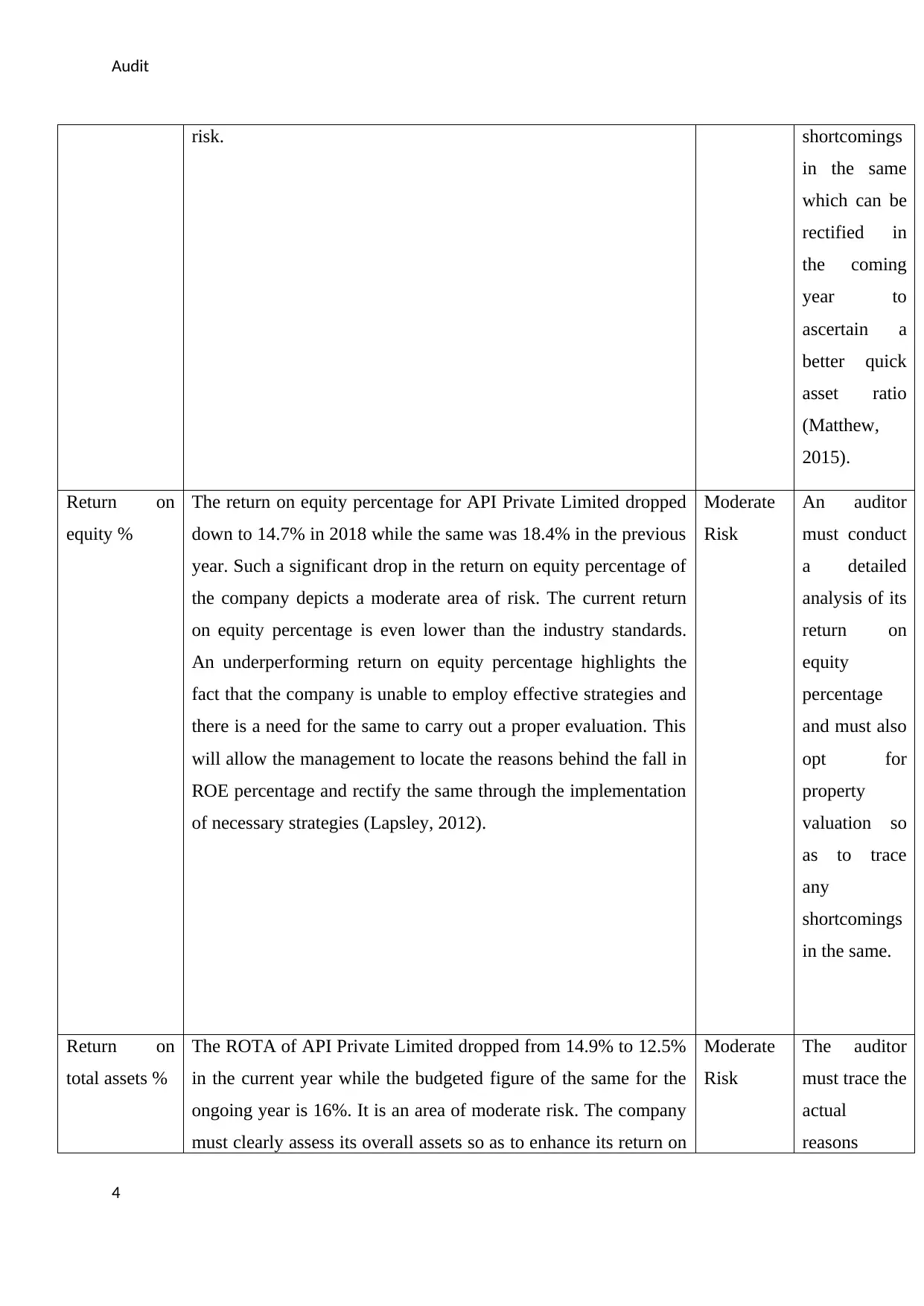
risk. shortcomings
in the same
which can be
rectified in
the coming
year to
ascertain a
better quick
asset ratio
(Matthew,
2015).
Return on
equity %
The return on equity percentage for API Private Limited dropped
down to 14.7% in 2018 while the same was 18.4% in the previous
year. Such a significant drop in the return on equity percentage of
the company depicts a moderate area of risk. The current return
on equity percentage is even lower than the industry standards.
An underperforming return on equity percentage highlights the
fact that the company is unable to employ effective strategies and
there is a need for the same to carry out a proper evaluation. This
will allow the management to locate the reasons behind the fall in
ROE percentage and rectify the same through the implementation
of necessary strategies (Lapsley, 2012).
Moderate
Risk
An auditor
must conduct
a detailed
analysis of its
return on
equity
percentage
and must also
opt for
property
valuation so
as to trace
any
shortcomings
in the same.
Return on
total assets %
The ROTA of API Private Limited dropped from 14.9% to 12.5%
in the current year while the budgeted figure of the same for the
ongoing year is 16%. It is an area of moderate risk. The company
must clearly assess its overall assets so as to enhance its return on
Moderate
Risk
The auditor
must trace the
actual
reasons
4
risk. shortcomings
in the same
which can be
rectified in
the coming
year to
ascertain a
better quick
asset ratio
(Matthew,
2015).
Return on
equity %
The return on equity percentage for API Private Limited dropped
down to 14.7% in 2018 while the same was 18.4% in the previous
year. Such a significant drop in the return on equity percentage of
the company depicts a moderate area of risk. The current return
on equity percentage is even lower than the industry standards.
An underperforming return on equity percentage highlights the
fact that the company is unable to employ effective strategies and
there is a need for the same to carry out a proper evaluation. This
will allow the management to locate the reasons behind the fall in
ROE percentage and rectify the same through the implementation
of necessary strategies (Lapsley, 2012).
Moderate
Risk
An auditor
must conduct
a detailed
analysis of its
return on
equity
percentage
and must also
opt for
property
valuation so
as to trace
any
shortcomings
in the same.
Return on
total assets %
The ROTA of API Private Limited dropped from 14.9% to 12.5%
in the current year while the budgeted figure of the same for the
ongoing year is 16%. It is an area of moderate risk. The company
must clearly assess its overall assets so as to enhance its return on
Moderate
Risk
The auditor
must trace the
actual
reasons
4
Paraphrase This Document
Need a fresh take? Get an instant paraphrase of this document with our AI Paraphraser
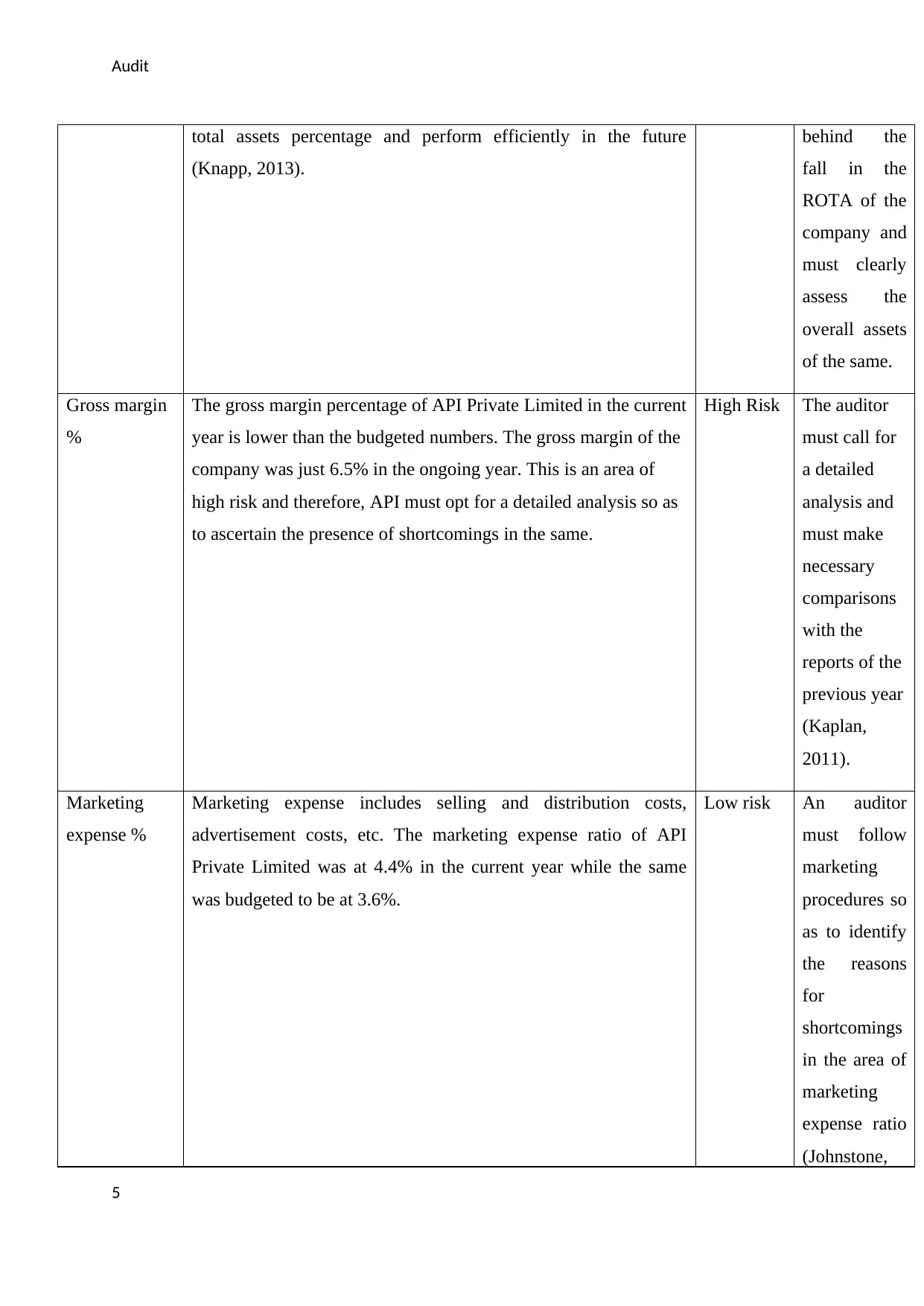
Audit
total assets percentage and perform efficiently in the future
(Knapp, 2013).
behind the
fall in the
ROTA of the
company and
must clearly
assess the
overall assets
of the same.
Gross margin
%
The gross margin percentage of API Private Limited in the current
year is lower than the budgeted numbers. The gross margin of the
company was just 6.5% in the ongoing year. This is an area of
high risk and therefore, API must opt for a detailed analysis so as
to ascertain the presence of shortcomings in the same.
High Risk The auditor
must call for
a detailed
analysis and
must make
necessary
comparisons
with the
reports of the
previous year
(Kaplan,
2011).
Marketing
expense %
Marketing expense includes selling and distribution costs,
advertisement costs, etc. The marketing expense ratio of API
Private Limited was at 4.4% in the current year while the same
was budgeted to be at 3.6%.
Low risk An auditor
must follow
marketing
procedures so
as to identify
the reasons
for
shortcomings
in the area of
marketing
expense ratio
(Johnstone,
5
total assets percentage and perform efficiently in the future
(Knapp, 2013).
behind the
fall in the
ROTA of the
company and
must clearly
assess the
overall assets
of the same.
Gross margin
%
The gross margin percentage of API Private Limited in the current
year is lower than the budgeted numbers. The gross margin of the
company was just 6.5% in the ongoing year. This is an area of
high risk and therefore, API must opt for a detailed analysis so as
to ascertain the presence of shortcomings in the same.
High Risk The auditor
must call for
a detailed
analysis and
must make
necessary
comparisons
with the
reports of the
previous year
(Kaplan,
2011).
Marketing
expense %
Marketing expense includes selling and distribution costs,
advertisement costs, etc. The marketing expense ratio of API
Private Limited was at 4.4% in the current year while the same
was budgeted to be at 3.6%.
Low risk An auditor
must follow
marketing
procedures so
as to identify
the reasons
for
shortcomings
in the area of
marketing
expense ratio
(Johnstone,
5
Audit
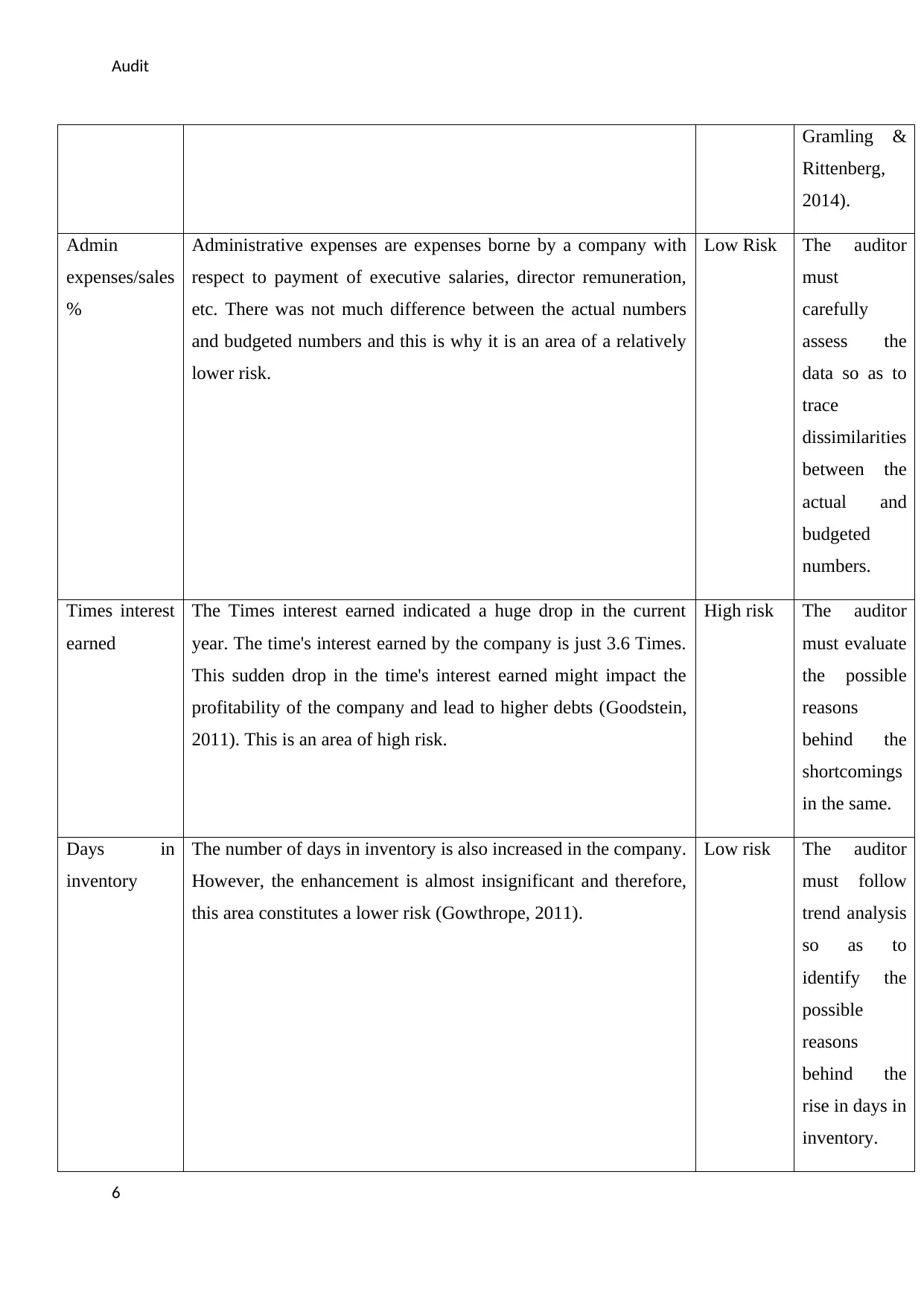
Gramling &
Rittenberg,
2014).
Admin
expenses/sales
%
Administrative expenses are expenses borne by a company with
respect to payment of executive salaries, director remuneration,
etc. There was not much difference between the actual numbers
and budgeted numbers and this is why it is an area of a relatively
lower risk.
Low Risk The auditor
must
carefully
assess the
data so as to
trace
dissimilarities
between the
actual and
budgeted
numbers.
Times interest
earned
The Times interest earned indicated a huge drop in the current
year. The time's interest earned by the company is just 3.6 Times.
This sudden drop in the time's interest earned might impact the
profitability of the company and lead to higher debts (Goodstein,
2011). This is an area of high risk.
High risk The auditor
must evaluate
the possible
reasons
behind the
shortcomings
in the same.
Days in
inventory
The number of days in inventory is also increased in the company.
However, the enhancement is almost insignificant and therefore,
this area constitutes a lower risk (Gowthrope, 2011).
Low risk The auditor
must follow
trend analysis
so as to
identify the
possible
reasons
behind the
rise in days in
inventory.
6
Gramling &
Rittenberg,
2014).
Admin
expenses/sales
%
Administrative expenses are expenses borne by a company with
respect to payment of executive salaries, director remuneration,
etc. There was not much difference between the actual numbers
and budgeted numbers and this is why it is an area of a relatively
lower risk.
Low Risk The auditor
must
carefully
assess the
data so as to
trace
dissimilarities
between the
actual and
budgeted
numbers.
Times interest
earned
The Times interest earned indicated a huge drop in the current
year. The time's interest earned by the company is just 3.6 Times.
This sudden drop in the time's interest earned might impact the
profitability of the company and lead to higher debts (Goodstein,
2011). This is an area of high risk.
High risk The auditor
must evaluate
the possible
reasons
behind the
shortcomings
in the same.
Days in
inventory
The number of days in inventory is also increased in the company.
However, the enhancement is almost insignificant and therefore,
this area constitutes a lower risk (Gowthrope, 2011).
Low risk The auditor
must follow
trend analysis
so as to
identify the
possible
reasons
behind the
rise in days in
inventory.
6
⊘ This is a preview!⊘
Do you want full access?
Subscribe today to unlock all pages.
Trusted by 1+ million students worldwide
Audit
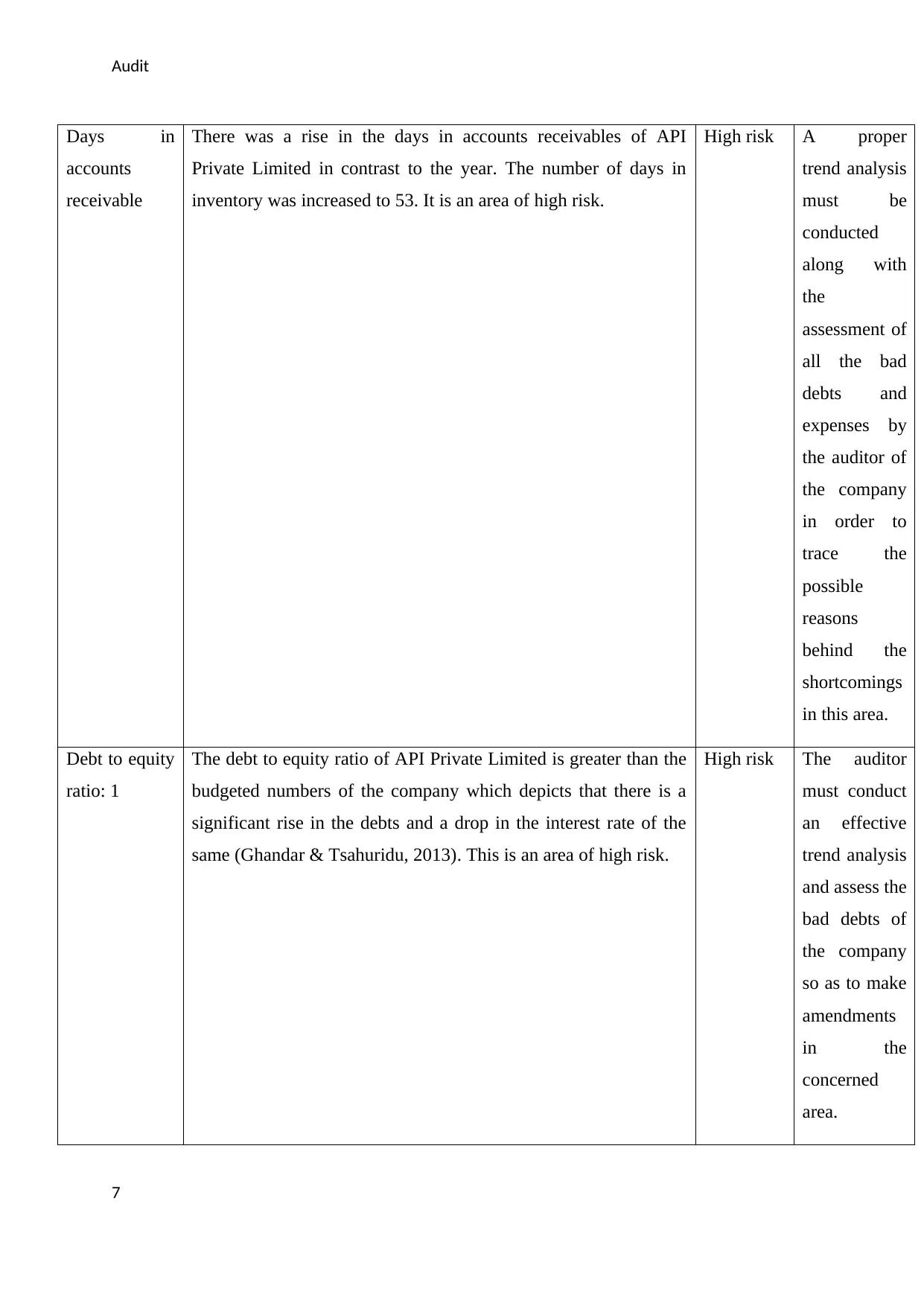
Days in
accounts
receivable
There was a rise in the days in accounts receivables of API
Private Limited in contrast to the year. The number of days in
inventory was increased to 53. It is an area of high risk.
High risk A proper
trend analysis
must be
conducted
along with
the
assessment of
all the bad
debts and
expenses by
the auditor of
the company
in order to
trace the
possible
reasons
behind the
shortcomings
in this area.
Debt to equity
ratio: 1
The debt to equity ratio of API Private Limited is greater than the
budgeted numbers of the company which depicts that there is a
significant rise in the debts and a drop in the interest rate of the
same (Ghandar & Tsahuridu, 2013). This is an area of high risk.
High risk The auditor
must conduct
an effective
trend analysis
and assess the
bad debts of
the company
so as to make
amendments
in the
concerned
area.
7
Days in
accounts
receivable
There was a rise in the days in accounts receivables of API
Private Limited in contrast to the year. The number of days in
inventory was increased to 53. It is an area of high risk.
High risk A proper
trend analysis
must be
conducted
along with
the
assessment of
all the bad
debts and
expenses by
the auditor of
the company
in order to
trace the
possible
reasons
behind the
shortcomings
in this area.
Debt to equity
ratio: 1
The debt to equity ratio of API Private Limited is greater than the
budgeted numbers of the company which depicts that there is a
significant rise in the debts and a drop in the interest rate of the
same (Ghandar & Tsahuridu, 2013). This is an area of high risk.
High risk The auditor
must conduct
an effective
trend analysis
and assess the
bad debts of
the company
so as to make
amendments
in the
concerned
area.
7
Paraphrase This Document
Need a fresh take? Get an instant paraphrase of this document with our AI Paraphraser
Audit
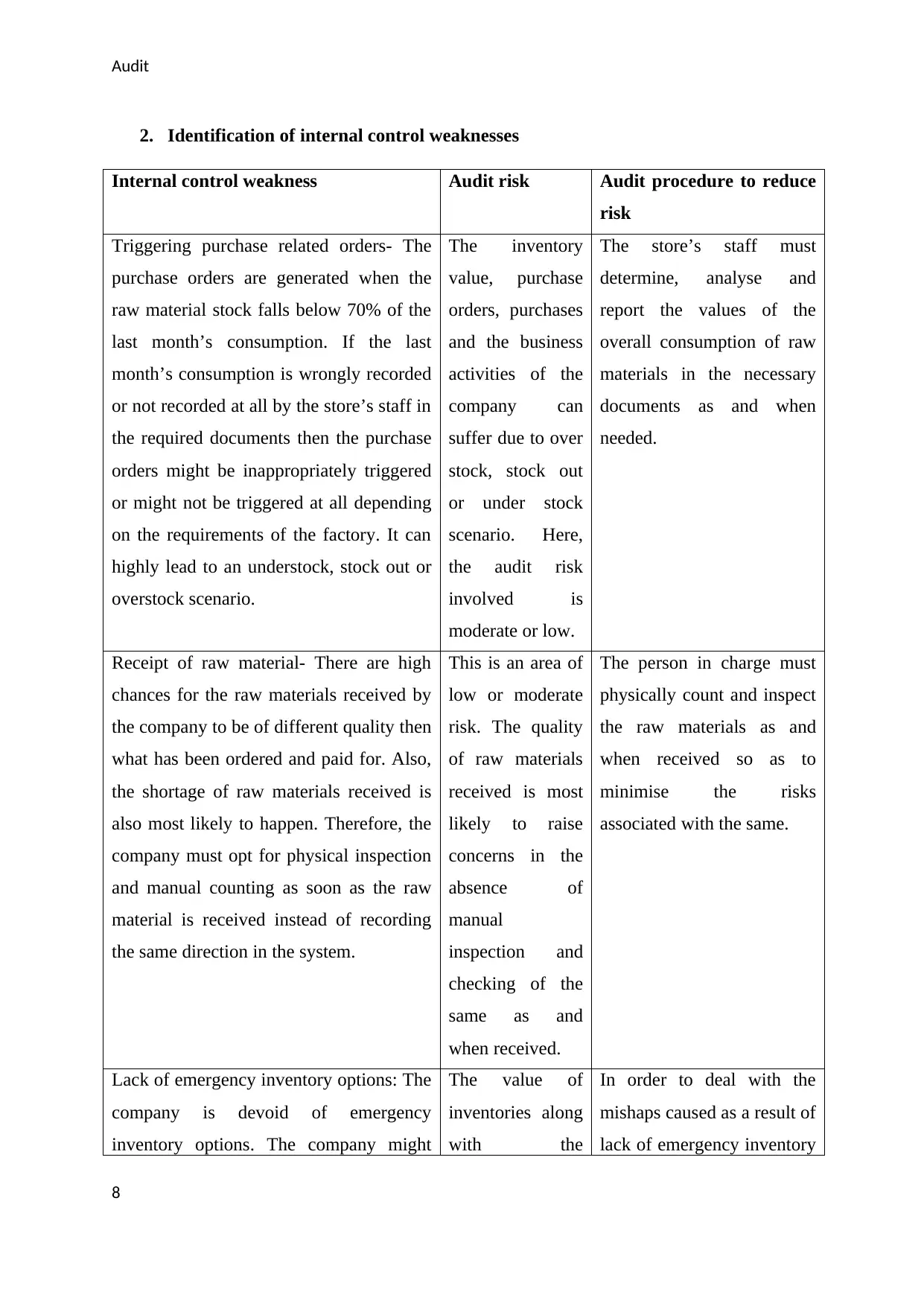
2. Identification of internal control weaknesses
Internal control weakness Audit risk Audit procedure to reduce
risk
Triggering purchase related orders- The
purchase orders are generated when the
raw material stock falls below 70% of the
last month’s consumption. If the last
month’s consumption is wrongly recorded
or not recorded at all by the store’s staff in
the required documents then the purchase
orders might be inappropriately triggered
or might not be triggered at all depending
on the requirements of the factory. It can
highly lead to an understock, stock out or
overstock scenario.
The inventory
value, purchase
orders, purchases
and the business
activities of the
company can
suffer due to over
stock, stock out
or under stock
scenario. Here,
the audit risk
involved is
moderate or low.
The store’s staff must
determine, analyse and
report the values of the
overall consumption of raw
materials in the necessary
documents as and when
needed.
Receipt of raw material- There are high
chances for the raw materials received by
the company to be of different quality then
what has been ordered and paid for. Also,
the shortage of raw materials received is
also most likely to happen. Therefore, the
company must opt for physical inspection
and manual counting as soon as the raw
material is received instead of recording
the same direction in the system.
This is an area of
low or moderate
risk. The quality
of raw materials
received is most
likely to raise
concerns in the
absence of
manual
inspection and
checking of the
same as and
when received.
The person in charge must
physically count and inspect
the raw materials as and
when received so as to
minimise the risks
associated with the same.
Lack of emergency inventory options: The
company is devoid of emergency
inventory options. The company might
The value of
inventories along
with the
In order to deal with the
mishaps caused as a result of
lack of emergency inventory
8
2. Identification of internal control weaknesses
Internal control weakness Audit risk Audit procedure to reduce
risk
Triggering purchase related orders- The
purchase orders are generated when the
raw material stock falls below 70% of the
last month’s consumption. If the last
month’s consumption is wrongly recorded
or not recorded at all by the store’s staff in
the required documents then the purchase
orders might be inappropriately triggered
or might not be triggered at all depending
on the requirements of the factory. It can
highly lead to an understock, stock out or
overstock scenario.
The inventory
value, purchase
orders, purchases
and the business
activities of the
company can
suffer due to over
stock, stock out
or under stock
scenario. Here,
the audit risk
involved is
moderate or low.
The store’s staff must
determine, analyse and
report the values of the
overall consumption of raw
materials in the necessary
documents as and when
needed.
Receipt of raw material- There are high
chances for the raw materials received by
the company to be of different quality then
what has been ordered and paid for. Also,
the shortage of raw materials received is
also most likely to happen. Therefore, the
company must opt for physical inspection
and manual counting as soon as the raw
material is received instead of recording
the same direction in the system.
This is an area of
low or moderate
risk. The quality
of raw materials
received is most
likely to raise
concerns in the
absence of
manual
inspection and
checking of the
same as and
when received.
The person in charge must
physically count and inspect
the raw materials as and
when received so as to
minimise the risks
associated with the same.
Lack of emergency inventory options: The
company is devoid of emergency
inventory options. The company might
The value of
inventories along
with the
In order to deal with the
mishaps caused as a result of
lack of emergency inventory
8
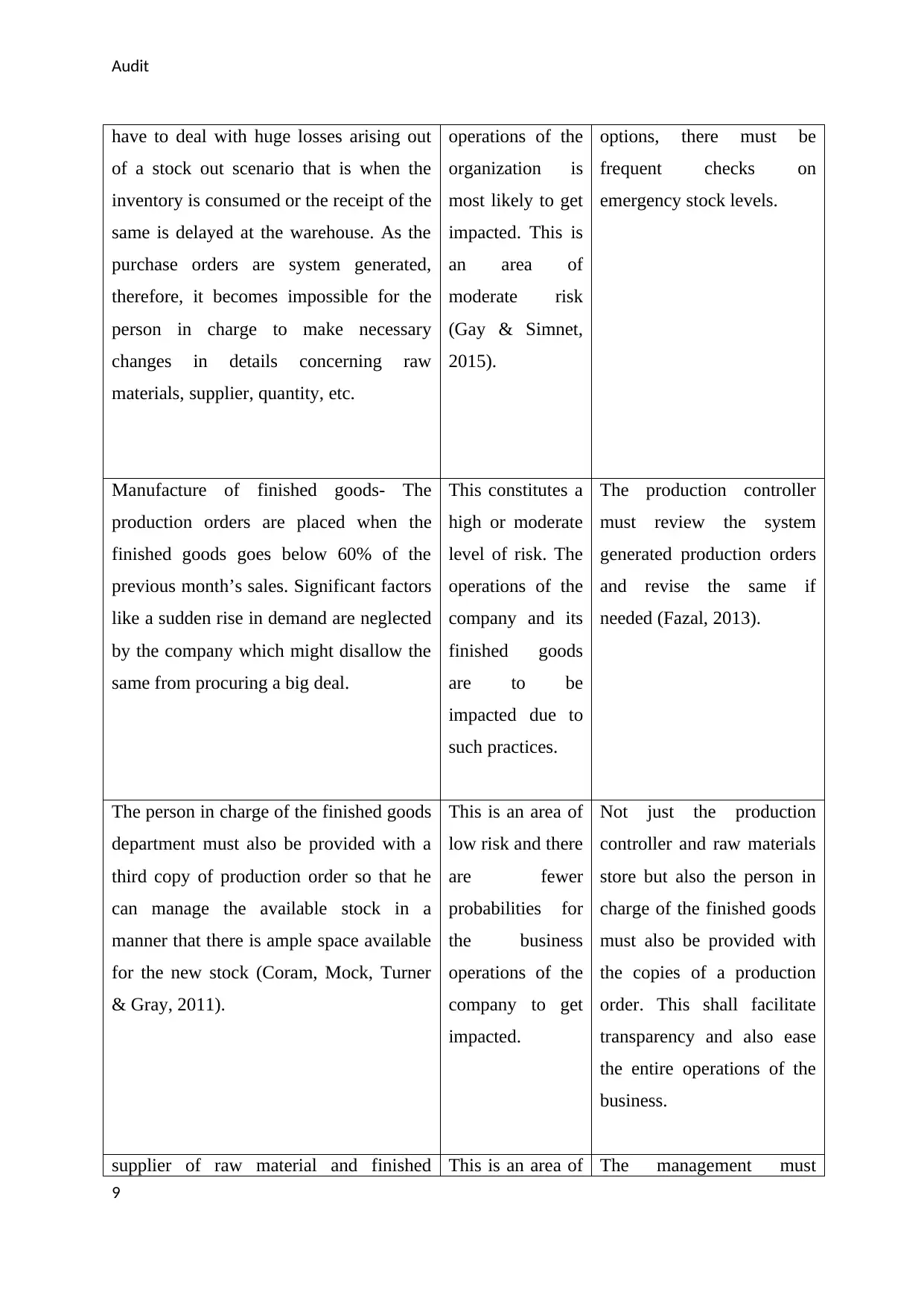
Audit
have to deal with huge losses arising out
of a stock out scenario that is when the
inventory is consumed or the receipt of the
same is delayed at the warehouse. As the
purchase orders are system generated,
therefore, it becomes impossible for the
person in charge to make necessary
changes in details concerning raw
materials, supplier, quantity, etc.
operations of the
organization is
most likely to get
impacted. This is
an area of
moderate risk
(Gay & Simnet,
2015).
options, there must be
frequent checks on
emergency stock levels.
Manufacture of finished goods- The
production orders are placed when the
finished goods goes below 60% of the
previous month’s sales. Significant factors
like a sudden rise in demand are neglected
by the company which might disallow the
same from procuring a big deal.
This constitutes a
high or moderate
level of risk. The
operations of the
company and its
finished goods
are to be
impacted due to
such practices.
The production controller
must review the system
generated production orders
and revise the same if
needed (Fazal, 2013).
The person in charge of the finished goods
department must also be provided with a
third copy of production order so that he
can manage the available stock in a
manner that there is ample space available
for the new stock (Coram, Mock, Turner
& Gray, 2011).
This is an area of
low risk and there
are fewer
probabilities for
the business
operations of the
company to get
impacted.
Not just the production
controller and raw materials
store but also the person in
charge of the finished goods
must also be provided with
the copies of a production
order. This shall facilitate
transparency and also ease
the entire operations of the
business.
supplier of raw material and finished This is an area of The management must
9
have to deal with huge losses arising out
of a stock out scenario that is when the
inventory is consumed or the receipt of the
same is delayed at the warehouse. As the
purchase orders are system generated,
therefore, it becomes impossible for the
person in charge to make necessary
changes in details concerning raw
materials, supplier, quantity, etc.
operations of the
organization is
most likely to get
impacted. This is
an area of
moderate risk
(Gay & Simnet,
2015).
options, there must be
frequent checks on
emergency stock levels.
Manufacture of finished goods- The
production orders are placed when the
finished goods goes below 60% of the
previous month’s sales. Significant factors
like a sudden rise in demand are neglected
by the company which might disallow the
same from procuring a big deal.
This constitutes a
high or moderate
level of risk. The
operations of the
company and its
finished goods
are to be
impacted due to
such practices.
The production controller
must review the system
generated production orders
and revise the same if
needed (Fazal, 2013).
The person in charge of the finished goods
department must also be provided with a
third copy of production order so that he
can manage the available stock in a
manner that there is ample space available
for the new stock (Coram, Mock, Turner
& Gray, 2011).
This is an area of
low risk and there
are fewer
probabilities for
the business
operations of the
company to get
impacted.
Not just the production
controller and raw materials
store but also the person in
charge of the finished goods
must also be provided with
the copies of a production
order. This shall facilitate
transparency and also ease
the entire operations of the
business.
supplier of raw material and finished This is an area of The management must
9
⊘ This is a preview!⊘
Do you want full access?
Subscribe today to unlock all pages.
Trusted by 1+ million students worldwide
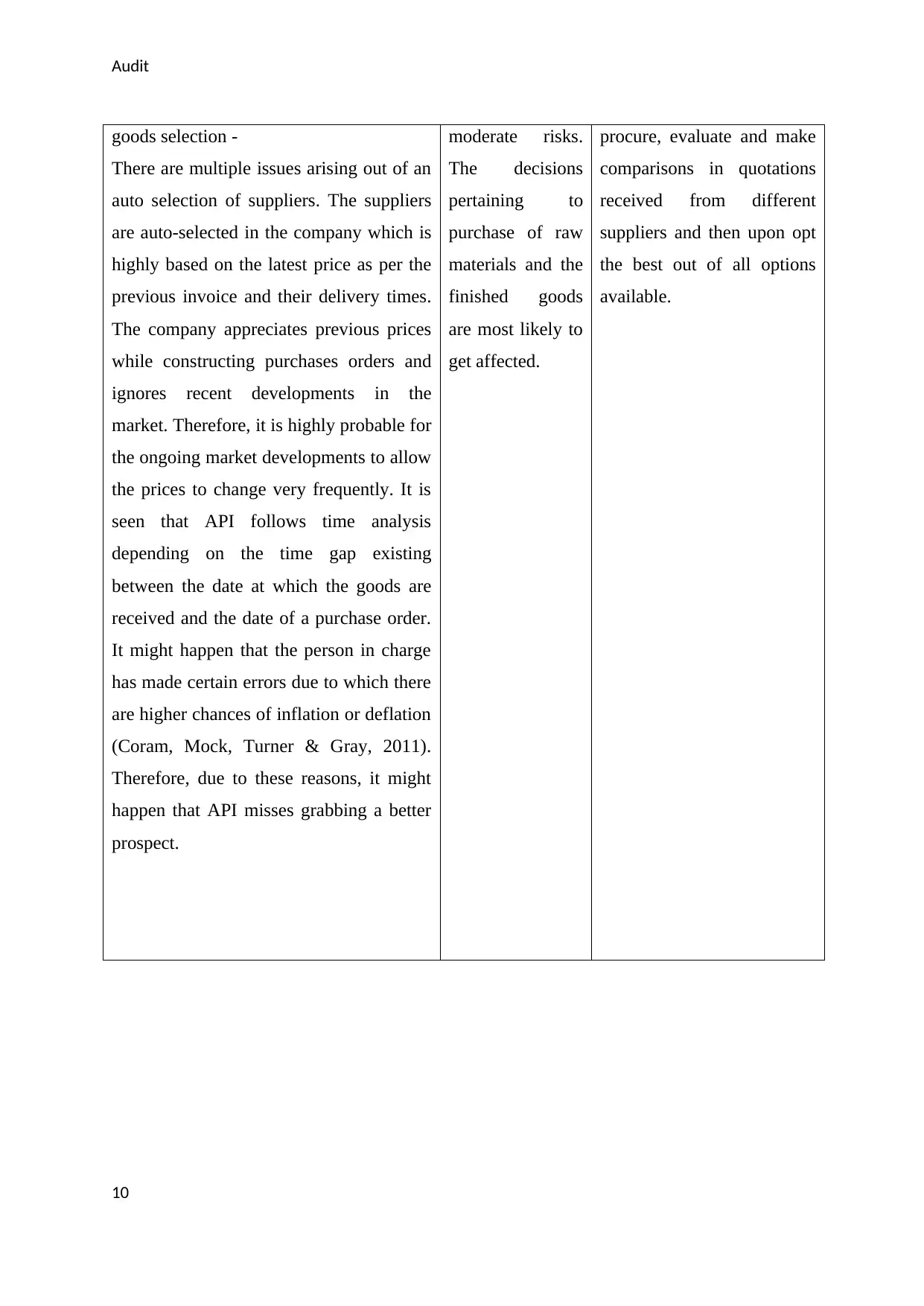
Audit
goods selection -
There are multiple issues arising out of an
auto selection of suppliers. The suppliers
are auto-selected in the company which is
highly based on the latest price as per the
previous invoice and their delivery times.
The company appreciates previous prices
while constructing purchases orders and
ignores recent developments in the
market. Therefore, it is highly probable for
the ongoing market developments to allow
the prices to change very frequently. It is
seen that API follows time analysis
depending on the time gap existing
between the date at which the goods are
received and the date of a purchase order.
It might happen that the person in charge
has made certain errors due to which there
are higher chances of inflation or deflation
(Coram, Mock, Turner & Gray, 2011).
Therefore, due to these reasons, it might
happen that API misses grabbing a better
prospect.
moderate risks.
The decisions
pertaining to
purchase of raw
materials and the
finished goods
are most likely to
get affected.
procure, evaluate and make
comparisons in quotations
received from different
suppliers and then upon opt
the best out of all options
available.
10
goods selection -
There are multiple issues arising out of an
auto selection of suppliers. The suppliers
are auto-selected in the company which is
highly based on the latest price as per the
previous invoice and their delivery times.
The company appreciates previous prices
while constructing purchases orders and
ignores recent developments in the
market. Therefore, it is highly probable for
the ongoing market developments to allow
the prices to change very frequently. It is
seen that API follows time analysis
depending on the time gap existing
between the date at which the goods are
received and the date of a purchase order.
It might happen that the person in charge
has made certain errors due to which there
are higher chances of inflation or deflation
(Coram, Mock, Turner & Gray, 2011).
Therefore, due to these reasons, it might
happen that API misses grabbing a better
prospect.
moderate risks.
The decisions
pertaining to
purchase of raw
materials and the
finished goods
are most likely to
get affected.
procure, evaluate and make
comparisons in quotations
received from different
suppliers and then upon opt
the best out of all options
available.
10
Paraphrase This Document
Need a fresh take? Get an instant paraphrase of this document with our AI Paraphraser
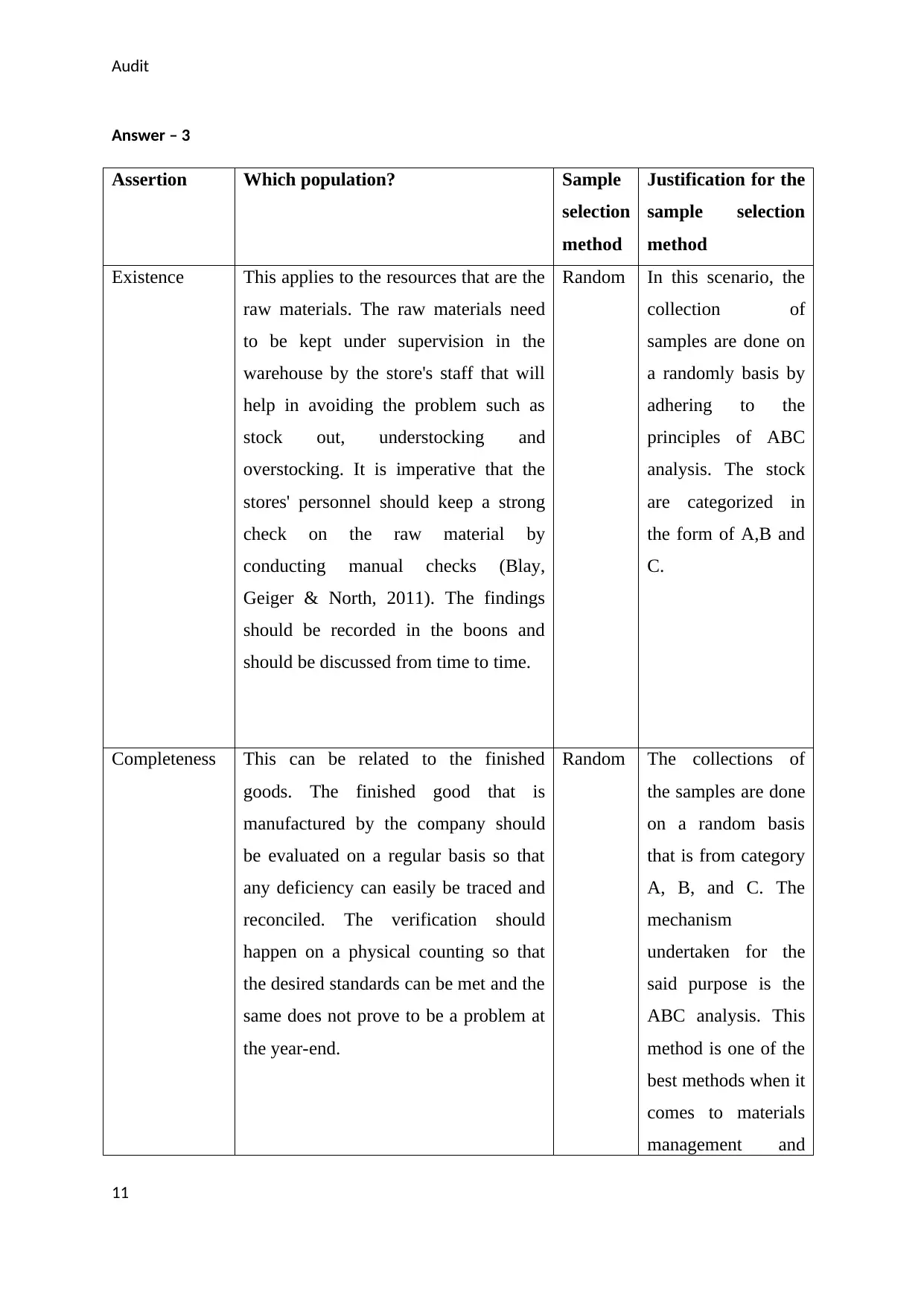
Audit
Answer – 3
Assertion Which population? Sample
selection
method
Justification for the
sample selection
method
Existence This applies to the resources that are the
raw materials. The raw materials need
to be kept under supervision in the
warehouse by the store's staff that will
help in avoiding the problem such as
stock out, understocking and
overstocking. It is imperative that the
stores' personnel should keep a strong
check on the raw material by
conducting manual checks (Blay,
Geiger & North, 2011). The findings
should be recorded in the boons and
should be discussed from time to time.
Random In this scenario, the
collection of
samples are done on
a randomly basis by
adhering to the
principles of ABC
analysis. The stock
are categorized in
the form of A,B and
C.
Completeness This can be related to the finished
goods. The finished good that is
manufactured by the company should
be evaluated on a regular basis so that
any deficiency can easily be traced and
reconciled. The verification should
happen on a physical counting so that
the desired standards can be met and the
same does not prove to be a problem at
the year-end.
Random The collections of
the samples are done
on a random basis
that is from category
A, B, and C. The
mechanism
undertaken for the
said purpose is the
ABC analysis. This
method is one of the
best methods when it
comes to materials
management and
11
Answer – 3
Assertion Which population? Sample
selection
method
Justification for the
sample selection
method
Existence This applies to the resources that are the
raw materials. The raw materials need
to be kept under supervision in the
warehouse by the store's staff that will
help in avoiding the problem such as
stock out, understocking and
overstocking. It is imperative that the
stores' personnel should keep a strong
check on the raw material by
conducting manual checks (Blay,
Geiger & North, 2011). The findings
should be recorded in the boons and
should be discussed from time to time.
Random In this scenario, the
collection of
samples are done on
a randomly basis by
adhering to the
principles of ABC
analysis. The stock
are categorized in
the form of A,B and
C.
Completeness This can be related to the finished
goods. The finished good that is
manufactured by the company should
be evaluated on a regular basis so that
any deficiency can easily be traced and
reconciled. The verification should
happen on a physical counting so that
the desired standards can be met and the
same does not prove to be a problem at
the year-end.
Random The collections of
the samples are done
on a random basis
that is from category
A, B, and C. The
mechanism
undertaken for the
said purpose is the
ABC analysis. This
method is one of the
best methods when it
comes to materials
management and
11

Audit
defines the priority
of the segment
(Baldwin, 2010).
12
defines the priority
of the segment
(Baldwin, 2010).
12
⊘ This is a preview!⊘
Do you want full access?
Subscribe today to unlock all pages.
Trusted by 1+ million students worldwide

1 out of 14


Related Documents


Your All-in-One AI-Powered Toolkit for Academic Success.
+13062052269
info@desklib.com
Available 24*7 on WhatsApp / Email
![[object Object]](/_next/static/media/star-bottom.7253800d.svg)
Unlock your academic potential
Copyright © 2020–2026 A2Z Services. All Rights Reserved. Developed and managed by ZUCOL.