Legal Analysis: Amadio Case - Mortgage, Guarantee, and Business Law
VerifiedAdded on 2020/01/23
|7
|2415
|39
Case Study
AI Summary
This case study analyzes the legal issues in the Amadio case, where Mr. and Mrs. Amadio provided a guarantee and mortgage to secure their son's company's debts. The case revolves around whether the bank had a duty to disclose information about the son's company's financial situation to the guarantors. The court ultimately set aside the mortgage, citing misrepresentation through non-disclosure, unconscionable conduct, and undue influence. The judges, including Gibbs, Mason, Deane, and Dawson, provided detailed reasoning, discussing the bank's obligations, the concept of 'uberrimae fides,' and the inequality of bargaining power. The case highlights the distinctions between undue influence and unconscionable conduct, emphasizing the importance of fair dealing and the protection of vulnerable parties in financial transactions. The Amadios successfully argued that the bank took advantage of their age, limited English proficiency, and reliance on their son, leading the court to rule in their favor.
BUSINESS LAW
Paraphrase This Document
Need a fresh take? Get an instant paraphrase of this document with our AI Paraphraser

Table of Contents
INTRODUCTION................................................................................................................................3
1.......................................................................................................................................................3
2.......................................................................................................................................................3
3.......................................................................................................................................................4
4.......................................................................................................................................................4
5.......................................................................................................................................................4
6.......................................................................................................................................................4
7.......................................................................................................................................................5
10. ...................................................................................................................................................6
11. ...................................................................................................................................................6
CONCLUSION....................................................................................................................................6
REFERENCES.....................................................................................................................................7
INTRODUCTION................................................................................................................................3
1.......................................................................................................................................................3
2.......................................................................................................................................................3
3.......................................................................................................................................................4
4.......................................................................................................................................................4
5.......................................................................................................................................................4
6.......................................................................................................................................................4
7.......................................................................................................................................................5
10. ...................................................................................................................................................6
11. ...................................................................................................................................................6
CONCLUSION....................................................................................................................................6
REFERENCES.....................................................................................................................................7

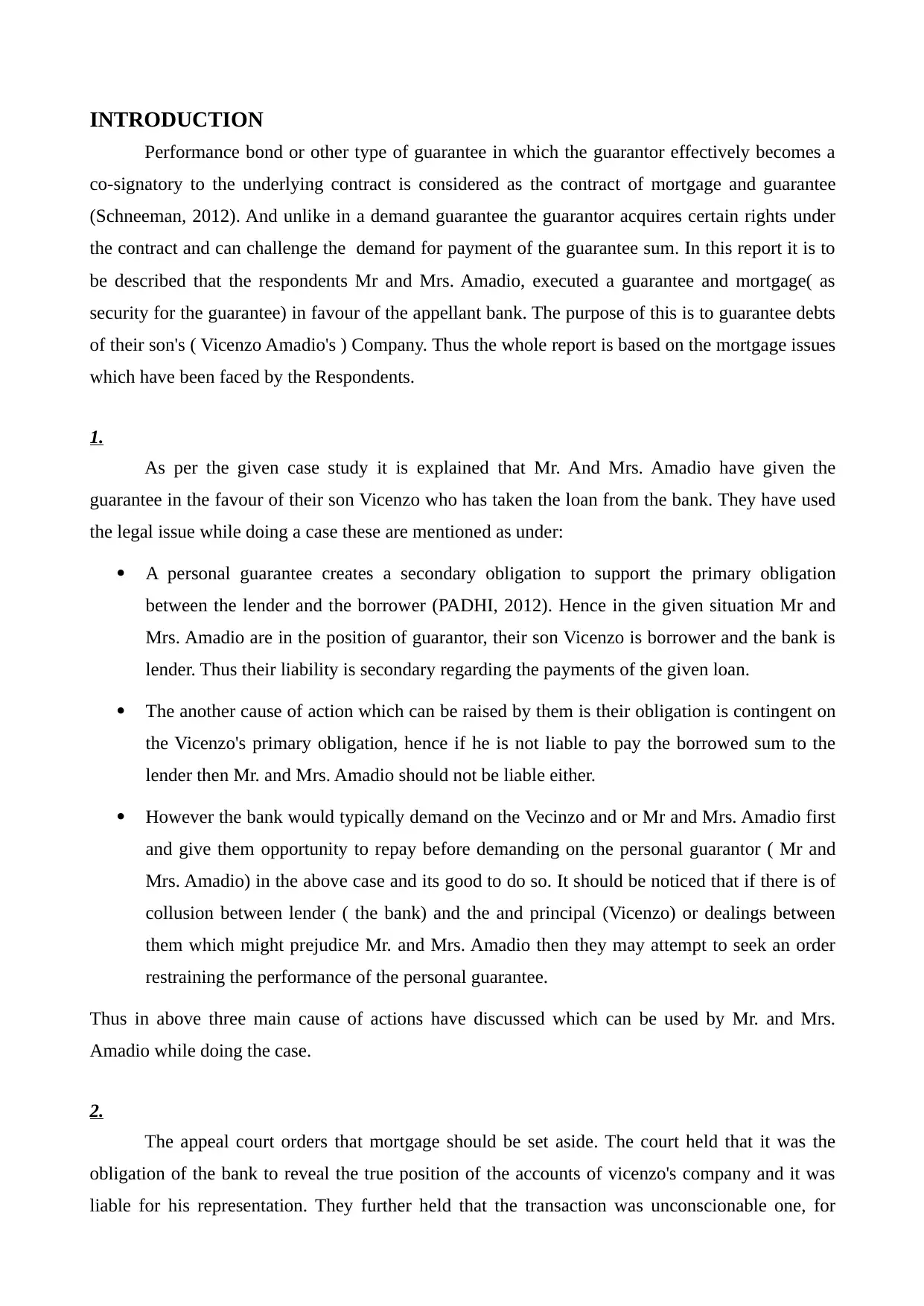
INTRODUCTION
Performance bond or other type of guarantee in which the guarantor effectively becomes a
co-signatory to the underlying contract is considered as the contract of mortgage and guarantee
(Schneeman, 2012). And unlike in a demand guarantee the guarantor acquires certain rights under
the contract and can challenge the demand for payment of the guarantee sum. In this report it is to
be described that the respondents Mr and Mrs. Amadio, executed a guarantee and mortgage( as
security for the guarantee) in favour of the appellant bank. The purpose of this is to guarantee debts
of their son's ( Vicenzo Amadio's ) Company. Thus the whole report is based on the mortgage issues
which have been faced by the Respondents.
1.
As per the given case study it is explained that Mr. And Mrs. Amadio have given the
guarantee in the favour of their son Vicenzo who has taken the loan from the bank. They have used
the legal issue while doing a case these are mentioned as under:
A personal guarantee creates a secondary obligation to support the primary obligation
between the lender and the borrower (PADHI, 2012). Hence in the given situation Mr and
Mrs. Amadio are in the position of guarantor, their son Vicenzo is borrower and the bank is
lender. Thus their liability is secondary regarding the payments of the given loan.
The another cause of action which can be raised by them is their obligation is contingent on
the Vicenzo's primary obligation, hence if he is not liable to pay the borrowed sum to the
lender then Mr. and Mrs. Amadio should not be liable either.
However the bank would typically demand on the Vecinzo and or Mr and Mrs. Amadio first
and give them opportunity to repay before demanding on the personal guarantor ( Mr and
Mrs. Amadio) in the above case and its good to do so. It should be noticed that if there is of
collusion between lender ( the bank) and the and principal (Vicenzo) or dealings between
them which might prejudice Mr. and Mrs. Amadio then they may attempt to seek an order
restraining the performance of the personal guarantee.
Thus in above three main cause of actions have discussed which can be used by Mr. and Mrs.
Amadio while doing the case.
2.
The appeal court orders that mortgage should be set aside. The court held that it was the
obligation of the bank to reveal the true position of the accounts of vicenzo's company and it was
liable for his representation. They further held that the transaction was unconscionable one, for
Performance bond or other type of guarantee in which the guarantor effectively becomes a
co-signatory to the underlying contract is considered as the contract of mortgage and guarantee
(Schneeman, 2012). And unlike in a demand guarantee the guarantor acquires certain rights under
the contract and can challenge the demand for payment of the guarantee sum. In this report it is to
be described that the respondents Mr and Mrs. Amadio, executed a guarantee and mortgage( as
security for the guarantee) in favour of the appellant bank. The purpose of this is to guarantee debts
of their son's ( Vicenzo Amadio's ) Company. Thus the whole report is based on the mortgage issues
which have been faced by the Respondents.
1.
As per the given case study it is explained that Mr. And Mrs. Amadio have given the
guarantee in the favour of their son Vicenzo who has taken the loan from the bank. They have used
the legal issue while doing a case these are mentioned as under:
A personal guarantee creates a secondary obligation to support the primary obligation
between the lender and the borrower (PADHI, 2012). Hence in the given situation Mr and
Mrs. Amadio are in the position of guarantor, their son Vicenzo is borrower and the bank is
lender. Thus their liability is secondary regarding the payments of the given loan.
The another cause of action which can be raised by them is their obligation is contingent on
the Vicenzo's primary obligation, hence if he is not liable to pay the borrowed sum to the
lender then Mr. and Mrs. Amadio should not be liable either.
However the bank would typically demand on the Vecinzo and or Mr and Mrs. Amadio first
and give them opportunity to repay before demanding on the personal guarantor ( Mr and
Mrs. Amadio) in the above case and its good to do so. It should be noticed that if there is of
collusion between lender ( the bank) and the and principal (Vicenzo) or dealings between
them which might prejudice Mr. and Mrs. Amadio then they may attempt to seek an order
restraining the performance of the personal guarantee.
Thus in above three main cause of actions have discussed which can be used by Mr. and Mrs.
Amadio while doing the case.
2.
The appeal court orders that mortgage should be set aside. The court held that it was the
obligation of the bank to reveal the true position of the accounts of vicenzo's company and it was
liable for his representation. They further held that the transaction was unconscionable one, for
⊘ This is a preview!⊘
Do you want full access?
Subscribe today to unlock all pages.

Trusted by 1+ million students worldwide

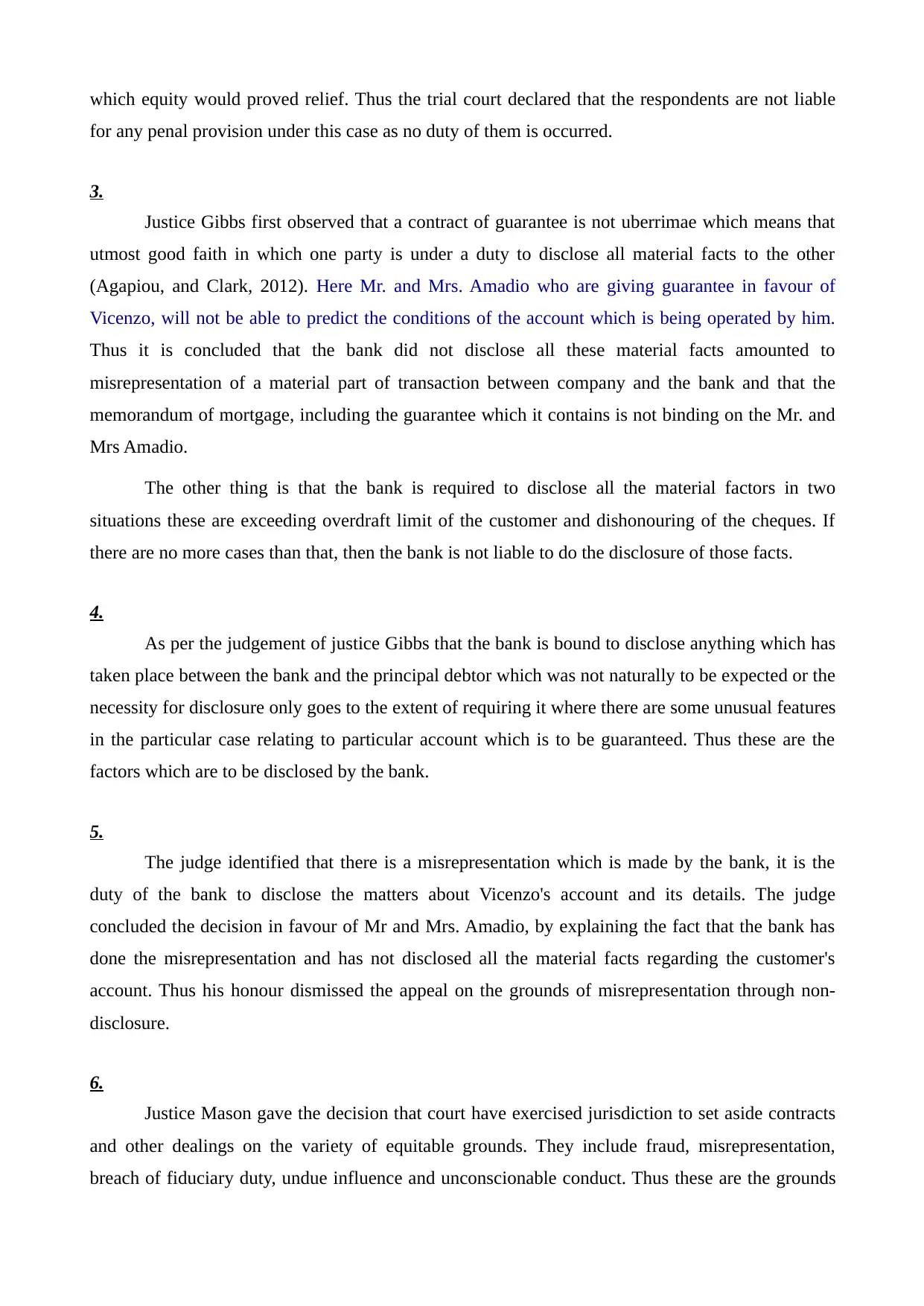
which equity would proved relief. Thus the trial court declared that the respondents are not liable
for any penal provision under this case as no duty of them is occurred.
3.
Justice Gibbs first observed that a contract of guarantee is not uberrimae which means that
utmost good faith in which one party is under a duty to disclose all material facts to the other
(Agapiou, and Clark, 2012). Here Mr. and Mrs. Amadio who are giving guarantee in favour of
Vicenzo, will not be able to predict the conditions of the account which is being operated by him.
Thus it is concluded that the bank did not disclose all these material facts amounted to
misrepresentation of a material part of transaction between company and the bank and that the
memorandum of mortgage, including the guarantee which it contains is not binding on the Mr. and
Mrs Amadio.
The other thing is that the bank is required to disclose all the material factors in two
situations these are exceeding overdraft limit of the customer and dishonouring of the cheques. If
there are no more cases than that, then the bank is not liable to do the disclosure of those facts.
4.
As per the judgement of justice Gibbs that the bank is bound to disclose anything which has
taken place between the bank and the principal debtor which was not naturally to be expected or the
necessity for disclosure only goes to the extent of requiring it where there are some unusual features
in the particular case relating to particular account which is to be guaranteed. Thus these are the
factors which are to be disclosed by the bank.
5.
The judge identified that there is a misrepresentation which is made by the bank, it is the
duty of the bank to disclose the matters about Vicenzo's account and its details. The judge
concluded the decision in favour of Mr and Mrs. Amadio, by explaining the fact that the bank has
done the misrepresentation and has not disclosed all the material facts regarding the customer's
account. Thus his honour dismissed the appeal on the grounds of misrepresentation through non-
disclosure.
6.
Justice Mason gave the decision that court have exercised jurisdiction to set aside contracts
and other dealings on the variety of equitable grounds. They include fraud, misrepresentation,
breach of fiduciary duty, undue influence and unconscionable conduct. Thus these are the grounds
for any penal provision under this case as no duty of them is occurred.
3.
Justice Gibbs first observed that a contract of guarantee is not uberrimae which means that
utmost good faith in which one party is under a duty to disclose all material facts to the other
(Agapiou, and Clark, 2012). Here Mr. and Mrs. Amadio who are giving guarantee in favour of
Vicenzo, will not be able to predict the conditions of the account which is being operated by him.
Thus it is concluded that the bank did not disclose all these material facts amounted to
misrepresentation of a material part of transaction between company and the bank and that the
memorandum of mortgage, including the guarantee which it contains is not binding on the Mr. and
Mrs Amadio.
The other thing is that the bank is required to disclose all the material factors in two
situations these are exceeding overdraft limit of the customer and dishonouring of the cheques. If
there are no more cases than that, then the bank is not liable to do the disclosure of those facts.
4.
As per the judgement of justice Gibbs that the bank is bound to disclose anything which has
taken place between the bank and the principal debtor which was not naturally to be expected or the
necessity for disclosure only goes to the extent of requiring it where there are some unusual features
in the particular case relating to particular account which is to be guaranteed. Thus these are the
factors which are to be disclosed by the bank.
5.
The judge identified that there is a misrepresentation which is made by the bank, it is the
duty of the bank to disclose the matters about Vicenzo's account and its details. The judge
concluded the decision in favour of Mr and Mrs. Amadio, by explaining the fact that the bank has
done the misrepresentation and has not disclosed all the material facts regarding the customer's
account. Thus his honour dismissed the appeal on the grounds of misrepresentation through non-
disclosure.
6.
Justice Mason gave the decision that court have exercised jurisdiction to set aside contracts
and other dealings on the variety of equitable grounds. They include fraud, misrepresentation,
breach of fiduciary duty, undue influence and unconscionable conduct. Thus these are the grounds
Paraphrase This Document
Need a fresh take? Get an instant paraphrase of this document with our AI Paraphraser

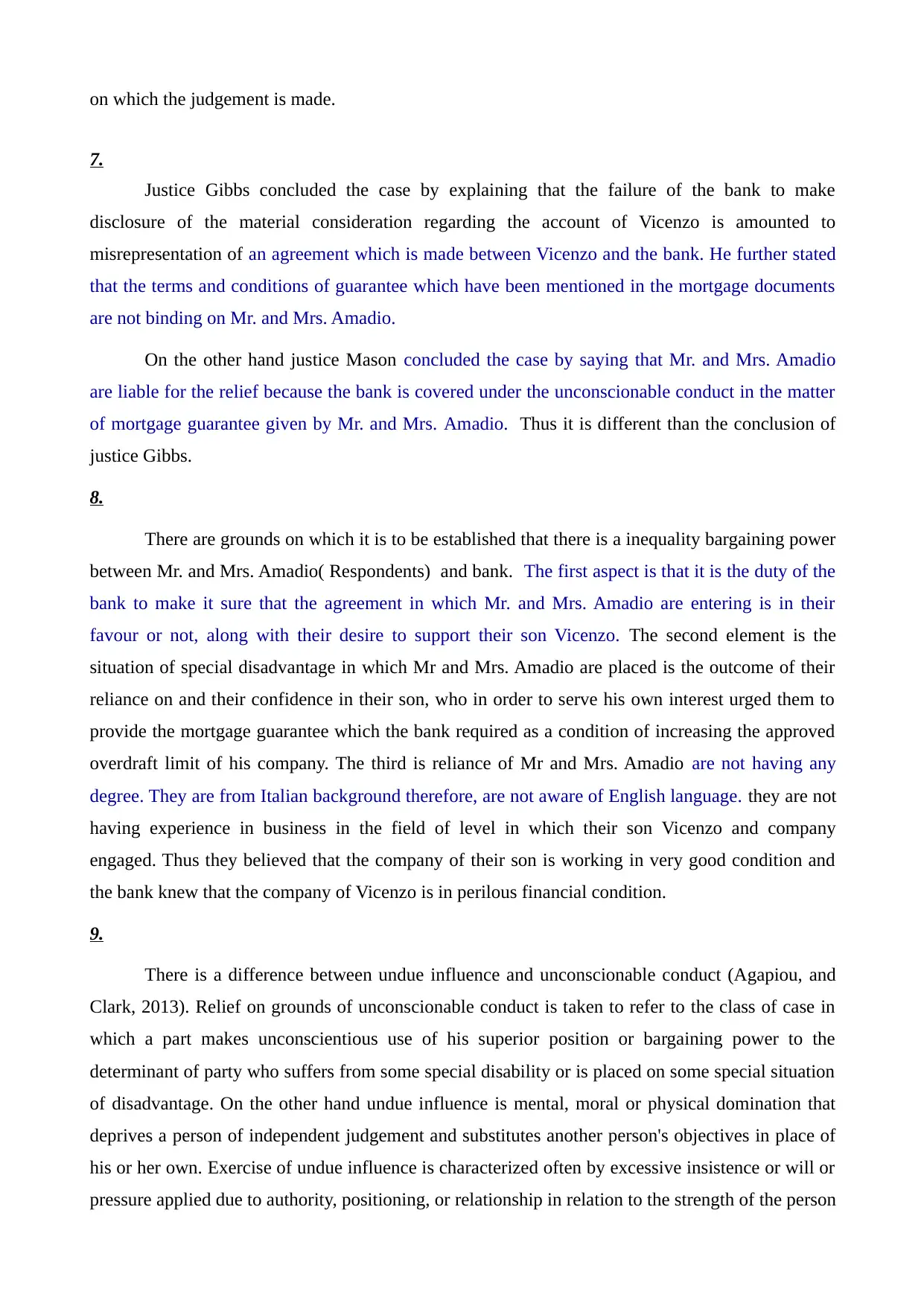
on which the judgement is made.
7.
Justice Gibbs concluded the case by explaining that the failure of the bank to make
disclosure of the material consideration regarding the account of Vicenzo is amounted to
misrepresentation of an agreement which is made between Vicenzo and the bank. He further stated
that the terms and conditions of guarantee which have been mentioned in the mortgage documents
are not binding on Mr. and Mrs. Amadio.
On the other hand justice Mason concluded the case by saying that Mr. and Mrs. Amadio
are liable for the relief because the bank is covered under the unconscionable conduct in the matter
of mortgage guarantee given by Mr. and Mrs. Amadio. Thus it is different than the conclusion of
justice Gibbs.
8.
There are grounds on which it is to be established that there is a inequality bargaining power
between Mr. and Mrs. Amadio( Respondents) and bank. The first aspect is that it is the duty of the
bank to make it sure that the agreement in which Mr. and Mrs. Amadio are entering is in their
favour or not, along with their desire to support their son Vicenzo. The second element is the
situation of special disadvantage in which Mr and Mrs. Amadio are placed is the outcome of their
reliance on and their confidence in their son, who in order to serve his own interest urged them to
provide the mortgage guarantee which the bank required as a condition of increasing the approved
overdraft limit of his company. The third is reliance of Mr and Mrs. Amadio are not having any
degree. They are from Italian background therefore, are not aware of English language. they are not
having experience in business in the field of level in which their son Vicenzo and company
engaged. Thus they believed that the company of their son is working in very good condition and
the bank knew that the company of Vicenzo is in perilous financial condition.
9.
There is a difference between undue influence and unconscionable conduct (Agapiou, and
Clark, 2013). Relief on grounds of unconscionable conduct is taken to refer to the class of case in
which a part makes unconscientious use of his superior position or bargaining power to the
determinant of party who suffers from some special disability or is placed on some special situation
of disadvantage. On the other hand undue influence is mental, moral or physical domination that
deprives a person of independent judgement and substitutes another person's objectives in place of
his or her own. Exercise of undue influence is characterized often by excessive insistence or will or
pressure applied due to authority, positioning, or relationship in relation to the strength of the person
7.
Justice Gibbs concluded the case by explaining that the failure of the bank to make
disclosure of the material consideration regarding the account of Vicenzo is amounted to
misrepresentation of an agreement which is made between Vicenzo and the bank. He further stated
that the terms and conditions of guarantee which have been mentioned in the mortgage documents
are not binding on Mr. and Mrs. Amadio.
On the other hand justice Mason concluded the case by saying that Mr. and Mrs. Amadio
are liable for the relief because the bank is covered under the unconscionable conduct in the matter
of mortgage guarantee given by Mr. and Mrs. Amadio. Thus it is different than the conclusion of
justice Gibbs.
8.
There are grounds on which it is to be established that there is a inequality bargaining power
between Mr. and Mrs. Amadio( Respondents) and bank. The first aspect is that it is the duty of the
bank to make it sure that the agreement in which Mr. and Mrs. Amadio are entering is in their
favour or not, along with their desire to support their son Vicenzo. The second element is the
situation of special disadvantage in which Mr and Mrs. Amadio are placed is the outcome of their
reliance on and their confidence in their son, who in order to serve his own interest urged them to
provide the mortgage guarantee which the bank required as a condition of increasing the approved
overdraft limit of his company. The third is reliance of Mr and Mrs. Amadio are not having any
degree. They are from Italian background therefore, are not aware of English language. they are not
having experience in business in the field of level in which their son Vicenzo and company
engaged. Thus they believed that the company of their son is working in very good condition and
the bank knew that the company of Vicenzo is in perilous financial condition.
9.
There is a difference between undue influence and unconscionable conduct (Agapiou, and
Clark, 2013). Relief on grounds of unconscionable conduct is taken to refer to the class of case in
which a part makes unconscientious use of his superior position or bargaining power to the
determinant of party who suffers from some special disability or is placed on some special situation
of disadvantage. On the other hand undue influence is mental, moral or physical domination that
deprives a person of independent judgement and substitutes another person's objectives in place of
his or her own. Exercise of undue influence is characterized often by excessive insistence or will or
pressure applied due to authority, positioning, or relationship in relation to the strength of the person

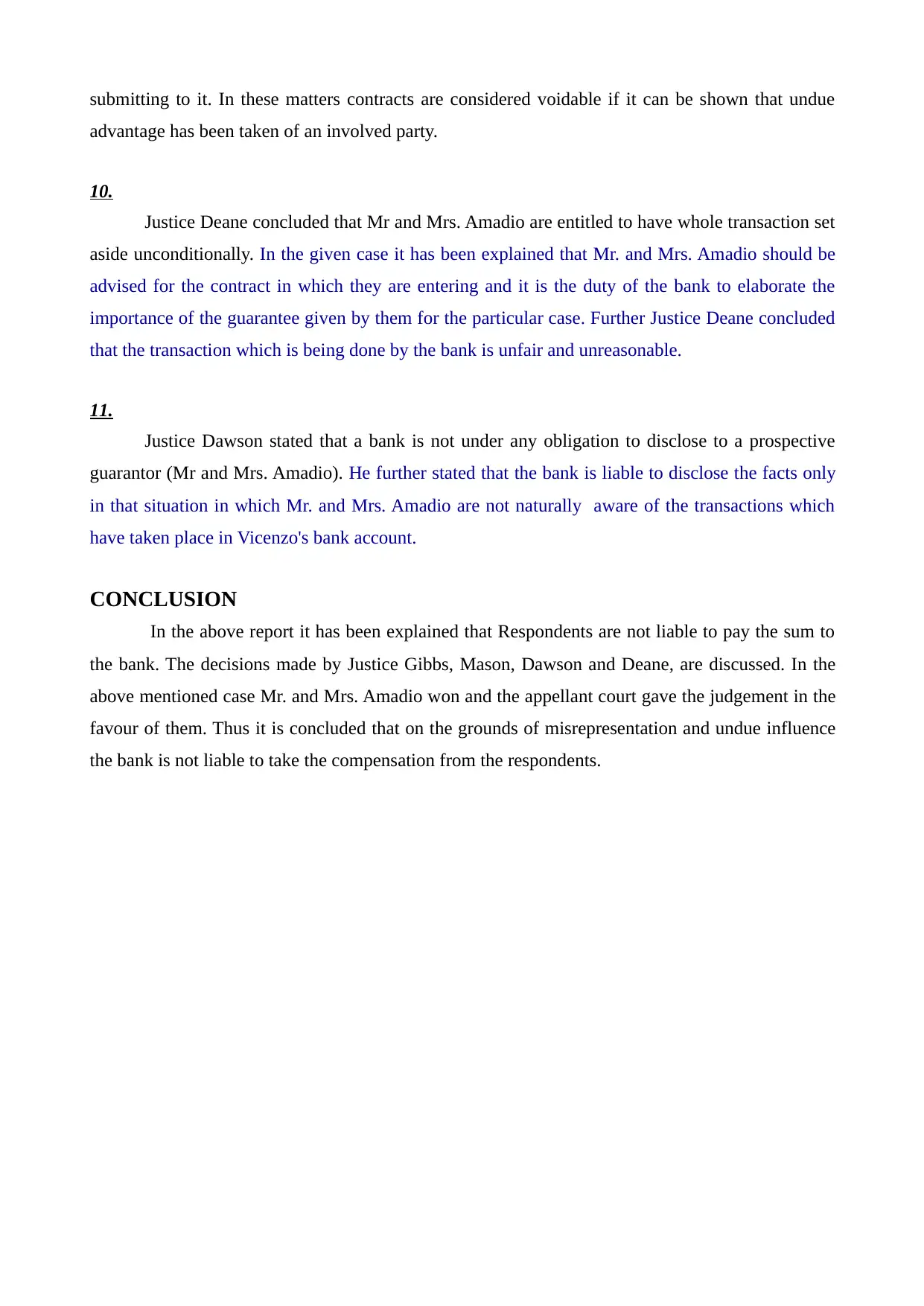
submitting to it. In these matters contracts are considered voidable if it can be shown that undue
advantage has been taken of an involved party.
10.
Justice Deane concluded that Mr and Mrs. Amadio are entitled to have whole transaction set
aside unconditionally. In the given case it has been explained that Mr. and Mrs. Amadio should be
advised for the contract in which they are entering and it is the duty of the bank to elaborate the
importance of the guarantee given by them for the particular case. Further Justice Deane concluded
that the transaction which is being done by the bank is unfair and unreasonable.
11.
Justice Dawson stated that a bank is not under any obligation to disclose to a prospective
guarantor (Mr and Mrs. Amadio). He further stated that the bank is liable to disclose the facts only
in that situation in which Mr. and Mrs. Amadio are not naturally aware of the transactions which
have taken place in Vicenzo's bank account.
CONCLUSION
In the above report it has been explained that Respondents are not liable to pay the sum to
the bank. The decisions made by Justice Gibbs, Mason, Dawson and Deane, are discussed. In the
above mentioned case Mr. and Mrs. Amadio won and the appellant court gave the judgement in the
favour of them. Thus it is concluded that on the grounds of misrepresentation and undue influence
the bank is not liable to take the compensation from the respondents.
advantage has been taken of an involved party.
10.
Justice Deane concluded that Mr and Mrs. Amadio are entitled to have whole transaction set
aside unconditionally. In the given case it has been explained that Mr. and Mrs. Amadio should be
advised for the contract in which they are entering and it is the duty of the bank to elaborate the
importance of the guarantee given by them for the particular case. Further Justice Deane concluded
that the transaction which is being done by the bank is unfair and unreasonable.
11.
Justice Dawson stated that a bank is not under any obligation to disclose to a prospective
guarantor (Mr and Mrs. Amadio). He further stated that the bank is liable to disclose the facts only
in that situation in which Mr. and Mrs. Amadio are not naturally aware of the transactions which
have taken place in Vicenzo's bank account.
CONCLUSION
In the above report it has been explained that Respondents are not liable to pay the sum to
the bank. The decisions made by Justice Gibbs, Mason, Dawson and Deane, are discussed. In the
above mentioned case Mr. and Mrs. Amadio won and the appellant court gave the judgement in the
favour of them. Thus it is concluded that on the grounds of misrepresentation and undue influence
the bank is not liable to take the compensation from the respondents.
⊘ This is a preview!⊘
Do you want full access?
Subscribe today to unlock all pages.

Trusted by 1+ million students worldwide

REFERENCES
Books And Journals
Agapiou, A and Clark, B., 2011. Scottish construction lawyers and mediation: an investigation into
attitudes and experiences. International Journal of Law in the Built Environment. 3(2). pp. 159-181.
Agapiou, A and Clark, B., 2012. An empirical analysis of Scottish construction lawyers’ interaction
with mediation: a qualitative approach. Civil Justice Quarterly. 31(4). pp. 494-513.
Agapiou, A and Clark, B., 2013. A follow-up empirical analysis of Scottish construction clients
interaction with mediation. Civil Justice Quarterly. 32(3). pp. 349-386.
Alfini, J., 2008. Mediation as a calling: addressing the disconnect between mediation ethics and the
practices of lawyer mediators. South Texas Law Review. 49(4). pp. 829-839.
Brooker, P., 2011. Towards a code of professional conduct for construction mediators. International
Journal of Law in the Built Environment. 3(1). pp. 24-47.
Clark, B., 2009. Mediation and Scottish lawyers: past, present and future. Edinburgh Law Review.
13(2). pp. 252-277.
Horne, J. P., 2012. God's Laws and Business: Wisdom Is the Principal Thing; Therefore Get
Wisdom: and With All Thy Getting Get Understanding Proverbs 4:7. WestBow Press.
PADHI, P. K., 2012. Legal Aspects of Business. PHI Learning Pvt. Ltd.
Schneeman, A., 2012. The Law of Corporations and Other Business Organizations. Cengage
Learning.
Online
Guarantee, 2016. [Online]. Available through: <http://www.investinganswers.com/financial-
dictionary/laws-regulations/guarantee-993>. [Accessed on 15th September 2016].
Guarantees and indemnities: a quick guide, 2016. [Online]. Available through:
<http://uk.practicallaw.com/7-523-6570>. [Accessed on 15th September 2016].
Books And Journals
Agapiou, A and Clark, B., 2011. Scottish construction lawyers and mediation: an investigation into
attitudes and experiences. International Journal of Law in the Built Environment. 3(2). pp. 159-181.
Agapiou, A and Clark, B., 2012. An empirical analysis of Scottish construction lawyers’ interaction
with mediation: a qualitative approach. Civil Justice Quarterly. 31(4). pp. 494-513.
Agapiou, A and Clark, B., 2013. A follow-up empirical analysis of Scottish construction clients
interaction with mediation. Civil Justice Quarterly. 32(3). pp. 349-386.
Alfini, J., 2008. Mediation as a calling: addressing the disconnect between mediation ethics and the
practices of lawyer mediators. South Texas Law Review. 49(4). pp. 829-839.
Brooker, P., 2011. Towards a code of professional conduct for construction mediators. International
Journal of Law in the Built Environment. 3(1). pp. 24-47.
Clark, B., 2009. Mediation and Scottish lawyers: past, present and future. Edinburgh Law Review.
13(2). pp. 252-277.
Horne, J. P., 2012. God's Laws and Business: Wisdom Is the Principal Thing; Therefore Get
Wisdom: and With All Thy Getting Get Understanding Proverbs 4:7. WestBow Press.
PADHI, P. K., 2012. Legal Aspects of Business. PHI Learning Pvt. Ltd.
Schneeman, A., 2012. The Law of Corporations and Other Business Organizations. Cengage
Learning.
Online
Guarantee, 2016. [Online]. Available through: <http://www.investinganswers.com/financial-
dictionary/laws-regulations/guarantee-993>. [Accessed on 15th September 2016].
Guarantees and indemnities: a quick guide, 2016. [Online]. Available through:
<http://uk.practicallaw.com/7-523-6570>. [Accessed on 15th September 2016].
1 out of 7
Related Documents
Your All-in-One AI-Powered Toolkit for Academic Success.
+13062052269
info@desklib.com
Available 24*7 on WhatsApp / Email
Unlock your academic potential
Copyright © 2020–2025 A2Z Services. All Rights Reserved. Developed and managed by ZUCOL.