Analyzing Amazon's Strategic Marketing & Customer-Centric Approach
VerifiedAdded on 2023/06/03
|22
|5771
|131
Case Study
AI Summary
This case study delves into Amazon's marketing strategy, analyzing its financial and market performance, organizational structure, and core competencies. It examines the strategic and tactical control of marketing management, highlighting the pros and cons of Amazon's approach. The analysis includes a SWOT analysis, Porter's five forces, and value chain analysis, providing a comprehensive view of Amazon's competitive landscape. The case study further explores customer and competitor analysis, Ansoff's Matrix, and a balanced scorecard perspective, covering learning and growth, business processes, customer relations, and financial aspects. The study concludes with recommendations for Amazon to enhance its marketing effectiveness and overall business strategy, emphasizing the importance of customer satisfaction and long-term growth while addressing short-term financial concerns.

Amazon’s marketing strategy
Student’s name
Institutional Affiliation(s)
Student’s name
Institutional Affiliation(s)

Paraphrase This Document
Need a fresh take? Get an instant paraphrase of this document with our AI Paraphraser
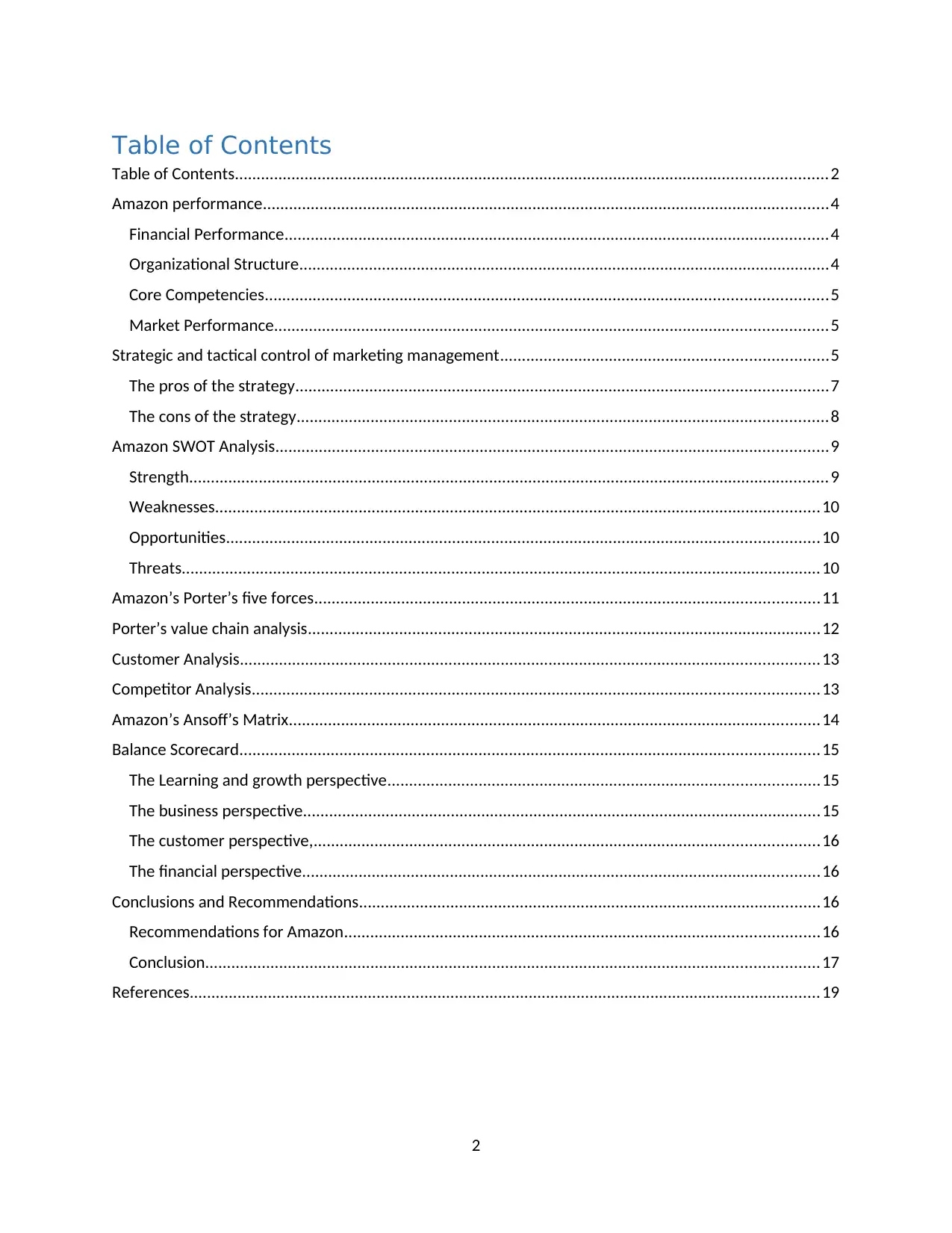
Table of Contents
Table of Contents........................................................................................................................................2
Amazon performance..................................................................................................................................4
Financial Performance.............................................................................................................................4
Organizational Structure..........................................................................................................................4
Core Competencies.................................................................................................................................5
Market Performance...............................................................................................................................5
Strategic and tactical control of marketing management...........................................................................5
The pros of the strategy..........................................................................................................................7
The cons of the strategy..........................................................................................................................8
Amazon SWOT Analysis...............................................................................................................................9
Strength...................................................................................................................................................9
Weaknesses...........................................................................................................................................10
Opportunities........................................................................................................................................10
Threats...................................................................................................................................................10
Amazon’s Porter’s five forces....................................................................................................................11
Porter’s value chain analysis......................................................................................................................12
Customer Analysis.....................................................................................................................................13
Competitor Analysis..................................................................................................................................13
Amazon’s Ansoff’s Matrix..........................................................................................................................14
Balance Scorecard.....................................................................................................................................15
The Learning and growth perspective...................................................................................................15
The business perspective.......................................................................................................................15
The customer perspective,....................................................................................................................16
The financial perspective.......................................................................................................................16
Conclusions and Recommendations..........................................................................................................16
Recommendations for Amazon.............................................................................................................16
Conclusion.............................................................................................................................................17
References.................................................................................................................................................19
2
Table of Contents........................................................................................................................................2
Amazon performance..................................................................................................................................4
Financial Performance.............................................................................................................................4
Organizational Structure..........................................................................................................................4
Core Competencies.................................................................................................................................5
Market Performance...............................................................................................................................5
Strategic and tactical control of marketing management...........................................................................5
The pros of the strategy..........................................................................................................................7
The cons of the strategy..........................................................................................................................8
Amazon SWOT Analysis...............................................................................................................................9
Strength...................................................................................................................................................9
Weaknesses...........................................................................................................................................10
Opportunities........................................................................................................................................10
Threats...................................................................................................................................................10
Amazon’s Porter’s five forces....................................................................................................................11
Porter’s value chain analysis......................................................................................................................12
Customer Analysis.....................................................................................................................................13
Competitor Analysis..................................................................................................................................13
Amazon’s Ansoff’s Matrix..........................................................................................................................14
Balance Scorecard.....................................................................................................................................15
The Learning and growth perspective...................................................................................................15
The business perspective.......................................................................................................................15
The customer perspective,....................................................................................................................16
The financial perspective.......................................................................................................................16
Conclusions and Recommendations..........................................................................................................16
Recommendations for Amazon.............................................................................................................16
Conclusion.............................................................................................................................................17
References.................................................................................................................................................19
2

3
⊘ This is a preview!⊘
Do you want full access?
Subscribe today to unlock all pages.

Trusted by 1+ million students worldwide
Amazon’s marketing strategy
Amazon is one of the largest online marketing platforms in the world. Like many online
marketing platforms, the idea behind Amazon is mutual benefit resulting from increased volume
of customers (Lee & Carter, 2012). It offers both the opportunity to manufacturers and business
people to sell their products as well as sell its products. Amazon is currently trying to pursue a
long-term strategy, and this is a good approach. The company should not focus on short-term
profits rather it should capitalize its brand name in a better way. The company is still in the
growth phase. Therefore, it should follow a growth-oriented strategy.
Amazon is focusing on customer satisfaction and retention, according to the case. This
strategy is also commendable as customers are the primary source of revenue. The customer base
of the company is strong, and this shows that customers are responding to the policies of the
company. There are also specific problems in the long-term strategy of the company. The
company has not accumulated enough cash that should have, and it is not prepared to face any
unseen economic disaster. Any unexpected economic problem can drive the company out of
business, and this is a severe concern in the short run (Bidgoli, 2010).
The lower profits of the company through services are also a concern. The company
should try to earn more and more revenue through advertising. This is an area where the
company is lacking. Google and Yahoo are making use of their brand name and presence to earn
massive advertisement revenue. Amazon should do the same thing and should attract companies
by selling places on its websites. This is an area where the company is lagging, and more can be
done in this regard. The long-term growth strategy is good enough, but short-term cash
accumulation should also under focus (Bhasin, 2018).
4
Amazon is one of the largest online marketing platforms in the world. Like many online
marketing platforms, the idea behind Amazon is mutual benefit resulting from increased volume
of customers (Lee & Carter, 2012). It offers both the opportunity to manufacturers and business
people to sell their products as well as sell its products. Amazon is currently trying to pursue a
long-term strategy, and this is a good approach. The company should not focus on short-term
profits rather it should capitalize its brand name in a better way. The company is still in the
growth phase. Therefore, it should follow a growth-oriented strategy.
Amazon is focusing on customer satisfaction and retention, according to the case. This
strategy is also commendable as customers are the primary source of revenue. The customer base
of the company is strong, and this shows that customers are responding to the policies of the
company. There are also specific problems in the long-term strategy of the company. The
company has not accumulated enough cash that should have, and it is not prepared to face any
unseen economic disaster. Any unexpected economic problem can drive the company out of
business, and this is a severe concern in the short run (Bidgoli, 2010).
The lower profits of the company through services are also a concern. The company
should try to earn more and more revenue through advertising. This is an area where the
company is lacking. Google and Yahoo are making use of their brand name and presence to earn
massive advertisement revenue. Amazon should do the same thing and should attract companies
by selling places on its websites. This is an area where the company is lagging, and more can be
done in this regard. The long-term growth strategy is good enough, but short-term cash
accumulation should also under focus (Bhasin, 2018).
4
Paraphrase This Document
Need a fresh take? Get an instant paraphrase of this document with our AI Paraphraser
Amazon also enjoys First-Mover advantage and has made numerous innovations and
significant research and developments (e.g., “one-click” shopping) to improve customer
experience, hence, gaining support from the online community. Amazon is the first company to
develop most of the currently known technologies in online retailing. The company is also the
most visited retailer online and the premier online place for members to contribute their work
(Rasmusen & Yoon, 2012).
Amazon performance
Financial Performance
Amazon is an electronic commerce company and is one of the largest internet-based
shops in the country. The company started as a bookstore and has been selling its books online
since 1994. Over the years, it started diversifying to selling CDs, video, DVDs, MP3, VHS,
video games, electronics, food, jewelry, toys, and furniture. Diversification aimed to increase the
profits of the company and its branches. Over the last ten years, the company has been
experiencing slower sales growth and evaporation experienced in profit margins. The company
has always depended on revenue gains to drive the prices of the stock higher (Steenkamp, 2017).
Over the ten years, the company has experienced a shrink in their gain, that is, from
$274M to a loss of $241M. This is because the expenses of the company are increasing over the
years, that is, from $74.5B to $89B (Amazon). For example, last year the company reported
revenue of $20 billion and its operating income fell by 19 percent.
Organizational Structure
The Amazon Company has a divisional structure because it deals with many services and
products. Different products have their different departments, and the department heads have the
responsibility of ensuring that their departments are operating profitably, and they have enough
resources. The organizational structure of the company is composed by the founder and CEO
5
significant research and developments (e.g., “one-click” shopping) to improve customer
experience, hence, gaining support from the online community. Amazon is the first company to
develop most of the currently known technologies in online retailing. The company is also the
most visited retailer online and the premier online place for members to contribute their work
(Rasmusen & Yoon, 2012).
Amazon performance
Financial Performance
Amazon is an electronic commerce company and is one of the largest internet-based
shops in the country. The company started as a bookstore and has been selling its books online
since 1994. Over the years, it started diversifying to selling CDs, video, DVDs, MP3, VHS,
video games, electronics, food, jewelry, toys, and furniture. Diversification aimed to increase the
profits of the company and its branches. Over the last ten years, the company has been
experiencing slower sales growth and evaporation experienced in profit margins. The company
has always depended on revenue gains to drive the prices of the stock higher (Steenkamp, 2017).
Over the ten years, the company has experienced a shrink in their gain, that is, from
$274M to a loss of $241M. This is because the expenses of the company are increasing over the
years, that is, from $74.5B to $89B (Amazon). For example, last year the company reported
revenue of $20 billion and its operating income fell by 19 percent.
Organizational Structure
The Amazon Company has a divisional structure because it deals with many services and
products. Different products have their different departments, and the department heads have the
responsibility of ensuring that their departments are operating profitably, and they have enough
resources. The organizational structure of the company is composed by the founder and CEO
5
Jeffery Bezos at the top and board of directors composed of eight members. The CEO is in
charge of the chief technology officer, the chief financial officer, and all departments.
Core Competencies
The first key core competency of the company is customer obsession where a company
focuses on customers then works backward. The leaders of the company believe that if they fail
to listen to the customers, they will fail. The second important element is technology. Amazon
uses technology to provide high value to its customers, for example, online selling of books
provides easy access to customers and reduces unnecessary costs thus providing high value for
customers. Thirdly, the company ensures that their products are produced in bulk to reduce the
cost of operations. By practicing economies of scale, the total costs is distributed to each product
thus lowering the cost of production (Bhasin, 2018).
Market Performance
Amazon has the largest market share, which has been achieved by focusing attention on
effective marketing communication strategies to improve customer experience. Also, the
company creates awareness of its products to customers by use of technology such as online
selling and advertising. The strategies of the company such as the use of technology, economies
of scale and customer focus help the company to be more competitive than their competitors in
the market.
Strategic and tactical control of marketing management
Strategic control in marketing management refers to controlling the overall strategy and
assessing its importance and efficacy of marketing from time to time. Marketing managers have
to assess whether their strategies are working or not regularly. It is also essential for managers to
analyze whether their marketing strategy has the desired effect or not. All this comes under
strategic control in strategic marketing management (Douglas & Craig, 2010).
6
charge of the chief technology officer, the chief financial officer, and all departments.
Core Competencies
The first key core competency of the company is customer obsession where a company
focuses on customers then works backward. The leaders of the company believe that if they fail
to listen to the customers, they will fail. The second important element is technology. Amazon
uses technology to provide high value to its customers, for example, online selling of books
provides easy access to customers and reduces unnecessary costs thus providing high value for
customers. Thirdly, the company ensures that their products are produced in bulk to reduce the
cost of operations. By practicing economies of scale, the total costs is distributed to each product
thus lowering the cost of production (Bhasin, 2018).
Market Performance
Amazon has the largest market share, which has been achieved by focusing attention on
effective marketing communication strategies to improve customer experience. Also, the
company creates awareness of its products to customers by use of technology such as online
selling and advertising. The strategies of the company such as the use of technology, economies
of scale and customer focus help the company to be more competitive than their competitors in
the market.
Strategic and tactical control of marketing management
Strategic control in marketing management refers to controlling the overall strategy and
assessing its importance and efficacy of marketing from time to time. Marketing managers have
to assess whether their strategies are working or not regularly. It is also essential for managers to
analyze whether their marketing strategy has the desired effect or not. All this comes under
strategic control in strategic marketing management (Douglas & Craig, 2010).
6
⊘ This is a preview!⊘
Do you want full access?
Subscribe today to unlock all pages.
Trusted by 1+ million students worldwide
Tactical control, on the other hand, refers to tactics used by the managers to achieve their
strategy. Managers also have to assess the tactics that are used to attain strategic goals. Tactical
control, therefore, is about managing the course of action while strategic control is all about
determining the overall strategy. Strategic controlling happens at a higher level than tactical
controlling.
Amazon is currently using the internet to market its brand name, and it has been
successful in making people aware of the brand. However, any change in the marketing
environment can force the company to alter its strategic marketing plan entirely. For example, if
countries restrict the internet, then it will change the marketing environment drastically. This is
not something impossible because many of the Middle East countries have dictator regimes and
they can impose such restrictions. If there is a ban like this, then the Amazon will have to change
the medium of its marketing. The company will have to search for avenues through which the
message is sent across to customers (Johansson, 2010).
Marketing environment can also change if any search engine companies like Google and
Yahoo can come in the retailing sector. This will change the dynamics of marketing as it is
through search engines that Amazon is currently running its marketing operations. Google and
Yahoo may use techniques to hinder the marketing plans of Amazon, and if that happens then,
the company will have to change its marketing plan (Lasserre, 2012).
It is critical to monitor any marketing campaign so that it can be ensured that it is
yielding the desired effects on the customers. Monitoring is an important responsibility for a
marketing management specialist. Marketing is something very fluid. Consumer demands
change on a daily basis. Therefore, it is critical to monitor whether the advertisement and
marketing have the desired effect on consumers. For this reason, monitoring is vital when it
7
strategy. Managers also have to assess the tactics that are used to attain strategic goals. Tactical
control, therefore, is about managing the course of action while strategic control is all about
determining the overall strategy. Strategic controlling happens at a higher level than tactical
controlling.
Amazon is currently using the internet to market its brand name, and it has been
successful in making people aware of the brand. However, any change in the marketing
environment can force the company to alter its strategic marketing plan entirely. For example, if
countries restrict the internet, then it will change the marketing environment drastically. This is
not something impossible because many of the Middle East countries have dictator regimes and
they can impose such restrictions. If there is a ban like this, then the Amazon will have to change
the medium of its marketing. The company will have to search for avenues through which the
message is sent across to customers (Johansson, 2010).
Marketing environment can also change if any search engine companies like Google and
Yahoo can come in the retailing sector. This will change the dynamics of marketing as it is
through search engines that Amazon is currently running its marketing operations. Google and
Yahoo may use techniques to hinder the marketing plans of Amazon, and if that happens then,
the company will have to change its marketing plan (Lasserre, 2012).
It is critical to monitor any marketing campaign so that it can be ensured that it is
yielding the desired effects on the customers. Monitoring is an important responsibility for a
marketing management specialist. Marketing is something very fluid. Consumer demands
change on a daily basis. Therefore, it is critical to monitor whether the advertisement and
marketing have the desired effect on consumers. For this reason, monitoring is vital when it
7
Paraphrase This Document
Need a fresh take? Get an instant paraphrase of this document with our AI Paraphraser
comes to marketing management. Amazon also has to observe the changing patterns of consumer
demand so that it can make sure that marketing has the desired effect (Leonidou & Hultman,
2018).
Evaluation is another crucial element of strategic marketing management. Time to time it
is essential for marketing managers to evaluate the effectiveness of the marketing campaign. This
is to ensure that the marketing campaign is still useful or not. Clients may change their
preferences, so it is important for marketing managers to evaluate marketing strategy. Amazon
also has to evaluate its marketing strategy and campaign time to time. There are different times
at which the demand for various items is high. This is where evaluation plays its part (Lee &
Carter, 2012).
Control involves keeping a check on both the marketing budget and reach. It is essential
to know the economic worth of a marketing plan. It is important for Amazon to conduct a cost-
benefit analysis for any marketing strategy. Marketing today costs a great amount and Amazon
have to make it sure that it is spent in the right way. Sometimes online companies can get over
the market, and this can become a financial burden (Leonidou & Hultman, 2018).
The pros of the strategy
The marketing strategy gives Amazon a competitive advantage. The company acquired
most of the e-commerce and IT start-ups as a way of differentiating itself. As a result, their
customers obtain high-value services from the diverse technology and expertise of these partners.
They have also received economies of scale since these start-ups have allowed them to diversify
their products (Schlegelmilch, 2016a). They can keep their prices low which is an advantage to
consumers. In the end, the loyalty of customers is increased, and they keep on coming back to
shop.
8
demand so that it can make sure that marketing has the desired effect (Leonidou & Hultman,
2018).
Evaluation is another crucial element of strategic marketing management. Time to time it
is essential for marketing managers to evaluate the effectiveness of the marketing campaign. This
is to ensure that the marketing campaign is still useful or not. Clients may change their
preferences, so it is important for marketing managers to evaluate marketing strategy. Amazon
also has to evaluate its marketing strategy and campaign time to time. There are different times
at which the demand for various items is high. This is where evaluation plays its part (Lee &
Carter, 2012).
Control involves keeping a check on both the marketing budget and reach. It is essential
to know the economic worth of a marketing plan. It is important for Amazon to conduct a cost-
benefit analysis for any marketing strategy. Marketing today costs a great amount and Amazon
have to make it sure that it is spent in the right way. Sometimes online companies can get over
the market, and this can become a financial burden (Leonidou & Hultman, 2018).
The pros of the strategy
The marketing strategy gives Amazon a competitive advantage. The company acquired
most of the e-commerce and IT start-ups as a way of differentiating itself. As a result, their
customers obtain high-value services from the diverse technology and expertise of these partners.
They have also received economies of scale since these start-ups have allowed them to diversify
their products (Schlegelmilch, 2016a). They can keep their prices low which is an advantage to
consumers. In the end, the loyalty of customers is increased, and they keep on coming back to
shop.
8
Their integration of the marketing strategy and distribution of products allows them to
deliver to their customers in time and at low costs. They infiltrate warehouses and improve their
performance, enhancing the distribution channels which is a bonus to the company as well as the
customers (Schlegelmilch, 2016b). Their customers obtain satisfaction from timely delivery and
packaging and the efficient distribution lines safes on the cost.
A high number of repeat buyers due to the quality of services, complemented by rising
numbers of first-time customers resulting from a robust advertisement. Survey has shown that
Amazon boasts a 55% of repeat buyers, this underlines the fact that customer satisfaction which
is always based on the quality of services and products, is at the core of the Amazon marketing
strategy (Lee & Carter, 2012). To add on this, amazon.com is an appreciating brand, thanks to
the much efforts in advertising.
The cons of the strategy
The marketing strategy has led to a shrink in the profit margins. Amazon focuses much
on retaining its customers; giving them a reason to shop with them another time. To achieve this,
it has incorporated high delivery services in its marketing which reduces the number of profits
(Lee & Carter, 2012). As if that is not enough, they want to keep their prices to keep the
customers and attract more. Thus, their profits have grown small as a result of these marketing
strategies.
Their marketing strategy does not favor all of their products leading to product flops.
Dealing with some products, the marketing strategy does not cater to all of them. For instance,
the fire phones in the US is one such historical big flop. The other flop is the kindle fire which
did not produce a flair in the market as expected. These are all weaknesses of their marketing
strategy which fails to accommodate all of their products, and this affects the whole business.
9
deliver to their customers in time and at low costs. They infiltrate warehouses and improve their
performance, enhancing the distribution channels which is a bonus to the company as well as the
customers (Schlegelmilch, 2016b). Their customers obtain satisfaction from timely delivery and
packaging and the efficient distribution lines safes on the cost.
A high number of repeat buyers due to the quality of services, complemented by rising
numbers of first-time customers resulting from a robust advertisement. Survey has shown that
Amazon boasts a 55% of repeat buyers, this underlines the fact that customer satisfaction which
is always based on the quality of services and products, is at the core of the Amazon marketing
strategy (Lee & Carter, 2012). To add on this, amazon.com is an appreciating brand, thanks to
the much efforts in advertising.
The cons of the strategy
The marketing strategy has led to a shrink in the profit margins. Amazon focuses much
on retaining its customers; giving them a reason to shop with them another time. To achieve this,
it has incorporated high delivery services in its marketing which reduces the number of profits
(Lee & Carter, 2012). As if that is not enough, they want to keep their prices to keep the
customers and attract more. Thus, their profits have grown small as a result of these marketing
strategies.
Their marketing strategy does not favor all of their products leading to product flops.
Dealing with some products, the marketing strategy does not cater to all of them. For instance,
the fire phones in the US is one such historical big flop. The other flop is the kindle fire which
did not produce a flair in the market as expected. These are all weaknesses of their marketing
strategy which fails to accommodate all of their products, and this affects the whole business.
9
⊘ This is a preview!⊘
Do you want full access?
Subscribe today to unlock all pages.
Trusted by 1+ million students worldwide
The marketing strategy used is open to competitors; they can unravel it so easily. E-
Commerce is an open market where anyone can access whatever they want in the market. The
existing competitors can easily figure out the marketing strategy and their strengths and use this
to own advantage reducing the market share for Amazon (Schlegelmilch, 2016a). Those entering
the market are also likely to adopt these methods and maybe perfect on them which is a threat to
Amazon survival.
Amazon SWOT Analysis
10
Commerce is an open market where anyone can access whatever they want in the market. The
existing competitors can easily figure out the marketing strategy and their strengths and use this
to own advantage reducing the market share for Amazon (Schlegelmilch, 2016a). Those entering
the market are also likely to adopt these methods and maybe perfect on them which is a threat to
Amazon survival.
Amazon SWOT Analysis
10
Paraphrase This Document
Need a fresh take? Get an instant paraphrase of this document with our AI Paraphraser
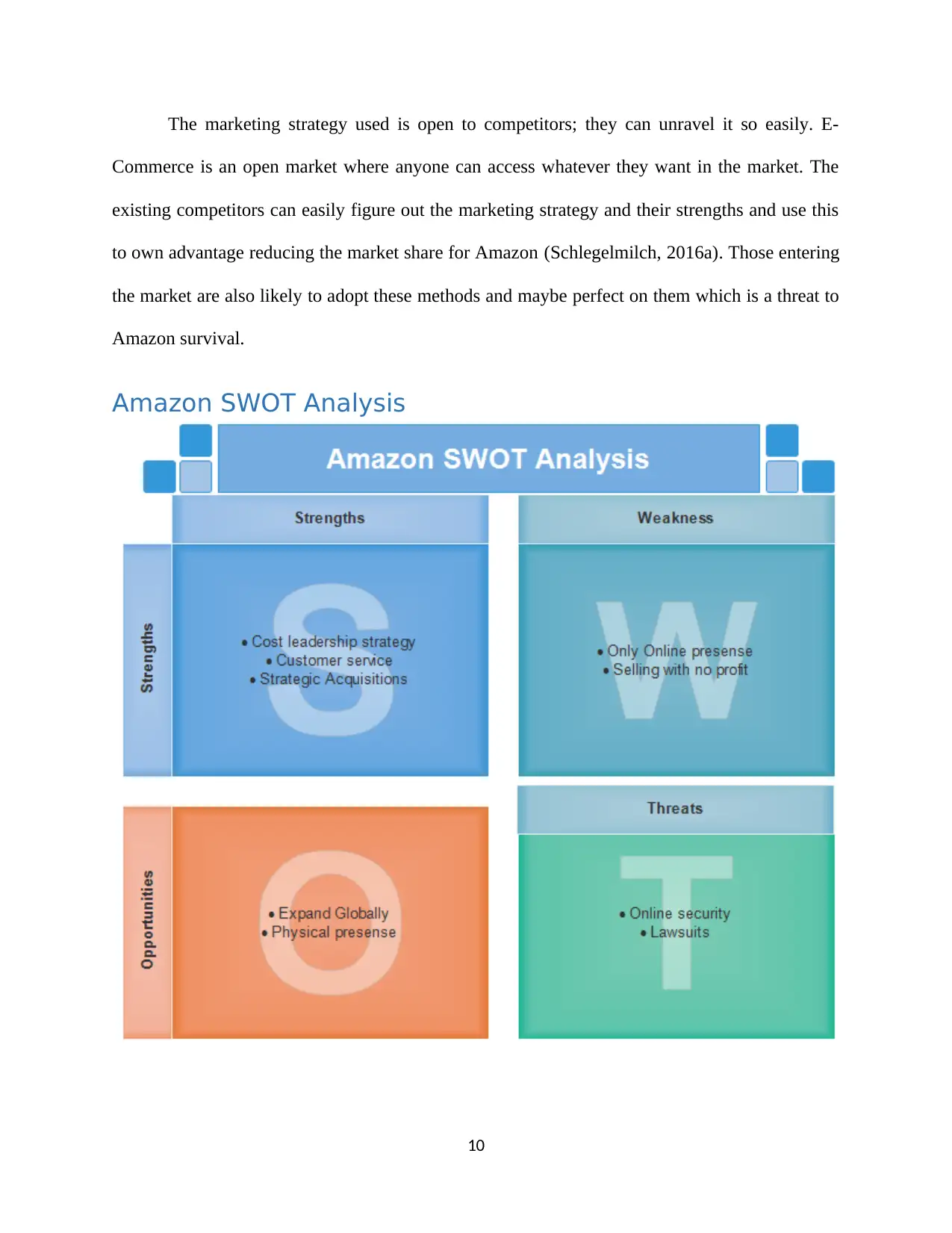
Strength
Amazon family is formed by the five parties. First, we have the third party sellers who
are considered the 1.3 million active sellers. Second, we got the enterprises that are a small and
medium business that can sell their products to customers (Palmatier & Sridhar, 2017). Third, we
have got the customers that are 76 million counted and are still growing on a daily basis. Then,
we have the developers who use the Amazon to develop their apps and programs. We have got
artists in different fields that can use Amazon to promote and sell their products. And we cannot
forget other branded websites that use Amazon website to sell their products. So, what we have
mentioned can be considered as the strength of the company, but the main downfall for the
company is that it does not have online stores in other countries. As some products cannot be
shipped to other countries, so this is a significant fault (Phadermrod, Crowder, & Wills, 2016).
Weaknesses
(i) Only Online Presence - Amazon does not have a physical store like Walmart and Target
where customers can pick their products or buy in the store.
(ii) Selling with No Profit - Amazon offers most of the products at zero margins. At the
short-term, it is a great strategy because it takes out of the market the competition.
However, in the long-term, it only makes it harder since they do not make too much
profit (Bhasin, 2017).
Opportunities
(i) Expand globally - Amazon can open online stores in other countries. This will increase
sales and their demand.
(ii) Physical presence - Amazon can have some physical establishments where it can serve as
distribution centers or pickup purchases, thus, increasing the brand presence (Bhasin,
2017).
11
Amazon family is formed by the five parties. First, we have the third party sellers who
are considered the 1.3 million active sellers. Second, we got the enterprises that are a small and
medium business that can sell their products to customers (Palmatier & Sridhar, 2017). Third, we
have got the customers that are 76 million counted and are still growing on a daily basis. Then,
we have the developers who use the Amazon to develop their apps and programs. We have got
artists in different fields that can use Amazon to promote and sell their products. And we cannot
forget other branded websites that use Amazon website to sell their products. So, what we have
mentioned can be considered as the strength of the company, but the main downfall for the
company is that it does not have online stores in other countries. As some products cannot be
shipped to other countries, so this is a significant fault (Phadermrod, Crowder, & Wills, 2016).
Weaknesses
(i) Only Online Presence - Amazon does not have a physical store like Walmart and Target
where customers can pick their products or buy in the store.
(ii) Selling with No Profit - Amazon offers most of the products at zero margins. At the
short-term, it is a great strategy because it takes out of the market the competition.
However, in the long-term, it only makes it harder since they do not make too much
profit (Bhasin, 2017).
Opportunities
(i) Expand globally - Amazon can open online stores in other countries. This will increase
sales and their demand.
(ii) Physical presence - Amazon can have some physical establishments where it can serve as
distribution centers or pickup purchases, thus, increasing the brand presence (Bhasin,
2017).
11
Threats
Their two major threats are online security and the lawsuits due to the unpaid taxes.
When it comes to the financial performance their past ten years were not that perfect facing a lot
of loss in their grows, going from $247million to $241 million and the main reason for that is
their expenses. The big responsibility that the heads of different department in the company have
to make sure their department is generating revenue. What they need to is to listen to the
customers more to be successful, then focusing on their technology. So, in conclusion, we can
see that the company is working to gain profit but their operation cost is taking that revenue to a
loss (Phadermrod, Crowder, & Wills, 2016).
Amazon’s Porter’s five forces
Amazon’s Porter’s five forces include the threat of new competitors, threat of substitute
product, the bargaining power of buyer, the bargaining power of seller and competitive rivalry
(Bruijl, 2018).
The threat of new competitors is great for Amazon because the services the company is
offering can easily be replicated by competitors. This danger is quite large also because the
virtual world has made companies launch easily. The only solace for the company is its brand
name that is quite famous. This will benefit the company when new entrants come in the market.
The threat of substitute product is also high for Amazon as the services can easily be
copied. The company is an online retailer, and it is not doing anything extremely unique. This is
a threat because customers can be stolen by a similar online retailer.
The bargaining power of the buyer is relatively high in the online retailing industry.
Buyers can switch to other companies if they want to buy stuff, so nothing is stopping them. The
services Amazon is offering is not such that it can attract customers like a magnet. Initially, it
12
Their two major threats are online security and the lawsuits due to the unpaid taxes.
When it comes to the financial performance their past ten years were not that perfect facing a lot
of loss in their grows, going from $247million to $241 million and the main reason for that is
their expenses. The big responsibility that the heads of different department in the company have
to make sure their department is generating revenue. What they need to is to listen to the
customers more to be successful, then focusing on their technology. So, in conclusion, we can
see that the company is working to gain profit but their operation cost is taking that revenue to a
loss (Phadermrod, Crowder, & Wills, 2016).
Amazon’s Porter’s five forces
Amazon’s Porter’s five forces include the threat of new competitors, threat of substitute
product, the bargaining power of buyer, the bargaining power of seller and competitive rivalry
(Bruijl, 2018).
The threat of new competitors is great for Amazon because the services the company is
offering can easily be replicated by competitors. This danger is quite large also because the
virtual world has made companies launch easily. The only solace for the company is its brand
name that is quite famous. This will benefit the company when new entrants come in the market.
The threat of substitute product is also high for Amazon as the services can easily be
copied. The company is an online retailer, and it is not doing anything extremely unique. This is
a threat because customers can be stolen by a similar online retailer.
The bargaining power of the buyer is relatively high in the online retailing industry.
Buyers can switch to other companies if they want to buy stuff, so nothing is stopping them. The
services Amazon is offering is not such that it can attract customers like a magnet. Initially, it
12
⊘ This is a preview!⊘
Do you want full access?
Subscribe today to unlock all pages.
Trusted by 1+ million students worldwide

1 out of 22


Related Documents


Your All-in-One AI-Powered Toolkit for Academic Success.
+13062052269
info@desklib.com
Available 24*7 on WhatsApp / Email
![[object Object]](/_next/static/media/star-bottom.7253800d.svg)
Unlock your academic potential
Copyright © 2020–2026 A2Z Services. All Rights Reserved. Developed and managed by ZUCOL.