AMCT5103 Counselling Theories: Behavioral Therapy Case Study
VerifiedAdded on 2023/03/30
|19
|4112
|143
Report
AI Summary
This report explores the application of Person-Centered and behavioral therapy techniques to counsel Lorelai Go, a mother who lost her three sons to liver cirrhosis and cancer. The report details the psychological impact of such a loss on parents, including depression, anxiety, and potential for complicated grief disorder. It outlines the use of classical and operant conditioning principles, specifically flooding, systemic desensitization, and contingency management, to address Lorelai's phobias and depression. The report includes counseling goals, a structured process for therapy, and a follow-up plan, emphasizing empathy and positive reinforcement to help Lorelai cope with her trauma and find a positive outlook on the future, while also acknowledging the importance of respecting her wishes and boundaries during the therapeutic process. The assignment solution is available on Desklib, a platform providing study resources for students.
Running head: BEHAVORIAL THERAPY
< PROGRAM >
< SEMESTER / YEAR>
< COURSE CODE>
< COURSE TITLE>
MATRICULATION NO : <MATRIC NO>
IDENTITY CARD NO. : <IC NUMBER>
TELEPHONE NO. : <TELEPHONE>
E-MAIL : <EMAIL ID>
LEARNING CENTRE : <LEARNING CENTER>
< PROGRAM >
< SEMESTER / YEAR>
< COURSE CODE>
< COURSE TITLE>
MATRICULATION NO : <MATRIC NO>
IDENTITY CARD NO. : <IC NUMBER>
TELEPHONE NO. : <TELEPHONE>
E-MAIL : <EMAIL ID>
LEARNING CENTRE : <LEARNING CENTER>

Paraphrase This Document
Need a fresh take? Get an instant paraphrase of this document with our AI Paraphraser
1BEHAVORIAL THERAPY
Executive Summary
This report contains the study of a case including a woman Lorelai Go who had lost all her
sons to Liver cirrhosis and cancer in the span of four years. The therapy provides is Person-
Centered and empathetic with behavioral techniques applied to address her phobias and
depression. This is a complex case that is to be handled with utmost care. The history of the
case is included as well as well as an overview of the psychological situation of bereaved
parents. There is in-depth study of the techniques used as requested by the client as well as a
follow up plan to further reduce depression in the patient.
Executive Summary
This report contains the study of a case including a woman Lorelai Go who had lost all her
sons to Liver cirrhosis and cancer in the span of four years. The therapy provides is Person-
Centered and empathetic with behavioral techniques applied to address her phobias and
depression. This is a complex case that is to be handled with utmost care. The history of the
case is included as well as well as an overview of the psychological situation of bereaved
parents. There is in-depth study of the techniques used as requested by the client as well as a
follow up plan to further reduce depression in the patient.
2BEHAVORIAL THERAPY
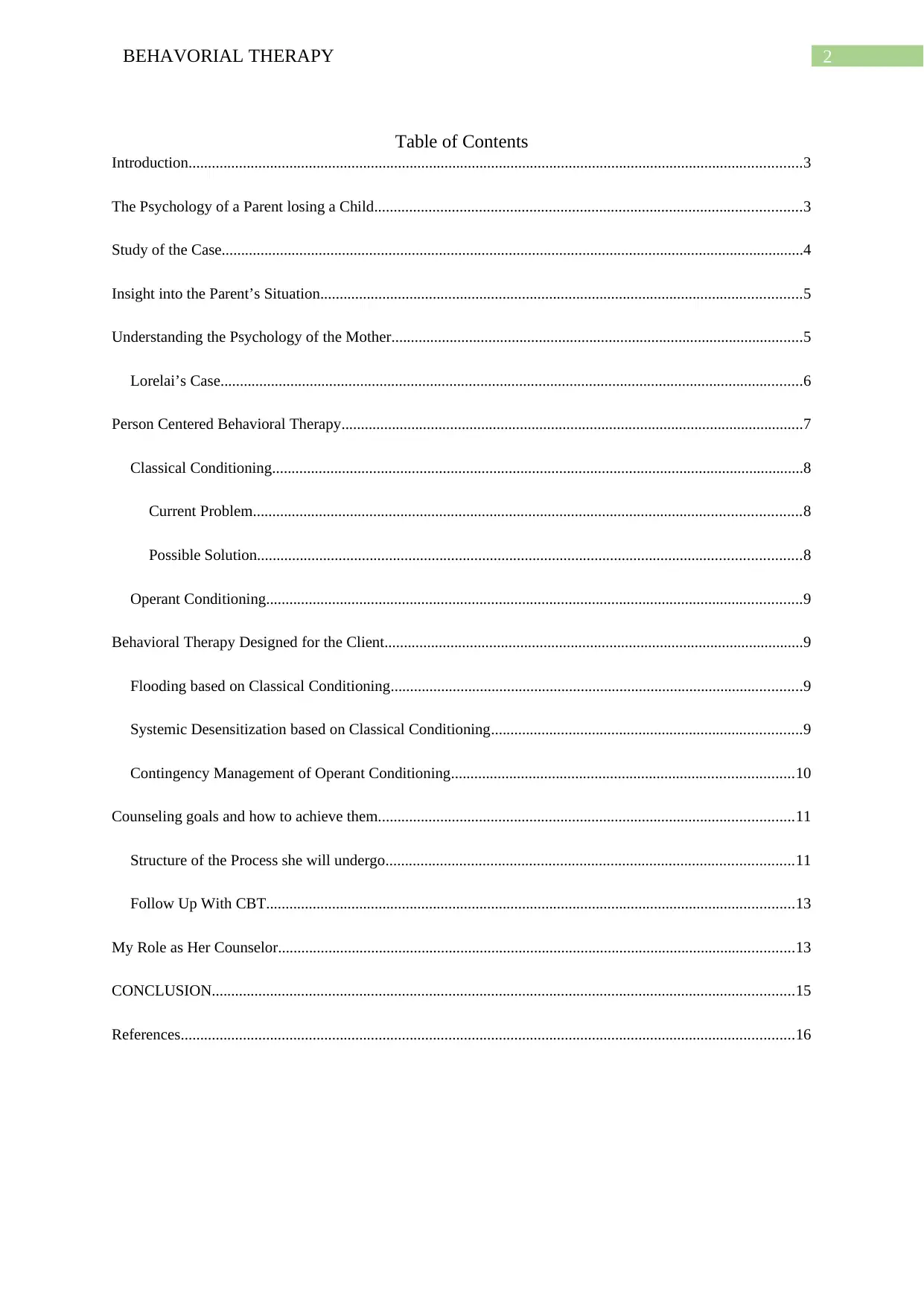
Table of Contents
Introduction..............................................................................................................................................................3
The Psychology of a Parent losing a Child..............................................................................................................3
Study of the Case......................................................................................................................................................4
Insight into the Parent’s Situation............................................................................................................................5
Understanding the Psychology of the Mother..........................................................................................................5
Lorelai’s Case......................................................................................................................................................6
Person Centered Behavioral Therapy.......................................................................................................................7
Classical Conditioning.........................................................................................................................................8
Current Problem.............................................................................................................................................8
Possible Solution............................................................................................................................................8
Operant Conditioning..........................................................................................................................................9
Behavioral Therapy Designed for the Client............................................................................................................9
Flooding based on Classical Conditioning..........................................................................................................9
Systemic Desensitization based on Classical Conditioning................................................................................9
Contingency Management of Operant Conditioning........................................................................................10
Counseling goals and how to achieve them...........................................................................................................11
Structure of the Process she will undergo.........................................................................................................11
Follow Up With CBT........................................................................................................................................13
My Role as Her Counselor.....................................................................................................................................13
CONCLUSION......................................................................................................................................................15
References..............................................................................................................................................................16
Table of Contents
Introduction..............................................................................................................................................................3
The Psychology of a Parent losing a Child..............................................................................................................3
Study of the Case......................................................................................................................................................4
Insight into the Parent’s Situation............................................................................................................................5
Understanding the Psychology of the Mother..........................................................................................................5
Lorelai’s Case......................................................................................................................................................6
Person Centered Behavioral Therapy.......................................................................................................................7
Classical Conditioning.........................................................................................................................................8
Current Problem.............................................................................................................................................8
Possible Solution............................................................................................................................................8
Operant Conditioning..........................................................................................................................................9
Behavioral Therapy Designed for the Client............................................................................................................9
Flooding based on Classical Conditioning..........................................................................................................9
Systemic Desensitization based on Classical Conditioning................................................................................9
Contingency Management of Operant Conditioning........................................................................................10
Counseling goals and how to achieve them...........................................................................................................11
Structure of the Process she will undergo.........................................................................................................11
Follow Up With CBT........................................................................................................................................13
My Role as Her Counselor.....................................................................................................................................13
CONCLUSION......................................................................................................................................................15
References..............................................................................................................................................................16
⊘ This is a preview!⊘
Do you want full access?
Subscribe today to unlock all pages.

Trusted by 1+ million students worldwide
3BEHAVORIAL THERAPY
Introduction
There is nothing more painful for a mother than watching her children pass away. It is
said that parents should never have to bury their child and it should always be the other way
around. It is difficult for parents to watch their children die because they give birth to them. It
becomes a traumatic experience because it violates the natural order of the system on this
planet. In this report we will be exploring the case of a parent losing all three of her children.
Then we will proceed with counselling the parent who has undergone the loss, using
Behavioral Therapy to help her cope with the trauma, handle depression and look at the
future with a positive mindset. It is important to address her issues in depth and devise
methods that help her depressive spells.
The Psychology of a Parent losing a Child
The emotional conflict associated with this kind of loss, leads up to various
psychological and physical complications that include, depression on the forefront, with
anxiety, various cognitive and physical symptoms as well. The physicals problems can be
like an enormous amount of stress for the parent, which in turn can lead to marital problems,
as parents who have lost their children tend to fall apart, as they presume that they have lost
the only thing that held them together and forgets the other factors that brought them
together. Along with these problems, there is an increased risk of the parents trying to
commit suicide fuelled by severe stress which is caused by pain, because coping with the
death of a child is very difficult, which many people call, feeling like a part of a person’s
Introduction
There is nothing more painful for a mother than watching her children pass away. It is
said that parents should never have to bury their child and it should always be the other way
around. It is difficult for parents to watch their children die because they give birth to them. It
becomes a traumatic experience because it violates the natural order of the system on this
planet. In this report we will be exploring the case of a parent losing all three of her children.
Then we will proceed with counselling the parent who has undergone the loss, using
Behavioral Therapy to help her cope with the trauma, handle depression and look at the
future with a positive mindset. It is important to address her issues in depth and devise
methods that help her depressive spells.
The Psychology of a Parent losing a Child
The emotional conflict associated with this kind of loss, leads up to various
psychological and physical complications that include, depression on the forefront, with
anxiety, various cognitive and physical symptoms as well. The physicals problems can be
like an enormous amount of stress for the parent, which in turn can lead to marital problems,
as parents who have lost their children tend to fall apart, as they presume that they have lost
the only thing that held them together and forgets the other factors that brought them
together. Along with these problems, there is an increased risk of the parents trying to
commit suicide fuelled by severe stress which is caused by pain, because coping with the
death of a child is very difficult, which many people call, feeling like a part of a person’s
Paraphrase This Document
Need a fresh take? Get an instant paraphrase of this document with our AI Paraphraser
4BEHAVORIAL THERAPY
existence has been ripped apart and an enormous guilt because during these times parents are
quick to assume, that they did not do enough to make sure the child survived.
Study of the Case
A similar story was reported about the three sons of a Filipina mother dying due to
Liver cirrhosis. Lorelei Go’s eldest son, Rowden was diagnosed with stage 4 liver cancer,
hepatocellular carcinoma and has received news of having just three weeks left to love. This
was back in May 2014. This was sudden for the family because he had no symptom during
the onset of the disease and they were visible only later. His story did the rounds when he
married his fiancé weeks later and married her at the hospital, beside his death bed only to
pass away 10 hours later. He was 29 years old.
After a month, the entire family got screened for any possible blood defect only to
realize that the second brother, who was celebrity chef and entrepreneur, Hasset Go, carries
the same kind of liver cancer which was at stage 3 ("Hisham Go | Check out my activity on
GoFundMe", 2019). He immediately got a surgery to remove the tumor which grew back. He
tried alternative medication as well. He even opted for chemotherapy for this cancer through
TACE but it was ineffective as it ended up weakening his body on August 2015 and he died
on October 2015.
Hisham, the youngest son was diagnosed with cancer at an early stage and he went on
strict diet and regimen to help avert the disease (Kapuso Mo, Jessica Soho: Pagsubok sa
buhay ni Lorelei Go, 2017). Both he and Lorelei was optimistic as he was flown to China to
undergo cryosurgery but to realize that the cancer has escalated from stage 1 to 4 really
quickly in a matter of six months. They went back to Philippines and Hisham continued
medication at home with the help of a private nurse but on November 14, 1017, he died.
existence has been ripped apart and an enormous guilt because during these times parents are
quick to assume, that they did not do enough to make sure the child survived.
Study of the Case
A similar story was reported about the three sons of a Filipina mother dying due to
Liver cirrhosis. Lorelei Go’s eldest son, Rowden was diagnosed with stage 4 liver cancer,
hepatocellular carcinoma and has received news of having just three weeks left to love. This
was back in May 2014. This was sudden for the family because he had no symptom during
the onset of the disease and they were visible only later. His story did the rounds when he
married his fiancé weeks later and married her at the hospital, beside his death bed only to
pass away 10 hours later. He was 29 years old.
After a month, the entire family got screened for any possible blood defect only to
realize that the second brother, who was celebrity chef and entrepreneur, Hasset Go, carries
the same kind of liver cancer which was at stage 3 ("Hisham Go | Check out my activity on
GoFundMe", 2019). He immediately got a surgery to remove the tumor which grew back. He
tried alternative medication as well. He even opted for chemotherapy for this cancer through
TACE but it was ineffective as it ended up weakening his body on August 2015 and he died
on October 2015.
Hisham, the youngest son was diagnosed with cancer at an early stage and he went on
strict diet and regimen to help avert the disease (Kapuso Mo, Jessica Soho: Pagsubok sa
buhay ni Lorelei Go, 2017). Both he and Lorelei was optimistic as he was flown to China to
undergo cryosurgery but to realize that the cancer has escalated from stage 1 to 4 really
quickly in a matter of six months. They went back to Philippines and Hisham continued
medication at home with the help of a private nurse but on November 14, 1017, he died.
5BEHAVORIAL THERAPY
Insight into the Parent’s Situation
Lorelei was a single parent who had bought these three boys up, she was separated
from her husband early into their marriage. In the documentaries that covered their story, It is
evident that she was strong, emotionally driven and a god-fearing individual. It is evident
from her speech during these interviews that she believe that the loss of her children is a test
of her faith. Her children were believers too.
Their family has a pastry business, in which Hasset was a chef as well. Her family
now includes herself and the widow of Rowden, Liezl and their daughter Zakiah.
Understanding the Psychology of the Mother
Since, behavioral therapy will be used to understand and counsel the bereaved mother,
understanding the mother’s personality is important to understand the current psychological
issues she might be undergoing. Using the key concepts of behavioral therapy, like the
cognitive elements of her behavior, her capability to analyze changes and adapt and ability to
utilize operant conditioning to help modify the problematic areas and heal.
For this, one must look at the research pointing to the general psychological problems
arising in people who have lost their children. The problems like suicide, pain and guilt can
persist for a long time that can cause the people to be diagnosed with complex disorders like
Insight into the Parent’s Situation
Lorelei was a single parent who had bought these three boys up, she was separated
from her husband early into their marriage. In the documentaries that covered their story, It is
evident that she was strong, emotionally driven and a god-fearing individual. It is evident
from her speech during these interviews that she believe that the loss of her children is a test
of her faith. Her children were believers too.
Their family has a pastry business, in which Hasset was a chef as well. Her family
now includes herself and the widow of Rowden, Liezl and their daughter Zakiah.
Understanding the Psychology of the Mother
Since, behavioral therapy will be used to understand and counsel the bereaved mother,
understanding the mother’s personality is important to understand the current psychological
issues she might be undergoing. Using the key concepts of behavioral therapy, like the
cognitive elements of her behavior, her capability to analyze changes and adapt and ability to
utilize operant conditioning to help modify the problematic areas and heal.
For this, one must look at the research pointing to the general psychological problems
arising in people who have lost their children. The problems like suicide, pain and guilt can
persist for a long time that can cause the people to be diagnosed with complex disorders like
⊘ This is a preview!⊘
Do you want full access?
Subscribe today to unlock all pages.
Trusted by 1+ million students worldwide
6BEHAVORIAL THERAPY
the Complicated Grief Disorder which shares the similarity of the symptoms with PTSD or
Post Traumatic Stress Disorder (Meert, Schim &Briller, 2011).
It is rumored to reduce the parent’s lifespan as well. Elderly parents tend to have a
greater impact who have various other problems in their bodies that can be adversely
impacted by their grief (Sanders, 1980). A research was done on 1239 Israelis at the Tel
Aviv University. 29.2% had lost one child to either war or disease. Their overall functioning
was significantly poorer than the non-bereaved parents. Their cognitive functioning was
lower as well, as they were significantly aloof and lonely but they tend to be more attached to
their surviving children and grandchildren. Parents who had lost a child would die earlier
than non-bereaved parents. Especially, bereaved mothers.
It is assumed that the biological impact of a long term stress may cause early death in
parents. The trauma associated with losing a child be it to an accident or disease, will cause
mental health issues and physical health issues.
Lorelai’s Case
She is a strong woman who tends to hide her true feelings. She feels the need to
appear strong foe her granddaughter whose life was disrupted at a very young age,
and she knows how difficult single motherhood is.
Suppression of depression increases stress. She seems to focus all her energy into the
pastry business which is both positive and negative, because she is trying to escape
facing her true feelings.
This is further due to her belief that this has happened because God wanted to test her,
which makes her pose like she is strong and suppress her feelings.
the Complicated Grief Disorder which shares the similarity of the symptoms with PTSD or
Post Traumatic Stress Disorder (Meert, Schim &Briller, 2011).
It is rumored to reduce the parent’s lifespan as well. Elderly parents tend to have a
greater impact who have various other problems in their bodies that can be adversely
impacted by their grief (Sanders, 1980). A research was done on 1239 Israelis at the Tel
Aviv University. 29.2% had lost one child to either war or disease. Their overall functioning
was significantly poorer than the non-bereaved parents. Their cognitive functioning was
lower as well, as they were significantly aloof and lonely but they tend to be more attached to
their surviving children and grandchildren. Parents who had lost a child would die earlier
than non-bereaved parents. Especially, bereaved mothers.
It is assumed that the biological impact of a long term stress may cause early death in
parents. The trauma associated with losing a child be it to an accident or disease, will cause
mental health issues and physical health issues.
Lorelai’s Case
She is a strong woman who tends to hide her true feelings. She feels the need to
appear strong foe her granddaughter whose life was disrupted at a very young age,
and she knows how difficult single motherhood is.
Suppression of depression increases stress. She seems to focus all her energy into the
pastry business which is both positive and negative, because she is trying to escape
facing her true feelings.
This is further due to her belief that this has happened because God wanted to test her,
which makes her pose like she is strong and suppress her feelings.
Paraphrase This Document
Need a fresh take? Get an instant paraphrase of this document with our AI Paraphraser
7BEHAVORIAL THERAPY
This requires the counseling process to be relatable for her. She will not accept
scientific explanations.
It is important to understand that she has forged a strong bond with her
Granddaughter, so she is the positive reinforcement that must be utilized for her
benefit.
Lorelai seems to evade questions about her sons, but it is important for her to stop
evading them because it will harm her otherwise. Acceptance is important. She seems
to be in a stage of borderline Denial.
She hopes that we are both empathetic and that we use techniques that are effective
and to the point. She believes in positive growth through the loss of negative thoughts.
Person Centered Behavioral Therapy
Behavioral theory will be used to counsel Lorelai however, this will be completely
empathetic in nature and centered on her. Not only will the negative thoughts be removed, it
will also be filled with positive thoughts (Galuser & Bozarth, 2001).
Every behavior is conditioned. We can refer to Pavlov’s Classical Conditioning here,
where he conditioned a dog to salivate when a bell was rung, where the response was the dog
salivating and ringing the bell meant food was coming. Operant conditioning can also be
utilized to understand the natural flow of behavior, the Skinner box method. This method was
researched with animals as well with a lever within a chamber in which the animal was kept
to obtain food or water, and their lever pressing was recorded to quantify their behavior.
The destructive Behavior we will be working on is Lorelai’s need to suppress sadness
and refusing to retain her cool in events that require her to talk or confront her son’s deaths.
Which is causing CGD or Complicated Grief Disorder.
This requires the counseling process to be relatable for her. She will not accept
scientific explanations.
It is important to understand that she has forged a strong bond with her
Granddaughter, so she is the positive reinforcement that must be utilized for her
benefit.
Lorelai seems to evade questions about her sons, but it is important for her to stop
evading them because it will harm her otherwise. Acceptance is important. She seems
to be in a stage of borderline Denial.
She hopes that we are both empathetic and that we use techniques that are effective
and to the point. She believes in positive growth through the loss of negative thoughts.
Person Centered Behavioral Therapy
Behavioral theory will be used to counsel Lorelai however, this will be completely
empathetic in nature and centered on her. Not only will the negative thoughts be removed, it
will also be filled with positive thoughts (Galuser & Bozarth, 2001).
Every behavior is conditioned. We can refer to Pavlov’s Classical Conditioning here,
where he conditioned a dog to salivate when a bell was rung, where the response was the dog
salivating and ringing the bell meant food was coming. Operant conditioning can also be
utilized to understand the natural flow of behavior, the Skinner box method. This method was
researched with animals as well with a lever within a chamber in which the animal was kept
to obtain food or water, and their lever pressing was recorded to quantify their behavior.
The destructive Behavior we will be working on is Lorelai’s need to suppress sadness
and refusing to retain her cool in events that require her to talk or confront her son’s deaths.
Which is causing CGD or Complicated Grief Disorder.
8BEHAVORIAL THERAPY
However, the therapy must center around her needs as well, it has to be centered on
her and when she demands termination, and it must be stopped (Tang, Goodchild &
Salkovskis, 2012). Counselling patents often have a tendency to escape but it can be
controlled if she is allowed to choose her methods.
For this, the two basic principles on which the therapy sessions on her will work on
need to be explored.
Classical Conditioning
Associations need to be formed between stimuli to evoke a response.
Current Problem
The thought of her son’s death makes her feel intense pain so she refuses go think or
talk about it a lot. She views those memories with borderline resentment although she
considers them a test by God.
Possible Solution
This has be changed to thoughts where she accepts what happened and thinks of her
son’s as people who once brought a lot of joy in her life. She can be conditioned to
understand that if her sons are indeed watching her from heaven, they will feel happy if they
watch her moving on and enjoying her life (Mearns, Thorne & McLeard, 2013).
However, the therapy must center around her needs as well, it has to be centered on
her and when she demands termination, and it must be stopped (Tang, Goodchild &
Salkovskis, 2012). Counselling patents often have a tendency to escape but it can be
controlled if she is allowed to choose her methods.
For this, the two basic principles on which the therapy sessions on her will work on
need to be explored.
Classical Conditioning
Associations need to be formed between stimuli to evoke a response.
Current Problem
The thought of her son’s death makes her feel intense pain so she refuses go think or
talk about it a lot. She views those memories with borderline resentment although she
considers them a test by God.
Possible Solution
This has be changed to thoughts where she accepts what happened and thinks of her
son’s as people who once brought a lot of joy in her life. She can be conditioned to
understand that if her sons are indeed watching her from heaven, they will feel happy if they
watch her moving on and enjoying her life (Mearns, Thorne & McLeard, 2013).
⊘ This is a preview!⊘
Do you want full access?
Subscribe today to unlock all pages.
Trusted by 1+ million students worldwide
9BEHAVORIAL THERAPY
Operant Conditioning
Focus on reinforcement being utilized to increase or decrease the frequency of a certain kind
of behavior.
The patient is afraid of any kind of disease that might occur within the family or
anyone close. She reduces interaction with people and tends to breakdown.
This can be reinforced by asking her to practice being calm. Show her, that her
granddaughter especially tends to feel happier if she in under control.
Behavioral Therapy Designed for the Client
Flooding based on Classical Conditioning
Exposing the patient to objects and situations that invoke fear in the mind of the patient.
This will be done by exposing her to various situations of parents losing their children. She
will be assigned to a support group of a similar nature which she has to compulsorily visit to
hear people talk about their experiences of the same nature (Spence, 1956). This will have
two effects:
1. She will eventually learn to normalize the situation.
2. She will eventually realize that people are brave enough to face their fear so she must
do the same.
Systemic Desensitization based on Classical Conditioning
The client was asked to make a list of fears in which she noted:
1. Any news of disease.
2. Her granddaughter in pain.
3. Money troubles.
Operant Conditioning
Focus on reinforcement being utilized to increase or decrease the frequency of a certain kind
of behavior.
The patient is afraid of any kind of disease that might occur within the family or
anyone close. She reduces interaction with people and tends to breakdown.
This can be reinforced by asking her to practice being calm. Show her, that her
granddaughter especially tends to feel happier if she in under control.
Behavioral Therapy Designed for the Client
Flooding based on Classical Conditioning
Exposing the patient to objects and situations that invoke fear in the mind of the patient.
This will be done by exposing her to various situations of parents losing their children. She
will be assigned to a support group of a similar nature which she has to compulsorily visit to
hear people talk about their experiences of the same nature (Spence, 1956). This will have
two effects:
1. She will eventually learn to normalize the situation.
2. She will eventually realize that people are brave enough to face their fear so she must
do the same.
Systemic Desensitization based on Classical Conditioning
The client was asked to make a list of fears in which she noted:
1. Any news of disease.
2. Her granddaughter in pain.
3. Money troubles.
Paraphrase This Document
Need a fresh take? Get an instant paraphrase of this document with our AI Paraphraser
10BEHAVORIAL THERAPY
4. Being left alone for long periods of time.
All of these fears were typical of someone who had went through the same kind of
trouble. Thus, for systemic desensitization, she will be asked to concentrate on these fears
and then confront them bravely to avoid them causing stress that triggers anxiety and
discomfort. For this the steps taken will be,
1. Relaxation techniques. A good amount of counseling will be done to help her
meditate and take care of herself. She seems to lack care for her body because she
talks of being too tired which is classic depression and her body refusing to cooperate.
2. Fear invoking situations will be manually created while counselling her to get rid of
the fear by constantly counseling her. Motivational narrative therapy will help in these
situations (Watchel, 1997).
3. She will also be asked to go through pictures of her sons and talk about them and her
pent up feelings. To ensure she learns how to speak out about how she feels to help
her unburden herself.
Contingency Management of Operant Conditioning
A formal written contract is to be handed out after she truthfully confirms that she
desperately needs this therapy. This will contain an outline of all the goals about behavior
changes and rewards she will be allowed if she reaches them. She will be warned that if she
does not act accordingly it will lead to the extermination of the contract and her counselling
sessions, because it is already based on her demands and she should not have any reason to
work against it.
4. Being left alone for long periods of time.
All of these fears were typical of someone who had went through the same kind of
trouble. Thus, for systemic desensitization, she will be asked to concentrate on these fears
and then confront them bravely to avoid them causing stress that triggers anxiety and
discomfort. For this the steps taken will be,
1. Relaxation techniques. A good amount of counseling will be done to help her
meditate and take care of herself. She seems to lack care for her body because she
talks of being too tired which is classic depression and her body refusing to cooperate.
2. Fear invoking situations will be manually created while counselling her to get rid of
the fear by constantly counseling her. Motivational narrative therapy will help in these
situations (Watchel, 1997).
3. She will also be asked to go through pictures of her sons and talk about them and her
pent up feelings. To ensure she learns how to speak out about how she feels to help
her unburden herself.
Contingency Management of Operant Conditioning
A formal written contract is to be handed out after she truthfully confirms that she
desperately needs this therapy. This will contain an outline of all the goals about behavior
changes and rewards she will be allowed if she reaches them. She will be warned that if she
does not act accordingly it will lead to the extermination of the contract and her counselling
sessions, because it is already based on her demands and she should not have any reason to
work against it.
11BEHAVORIAL THERAPY
Counseling goals and how to achieve them.
It is important for goals to be set for the person to achieve. A clear outline that will be
provided in the contingency form is as follows:
1. Given her condition is depression triggered off by phobias, it is a complex case, and thus
behavioral therapy is being used to address the phobias first. Although this has to be used
with drugs issued by a psychiatrist to help her cope. Soothing her will affect her
positively (Knox 2008).
2. The phobia to be addressed is her fear of death and disease primarily. It is to be kept in
mind that she is a god fearing individual hence, it must be constructed according to her
beliefs which must not be hurt.
3. Her rewards should be belief based. She must find the therapy relatable else it will be
difficult for counsellors to make her understand.
4. She must let go of phobias, by force if necessary, to help normalize her interaction with
people. Support groups that will address her phobias and allow socialization will help her
with it (mason, Clare & Pistrang, 2005).
5. She can also be helped by the counsellors to start an organization that will help raise
money for people afflicted with the same kind of carcinoma, given how inspirational her
story was.
Structure of the Process she will undergo
Belief exercises. To enhance the bond between her and the counsellor. She is a closed
person who refuses to talk about things due to her underlying phobias. She must be
coaxed out of her shell. This might require counselling in open spaces, in public or in
some familiar platform for her.
Counseling goals and how to achieve them.
It is important for goals to be set for the person to achieve. A clear outline that will be
provided in the contingency form is as follows:
1. Given her condition is depression triggered off by phobias, it is a complex case, and thus
behavioral therapy is being used to address the phobias first. Although this has to be used
with drugs issued by a psychiatrist to help her cope. Soothing her will affect her
positively (Knox 2008).
2. The phobia to be addressed is her fear of death and disease primarily. It is to be kept in
mind that she is a god fearing individual hence, it must be constructed according to her
beliefs which must not be hurt.
3. Her rewards should be belief based. She must find the therapy relatable else it will be
difficult for counsellors to make her understand.
4. She must let go of phobias, by force if necessary, to help normalize her interaction with
people. Support groups that will address her phobias and allow socialization will help her
with it (mason, Clare & Pistrang, 2005).
5. She can also be helped by the counsellors to start an organization that will help raise
money for people afflicted with the same kind of carcinoma, given how inspirational her
story was.
Structure of the Process she will undergo
Belief exercises. To enhance the bond between her and the counsellor. She is a closed
person who refuses to talk about things due to her underlying phobias. She must be
coaxed out of her shell. This might require counselling in open spaces, in public or in
some familiar platform for her.
⊘ This is a preview!⊘
Do you want full access?
Subscribe today to unlock all pages.
Trusted by 1+ million students worldwide

1 out of 19


Related Documents


Your All-in-One AI-Powered Toolkit for Academic Success.
+13062052269
info@desklib.com
Available 24*7 on WhatsApp / Email
![[object Object]](/_next/static/media/star-bottom.7253800d.svg)
Unlock your academic potential
Copyright © 2020–2026 A2Z Services. All Rights Reserved. Developed and managed by ZUCOL.