Detailed Analysis: Amending Company Constitution & Shareholder Rights
VerifiedAdded on 2023/06/05
|10
|2647
|267
Case Study
AI Summary
This case study provides a comprehensive analysis of amending a company's constitution under the Corporations Act, focusing on shareholder rights and limitations. It examines the documents governing company operations, the process of amending the constitution through special resolutions or court orders, and the extent to which majority shareholders' powers are limited to protect minority shareholder interests. Key legal principles are illustrated through case law, such as Allen v Gold Reefs of West Africa and Gambotto v WCP Ltd, highlighting the balance between majority rule and the need to prevent oppressive conduct. The study further explores the remedies available to shareholders under the Corporations Act and emphasizes the duty of shareholders to exercise their voting rights in good faith. Desklib provides access to this and other solved assignments for students.
Running head: Amending Company Constitution 1
Amending Company Constitution
Name of the Student:
Name of the Institution:
Name of the Instructor:
Amending Company Constitution
Name of the Student:
Name of the Institution:
Name of the Instructor:

Paraphrase This Document
Need a fresh take? Get an instant paraphrase of this document with our AI Paraphraser
Amending Company Constitution 2
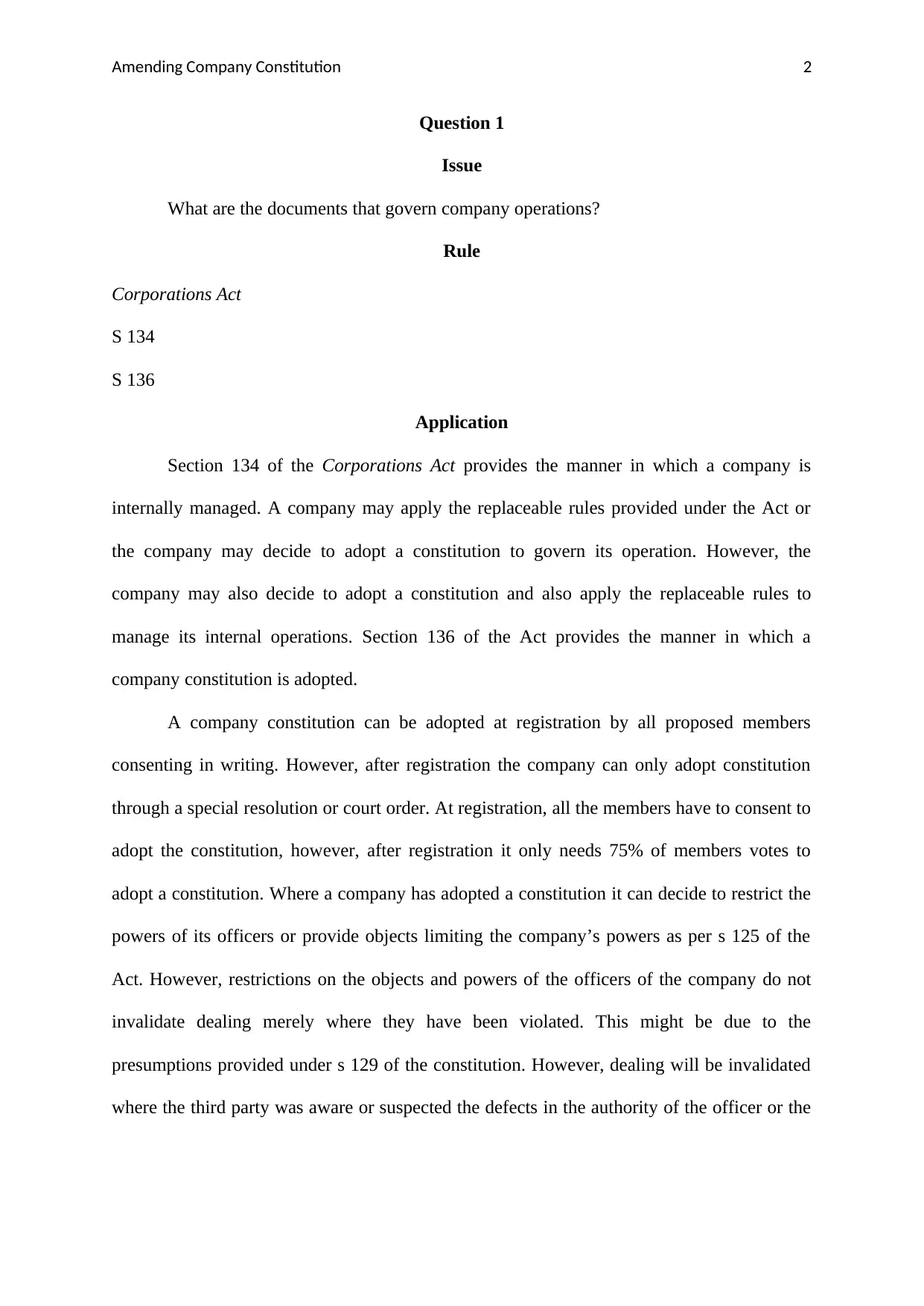
Question 1
Issue
What are the documents that govern company operations?
Rule
Corporations Act
S 134
S 136
Application
Section 134 of the Corporations Act provides the manner in which a company is
internally managed. A company may apply the replaceable rules provided under the Act or
the company may decide to adopt a constitution to govern its operation. However, the
company may also decide to adopt a constitution and also apply the replaceable rules to
manage its internal operations. Section 136 of the Act provides the manner in which a
company constitution is adopted.
A company constitution can be adopted at registration by all proposed members
consenting in writing. However, after registration the company can only adopt constitution
through a special resolution or court order. At registration, all the members have to consent to
adopt the constitution, however, after registration it only needs 75% of members votes to
adopt a constitution. Where a company has adopted a constitution it can decide to restrict the
powers of its officers or provide objects limiting the company’s powers as per s 125 of the
Act. However, restrictions on the objects and powers of the officers of the company do not
invalidate dealing merely where they have been violated. This might be due to the
presumptions provided under s 129 of the constitution. However, dealing will be invalidated
where the third party was aware or suspected the defects in the authority of the officer or the
Question 1
Issue
What are the documents that govern company operations?
Rule
Corporations Act
S 134
S 136
Application
Section 134 of the Corporations Act provides the manner in which a company is
internally managed. A company may apply the replaceable rules provided under the Act or
the company may decide to adopt a constitution to govern its operation. However, the
company may also decide to adopt a constitution and also apply the replaceable rules to
manage its internal operations. Section 136 of the Act provides the manner in which a
company constitution is adopted.
A company constitution can be adopted at registration by all proposed members
consenting in writing. However, after registration the company can only adopt constitution
through a special resolution or court order. At registration, all the members have to consent to
adopt the constitution, however, after registration it only needs 75% of members votes to
adopt a constitution. Where a company has adopted a constitution it can decide to restrict the
powers of its officers or provide objects limiting the company’s powers as per s 125 of the
Act. However, restrictions on the objects and powers of the officers of the company do not
invalidate dealing merely where they have been violated. This might be due to the
presumptions provided under s 129 of the constitution. However, dealing will be invalidated
where the third party was aware or suspected the defects in the authority of the officer or the
Amending Company Constitution 3
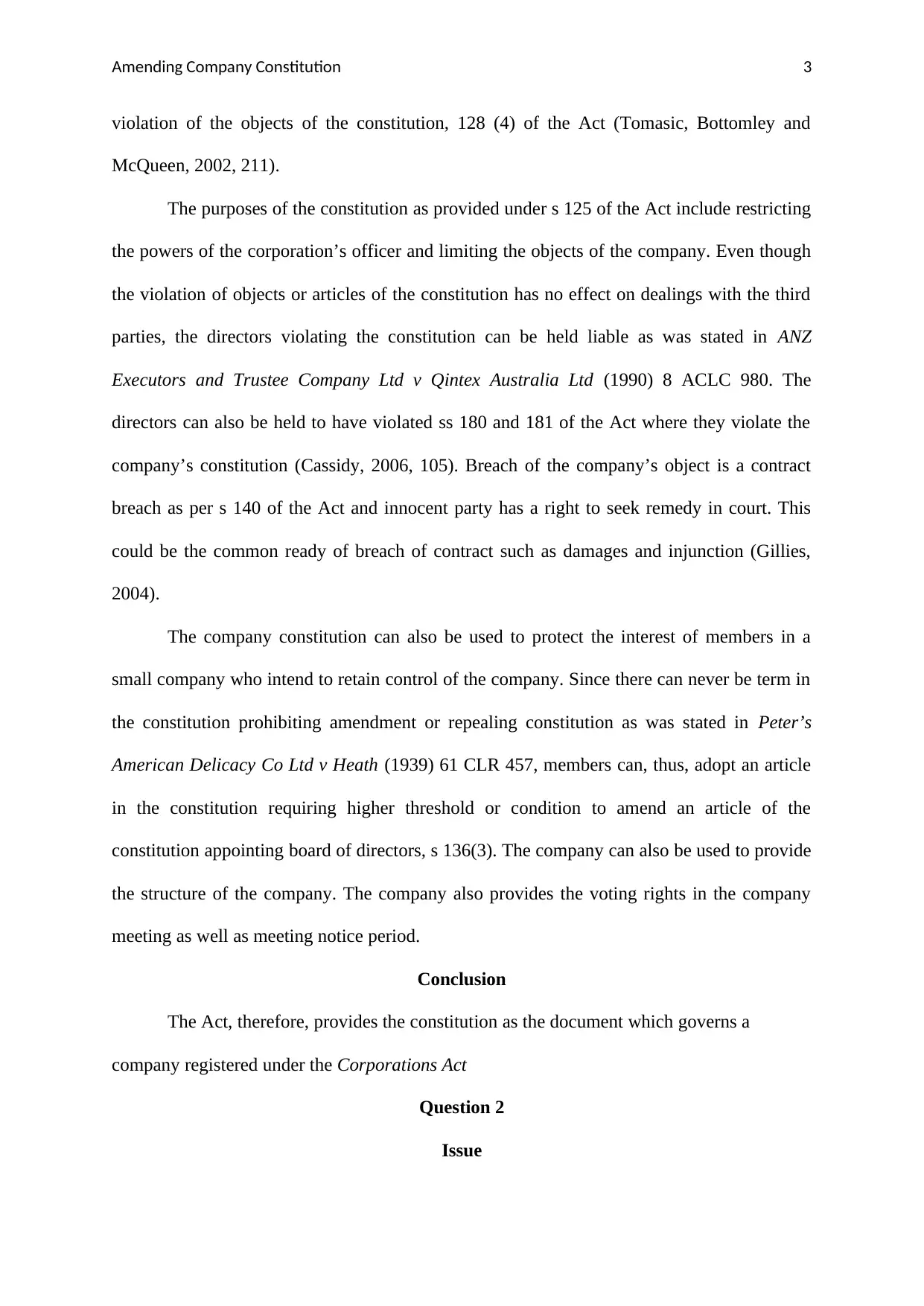
violation of the objects of the constitution, 128 (4) of the Act (Tomasic, Bottomley and
McQueen, 2002, 211).
The purposes of the constitution as provided under s 125 of the Act include restricting
the powers of the corporation’s officer and limiting the objects of the company. Even though
the violation of objects or articles of the constitution has no effect on dealings with the third
parties, the directors violating the constitution can be held liable as was stated in ANZ
Executors and Trustee Company Ltd v Qintex Australia Ltd (1990) 8 ACLC 980. The
directors can also be held to have violated ss 180 and 181 of the Act where they violate the
company’s constitution (Cassidy, 2006, 105). Breach of the company’s object is a contract
breach as per s 140 of the Act and innocent party has a right to seek remedy in court. This
could be the common ready of breach of contract such as damages and injunction (Gillies,
2004).
The company constitution can also be used to protect the interest of members in a
small company who intend to retain control of the company. Since there can never be term in
the constitution prohibiting amendment or repealing constitution as was stated in Peter’s
American Delicacy Co Ltd v Heath (1939) 61 CLR 457, members can, thus, adopt an article
in the constitution requiring higher threshold or condition to amend an article of the
constitution appointing board of directors, s 136(3). The company can also be used to provide
the structure of the company. The company also provides the voting rights in the company
meeting as well as meeting notice period.
Conclusion
The Act, therefore, provides the constitution as the document which governs a
company registered under the Corporations Act
Question 2
Issue
violation of the objects of the constitution, 128 (4) of the Act (Tomasic, Bottomley and
McQueen, 2002, 211).
The purposes of the constitution as provided under s 125 of the Act include restricting
the powers of the corporation’s officer and limiting the objects of the company. Even though
the violation of objects or articles of the constitution has no effect on dealings with the third
parties, the directors violating the constitution can be held liable as was stated in ANZ
Executors and Trustee Company Ltd v Qintex Australia Ltd (1990) 8 ACLC 980. The
directors can also be held to have violated ss 180 and 181 of the Act where they violate the
company’s constitution (Cassidy, 2006, 105). Breach of the company’s object is a contract
breach as per s 140 of the Act and innocent party has a right to seek remedy in court. This
could be the common ready of breach of contract such as damages and injunction (Gillies,
2004).
The company constitution can also be used to protect the interest of members in a
small company who intend to retain control of the company. Since there can never be term in
the constitution prohibiting amendment or repealing constitution as was stated in Peter’s
American Delicacy Co Ltd v Heath (1939) 61 CLR 457, members can, thus, adopt an article
in the constitution requiring higher threshold or condition to amend an article of the
constitution appointing board of directors, s 136(3). The company can also be used to provide
the structure of the company. The company also provides the voting rights in the company
meeting as well as meeting notice period.
Conclusion
The Act, therefore, provides the constitution as the document which governs a
company registered under the Corporations Act
Question 2
Issue
⊘ This is a preview!⊘
Do you want full access?
Subscribe today to unlock all pages.

Trusted by 1+ million students worldwide
Amending Company Constitution 4
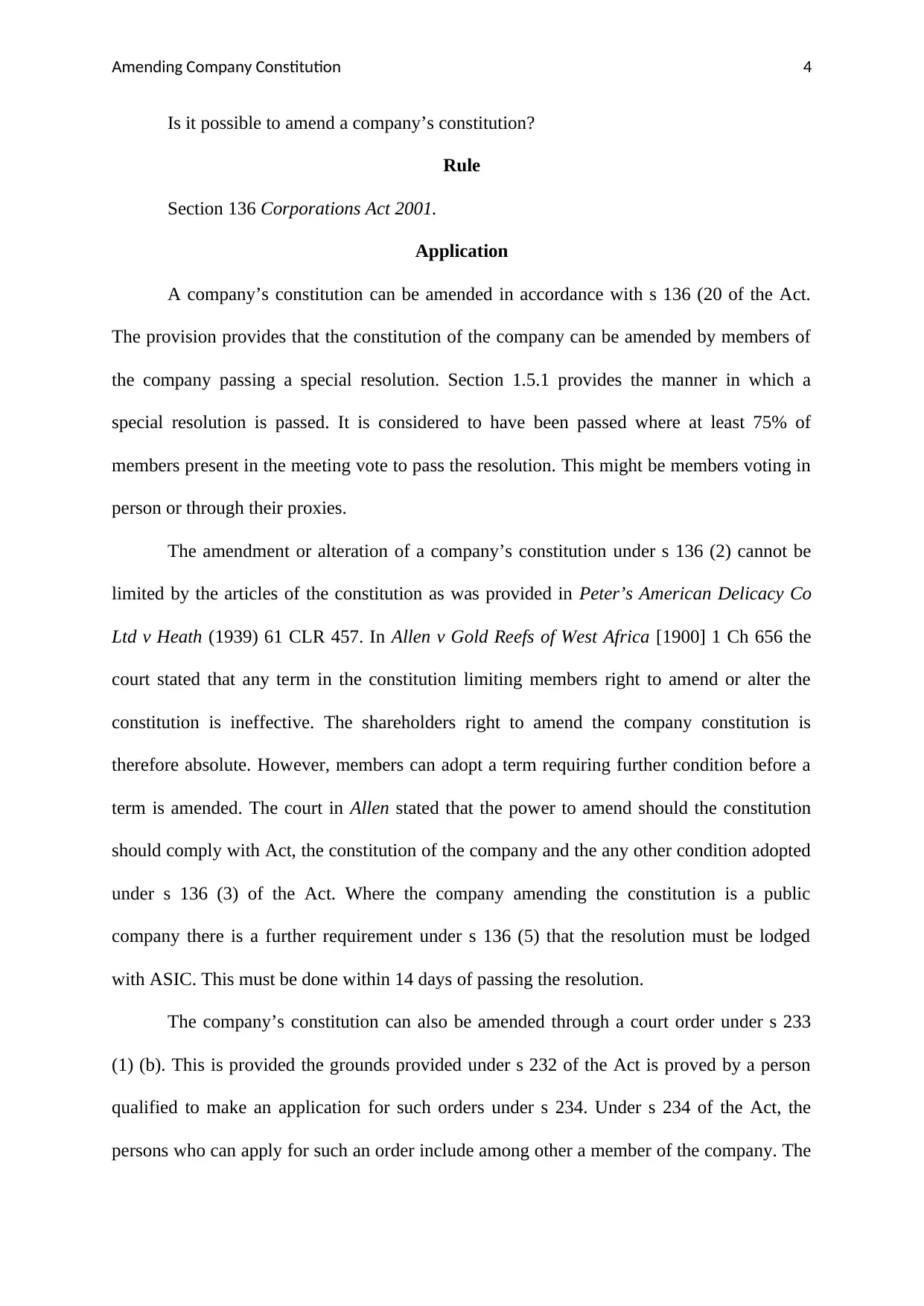
Is it possible to amend a company’s constitution?
Rule
Section 136 Corporations Act 2001.
Application
A company’s constitution can be amended in accordance with s 136 (20 of the Act.
The provision provides that the constitution of the company can be amended by members of
the company passing a special resolution. Section 1.5.1 provides the manner in which a
special resolution is passed. It is considered to have been passed where at least 75% of
members present in the meeting vote to pass the resolution. This might be members voting in
person or through their proxies.
The amendment or alteration of a company’s constitution under s 136 (2) cannot be
limited by the articles of the constitution as was provided in Peter’s American Delicacy Co
Ltd v Heath (1939) 61 CLR 457. In Allen v Gold Reefs of West Africa [1900] 1 Ch 656 the
court stated that any term in the constitution limiting members right to amend or alter the
constitution is ineffective. The shareholders right to amend the company constitution is
therefore absolute. However, members can adopt a term requiring further condition before a
term is amended. The court in Allen stated that the power to amend should the constitution
should comply with Act, the constitution of the company and the any other condition adopted
under s 136 (3) of the Act. Where the company amending the constitution is a public
company there is a further requirement under s 136 (5) that the resolution must be lodged
with ASIC. This must be done within 14 days of passing the resolution.
The company’s constitution can also be amended through a court order under s 233
(1) (b). This is provided the grounds provided under s 232 of the Act is proved by a person
qualified to make an application for such orders under s 234. Under s 234 of the Act, the
persons who can apply for such an order include among other a member of the company. The
Is it possible to amend a company’s constitution?
Rule
Section 136 Corporations Act 2001.
Application
A company’s constitution can be amended in accordance with s 136 (20 of the Act.
The provision provides that the constitution of the company can be amended by members of
the company passing a special resolution. Section 1.5.1 provides the manner in which a
special resolution is passed. It is considered to have been passed where at least 75% of
members present in the meeting vote to pass the resolution. This might be members voting in
person or through their proxies.
The amendment or alteration of a company’s constitution under s 136 (2) cannot be
limited by the articles of the constitution as was provided in Peter’s American Delicacy Co
Ltd v Heath (1939) 61 CLR 457. In Allen v Gold Reefs of West Africa [1900] 1 Ch 656 the
court stated that any term in the constitution limiting members right to amend or alter the
constitution is ineffective. The shareholders right to amend the company constitution is
therefore absolute. However, members can adopt a term requiring further condition before a
term is amended. The court in Allen stated that the power to amend should the constitution
should comply with Act, the constitution of the company and the any other condition adopted
under s 136 (3) of the Act. Where the company amending the constitution is a public
company there is a further requirement under s 136 (5) that the resolution must be lodged
with ASIC. This must be done within 14 days of passing the resolution.
The company’s constitution can also be amended through a court order under s 233
(1) (b). This is provided the grounds provided under s 232 of the Act is proved by a person
qualified to make an application for such orders under s 234. Under s 234 of the Act, the
persons who can apply for such an order include among other a member of the company. The
Paraphrase This Document
Need a fresh take? Get an instant paraphrase of this document with our AI Paraphraser
Amending Company Constitution 5
ground upon which an amendment order can be sought include where a particular resolution
or action do not accord with the interest of the company. Where an amendment is effected by
a court order under s 233 (1) (b) the company’s power under s 136 (2) to amend the
constitution is limited in accordance with s 233 (3) of the Act and the amendment can only br
valid where it is consistent with court order or where company has sought leave of the court
to amend the clause.
The amendment of the company’s constitution under s 236 (2) is not fair as it is based
on the power of the majority. It is the votes of the majority which count. This can be seen in
Allen v Gold Reefs of West Africa [1900] 1 Ch 656 where majority shareholders voted to
amend the constitution affecting the rights of a minority shareholder. Zuccani a former
shareholder had both fully-paid and partly-paid shares. The company constitution provided
that the company was to have lien over partly-paid shares for debts owed to the company.
However, the lien was not able to fully settle his debts and therefore, the shareholders
proposed an amendment extending the lien to the fully-paid shares to the detriment of the
estate of Zucanni.
Conclusion
A company can be amend its constitution through a special resolution
Question 3
Issue
Are the powers of the majority shareholders limitless?
Rule
Corporations Act 2001
S 232
233
234
ground upon which an amendment order can be sought include where a particular resolution
or action do not accord with the interest of the company. Where an amendment is effected by
a court order under s 233 (1) (b) the company’s power under s 136 (2) to amend the
constitution is limited in accordance with s 233 (3) of the Act and the amendment can only br
valid where it is consistent with court order or where company has sought leave of the court
to amend the clause.
The amendment of the company’s constitution under s 236 (2) is not fair as it is based
on the power of the majority. It is the votes of the majority which count. This can be seen in
Allen v Gold Reefs of West Africa [1900] 1 Ch 656 where majority shareholders voted to
amend the constitution affecting the rights of a minority shareholder. Zuccani a former
shareholder had both fully-paid and partly-paid shares. The company constitution provided
that the company was to have lien over partly-paid shares for debts owed to the company.
However, the lien was not able to fully settle his debts and therefore, the shareholders
proposed an amendment extending the lien to the fully-paid shares to the detriment of the
estate of Zucanni.
Conclusion
A company can be amend its constitution through a special resolution
Question 3
Issue
Are the powers of the majority shareholders limitless?
Rule
Corporations Act 2001
S 232
233
234
Amending Company Constitution 6
Cases
Gambotto v WCP Ltd (1995) 182 CLR 432
Application
The power to amend the constitution by the shareholders is not absolute and is subject
to certain limitations as provided the Act and the court decisions. The Corporations Act under
part 2F.1 provides remedies for shareholder offended by the acts of the majority shareholders.
Section 232 provides grounds upon which the application can be brought while section 233
provides the remedies available to a successful applicant. Any person provided under s 234 of
the Act can apply to court for orders under s 233 of the Act where the person is not satisfied
with the manner in which the affairs of the company are being conducted, where a proposed
act or resolution is not in the interest of the shareholders as a whole or is oppressive. The
provision can be used to limit the powers of the majority shareholders and even to overturn
some of the resolutions passed by the majority shareholders.
The difference between majority and minority shareholders is important for purposes
of ensuring fairness between the parties (McLaughlin, 2013, 127). Majority shareholding
exists where a single shareholder or two have control of the company in terms of voting in
the company’s meetings (Bottomley, Hall, Spender and Nosworthy, 2017, 129). For a private
company the majority shareholders could be having aggregate shareholding of more than
50% in the company. However, in the public companies the majority shareholders could be
having less than 50% but still have influence on the company voting. The minority
shareholders cannot muscle enough numbers to outnumber the majority shareholders. The
shareholders have a duty to exercise their voting right in the amendment of the constitution
for a proper purpose (Sheikh, 2013, 375). Shareholders could be equated to directors of the
company as they approve directors’ actions and give company direction through general
meetings (Wallace and Pagone, 1990, 201). They should at all-time conduct themselves in
Cases
Gambotto v WCP Ltd (1995) 182 CLR 432
Application
The power to amend the constitution by the shareholders is not absolute and is subject
to certain limitations as provided the Act and the court decisions. The Corporations Act under
part 2F.1 provides remedies for shareholder offended by the acts of the majority shareholders.
Section 232 provides grounds upon which the application can be brought while section 233
provides the remedies available to a successful applicant. Any person provided under s 234 of
the Act can apply to court for orders under s 233 of the Act where the person is not satisfied
with the manner in which the affairs of the company are being conducted, where a proposed
act or resolution is not in the interest of the shareholders as a whole or is oppressive. The
provision can be used to limit the powers of the majority shareholders and even to overturn
some of the resolutions passed by the majority shareholders.
The difference between majority and minority shareholders is important for purposes
of ensuring fairness between the parties (McLaughlin, 2013, 127). Majority shareholding
exists where a single shareholder or two have control of the company in terms of voting in
the company’s meetings (Bottomley, Hall, Spender and Nosworthy, 2017, 129). For a private
company the majority shareholders could be having aggregate shareholding of more than
50% in the company. However, in the public companies the majority shareholders could be
having less than 50% but still have influence on the company voting. The minority
shareholders cannot muscle enough numbers to outnumber the majority shareholders. The
shareholders have a duty to exercise their voting right in the amendment of the constitution
for a proper purpose (Sheikh, 2013, 375). Shareholders could be equated to directors of the
company as they approve directors’ actions and give company direction through general
meetings (Wallace and Pagone, 1990, 201). They should at all-time conduct themselves in
⊘ This is a preview!⊘
Do you want full access?
Subscribe today to unlock all pages.
Trusted by 1+ million students worldwide
Amending Company Constitution 7
good faith as was stated in Ngurli Ltd v McCann (1953) 90 CLR 425. In Allen v Gold Reefs of
West Africa [1900] 1 Ch 656 it was stated that the alteration should be bona fide and in the
interest of the shareholders as a whole.
The court in Gambotto v WCP Ltd (1995) 182 CLR 432 the court discussed
circumstances under which the majority shareholders powers will be limited with regard to
amendment of the company’s constitution. In that case the majority shareholders proposed to
introduce an amendment to the company constitution authorising the majority shareholders to
acquire the shares of the minority shareholders. Some of the minority shareholders were
opposed to the amendment and brought a suit to stop the resolution. The shares were being
offered at higher price. However, the meeting was held and the resolution was passed by the
minority shareholders present with majority shareholders absconding to vote. The court stated
that the power of the majority shareholders will be limited where its exercise is beyond the
contemplation of the company’s constitution objections. The power must also be exercised
for proper purpose.
The power of the majority shareholders will be limited where it has the consequence
of creating imbalance of advantages between the majority shareholder and the minority
shareholders. The rights of the shareholders must always be weighed and the effect of
amendment considered (Chivers and Shaw, 2008). It was stated in Gambitto that the power of
the majority shareholders will not be interfered with where it is exercised in the interest of the
company and it has no oppressive effect on the minority shareholders. The oppression is
based on the effect it has on the minority shareholders. The exercise of the power should not
be geared towards marginalising the minority shareholders. The majority shareholders
powers to amend the constitution of the company are limited where the main objective of the
proposed amendment is to bestow some gain on the majority shareholders to the detriment of
the minority shareholders and the objects of the company.
good faith as was stated in Ngurli Ltd v McCann (1953) 90 CLR 425. In Allen v Gold Reefs of
West Africa [1900] 1 Ch 656 it was stated that the alteration should be bona fide and in the
interest of the shareholders as a whole.
The court in Gambotto v WCP Ltd (1995) 182 CLR 432 the court discussed
circumstances under which the majority shareholders powers will be limited with regard to
amendment of the company’s constitution. In that case the majority shareholders proposed to
introduce an amendment to the company constitution authorising the majority shareholders to
acquire the shares of the minority shareholders. Some of the minority shareholders were
opposed to the amendment and brought a suit to stop the resolution. The shares were being
offered at higher price. However, the meeting was held and the resolution was passed by the
minority shareholders present with majority shareholders absconding to vote. The court stated
that the power of the majority shareholders will be limited where its exercise is beyond the
contemplation of the company’s constitution objections. The power must also be exercised
for proper purpose.
The power of the majority shareholders will be limited where it has the consequence
of creating imbalance of advantages between the majority shareholder and the minority
shareholders. The rights of the shareholders must always be weighed and the effect of
amendment considered (Chivers and Shaw, 2008). It was stated in Gambitto that the power of
the majority shareholders will not be interfered with where it is exercised in the interest of the
company and it has no oppressive effect on the minority shareholders. The oppression is
based on the effect it has on the minority shareholders. The exercise of the power should not
be geared towards marginalising the minority shareholders. The majority shareholders
powers to amend the constitution of the company are limited where the main objective of the
proposed amendment is to bestow some gain on the majority shareholders to the detriment of
the minority shareholders and the objects of the company.
Paraphrase This Document
Need a fresh take? Get an instant paraphrase of this document with our AI Paraphraser
Amending Company Constitution 8
The court discussed circumstances where the powers will not be limited even though
they have the effect of disadvantaging the minority shareholders. This could be where the
minority shareholding is considered to be detriment to the company and this is has effect on
shareholders as a whole. In such a case the majority shareholder are permitted to propose an
amendment likely to acquire the shares of the minority shareholders. The purpose of the
amendment should be to mitigate the detriment to the company and at all times the minority
shareholders should not be oppressed. The majority shareholders will also be permitted,
without any limitation, to propose a resolution the result of which is to acquire minority
shareholders shares where the purpose of the acquisition is to comply with the law or
regulation requirements.
Where a shareholder is competing with the company, amendment to acquire the
shares will not be interfered. This might because it is mean to protect the business interest of
the company. The court emphasised that all the acquisition must be fair (Hannigan, 2018,
110). That is, the shareholders must be adequately notified of the intention to acquire the
shares. The majority shareholders must also be open to the other shareholders and provide all
information pertaining to the acquisition. The majority shareholders must also ensure that the
shares are properly priced, that is having an expert value the shares for acquisition.
However, the courts have found the rule in Gambotto to be limited in application. In
Arakella v Paton [2004] NSWSC 13 the rule was found not be applicable where the rights of
both the parties was equally affected. In Australand Holdings Ltd [2005] NSWSC 835 the
application was limited on the same grounds that the suggested amendment affected both the
parties almost equally. It, therefore, possible to state that the rule develop in Gambotto is not
applicable where there is no advantage or gain to the majority shareholders. Under those
circumstances the powers are not limited.
Conclusion
The court discussed circumstances where the powers will not be limited even though
they have the effect of disadvantaging the minority shareholders. This could be where the
minority shareholding is considered to be detriment to the company and this is has effect on
shareholders as a whole. In such a case the majority shareholder are permitted to propose an
amendment likely to acquire the shares of the minority shareholders. The purpose of the
amendment should be to mitigate the detriment to the company and at all times the minority
shareholders should not be oppressed. The majority shareholders will also be permitted,
without any limitation, to propose a resolution the result of which is to acquire minority
shareholders shares where the purpose of the acquisition is to comply with the law or
regulation requirements.
Where a shareholder is competing with the company, amendment to acquire the
shares will not be interfered. This might because it is mean to protect the business interest of
the company. The court emphasised that all the acquisition must be fair (Hannigan, 2018,
110). That is, the shareholders must be adequately notified of the intention to acquire the
shares. The majority shareholders must also be open to the other shareholders and provide all
information pertaining to the acquisition. The majority shareholders must also ensure that the
shares are properly priced, that is having an expert value the shares for acquisition.
However, the courts have found the rule in Gambotto to be limited in application. In
Arakella v Paton [2004] NSWSC 13 the rule was found not be applicable where the rights of
both the parties was equally affected. In Australand Holdings Ltd [2005] NSWSC 835 the
application was limited on the same grounds that the suggested amendment affected both the
parties almost equally. It, therefore, possible to state that the rule develop in Gambotto is not
applicable where there is no advantage or gain to the majority shareholders. Under those
circumstances the powers are not limited.
Conclusion

Amending Company Constitution 9
Majority shareholders’ power can be limited.
Majority shareholders’ power can be limited.
⊘ This is a preview!⊘
Do you want full access?
Subscribe today to unlock all pages.
Trusted by 1+ million students worldwide
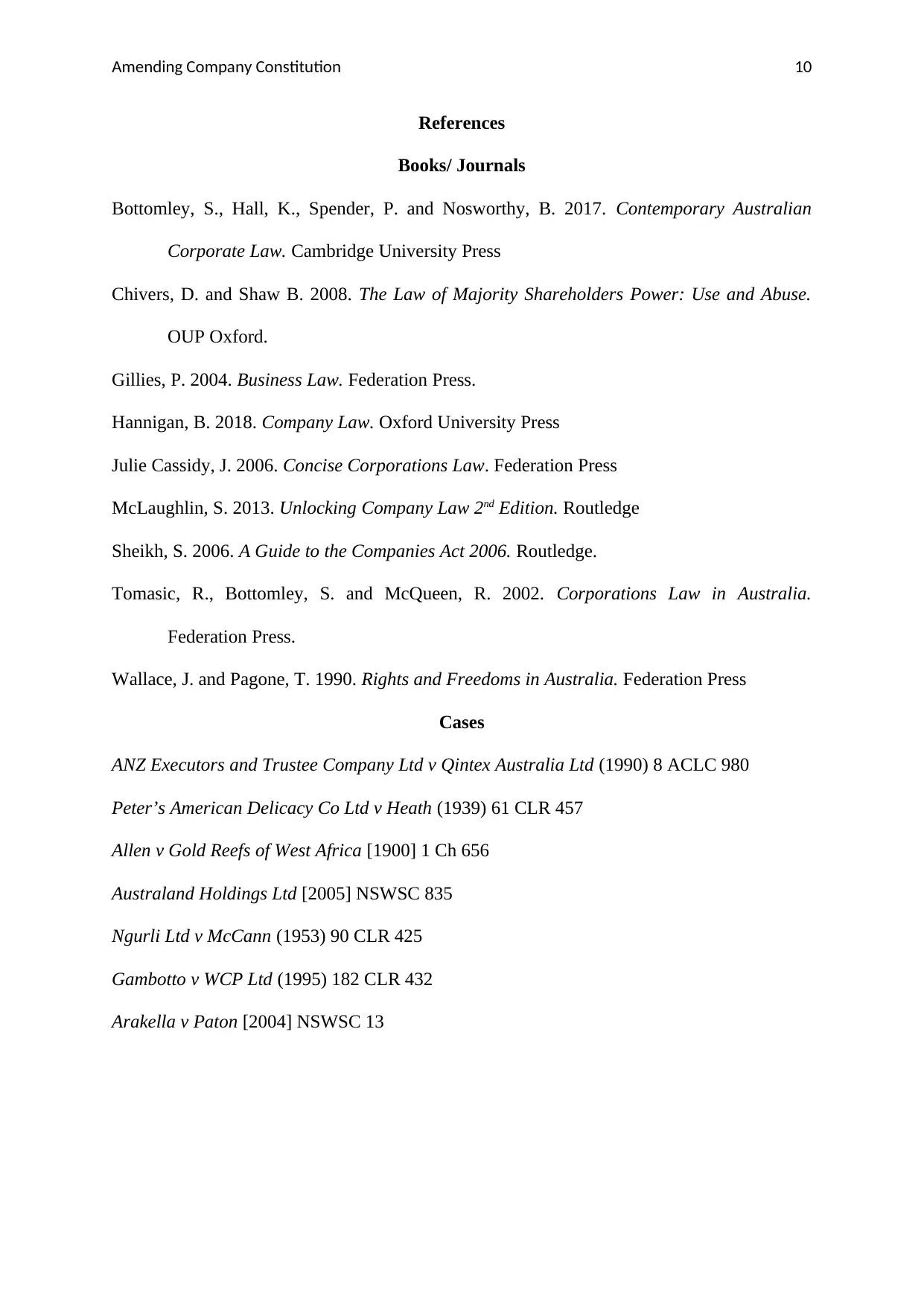
Amending Company Constitution 10
References
Books/ Journals
Bottomley, S., Hall, K., Spender, P. and Nosworthy, B. 2017. Contemporary Australian
Corporate Law. Cambridge University Press
Chivers, D. and Shaw B. 2008. The Law of Majority Shareholders Power: Use and Abuse.
OUP Oxford.
Gillies, P. 2004. Business Law. Federation Press.
Hannigan, B. 2018. Company Law. Oxford University Press
Julie Cassidy, J. 2006. Concise Corporations Law. Federation Press
McLaughlin, S. 2013. Unlocking Company Law 2nd Edition. Routledge
Sheikh, S. 2006. A Guide to the Companies Act 2006. Routledge.
Tomasic, R., Bottomley, S. and McQueen, R. 2002. Corporations Law in Australia.
Federation Press.
Wallace, J. and Pagone, T. 1990. Rights and Freedoms in Australia. Federation Press
Cases
ANZ Executors and Trustee Company Ltd v Qintex Australia Ltd (1990) 8 ACLC 980
Peter’s American Delicacy Co Ltd v Heath (1939) 61 CLR 457
Allen v Gold Reefs of West Africa [1900] 1 Ch 656
Australand Holdings Ltd [2005] NSWSC 835
Ngurli Ltd v McCann (1953) 90 CLR 425
Gambotto v WCP Ltd (1995) 182 CLR 432
Arakella v Paton [2004] NSWSC 13
References
Books/ Journals
Bottomley, S., Hall, K., Spender, P. and Nosworthy, B. 2017. Contemporary Australian
Corporate Law. Cambridge University Press
Chivers, D. and Shaw B. 2008. The Law of Majority Shareholders Power: Use and Abuse.
OUP Oxford.
Gillies, P. 2004. Business Law. Federation Press.
Hannigan, B. 2018. Company Law. Oxford University Press
Julie Cassidy, J. 2006. Concise Corporations Law. Federation Press
McLaughlin, S. 2013. Unlocking Company Law 2nd Edition. Routledge
Sheikh, S. 2006. A Guide to the Companies Act 2006. Routledge.
Tomasic, R., Bottomley, S. and McQueen, R. 2002. Corporations Law in Australia.
Federation Press.
Wallace, J. and Pagone, T. 1990. Rights and Freedoms in Australia. Federation Press
Cases
ANZ Executors and Trustee Company Ltd v Qintex Australia Ltd (1990) 8 ACLC 980
Peter’s American Delicacy Co Ltd v Heath (1939) 61 CLR 457
Allen v Gold Reefs of West Africa [1900] 1 Ch 656
Australand Holdings Ltd [2005] NSWSC 835
Ngurli Ltd v McCann (1953) 90 CLR 425
Gambotto v WCP Ltd (1995) 182 CLR 432
Arakella v Paton [2004] NSWSC 13

1 out of 10


Related Documents


Your All-in-One AI-Powered Toolkit for Academic Success.
+13062052269
info@desklib.com
Available 24*7 on WhatsApp / Email
![[object Object]](/_next/static/media/star-bottom.7253800d.svg)
Unlock your academic potential
Copyright © 2020–2026 A2Z Services. All Rights Reserved. Developed and managed by ZUCOL.