Detailed Report: American Civil Rights Movement and Its Impact

Verified

Added on  2022/08/21

|3
|438
|14
Report
AI Summary
This report delves into the American Civil Rights Movement, examining its origins, key figures, and impact. It explores the movement's goal to end racial segregation and discrimination against African Americans, highlighting the historical context and the struggle for equality. The report discusses the role of key figures such as Martin Luther King Jr., and the significance of the Civil Rights Act of 1964. It also analyzes the social and political changes resulting from the movement, emphasizing the importance of equal rights and the fight against injustice. The report concludes by emphasizing the continued relevance of the movement's principles and the need for ongoing efforts to promote social justice and equality for all. The document also includes the references used in the assignment.
Document Page
Running Head: COMMUNITY MOBILIZATION
AMERICAN CIVIL RIGHTS MOVEMENT
Name of the Student
Name of the University
Author’s Note
tabler-icon-diamond-filled.svg

Paraphrase This Document

Need a fresh take? Get an instant paraphrase of this document with our AI Paraphraser
Document Page
1COMMUNITY MOBILIZATION
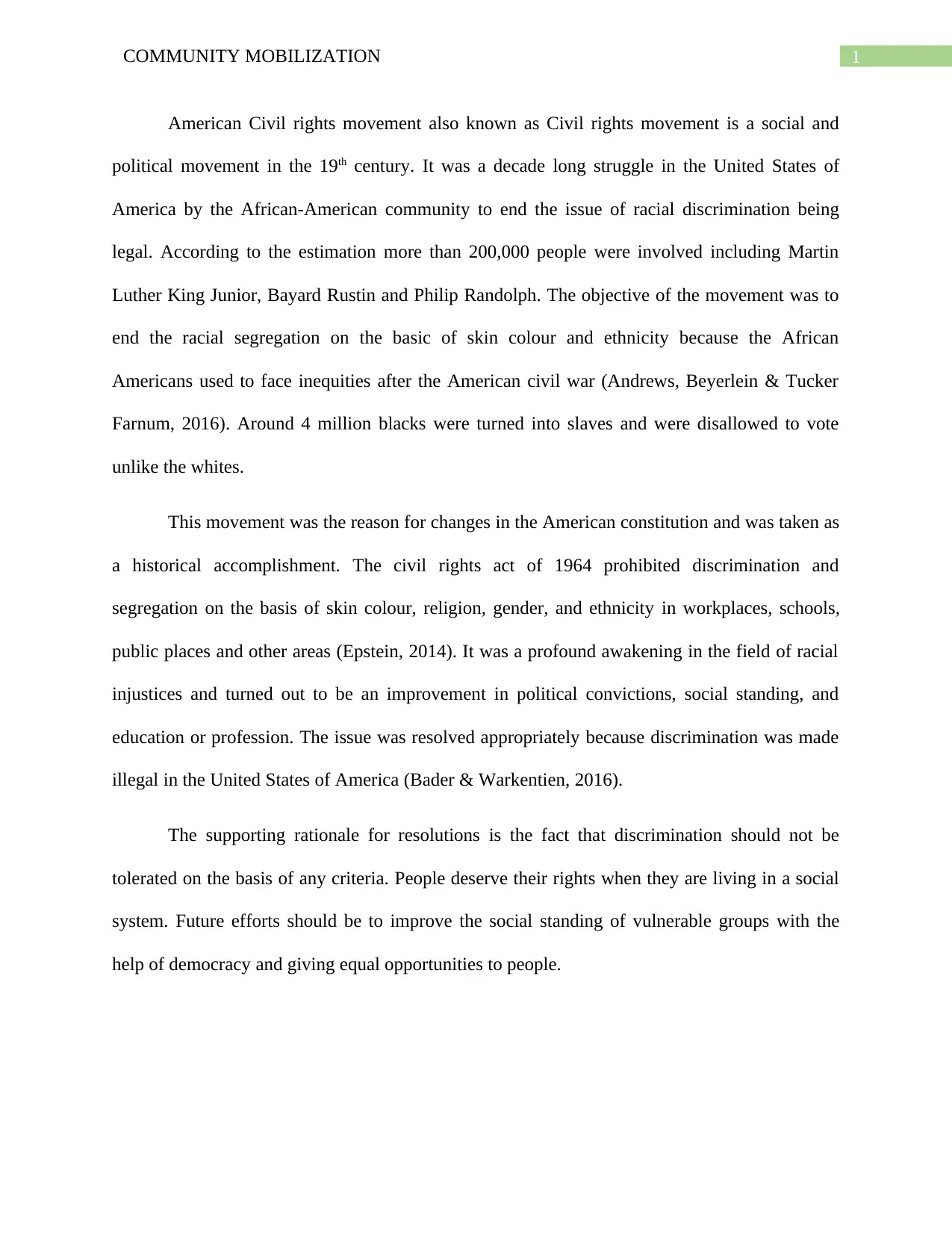
American Civil rights movement also known as Civil rights movement is a social and
political movement in the 19th century. It was a decade long struggle in the United States of
America by the African-American community to end the issue of racial discrimination being
legal. According to the estimation more than 200,000 people were involved including Martin
Luther King Junior, Bayard Rustin and Philip Randolph. The objective of the movement was to
end the racial segregation on the basic of skin colour and ethnicity because the African
Americans used to face inequities after the American civil war (Andrews, Beyerlein & Tucker
Farnum, 2016). Around 4 million blacks were turned into slaves and were disallowed to vote
unlike the whites.
This movement was the reason for changes in the American constitution and was taken as
a historical accomplishment. The civil rights act of 1964 prohibited discrimination and
segregation on the basis of skin colour, religion, gender, and ethnicity in workplaces, schools,
public places and other areas (Epstein, 2014). It was a profound awakening in the field of racial
injustices and turned out to be an improvement in political convictions, social standing, and
education or profession. The issue was resolved appropriately because discrimination was made
illegal in the United States of America (Bader & Warkentien, 2016).
The supporting rationale for resolutions is the fact that discrimination should not be
tolerated on the basis of any criteria. People deserve their rights when they are living in a social
system. Future efforts should be to improve the social standing of vulnerable groups with the
help of democracy and giving equal opportunities to people.
Document Page
2COMMUNITY MOBILIZATION
References
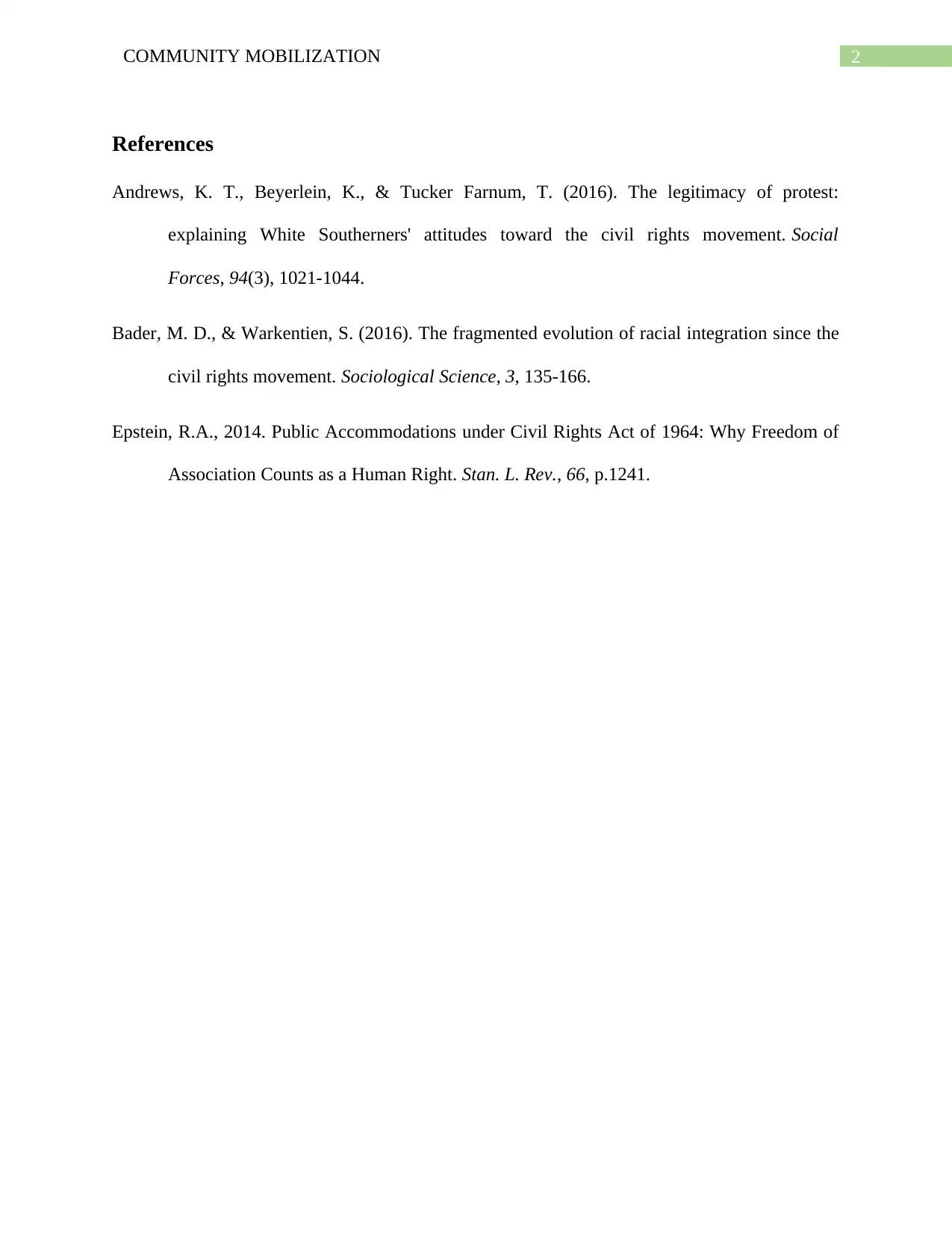
Andrews, K. T., Beyerlein, K., & Tucker Farnum, T. (2016). The legitimacy of protest:
explaining White Southerners' attitudes toward the civil rights movement. Social
Forces, 94(3), 1021-1044.
Bader, M. D., & Warkentien, S. (2016). The fragmented evolution of racial integration since the
civil rights movement. Sociological Science, 3, 135-166.
Epstein, R.A., 2014. Public Accommodations under Civil Rights Act of 1964: Why Freedom of
Association Counts as a Human Right. Stan. L. Rev., 66, p.1241.
chevron_up_icon
1 out of 3
circle_padding
hide_on_mobile
zoom_out_icon
[object Object]