Value Proposition Analysis: American Express Credit Card and Visa
VerifiedAdded on 2021/06/17
|19
|3888
|181
Report
AI Summary
This report delves into the value proposition of American Express credit cards, examining their core features and benefits. It begins by exploring the customer perceived value of the Amex card, referencing the Woodruff Customer Value Hierarchy and the Holbrook Consumer Value model to understand how Amex can satisfy customer needs and provide value. The report then compares and contrasts American Express with Visa, highlighting key differences in their business models, market share, and offerings to cardholders and merchants. Furthermore, it outlines two distinct value propositions within the credit card sector: one for cardholders, emphasizing safety, rewards, and convenience, and another for merchants, focusing on increased sales, improved cash flow, and ease of transactions. The analysis aims to provide insights into how American Express can leverage these value propositions to maintain a competitive edge and enhance customer satisfaction in the financial services market.

Value Proposition to Customer

Paraphrase This Document
Need a fresh take? Get an instant paraphrase of this document with our AI Paraphraser
VALUE PROPOSITION 1
Contents
First Part:...............................................................................................................................................2
American Express Card:....................................................................................................................2
Customer perceived value of credit card............................................................................................2
Woodruff Customer Value Hierarchy................................................................................................3
Holbrook Consumer value model......................................................................................................4
Second Part............................................................................................................................................6
Compare and contrast between American Express and VISA...........................................................6
Two Value Propositions of Credit Card Sector..................................................................................8
Third Part.............................................................................................................................................10
Existing value proposition...............................................................................................................10
New Value Proposition:...................................................................................................................12
Value Criteria:.................................................................................................................................13
Implementation of New Proposition................................................................................................13
References...........................................................................................................................................16
Contents
First Part:...............................................................................................................................................2
American Express Card:....................................................................................................................2
Customer perceived value of credit card............................................................................................2
Woodruff Customer Value Hierarchy................................................................................................3
Holbrook Consumer value model......................................................................................................4
Second Part............................................................................................................................................6
Compare and contrast between American Express and VISA...........................................................6
Two Value Propositions of Credit Card Sector..................................................................................8
Third Part.............................................................................................................................................10
Existing value proposition...............................................................................................................10
New Value Proposition:...................................................................................................................12
Value Criteria:.................................................................................................................................13
Implementation of New Proposition................................................................................................13
References...........................................................................................................................................16
VALUE PROPOSITION 2
First Part:
American Express Card:
The American Express is a US based Multinational Company which deals in financial
services. It was founded by Dow Jones in 1850. The main products company are charge card,
traveler’s cheque and credit card. American Express is best known for its credit card.
American Express card is also known as Amex card. The American Express deals in an
electronic payment card which is issued and processed by American Express. Cards are
available for individual, corporate consumers and small businesses in the US and all around
the world (American Express, 2018)
Customer perceived value of credit card
In 2016, out of total dollar volume of credit cards transactions, the transaction of American
Express Credit card was 22.9%. In December 2017 Company had 112.8 million card users
which include 50 million card users in US, each card consist average yearly spending of
$18,519 (American Express, 2018)
First Part:
American Express Card:
The American Express is a US based Multinational Company which deals in financial
services. It was founded by Dow Jones in 1850. The main products company are charge card,
traveler’s cheque and credit card. American Express is best known for its credit card.
American Express card is also known as Amex card. The American Express deals in an
electronic payment card which is issued and processed by American Express. Cards are
available for individual, corporate consumers and small businesses in the US and all around
the world (American Express, 2018)
Customer perceived value of credit card
In 2016, out of total dollar volume of credit cards transactions, the transaction of American
Express Credit card was 22.9%. In December 2017 Company had 112.8 million card users
which include 50 million card users in US, each card consist average yearly spending of
$18,519 (American Express, 2018)
⊘ This is a preview!⊘
Do you want full access?
Subscribe today to unlock all pages.

Trusted by 1+ million students worldwide
VALUE PROPOSITION 3
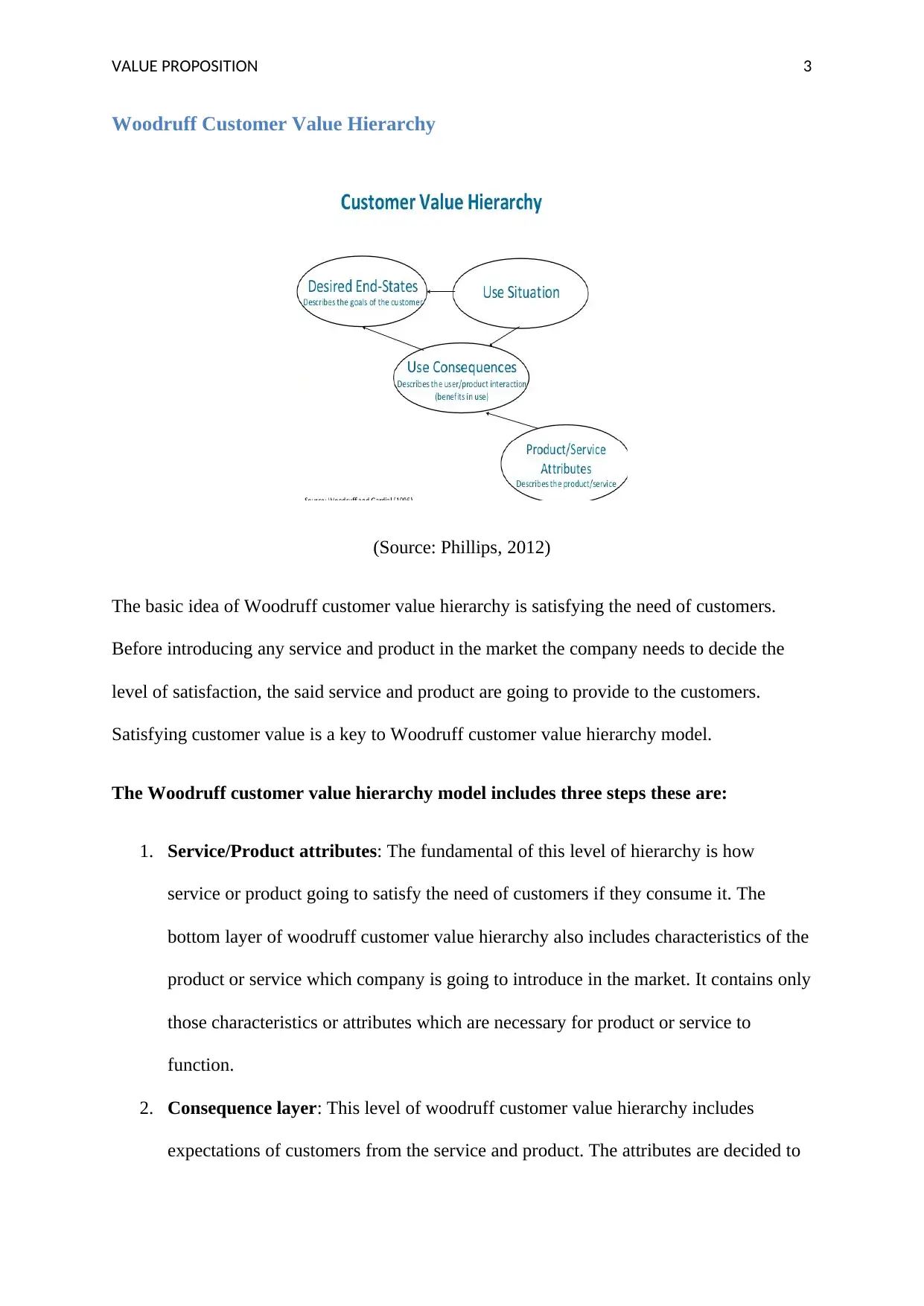
Woodruff Customer Value Hierarchy
(Source: Phillips, 2012)
The basic idea of Woodruff customer value hierarchy is satisfying the need of customers.
Before introducing any service and product in the market the company needs to decide the
level of satisfaction, the said service and product are going to provide to the customers.
Satisfying customer value is a key to Woodruff customer value hierarchy model.
The Woodruff customer value hierarchy model includes three steps these are:
1. Service/Product attributes: The fundamental of this level of hierarchy is how
service or product going to satisfy the need of customers if they consume it. The
bottom layer of woodruff customer value hierarchy also includes characteristics of the
product or service which company is going to introduce in the market. It contains only
those characteristics or attributes which are necessary for product or service to
function.
2. Consequence layer: This level of woodruff customer value hierarchy includes
expectations of customers from the service and product. The attributes are decided to
Woodruff Customer Value Hierarchy
(Source: Phillips, 2012)
The basic idea of Woodruff customer value hierarchy is satisfying the need of customers.
Before introducing any service and product in the market the company needs to decide the
level of satisfaction, the said service and product are going to provide to the customers.
Satisfying customer value is a key to Woodruff customer value hierarchy model.
The Woodruff customer value hierarchy model includes three steps these are:
1. Service/Product attributes: The fundamental of this level of hierarchy is how
service or product going to satisfy the need of customers if they consume it. The
bottom layer of woodruff customer value hierarchy also includes characteristics of the
product or service which company is going to introduce in the market. It contains only
those characteristics or attributes which are necessary for product or service to
function.
2. Consequence layer: This level of woodruff customer value hierarchy includes
expectations of customers from the service and product. The attributes are decided to
Paraphrase This Document
Need a fresh take? Get an instant paraphrase of this document with our AI Paraphraser
VALUE PROPOSITION 4
satisfy the needs of customers. So when buyers buy the product they normally assume
that the service or product may contain those attributes which they are expecting.
3. End state: This stage includes additional features, attributes, benefits those are related
to service and product which provide a competitive advantage to the company. In
other words, we can say that it includes those additional attributes which customers
not expect from the service and product. But if they come to know about those
additional attributes they will surely buy the service and product (Yajing, 2014).
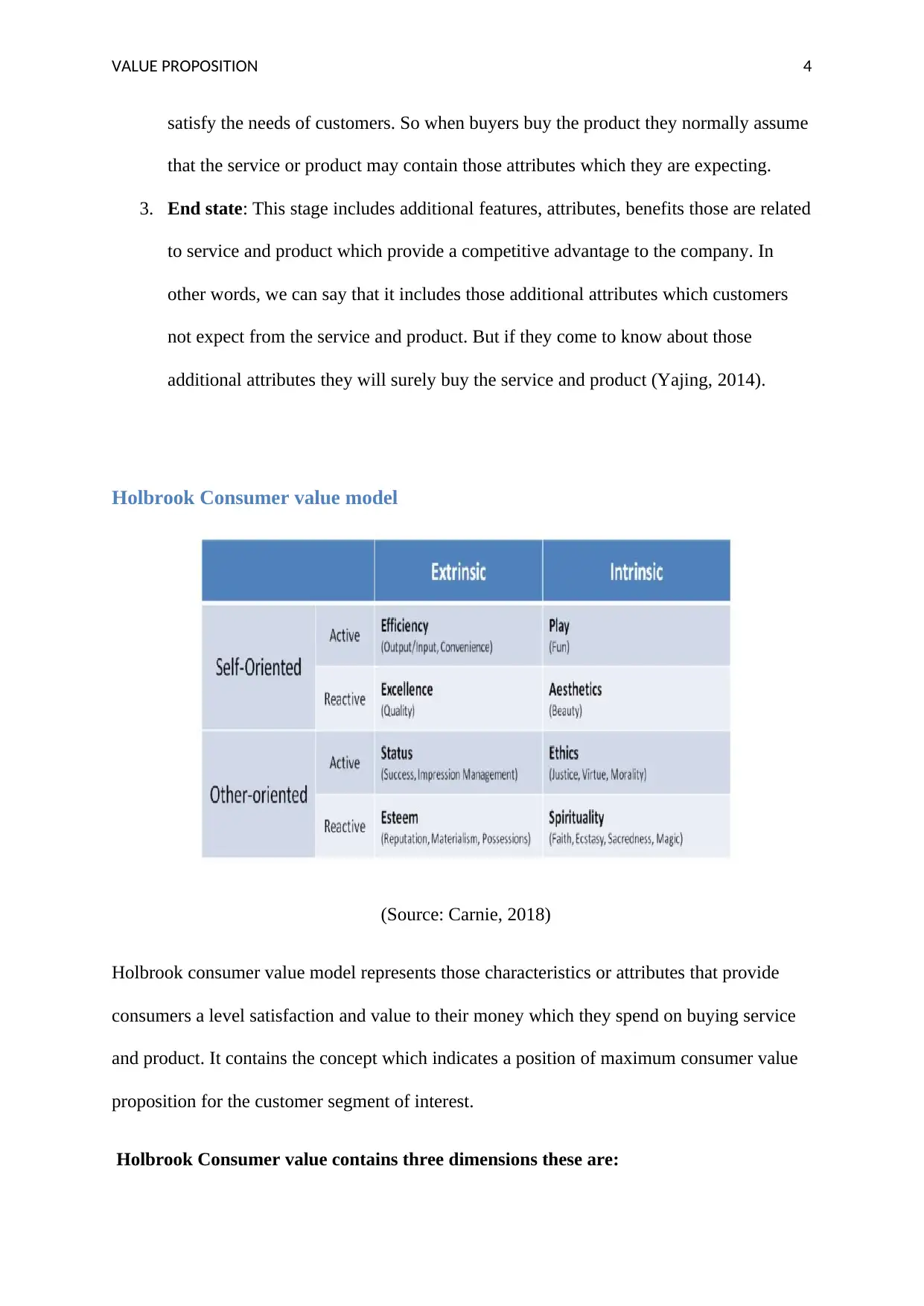
Holbrook Consumer value model
(Source: Carnie, 2018)
Holbrook consumer value model represents those characteristics or attributes that provide
consumers a level satisfaction and value to their money which they spend on buying service
and product. It contains the concept which indicates a position of maximum consumer value
proposition for the customer segment of interest.
Holbrook Consumer value contains three dimensions these are:
satisfy the needs of customers. So when buyers buy the product they normally assume
that the service or product may contain those attributes which they are expecting.
3. End state: This stage includes additional features, attributes, benefits those are related
to service and product which provide a competitive advantage to the company. In
other words, we can say that it includes those additional attributes which customers
not expect from the service and product. But if they come to know about those
additional attributes they will surely buy the service and product (Yajing, 2014).
Holbrook Consumer value model
(Source: Carnie, 2018)
Holbrook consumer value model represents those characteristics or attributes that provide
consumers a level satisfaction and value to their money which they spend on buying service
and product. It contains the concept which indicates a position of maximum consumer value
proposition for the customer segment of interest.
Holbrook Consumer value contains three dimensions these are:
VALUE PROPOSITION 5
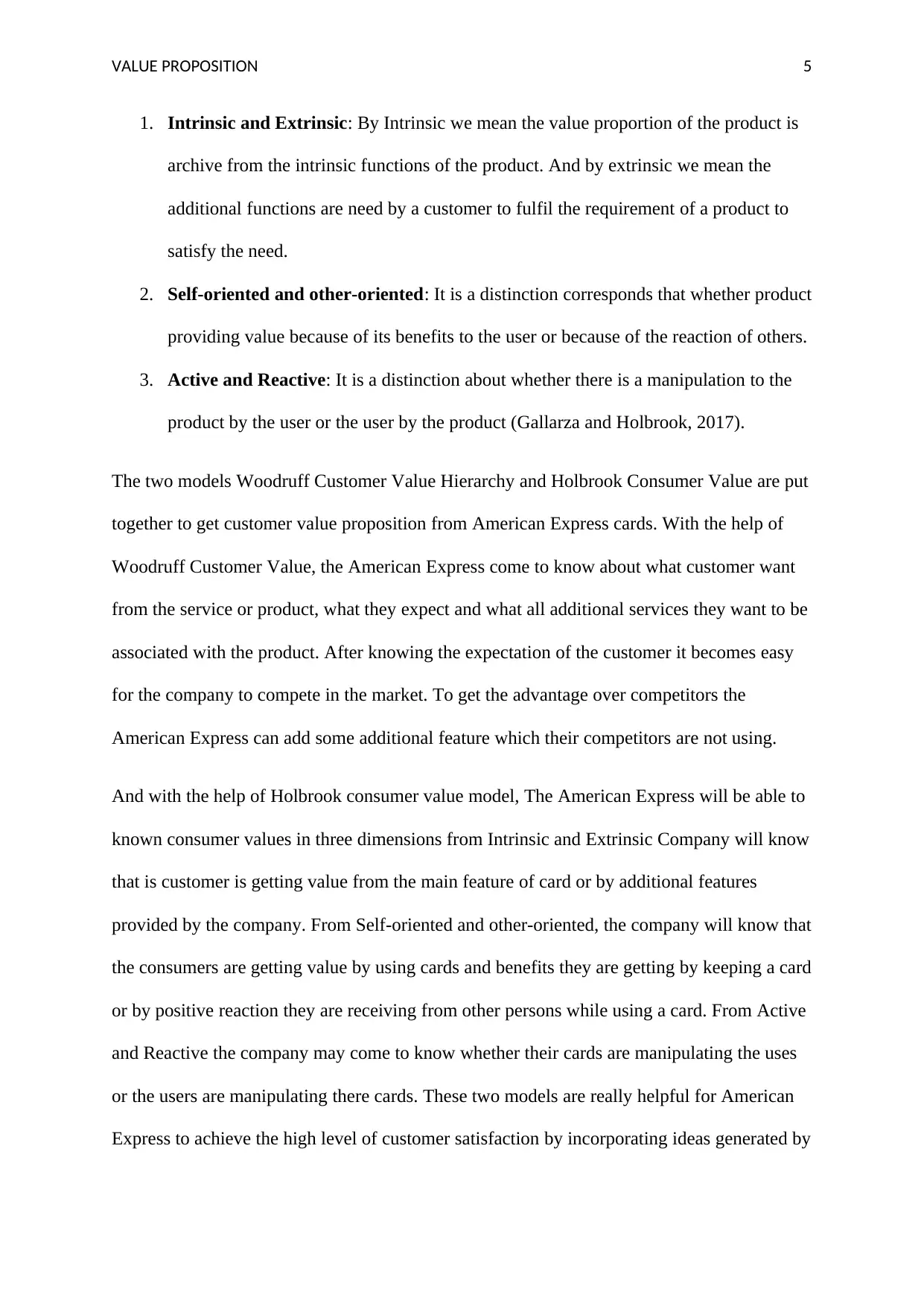
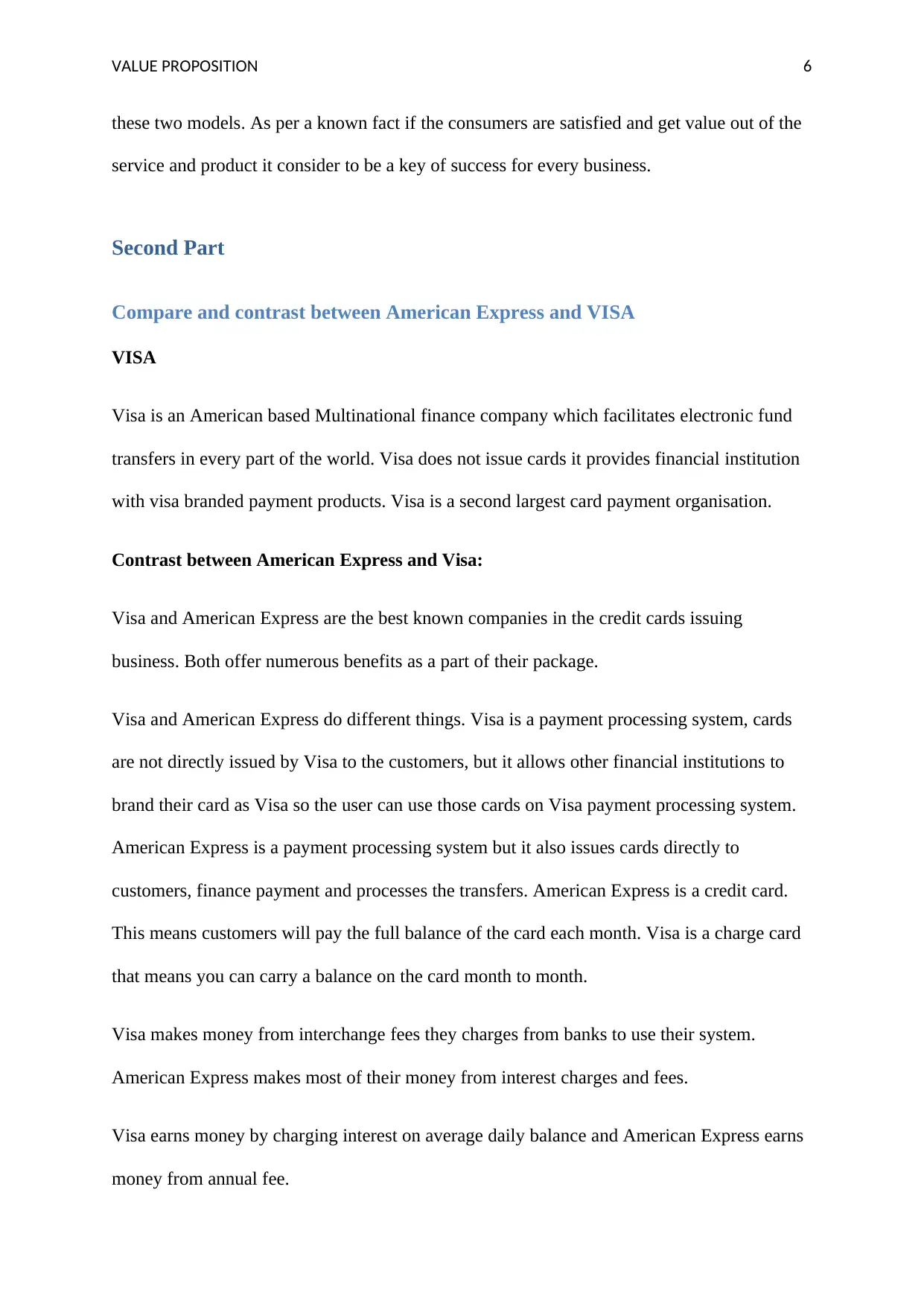
1. Intrinsic and Extrinsic: By Intrinsic we mean the value proportion of the product is
archive from the intrinsic functions of the product. And by extrinsic we mean the
additional functions are need by a customer to fulfil the requirement of a product to
satisfy the need.
2. Self-oriented and other-oriented: It is a distinction corresponds that whether product
providing value because of its benefits to the user or because of the reaction of others.
3. Active and Reactive: It is a distinction about whether there is a manipulation to the
product by the user or the user by the product (Gallarza and Holbrook, 2017).
The two models Woodruff Customer Value Hierarchy and Holbrook Consumer Value are put
together to get customer value proposition from American Express cards. With the help of
Woodruff Customer Value, the American Express come to know about what customer want
from the service or product, what they expect and what all additional services they want to be
associated with the product. After knowing the expectation of the customer it becomes easy
for the company to compete in the market. To get the advantage over competitors the
American Express can add some additional feature which their competitors are not using.
And with the help of Holbrook consumer value model, The American Express will be able to
known consumer values in three dimensions from Intrinsic and Extrinsic Company will know
that is customer is getting value from the main feature of card or by additional features
provided by the company. From Self-oriented and other-oriented, the company will know that
the consumers are getting value by using cards and benefits they are getting by keeping a card
or by positive reaction they are receiving from other persons while using a card. From Active
and Reactive the company may come to know whether their cards are manipulating the uses
or the users are manipulating there cards. These two models are really helpful for American
Express to achieve the high level of customer satisfaction by incorporating ideas generated by
1. Intrinsic and Extrinsic: By Intrinsic we mean the value proportion of the product is
archive from the intrinsic functions of the product. And by extrinsic we mean the
additional functions are need by a customer to fulfil the requirement of a product to
satisfy the need.
2. Self-oriented and other-oriented: It is a distinction corresponds that whether product
providing value because of its benefits to the user or because of the reaction of others.
3. Active and Reactive: It is a distinction about whether there is a manipulation to the
product by the user or the user by the product (Gallarza and Holbrook, 2017).
The two models Woodruff Customer Value Hierarchy and Holbrook Consumer Value are put
together to get customer value proposition from American Express cards. With the help of
Woodruff Customer Value, the American Express come to know about what customer want
from the service or product, what they expect and what all additional services they want to be
associated with the product. After knowing the expectation of the customer it becomes easy
for the company to compete in the market. To get the advantage over competitors the
American Express can add some additional feature which their competitors are not using.
And with the help of Holbrook consumer value model, The American Express will be able to
known consumer values in three dimensions from Intrinsic and Extrinsic Company will know
that is customer is getting value from the main feature of card or by additional features
provided by the company. From Self-oriented and other-oriented, the company will know that
the consumers are getting value by using cards and benefits they are getting by keeping a card
or by positive reaction they are receiving from other persons while using a card. From Active
and Reactive the company may come to know whether their cards are manipulating the uses
or the users are manipulating there cards. These two models are really helpful for American
Express to achieve the high level of customer satisfaction by incorporating ideas generated by
⊘ This is a preview!⊘
Do you want full access?
Subscribe today to unlock all pages.
Trusted by 1+ million students worldwide
VALUE PROPOSITION 6
these two models. As per a known fact if the consumers are satisfied and get value out of the
service and product it consider to be a key of success for every business.
Second Part
Compare and contrast between American Express and VISA
VISA
Visa is an American based Multinational finance company which facilitates electronic fund
transfers in every part of the world. Visa does not issue cards it provides financial institution
with visa branded payment products. Visa is a second largest card payment organisation.
Contrast between American Express and Visa:
Visa and American Express are the best known companies in the credit cards issuing
business. Both offer numerous benefits as a part of their package.
Visa and American Express do different things. Visa is a payment processing system, cards
are not directly issued by Visa to the customers, but it allows other financial institutions to
brand their card as Visa so the user can use those cards on Visa payment processing system.
American Express is a payment processing system but it also issues cards directly to
customers, finance payment and processes the transfers. American Express is a credit card.
This means customers will pay the full balance of the card each month. Visa is a charge card
that means you can carry a balance on the card month to month.
Visa makes money from interchange fees they charges from banks to use their system.
American Express makes most of their money from interest charges and fees.
Visa earns money by charging interest on average daily balance and American Express earns
money from annual fee.
these two models. As per a known fact if the consumers are satisfied and get value out of the
service and product it consider to be a key of success for every business.
Second Part
Compare and contrast between American Express and VISA
VISA
Visa is an American based Multinational finance company which facilitates electronic fund
transfers in every part of the world. Visa does not issue cards it provides financial institution
with visa branded payment products. Visa is a second largest card payment organisation.
Contrast between American Express and Visa:
Visa and American Express are the best known companies in the credit cards issuing
business. Both offer numerous benefits as a part of their package.
Visa and American Express do different things. Visa is a payment processing system, cards
are not directly issued by Visa to the customers, but it allows other financial institutions to
brand their card as Visa so the user can use those cards on Visa payment processing system.
American Express is a payment processing system but it also issues cards directly to
customers, finance payment and processes the transfers. American Express is a credit card.
This means customers will pay the full balance of the card each month. Visa is a charge card
that means you can carry a balance on the card month to month.
Visa makes money from interchange fees they charges from banks to use their system.
American Express makes most of their money from interest charges and fees.
Visa earns money by charging interest on average daily balance and American Express earns
money from annual fee.
Paraphrase This Document
Need a fresh take? Get an instant paraphrase of this document with our AI Paraphraser
VALUE PROPOSITION 7
American Express has no pre-set spending limit. Visa has a hard limit and it charge fees for
exceeding the limit (Ryan, 2016).
Visa is a huge company, it has 16% market share worldwide and there are 2.5 billion Visa
cards are floating in more than 200 countries. In contrast American Express has much smaller
market share worldwide, they have 117 million cards active in total.
Visa and American express both charge interchange fees from the banks that use their
payment system, so surcharge for both of these cards still exist. Card issued by American
Express has not reduced their surcharge because it is a closed system that the RBA does not
regulate.
To platinum cardholder, Visa offers like emergency assistance services, discounts on dining,
tickets of major concerts and sports events. For visa cardholder travelling overseas, it provide
various facilities like a discount on airfares and tour packages, offers good exchange rates,
direct conversion in local currencies. American Cardholders also receive offers like fine
dining deals and concerts and sports event tickets.
American Express card has cash back offers on a purchase that may be up to 3% while Visa
rarely offers cash back. Visa card offers generally come with no annual fees.
American Express is not as widely accepted as Visa. This makes it customer to have Visa
card on international travels (Rubin, 2018)
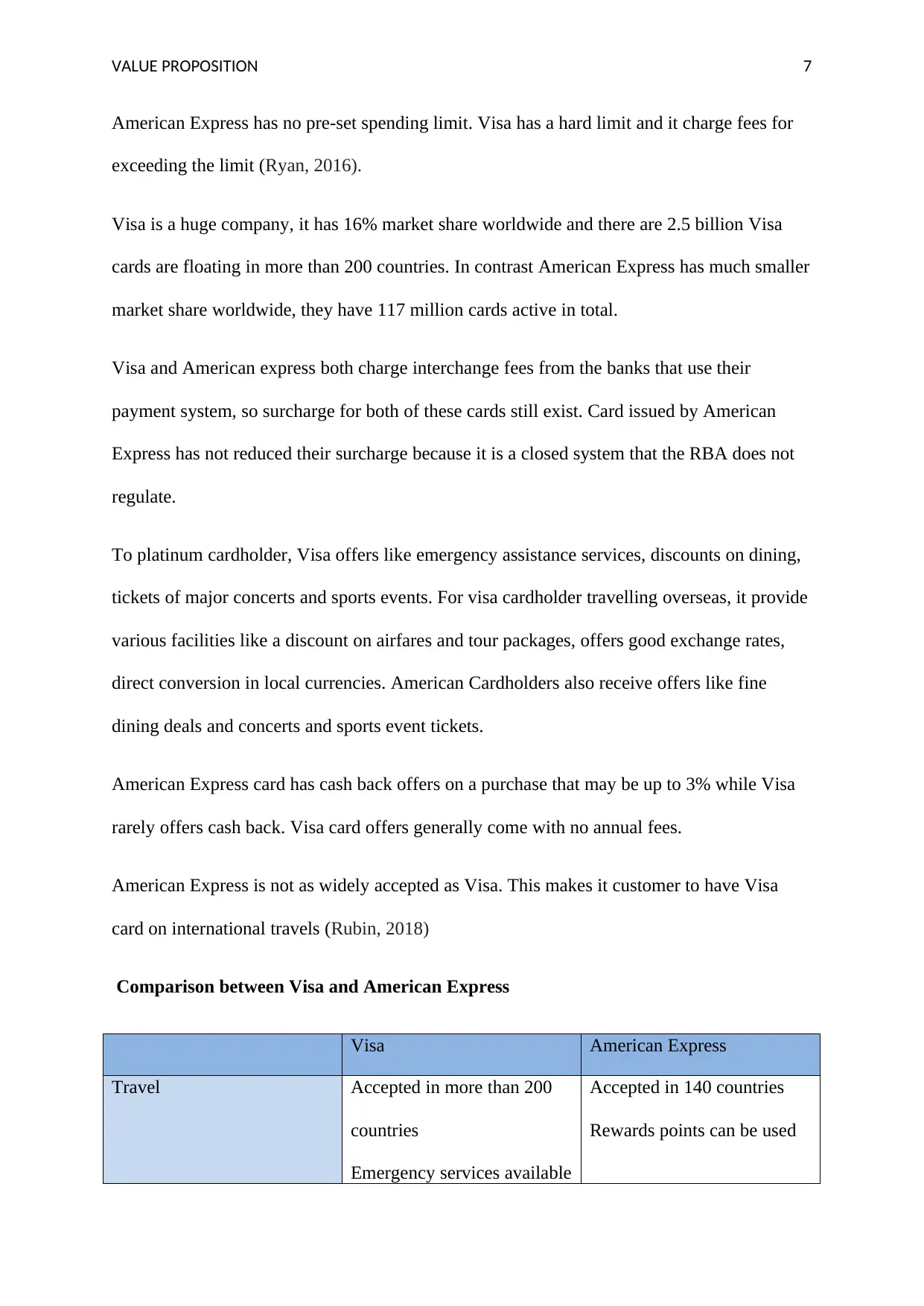
Comparison between Visa and American Express
Visa American Express
Travel Accepted in more than 200
countries
Emergency services available
Accepted in 140 countries
Rewards points can be used
American Express has no pre-set spending limit. Visa has a hard limit and it charge fees for
exceeding the limit (Ryan, 2016).
Visa is a huge company, it has 16% market share worldwide and there are 2.5 billion Visa
cards are floating in more than 200 countries. In contrast American Express has much smaller
market share worldwide, they have 117 million cards active in total.
Visa and American express both charge interchange fees from the banks that use their
payment system, so surcharge for both of these cards still exist. Card issued by American
Express has not reduced their surcharge because it is a closed system that the RBA does not
regulate.
To platinum cardholder, Visa offers like emergency assistance services, discounts on dining,
tickets of major concerts and sports events. For visa cardholder travelling overseas, it provide
various facilities like a discount on airfares and tour packages, offers good exchange rates,
direct conversion in local currencies. American Cardholders also receive offers like fine
dining deals and concerts and sports event tickets.
American Express card has cash back offers on a purchase that may be up to 3% while Visa
rarely offers cash back. Visa card offers generally come with no annual fees.
American Express is not as widely accepted as Visa. This makes it customer to have Visa
card on international travels (Rubin, 2018)
Comparison between Visa and American Express
Visa American Express
Travel Accepted in more than 200
countries
Emergency services available
Accepted in 140 countries
Rewards points can be used
VALUE PROPOSITION 8
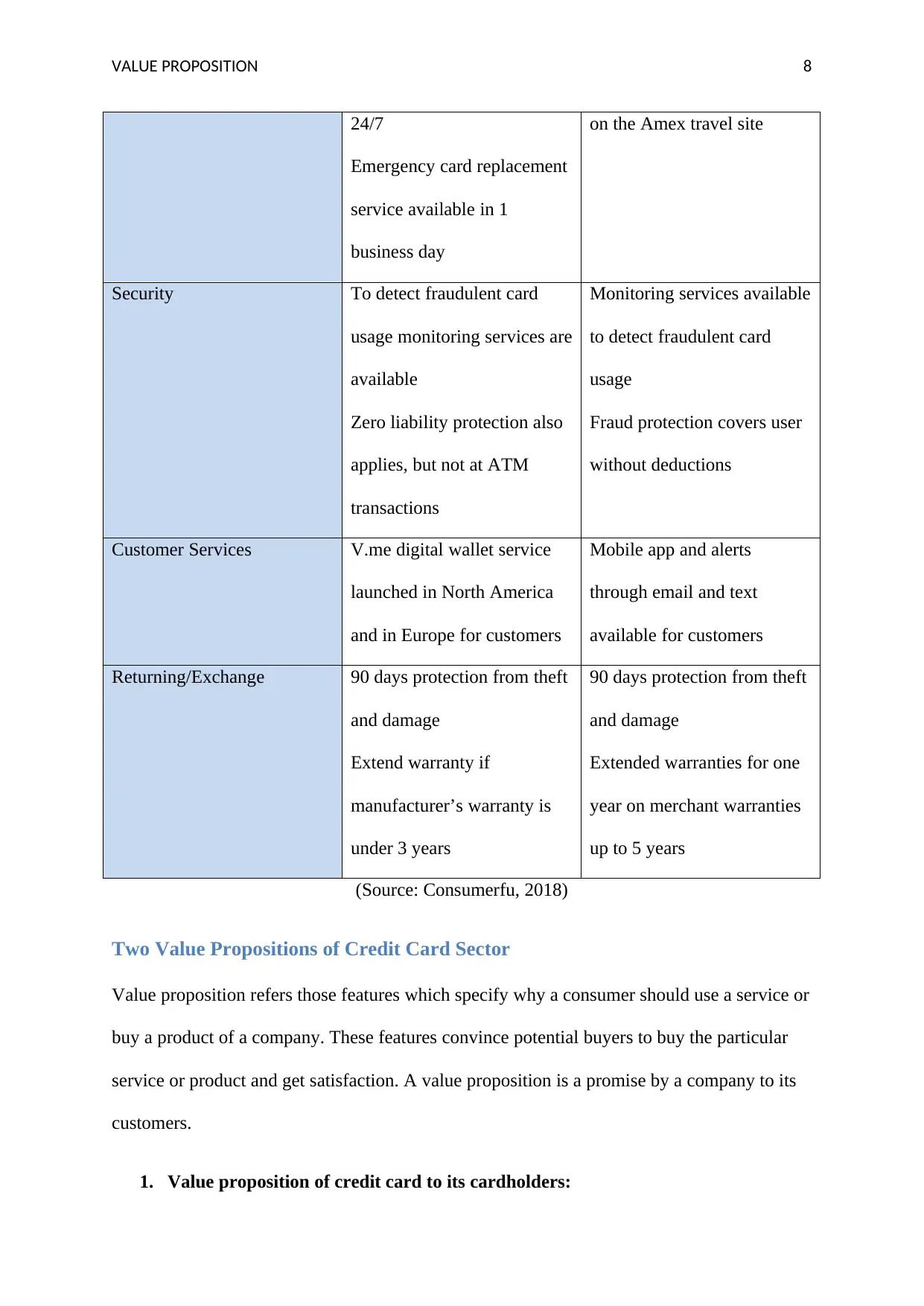
24/7
Emergency card replacement
service available in 1
business day
on the Amex travel site
Security To detect fraudulent card
usage monitoring services are
available
Zero liability protection also
applies, but not at ATM
transactions
Monitoring services available
to detect fraudulent card
usage
Fraud protection covers user
without deductions
Customer Services V.me digital wallet service
launched in North America
and in Europe for customers
Mobile app and alerts
through email and text
available for customers
Returning/Exchange 90 days protection from theft
and damage
Extend warranty if
manufacturer’s warranty is
under 3 years
90 days protection from theft
and damage
Extended warranties for one
year on merchant warranties
up to 5 years
(Source: Consumerfu, 2018)
Two Value Propositions of Credit Card Sector
Value proposition refers those features which specify why a consumer should use a service or
buy a product of a company. These features convince potential buyers to buy the particular
service or product and get satisfaction. A value proposition is a promise by a company to its
customers.
1. Value proposition of credit card to its cardholders:
24/7
Emergency card replacement
service available in 1
business day
on the Amex travel site
Security To detect fraudulent card
usage monitoring services are
available
Zero liability protection also
applies, but not at ATM
transactions
Monitoring services available
to detect fraudulent card
usage
Fraud protection covers user
without deductions
Customer Services V.me digital wallet service
launched in North America
and in Europe for customers
Mobile app and alerts
through email and text
available for customers
Returning/Exchange 90 days protection from theft
and damage
Extend warranty if
manufacturer’s warranty is
under 3 years
90 days protection from theft
and damage
Extended warranties for one
year on merchant warranties
up to 5 years
(Source: Consumerfu, 2018)
Two Value Propositions of Credit Card Sector
Value proposition refers those features which specify why a consumer should use a service or
buy a product of a company. These features convince potential buyers to buy the particular
service or product and get satisfaction. A value proposition is a promise by a company to its
customers.
1. Value proposition of credit card to its cardholders:
⊘ This is a preview!⊘
Do you want full access?
Subscribe today to unlock all pages.
Trusted by 1+ million students worldwide
VALUE PROPOSITION 9
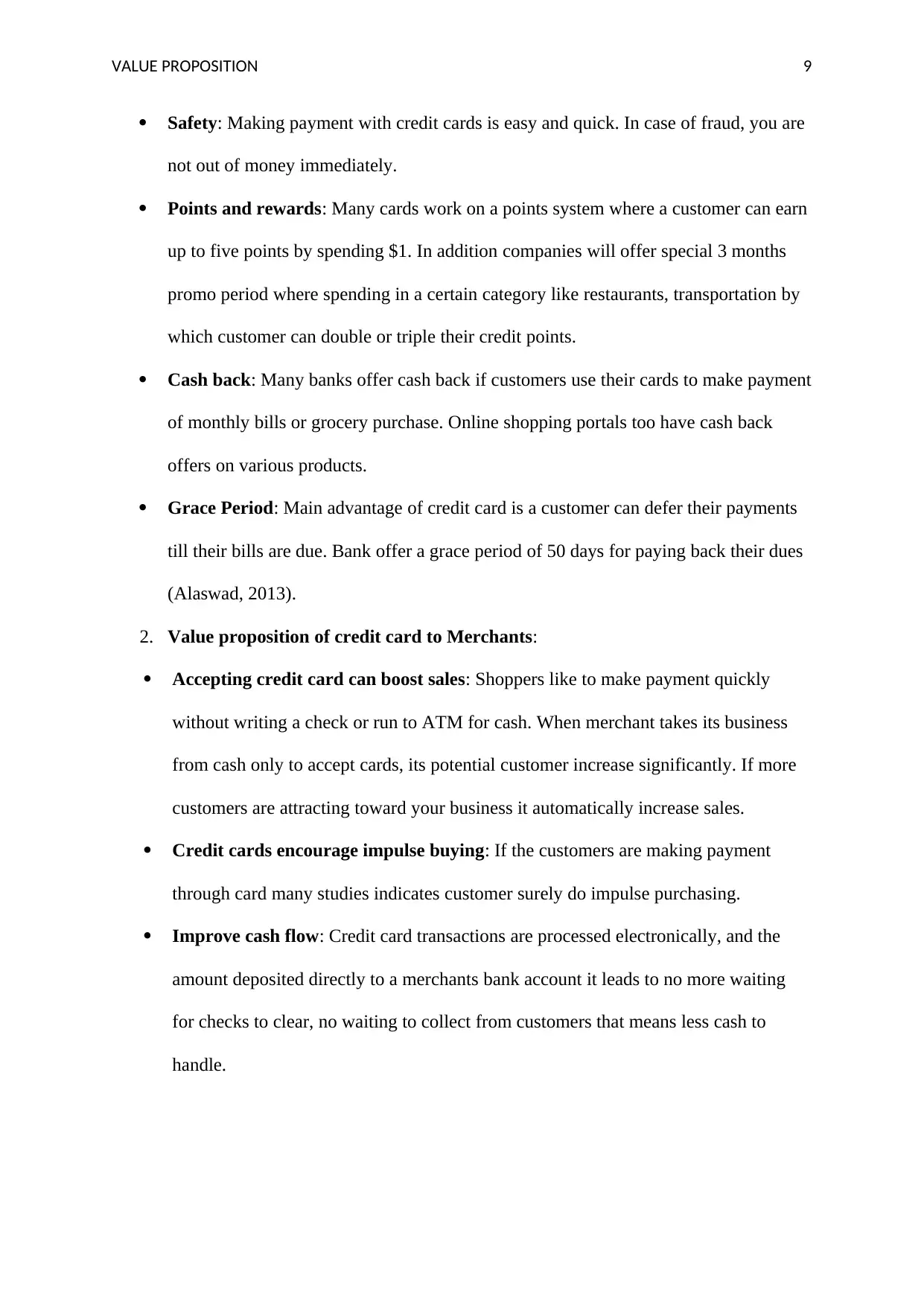
Safety: Making payment with credit cards is easy and quick. In case of fraud, you are
not out of money immediately.
Points and rewards: Many cards work on a points system where a customer can earn
up to five points by spending $1. In addition companies will offer special 3 months
promo period where spending in a certain category like restaurants, transportation by
which customer can double or triple their credit points.
Cash back: Many banks offer cash back if customers use their cards to make payment
of monthly bills or grocery purchase. Online shopping portals too have cash back
offers on various products.
Grace Period: Main advantage of credit card is a customer can defer their payments
till their bills are due. Bank offer a grace period of 50 days for paying back their dues
(Alaswad, 2013).
2. Value proposition of credit card to Merchants:
Accepting credit card can boost sales: Shoppers like to make payment quickly
without writing a check or run to ATM for cash. When merchant takes its business
from cash only to accept cards, its potential customer increase significantly. If more
customers are attracting toward your business it automatically increase sales.
Credit cards encourage impulse buying: If the customers are making payment
through card many studies indicates customer surely do impulse purchasing.
Improve cash flow: Credit card transactions are processed electronically, and the
amount deposited directly to a merchants bank account it leads to no more waiting
for checks to clear, no waiting to collect from customers that means less cash to
handle.
Safety: Making payment with credit cards is easy and quick. In case of fraud, you are
not out of money immediately.
Points and rewards: Many cards work on a points system where a customer can earn
up to five points by spending $1. In addition companies will offer special 3 months
promo period where spending in a certain category like restaurants, transportation by
which customer can double or triple their credit points.
Cash back: Many banks offer cash back if customers use their cards to make payment
of monthly bills or grocery purchase. Online shopping portals too have cash back
offers on various products.
Grace Period: Main advantage of credit card is a customer can defer their payments
till their bills are due. Bank offer a grace period of 50 days for paying back their dues
(Alaswad, 2013).
2. Value proposition of credit card to Merchants:
Accepting credit card can boost sales: Shoppers like to make payment quickly
without writing a check or run to ATM for cash. When merchant takes its business
from cash only to accept cards, its potential customer increase significantly. If more
customers are attracting toward your business it automatically increase sales.
Credit cards encourage impulse buying: If the customers are making payment
through card many studies indicates customer surely do impulse purchasing.
Improve cash flow: Credit card transactions are processed electronically, and the
amount deposited directly to a merchants bank account it leads to no more waiting
for checks to clear, no waiting to collect from customers that means less cash to
handle.
Paraphrase This Document
Need a fresh take? Get an instant paraphrase of this document with our AI Paraphraser
VALUE PROPOSITION 10
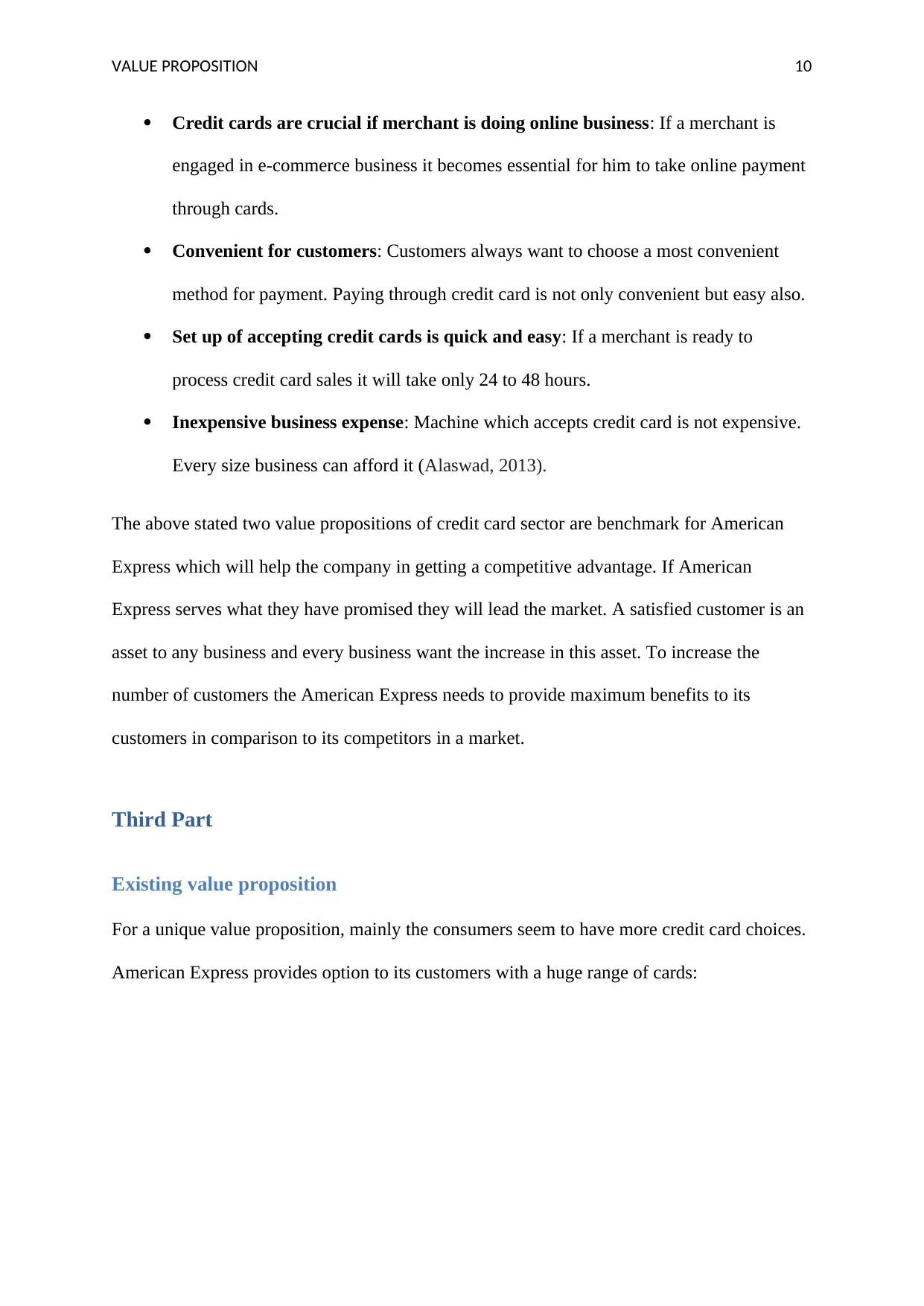
Credit cards are crucial if merchant is doing online business: If a merchant is
engaged in e-commerce business it becomes essential for him to take online payment
through cards.
Convenient for customers: Customers always want to choose a most convenient
method for payment. Paying through credit card is not only convenient but easy also.
Set up of accepting credit cards is quick and easy: If a merchant is ready to
process credit card sales it will take only 24 to 48 hours.
Inexpensive business expense: Machine which accepts credit card is not expensive.
Every size business can afford it (Alaswad, 2013).
The above stated two value propositions of credit card sector are benchmark for American
Express which will help the company in getting a competitive advantage. If American
Express serves what they have promised they will lead the market. A satisfied customer is an
asset to any business and every business want the increase in this asset. To increase the
number of customers the American Express needs to provide maximum benefits to its
customers in comparison to its competitors in a market.
Third Part
Existing value proposition
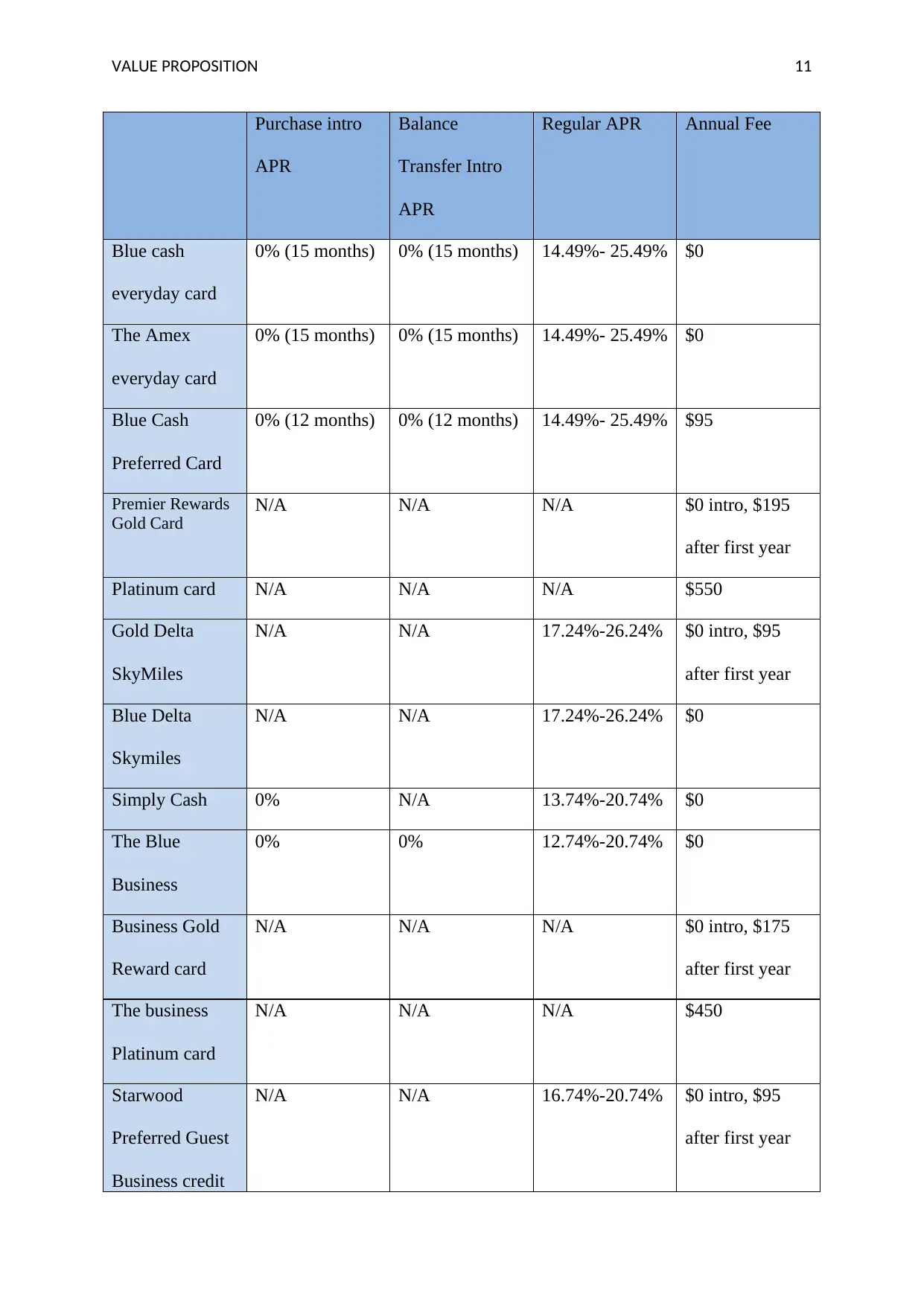
For a unique value proposition, mainly the consumers seem to have more credit card choices.
American Express provides option to its customers with a huge range of cards:
Credit cards are crucial if merchant is doing online business: If a merchant is
engaged in e-commerce business it becomes essential for him to take online payment
through cards.
Convenient for customers: Customers always want to choose a most convenient
method for payment. Paying through credit card is not only convenient but easy also.
Set up of accepting credit cards is quick and easy: If a merchant is ready to
process credit card sales it will take only 24 to 48 hours.
Inexpensive business expense: Machine which accepts credit card is not expensive.
Every size business can afford it (Alaswad, 2013).
The above stated two value propositions of credit card sector are benchmark for American
Express which will help the company in getting a competitive advantage. If American
Express serves what they have promised they will lead the market. A satisfied customer is an
asset to any business and every business want the increase in this asset. To increase the
number of customers the American Express needs to provide maximum benefits to its
customers in comparison to its competitors in a market.
Third Part
Existing value proposition
For a unique value proposition, mainly the consumers seem to have more credit card choices.
American Express provides option to its customers with a huge range of cards:
VALUE PROPOSITION 11
Purchase intro
APR
Balance
Transfer Intro
APR
Regular APR Annual Fee
Blue cash
everyday card
0% (15 months) 0% (15 months) 14.49%- 25.49% $0
The Amex
everyday card
0% (15 months) 0% (15 months) 14.49%- 25.49% $0
Blue Cash
Preferred Card
0% (12 months) 0% (12 months) 14.49%- 25.49% $95
Premier Rewards
Gold Card
N/A N/A N/A $0 intro, $195
after first year
Platinum card N/A N/A N/A $550
Gold Delta
SkyMiles
N/A N/A 17.24%-26.24% $0 intro, $95
after first year
Blue Delta
Skymiles
N/A N/A 17.24%-26.24% $0
Simply Cash 0% N/A 13.74%-20.74% $0
The Blue
Business
0% 0% 12.74%-20.74% $0
Business Gold
Reward card
N/A N/A N/A $0 intro, $175
after first year
The business
Platinum card
N/A N/A N/A $450
Starwood
Preferred Guest
Business credit
N/A N/A 16.74%-20.74% $0 intro, $95
after first year
Purchase intro
APR
Balance
Transfer Intro
APR
Regular APR Annual Fee
Blue cash
everyday card
0% (15 months) 0% (15 months) 14.49%- 25.49% $0
The Amex
everyday card
0% (15 months) 0% (15 months) 14.49%- 25.49% $0
Blue Cash
Preferred Card
0% (12 months) 0% (12 months) 14.49%- 25.49% $95
Premier Rewards
Gold Card
N/A N/A N/A $0 intro, $195
after first year
Platinum card N/A N/A N/A $550
Gold Delta
SkyMiles
N/A N/A 17.24%-26.24% $0 intro, $95
after first year
Blue Delta
Skymiles
N/A N/A 17.24%-26.24% $0
Simply Cash 0% N/A 13.74%-20.74% $0
The Blue
Business
0% 0% 12.74%-20.74% $0
Business Gold
Reward card
N/A N/A N/A $0 intro, $175
after first year
The business
Platinum card
N/A N/A N/A $450
Starwood
Preferred Guest
Business credit
N/A N/A 16.74%-20.74% $0 intro, $95
after first year
⊘ This is a preview!⊘
Do you want full access?
Subscribe today to unlock all pages.
Trusted by 1+ million students worldwide

1 out of 19


Related Documents


Your All-in-One AI-Powered Toolkit for Academic Success.
+13062052269
info@desklib.com
Available 24*7 on WhatsApp / Email
![[object Object]](/_next/static/media/star-bottom.7253800d.svg)
Unlock your academic potential
Copyright © 2020–2026 A2Z Services. All Rights Reserved. Developed and managed by ZUCOL.