American History Essay: Section 213 and the Patriot Act Analysis

Verified

Added on  2020/05/16

|4
|780
|60
Essay
AI Summary
This essay examines the USA Patriot Act, specifically focusing on Section 213, also known as "Sneak Peek" warrants, which allows authorities to search properties without prior notice. The essay discusses the misuse of this section, citing the case of Brandon Mayfield, an attorney falsely accused due to his Muslim faith. It analyzes the controversies surrounding the Act, its impact on civil liberties, and its effectiveness in combating terrorism. The essay references research from the Electronic Frontier Foundation and other sources, highlighting instances of wrongful accusations and the Act's deviation from its intended purpose. The author concludes by summarizing the Act's mixed legacy, acknowledging its role in addressing crimes while emphasizing its negative effects on individual freedoms and the need for a reevaluation of its implementation.
Document Page
Running head: AMERICAN HISTORY
American History
Name of the Student
Name of the University
Author Note
tabler-icon-diamond-filled.svg

Paraphrase This Document

Need a fresh take? Get an instant paraphrase of this document with our AI Paraphraser
Document Page
1AMERICAN HISTORY
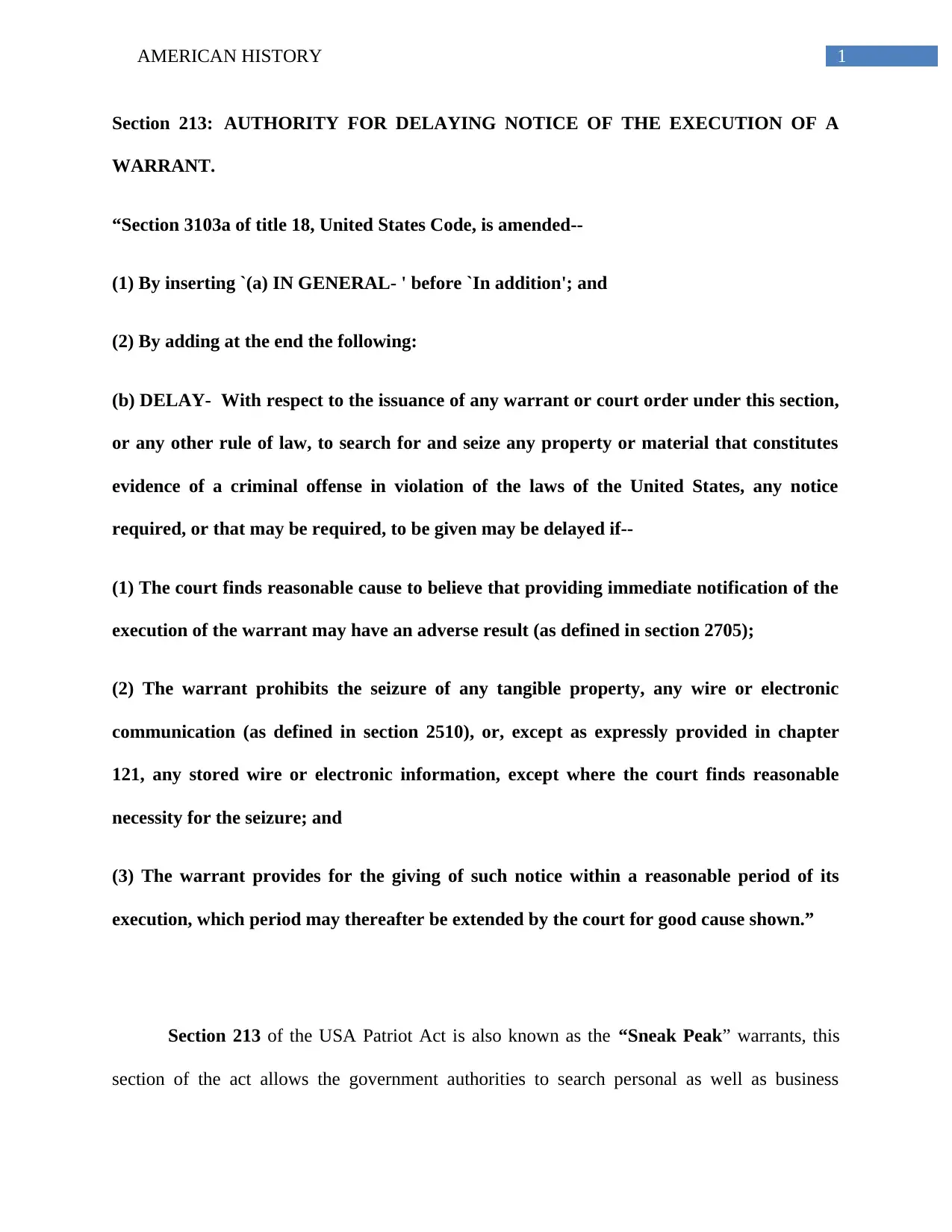
Section 213: AUTHORITY FOR DELAYING NOTICE OF THE EXECUTION OF A
WARRANT.
“Section 3103a of title 18, United States Code, is amended--
(1) By inserting `(a) IN GENERAL- ' before `In addition'; and
(2) By adding at the end the following:
(b) DELAY- With respect to the issuance of any warrant or court order under this section,
or any other rule of law, to search for and seize any property or material that constitutes
evidence of a criminal offense in violation of the laws of the United States, any notice
required, or that may be required, to be given may be delayed if--
(1) The court finds reasonable cause to believe that providing immediate notification of the
execution of the warrant may have an adverse result (as defined in section 2705);
(2) The warrant prohibits the seizure of any tangible property, any wire or electronic
communication (as defined in section 2510), or, except as expressly provided in chapter
121, any stored wire or electronic information, except where the court finds reasonable
necessity for the seizure; and
(3) The warrant provides for the giving of such notice within a reasonable period of its
execution, which period may thereafter be extended by the court for good cause shown.”
Section 213 of the USA Patriot Act is also known as the “Sneak Peak” warrants, this
section of the act allows the government authorities to search personal as well as business
Document Page
2AMERICAN HISTORY
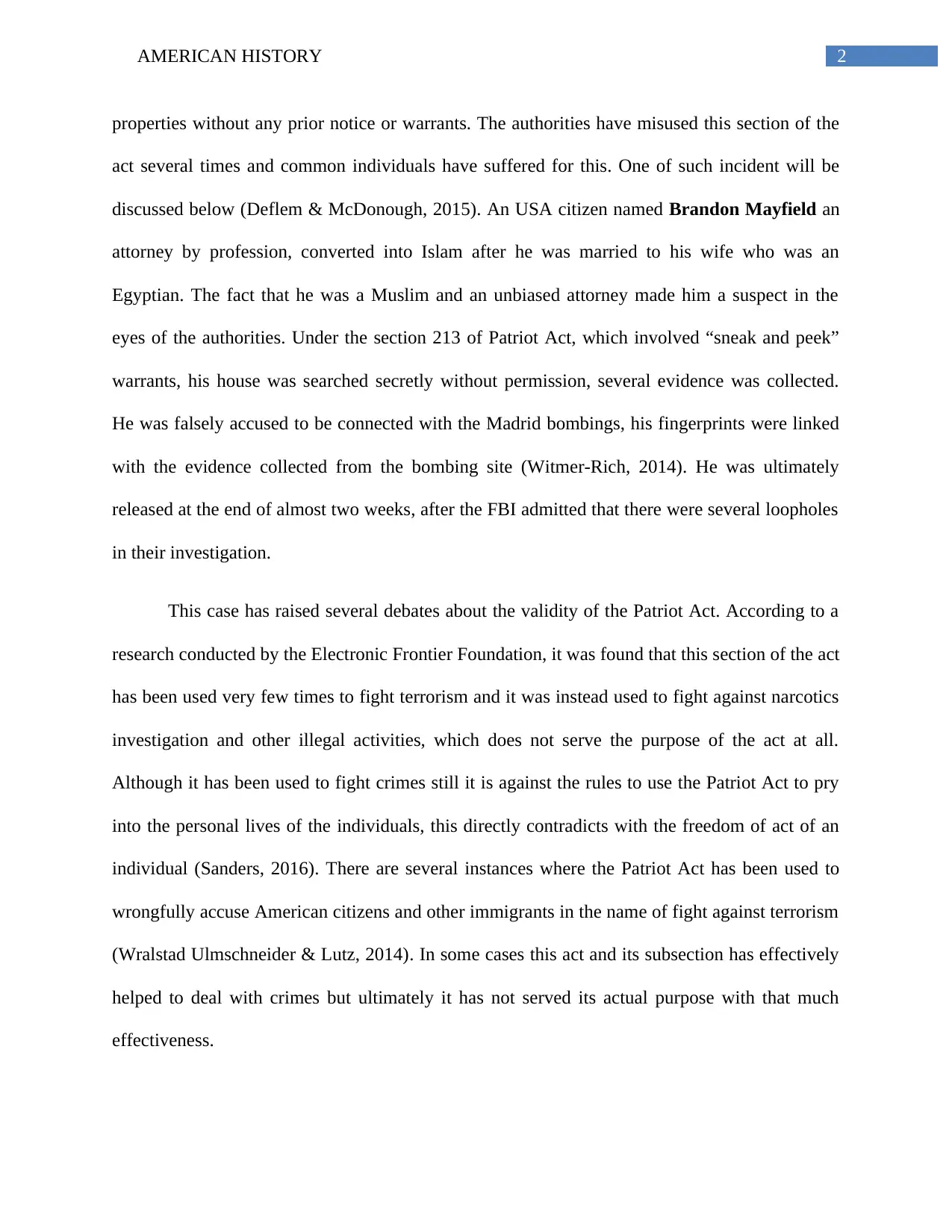
properties without any prior notice or warrants. The authorities have misused this section of the
act several times and common individuals have suffered for this. One of such incident will be
discussed below (Deflem & McDonough, 2015). An USA citizen named Brandon Mayfield an
attorney by profession, converted into Islam after he was married to his wife who was an
Egyptian. The fact that he was a Muslim and an unbiased attorney made him a suspect in the
eyes of the authorities. Under the section 213 of Patriot Act, which involved “sneak and peek”
warrants, his house was searched secretly without permission, several evidence was collected.
He was falsely accused to be connected with the Madrid bombings, his fingerprints were linked
with the evidence collected from the bombing site (Witmer-Rich, 2014). He was ultimately
released at the end of almost two weeks, after the FBI admitted that there were several loopholes
in their investigation.
This case has raised several debates about the validity of the Patriot Act. According to a
research conducted by the Electronic Frontier Foundation, it was found that this section of the act
has been used very few times to fight terrorism and it was instead used to fight against narcotics
investigation and other illegal activities, which does not serve the purpose of the act at all.
Although it has been used to fight crimes still it is against the rules to use the Patriot Act to pry
into the personal lives of the individuals, this directly contradicts with the freedom of act of an
individual (Sanders, 2016). There are several instances where the Patriot Act has been used to
wrongfully accuse American citizens and other immigrants in the name of fight against terrorism
(Wralstad Ulmschneider & Lutz, 2014). In some cases this act and its subsection has effectively
helped to deal with crimes but ultimately it has not served its actual purpose with that much
effectiveness.
Document Page
3AMERICAN HISTORY
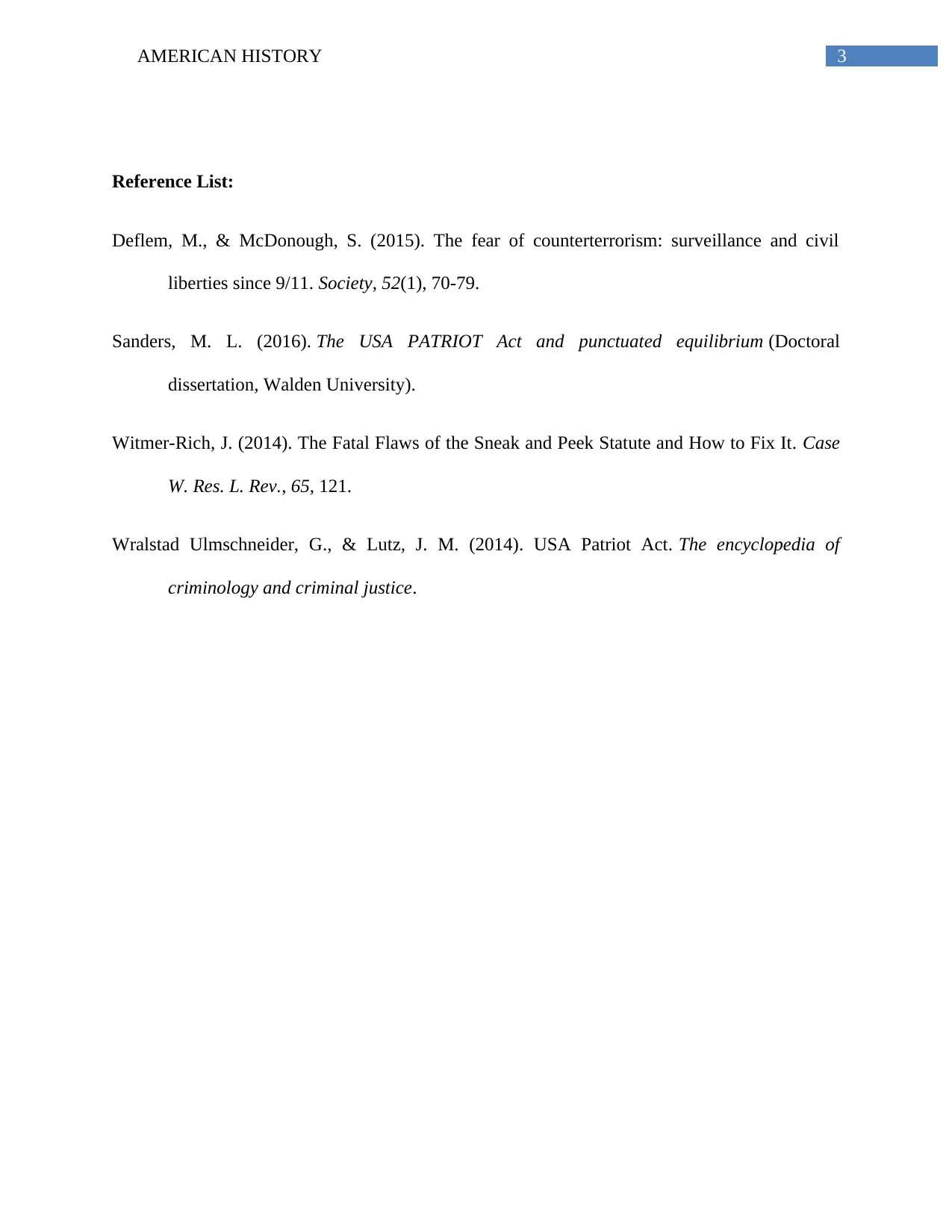
Reference List:
Deflem, M., & McDonough, S. (2015). The fear of counterterrorism: surveillance and civil
liberties since 9/11. Society, 52(1), 70-79.
Sanders, M. L. (2016). The USA PATRIOT Act and punctuated equilibrium (Doctoral
dissertation, Walden University).
Witmer-Rich, J. (2014). The Fatal Flaws of the Sneak and Peek Statute and How to Fix It. Case
W. Res. L. Rev., 65, 121.
Wralstad Ulmschneider, G., & Lutz, J. M. (2014). USA Patriot Act. The encyclopedia of
criminology and criminal justice.
chevron_up_icon
1 out of 4
circle_padding
hide_on_mobile
zoom_out_icon
[object Object]