American History: Chapter 12 Response - Analysis of Roosevelt's Views

Verified

Added on  2022/08/19

|4
|737
|11
Homework Assignment
AI Summary
This assignment is a student's response to Chapter 12 of an American History course, focusing on Theodore Roosevelt's views on war, expansionism, and the role of labor unions during the late 19th and early 20th centuries. The student analyzes Roosevelt's statements, particularly his perspective on the importance of conflict for national greatness, and contrasts them with the realities of labor movements and the Spanish-American War. The analysis references key historical figures and events, including the concerns of business owners, the formation of labor regulations, and America's involvement in the Cuban conflict. Furthermore, the response explores Roosevelt's hesitations regarding personal involvement in World War I and his broader vision for America's role in the world, drawing from the works of historians like Zinn, Damon, Feis, Lunde, and Wunderlin. The student also examines Roosevelt's public persona and how it contrasted with his actions in the White House.
Document Page
Running head: AMERICAN HISTORY
AMERICAN HISTORY
Name of the Student:
Name of the University:
Author note:
tabler-icon-diamond-filled.svg

Paraphrase This Document

Need a fresh take? Get an instant paraphrase of this document with our AI Paraphraser
Document Page
1AMERICAN HISTORY
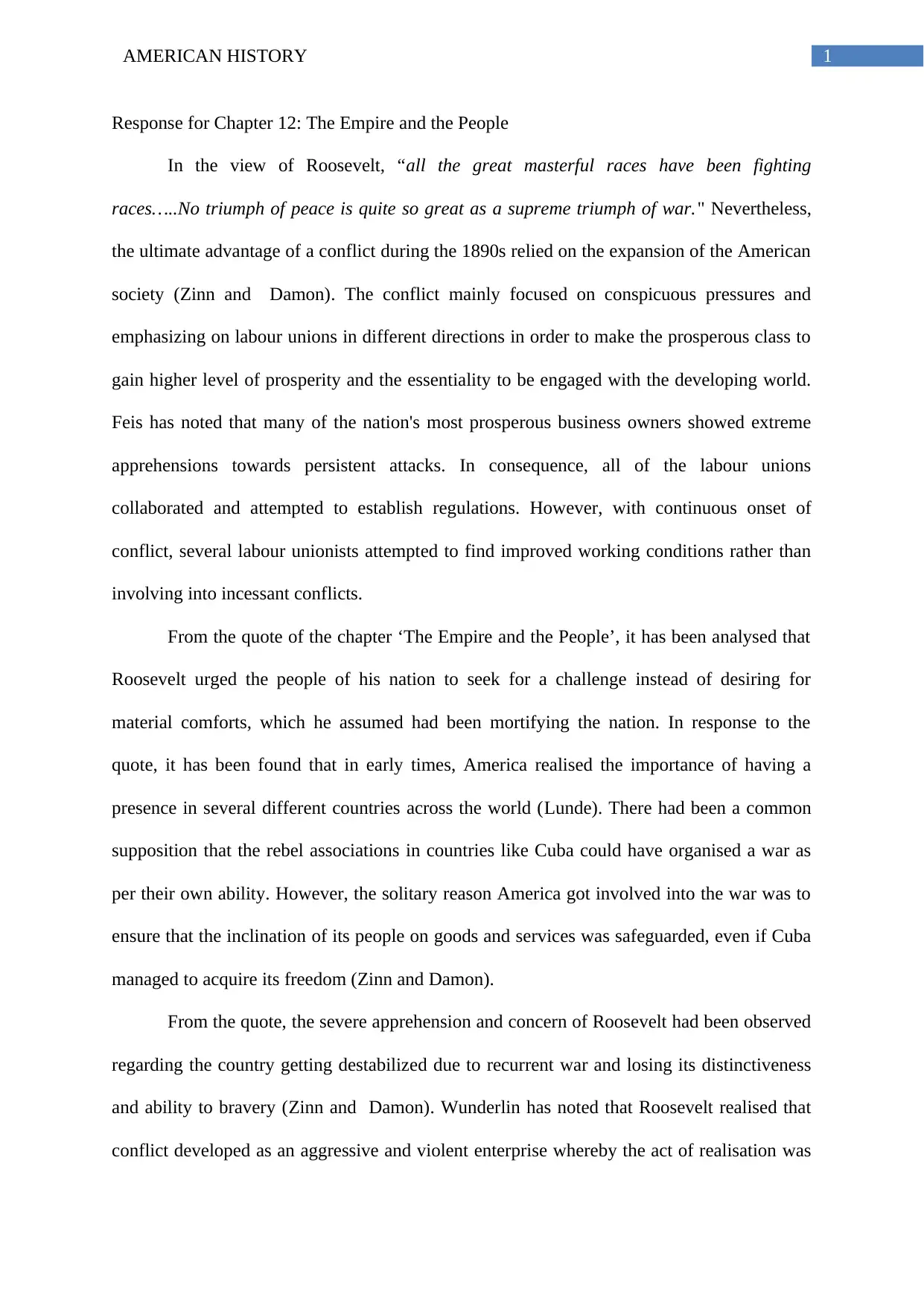
Response for Chapter 12: The Empire and the People
In the view of Roosevelt, all the great masterful races have been fighting
races…..No triumph of peace is quite so great as a supreme triumph of war." Nevertheless,
the ultimate advantage of a conflict during the 1890s relied on the expansion of the American
society (Zinn and Damon). The conflict mainly focused on conspicuous pressures and
emphasizing on labour unions in different directions in order to make the prosperous class to
gain higher level of prosperity and the essentiality to be engaged with the developing world.
Feis has noted that many of the nation's most prosperous business owners showed extreme
apprehensions towards persistent attacks. In consequence, all of the labour unions
collaborated and attempted to establish regulations. However, with continuous onset of
conflict, several labour unionists attempted to find improved working conditions rather than
involving into incessant conflicts.
From the quote of the chapter ‘The Empire and the People’, it has been analysed that
Roosevelt urged the people of his nation to seek for a challenge instead of desiring for
material comforts, which he assumed had been mortifying the nation. In response to the
quote, it has been found that in early times, America realised the importance of having a
presence in several different countries across the world (Lunde). There had been a common
supposition that the rebel associations in countries like Cuba could have organised a war as
per their own ability. However, the solitary reason America got involved into the war was to
ensure that the inclination of its people on goods and services was safeguarded, even if Cuba
managed to acquire its freedom (Zinn and Damon).
From the quote, the severe apprehension and concern of Roosevelt had been observed
regarding the country getting destabilized due to recurrent war and losing its distinctiveness
and ability to bravery (Zinn and Damon). Wunderlin has noted that Roosevelt realised that
conflict developed as an aggressive and violent enterprise whereby the act of realisation was
Document Page
2AMERICAN HISTORY
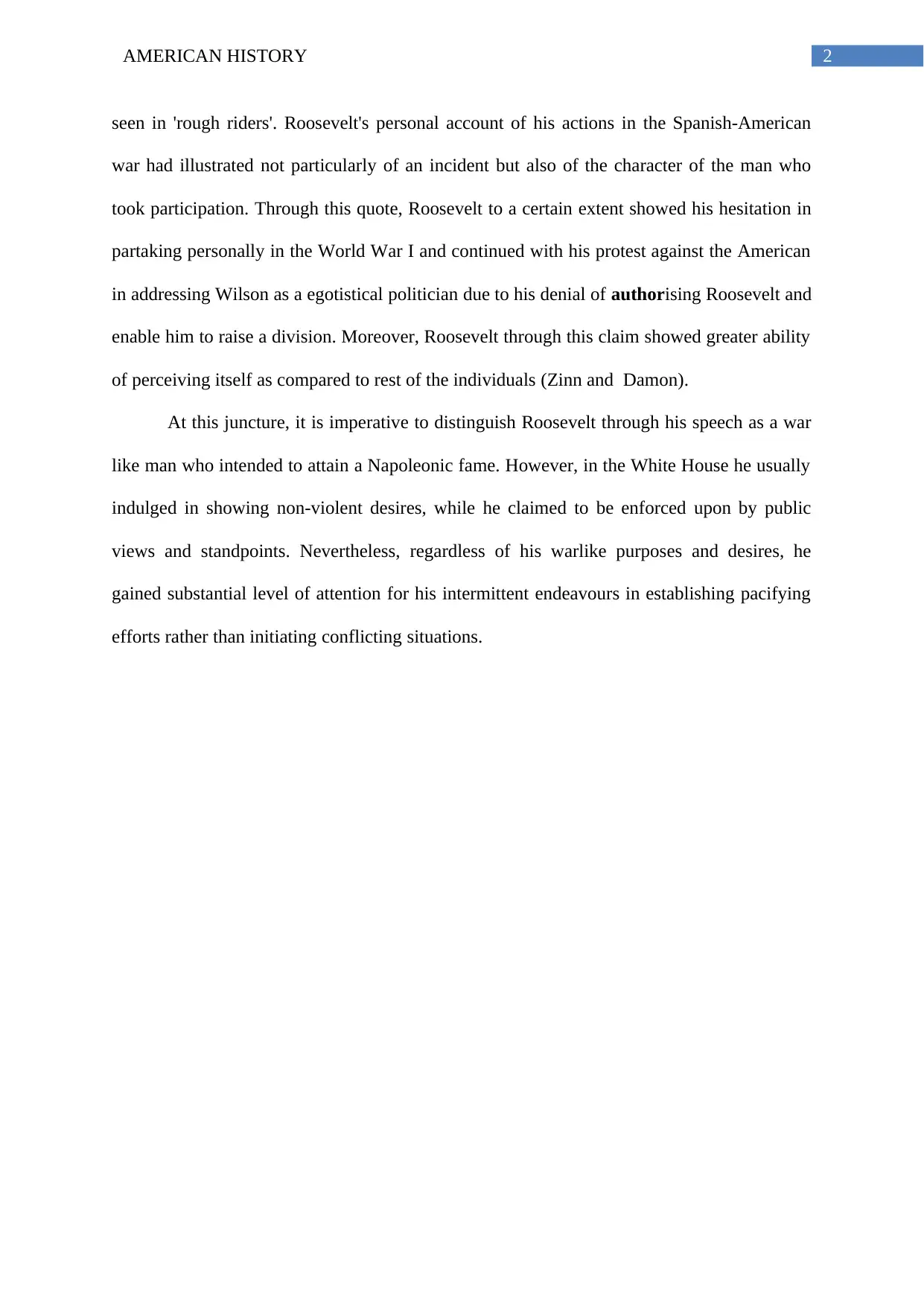
seen in 'rough riders'. Roosevelt's personal account of his actions in the Spanish-American
war had illustrated not particularly of an incident but also of the character of the man who
took participation. Through this quote, Roosevelt to a certain extent showed his hesitation in
partaking personally in the World War I and continued with his protest against the American
in addressing Wilson as a egotistical politician due to his denial of authorising Roosevelt and
enable him to raise a division. Moreover, Roosevelt through this claim showed greater ability
of perceiving itself as compared to rest of the individuals (Zinn and Damon).
At this juncture, it is imperative to distinguish Roosevelt through his speech as a war
like man who intended to attain a Napoleonic fame. However, in the White House he usually
indulged in showing non-violent desires, while he claimed to be enforced upon by public
views and standpoints. Nevertheless, regardless of his warlike purposes and desires, he
gained substantial level of attention for his intermittent endeavours in establishing pacifying
efforts rather than initiating conflicting situations.
Document Page
3AMERICAN HISTORY
References
Feis, Herbert. Churchill-Roosevelt-Stalin: The war they waged and the peace they sought.
Princeton University Press, 2015.
Lunde, Darrin P. The naturalist: Theodore Roosevelt, a lifetime of exploration, and the
triumph of American natural history. Crown, 2016.
Wunderlin, C.E., 2019. Martial Values and Political Ambition-David Pietrusza. TR's Last
War: Theodore Roosevelt, the Great War, and a Journey of Triumph and Tragedy.
Guilford, CT: Lyons Press, 2018. xvi+ 383 pp. $34.95 (cloth), ISBN
9781493028870. The Journal of the Gilded Age and Progressive Era, 18(2), pp.254-
256.
Zinn, Howard, and Matt Damon. A people's history of the United States. New York: New
Press, 1998.
chevron_up_icon
1 out of 4
circle_padding
hide_on_mobile
zoom_out_icon
[object Object]