Detailed Visual Analysis of a Framed American Portrait (1853-1906)

Verified

Added on  2020/05/16

|5
|783
|82
Essay
AI Summary
This essay provides a detailed visual analysis of a framed American portrait dating from the period of 1853-1906. The analysis examines the artwork's characteristics, including its handcrafted wooden frame, dimensions, and the use of color and design. The essay explores the portrait's historical context, referencing Romanticism and the influence of European intellectualism. It delves into the subject matter, focusing on the depiction of a man in a 19th-century European suit, accompanied by dogs, and the symbolic techniques employed. The analysis highlights the portrait's representation of American art, its cultural significance, and the role of framing in enhancing the appearance of the artwork. The essay also references the popularity of portraits throughout history and their evolution with the introduction of frames. The analysis concludes by emphasizing how artists successfully used portraits to demonstrate different themes from across different ages.

Document Page
1
Visual Analysis Assignment
Name:
Student ID:
tabler-icon-diamond-filled.svg

Paraphrase This Document

Need a fresh take? Get an instant paraphrase of this document with our AI Paraphraser
Document Page
2
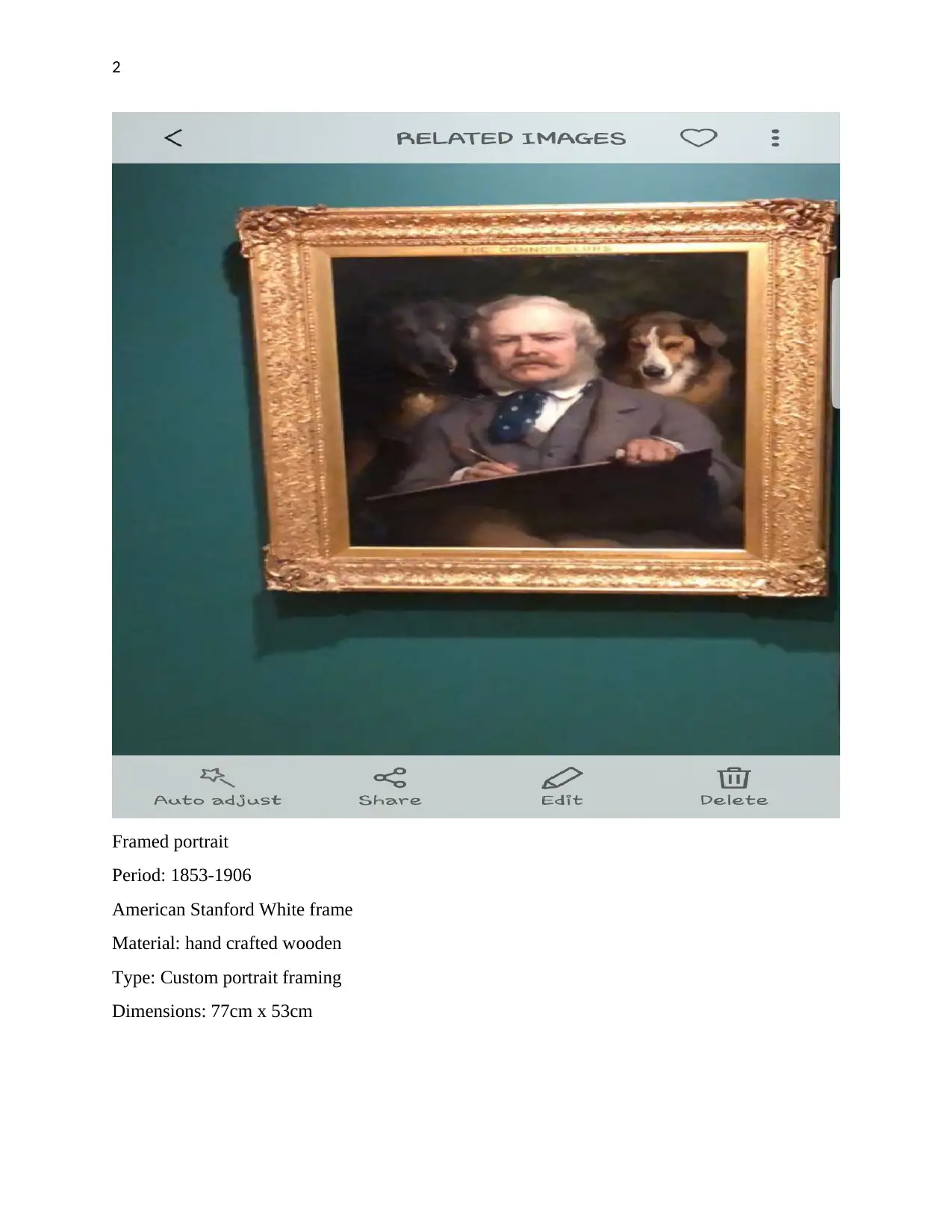
Framed portrait
Period: 1853-1906
American Stanford White frame
Material: hand crafted wooden
Type: Custom portrait framing
Dimensions: 77cm x 53cm
Document Page
3
American portraits are common art pieces in the living room, offices and lounge areas. Silver
and golden framed paintings in antique designs have a classic design with fabulous finishing.
The above example compliments the color and painting design used. The two dogs also have
shades of brown, which match the frame color. Portrait paintings represent a human subject. In
most cases, the image is a revered personality that inspires people. People design such images of
people that they love from political, social, and religious spheres. Public image portraits cost a
fortune and sell across different centuries. This portrait a resemblance of an 18th Century portrait
because of its attributes (Romanticism, 2018)
First, the focal point in the portrait is the man who is wearing a dashing suit with a 19th Century
European design. This is a combination of traditional and modern oil portrait techniques for half-
length images. It brings out aesthetic ideas of Romanticism where inspiration and subjectivity
was at the center stage. The European intellectualism in the picture comes out through the picture
focus of a man writing something on paper. The dogs in the background find this a fascination,
as they appear focused on the work done. The picture explains how European enlightenment
flourished through imagination and emotion. The painting highlights natures experience when
confronting the spectacular. The subject is either a writer or poet demonstrating knowledge of
something, which he puts down on paper. In the 18th portraits, featuring man and dogs were
popular (Breig, 2004).
Secondly, the paintings symbolic techniques depict a professional approach to an emotional
style. Its background details have a naturalist idea of the relationship between man and dogs. The
dogs seem focused on what the individual in the picture is doing. This looks like a historic
portrait of a public or private individual emphasizing the visual aspects of the unified sense.
Colors that capture the appearance of the individual. This technique comprises of different color
schemes and subject references. A combination of American art symbolizes generational art with
an elegant colors revealing confidence of the sitter. This is an American themed masterpiece
showing effective use of color for texture, facial expression and harmony. The dog in the image
has a cultural depiction with different breeds identified as man’s favorites for watchfulness and
loyalty.
The framed portrait shows a monumental wooden frame with elements of antiquity, which were
popular in this period. Its design compliments the subtle colors used in the painting. It enhances
the facial expressions of the classic person in the picture. The popularity of portraits in the 18th
and 19th Century revolved around true life images that looked real and made the subject look
good. Different styles represented images of celebrities, businesspersons, landowners and known
figures. The development of portrait s came with the introduction of frames to enhance the
appearance of the art. This traditional frame with a rectangular frame is common with portraits
and have in-depth additions for a better dimension of the portrait (Nintin, 2014).
The popularity of the portrait photography dates back to the middle ages where different themes
featured. The half-length portrait was common as centerpieces for homes and formal rooms. The
idea behind the portrait was the subject theme. Public and private individuals relied on
professional techniques such as oil painting and mixed methods to bring out reality in a portrait.
Themed according to its period, such images comprised of different characteristics. A blend of
traditional and modern artistic elements enhanced the portrait quality. The advancement of this
technique led to the use of frames for classic representations. Artists succeeded in using portraits
to demonstrate different themes from across different ages.
Document Page
4
Word Count (605)
Selfie
tabler-icon-diamond-filled.svg

Paraphrase This Document

Need a fresh take? Get an instant paraphrase of this document with our AI Paraphraser
Document Page
5
References
Breig, B. (2004). The eighteenth Century goes to the dogs. History Fooundation. Retrieved
February 2, 2018, from http://www.history.org/foundation/journal/autumn04/dogs.cfm
Nintin. (2014, March 7). Types of Portraits. Retrieved from artpaintings:
http://artpaintingartist.org/types-of-portraits/
Romanticism. (2018). Romanticism. Retrieved from The art story modern art insight:
http://www.theartstory.org/movement-romanticism.htm
chevron_up_icon
1 out of 5
circle_padding
hide_on_mobile
zoom_out_icon
[object Object]