ASL Interpreting: Overview of Interpreting, Challenges, and Ethics

Verified

Added on  2022/08/20

|3
|405
|16
Report
AI Summary
This report provides an overview of American Sign Language (ASL) interpreting, emphasizing its significance in the deaf community. It highlights the role of interpreters, discussing the need for skilled professionals who can accurately and ethically convey information. The report addresses the challenges faced by interpreters, including linguistic, relational, and ecological issues. It underscores the importance of trust, ethical behavior, and a deep understanding of both ASL and English. The report references the National Association of the Deaf (NAD), emphasizing the need for ongoing training and development to maintain and improve interpreting skills. The report's conclusion emphasizes the responsibility of ASL interpreters to maintain accuracy and neutrality.
Document Page
Running head: AMERICAN SIGN LANGUAGE
AMERICAN SIGN LANGUAGE
Name of the Student:
Name of the University:
Author’s Note:
tabler-icon-diamond-filled.svg

Paraphrase This Document

Need a fresh take? Get an instant paraphrase of this document with our AI Paraphraser
Document Page
1AMERICAN SIGN LANGUAGE
ASL interpreter:-
ASL Interpretation is the most noticeable style of interpreting used currently. Two
languages are applying by the interpreters such as English and ASL. ASL interpreting is mostly
using for deaf children. Deaf people deserve to take interpreters who distinguish the overall
process accurately. A capable interpreter is one who can, both approachable and meaningfully,
interpret precisely, efficiently, and neutrally, using any particular essential vocabulary. Potential
interpreters will be verifying on their sensitive and accessible signing, voice-to-sign and sign-to-
voice abilities. The familiar people are cheered to take as several workshops and curriculums as
possible to rise and progress their abilities ("National Association of the Deaf - NAD", 2020).
They were training with deaf people frequently to progress a person's approachable and sensitive
skills. The interpretation industry is a societies business and to do the work well, an ASL
interpreter must have a desire for assisting people.
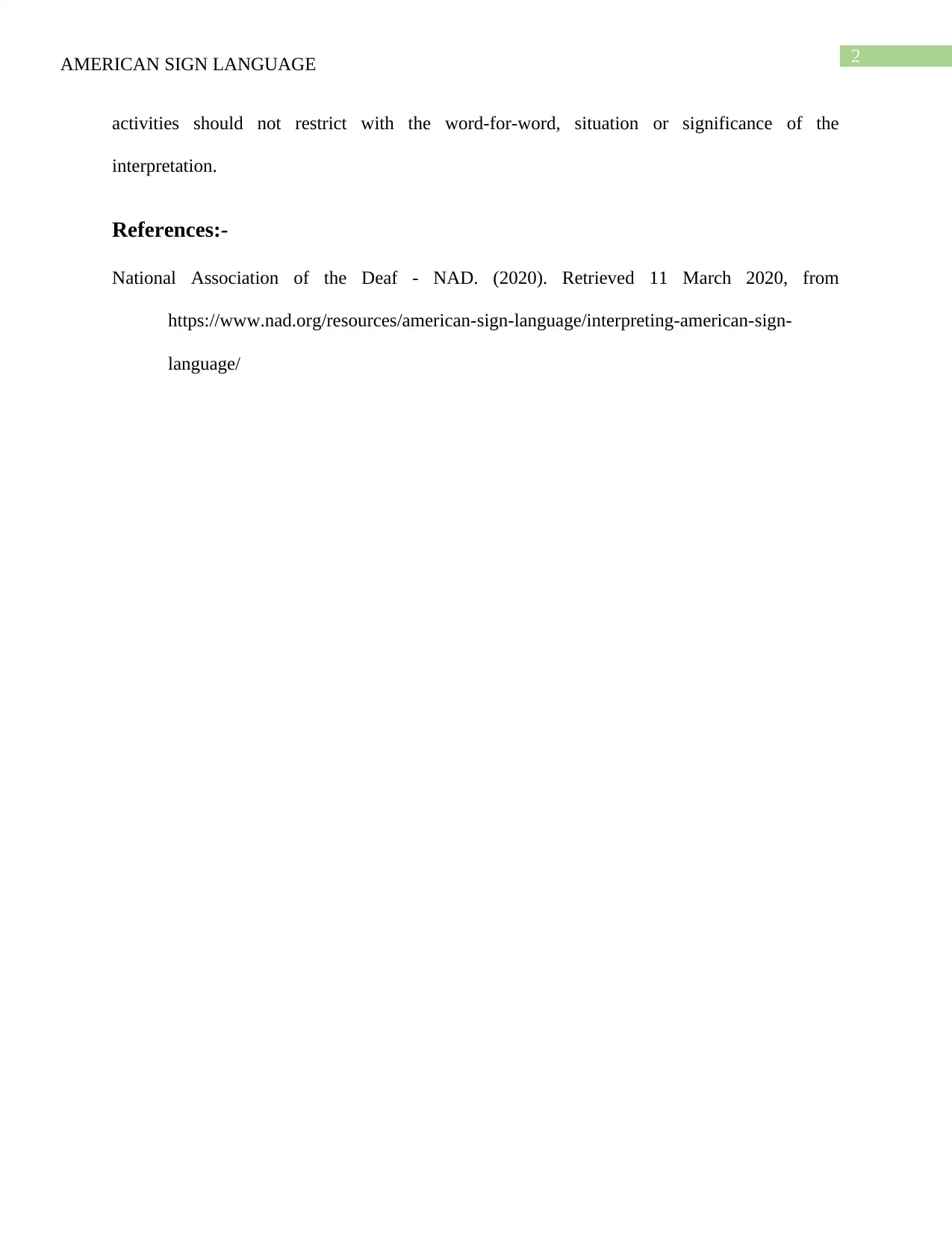
ASL interpreters must recognize the subject material at hand be capable of dependably
and confidently transmit the evidence without preference, and be familiarizing to directing any
societal condition. It is a multifaceted profession, necessitating supervision of linguistic,
relational, and ecological issues. The interpreter should be a knowledgeable person. A
knowledgeable interpreter quickly understands the conversation and respond it appropriately
("National Association of the Deaf - NAD", 2020). If the deaf people are frustrated for any
unethical behavior of interpreter, then it should be illegal for them. Trust is one of the essential
core values of the interpreter. If the deaf person is not trusted their interpreter, then they cannot
express anything. This situation can create the most significant gap between the deaf person and
interpreter. The greatest ASL interpreters are aware of their responsibility and that their
Document Page
2AMERICAN SIGN LANGUAGE
activities should not restrict with the word-for-word, situation or significance of the
interpretation.
References:-
National Association of the Deaf - NAD. (2020). Retrieved 11 March 2020, from
https://www.nad.org/resources/american-sign-language/interpreting-american-sign-
language/
chevron_up_icon
1 out of 3
circle_padding
hide_on_mobile
zoom_out_icon
[object Object]