The Application of Computer Vision in Facial Filler Injection Analysis
VerifiedAdded on 2023/01/19
|47
|13253
|64
Report
AI Summary
This report delves into the application of computer vision in the context of facial filler injections, exploring how AI can enhance these procedures. The study begins with an introduction to facial fillers and the challenges computers face in image analysis compared to human perception. The literature review covers face detection techniques, including texture descriptors and deep learning methods, facial feature extraction, and wrinkle detection algorithms like Hessian Line Tracking. The methodological approach outlines the use of the FERET database, MTCNN for face detection, image cropping, k-means clustering for data labeling, and the Inception model with transfer learning for wrinkle prediction. The implementation strategy details model formulation, data preparation, and feature engineering. Evaluation includes proposed metrics and experimental strategies. The results show an 85.3% accuracy using the Inception model in predicting wrinkles. The discussion summarizes the findings, answers research questions, and addresses limitations, proposing recommendations for future research, particularly in the context of beauty treatments and aesthetic medicine.

Analysing the Role of
Computer Vision in Facial Filler
Injections
Computer Vision in Facial Filler
Injections

Paraphrase This Document
Need a fresh take? Get an instant paraphrase of this document with our AI Paraphraser

Abstract
Analysing the Role of Computer Vision in Facial Filler Injections
The report will highlight the Role of Computer Vision in Facial Filler Injections and in
particular facial detection, facial feature extraction, and wrinkle detection. After a systematic
review of the past literature and research, the study will use mixed research methodology to
deduce conclusions. Experiments on the use of computer visions on image acquisition, image
processing and analysis will be done. From the results of the literature review, although much
has been written regarding these three areas, there is still a dearth in research regarding how
computer vision can be deployed in facial filler injections. Such is the case that although
researchers have come up with operators to detect human faces on an image, existing studies
have not been able to meet the challenges, for instance those posed by illumination, old age, or
artefacts resulting from repeated patches. To address this research gaps, the study will carry
out experiments in three major areas including image acquisition, processing, and analysis
to ascertain whether computer vision methods can influence the detection of areas to
apply facial filler injections which can be included in various image based applications related
to beauty treatments and aesthetic medicine.
Analysing the Role of Computer Vision in Facial Filler Injections
The report will highlight the Role of Computer Vision in Facial Filler Injections and in
particular facial detection, facial feature extraction, and wrinkle detection. After a systematic
review of the past literature and research, the study will use mixed research methodology to
deduce conclusions. Experiments on the use of computer visions on image acquisition, image
processing and analysis will be done. From the results of the literature review, although much
has been written regarding these three areas, there is still a dearth in research regarding how
computer vision can be deployed in facial filler injections. Such is the case that although
researchers have come up with operators to detect human faces on an image, existing studies
have not been able to meet the challenges, for instance those posed by illumination, old age, or
artefacts resulting from repeated patches. To address this research gaps, the study will carry
out experiments in three major areas including image acquisition, processing, and analysis
to ascertain whether computer vision methods can influence the detection of areas to
apply facial filler injections which can be included in various image based applications related
to beauty treatments and aesthetic medicine.

Table of Contents
Abstract...........................................................................................................................2
Introduction.....................................................................................................................4
Literature Review............................................................................................................6
Introduction..................................................................................................................6
Face Detection.............................................................................................................7
Texture descriptor....................................................................................................7
Viola-Jones face detector.........................................................................................8
Deep learning-based method....................................................................................9
Facial Feature Extraction...........................................................................................11
Cascaded regression-based method.......................................................................11
Deep learning-based methods................................................................................13
Comprehensive survey...........................................................................................15
Wrinkle Detection......................................................................................................18
Hessian Line Tracking...........................................................................................18
Transient wrinkles detector....................................................................................18
Gabor filters and image morphology.....................................................................19
Texture orientation fields.......................................................................................19
Conclusion.................................................................................................................22
Methodological Approach.............................................................................................23
Implementation strategy................................................................................................26
Evaluation......................................................................................................................32
Discussion.....................................................................................................................34
References.....................................................................................................................41
Abstract...........................................................................................................................2
Introduction.....................................................................................................................4
Literature Review............................................................................................................6
Introduction..................................................................................................................6
Face Detection.............................................................................................................7
Texture descriptor....................................................................................................7
Viola-Jones face detector.........................................................................................8
Deep learning-based method....................................................................................9
Facial Feature Extraction...........................................................................................11
Cascaded regression-based method.......................................................................11
Deep learning-based methods................................................................................13
Comprehensive survey...........................................................................................15
Wrinkle Detection......................................................................................................18
Hessian Line Tracking...........................................................................................18
Transient wrinkles detector....................................................................................18
Gabor filters and image morphology.....................................................................19
Texture orientation fields.......................................................................................19
Conclusion.................................................................................................................22
Methodological Approach.............................................................................................23
Implementation strategy................................................................................................26
Evaluation......................................................................................................................32
Discussion.....................................................................................................................34
References.....................................................................................................................41
⊘ This is a preview!⊘
Do you want full access?
Subscribe today to unlock all pages.

Trusted by 1+ million students worldwide

Chapter One
Introduction
Filler injections are a modern cosmetic procedure and have been widely embraced by
women and men alike because of their wonderful ability to create fuller cheeks, lips,
and other facial features. Filler injections are also used to reduce the effects of
wrinkles around the mouth, eyes, and eyebrows and to hide any scars that may be
causing an individual to feel self-conscious and unattractive.
We as human beings can effortlessly see what the image represents. As an example,
we can easily see that the image contains a number of objects, and we can detect faces
on an image as well distinguish between the different features of the face. When it
comes to computer systems, on the other hand, has difficulties. Computers cannot
easily see whether the image contains objects or not. Also, cannot easily detect human
faces and facial features.
The aim of this thesis is to explore the contributions of the existing work presented on
the implementation of computer vision in the analysis of facial features and investigate
the role of computer vision in facial filler injections.
Research questions
What are the best methods that enable computers to detect a face on an image?
What are the computer vision methods to discover the location of different facial
features such as mouth, eyes?
Can pattern recognition methods be used to detect wrinkles or fine lines?
Introduction
Filler injections are a modern cosmetic procedure and have been widely embraced by
women and men alike because of their wonderful ability to create fuller cheeks, lips,
and other facial features. Filler injections are also used to reduce the effects of
wrinkles around the mouth, eyes, and eyebrows and to hide any scars that may be
causing an individual to feel self-conscious and unattractive.
We as human beings can effortlessly see what the image represents. As an example,
we can easily see that the image contains a number of objects, and we can detect faces
on an image as well distinguish between the different features of the face. When it
comes to computer systems, on the other hand, has difficulties. Computers cannot
easily see whether the image contains objects or not. Also, cannot easily detect human
faces and facial features.
The aim of this thesis is to explore the contributions of the existing work presented on
the implementation of computer vision in the analysis of facial features and investigate
the role of computer vision in facial filler injections.
Research questions
What are the best methods that enable computers to detect a face on an image?
What are the computer vision methods to discover the location of different facial
features such as mouth, eyes?
Can pattern recognition methods be used to detect wrinkles or fine lines?
Paraphrase This Document
Need a fresh take? Get an instant paraphrase of this document with our AI Paraphraser

Data will be used for investigations
The Facial Recognition Technology (FERET) database.
Experiments expected to run
1. Image acquisition.
2. Image processing.
3. Image analysis.
Output of the thesis
Computer vision method influence the detection of areas to apply facial filler
injections.
The Facial Recognition Technology (FERET) database.
Experiments expected to run
1. Image acquisition.
2. Image processing.
3. Image analysis.
Output of the thesis
Computer vision method influence the detection of areas to apply facial filler
injections.
Chapter Two
Literature Review
Introduction
Modern medical practice has embraced facial filler injections as part of the
innumerable cosmetic procedures that characterize the current age of medicine. These
procedures are not only popular among women, but men as well, meaning that their
acceptability will continue to increase in the world across different demographics. The
reason why facial-filler injections have grown in popularity draws from the fact that
they carry the ability to help people to create fuller cheeks, lips, in addition to other
related facial features. Filler injections, at the same time also diminish the effects of
wrinkles around the eyes, mouth, and eyebrows not to mention the fact that they also
help people to hide scars. More importantly is the fact that they play an integral role in
helping people to stop being self-conscious about their appearance while increasing
their overall confidence.
This literature review is divided into three major parts including facial
detection, facial feature extraction, and wrinkle detection. The first part of the
literature review explores studies on facial detection and covers specific areas, such as
face description with Local Binary Patterns (LBP). Medical practice requires the input
of the actual face into a computer in order to correctly analyse it for optimization with
regard to filler injections. The review will seek to analyse the extent to which existing
operators have delivered significant capabilities that have gone a long way towards
helping medical practitioners with facial detection. The second part of the review will
explore facial feature extraction. After an image is input into a computer, there is a
need for an operative that can be used for extracting facial features for analysis and
subsequent optimization in order to generate desired results for facial filler injections.
The review covers studies for instance which make contributions to research including
proposing a novel approach for image alignment whose basis is on ensemble of
regression trees with the capacity to carry out shape invariant selection of features. The
last section on detection of wrinkles is necessary in light of difficulties encountered
related to wrinkle variability that require complex algorithms for detecting the said
wrinkles. Other problems have to do with transient wrinkles that appear from facial
expressions and require a different approach from permanent wrinkles of old age. The
review covers different aspects in wrinkle detection including Hessian Line Tracking
Literature Review
Introduction
Modern medical practice has embraced facial filler injections as part of the
innumerable cosmetic procedures that characterize the current age of medicine. These
procedures are not only popular among women, but men as well, meaning that their
acceptability will continue to increase in the world across different demographics. The
reason why facial-filler injections have grown in popularity draws from the fact that
they carry the ability to help people to create fuller cheeks, lips, in addition to other
related facial features. Filler injections, at the same time also diminish the effects of
wrinkles around the eyes, mouth, and eyebrows not to mention the fact that they also
help people to hide scars. More importantly is the fact that they play an integral role in
helping people to stop being self-conscious about their appearance while increasing
their overall confidence.
This literature review is divided into three major parts including facial
detection, facial feature extraction, and wrinkle detection. The first part of the
literature review explores studies on facial detection and covers specific areas, such as
face description with Local Binary Patterns (LBP). Medical practice requires the input
of the actual face into a computer in order to correctly analyse it for optimization with
regard to filler injections. The review will seek to analyse the extent to which existing
operators have delivered significant capabilities that have gone a long way towards
helping medical practitioners with facial detection. The second part of the review will
explore facial feature extraction. After an image is input into a computer, there is a
need for an operative that can be used for extracting facial features for analysis and
subsequent optimization in order to generate desired results for facial filler injections.
The review covers studies for instance which make contributions to research including
proposing a novel approach for image alignment whose basis is on ensemble of
regression trees with the capacity to carry out shape invariant selection of features. The
last section on detection of wrinkles is necessary in light of difficulties encountered
related to wrinkle variability that require complex algorithms for detecting the said
wrinkles. Other problems have to do with transient wrinkles that appear from facial
expressions and require a different approach from permanent wrinkles of old age. The
review covers different aspects in wrinkle detection including Hessian Line Tracking
⊘ This is a preview!⊘
Do you want full access?
Subscribe today to unlock all pages.
Trusted by 1+ million students worldwide
as well as fast deterministic algorithms based on image morphology as well as Gabor
filters with the aim of improving localization results. The reason why the review is
divided into three major parts is to allow for a thorough exploration of the concepts
related to filler injections and establish gaps that remain regarding how computer
vision can help to improve the process.
Face Detection
Texture descriptor. In the first study, researchers presented a novel and efficient
facial image representation based on the texture features of LBP (Ahonen, Hadid, &
Pietikainen, 2006). The study primarily divided the facial image into smaller regions
and proceeded to compute a description of each region using local binary patterns. In
the next stage, the researchers combined the descriptors into a spatially enhanced
histogram. The rationale was that the texture description of a single region described
the appearance of the region while the combination of all region descriptions encoded
the global geometry of the face. Facial description approaches that employ the LBP
approach are one of the most preferred texture descriptors whose use also cuts across
numerous applications. Preference for the LBP based approach draws from evidence in
which it is highly discriminative while also generating a number of merits. Among the
advantages that the LBP-based face description approach generates is invariance to
monotonic gray-level changes as well as computational efficiency (Ahonen et al.,
2006). The reason why these two factors are particularly important is because they
make the approach suitable for image analysis tasks that tend to be increasingly
demanding. The rationale behind researchers’ preference for LBP-based facial
description similarly draws from the fact that faces can be seen as composition of
micro-patterns whereby an operator, such as LBP is better positioned in describing
them. In the beginning, the LBP operator was primarily designed as a tool for texture
description. With the LBP, every pixel of an image derives a label. This is achieved by
thresholding the 3×3-neighborhood of each pixel with the midpoint pixel-value – the
operator considers the result as a binary number (Ahonen et al., 2006). They (the
operator) then use the histogram of the labels as a texture descriptor. In their study,
Ahonen et al. (2006) assessed their approach on the face recognition problem using the
Colorado State University Face Identification Evaluation System. The images in the
experiment were acquired from the FERET database. The FERET database comprises
of 14,051 grayscale images in total which as Ahonen et al. report (2006) represent
filters with the aim of improving localization results. The reason why the review is
divided into three major parts is to allow for a thorough exploration of the concepts
related to filler injections and establish gaps that remain regarding how computer
vision can help to improve the process.
Face Detection
Texture descriptor. In the first study, researchers presented a novel and efficient
facial image representation based on the texture features of LBP (Ahonen, Hadid, &
Pietikainen, 2006). The study primarily divided the facial image into smaller regions
and proceeded to compute a description of each region using local binary patterns. In
the next stage, the researchers combined the descriptors into a spatially enhanced
histogram. The rationale was that the texture description of a single region described
the appearance of the region while the combination of all region descriptions encoded
the global geometry of the face. Facial description approaches that employ the LBP
approach are one of the most preferred texture descriptors whose use also cuts across
numerous applications. Preference for the LBP based approach draws from evidence in
which it is highly discriminative while also generating a number of merits. Among the
advantages that the LBP-based face description approach generates is invariance to
monotonic gray-level changes as well as computational efficiency (Ahonen et al.,
2006). The reason why these two factors are particularly important is because they
make the approach suitable for image analysis tasks that tend to be increasingly
demanding. The rationale behind researchers’ preference for LBP-based facial
description similarly draws from the fact that faces can be seen as composition of
micro-patterns whereby an operator, such as LBP is better positioned in describing
them. In the beginning, the LBP operator was primarily designed as a tool for texture
description. With the LBP, every pixel of an image derives a label. This is achieved by
thresholding the 3×3-neighborhood of each pixel with the midpoint pixel-value – the
operator considers the result as a binary number (Ahonen et al., 2006). They (the
operator) then use the histogram of the labels as a texture descriptor. In their study,
Ahonen et al. (2006) assessed their approach on the face recognition problem using the
Colorado State University Face Identification Evaluation System. The images in the
experiment were acquired from the FERET database. The FERET database comprises
of 14,051 grayscale images in total which as Ahonen et al. report (2006) represent
Paraphrase This Document
Need a fresh take? Get an instant paraphrase of this document with our AI Paraphraser
1,199 individuals. The images in the database vary with regard to facial expressions,
lighting, as well as pose angle among many other attributes. The study however only
employed frontal face images that were further divided into five clusters. For control
algorithms, the researchers employed Elastic Bunch Graph Matching (EBGM),
Bayesian Intra/Extra-personal Classifier, and Principal Component Analysis (PCA). In
order to ensure that the experiment could be reproduced, the researchers utilized
publicly available Colorado State University face identification evaluation system. The
system deploys the FERET face images while also following the FERET test
procedure for semi-automatic face-recognition algorithms – however, the authors
applied slight adjustments in order to fit the model to their experiment. This is the first
study to apply the LBP operator to represent facial images – the LBP was initially
applied in image retrieval and texture classification. Moreover, the developed model in
this experiment is not only limited to face detection, representation, and facial
expression recognition. Such is the case because the model can be applied to other
recognition and object detection tasks (Ahonen et al., 2006).
Viola-Jones face detector. In the second study, researchers described a machine
learning approach for detecting objects visually with the capacity to process images
extremely rapidly while also achieving high rates of detection (Viola & Jones, 2001).
The paper primarily fused new algorithms as well as insights to develop a framework
for robust and extremely fast object detection. There were three major contributions in
the proposed approach that the authors outline. Firstly, the experiment demonstrates a
new image representation referred to as integral image which is ideal because of the
innate capacity for fast feature evaluation - this capability was in part inspired by
previous research by Papageorgiou et al. (1998), quoted in Viola and Jones, (2001).
However, the detection system in the new experiment did not work directly with image
intensities. Like was the case with the previous authors, the new study employed a set
of features that echoed Haar Basis functions (although these are supplemented by more
complex related filters). So as to compute these features at a high rate and at many
scales, the study introduced the integral image representation for images. Significant to
note is the fact that the integral image can be computed from an image with only a
handful of operations per pixel. Once the image is computed, the researchers could
then compute any of the Haar-like features at any location or scale in constant time
(Viola & Jones, 2001). Secondly, the study also contributes to related body of research
with a method or framework for constructing a classifier which is achieved through
lighting, as well as pose angle among many other attributes. The study however only
employed frontal face images that were further divided into five clusters. For control
algorithms, the researchers employed Elastic Bunch Graph Matching (EBGM),
Bayesian Intra/Extra-personal Classifier, and Principal Component Analysis (PCA). In
order to ensure that the experiment could be reproduced, the researchers utilized
publicly available Colorado State University face identification evaluation system. The
system deploys the FERET face images while also following the FERET test
procedure for semi-automatic face-recognition algorithms – however, the authors
applied slight adjustments in order to fit the model to their experiment. This is the first
study to apply the LBP operator to represent facial images – the LBP was initially
applied in image retrieval and texture classification. Moreover, the developed model in
this experiment is not only limited to face detection, representation, and facial
expression recognition. Such is the case because the model can be applied to other
recognition and object detection tasks (Ahonen et al., 2006).
Viola-Jones face detector. In the second study, researchers described a machine
learning approach for detecting objects visually with the capacity to process images
extremely rapidly while also achieving high rates of detection (Viola & Jones, 2001).
The paper primarily fused new algorithms as well as insights to develop a framework
for robust and extremely fast object detection. There were three major contributions in
the proposed approach that the authors outline. Firstly, the experiment demonstrates a
new image representation referred to as integral image which is ideal because of the
innate capacity for fast feature evaluation - this capability was in part inspired by
previous research by Papageorgiou et al. (1998), quoted in Viola and Jones, (2001).
However, the detection system in the new experiment did not work directly with image
intensities. Like was the case with the previous authors, the new study employed a set
of features that echoed Haar Basis functions (although these are supplemented by more
complex related filters). So as to compute these features at a high rate and at many
scales, the study introduced the integral image representation for images. Significant to
note is the fact that the integral image can be computed from an image with only a
handful of operations per pixel. Once the image is computed, the researchers could
then compute any of the Haar-like features at any location or scale in constant time
(Viola & Jones, 2001). Secondly, the study also contributes to related body of research
with a method or framework for constructing a classifier which is achieved through
using AdaBoost1 in the selection of a small number of critical features. It is important
to note that within any given image sub-window, the total number of Harr-like features
is usually high – higher than the total number of pixels (Viola & Jones, 2001).
Subsequently, in order to account for fast classification with an operator that is not
easily overwhelmed by the sheer scale of tasks, there is a need to ensure that the
learning process excludes a large majority of available features, while focusing on a
small set of features. The selection of features was inspired by the previous study of
Tieu and Viola (2000) whereby it was achieved by a simple modification of the
AdaBoost procedure. In the modification, the weaker learner is restrained in order to
ensure that each weak classifier that the operator returns relies only on one feature. For
this matter, each phase of the boosting process, responsible for selecting a new weak
classifier, is perceived as a feature selection process. The third and last major
contribution of Viola and Jones (2001), study is related to the method of successfully
fusing more complex classifiers in a cascade structure – this is critical because it
dramatically increases the detector by focusing attention on regions of an image that
appear to be promising. The rationale behind focus of attention models, as the authors
explain, draws from the fact that in many instances, it is usually possible for an
experiment to rapidly determine where in an image an object might occur (Viola &
Jones, 2001). For this matter the experiment reserved more complex processing effort
for such regions on an image. The key measure of this model is the rate of false
negatives registered in the attentional process. As such, the researchers selected
majority of object instances by the attentional filter.
Deep learning-based method. In the third study, researchers proposed a deep
cascaded multitask framework that made use of the inherent correlation between
alignment and detection to boost up their performance (Zhang, Zhang, Li, & Qiao,
2016). Although face detection and alignment are increasingly useful in many face
applications for instance facial expression analysis and face recognition, there are a
number of challenges that real world applications of such tasks face. These challenges
are attributed to large visual variations such as extreme lightings, large pose variations,
and occlusions (Zhang et al., 2016). The study sought to build on the cascade face
detector by Viola and Jones in which the researchers utilized AdaBoost and Haar-Like
features for training cascaded classifiers – this approach is reported to achieve good
1 According to Viola and Jones (2001) the “AdaBoost learning algorithm was used to boost the
classification of performance of a simple (sometimes called weak) learning algorithm” (p.I-513).
to note that within any given image sub-window, the total number of Harr-like features
is usually high – higher than the total number of pixels (Viola & Jones, 2001).
Subsequently, in order to account for fast classification with an operator that is not
easily overwhelmed by the sheer scale of tasks, there is a need to ensure that the
learning process excludes a large majority of available features, while focusing on a
small set of features. The selection of features was inspired by the previous study of
Tieu and Viola (2000) whereby it was achieved by a simple modification of the
AdaBoost procedure. In the modification, the weaker learner is restrained in order to
ensure that each weak classifier that the operator returns relies only on one feature. For
this matter, each phase of the boosting process, responsible for selecting a new weak
classifier, is perceived as a feature selection process. The third and last major
contribution of Viola and Jones (2001), study is related to the method of successfully
fusing more complex classifiers in a cascade structure – this is critical because it
dramatically increases the detector by focusing attention on regions of an image that
appear to be promising. The rationale behind focus of attention models, as the authors
explain, draws from the fact that in many instances, it is usually possible for an
experiment to rapidly determine where in an image an object might occur (Viola &
Jones, 2001). For this matter the experiment reserved more complex processing effort
for such regions on an image. The key measure of this model is the rate of false
negatives registered in the attentional process. As such, the researchers selected
majority of object instances by the attentional filter.
Deep learning-based method. In the third study, researchers proposed a deep
cascaded multitask framework that made use of the inherent correlation between
alignment and detection to boost up their performance (Zhang, Zhang, Li, & Qiao,
2016). Although face detection and alignment are increasingly useful in many face
applications for instance facial expression analysis and face recognition, there are a
number of challenges that real world applications of such tasks face. These challenges
are attributed to large visual variations such as extreme lightings, large pose variations,
and occlusions (Zhang et al., 2016). The study sought to build on the cascade face
detector by Viola and Jones in which the researchers utilized AdaBoost and Haar-Like
features for training cascaded classifiers – this approach is reported to achieve good
1 According to Viola and Jones (2001) the “AdaBoost learning algorithm was used to boost the
classification of performance of a simple (sometimes called weak) learning algorithm” (p.I-513).
⊘ This is a preview!⊘
Do you want full access?
Subscribe today to unlock all pages.
Trusted by 1+ million students worldwide
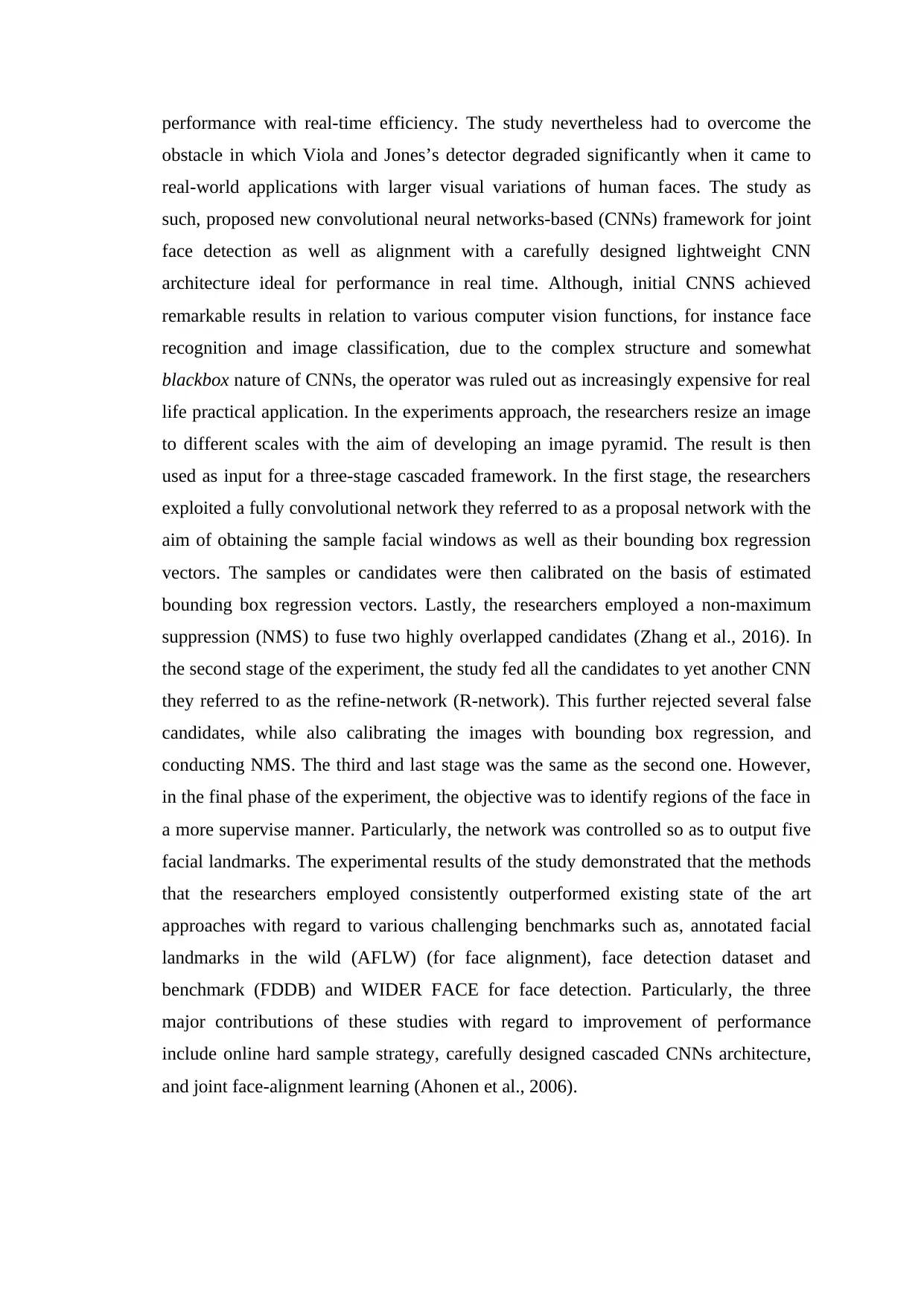
performance with real-time efficiency. The study nevertheless had to overcome the
obstacle in which Viola and Jones’s detector degraded significantly when it came to
real-world applications with larger visual variations of human faces. The study as
such, proposed new convolutional neural networks-based (CNNs) framework for joint
face detection as well as alignment with a carefully designed lightweight CNN
architecture ideal for performance in real time. Although, initial CNNS achieved
remarkable results in relation to various computer vision functions, for instance face
recognition and image classification, due to the complex structure and somewhat
blackbox nature of CNNs, the operator was ruled out as increasingly expensive for real
life practical application. In the experiments approach, the researchers resize an image
to different scales with the aim of developing an image pyramid. The result is then
used as input for a three-stage cascaded framework. In the first stage, the researchers
exploited a fully convolutional network they referred to as a proposal network with the
aim of obtaining the sample facial windows as well as their bounding box regression
vectors. The samples or candidates were then calibrated on the basis of estimated
bounding box regression vectors. Lastly, the researchers employed a non-maximum
suppression (NMS) to fuse two highly overlapped candidates (Zhang et al., 2016). In
the second stage of the experiment, the study fed all the candidates to yet another CNN
they referred to as the refine-network (R-network). This further rejected several false
candidates, while also calibrating the images with bounding box regression, and
conducting NMS. The third and last stage was the same as the second one. However,
in the final phase of the experiment, the objective was to identify regions of the face in
a more supervise manner. Particularly, the network was controlled so as to output five
facial landmarks. The experimental results of the study demonstrated that the methods
that the researchers employed consistently outperformed existing state of the art
approaches with regard to various challenging benchmarks such as, annotated facial
landmarks in the wild (AFLW) (for face alignment), face detection dataset and
benchmark (FDDB) and WIDER FACE for face detection. Particularly, the three
major contributions of these studies with regard to improvement of performance
include online hard sample strategy, carefully designed cascaded CNNs architecture,
and joint face-alignment learning (Ahonen et al., 2006).
obstacle in which Viola and Jones’s detector degraded significantly when it came to
real-world applications with larger visual variations of human faces. The study as
such, proposed new convolutional neural networks-based (CNNs) framework for joint
face detection as well as alignment with a carefully designed lightweight CNN
architecture ideal for performance in real time. Although, initial CNNS achieved
remarkable results in relation to various computer vision functions, for instance face
recognition and image classification, due to the complex structure and somewhat
blackbox nature of CNNs, the operator was ruled out as increasingly expensive for real
life practical application. In the experiments approach, the researchers resize an image
to different scales with the aim of developing an image pyramid. The result is then
used as input for a three-stage cascaded framework. In the first stage, the researchers
exploited a fully convolutional network they referred to as a proposal network with the
aim of obtaining the sample facial windows as well as their bounding box regression
vectors. The samples or candidates were then calibrated on the basis of estimated
bounding box regression vectors. Lastly, the researchers employed a non-maximum
suppression (NMS) to fuse two highly overlapped candidates (Zhang et al., 2016). In
the second stage of the experiment, the study fed all the candidates to yet another CNN
they referred to as the refine-network (R-network). This further rejected several false
candidates, while also calibrating the images with bounding box regression, and
conducting NMS. The third and last stage was the same as the second one. However,
in the final phase of the experiment, the objective was to identify regions of the face in
a more supervise manner. Particularly, the network was controlled so as to output five
facial landmarks. The experimental results of the study demonstrated that the methods
that the researchers employed consistently outperformed existing state of the art
approaches with regard to various challenging benchmarks such as, annotated facial
landmarks in the wild (AFLW) (for face alignment), face detection dataset and
benchmark (FDDB) and WIDER FACE for face detection. Particularly, the three
major contributions of these studies with regard to improvement of performance
include online hard sample strategy, carefully designed cascaded CNNs architecture,
and joint face-alignment learning (Ahonen et al., 2006).
Paraphrase This Document
Need a fresh take? Get an instant paraphrase of this document with our AI Paraphraser
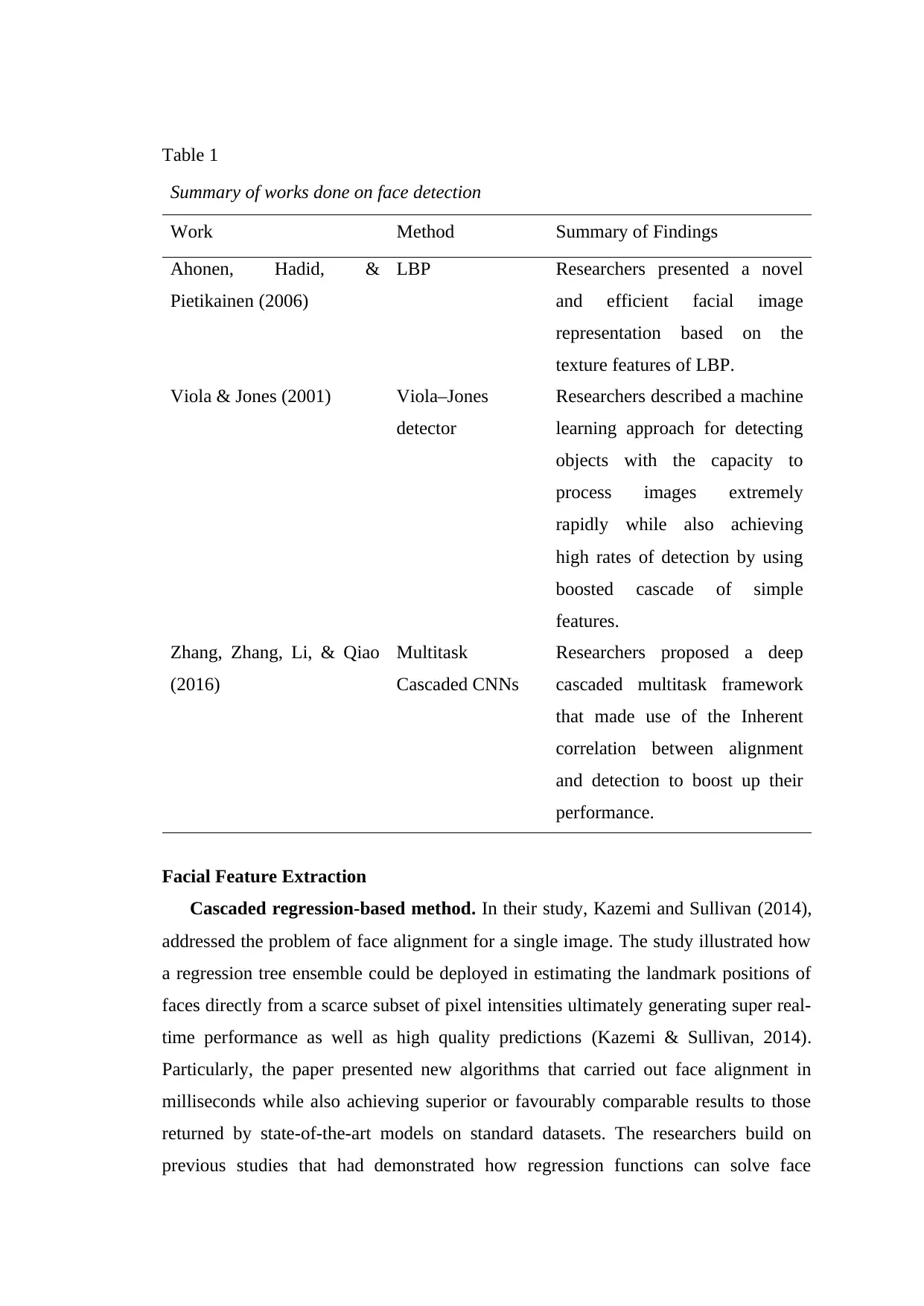
Table 1
Summary of works done on face detection
Work Method Summary of Findings
Ahonen, Hadid, &
Pietikainen (2006)
LBP Researchers presented a novel
and efficient facial image
representation based on the
texture features of LBP.
Viola & Jones (2001) Viola–Jones
detector
Researchers described a machine
learning approach for detecting
objects with the capacity to
process images extremely
rapidly while also achieving
high rates of detection by using
boosted cascade of simple
features.
Zhang, Zhang, Li, & Qiao
(2016)
Multitask
Cascaded CNNs
Researchers proposed a deep
cascaded multitask framework
that made use of the Inherent
correlation between alignment
and detection to boost up their
performance.
Facial Feature Extraction
Cascaded regression-based method. In their study, Kazemi and Sullivan (2014),
addressed the problem of face alignment for a single image. The study illustrated how
a regression tree ensemble could be deployed in estimating the landmark positions of
faces directly from a scarce subset of pixel intensities ultimately generating super real-
time performance as well as high quality predictions (Kazemi & Sullivan, 2014).
Particularly, the paper presented new algorithms that carried out face alignment in
milliseconds while also achieving superior or favourably comparable results to those
returned by state-of-the-art models on standard datasets. The researchers build on
previous studies that had demonstrated how regression functions can solve face
Summary of works done on face detection
Work Method Summary of Findings
Ahonen, Hadid, &
Pietikainen (2006)
LBP Researchers presented a novel
and efficient facial image
representation based on the
texture features of LBP.
Viola & Jones (2001) Viola–Jones
detector
Researchers described a machine
learning approach for detecting
objects with the capacity to
process images extremely
rapidly while also achieving
high rates of detection by using
boosted cascade of simple
features.
Zhang, Zhang, Li, & Qiao
(2016)
Multitask
Cascaded CNNs
Researchers proposed a deep
cascaded multitask framework
that made use of the Inherent
correlation between alignment
and detection to boost up their
performance.
Facial Feature Extraction
Cascaded regression-based method. In their study, Kazemi and Sullivan (2014),
addressed the problem of face alignment for a single image. The study illustrated how
a regression tree ensemble could be deployed in estimating the landmark positions of
faces directly from a scarce subset of pixel intensities ultimately generating super real-
time performance as well as high quality predictions (Kazemi & Sullivan, 2014).
Particularly, the paper presented new algorithms that carried out face alignment in
milliseconds while also achieving superior or favourably comparable results to those
returned by state-of-the-art models on standard datasets. The researchers build on
previous studies that had demonstrated how regression functions can solve face
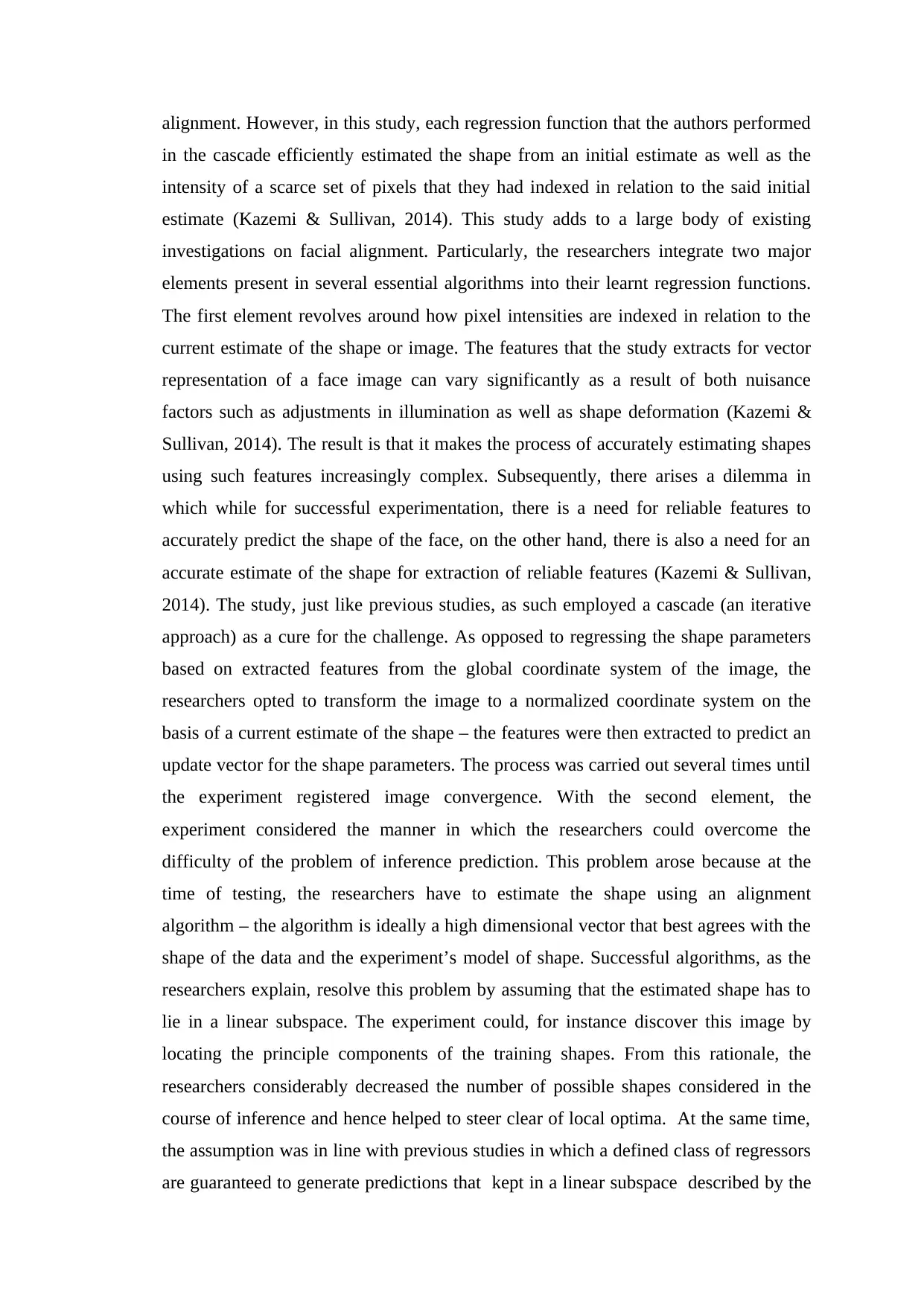
alignment. However, in this study, each regression function that the authors performed
in the cascade efficiently estimated the shape from an initial estimate as well as the
intensity of a scarce set of pixels that they had indexed in relation to the said initial
estimate (Kazemi & Sullivan, 2014). This study adds to a large body of existing
investigations on facial alignment. Particularly, the researchers integrate two major
elements present in several essential algorithms into their learnt regression functions.
The first element revolves around how pixel intensities are indexed in relation to the
current estimate of the shape or image. The features that the study extracts for vector
representation of a face image can vary significantly as a result of both nuisance
factors such as adjustments in illumination as well as shape deformation (Kazemi &
Sullivan, 2014). The result is that it makes the process of accurately estimating shapes
using such features increasingly complex. Subsequently, there arises a dilemma in
which while for successful experimentation, there is a need for reliable features to
accurately predict the shape of the face, on the other hand, there is also a need for an
accurate estimate of the shape for extraction of reliable features (Kazemi & Sullivan,
2014). The study, just like previous studies, as such employed a cascade (an iterative
approach) as a cure for the challenge. As opposed to regressing the shape parameters
based on extracted features from the global coordinate system of the image, the
researchers opted to transform the image to a normalized coordinate system on the
basis of a current estimate of the shape – the features were then extracted to predict an
update vector for the shape parameters. The process was carried out several times until
the experiment registered image convergence. With the second element, the
experiment considered the manner in which the researchers could overcome the
difficulty of the problem of inference prediction. This problem arose because at the
time of testing, the researchers have to estimate the shape using an alignment
algorithm – the algorithm is ideally a high dimensional vector that best agrees with the
shape of the data and the experiment’s model of shape. Successful algorithms, as the
researchers explain, resolve this problem by assuming that the estimated shape has to
lie in a linear subspace. The experiment could, for instance discover this image by
locating the principle components of the training shapes. From this rationale, the
researchers considerably decreased the number of possible shapes considered in the
course of inference and hence helped to steer clear of local optima. At the same time,
the assumption was in line with previous studies in which a defined class of regressors
are guaranteed to generate predictions that kept in a linear subspace described by the
in the cascade efficiently estimated the shape from an initial estimate as well as the
intensity of a scarce set of pixels that they had indexed in relation to the said initial
estimate (Kazemi & Sullivan, 2014). This study adds to a large body of existing
investigations on facial alignment. Particularly, the researchers integrate two major
elements present in several essential algorithms into their learnt regression functions.
The first element revolves around how pixel intensities are indexed in relation to the
current estimate of the shape or image. The features that the study extracts for vector
representation of a face image can vary significantly as a result of both nuisance
factors such as adjustments in illumination as well as shape deformation (Kazemi &
Sullivan, 2014). The result is that it makes the process of accurately estimating shapes
using such features increasingly complex. Subsequently, there arises a dilemma in
which while for successful experimentation, there is a need for reliable features to
accurately predict the shape of the face, on the other hand, there is also a need for an
accurate estimate of the shape for extraction of reliable features (Kazemi & Sullivan,
2014). The study, just like previous studies, as such employed a cascade (an iterative
approach) as a cure for the challenge. As opposed to regressing the shape parameters
based on extracted features from the global coordinate system of the image, the
researchers opted to transform the image to a normalized coordinate system on the
basis of a current estimate of the shape – the features were then extracted to predict an
update vector for the shape parameters. The process was carried out several times until
the experiment registered image convergence. With the second element, the
experiment considered the manner in which the researchers could overcome the
difficulty of the problem of inference prediction. This problem arose because at the
time of testing, the researchers have to estimate the shape using an alignment
algorithm – the algorithm is ideally a high dimensional vector that best agrees with the
shape of the data and the experiment’s model of shape. Successful algorithms, as the
researchers explain, resolve this problem by assuming that the estimated shape has to
lie in a linear subspace. The experiment could, for instance discover this image by
locating the principle components of the training shapes. From this rationale, the
researchers considerably decreased the number of possible shapes considered in the
course of inference and hence helped to steer clear of local optima. At the same time,
the assumption was in line with previous studies in which a defined class of regressors
are guaranteed to generate predictions that kept in a linear subspace described by the
⊘ This is a preview!⊘
Do you want full access?
Subscribe today to unlock all pages.
Trusted by 1+ million students worldwide

1 out of 47


Your All-in-One AI-Powered Toolkit for Academic Success.
+13062052269
info@desklib.com
Available 24*7 on WhatsApp / Email
![[object Object]](/_next/static/media/star-bottom.7253800d.svg)
Unlock your academic potential
Copyright © 2020–2025 A2Z Services. All Rights Reserved. Developed and managed by ZUCOL.