An Analysis of Australian Corporate Law: History and Implications
VerifiedAdded on 2022/09/22
|9
|1994
|25
Report
AI Summary
This report provides a comprehensive analysis of Australian corporate law, tracing its historical development from its roots in English law to the implementation of the Corporations Act 2001. It examines key legal concepts such as separate legal entity, limited liability, transferable shares, and delegated management, along with relevant case law like Huddart Parker v. Moorehead (1909), NSW v. Commonwealth (1990), and Salomon v A Salomon & Co. Ltd. (1897). The report also explores the implications of these legal principles for the accounting profession, including financial reporting, shareholder liability, and the role of delegated management. Furthermore, it discusses the concept of the corporate veil, its exceptions, and the circumstances under which courts may lift it, as illustrated by the Dennis Willcox case. The report concludes with a detailed list of references supporting the analysis.
Running head: AN ANALYSIS OF AUSTRALIAN CORPORATE LAW
AN ANALYSIS OF AUSTRALIAN CORPORATE LAW
Name of the Student
Name of the University
Author Note
AN ANALYSIS OF AUSTRALIAN CORPORATE LAW
Name of the Student
Name of the University
Author Note

Paraphrase This Document
Need a fresh take? Get an instant paraphrase of this document with our AI Paraphraser
1AN ANALYSIS OF AUSTRALIAN CORPORATE LAW
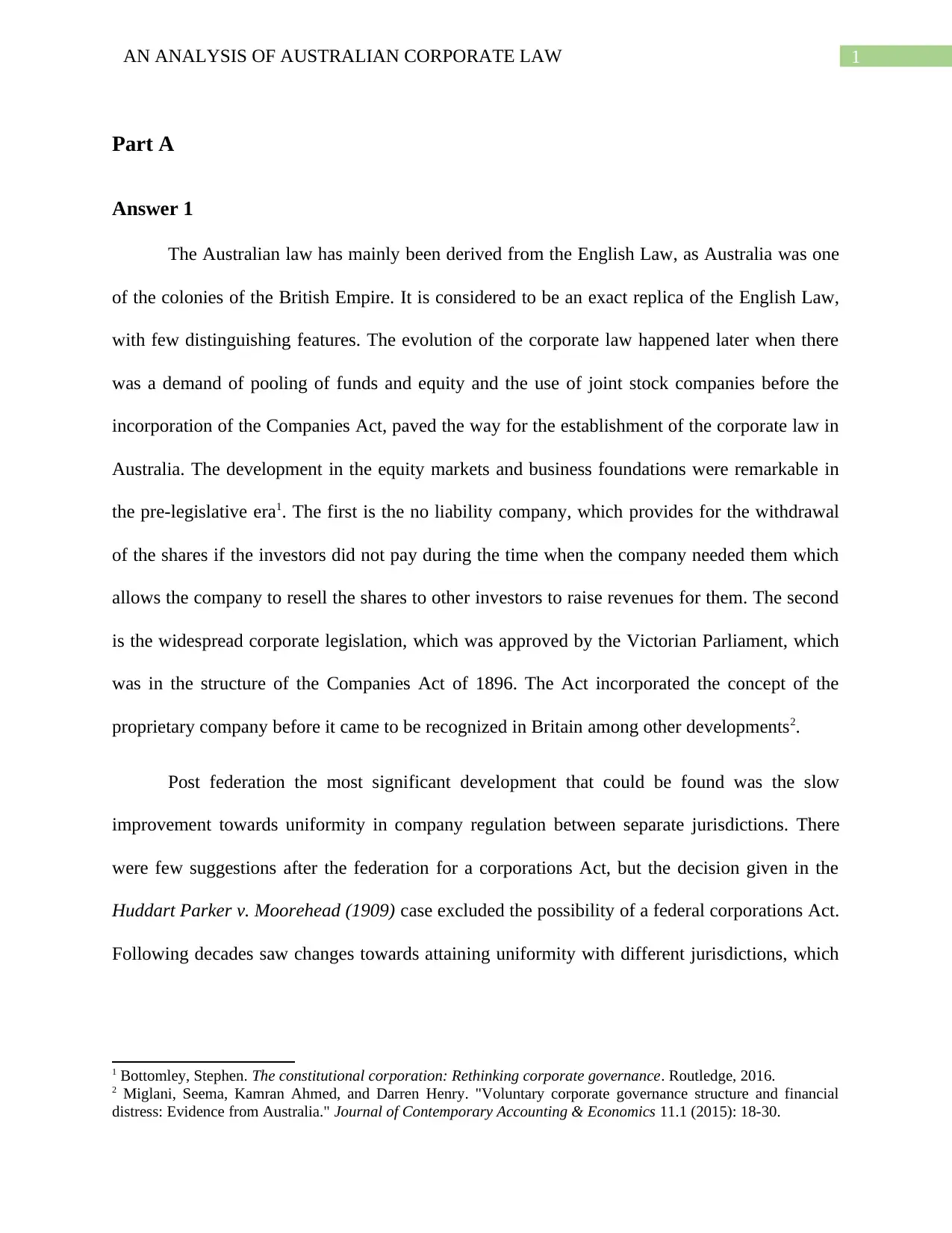
Part A
Answer 1
The Australian law has mainly been derived from the English Law, as Australia was one
of the colonies of the British Empire. It is considered to be an exact replica of the English Law,
with few distinguishing features. The evolution of the corporate law happened later when there
was a demand of pooling of funds and equity and the use of joint stock companies before the
incorporation of the Companies Act, paved the way for the establishment of the corporate law in
Australia. The development in the equity markets and business foundations were remarkable in
the pre-legislative era1. The first is the no liability company, which provides for the withdrawal
of the shares if the investors did not pay during the time when the company needed them which
allows the company to resell the shares to other investors to raise revenues for them. The second
is the widespread corporate legislation, which was approved by the Victorian Parliament, which
was in the structure of the Companies Act of 1896. The Act incorporated the concept of the
proprietary company before it came to be recognized in Britain among other developments2.
Post federation the most significant development that could be found was the slow
improvement towards uniformity in company regulation between separate jurisdictions. There
were few suggestions after the federation for a corporations Act, but the decision given in the
Huddart Parker v. Moorehead (1909) case excluded the possibility of a federal corporations Act.
Following decades saw changes towards attaining uniformity with different jurisdictions, which
1 Bottomley, Stephen. The constitutional corporation: Rethinking corporate governance. Routledge, 2016.
2 Miglani, Seema, Kamran Ahmed, and Darren Henry. "Voluntary corporate governance structure and financial
distress: Evidence from Australia." Journal of Contemporary Accounting & Economics 11.1 (2015): 18-30.
Part A
Answer 1
The Australian law has mainly been derived from the English Law, as Australia was one
of the colonies of the British Empire. It is considered to be an exact replica of the English Law,
with few distinguishing features. The evolution of the corporate law happened later when there
was a demand of pooling of funds and equity and the use of joint stock companies before the
incorporation of the Companies Act, paved the way for the establishment of the corporate law in
Australia. The development in the equity markets and business foundations were remarkable in
the pre-legislative era1. The first is the no liability company, which provides for the withdrawal
of the shares if the investors did not pay during the time when the company needed them which
allows the company to resell the shares to other investors to raise revenues for them. The second
is the widespread corporate legislation, which was approved by the Victorian Parliament, which
was in the structure of the Companies Act of 1896. The Act incorporated the concept of the
proprietary company before it came to be recognized in Britain among other developments2.
Post federation the most significant development that could be found was the slow
improvement towards uniformity in company regulation between separate jurisdictions. There
were few suggestions after the federation for a corporations Act, but the decision given in the
Huddart Parker v. Moorehead (1909) case excluded the possibility of a federal corporations Act.
Following decades saw changes towards attaining uniformity with different jurisdictions, which
1 Bottomley, Stephen. The constitutional corporation: Rethinking corporate governance. Routledge, 2016.
2 Miglani, Seema, Kamran Ahmed, and Darren Henry. "Voluntary corporate governance structure and financial
distress: Evidence from Australia." Journal of Contemporary Accounting & Economics 11.1 (2015): 18-30.
2AN ANALYSIS OF AUSTRALIAN CORPORATE LAW
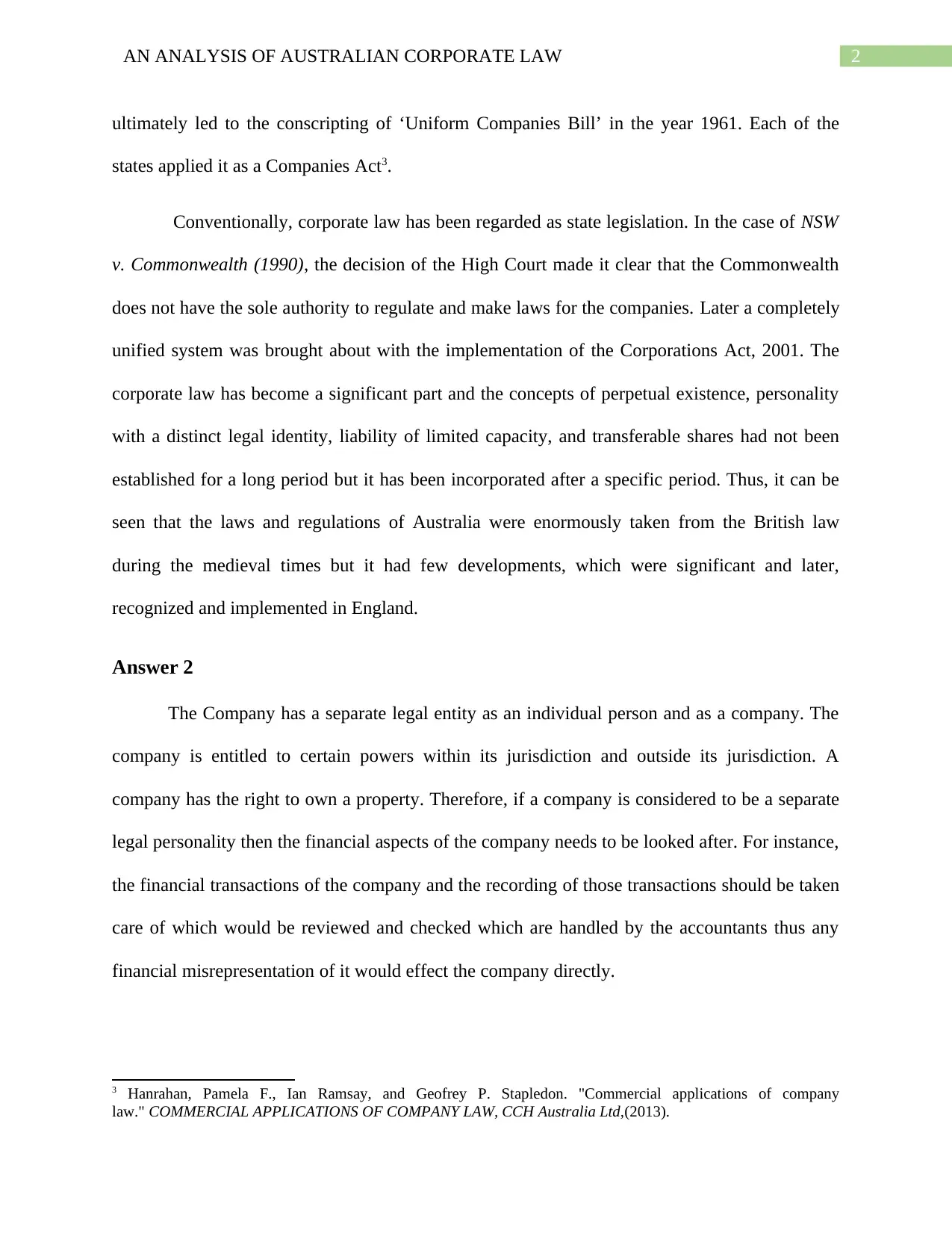
ultimately led to the conscripting of ‘Uniform Companies Bill’ in the year 1961. Each of the
states applied it as a Companies Act3.
Conventionally, corporate law has been regarded as state legislation. In the case of NSW
v. Commonwealth (1990), the decision of the High Court made it clear that the Commonwealth
does not have the sole authority to regulate and make laws for the companies. Later a completely
unified system was brought about with the implementation of the Corporations Act, 2001. The
corporate law has become a significant part and the concepts of perpetual existence, personality
with a distinct legal identity, liability of limited capacity, and transferable shares had not been
established for a long period but it has been incorporated after a specific period. Thus, it can be
seen that the laws and regulations of Australia were enormously taken from the British law
during the medieval times but it had few developments, which were significant and later,
recognized and implemented in England.
Answer 2
The Company has a separate legal entity as an individual person and as a company. The
company is entitled to certain powers within its jurisdiction and outside its jurisdiction. A
company has the right to own a property. Therefore, if a company is considered to be a separate
legal personality then the financial aspects of the company needs to be looked after. For instance,
the financial transactions of the company and the recording of those transactions should be taken
care of which would be reviewed and checked which are handled by the accountants thus any
financial misrepresentation of it would effect the company directly.
3 Hanrahan, Pamela F., Ian Ramsay, and Geofrey P. Stapledon. "Commercial applications of company
law." COMMERCIAL APPLICATIONS OF COMPANY LAW, CCH Australia Ltd,(2013).
ultimately led to the conscripting of ‘Uniform Companies Bill’ in the year 1961. Each of the
states applied it as a Companies Act3.
Conventionally, corporate law has been regarded as state legislation. In the case of NSW
v. Commonwealth (1990), the decision of the High Court made it clear that the Commonwealth
does not have the sole authority to regulate and make laws for the companies. Later a completely
unified system was brought about with the implementation of the Corporations Act, 2001. The
corporate law has become a significant part and the concepts of perpetual existence, personality
with a distinct legal identity, liability of limited capacity, and transferable shares had not been
established for a long period but it has been incorporated after a specific period. Thus, it can be
seen that the laws and regulations of Australia were enormously taken from the British law
during the medieval times but it had few developments, which were significant and later,
recognized and implemented in England.
Answer 2
The Company has a separate legal entity as an individual person and as a company. The
company is entitled to certain powers within its jurisdiction and outside its jurisdiction. A
company has the right to own a property. Therefore, if a company is considered to be a separate
legal personality then the financial aspects of the company needs to be looked after. For instance,
the financial transactions of the company and the recording of those transactions should be taken
care of which would be reviewed and checked which are handled by the accountants thus any
financial misrepresentation of it would effect the company directly.
3 Hanrahan, Pamela F., Ian Ramsay, and Geofrey P. Stapledon. "Commercial applications of company
law." COMMERCIAL APPLICATIONS OF COMPANY LAW, CCH Australia Ltd,(2013).
⊘ This is a preview!⊘
Do you want full access?
Subscribe today to unlock all pages.

Trusted by 1+ million students worldwide
3AN ANALYSIS OF AUSTRALIAN CORPORATE LAW
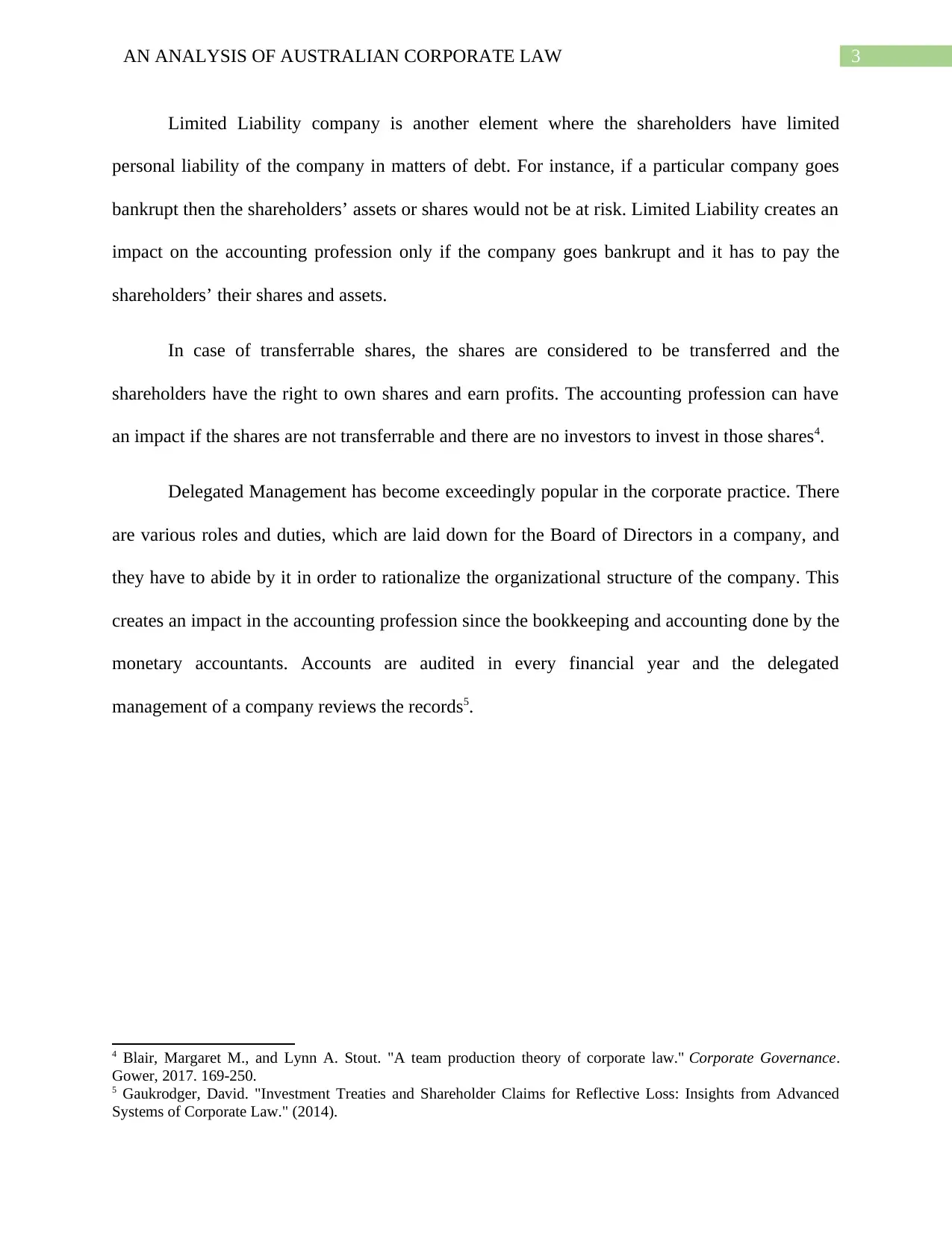
Limited Liability company is another element where the shareholders have limited
personal liability of the company in matters of debt. For instance, if a particular company goes
bankrupt then the shareholders’ assets or shares would not be at risk. Limited Liability creates an
impact on the accounting profession only if the company goes bankrupt and it has to pay the
shareholders’ their shares and assets.
In case of transferrable shares, the shares are considered to be transferred and the
shareholders have the right to own shares and earn profits. The accounting profession can have
an impact if the shares are not transferrable and there are no investors to invest in those shares4.
Delegated Management has become exceedingly popular in the corporate practice. There
are various roles and duties, which are laid down for the Board of Directors in a company, and
they have to abide by it in order to rationalize the organizational structure of the company. This
creates an impact in the accounting profession since the bookkeeping and accounting done by the
monetary accountants. Accounts are audited in every financial year and the delegated
management of a company reviews the records5.
4 Blair, Margaret M., and Lynn A. Stout. "A team production theory of corporate law." Corporate Governance.
Gower, 2017. 169-250.
5 Gaukrodger, David. "Investment Treaties and Shareholder Claims for Reflective Loss: Insights from Advanced
Systems of Corporate Law." (2014).
Limited Liability company is another element where the shareholders have limited
personal liability of the company in matters of debt. For instance, if a particular company goes
bankrupt then the shareholders’ assets or shares would not be at risk. Limited Liability creates an
impact on the accounting profession only if the company goes bankrupt and it has to pay the
shareholders’ their shares and assets.
In case of transferrable shares, the shares are considered to be transferred and the
shareholders have the right to own shares and earn profits. The accounting profession can have
an impact if the shares are not transferrable and there are no investors to invest in those shares4.
Delegated Management has become exceedingly popular in the corporate practice. There
are various roles and duties, which are laid down for the Board of Directors in a company, and
they have to abide by it in order to rationalize the organizational structure of the company. This
creates an impact in the accounting profession since the bookkeeping and accounting done by the
monetary accountants. Accounts are audited in every financial year and the delegated
management of a company reviews the records5.
4 Blair, Margaret M., and Lynn A. Stout. "A team production theory of corporate law." Corporate Governance.
Gower, 2017. 169-250.
5 Gaukrodger, David. "Investment Treaties and Shareholder Claims for Reflective Loss: Insights from Advanced
Systems of Corporate Law." (2014).
Paraphrase This Document
Need a fresh take? Get an instant paraphrase of this document with our AI Paraphraser
4AN ANALYSIS OF AUSTRALIAN CORPORATE LAW
Part B
Answer 1
An important feature of a company is having a distinct legal individual. This concept of
separate legal existence also gives rise to the idea or knowledge of limited liability. The
accountability of the stockholders in a company is limited up to the bequest made by the
stockholders and no additional interest of any shareholder is created in the property or goods of
the organization. It creates a distinct protection for the shareowners of the organization6.
The structure of separate existence provides a legal protection to the stockholders of the
company. However, this protection is not ironclad. The corporate veil may be lifted where the
court deems it necessary. The court might be of the opinion that the actions or decisions of the
stockholders and the company are the same. In such cases, the court, in order to make the
shareholders accountable, shall penetrate the shield of incorporation. In case the court arrives at a
conclusion that the affairs of the company were not managed by the shareholders in a proper
legal manner and did not follow the provisions of the statutes in relation to corporate entities,
then the court shall hold the stockholders as personally obligated towards the activities of the
company. On such occasions, the corporate veil of an organization is lifted or pierced.
The Salomon case7 is the foundation of the notion of separate legal existence. In this case,
the principle of separate entity was established and that the existence of the organization shall be
separate from the existence of its members and shareholders. Since the Salomon case, the courts
of various countries, especially UK, Australia and the United States have slightly departed from
the basic notion of separate entity and established certain exceptions to this basic concept
depending on the circumstances of each cases. These exceptions may involve situations where
6 Grantham, Ross. "The corporate veil: An ingenious device." U. Queensland LJ 32 (2013): 311.
7 Salomon v A Salomon & Co. Ltd. (1897)
Part B
Answer 1
An important feature of a company is having a distinct legal individual. This concept of
separate legal existence also gives rise to the idea or knowledge of limited liability. The
accountability of the stockholders in a company is limited up to the bequest made by the
stockholders and no additional interest of any shareholder is created in the property or goods of
the organization. It creates a distinct protection for the shareowners of the organization6.
The structure of separate existence provides a legal protection to the stockholders of the
company. However, this protection is not ironclad. The corporate veil may be lifted where the
court deems it necessary. The court might be of the opinion that the actions or decisions of the
stockholders and the company are the same. In such cases, the court, in order to make the
shareholders accountable, shall penetrate the shield of incorporation. In case the court arrives at a
conclusion that the affairs of the company were not managed by the shareholders in a proper
legal manner and did not follow the provisions of the statutes in relation to corporate entities,
then the court shall hold the stockholders as personally obligated towards the activities of the
company. On such occasions, the corporate veil of an organization is lifted or pierced.
The Salomon case7 is the foundation of the notion of separate legal existence. In this case,
the principle of separate entity was established and that the existence of the organization shall be
separate from the existence of its members and shareholders. Since the Salomon case, the courts
of various countries, especially UK, Australia and the United States have slightly departed from
the basic notion of separate entity and established certain exceptions to this basic concept
depending on the circumstances of each cases. These exceptions may involve situations where
6 Grantham, Ross. "The corporate veil: An ingenious device." U. Queensland LJ 32 (2013): 311.
7 Salomon v A Salomon & Co. Ltd. (1897)
5AN ANALYSIS OF AUSTRALIAN CORPORATE LAW
the company and the stockholders have an agent-principal relationship which gives rise to the
liability of such shareholders, or when a fraud or injustice has been committed by the
stockholders8.
Answer 2
The organization is distinct legal person detached from its shareholders. The liabilities of
the organization shall be borne by the organization itself and not by the investors or the directors.
Such a notion of corporate world provides a unique protection to the shareowners of the
organization. However, on many occasions, the shareholders or the directors promote illegal
activities in the name of the company risking the investment and money of a certain population
who invested in that particular company. In these situations, the court, in order to protect the
investments of the public, penetrates the corporate veil and makes the directors liable,
personally9. There are different situations where the corporate might be lifted.
Firstly, when the company refuses its legal duties, the court shall ignore the concept of
separate legal identity of the organization and consider the members as personally liable. The
accountability of the shareholders becomes unlimited. Secondly, when the character of an
organization is in question the veil may be pierced. If a question arises regarding the ownership
of the organization as being controlled by an enemy of the state, then the courts will have the
volition to lift the veil and scrutinize the members of such organization. Thirdly, if an
organization continues or moves ahead with its business in an illegal manner and deceive the
creditors of the business, then the veil shall be removed. Fourthly, when the company refuses the
duties in relation to paying taxes, the corporate shell protecting the company will be lifted by the
8 Nyombi, Chrispas. "Lifting the veil of incorporation under common law and statute." International Journal of Law
and Management 56.1 (2014): 66-81.
9 Deva, Surya. "Sustainable Business and Australian Corporate Law: An Exploration." University of Oslo Faculty of
Law Research Paper 2013-11 (2013).
the company and the stockholders have an agent-principal relationship which gives rise to the
liability of such shareholders, or when a fraud or injustice has been committed by the
stockholders8.
Answer 2
The organization is distinct legal person detached from its shareholders. The liabilities of
the organization shall be borne by the organization itself and not by the investors or the directors.
Such a notion of corporate world provides a unique protection to the shareowners of the
organization. However, on many occasions, the shareholders or the directors promote illegal
activities in the name of the company risking the investment and money of a certain population
who invested in that particular company. In these situations, the court, in order to protect the
investments of the public, penetrates the corporate veil and makes the directors liable,
personally9. There are different situations where the corporate might be lifted.
Firstly, when the company refuses its legal duties, the court shall ignore the concept of
separate legal identity of the organization and consider the members as personally liable. The
accountability of the shareholders becomes unlimited. Secondly, when the character of an
organization is in question the veil may be pierced. If a question arises regarding the ownership
of the organization as being controlled by an enemy of the state, then the courts will have the
volition to lift the veil and scrutinize the members of such organization. Thirdly, if an
organization continues or moves ahead with its business in an illegal manner and deceive the
creditors of the business, then the veil shall be removed. Fourthly, when the company refuses the
duties in relation to paying taxes, the corporate shell protecting the company will be lifted by the
8 Nyombi, Chrispas. "Lifting the veil of incorporation under common law and statute." International Journal of Law
and Management 56.1 (2014): 66-81.
9 Deva, Surya. "Sustainable Business and Australian Corporate Law: An Exploration." University of Oslo Faculty of
Law Research Paper 2013-11 (2013).
⊘ This is a preview!⊘
Do you want full access?
Subscribe today to unlock all pages.
Trusted by 1+ million students worldwide
6AN ANALYSIS OF AUSTRALIAN CORPORATE LAW
court10. On several instances, the company plays the role of a trustee or an agent to the
shareowners and in such situations, the organization do not have a separate legal individuality
and the members and the organization are considered to be one and the same. When an
organization is created merely to function as a cloak for another company to hide any unlawful
activity of such company, the veil is penetrated11. If a company decides to enter into agreements
or transactions that may be against the welfare of the public or the protection of public policies
becomes a serious issue, then it will be the discretion of the court to remove the structure of veil
of incorporation protecting the organization like a shield12. The Dennis Willcox case13 is an
important Australian case law that provides the basic grounds on which a court may remove the
corporate veil and consider the actions of the organization as that of the shareowners.
10 Parker, David. "The Company in the 21 st Century: Piercing the veil: reconceptualising the company under
law." Journal of Business Systems, Governance & Ethics 10.2 (2015).
11 Lo, Stefan HC. "Piercing of the corporate veil for evasion of tort obligations." Common Law World Review 46.1
(2017): 42-60.
12 Farrar, John H. "Piercing the Corporate Veil in Favor of Creditors and Pooling of Groups-A Comparative
Study." Bond L. Rev. 25 (2013): 31.
13 Dennis Wilcox Pty Ltd v. The Commissioner of Taxation of the Commonwealth of Australia (1988)
court10. On several instances, the company plays the role of a trustee or an agent to the
shareowners and in such situations, the organization do not have a separate legal individuality
and the members and the organization are considered to be one and the same. When an
organization is created merely to function as a cloak for another company to hide any unlawful
activity of such company, the veil is penetrated11. If a company decides to enter into agreements
or transactions that may be against the welfare of the public or the protection of public policies
becomes a serious issue, then it will be the discretion of the court to remove the structure of veil
of incorporation protecting the organization like a shield12. The Dennis Willcox case13 is an
important Australian case law that provides the basic grounds on which a court may remove the
corporate veil and consider the actions of the organization as that of the shareowners.
10 Parker, David. "The Company in the 21 st Century: Piercing the veil: reconceptualising the company under
law." Journal of Business Systems, Governance & Ethics 10.2 (2015).
11 Lo, Stefan HC. "Piercing of the corporate veil for evasion of tort obligations." Common Law World Review 46.1
(2017): 42-60.
12 Farrar, John H. "Piercing the Corporate Veil in Favor of Creditors and Pooling of Groups-A Comparative
Study." Bond L. Rev. 25 (2013): 31.
13 Dennis Wilcox Pty Ltd v. The Commissioner of Taxation of the Commonwealth of Australia (1988)
Paraphrase This Document
Need a fresh take? Get an instant paraphrase of this document with our AI Paraphraser
7AN ANALYSIS OF AUSTRALIAN CORPORATE LAW
References
Blair, Margaret M., and Lynn A. Stout. "A team production theory of corporate law." Corporate
Governance. Gower, 2017. 169-250.
Bottomley, Stephen. The constitutional corporation: Rethinking corporate governance.
Routledge, 2016.
Dennis Wilcox Pty Ltd v. The Commissioner of Taxation of the Commonwealth of Australia
(1988)
Deva, Surya. "Sustainable Business and Australian Corporate Law: An Exploration." University
of Oslo Faculty of Law Research Paper 2013-11 (2013).
Farrar, John H. "Piercing the Corporate Veil in Favor of Creditors and Pooling of Groups-A
Comparative Study." Bond L. Rev. 25 (2013): 31.
Gaukrodger, David. "Investment Treaties and Shareholder Claims for Reflective Loss: Insights
from Advanced Systems of Corporate Law." (2014).
Grantham, Ross. "The corporate veil: An ingenious device." U. Queensland LJ 32 (2013): 311.
Hanrahan, Pamela F., Ian Ramsay, and Geofrey P. Stapledon. "Commercial applications of
company law." COMMERCIAL APPLICATIONS OF COMPANY LAW, CCH Australia Ltd,
(2013).
Huddart Parker v. Moorehead (1909)
Lo, Stefan HC. "Piercing of the corporate veil for evasion of tort obligations." Common Law
World Review 46.1 (2017): 42-60.
References
Blair, Margaret M., and Lynn A. Stout. "A team production theory of corporate law." Corporate
Governance. Gower, 2017. 169-250.
Bottomley, Stephen. The constitutional corporation: Rethinking corporate governance.
Routledge, 2016.
Dennis Wilcox Pty Ltd v. The Commissioner of Taxation of the Commonwealth of Australia
(1988)
Deva, Surya. "Sustainable Business and Australian Corporate Law: An Exploration." University
of Oslo Faculty of Law Research Paper 2013-11 (2013).
Farrar, John H. "Piercing the Corporate Veil in Favor of Creditors and Pooling of Groups-A
Comparative Study." Bond L. Rev. 25 (2013): 31.
Gaukrodger, David. "Investment Treaties and Shareholder Claims for Reflective Loss: Insights
from Advanced Systems of Corporate Law." (2014).
Grantham, Ross. "The corporate veil: An ingenious device." U. Queensland LJ 32 (2013): 311.
Hanrahan, Pamela F., Ian Ramsay, and Geofrey P. Stapledon. "Commercial applications of
company law." COMMERCIAL APPLICATIONS OF COMPANY LAW, CCH Australia Ltd,
(2013).
Huddart Parker v. Moorehead (1909)
Lo, Stefan HC. "Piercing of the corporate veil for evasion of tort obligations." Common Law
World Review 46.1 (2017): 42-60.
8AN ANALYSIS OF AUSTRALIAN CORPORATE LAW
Miglani, Seema, Kamran Ahmed, and Darren Henry. "Voluntary corporate governance structure
and financial distress: Evidence from Australia." Journal of Contemporary Accounting &
Economics 11.1 (2015): 18-30.
NSW v. Commonwealth (1990)
Nyombi, Chrispas. "Lifting the veil of incorporation under common law and
statute." International Journal of Law and Management 56.1 (2014): 66-81.
Parker, David. "The Company in the 21 st Century: Piercing the veil: reconceptualising the
company under law." Journal of Business Systems, Governance & Ethics 10.2 (2015).
Salomon v A Salomon & Co. Ltd. (1897)
Miglani, Seema, Kamran Ahmed, and Darren Henry. "Voluntary corporate governance structure
and financial distress: Evidence from Australia." Journal of Contemporary Accounting &
Economics 11.1 (2015): 18-30.
NSW v. Commonwealth (1990)
Nyombi, Chrispas. "Lifting the veil of incorporation under common law and
statute." International Journal of Law and Management 56.1 (2014): 66-81.
Parker, David. "The Company in the 21 st Century: Piercing the veil: reconceptualising the
company under law." Journal of Business Systems, Governance & Ethics 10.2 (2015).
Salomon v A Salomon & Co. Ltd. (1897)
⊘ This is a preview!⊘
Do you want full access?
Subscribe today to unlock all pages.
Trusted by 1+ million students worldwide

1 out of 9


Related Documents


Your All-in-One AI-Powered Toolkit for Academic Success.
+13062052269
info@desklib.com
Available 24*7 on WhatsApp / Email
![[object Object]](/_next/static/media/star-bottom.7253800d.svg)
Unlock your academic potential
Copyright © 2020–2026 A2Z Services. All Rights Reserved. Developed and managed by ZUCOL.