Critical Analysis of Business Communication Proposal in MGT502

Verified

Added on  2022/08/25

|3
|555
|20
Discussion Board Post
AI Summary
This discussion board post critically analyzes a business communication proposal, focusing on its structure, content, and effectiveness. The author critiques the proposal's lack of detail regarding different proposal types, technology integration, subheads, and financial aspects like SWOT analysis and balance sheet evaluation. The post identifies areas where the proposal could be improved, such as providing more in-depth explanations of key concepts and addressing how the proposal enhances B2B sales. References to relevant academic sources are included to support the analysis. The post highlights the importance of a well-structured and comprehensive proposal in business communication, emphasizing the need for clarity, justification, and detailed information to persuade potential buyers.
Document Page
Running head: BUSINESS COMMUNICATION
BUISNESS COMMUNICATION
Name of the Student
Name of the University
Author note
tabler-icon-diamond-filled.svg

Paraphrase This Document

Need a fresh take? Get an instant paraphrase of this document with our AI Paraphraser
Document Page
1BUSINESS COMMUNICATION
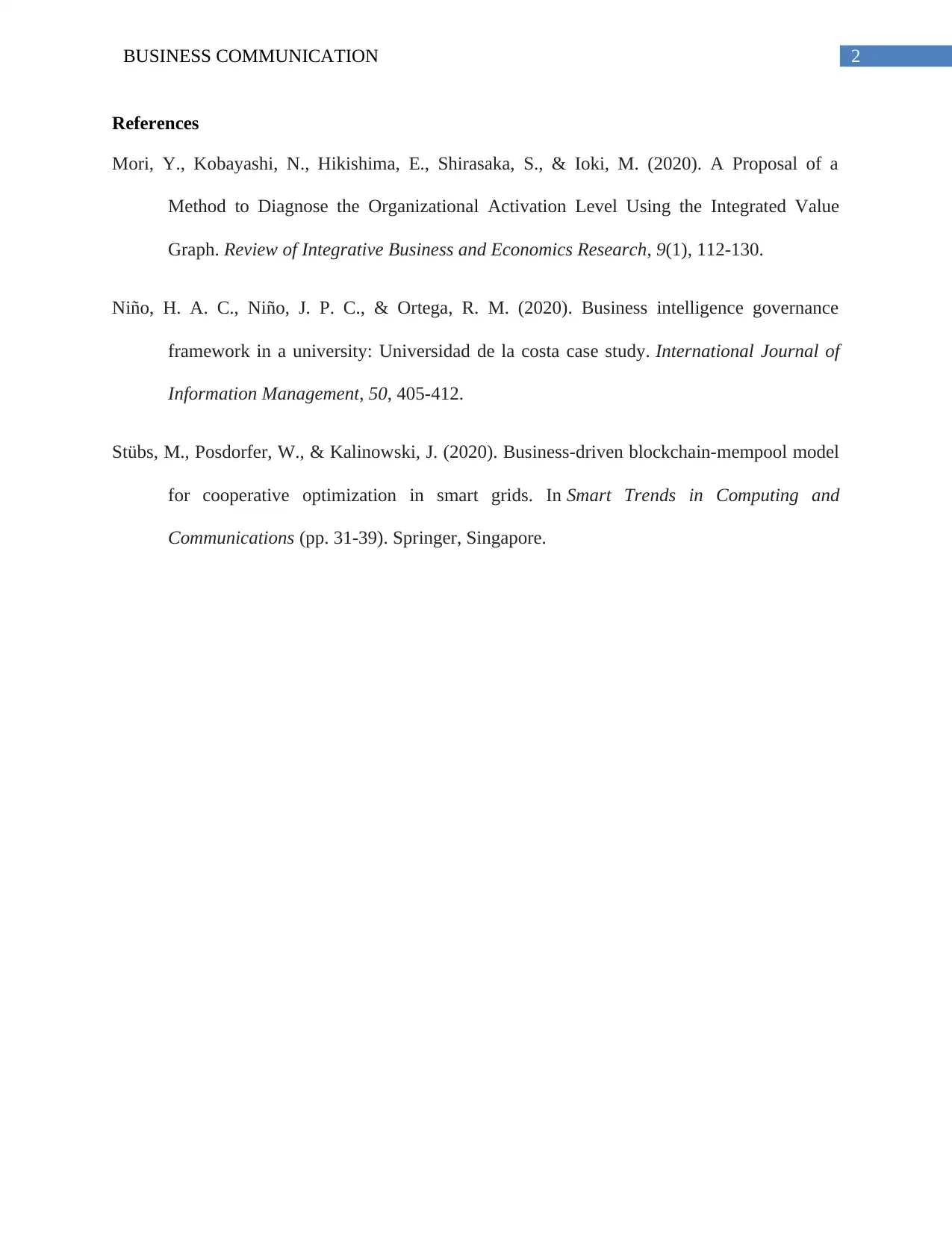
Criticize of business communication
In this report, criticism of post two is performed. In this post, it is mentioned that the
proposal is a type of document which is used by business organisations. It is mainly used by the
business to business organisations. In this case, the main target of the seller is engaged potential
buyers to engage in the selling of goods (Stübs, Posdorfer & Kalinowski, 2020). This post says
that proposal can be of three different types: These are unsolicited, formally solicited and
informally solicited. In this post, it is mentioned that the proposal must be self-explanatory.
Proposal gives appropriate justification for the venture. For this particular reason, it becomes
successful. But in this post, the author does not provide much information regarding different
types of above-mentioned proposals. This post highlights the state of the art of technology (Mori
et al., 2020). But it does not provide much information regarding this matter. The subheads of the
proposal must be mentioned in detail. These are time-bound allocation and capital allocation.
This post does not describe these two concepts in depth. In the proposal, recurring expenditure
and various types of expected manpower are discussed. It is also discussed how these can be
sourced. In this post, the author mentions the analysis of the outcome of SWOT (Niño, Niño &
Ortega, 2020). But it does not describe how the SWOT analysis is performed for this proposal. In
this proposal, the author mentions the elaborated evaluation of the proposed balance sheet. But it
does not mention the purpose of the balance sheet for this proposal. In this post, the author
mentions that the proposal is used to enhance the business to business sales among the buyers
and sellers. It serves as a double purpose. But it does not discuss how the enhancement is
performed among the sellers as well as buyers. In this post, it is mentioned that the proposal
should answer several questions and it must-have the title, executive summary, table of contents
and many others.
Document Page
2BUSINESS COMMUNICATION
References
Mori, Y., Kobayashi, N., Hikishima, E., Shirasaka, S., & Ioki, M. (2020). A Proposal of a
Method to Diagnose the Organizational Activation Level Using the Integrated Value
Graph. Review of Integrative Business and Economics Research, 9(1), 112-130.
Niño, H. A. C., Niño, J. P. C., & Ortega, R. M. (2020). Business intelligence governance
framework in a university: Universidad de la costa case study. International Journal of
Information Management, 50, 405-412.
Stübs, M., Posdorfer, W., & Kalinowski, J. (2020). Business-driven blockchain-mempool model
for cooperative optimization in smart grids. In Smart Trends in Computing and
Communications (pp. 31-39). Springer, Singapore.
chevron_up_icon
1 out of 3
circle_padding
hide_on_mobile
zoom_out_icon
[object Object]